Blood studies: Hematology &  Coagulation Mrs. Nur Aisyah Aziz Pathology Practical  27.12.2010
Test of Hemostasis & Coagulation Bleeding disorder Vascular injury  Trauma Coagulopathies
Laboratory Investigation of Hemostasis 5 primary screening test to diagnosed suspected coagulation disorders: Platelet count, size and shape Bleeding time – platelet fx. & capillaries wall PTT – ability to clot PT – fx. of second-stage clotting factors (????) Fibrinogen level
Laboratory Investigation of Hemostasis Factor assay – definitive coagulation studies of specific clotting factors Fibrinolysis – to address problem with fibrinolytic system Euglobulin clot lysis Factor XIII Fibrin split product The investigations of hypercoagulable status PT PTT Fibrinogen test Antiplatelet factors Anticoagulant factors Fibrinolysis tests
1. BLEEDING TIME Primary phase of hemostasis Best single screening test for platelet screening tests platelet fx disorder & coagulation disorder This test is of value in detecting vascular abnormalities and platelet abN & def. Not recommended for routine presurgical workup Procedure:  Ivy Method
Thrombin time (TT) Stage III fibrinogen defects can be detected by TT test Detection: DIC, hypofibrinogenemia Useful for monitoring streptokinase therapy Test mechanism: time for plasma to clot when thrombin is added N = clot forms rapidly abN = no clot    presence of stage III def.
Partial Thromboplastin Time (PTT); Activated Partial Thrombin Time (APTT) PTT – screens for coagulation disorder Specific detection – Intrinsic thromboplastin system & defect in extrinsic coagulation mechanism pathway APTT – detect def. in intrinsic coagulation system, incubating anticoagulants, monitor heparin therapy
Activated Coagulation Time (ACT) To evaluate coagulation status ACT responds linearly to heparin level changes Responds to wider range of [heparin]  than does the APTT Bedside procedure – requires only 0.4mL of blood Routinely use during dialysis, coronary artery bypass procedures, arteriograms & percutaneous transluminal coronary arteriography HARD TO STANDARDIZE, NO CONTROLS AVAILABLE = results back-up with APTT
Prothrombin Time (Pro Time; PT) Prothrombin – a protein, produced by liver, blood clotting Production – depends on adequate vit. K intake & absorption Clotting process – Prothrombin    THROMBIN ProT reduced in liver ds. Important screening test for coagulation dx. Measures – potential defect in Stage II clotting mechanism (extrinsic system) Used to evaluate disfibrinogenemia, heparin & coumarin effect, liver failure & vit. K def.
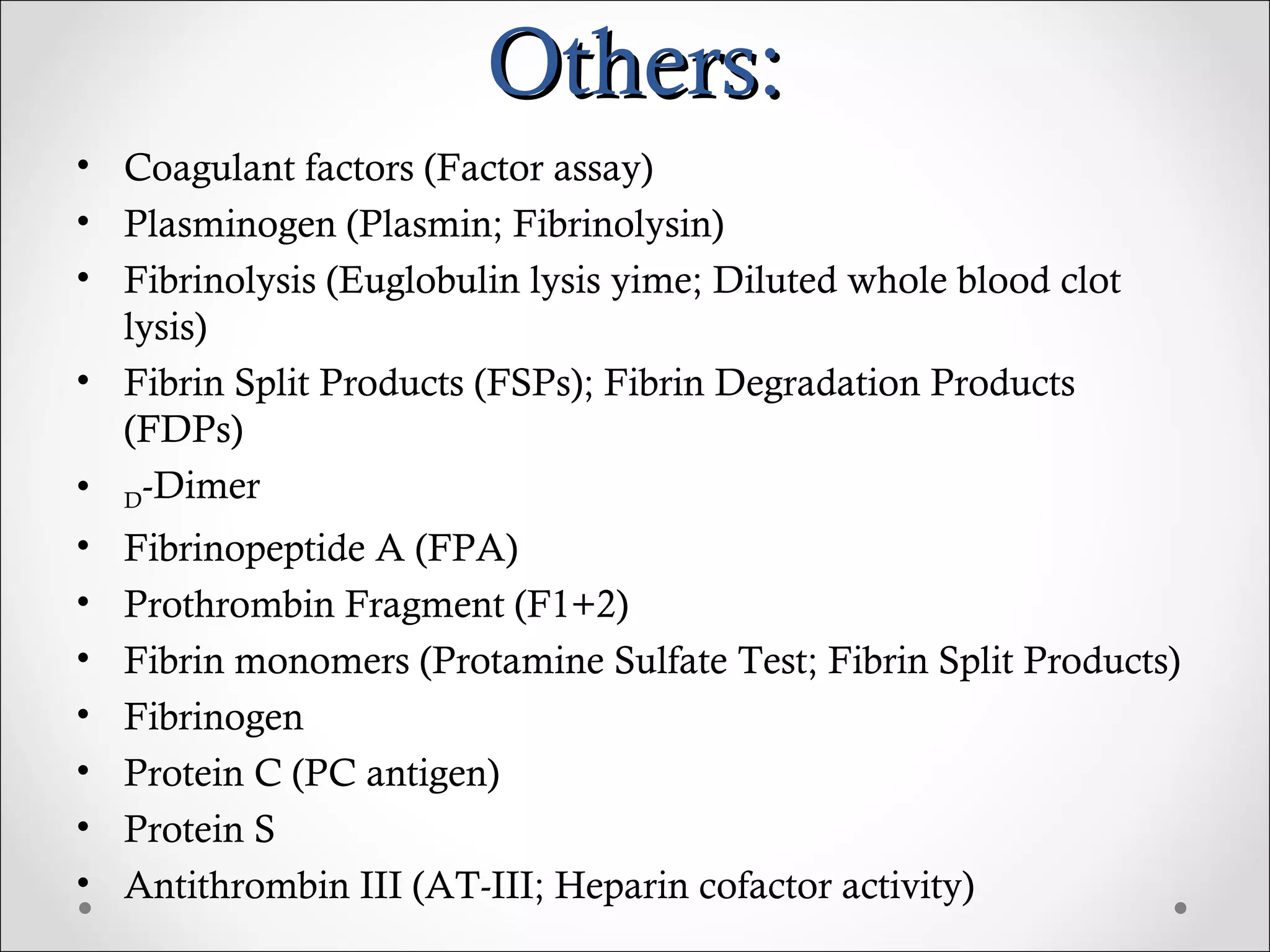
Others: Coagulant factors (Factor assay) Plasminogen (Plasmin; Fibrinolysin) Fibrinolysis (Euglobulin lysis yime; Diluted whole blood clot lysis) Fibrin Split Products (FSPs); Fibrin Degradation Products (FDPs) D -Dimer Fibrinopeptide A (FPA) Prothrombin Fragment (F1+2) Fibrin monomers (Protamine Sulfate Test; Fibrin Split Products) Fibrinogen Protein C (PC antigen) Protein S Antithrombin III (AT-III; Heparin cofactor activity)
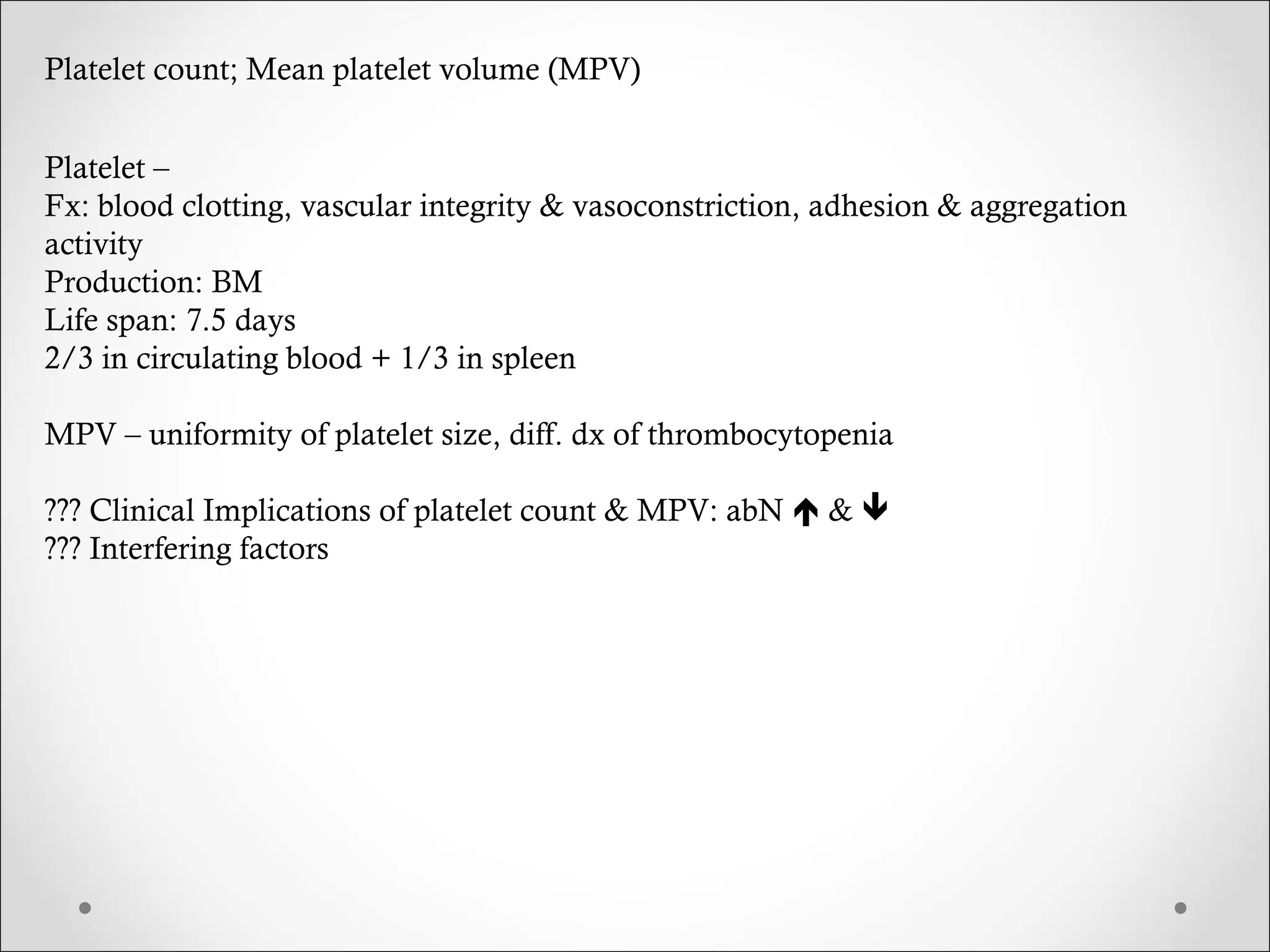
Platelet count; Mean platelet volume (MPV) Platelet –  Fx: blood clotting, vascular integrity & vasoconstriction, adhesion & aggregation activity Production: BM Life span: 7.5 days 2/3 in circulating blood + 1/3 in spleen MPV – uniformity of platelet size, diff. dx of thrombocytopenia ??? Clinical Implications of platelet count & MPV: abN    &   ??? Interfering factors
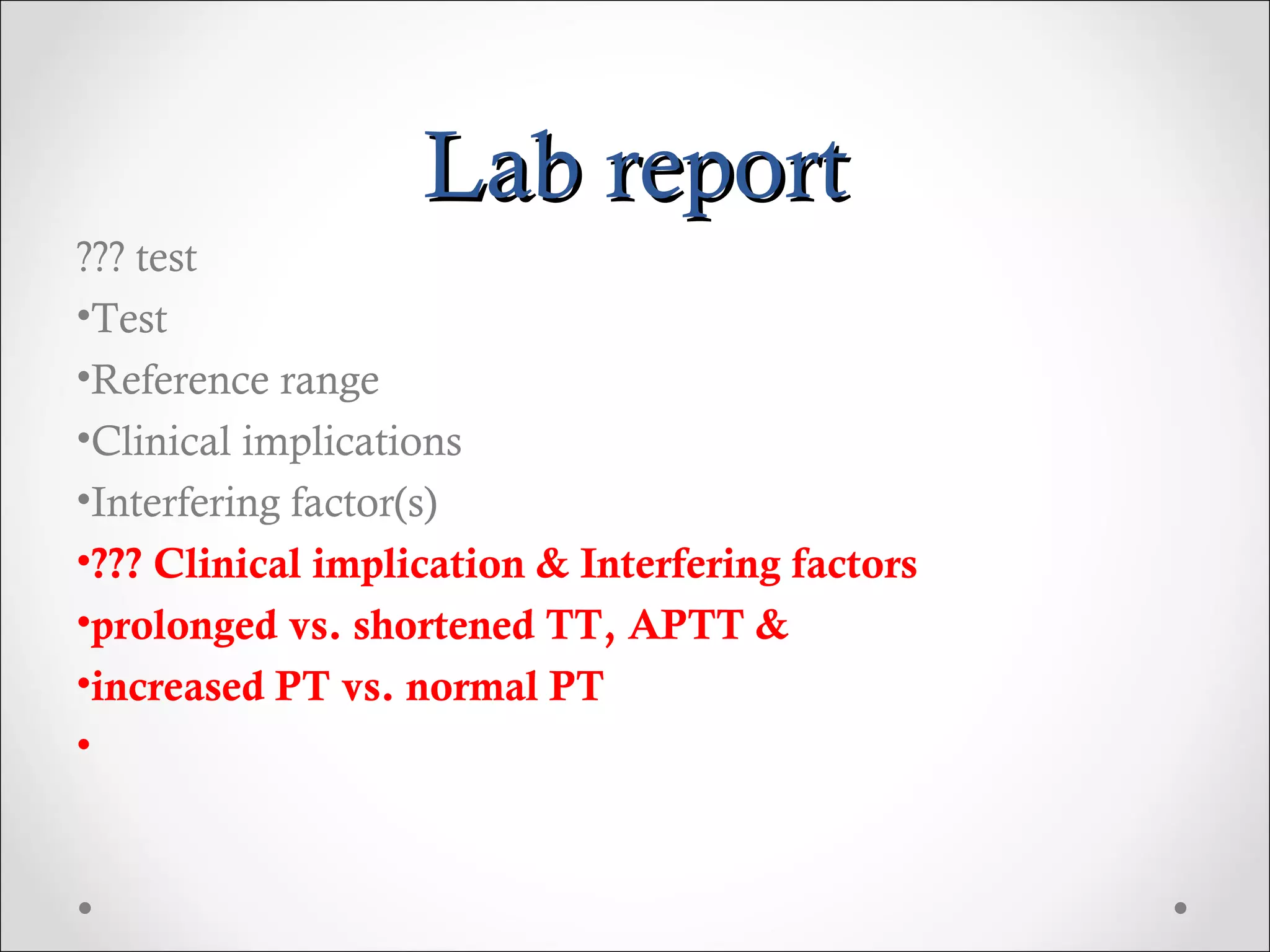
Lab report ??? test Test Reference range Clinical implications Interfering factor(s) ??? Clinical implication & Interfering factors prolonged vs. shortened TT, APTT &  increased PT vs. normal PT

Hema practical 03 coagulation

  • 1.
    Blood studies: Hematology& Coagulation Mrs. Nur Aisyah Aziz Pathology Practical 27.12.2010
  • 2.
    Test of Hemostasis& Coagulation Bleeding disorder Vascular injury Trauma Coagulopathies
  • 3.
    Laboratory Investigation ofHemostasis 5 primary screening test to diagnosed suspected coagulation disorders: Platelet count, size and shape Bleeding time – platelet fx. & capillaries wall PTT – ability to clot PT – fx. of second-stage clotting factors (????) Fibrinogen level
  • 4.
    Laboratory Investigation ofHemostasis Factor assay – definitive coagulation studies of specific clotting factors Fibrinolysis – to address problem with fibrinolytic system Euglobulin clot lysis Factor XIII Fibrin split product The investigations of hypercoagulable status PT PTT Fibrinogen test Antiplatelet factors Anticoagulant factors Fibrinolysis tests
  • 5.
    1. BLEEDING TIMEPrimary phase of hemostasis Best single screening test for platelet screening tests platelet fx disorder & coagulation disorder This test is of value in detecting vascular abnormalities and platelet abN & def. Not recommended for routine presurgical workup Procedure: Ivy Method
  • 6.
    Thrombin time (TT)Stage III fibrinogen defects can be detected by TT test Detection: DIC, hypofibrinogenemia Useful for monitoring streptokinase therapy Test mechanism: time for plasma to clot when thrombin is added N = clot forms rapidly abN = no clot  presence of stage III def.
  • 7.
    Partial Thromboplastin Time(PTT); Activated Partial Thrombin Time (APTT) PTT – screens for coagulation disorder Specific detection – Intrinsic thromboplastin system & defect in extrinsic coagulation mechanism pathway APTT – detect def. in intrinsic coagulation system, incubating anticoagulants, monitor heparin therapy
  • 8.
    Activated Coagulation Time(ACT) To evaluate coagulation status ACT responds linearly to heparin level changes Responds to wider range of [heparin] than does the APTT Bedside procedure – requires only 0.4mL of blood Routinely use during dialysis, coronary artery bypass procedures, arteriograms & percutaneous transluminal coronary arteriography HARD TO STANDARDIZE, NO CONTROLS AVAILABLE = results back-up with APTT
  • 9.
    Prothrombin Time (ProTime; PT) Prothrombin – a protein, produced by liver, blood clotting Production – depends on adequate vit. K intake & absorption Clotting process – Prothrombin  THROMBIN ProT reduced in liver ds. Important screening test for coagulation dx. Measures – potential defect in Stage II clotting mechanism (extrinsic system) Used to evaluate disfibrinogenemia, heparin & coumarin effect, liver failure & vit. K def.
  • 10.
    Others: Coagulant factors(Factor assay) Plasminogen (Plasmin; Fibrinolysin) Fibrinolysis (Euglobulin lysis yime; Diluted whole blood clot lysis) Fibrin Split Products (FSPs); Fibrin Degradation Products (FDPs) D -Dimer Fibrinopeptide A (FPA) Prothrombin Fragment (F1+2) Fibrin monomers (Protamine Sulfate Test; Fibrin Split Products) Fibrinogen Protein C (PC antigen) Protein S Antithrombin III (AT-III; Heparin cofactor activity)
  • 11.
    Platelet count; Meanplatelet volume (MPV) Platelet – Fx: blood clotting, vascular integrity & vasoconstriction, adhesion & aggregation activity Production: BM Life span: 7.5 days 2/3 in circulating blood + 1/3 in spleen MPV – uniformity of platelet size, diff. dx of thrombocytopenia ??? Clinical Implications of platelet count & MPV: abN  &  ??? Interfering factors
  • 12.
    Lab report ???test Test Reference range Clinical implications Interfering factor(s) ??? Clinical implication & Interfering factors prolonged vs. shortened TT, APTT & increased PT vs. normal PT