1
Hole’s Human Anatomy
and Physiology
Twelfth Edition
Shier w Butler w Lewis
Chapter
6
Integumentary System
Copyright © The McGraw-Hill Companies, Inc. Permission required for reproduction or display.
2
6.1: Introduction
• Two or more kinds of tissues grouped together and
performing specialized functions constitutes an organ.
• The skin and its various structures make up the
integumentary system.
3
6.2: Skin and Its Tissues
• Composed of several tissue types
• Maintains homeostasis
• Protective covering
• Retards water loss
• Regulates body temperature
• Houses sensory receptors
• Contains immune system cells
• Synthesizes chemicals
• Excretes small amounts of wastes
4
Skin Cells
• Help produce Vitamin D needed for normal bone
and tooth development
• Some cells (keratinocytes) produce substances
that simulate development of some white blood
cells
5
Layers of Skin (3)
• Epidermis
• Dermis
• Subcutaneous layer
• Aka hypodermis
• Beneath dermis
• Some also call it
the superficial
fascia
• Some consider it
not part of the skin
Stratified
squamous
epithelium
Dense irregular
connective
tissue
Adipose tissue
Copyright © The McGraw-Hill Companies, Inc. Permission required for reproduction or display.
© The McGraw-Hill Companies, Inc./Al Telser, photographer
6
(a)
Hair shaft
Epidermis
Hair follicle
(b)
Sebaceous gland
Dermis
Sweat
Epidermis
Dermis
Hair shaft
Sweat gland pore
Capillary
Stratum corneum
Stratum basale
Dermal papilla
Arrector pili muscle
Lamellated (Pacinian) corpuscle
Basement membrane
Sebaceous gland
Hair follicle
Sweat gland
Nerve cell process
Adipose tissue
Blood vessels
Muscle layer
Sweat gland duct
Subcutaneous
layer
TTactile (Meissner’s) corpuscle
Epidermis
• Lacks blood vessels
• Keratinized
• Thickest on palms and
soles (0.8-1.4mm)
• Melanocytes provide melanin
• Rests on basement membrane
• Stratified squamous epithelia
Copyright © The McGraw-Hill Companies, Inc. Permission required for reproduction or display.
b: © Victor Eroschenko
7
Epidermis
There are five (5) layers of the epidermis:
• Stratum corneum
• Stratum lucidum
• Stratum granulosum
• Stratum spinosum
• Stratum basale
Stratum corneum
Stratum lucidum
Stratum granulosum
Stratum spinosum
Stratum basale
Basement
membrane
Dermis
Dermal papilla
(a) (b)
Copyright © The McGraw-Hill Companies, Inc. Permission required for reproduction or display.
b: © The McGraw-Hill Companies, Inc./Al Telser, photographer
8
Epidermis
• Genetic Factors
• Varying amounts of
melanin
• Varying size of melanin
granules
• Albinos lack melanin
• Environmental Factors
• Sunlight
• UV light from sunlamps
• X-rays
• Darkens melanin
• Physiological Factors
• Dilation of dermal blood
vessels
• Constriction of dermal blood
vessels
• Accumulation of carotene
• Jaundice
• Heredity and environment determine skin color
9
Dermis
• Contains dermal papillae
• Binds epidermis to underlying
tissues
• Irregular dense connective tissue
• On average 1.0-2.0mm thick
• Muscle cells
• Nerve cell processes
• Specialized sensory receptors
• Blood vessels
• Hair follicles
• Glands
(a)
Sweat
Epidermis
Dermis
Hair shaft
Sweat gland pore
Capillary
Stratum corneum
Stratum basale
Dermal papilla
Arrector pili muscle
Lamellated (Pacinian) corpuscle
Basement membrane
Sebaceous gland
Hair follicle
Sweat gland
Nerve cell process
Adipose tissue
Blood vessels
Muscle layer
Sweat gland duct
SubcutaneousSubcutaneous
layer
Tactile (Meissner’s) corpuscle
Copyright © The McGraw-Hill Companies, Inc. Permission required for reproduction or display.
10
Dermis
• Papillary layer
• Thin
• Superficial
• Dermal papillae here
• Reticular layer
• 80% of dermis
• Cleavage, tension or
Langer’s lines are here
• There are actually two (2) layers to the dermis:
(a)
Sweat
Epidermis
Dermis
Hair shaft
Sweat gland pore
Capillary
Stratum corneum
Stratum basale
Dermal papilla
Arrector pili muscle
Lamellated (Pacinian) corpuscle
Basement membrane
Sebaceous gland
Hair follicle
Sweat gland
Nerve cell process
Adipose tissue
Blood vessels
Muscle layer
Sweat gland duct
SubcutaneousSubcutaneous
layer
Tactile (Meissner’s) corpuscle
Copyright © The McGraw-Hill Companies, Inc. Permission required for reproduction or display.
11
Subcutaneous Layer
• Aka hypodermis
• Loose connective
tissue and …
• Adipose tissue are
present
• Insulates
• Major blood vessels
present (a)
Sweat
Epidermis
Dermis
Hair shaft
Sweat gland pore
Capillary
Stratum corneum
Stratum basale
Dermal papilla
Arrector pili muscle
Lamellated (Pacinian) corpuscle
Basement membrane
Sebaceous gland
Hair follicle
Sweat gland
Nerve cell process
Adipose tissue
Blood vessels
Muscle layer
Sweat gland duct
SubcutaneousSubcutaneous
layer
Tactile (Meissner’s) corpuscle
Copyright © The McGraw-Hill Companies, Inc. Permission required for reproduction or display.
12
6.3: Accessory Structures
of the Skin
• Accessory structures of the skin originate from the
epidermis and include:
• Hair follicles
• Nails
• Skin glands
13
Hair Follicles
• Epidermal cells
• Tube-like depression
• Extends into dermis
• Three (3) parts:
• Hair root
• Hair shaft
• Hair papilla
• Dead epidermal cells
• Melanin
• Arrector pili muscle
(a)
Hair shaft
Pore
Hair root
(keratinized
cells)
Arrector pili
muscle
Sebaceous
gland
Hair follicle
Region of
cell division
Hair papilla
Eccrine
sweat gland
DermalDermal
blood
vessels
Copyright © The McGraw-Hill Companies, Inc. Permission required for reproduction or display.
14
Nails
• Protective coverings
• Three (3) parts:
• Nail plate
• Nail bed
• Lunula
Nail bed Nail plate
Lunula
Copyright © The McGraw-Hill Companies, Inc. Permission required for reproduction or display.
15
Sebaceous Glands
• Usually associated with hair
follicles
• Holocrine glands
• Secrete sebum (oil)
• Absent on palms and soles
Hair
Sebaceous
gland
Hair follicle
Copyright © The McGraw-Hill Companies, Inc. Permission required for reproduction or display.
© Per H. Kjeldsen
16
Sweat Glands
• Aka sudoriferous glands
• Widespread in skin
• Originates in deeper dermis
or hypodermis
• Eccrine glands
• Apocrine glands
• Ceruminous glands
• Mammary glands
Dermal
papilla
Sebaceous
gland
Duct
Hair shaft
Hair
follicle
Eccrine
sweat
gland
Apocrine
sweat
gland
Pore
Copyright © The McGraw-Hill Companies, Inc. Permission required for reproduction or display.
17
6.4: Regulation of
Body Temperature
• Regulation of body temperature is vitally important
because even slight shifts can disrupt metabolic reactions.
18
Regulation of Body
Temperature
If body temperature
continues to drop,
control center signals
muscles to contract
involuntarily.
too high
too low
Normal body
temperature
37°C (98.6°F)
Control center
Hypothalamus
detects the deviation
from the set point and
signals effector organs.
Control center
Hypothalamus
detects the deviation
from the set point and
signals effector organs.
Stimulus
Body temperature rises
above normal.
Effectors
Dermal blood vessels
dilate and sweat glands
secrete.
Response
Body heat is
lost to surroundings,
temperature drops toward
normal.
Effectors
Dermal blood
vessels constrict
and sweat glands
remain inactive.
Effectors
Dermal blood
vessels constrict
and sweat glands
remain inactive.
Response
Body heat is conserved,
temperature rises toward normal.
Stimulus
Body temperature
drops below normal.
Receptors
Thermoreceptors
send signals to the
control center.
Receptors
Thermoreceptors
send signals to the
control center.
Copyright © The McGraw-Hill Companies, Inc. Permission required for reproduction or display.
19
Heat Production and Loss
• Heat is a product of cellular metabolism
• The most active body cells are the heat producers and
include:
• Skeletal muscle
• Cardiac muscle
• Cells of certain glands such as the liver
• The primary means of heat loss is radiation
• Also there is conduction, convection and evaporation
20
Problems in Temperature
Regulation
• Hyperthermia – abnormally high body temperature
• Hypothermia – abnormally low body temperature
21
6.5: Healing of Wounds and Burns
• Inflammation is a normal response to injury or stress.
• Blood vessels in affected tissues dilate and become more
permeable, allowing fluids to leak into the damaged tissues.
• Inflammed skin may become:
• Reddened
• Swollen
• Warm
• Painful
22
Healing of Cuts
(a) (b)
(f) (g)
(c) (d) (e)
Scar
tissue
Fibroblasts
Scar
tissue
Blood cells
Site of injury
Scab
Blood
clot
Scab
Copyright © The McGraw-Hill Companies, Inc. Permission required for reproduction or display.
23
Types of Burns
• First degree burn – superficial, partial-thickness
• Second degree burn – deep, partial-thickness
• Third degree burn – full-thickness
• Autograft
• Homograft
• Various skin substitutes
24
Rule of Nines for Adults
Copyright © The McGraw-Hill Companies, Inc. Permission required for reproduction or display.
Anterior
trunk
18%
Posterior
trunk
18%
Anterior upper
extremities 9%
Posterior upper
extremities 9%
Posterior lower
extremities 18%
Perineum 1%
Anterior and
posterior upper
extremities
18%
Anterior and
posterior lower
extremities
36%
100%
Anterior and
posterior trunk
36%
Anterior and posterior head and neck
9%
Anterior head
and neck 41/2%
Posterior head
and neck 41/2%
Anterior lower
extremities 18%
9% 9% 9% 9%
41/2%
41/2% 41/2% 41/2% 41/2%
41/2%
25
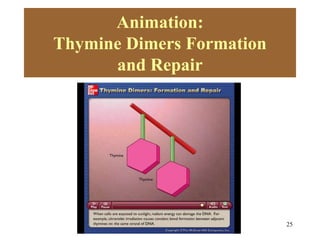
Animation:
Thymine Dimers Formation
and Repair
Please note that due to differing
operating systems, some animations
will not appear until the presentation is
viewed in Presentation Mode (Slide
Show view). You may see blank slides
in the “Normal” or “Slide Sorter” views.
All animations will appear after viewing
in Presentation Mode and playing each
animation. Most animations will require
the latest version of the Flash Player,
which is available at
http://get.adobe.com/flashplayer.
26
6.6: Lifespan Changes
• Skin becomes scaly
• Age spots appear
• Epidermis thins
• Dermis becomes reduced
• Loss of fat
• Wrinkling
• Sagging
• Sebaceous glands secrete
less oil
• Melanin production slows
• Hair thins
• Number of hair follicles
decreases
• Nail growth becomes impaired
• Sensory receptors decline
• Body temperature unable to be
controlled
• Diminished ability to activate
Vitamin D
27

Intugmentary System.pptx

  • 1.
    1 Hole’s Human Anatomy andPhysiology Twelfth Edition Shier w Butler w Lewis Chapter 6 Integumentary System Copyright © The McGraw-Hill Companies, Inc. Permission required for reproduction or display.
  • 2.
    2 6.1: Introduction • Twoor more kinds of tissues grouped together and performing specialized functions constitutes an organ. • The skin and its various structures make up the integumentary system.
  • 3.
    3 6.2: Skin andIts Tissues • Composed of several tissue types • Maintains homeostasis • Protective covering • Retards water loss • Regulates body temperature • Houses sensory receptors • Contains immune system cells • Synthesizes chemicals • Excretes small amounts of wastes
  • 4.
    4 Skin Cells • Helpproduce Vitamin D needed for normal bone and tooth development • Some cells (keratinocytes) produce substances that simulate development of some white blood cells
  • 5.
    5 Layers of Skin(3) • Epidermis • Dermis • Subcutaneous layer • Aka hypodermis • Beneath dermis • Some also call it the superficial fascia • Some consider it not part of the skin Stratified squamous epithelium Dense irregular connective tissue Adipose tissue Copyright © The McGraw-Hill Companies, Inc. Permission required for reproduction or display. © The McGraw-Hill Companies, Inc./Al Telser, photographer
  • 6.
    6 (a) Hair shaft Epidermis Hair follicle (b) Sebaceousgland Dermis Sweat Epidermis Dermis Hair shaft Sweat gland pore Capillary Stratum corneum Stratum basale Dermal papilla Arrector pili muscle Lamellated (Pacinian) corpuscle Basement membrane Sebaceous gland Hair follicle Sweat gland Nerve cell process Adipose tissue Blood vessels Muscle layer Sweat gland duct Subcutaneous layer TTactile (Meissner’s) corpuscle Epidermis • Lacks blood vessels • Keratinized • Thickest on palms and soles (0.8-1.4mm) • Melanocytes provide melanin • Rests on basement membrane • Stratified squamous epithelia Copyright © The McGraw-Hill Companies, Inc. Permission required for reproduction or display. b: © Victor Eroschenko
  • 7.
    7 Epidermis There are five(5) layers of the epidermis: • Stratum corneum • Stratum lucidum • Stratum granulosum • Stratum spinosum • Stratum basale Stratum corneum Stratum lucidum Stratum granulosum Stratum spinosum Stratum basale Basement membrane Dermis Dermal papilla (a) (b) Copyright © The McGraw-Hill Companies, Inc. Permission required for reproduction or display. b: © The McGraw-Hill Companies, Inc./Al Telser, photographer
  • 8.
    8 Epidermis • Genetic Factors •Varying amounts of melanin • Varying size of melanin granules • Albinos lack melanin • Environmental Factors • Sunlight • UV light from sunlamps • X-rays • Darkens melanin • Physiological Factors • Dilation of dermal blood vessels • Constriction of dermal blood vessels • Accumulation of carotene • Jaundice • Heredity and environment determine skin color
  • 9.
    9 Dermis • Contains dermalpapillae • Binds epidermis to underlying tissues • Irregular dense connective tissue • On average 1.0-2.0mm thick • Muscle cells • Nerve cell processes • Specialized sensory receptors • Blood vessels • Hair follicles • Glands (a) Sweat Epidermis Dermis Hair shaft Sweat gland pore Capillary Stratum corneum Stratum basale Dermal papilla Arrector pili muscle Lamellated (Pacinian) corpuscle Basement membrane Sebaceous gland Hair follicle Sweat gland Nerve cell process Adipose tissue Blood vessels Muscle layer Sweat gland duct SubcutaneousSubcutaneous layer Tactile (Meissner’s) corpuscle Copyright © The McGraw-Hill Companies, Inc. Permission required for reproduction or display.
  • 10.
    10 Dermis • Papillary layer •Thin • Superficial • Dermal papillae here • Reticular layer • 80% of dermis • Cleavage, tension or Langer’s lines are here • There are actually two (2) layers to the dermis: (a) Sweat Epidermis Dermis Hair shaft Sweat gland pore Capillary Stratum corneum Stratum basale Dermal papilla Arrector pili muscle Lamellated (Pacinian) corpuscle Basement membrane Sebaceous gland Hair follicle Sweat gland Nerve cell process Adipose tissue Blood vessels Muscle layer Sweat gland duct SubcutaneousSubcutaneous layer Tactile (Meissner’s) corpuscle Copyright © The McGraw-Hill Companies, Inc. Permission required for reproduction or display.
  • 11.
    11 Subcutaneous Layer • Akahypodermis • Loose connective tissue and … • Adipose tissue are present • Insulates • Major blood vessels present (a) Sweat Epidermis Dermis Hair shaft Sweat gland pore Capillary Stratum corneum Stratum basale Dermal papilla Arrector pili muscle Lamellated (Pacinian) corpuscle Basement membrane Sebaceous gland Hair follicle Sweat gland Nerve cell process Adipose tissue Blood vessels Muscle layer Sweat gland duct SubcutaneousSubcutaneous layer Tactile (Meissner’s) corpuscle Copyright © The McGraw-Hill Companies, Inc. Permission required for reproduction or display.
  • 12.
    12 6.3: Accessory Structures ofthe Skin • Accessory structures of the skin originate from the epidermis and include: • Hair follicles • Nails • Skin glands
  • 13.
    13 Hair Follicles • Epidermalcells • Tube-like depression • Extends into dermis • Three (3) parts: • Hair root • Hair shaft • Hair papilla • Dead epidermal cells • Melanin • Arrector pili muscle (a) Hair shaft Pore Hair root (keratinized cells) Arrector pili muscle Sebaceous gland Hair follicle Region of cell division Hair papilla Eccrine sweat gland DermalDermal blood vessels Copyright © The McGraw-Hill Companies, Inc. Permission required for reproduction or display.
  • 14.
    14 Nails • Protective coverings •Three (3) parts: • Nail plate • Nail bed • Lunula Nail bed Nail plate Lunula Copyright © The McGraw-Hill Companies, Inc. Permission required for reproduction or display.
  • 15.
    15 Sebaceous Glands • Usuallyassociated with hair follicles • Holocrine glands • Secrete sebum (oil) • Absent on palms and soles Hair Sebaceous gland Hair follicle Copyright © The McGraw-Hill Companies, Inc. Permission required for reproduction or display. © Per H. Kjeldsen
  • 16.
    16 Sweat Glands • Akasudoriferous glands • Widespread in skin • Originates in deeper dermis or hypodermis • Eccrine glands • Apocrine glands • Ceruminous glands • Mammary glands Dermal papilla Sebaceous gland Duct Hair shaft Hair follicle Eccrine sweat gland Apocrine sweat gland Pore Copyright © The McGraw-Hill Companies, Inc. Permission required for reproduction or display.
  • 17.
    17 6.4: Regulation of BodyTemperature • Regulation of body temperature is vitally important because even slight shifts can disrupt metabolic reactions.
  • 18.
    18 Regulation of Body Temperature Ifbody temperature continues to drop, control center signals muscles to contract involuntarily. too high too low Normal body temperature 37°C (98.6°F) Control center Hypothalamus detects the deviation from the set point and signals effector organs. Control center Hypothalamus detects the deviation from the set point and signals effector organs. Stimulus Body temperature rises above normal. Effectors Dermal blood vessels dilate and sweat glands secrete. Response Body heat is lost to surroundings, temperature drops toward normal. Effectors Dermal blood vessels constrict and sweat glands remain inactive. Effectors Dermal blood vessels constrict and sweat glands remain inactive. Response Body heat is conserved, temperature rises toward normal. Stimulus Body temperature drops below normal. Receptors Thermoreceptors send signals to the control center. Receptors Thermoreceptors send signals to the control center. Copyright © The McGraw-Hill Companies, Inc. Permission required for reproduction or display.
  • 19.
    19 Heat Production andLoss • Heat is a product of cellular metabolism • The most active body cells are the heat producers and include: • Skeletal muscle • Cardiac muscle • Cells of certain glands such as the liver • The primary means of heat loss is radiation • Also there is conduction, convection and evaporation
  • 20.
    20 Problems in Temperature Regulation •Hyperthermia – abnormally high body temperature • Hypothermia – abnormally low body temperature
  • 21.
    21 6.5: Healing ofWounds and Burns • Inflammation is a normal response to injury or stress. • Blood vessels in affected tissues dilate and become more permeable, allowing fluids to leak into the damaged tissues. • Inflammed skin may become: • Reddened • Swollen • Warm • Painful
  • 22.
    22 Healing of Cuts (a)(b) (f) (g) (c) (d) (e) Scar tissue Fibroblasts Scar tissue Blood cells Site of injury Scab Blood clot Scab Copyright © The McGraw-Hill Companies, Inc. Permission required for reproduction or display.
  • 23.
    23 Types of Burns •First degree burn – superficial, partial-thickness • Second degree burn – deep, partial-thickness • Third degree burn – full-thickness • Autograft • Homograft • Various skin substitutes
  • 24.
    24 Rule of Ninesfor Adults Copyright © The McGraw-Hill Companies, Inc. Permission required for reproduction or display. Anterior trunk 18% Posterior trunk 18% Anterior upper extremities 9% Posterior upper extremities 9% Posterior lower extremities 18% Perineum 1% Anterior and posterior upper extremities 18% Anterior and posterior lower extremities 36% 100% Anterior and posterior trunk 36% Anterior and posterior head and neck 9% Anterior head and neck 41/2% Posterior head and neck 41/2% Anterior lower extremities 18% 9% 9% 9% 9% 41/2% 41/2% 41/2% 41/2% 41/2% 41/2%
  • 25.
    25 Animation: Thymine Dimers Formation andRepair Please note that due to differing operating systems, some animations will not appear until the presentation is viewed in Presentation Mode (Slide Show view). You may see blank slides in the “Normal” or “Slide Sorter” views. All animations will appear after viewing in Presentation Mode and playing each animation. Most animations will require the latest version of the Flash Player, which is available at http://get.adobe.com/flashplayer.
  • 26.
    26 6.6: Lifespan Changes •Skin becomes scaly • Age spots appear • Epidermis thins • Dermis becomes reduced • Loss of fat • Wrinkling • Sagging • Sebaceous glands secrete less oil • Melanin production slows • Hair thins • Number of hair follicles decreases • Nail growth becomes impaired • Sensory receptors decline • Body temperature unable to be controlled • Diminished ability to activate Vitamin D
  • 27.