
1
Ahmed Abdulwahab
UG : (1330095)
2
The skin and hypodermis
 Skin – our largest organ
 Accounts for 7% of body weight
 The skin varies in thickness from 1.5 to 4mm distinct
region
 The superficial region is a thick epithelial tissue
 Divided into two distinct layers
 Epidermis
 Dermis
 Hypodermis – lies deep to the dermis
3
4
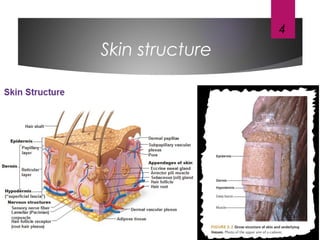
Skin structure
Functions
 Protection : Skin cushions and insulates
the deeper body organs
 Protects the body from scrapes ,chemicals
and invading microorganisms
 The epidermis is waterproof, preventing
unnecessary loss of water across the body
surface
 produce pigment to protect the skin from
the harmful effects of ultraviolet (UV)
radiation
5
Function
 Body temperature regulation :The skin’s rich
capillary networks and sweat glands
regulate the loss of heat from the body
 Excreation : The skin acts as a miniature
excretory system when urea, salts, and
water are lost through sweat.
 Production of vitamin : The epidermal cells
use UV radiation to synthesize vitamin D
 Sensory reseption : touch, pressure,
temperature, and pain
6
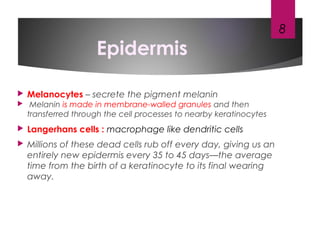
Epidermis
 A keratinized stratified squamous
epithelium that contains four distinct
types of cells
 Keratinocytes – most abundant epidermis cell
 Produce keratin – a tough fibrous protein that gives
the epidermis its protective properties.
 Produce antibodies and enzymes
 Arise from deepest layer of epidermis
 Keratinocytes are dead at skin's surface
 Merkel cells ,Tactile epithelial cells –
associated with sensory nerve ending and
function as a receptor for touch
7
Epidermis
 Melanocytes – secrete the pigment melanin
 Melanin is made in membrane-walled granules and then
transferred through the cell processes to nearby keratinocytes
 Langerhans cells : macrophage like dendritic cells
 Millions of these dead cells rub off every day, giving us an
entirely new epidermis every 35 to 45 days—the average
time from the birth of a keratinocyte to its final wearing
away.
8
Layer of the Epidermis
 Stratum basale
 Deepest layer of epidermis
 Attached to underlying dermis
 Also called the Stratum
germinativum
 these Cells divide rapidly
 Merkel cells – associated with
sensory nerve ending
 Melanocytes – secrete the
pigment melanin
9
Layer of the epidermis
 Stratum spinosum (spiny layer)
 "Spiny" appearance caused by artifacts of histological preparation
 Contains thick bundles of intermediate filaments
 Contains star-shaped cells are part of the immune system
 Dendritic cells police the outer body surface, using receptor-mediated
endocytosis to take up foreign proteins (antigens) that have invaded the
epidermis
 Stratum granulosum
 Consists of one to five layers of flattened keratinocytes and intermediate
filaments
intermediate filaments contain
 Keratohyaline granules – help form keratin
 Lamellated granules – contain a waterproofing glycolipid
10
Layer of the epidermis
 Stratum lucidum (clear layer)
 Occurs only in thick skin but not in thin skin
 Consists of a few rows of flat, dead
keratinocytes
 It is also named the transition zone
 Stratum corneum (horny layer)
 Thick layer of dead keratinocytes and
thickened plasma membranes
 Protects skin against abrasion and
penetration
11
Dermis
 Second major layer of the skin
 Strong, flexible connective tissue
 Richly supplied with blood vessels and nerves fibers
 The deep dermal plexus is located between the hypodermis
and the dermis
 It nourishes the hypodermis and the structures located within the
deeper portions of the dermis
 subpapillary located just below the dermal papillae
 perform a critical role in temperature regulation. These vessels are
so extensive that they can hold 5% of all blood in the body.
12
Dermis
 The dermis has two layers
 papillary layer the superficial 20% of the
dermis
 is areolar connective tissue containing very thin
collagen and elastic fibers It includes the dermal
papillae
 increase the surface area for exchange of gases,
nutrients, and waste products between these layers
 reticular layer the deeper – 80% of thickness
of dermis. is dense irregular connective tissue
13
Hypodermis
 Deep to the skin – also called superficial fascia
 Contains areolar and adipose connective
tissues
 Besides storing fat, the hypodermis anchors the
skin to the underlying structures
 is also an insulator because fat is a poor
conductor of heat, it helps prevent heat loss
from the body
14
Skin color
 Three pigments contribute to skin color
 Melanin – most important pigment – made
from tyrosine
 Carotene – yellowish pigment from carrots
and tomatoes
 Hemoglobin – Caucasian skin contains little
melanin
 Allows crimson color of blood to show through
15
Skin color
 Melanin in granules passes from melanocytes (same number in all
races) to keratinocytes in stratum basale
 Digested by lysosomes
 Variations in color
 Protection from UV light vs vitamin D?
 Derived from epidermis but extend into dermis
 Include
 Hair and hair follicles
 Sebaceous (oil) glands
 Sweat (sudoriferous) glands
 Nails
16
Skin Appendages
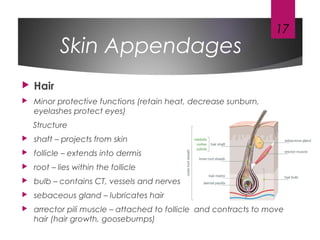
 Hair
 Minor protective functions (retain heat, decrease sunburn,
eyelashes protect eyes)
Structure
 shaft – projects from skin
 follicle – extends into dermis
 root – lies within the follicle
 bulb – contains CT, vessels and nerves
 sebaceous gland – lubricates hair
 arrector pili muscle – attached to follicle and contracts to move
hair (hair growth, goosebumps)
17
18
Skin Appendages
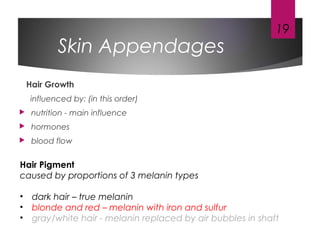
Hair Growth
influenced by: (in this order)
 nutrition - main influence
 hormones
 blood flow
19
Hair Pigment
caused by proportions of 3 melanin types
• dark hair – true melanin
• blonde and red – melanin with iron and sulfur
• gray/white hair - melanin replaced by air bubbles in shaft
20
Skin Appendages
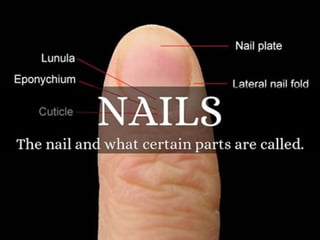
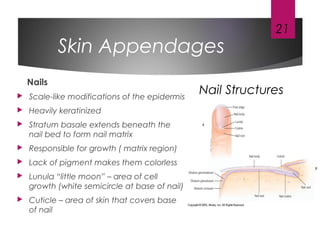
Nails
 Scale-like modifications of the epidermis
 Heavily keratinized
 Stratum basale extends beneath the
nail bed to form nail matrix
 Responsible for growth ( matrix region)
 Lack of pigment makes them colorless
 Lunula “little moon” – area of cell
growth (white semicircle at base of nail)
 Cuticle – area of skin that covers base
of nail
21
Nail Structures
Skin Appendages
Sebaceous glands
all over except palms and soles of feet
Produce oil for waterproofing
Lubricant for skin & kills bacteria
Most with ducts that empty into hair follicles
Glands are activated at puberty: stimulated by hormones
22
Skin Appendages
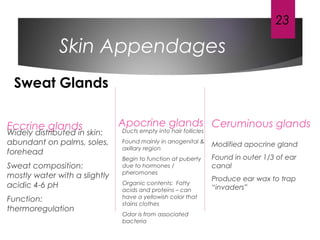
Eccrine glands
Widely distributed in skin:
abundant on palms, soles,
forehead
Sweat composition:
mostly water with a slightly
acidic 4-6 pH
Function:
thermoregulation
Apocrine glands
Ducts empty into hair follicles
Found mainly in anogenital &
axillary region
Begin to function at puberty
due to hormones /
pheromones
Organic contents: Fatty
acids and proteins – can
have a yellowish color that
stains clothes
Odor is from associated
bacteria
Ceruminous glands
Modified apocrine gland
Found in outer 1/3 of ear
canal
Produce ear wax to trap
“invaders”
23
Sweat Glands
Thank you
for your attention
Ahmed abdulwahab
UG : (1330095)
24

Integumentary system

  • 1.
  • 2.
  • 3.
    The skin andhypodermis  Skin – our largest organ  Accounts for 7% of body weight  The skin varies in thickness from 1.5 to 4mm distinct region  The superficial region is a thick epithelial tissue  Divided into two distinct layers  Epidermis  Dermis  Hypodermis – lies deep to the dermis 3
  • 4.
  • 5.
    Functions  Protection :Skin cushions and insulates the deeper body organs  Protects the body from scrapes ,chemicals and invading microorganisms  The epidermis is waterproof, preventing unnecessary loss of water across the body surface  produce pigment to protect the skin from the harmful effects of ultraviolet (UV) radiation 5
  • 6.
    Function  Body temperatureregulation :The skin’s rich capillary networks and sweat glands regulate the loss of heat from the body  Excreation : The skin acts as a miniature excretory system when urea, salts, and water are lost through sweat.  Production of vitamin : The epidermal cells use UV radiation to synthesize vitamin D  Sensory reseption : touch, pressure, temperature, and pain 6
  • 7.
    Epidermis  A keratinizedstratified squamous epithelium that contains four distinct types of cells  Keratinocytes – most abundant epidermis cell  Produce keratin – a tough fibrous protein that gives the epidermis its protective properties.  Produce antibodies and enzymes  Arise from deepest layer of epidermis  Keratinocytes are dead at skin's surface  Merkel cells ,Tactile epithelial cells – associated with sensory nerve ending and function as a receptor for touch 7
  • 8.
    Epidermis  Melanocytes –secrete the pigment melanin  Melanin is made in membrane-walled granules and then transferred through the cell processes to nearby keratinocytes  Langerhans cells : macrophage like dendritic cells  Millions of these dead cells rub off every day, giving us an entirely new epidermis every 35 to 45 days—the average time from the birth of a keratinocyte to its final wearing away. 8
  • 9.
    Layer of theEpidermis  Stratum basale  Deepest layer of epidermis  Attached to underlying dermis  Also called the Stratum germinativum  these Cells divide rapidly  Merkel cells – associated with sensory nerve ending  Melanocytes – secrete the pigment melanin 9
  • 10.
    Layer of theepidermis  Stratum spinosum (spiny layer)  "Spiny" appearance caused by artifacts of histological preparation  Contains thick bundles of intermediate filaments  Contains star-shaped cells are part of the immune system  Dendritic cells police the outer body surface, using receptor-mediated endocytosis to take up foreign proteins (antigens) that have invaded the epidermis  Stratum granulosum  Consists of one to five layers of flattened keratinocytes and intermediate filaments intermediate filaments contain  Keratohyaline granules – help form keratin  Lamellated granules – contain a waterproofing glycolipid 10
  • 11.
    Layer of theepidermis  Stratum lucidum (clear layer)  Occurs only in thick skin but not in thin skin  Consists of a few rows of flat, dead keratinocytes  It is also named the transition zone  Stratum corneum (horny layer)  Thick layer of dead keratinocytes and thickened plasma membranes  Protects skin against abrasion and penetration 11
  • 12.
    Dermis  Second majorlayer of the skin  Strong, flexible connective tissue  Richly supplied with blood vessels and nerves fibers  The deep dermal plexus is located between the hypodermis and the dermis  It nourishes the hypodermis and the structures located within the deeper portions of the dermis  subpapillary located just below the dermal papillae  perform a critical role in temperature regulation. These vessels are so extensive that they can hold 5% of all blood in the body. 12
  • 13.
    Dermis  The dermishas two layers  papillary layer the superficial 20% of the dermis  is areolar connective tissue containing very thin collagen and elastic fibers It includes the dermal papillae  increase the surface area for exchange of gases, nutrients, and waste products between these layers  reticular layer the deeper – 80% of thickness of dermis. is dense irregular connective tissue 13
  • 14.
    Hypodermis  Deep tothe skin – also called superficial fascia  Contains areolar and adipose connective tissues  Besides storing fat, the hypodermis anchors the skin to the underlying structures  is also an insulator because fat is a poor conductor of heat, it helps prevent heat loss from the body 14
  • 15.
    Skin color  Threepigments contribute to skin color  Melanin – most important pigment – made from tyrosine  Carotene – yellowish pigment from carrots and tomatoes  Hemoglobin – Caucasian skin contains little melanin  Allows crimson color of blood to show through 15
  • 16.
    Skin color  Melaninin granules passes from melanocytes (same number in all races) to keratinocytes in stratum basale  Digested by lysosomes  Variations in color  Protection from UV light vs vitamin D?  Derived from epidermis but extend into dermis  Include  Hair and hair follicles  Sebaceous (oil) glands  Sweat (sudoriferous) glands  Nails 16
  • 17.
    Skin Appendages  Hair Minor protective functions (retain heat, decrease sunburn, eyelashes protect eyes) Structure  shaft – projects from skin  follicle – extends into dermis  root – lies within the follicle  bulb – contains CT, vessels and nerves  sebaceous gland – lubricates hair  arrector pili muscle – attached to follicle and contracts to move hair (hair growth, goosebumps) 17
  • 18.
  • 19.
    Skin Appendages Hair Growth influencedby: (in this order)  nutrition - main influence  hormones  blood flow 19 Hair Pigment caused by proportions of 3 melanin types • dark hair – true melanin • blonde and red – melanin with iron and sulfur • gray/white hair - melanin replaced by air bubbles in shaft
  • 20.
  • 21.
    Skin Appendages Nails  Scale-likemodifications of the epidermis  Heavily keratinized  Stratum basale extends beneath the nail bed to form nail matrix  Responsible for growth ( matrix region)  Lack of pigment makes them colorless  Lunula “little moon” – area of cell growth (white semicircle at base of nail)  Cuticle – area of skin that covers base of nail 21 Nail Structures
  • 22.
    Skin Appendages Sebaceous glands allover except palms and soles of feet Produce oil for waterproofing Lubricant for skin & kills bacteria Most with ducts that empty into hair follicles Glands are activated at puberty: stimulated by hormones 22
  • 23.
    Skin Appendages Eccrine glands Widelydistributed in skin: abundant on palms, soles, forehead Sweat composition: mostly water with a slightly acidic 4-6 pH Function: thermoregulation Apocrine glands Ducts empty into hair follicles Found mainly in anogenital & axillary region Begin to function at puberty due to hormones / pheromones Organic contents: Fatty acids and proteins – can have a yellowish color that stains clothes Odor is from associated bacteria Ceruminous glands Modified apocrine gland Found in outer 1/3 of ear canal Produce ear wax to trap “invaders” 23 Sweat Glands
  • 24.
    Thank you for yourattention Ahmed abdulwahab UG : (1330095) 24

Editor's Notes

  • #4 <number>