Backcross Method for Dominant and Recessive
Gene Transfer.
 Submitted to- Dr. J. N. Patel,
Associate Research Scientist,
Main Vegetable Research Station,
AAU, Anand.
 Submitted by- Gediya lalji N,
M.Sc in Genetics and Plant Breeding,
AAU, Anand.
Content…
 Introduction
 Requirement of backcross programme
 Application of backcross method
 Genetic consequences of repeated backcrossing
 Transfer of a dominant gene
 Transfer of a recessive gene
 Merits of backcross method
 Demerits of backcross method
 Achievement
•What is Backcross ?
• A cross between a hybrid (F1 or a segregating
generation) and one of its parents is known as
backcross.
• In BACKCROSS METHOD, the hybrid and the
progenies in the subsequent generation are repeatedly
backcrossed to one of the parents of the F1.
•Why backcross method is used?
•Since there are many varieties which are deficient in
some characters, therefore that deficient character present
in recurrent parent is crossed with donor parent in
which that character is present, so we use backcross for
the transfer of the character
•The objective of backcross method is to imprrovw one
or two specific defect of a high yielding variety, which is
well adapted to the area and has a other desirable
characteristics.
•What is Recurrent Parent and Non-
recurrent Parent ?
In backcross breeding, the parent from which few or
more genes are transferred to the recurrent parent is
called the Donor parent.
In backcross breeding, the parent to which few or more
genes are transferred from the donor parent is called the
Recurrent parent.
Requirement for a Backcross
Programme-
1. A suitable recurrent parent, which lacks in one or
two characters.
2. A suitable Donor parent that has an intense form of
character which is deficient in recurrent parent.
3. The character to be transferred must have high
heritability and governed by one or few genes.
4. Sufficient number of backcrosses should be made so
that genotype of the recurrent parent is recovered in
full.
Applications of Backcross Method
This method is commonly used to transfer
disease resistance from one variety to another. But it is
also useful for transfer of other characteristics.
1. Intervarietal transfer of simply inherited characters
E.g. Disease resistance, seed coat colour
2. Intervarietal transfer of quantitative characters.
E.g. Plant height, Seed size, Seed shape.
3. Interspecific transfer of simply inherited characters
E.g. Transfer of disease resistance from related species
to cultivated species.
E.g. Resistance to black arm disease in cotton from wild
tetraploid species into G.hirsutum .
4. Transfer of cytoplasm This is employed to transfer
male sterility. The female parent will be having the
sterile cytoplasm and recurrent parent will be used as
male parent. E.g. Sesamum malabariucum x S.indicum
Female parent Recurrent parent.
5. Transgressive segregation Back cross method may be
modified to produce transgressive segregants. The F1 is
backcrossed to recurrent parent for 2 to 3 times for
getting transgressive segregants.
6. Production of isogenic lines
7. Germplasm conversion
E.g. Production of photo insensitive line from photo
Sensitive germplasm through back crossing. This was
done in the case of sorghum. Popularly known as
conversion programme.
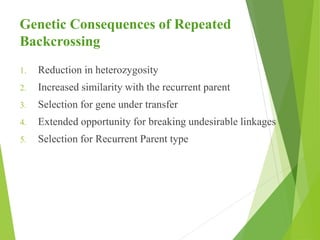
Genetic Consequences of Repeated
Backcrossing
1. Reduction in heterozygosity
2. Increased similarity with the recurrent parent
3. Selection for gene under transfer
4. Extended opportunity for breaking undesirable linkages
5. Selection for Recurrent Parent type
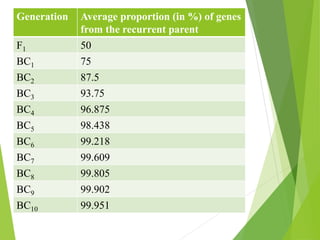
Generation Average proportion (in %) of genes
from the recurrent parent
F1 50
BC1 75
BC2 87.5
BC3 93.75
BC4 96.875
BC5 98.438
BC6 99.218
BC7 99.609
BC8 99.805
BC9 99.902
BC10 99.951
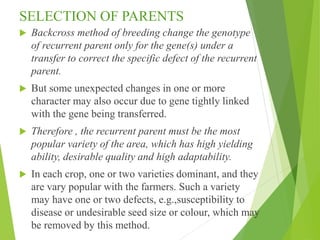
SELECTION OF PARENTS
 Backcross method of breeding change the genotype
of recurrent parent only for the gene(s) under a
transfer to correct the specific defect of the recurrent
parent.
 But some unexpected changes in one or more
character may also occur due to gene tightly linked
with the gene being transferred.
 Therefore , the recurrent parent must be the most
popular variety of the area, which has high yielding
ability, desirable quality and high adaptability.
 In each crop, one or two varieties dominant, and they
are vary popular with the farmers. Such a variety
may have one or two defects, e.g.,susceptibility to
disease or undesirable seed size or colour, which may
be removed by this method.
 The nonrecurrnt parent is selected for high
intensity of the character that is to be improved
in the recurrent parent, and yielding ability and
other feature of the parent are not important.
 The intensity of the character should preferably
be more than that desired in the recurrent
parent because the intensity may decline
during the transfer and in the new genetic
background of the recurrent parent.
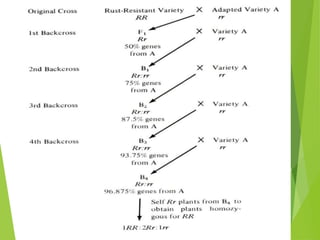
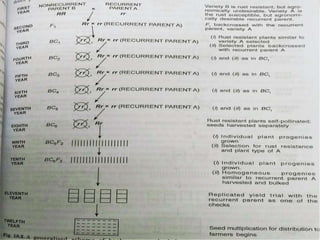
Transfer of a Dominant Gene –
 Suppose that a high yielding variety and widely
adapted wheat variety A is susceptible to stem rust.
Another variety B is resistant to stem rust and this
resistance is dominant to susceptibility.
 Therefore, variety A is taken as Recurrent parent and
variety B is used as Non-recurrent parent.
 Procedure is simple for dominant gene transfer than
recessive gene transfer.
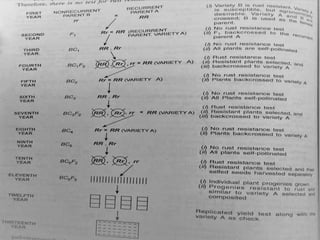
Transfer of Recessive Gene –
 When rust resistance is due to recessive gene, all the
backcross cannot be made one after the other. After the
first backcross, and after every two subsequent
backcrosses, F2 generations must be grown to identify
rust resistant plants.
 The F1 and the backcross progenies are not inoculated
with rust because they will be uniformly susceptible so,
only the F2 populations are tested for rust resistance.
 Here, Variety B is rust resistance(rr) and it is Non-
recurrent parent, whereas Variety A is agronomically
desirable and it is as Recurrent parent.
Merits of Backcross Method –
 The genotype of new variety is nearly identical with
that of the recurrent parent, except for the gene
transfer. Thus the outcome of a backcross
programme is khown before hand and it can be
reproduced any time in future.
 Much smaller population is needed in this method
than in pedigree method.
 It is not necessary to test the variety developed by
the backcross method in extensive yield tests
because the performance of recurrent parent is
already known. This may save up to 3-4 years time
and considerable expense.
 The backcross programme is not dependent
on the environment, except for the needed
fpr selection of the character under transfer.
 This is the only method for inter-specific
gene transfers, and for the transfer of
cytoplasm.
 Defect like susceptibility to the disease of a
well adapted variety can be removed without
affecting its performance and adaptability.
Demerits of the Backcross Method
 The new variety generally cannot be superior to the
recurrent parent, except for the character that is transferred.
 Linkage drag (close linkage between a desirable and
undesirable gene.)
 Hybridization required for each backcross; which is often
difficult, time taking and costly.
 By the time backcross programme improves it, recurrent
parent may have been replaced by other varieties superior
in yielding ability and other characteristics.
Achievements..
 Rust resistance has been transferred to Kalyan Sona
from several
 diverse sources, eg. Robin, HS19, Bluebird etc.
 Tift23A was used in backcross programme with
resistant lines from India and Africa to develop
downy mildew resistant male sterile lines, such as
MS521, MS541, etc
 G. herbaceum varieties Vijapla, Vijay, Digvijay and
Kalyan are some of the cotton varieties developed by
this method.
• Plant breeding; Principles and method, B.D.Singh,
Kalyani publishers
• An introduction to plant breeding, Jack Brown and
Peter Caligari, Blackwell publishers
THANK YOU

backcross method by LALJI N. GEDIYA

  • 2.
    Backcross Method forDominant and Recessive Gene Transfer.  Submitted to- Dr. J. N. Patel, Associate Research Scientist, Main Vegetable Research Station, AAU, Anand.  Submitted by- Gediya lalji N, M.Sc in Genetics and Plant Breeding, AAU, Anand.
  • 3.
    Content…  Introduction  Requirementof backcross programme  Application of backcross method  Genetic consequences of repeated backcrossing  Transfer of a dominant gene  Transfer of a recessive gene  Merits of backcross method  Demerits of backcross method  Achievement
  • 4.
    •What is Backcross? • A cross between a hybrid (F1 or a segregating generation) and one of its parents is known as backcross. • In BACKCROSS METHOD, the hybrid and the progenies in the subsequent generation are repeatedly backcrossed to one of the parents of the F1.
  • 5.
    •Why backcross methodis used? •Since there are many varieties which are deficient in some characters, therefore that deficient character present in recurrent parent is crossed with donor parent in which that character is present, so we use backcross for the transfer of the character •The objective of backcross method is to imprrovw one or two specific defect of a high yielding variety, which is well adapted to the area and has a other desirable characteristics.
  • 6.
    •What is RecurrentParent and Non- recurrent Parent ? In backcross breeding, the parent from which few or more genes are transferred to the recurrent parent is called the Donor parent. In backcross breeding, the parent to which few or more genes are transferred from the donor parent is called the Recurrent parent.
  • 7.
    Requirement for aBackcross Programme- 1. A suitable recurrent parent, which lacks in one or two characters. 2. A suitable Donor parent that has an intense form of character which is deficient in recurrent parent. 3. The character to be transferred must have high heritability and governed by one or few genes. 4. Sufficient number of backcrosses should be made so that genotype of the recurrent parent is recovered in full.
  • 8.
    Applications of BackcrossMethod This method is commonly used to transfer disease resistance from one variety to another. But it is also useful for transfer of other characteristics. 1. Intervarietal transfer of simply inherited characters E.g. Disease resistance, seed coat colour 2. Intervarietal transfer of quantitative characters. E.g. Plant height, Seed size, Seed shape. 3. Interspecific transfer of simply inherited characters E.g. Transfer of disease resistance from related species to cultivated species. E.g. Resistance to black arm disease in cotton from wild tetraploid species into G.hirsutum .
  • 9.
    4. Transfer ofcytoplasm This is employed to transfer male sterility. The female parent will be having the sterile cytoplasm and recurrent parent will be used as male parent. E.g. Sesamum malabariucum x S.indicum Female parent Recurrent parent. 5. Transgressive segregation Back cross method may be modified to produce transgressive segregants. The F1 is backcrossed to recurrent parent for 2 to 3 times for getting transgressive segregants. 6. Production of isogenic lines 7. Germplasm conversion E.g. Production of photo insensitive line from photo Sensitive germplasm through back crossing. This was done in the case of sorghum. Popularly known as conversion programme.
  • 10.
    Genetic Consequences ofRepeated Backcrossing 1. Reduction in heterozygosity 2. Increased similarity with the recurrent parent 3. Selection for gene under transfer 4. Extended opportunity for breaking undesirable linkages 5. Selection for Recurrent Parent type
  • 12.
    Generation Average proportion(in %) of genes from the recurrent parent F1 50 BC1 75 BC2 87.5 BC3 93.75 BC4 96.875 BC5 98.438 BC6 99.218 BC7 99.609 BC8 99.805 BC9 99.902 BC10 99.951
  • 13.
    SELECTION OF PARENTS Backcross method of breeding change the genotype of recurrent parent only for the gene(s) under a transfer to correct the specific defect of the recurrent parent.  But some unexpected changes in one or more character may also occur due to gene tightly linked with the gene being transferred.  Therefore , the recurrent parent must be the most popular variety of the area, which has high yielding ability, desirable quality and high adaptability.  In each crop, one or two varieties dominant, and they are vary popular with the farmers. Such a variety may have one or two defects, e.g.,susceptibility to disease or undesirable seed size or colour, which may be removed by this method.
  • 14.
     The nonrecurrntparent is selected for high intensity of the character that is to be improved in the recurrent parent, and yielding ability and other feature of the parent are not important.  The intensity of the character should preferably be more than that desired in the recurrent parent because the intensity may decline during the transfer and in the new genetic background of the recurrent parent.
  • 15.
    Transfer of aDominant Gene –  Suppose that a high yielding variety and widely adapted wheat variety A is susceptible to stem rust. Another variety B is resistant to stem rust and this resistance is dominant to susceptibility.  Therefore, variety A is taken as Recurrent parent and variety B is used as Non-recurrent parent.  Procedure is simple for dominant gene transfer than recessive gene transfer.
  • 17.
    Transfer of RecessiveGene –  When rust resistance is due to recessive gene, all the backcross cannot be made one after the other. After the first backcross, and after every two subsequent backcrosses, F2 generations must be grown to identify rust resistant plants.  The F1 and the backcross progenies are not inoculated with rust because they will be uniformly susceptible so, only the F2 populations are tested for rust resistance.  Here, Variety B is rust resistance(rr) and it is Non- recurrent parent, whereas Variety A is agronomically desirable and it is as Recurrent parent.
  • 19.
    Merits of BackcrossMethod –  The genotype of new variety is nearly identical with that of the recurrent parent, except for the gene transfer. Thus the outcome of a backcross programme is khown before hand and it can be reproduced any time in future.  Much smaller population is needed in this method than in pedigree method.  It is not necessary to test the variety developed by the backcross method in extensive yield tests because the performance of recurrent parent is already known. This may save up to 3-4 years time and considerable expense.
  • 20.
     The backcrossprogramme is not dependent on the environment, except for the needed fpr selection of the character under transfer.  This is the only method for inter-specific gene transfers, and for the transfer of cytoplasm.  Defect like susceptibility to the disease of a well adapted variety can be removed without affecting its performance and adaptability.
  • 21.
    Demerits of theBackcross Method  The new variety generally cannot be superior to the recurrent parent, except for the character that is transferred.  Linkage drag (close linkage between a desirable and undesirable gene.)  Hybridization required for each backcross; which is often difficult, time taking and costly.  By the time backcross programme improves it, recurrent parent may have been replaced by other varieties superior in yielding ability and other characteristics.
  • 22.
    Achievements..  Rust resistancehas been transferred to Kalyan Sona from several  diverse sources, eg. Robin, HS19, Bluebird etc.  Tift23A was used in backcross programme with resistant lines from India and Africa to develop downy mildew resistant male sterile lines, such as MS521, MS541, etc  G. herbaceum varieties Vijapla, Vijay, Digvijay and Kalyan are some of the cotton varieties developed by this method.
  • 23.
    • Plant breeding;Principles and method, B.D.Singh, Kalyani publishers • An introduction to plant breeding, Jack Brown and Peter Caligari, Blackwell publishers
  • 24.