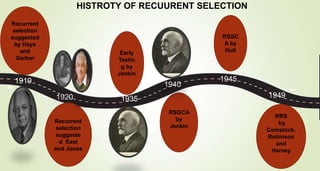
Recurrent
selection
suggested
by Hays
and
Garber
Recurrent
selection
suggeste
d East
and Jones
Early
Testin
g by
Jenkin
RSGCA
by
Jenkin
RSSC
A by
Hull
1919
1920 1935
1940
1945
1949
RRS
by
Comstock.
Robinson
and
Harvey
HISTROTY OF RECUURENT SELECTION
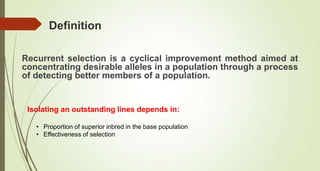
Definition
Recurrent selection is a cyclical improvement method aimed at
concentrating desirable alleles in a population through a process
of detecting better members of a population.
Isolating an outstanding lines depends in:
• Proportion of superior inbred in the base population
• Effectiveness of selection
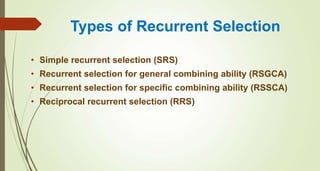
Types of Recurrent Selection
• Simple recurrent selection (SRS)
• Recurrent selection for general combining ability (RSGCA)
• Recurrent selection for specific combining ability (RSSCA)
• Reciprocal recurrent selection (RRS)
• Simple recurrent selection (SRS)
• Recurrent selection for general combining ability (RSGCA)
• Recurrent selection for specific combining ability (RSSCA)
• Reciprocal recurrent selection (RRS)
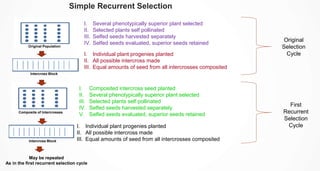
Simple Recurrent Selection
I. Several phenotypically superior plant selected
II. Selected plants self pollinated
III. Selfed seeds harvested separately
IV. Selfed seeds evaluated, superior seeds retained
I. Individual plant progenies planted
II. All possible intercross made
III. Equal amounts of seed from all intercrosses composited
I. Composited intercross seed planted
II. Several phenotypically superior plant selected
III. Selected plants self pollinated
IV. Selfed seeds harvested separately
V. Selfed seeds evaluated, superior seeds retained
I. Individual plant progenies planted
II. All possible intercross made
III. Equal amounts of seed from all intercrosses composited
Original Population
Intercross Block
Composite of Intercrosses
Intercross Block
May be repeated
As in the first recurrent selection cycle
Original
Selection
Cycle
First
Recurrent
Selection
Cycle
• Simple recurrent selection (SRS)
• Recurrent selection for general combining ability (RSGCA)
• Recurrent selection for specific combining ability (RSSCA)
• Reciprocal recurrent selection (RRS)
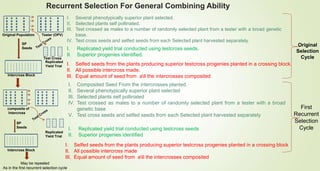
Recurrent Selection For General Combining Ability
I. Several phenotypically superior plant selected.
II. Selected plants self pollinated.
III. Test crossed as males to a number of randomly selected plant from a tester with a broad genetic
base.
IV. Test cross seeds and selfed seeds from each Selected plant harvested separately.
I. Replicated yield trial conducted using testcross seeds.
II. Superior progenies identified.
I. Selfed seeds from the plants producing superior testcross progenies planted in a crossing block.
II. All possible intercross made.
III. Equal amount of seed from all the intercrosses composited.
Original
Selection
Cycle
I. Composited Seed From the intercrosses planted.
II. Several phenotypically superior plant selected
III. Selected plants self pollinated
IV. Test crossed as males to a number of randomly selected plant from a tester with a broad
genetic base
V. Test cross seeds and selfed seeds from each Selected plant harvested separately
I. Replicated yield trial conducted using testcross seeds
II. Superior progenies identified
I. Selfed seeds from the plants producing superior testcross progenies planted in a crossing block
II. All possible intercross made
III. Equal amount of seed from all the intercrosses composited
First
Recurrent
Selection
Cycle
Original Population
Intercross Block
Intercross Block
Replicated
Yield Trial
Replicated
Yield Trial
May be repeated
As in the first recurrent selection cycle
composite of
Intercross
Tester (OPV)
SP
Seeds
SP
Seeds
Test Cross
• Simple recurrent selection (SRS)
• Recurrent selection for general combining ability (RSGCA)
• Recurrent selection for specific combining ability (RSSCA)
• Reciprocal recurrent selection (RRS)
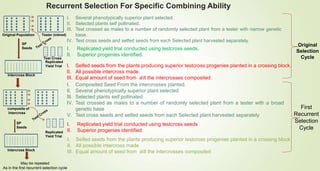
Recurrent Selection For Specific Combining Ability
I. Several phenotypically superior plant selected.
II. Selected plants self pollinated.
III. Test crossed as males to a number of randomly selected plant from a tester with narrow genetic
base.
IV. Test cross seeds and selfed seeds from each Selected plant harvested separately.
I. Replicated yield trial conducted using testcross seeds.
II. Superior progenies identified.
I. Selfed seeds from the plants producing superior testcross progenies planted in a crossing block.
II. All possible intercross made.
III. Equal amount of seed from all the intercrosses composited.
Original
Selection
Cycle
I. Composited Seed From the intercrosses planted.
II. Several phenotypically superior plant selected
III. Selected plants self pollinated
IV. Test crossed as males to a number of randomly selected plant from a tester with a broad
genetic base
V. Test cross seeds and selfed seeds from each Selected plant harvested separately
I. Replicated yield trial conducted using testcross seeds
II. Superior progenies identified
I. Selfed seeds from the plants producing superior testcross progenies planted in a crossing block
II. All possible intercross made
III. Equal amount of seed from all the intercrosses composited
First
Recurrent
Selection
Cycle
Original Population
Intercross Block
Intercross Block
Replicated
Yield Trial
Replicated
Yield Trial
May be repeated
As in the first recurrent selection cycle
composite of
Intercross
Tester (inbred)
SP
Seeds
SP
Seeds
Test Cross
• Simple recurrent selection (SRS)
• Recurrent selection for general combining ability (RSGCA)
• Recurrent selection for specific combining ability (RSSCA)
• Reciprocal recurrent selection (RRS)
Original Population
A
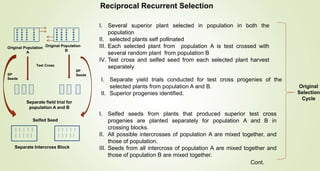
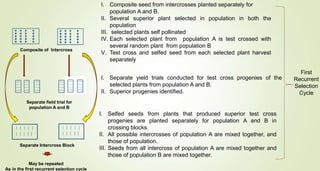
Reciprocal Recurrent Selection
Original Population
B
Separate field trial for
population A and B
SP
Seeds
SP
Seeds
Test Cross
Separate Intercross Block
I. Several superior plant selected in population in both the
population
II. selected plants self pollinated
III. Each selected plant from population A is test crossed with
several random plant from population B
IV. Test cross and selfed seed from each selected plant harvest
separately
I. Separate yield trials conducted for test cross progenies of the
selected plants from population A and B.
II. Superior progenies identified.
I. Selfed seeds from plants that produced superior test cross
progenies are planted separately for population A and B in
crossing blocks.
II. All possible intercrosses of population A are mixed together, and
those of population.
III. Seeds from all intercross of population A are mixed together and
those of population B are mixed together.
Original
Selection
Cycle
Selfed Seed
Cont.
Separate Intercross Block
Composite of Intercross
Separate field trial for
population A and B
I. Composite seed from intercrosses planted separately for
population A and B.
II. Several superior plant selected in population in both the
population
III. selected plants self pollinated
IV. Each selected plant from population A is test crossed with
several random plant from population B
V. Test cross and selfed seed from each selected plant harvest
separately
I. Separate yield trials conducted for test cross progenies of the
selected plants from population A and B.
II. Superior progenies identified.
I. Selfed seeds from plants that produced superior test cross
progenies are planted separately for population A and B in
crossing blocks.
II. All possible intercrosses of population A are mixed together, and
those of population.
III. Seeds from all intercross of population A are mixed together and
those of population B are mixed together.
First
Recurrent
Selection
Cycle
May be repeated
As in the first recurrent selection cycle
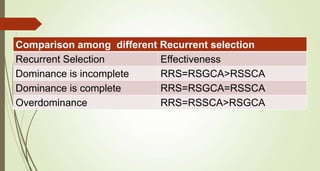
Comparison among different Recurrent selection
Recurrent Selection Effectiveness
Dominance is incomplete RRS=RSGCA>RSSCA
Dominance is complete RRS=RSGCA=RSSCA
Overdominance RRS=RSSCA>RSGCA
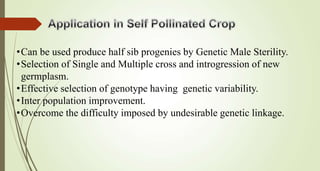
•Can be used produce half sib progenies by Genetic Male Sterility.
•Selection of Single and Multiple cross and introgression of new
germplasm.
•Effective selection of genotype having genetic variability.
•Inter population improvement.
•Overcome the difficulty imposed by undesirable genetic linkage.
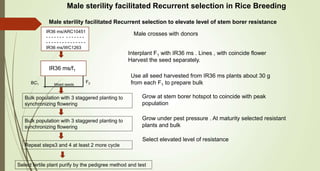
Male sterility facilitated Recurrent selection in Rice Breeding
Male sterility facilitated Recurrent selection to elevate level of stem borer resistance
IR36 ms/ARC10451
- - - - - - - - - - - - - -
- - - - - - - - - - - - - - -
IR36 ms/WC1263
IR36 ms/f1
Bulk population with 3 staggered planting to
synchronizing flowering
Bulk population with 3 staggered planting to
synchronizing flowering
Repeat steps3 and 4 at least 2 more cycle
Select fertile plant purify by the pedigree method and test
BC1
F2
Mixed seeds
Male crosses with donors
Interplant F1 with IR36 ms . Lines , with coincide flower
Harvest the seed separately.
Use all seed harvested from IR36 ms plants about 30 g
from each F1 to prepare bulk
Grow at stem borer hotspot to coincide with peak
population
Grow under pest pressure . At maturity selected resistant
plants and bulk
Select elevated level of resistance
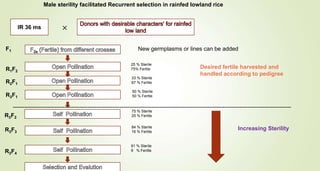
Male sterility facilitated Recurrent selection in rainfed lowland rice
IR 36 ms
New germplasms or lines can be added
--------------------------------------------------------------------------------------------------------------------------------------------------
25 % Sterile
75% Fertile
33 % Sterile
67 % Fertile
50 % Sterile
50 % Fertile
75 % Sterile
25 % Fertile
84 % Sterile
16 % Fertile
91 % Sterile
9 % Fertile
Desired fertile harvested and
handled according to pedigree
Increasing Sterility
F1
R1F2
R3F4
R2F1
R3F1
R3F2
R3F3
recurrent selection and its application in self pollinated crop.pptx

recurrent selection and its application in self pollinated crop.pptx

  • 2.
    Recurrent selection suggested by Hays and Garber Recurrent selection suggeste d East andJones Early Testin g by Jenkin RSGCA by Jenkin RSSC A by Hull 1919 1920 1935 1940 1945 1949 RRS by Comstock. Robinson and Harvey HISTROTY OF RECUURENT SELECTION
  • 3.
    Definition Recurrent selection isa cyclical improvement method aimed at concentrating desirable alleles in a population through a process of detecting better members of a population. Isolating an outstanding lines depends in: • Proportion of superior inbred in the base population • Effectiveness of selection
  • 4.
    Types of RecurrentSelection • Simple recurrent selection (SRS) • Recurrent selection for general combining ability (RSGCA) • Recurrent selection for specific combining ability (RSSCA) • Reciprocal recurrent selection (RRS)
  • 5.
    • Simple recurrentselection (SRS) • Recurrent selection for general combining ability (RSGCA) • Recurrent selection for specific combining ability (RSSCA) • Reciprocal recurrent selection (RRS)
  • 6.
    Simple Recurrent Selection I.Several phenotypically superior plant selected II. Selected plants self pollinated III. Selfed seeds harvested separately IV. Selfed seeds evaluated, superior seeds retained I. Individual plant progenies planted II. All possible intercross made III. Equal amounts of seed from all intercrosses composited I. Composited intercross seed planted II. Several phenotypically superior plant selected III. Selected plants self pollinated IV. Selfed seeds harvested separately V. Selfed seeds evaluated, superior seeds retained I. Individual plant progenies planted II. All possible intercross made III. Equal amounts of seed from all intercrosses composited Original Population Intercross Block Composite of Intercrosses Intercross Block May be repeated As in the first recurrent selection cycle Original Selection Cycle First Recurrent Selection Cycle
  • 7.
    • Simple recurrentselection (SRS) • Recurrent selection for general combining ability (RSGCA) • Recurrent selection for specific combining ability (RSSCA) • Reciprocal recurrent selection (RRS)
  • 8.
    Recurrent Selection ForGeneral Combining Ability I. Several phenotypically superior plant selected. II. Selected plants self pollinated. III. Test crossed as males to a number of randomly selected plant from a tester with a broad genetic base. IV. Test cross seeds and selfed seeds from each Selected plant harvested separately. I. Replicated yield trial conducted using testcross seeds. II. Superior progenies identified. I. Selfed seeds from the plants producing superior testcross progenies planted in a crossing block. II. All possible intercross made. III. Equal amount of seed from all the intercrosses composited. Original Selection Cycle I. Composited Seed From the intercrosses planted. II. Several phenotypically superior plant selected III. Selected plants self pollinated IV. Test crossed as males to a number of randomly selected plant from a tester with a broad genetic base V. Test cross seeds and selfed seeds from each Selected plant harvested separately I. Replicated yield trial conducted using testcross seeds II. Superior progenies identified I. Selfed seeds from the plants producing superior testcross progenies planted in a crossing block II. All possible intercross made III. Equal amount of seed from all the intercrosses composited First Recurrent Selection Cycle Original Population Intercross Block Intercross Block Replicated Yield Trial Replicated Yield Trial May be repeated As in the first recurrent selection cycle composite of Intercross Tester (OPV) SP Seeds SP Seeds Test Cross
  • 9.
    • Simple recurrentselection (SRS) • Recurrent selection for general combining ability (RSGCA) • Recurrent selection for specific combining ability (RSSCA) • Reciprocal recurrent selection (RRS)
  • 10.
    Recurrent Selection ForSpecific Combining Ability I. Several phenotypically superior plant selected. II. Selected plants self pollinated. III. Test crossed as males to a number of randomly selected plant from a tester with narrow genetic base. IV. Test cross seeds and selfed seeds from each Selected plant harvested separately. I. Replicated yield trial conducted using testcross seeds. II. Superior progenies identified. I. Selfed seeds from the plants producing superior testcross progenies planted in a crossing block. II. All possible intercross made. III. Equal amount of seed from all the intercrosses composited. Original Selection Cycle I. Composited Seed From the intercrosses planted. II. Several phenotypically superior plant selected III. Selected plants self pollinated IV. Test crossed as males to a number of randomly selected plant from a tester with a broad genetic base V. Test cross seeds and selfed seeds from each Selected plant harvested separately I. Replicated yield trial conducted using testcross seeds II. Superior progenies identified I. Selfed seeds from the plants producing superior testcross progenies planted in a crossing block II. All possible intercross made III. Equal amount of seed from all the intercrosses composited First Recurrent Selection Cycle Original Population Intercross Block Intercross Block Replicated Yield Trial Replicated Yield Trial May be repeated As in the first recurrent selection cycle composite of Intercross Tester (inbred) SP Seeds SP Seeds Test Cross
  • 11.
    • Simple recurrentselection (SRS) • Recurrent selection for general combining ability (RSGCA) • Recurrent selection for specific combining ability (RSSCA) • Reciprocal recurrent selection (RRS)
  • 12.
    Original Population A Reciprocal RecurrentSelection Original Population B Separate field trial for population A and B SP Seeds SP Seeds Test Cross Separate Intercross Block I. Several superior plant selected in population in both the population II. selected plants self pollinated III. Each selected plant from population A is test crossed with several random plant from population B IV. Test cross and selfed seed from each selected plant harvest separately I. Separate yield trials conducted for test cross progenies of the selected plants from population A and B. II. Superior progenies identified. I. Selfed seeds from plants that produced superior test cross progenies are planted separately for population A and B in crossing blocks. II. All possible intercrosses of population A are mixed together, and those of population. III. Seeds from all intercross of population A are mixed together and those of population B are mixed together. Original Selection Cycle Selfed Seed Cont.
  • 13.
    Separate Intercross Block Compositeof Intercross Separate field trial for population A and B I. Composite seed from intercrosses planted separately for population A and B. II. Several superior plant selected in population in both the population III. selected plants self pollinated IV. Each selected plant from population A is test crossed with several random plant from population B V. Test cross and selfed seed from each selected plant harvest separately I. Separate yield trials conducted for test cross progenies of the selected plants from population A and B. II. Superior progenies identified. I. Selfed seeds from plants that produced superior test cross progenies are planted separately for population A and B in crossing blocks. II. All possible intercrosses of population A are mixed together, and those of population. III. Seeds from all intercross of population A are mixed together and those of population B are mixed together. First Recurrent Selection Cycle May be repeated As in the first recurrent selection cycle
  • 14.
    Comparison among differentRecurrent selection Recurrent Selection Effectiveness Dominance is incomplete RRS=RSGCA>RSSCA Dominance is complete RRS=RSGCA=RSSCA Overdominance RRS=RSSCA>RSGCA
  • 15.
    •Can be usedproduce half sib progenies by Genetic Male Sterility. •Selection of Single and Multiple cross and introgression of new germplasm. •Effective selection of genotype having genetic variability. •Inter population improvement. •Overcome the difficulty imposed by undesirable genetic linkage.
  • 17.
    Male sterility facilitatedRecurrent selection in Rice Breeding Male sterility facilitated Recurrent selection to elevate level of stem borer resistance IR36 ms/ARC10451 - - - - - - - - - - - - - - - - - - - - - - - - - - - - - IR36 ms/WC1263 IR36 ms/f1 Bulk population with 3 staggered planting to synchronizing flowering Bulk population with 3 staggered planting to synchronizing flowering Repeat steps3 and 4 at least 2 more cycle Select fertile plant purify by the pedigree method and test BC1 F2 Mixed seeds Male crosses with donors Interplant F1 with IR36 ms . Lines , with coincide flower Harvest the seed separately. Use all seed harvested from IR36 ms plants about 30 g from each F1 to prepare bulk Grow at stem borer hotspot to coincide with peak population Grow under pest pressure . At maturity selected resistant plants and bulk Select elevated level of resistance
  • 18.
    Male sterility facilitatedRecurrent selection in rainfed lowland rice IR 36 ms New germplasms or lines can be added -------------------------------------------------------------------------------------------------------------------------------------------------- 25 % Sterile 75% Fertile 33 % Sterile 67 % Fertile 50 % Sterile 50 % Fertile 75 % Sterile 25 % Fertile 84 % Sterile 16 % Fertile 91 % Sterile 9 % Fertile Desired fertile harvested and handled according to pedigree Increasing Sterility F1 R1F2 R3F4 R2F1 R3F1 R3F2 R3F3