Dr. NAVEENKUMAR K.L
Assistant Professor
Dept. Of Genetics and Plant Breeding
UAHS Shivamogga
Selection methods for the development of pure
lines from crosses/segregating generations
 Mass selection (MS) and Pure line (PL) selection are applied to
genetically variable and homozygous populations of SPC’s. But these
methods cannot be applied to segregating populations obtained from
crosses.
 Crosses between varieties, germplasm introduction and breeding lines
are made to create new gene combinations.
 In the generations to follow, superior genotypes (presumably having
superior genes and gene combinations) are selected and fixed in the
homozygous state by means of self fertilization and selection.
 The selection methods generally applied to such situations are
 Pedigree method
 Bulk method
 Backcross method
INTRODUCTON
PEDIGREE METHOD
 In Pedigree method individual plants are selected from F2 and
subsequent segregating generations and their offspring's are
tested.
 During the process of entire selection a record of all parent-
offspring relations is kept – called as Pedigree record.
 Individual plant selection (IPS) is continued till the progenies
become almost (F6) homozygous/show no segregation.
 Selection is done between progenies as there will be no genetic
variation within the progenies.
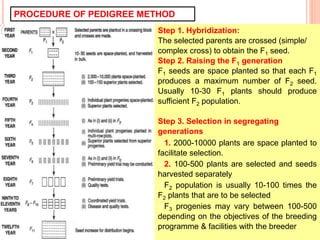
PROCEDURE OF PEDIGREE METHOD
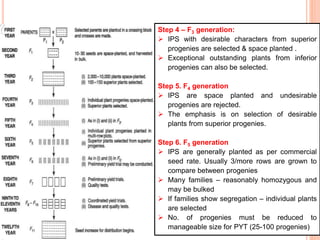
Step 1. Hybridization:
The selected parents are crossed (simple/
complex cross) to obtain the F1 seed.
Step 2. Raising the F1 generation
F1 seeds are space planted so that each F1
produces a maximum number of F2 seed.
Usually 10-30 F1 plants should produce
sufficient F2 population.
Step 3. Selection in segregating
generations
1. 2000-10000 plants are space planted to
facilitate selection.
2. 100-500 plants are selected and seeds
harvested separately
F2 population is usually 10-100 times the
F2 plants that are to be selected
F3 progenies may vary between 100-500
depending on the objectives of the breeding
programme & facilities with the breeder
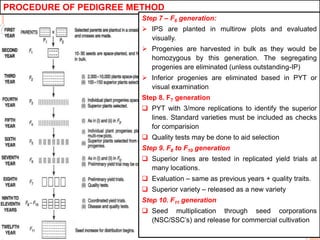
Step 4 – F3 generation:
 IPS with desirable characters from superior
progenies are selected & space planted .
 Exceptional outstanding plants from inferior
progenies can also be selected.
Step 5. F4 generation
 IPS are space planted and undesirable
progenies are rejected.
 The emphasis is on selection of desirable
plants from superior progenies.
Step 6. F5 generation
 IPS are generally planted as per commercial
seed rate. Usually 3/more rows are grown to
compare between progenies
 Many families – reasonably homozygous and
may be bulked
 If families show segregation – individual plants
are selected
 No. of progenies must be reduced to
manageable size for PYT (25-100 progenies)
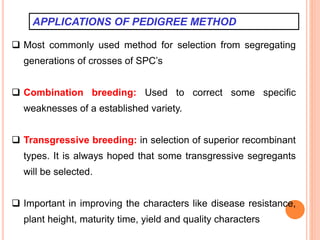
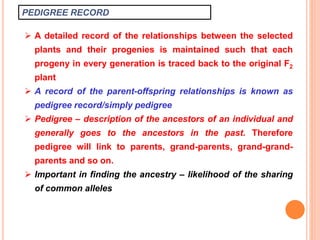
PROCEDURE OF PEDIGREE METHOD
Step 7 – F6 generation:
 IPS are planted in multirow plots and evaluated
visually.
 Progenies are harvested in bulk as they would be
homozygous by this generation. The segregating
progenies are eliminated (unless outstanding-IP)
 Inferior progenies are eliminated based in PYT or
visual examination
Step 8. F7 generation
 PYT with 3/more replications to identify the superior
lines. Standard varieties must be included as checks
for comparision
 Quality tests may be done to aid selection
Step 9. F8 to F10 generation
 Superior lines are tested in replicated yield trials at
many locations.
 Evaluation – same as previous years + quality traits.
 Superior variety – released as a new variety
Step 10. F11 generation
 Seed multiplication through seed corporations
(NSC/SSC’s) and release for commercial cultivation
APPLICATIONS OF PEDIGREE METHOD
 Most commonly used method for selection from segregating
generations of crosses of SPC’s
 Combination breeding: Used to correct some specific
weaknesses of a established variety.
 Transgressive breeding: in selection of superior recombinant
types. It is always hoped that some transgressive segregants
will be selected.
 Important in improving the characters like disease resistance,
plant height, maturity time, yield and quality characters
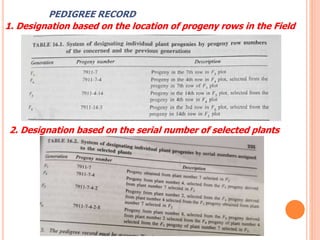
PEDIGREE RECORD
 A detailed record of the relationships between the selected
plants and their progenies is maintained such that each
progeny in every generation is traced back to the original F2
plant
 A record of the parent-offspring relationships is known as
pedigree record/simply pedigree
 Pedigree – description of the ancestors of an individual and
generally goes to the ancestors in the past. Therefore
pedigree will link to parents, grand-parents, grand-grand-
parents and so on.
 Important in finding the ancestry – likelihood of the sharing
of common alleles
PEDIGREE RECORD
1. Designation based on the location of progeny rows in the Field
2. Designation based on the serial number of selected plants
MERITS AND DEMERITS OF PEDIGREE METHOD
MERITS
1. Gives maximum opportunity for the breeder to use his skill and judgment
for selection of plants, particularly in early segregating generations.
2. Well suited for improvement of characters that are simply inherited and
easily identified.
3. Transgressive segregations for yield and other quantitative characters
may be recovered in addition to improvement of specific characters
4. It takes lesser time than bulk method to develop a new variety
5. The breeder may often be able to obtain information about the
inheritance of quantitative characters from the pedigree record
6. Plants and progenies with visible defects and weaknesses are eliminated
at an early stage of testing/programme, which saves resources and time
of the breeder
DEMERITS
1. Maintenance of accurate pedigree record takes valuable time. It
may sometimes be a limiting factor if the breeding programme is
relatively large.
2. Selection among and within the large number of progenies in
every generation is laborious and time consuming, can be a
limitation for number of crosses a breeder can handle.
3. The success of this method largely depends on the skill of the
breeder. There is no opportunity for natural selection to influence
the populations.
4. Selection for yield in F2 and F3 is ineffective. If care is not taken to
retain sufficient number of progenies, valuable genotypes may be
lost in early segregating generations
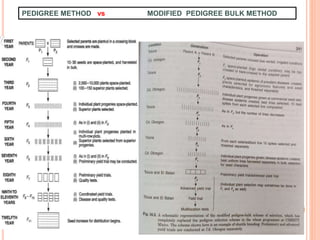
PEDIGREE METHOD vs MODIFIED PEDIGREE BULK METHOD
BREEDING SELF POLLINATED CROPS: Selection
methods for the development of pure breeding
cultivars from crosses
2.BULK METHOD/ BULK POPULATION METHOD
INTRODUCTION
 Bulk method of breeding was first used by Nilsson-Ehle (1908)
 Also known as population method of breeding.
 F2 and subsequent generations are harvested in mass/bulk to
raise the next generation.
 At the end of bulking period individual plants are selected and
evaluated in a manner as in the pedigree method.
 The duration of bulking may vary from 6-7 generations to 30 or
more generations during artificial selection may or may not be
practiced.
 Bulk method is suitable for handling segregating
generations of cereals, smaller millets, grain legumes
and oilseeds.
 BM may be used for three different purposes
1. Isolation of homozygous lines
2. Waiting for the opportunity for selection
3. To provide opportunity for natural selection to
change the composition of the populations
APPLICATIONS OF BULK METHOD
1. ISOLATION OF HOMOZYGOUS LINES
 Most common use of bulk method with minimum
effort and expense
 Population is bulked upto F6 or F7 – individual plants
are selected and evaluated as in case of pedigree
method/PL selection from these homozygous
populations. All plants are expected to be homozygous
and homogenous
 PYT is done for the selection of individual plants
2. WAITING FOR THE OPPORTUNITY FOR SELECTION
 Selection for resistance to diseases, lodging, cold etc
depends upon the presence of suitable environment
favoring such conditions.
 The segregating generations may be carried in bulk
until such environment occurs. IPS are then made and
handled as in Pedigree method.
 Duration of bulking depends on the occurrence of
environment - F2 or F6 or many years.
 This method is generally known as Pedigree method of
Harlan.
3. OPPORTUNITY FOR NATURAL SELECTION
 Maintenance of bulks is inexpensive & may be carried upto F20 or
F30 so that natural selection acts on their composition.
 F7 onwards natural selection will act on homozygous plants and
change the frequency of homozygous plants. Generally assumed
that natural selection will favour fit genotypes and eliminate poor
types. Therefore also termed as Evolutionary method of Breeding
by Suneson.
 From a population maintained by bulk method for longer duration,
superior lines may be expected at higher frequency.
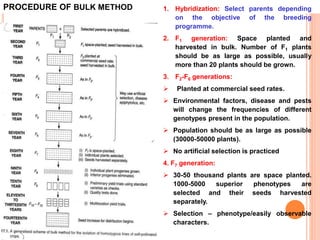
PROCEDURE OF BULK METHOD 1. Hybridization: Select parents depending
on the objective of the breeding
programme.
2. F1 generation: Space planted and
harvested in bulk. Number of F1 plants
should be as large as possible, usually
more than 20 plants should be grown.
3. F2-F6 generations:
 Planted at commercial seed rates.
 Environmental factors, disease and pests
will change the frequencies of different
genotypes present in the population.
 Population should be as large as possible
(30000-50000 plants).
 No artificial selection is practiced
4. F7 generation:
 30-50 thousand plants are space planted.
1000-5000 superior phenotypes are
selected and their seeds harvested
separately.
 Selection – phenotype/easily observable
characters.
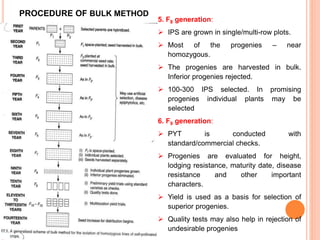
PROCEDURE OF BULK METHOD
5. F8 generation:
 IPS are grown in single/multi-row plots.
 Most of the progenies – near
homozygous.
 The progenies are harvested in bulk.
Inferior progenies rejected.
 100-300 IPS selected. In promising
progenies individual plants may be
selected
6. F9 generation:
 PYT is conducted with
standard/commercial checks.
 Progenies are evaluated for height,
lodging resistance, maturity date, disease
resistance and other important
characters.
 Yield is used as a basis for selection of
superior progenies.
 Quality tests may also help in rejection of
undesirable progenies
PROCEDURE OF BULK METHOD
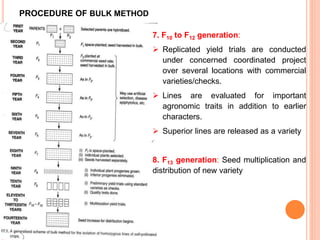
7. F10 to F12 generation:
 Replicated yield trials are conducted
under concerned coordinated project
over several locations with commercial
varieties/checks.
 Lines are evaluated for important
agronomic traits in addition to earlier
characters.
 Superior lines are released as a variety
8. F13 generation: Seed multiplication and
distribution of new variety
MERITS AND DEMERITS OF BULK METHOD
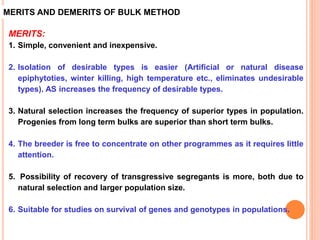
MERITS:
1. Simple, convenient and inexpensive.
2. Isolation of desirable types is easier (Artificial or natural disease
epiphytoties, winter killing, high temperature etc., eliminates undesirable
types). AS increases the frequency of desirable types.
3. Natural selection increases the frequency of superior types in population.
Progenies from long term bulks are superior than short term bulks.
4. The breeder is free to concentrate on other programmes as it requires little
attention.
5. Possibility of recovery of transgressive segregants is more, both due to
natural selection and larger population size.
6. Suitable for studies on survival of genes and genotypes in populations.
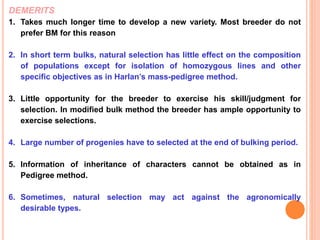
DEMERITS
1. Takes much longer time to develop a new variety. Most breeder do not
prefer BM for this reason
2. In short term bulks, natural selection has little effect on the composition
of populations except for isolation of homozygous lines and other
specific objectives as in Harlan’s mass-pedigree method.
3. Little opportunity for the breeder to exercise his skill/judgment for
selection. In modified bulk method the breeder has ample opportunity to
exercise selections.
4. Large number of progenies have to selected at the end of bulking period.
5. Information of inheritance of characters cannot be obtained as in
Pedigree method.
6. Sometimes, natural selection may act against the agronomically
desirable types.
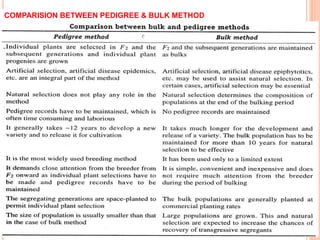
COMPARISION BETWEEN PEDIGREE & BULK METHOD
BREEDING SELF POLLINATED CROPS:
Selection methods for the development of pure
breeding cultivars from crosses
3. SINGLE SEED DESCENT METHOD
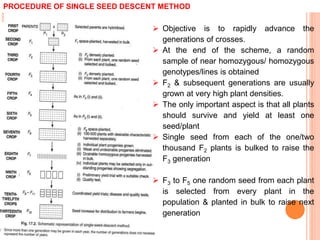
PROCEDURE OF SINGLE SEED DESCENT METHOD
 Objective is to rapidly advance the
generations of crosses.
 At the end of the scheme, a random
sample of near homozygous/ homozygous
genotypes/lines is obtained
 F2 & subsequent generations are usually
grown at very high plant densities.
 The only important aspect is that all plants
should survive and yield at least one
seed/plant
 Single seed from each of the one/two
thousand F2 plants is bulked to raise the
F3 generation
 F3 to F5 one random seed from each plant
is selected from every plant in the
population & planted in bulk to raise next
generation
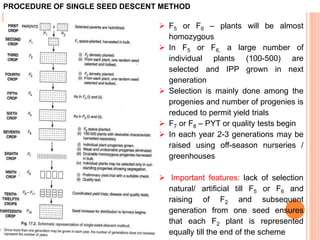
PROCEDURE OF SINGLE SEED DESCENT METHOD
 F5 or F6 – plants will be almost
homozygous
 In F5 or F6, a large number of
individual plants (100-500) are
selected and IPP grown in next
generation
 Selection is mainly done among the
progenies and number of progenies is
reduced to permit yield trials
 F7 or F8 – PYT or quality tests begin
 In each year 2-3 generations may be
raised using off-season nurseries /
greenhouses
 Important features: lack of selection
natural/ artificial till F5 or F6 and
raising of F2 and subsequent
generation from one seed ensures
that each F2 plant is represented
equally till the end of the scheme
MERITS AND DEMERITS OF SSD METHOD
MERITS:
1. Advances the generation with maximum possible speed in a
conventional breeding method.
2. Requires little space, effort and labour.
3. Makes the best use of greenhouse and off-season nursery facilities.
4. Ensures that plants retained in the end represent a random sample
of homozygous genotypes derived from F2 population.
5. Maintenance of unbiased broad germplasm base.
6. Easy way to maintain the populations-no record keeping /extensive
field trials.
DEMERITS
1. Does not permit any form of selection during the segregating
generations.
2. Population size becomes progressively smaller due to poor
germination and death of plants due to diseases, insect pests etc.
3. In some crops the plant loss may seriously hinder the scheme (eg:
pulses)
4. Maximum productivity is established in F2 generations.
5. No recombination among selected lines.
4. Must evaluate large numbers of inbred lines to identify superior ones.
5. Little opportunity for early generation selection, as inbreeding may be
done in greenhouse or winter nursery.

Pedigree and bulk SSD

  • 1.
    Dr. NAVEENKUMAR K.L AssistantProfessor Dept. Of Genetics and Plant Breeding UAHS Shivamogga Selection methods for the development of pure lines from crosses/segregating generations
  • 2.
     Mass selection(MS) and Pure line (PL) selection are applied to genetically variable and homozygous populations of SPC’s. But these methods cannot be applied to segregating populations obtained from crosses.  Crosses between varieties, germplasm introduction and breeding lines are made to create new gene combinations.  In the generations to follow, superior genotypes (presumably having superior genes and gene combinations) are selected and fixed in the homozygous state by means of self fertilization and selection.  The selection methods generally applied to such situations are  Pedigree method  Bulk method  Backcross method INTRODUCTON
  • 3.
    PEDIGREE METHOD  InPedigree method individual plants are selected from F2 and subsequent segregating generations and their offspring's are tested.  During the process of entire selection a record of all parent- offspring relations is kept – called as Pedigree record.  Individual plant selection (IPS) is continued till the progenies become almost (F6) homozygous/show no segregation.  Selection is done between progenies as there will be no genetic variation within the progenies.
  • 4.
    PROCEDURE OF PEDIGREEMETHOD Step 1. Hybridization: The selected parents are crossed (simple/ complex cross) to obtain the F1 seed. Step 2. Raising the F1 generation F1 seeds are space planted so that each F1 produces a maximum number of F2 seed. Usually 10-30 F1 plants should produce sufficient F2 population. Step 3. Selection in segregating generations 1. 2000-10000 plants are space planted to facilitate selection. 2. 100-500 plants are selected and seeds harvested separately F2 population is usually 10-100 times the F2 plants that are to be selected F3 progenies may vary between 100-500 depending on the objectives of the breeding programme & facilities with the breeder
  • 5.
    Step 4 –F3 generation:  IPS with desirable characters from superior progenies are selected & space planted .  Exceptional outstanding plants from inferior progenies can also be selected. Step 5. F4 generation  IPS are space planted and undesirable progenies are rejected.  The emphasis is on selection of desirable plants from superior progenies. Step 6. F5 generation  IPS are generally planted as per commercial seed rate. Usually 3/more rows are grown to compare between progenies  Many families – reasonably homozygous and may be bulked  If families show segregation – individual plants are selected  No. of progenies must be reduced to manageable size for PYT (25-100 progenies)
  • 6.
    PROCEDURE OF PEDIGREEMETHOD Step 7 – F6 generation:  IPS are planted in multirow plots and evaluated visually.  Progenies are harvested in bulk as they would be homozygous by this generation. The segregating progenies are eliminated (unless outstanding-IP)  Inferior progenies are eliminated based in PYT or visual examination Step 8. F7 generation  PYT with 3/more replications to identify the superior lines. Standard varieties must be included as checks for comparision  Quality tests may be done to aid selection Step 9. F8 to F10 generation  Superior lines are tested in replicated yield trials at many locations.  Evaluation – same as previous years + quality traits.  Superior variety – released as a new variety Step 10. F11 generation  Seed multiplication through seed corporations (NSC/SSC’s) and release for commercial cultivation
  • 7.
    APPLICATIONS OF PEDIGREEMETHOD  Most commonly used method for selection from segregating generations of crosses of SPC’s  Combination breeding: Used to correct some specific weaknesses of a established variety.  Transgressive breeding: in selection of superior recombinant types. It is always hoped that some transgressive segregants will be selected.  Important in improving the characters like disease resistance, plant height, maturity time, yield and quality characters
  • 8.
    PEDIGREE RECORD  Adetailed record of the relationships between the selected plants and their progenies is maintained such that each progeny in every generation is traced back to the original F2 plant  A record of the parent-offspring relationships is known as pedigree record/simply pedigree  Pedigree – description of the ancestors of an individual and generally goes to the ancestors in the past. Therefore pedigree will link to parents, grand-parents, grand-grand- parents and so on.  Important in finding the ancestry – likelihood of the sharing of common alleles
  • 9.
    PEDIGREE RECORD 1. Designationbased on the location of progeny rows in the Field 2. Designation based on the serial number of selected plants
  • 10.
    MERITS AND DEMERITSOF PEDIGREE METHOD MERITS 1. Gives maximum opportunity for the breeder to use his skill and judgment for selection of plants, particularly in early segregating generations. 2. Well suited for improvement of characters that are simply inherited and easily identified. 3. Transgressive segregations for yield and other quantitative characters may be recovered in addition to improvement of specific characters 4. It takes lesser time than bulk method to develop a new variety 5. The breeder may often be able to obtain information about the inheritance of quantitative characters from the pedigree record 6. Plants and progenies with visible defects and weaknesses are eliminated at an early stage of testing/programme, which saves resources and time of the breeder
  • 11.
    DEMERITS 1. Maintenance ofaccurate pedigree record takes valuable time. It may sometimes be a limiting factor if the breeding programme is relatively large. 2. Selection among and within the large number of progenies in every generation is laborious and time consuming, can be a limitation for number of crosses a breeder can handle. 3. The success of this method largely depends on the skill of the breeder. There is no opportunity for natural selection to influence the populations. 4. Selection for yield in F2 and F3 is ineffective. If care is not taken to retain sufficient number of progenies, valuable genotypes may be lost in early segregating generations
  • 12.
    PEDIGREE METHOD vsMODIFIED PEDIGREE BULK METHOD
  • 13.
    BREEDING SELF POLLINATEDCROPS: Selection methods for the development of pure breeding cultivars from crosses 2.BULK METHOD/ BULK POPULATION METHOD
  • 14.
    INTRODUCTION  Bulk methodof breeding was first used by Nilsson-Ehle (1908)  Also known as population method of breeding.  F2 and subsequent generations are harvested in mass/bulk to raise the next generation.  At the end of bulking period individual plants are selected and evaluated in a manner as in the pedigree method.  The duration of bulking may vary from 6-7 generations to 30 or more generations during artificial selection may or may not be practiced.
  • 15.
     Bulk methodis suitable for handling segregating generations of cereals, smaller millets, grain legumes and oilseeds.  BM may be used for three different purposes 1. Isolation of homozygous lines 2. Waiting for the opportunity for selection 3. To provide opportunity for natural selection to change the composition of the populations APPLICATIONS OF BULK METHOD
  • 16.
    1. ISOLATION OFHOMOZYGOUS LINES  Most common use of bulk method with minimum effort and expense  Population is bulked upto F6 or F7 – individual plants are selected and evaluated as in case of pedigree method/PL selection from these homozygous populations. All plants are expected to be homozygous and homogenous  PYT is done for the selection of individual plants
  • 17.
    2. WAITING FORTHE OPPORTUNITY FOR SELECTION  Selection for resistance to diseases, lodging, cold etc depends upon the presence of suitable environment favoring such conditions.  The segregating generations may be carried in bulk until such environment occurs. IPS are then made and handled as in Pedigree method.  Duration of bulking depends on the occurrence of environment - F2 or F6 or many years.  This method is generally known as Pedigree method of Harlan.
  • 18.
    3. OPPORTUNITY FORNATURAL SELECTION  Maintenance of bulks is inexpensive & may be carried upto F20 or F30 so that natural selection acts on their composition.  F7 onwards natural selection will act on homozygous plants and change the frequency of homozygous plants. Generally assumed that natural selection will favour fit genotypes and eliminate poor types. Therefore also termed as Evolutionary method of Breeding by Suneson.  From a population maintained by bulk method for longer duration, superior lines may be expected at higher frequency.
  • 19.
    PROCEDURE OF BULKMETHOD 1. Hybridization: Select parents depending on the objective of the breeding programme. 2. F1 generation: Space planted and harvested in bulk. Number of F1 plants should be as large as possible, usually more than 20 plants should be grown. 3. F2-F6 generations:  Planted at commercial seed rates.  Environmental factors, disease and pests will change the frequencies of different genotypes present in the population.  Population should be as large as possible (30000-50000 plants).  No artificial selection is practiced 4. F7 generation:  30-50 thousand plants are space planted. 1000-5000 superior phenotypes are selected and their seeds harvested separately.  Selection – phenotype/easily observable characters.
  • 20.
    PROCEDURE OF BULKMETHOD 5. F8 generation:  IPS are grown in single/multi-row plots.  Most of the progenies – near homozygous.  The progenies are harvested in bulk. Inferior progenies rejected.  100-300 IPS selected. In promising progenies individual plants may be selected 6. F9 generation:  PYT is conducted with standard/commercial checks.  Progenies are evaluated for height, lodging resistance, maturity date, disease resistance and other important characters.  Yield is used as a basis for selection of superior progenies.  Quality tests may also help in rejection of undesirable progenies
  • 21.
    PROCEDURE OF BULKMETHOD 7. F10 to F12 generation:  Replicated yield trials are conducted under concerned coordinated project over several locations with commercial varieties/checks.  Lines are evaluated for important agronomic traits in addition to earlier characters.  Superior lines are released as a variety 8. F13 generation: Seed multiplication and distribution of new variety
  • 22.
    MERITS AND DEMERITSOF BULK METHOD MERITS: 1. Simple, convenient and inexpensive. 2. Isolation of desirable types is easier (Artificial or natural disease epiphytoties, winter killing, high temperature etc., eliminates undesirable types). AS increases the frequency of desirable types. 3. Natural selection increases the frequency of superior types in population. Progenies from long term bulks are superior than short term bulks. 4. The breeder is free to concentrate on other programmes as it requires little attention. 5. Possibility of recovery of transgressive segregants is more, both due to natural selection and larger population size. 6. Suitable for studies on survival of genes and genotypes in populations.
  • 23.
    DEMERITS 1. Takes muchlonger time to develop a new variety. Most breeder do not prefer BM for this reason 2. In short term bulks, natural selection has little effect on the composition of populations except for isolation of homozygous lines and other specific objectives as in Harlan’s mass-pedigree method. 3. Little opportunity for the breeder to exercise his skill/judgment for selection. In modified bulk method the breeder has ample opportunity to exercise selections. 4. Large number of progenies have to selected at the end of bulking period. 5. Information of inheritance of characters cannot be obtained as in Pedigree method. 6. Sometimes, natural selection may act against the agronomically desirable types.
  • 24.
  • 25.
    BREEDING SELF POLLINATEDCROPS: Selection methods for the development of pure breeding cultivars from crosses 3. SINGLE SEED DESCENT METHOD
  • 26.
    PROCEDURE OF SINGLESEED DESCENT METHOD  Objective is to rapidly advance the generations of crosses.  At the end of the scheme, a random sample of near homozygous/ homozygous genotypes/lines is obtained  F2 & subsequent generations are usually grown at very high plant densities.  The only important aspect is that all plants should survive and yield at least one seed/plant  Single seed from each of the one/two thousand F2 plants is bulked to raise the F3 generation  F3 to F5 one random seed from each plant is selected from every plant in the population & planted in bulk to raise next generation
  • 27.
    PROCEDURE OF SINGLESEED DESCENT METHOD  F5 or F6 – plants will be almost homozygous  In F5 or F6, a large number of individual plants (100-500) are selected and IPP grown in next generation  Selection is mainly done among the progenies and number of progenies is reduced to permit yield trials  F7 or F8 – PYT or quality tests begin  In each year 2-3 generations may be raised using off-season nurseries / greenhouses  Important features: lack of selection natural/ artificial till F5 or F6 and raising of F2 and subsequent generation from one seed ensures that each F2 plant is represented equally till the end of the scheme
  • 28.
    MERITS AND DEMERITSOF SSD METHOD MERITS: 1. Advances the generation with maximum possible speed in a conventional breeding method. 2. Requires little space, effort and labour. 3. Makes the best use of greenhouse and off-season nursery facilities. 4. Ensures that plants retained in the end represent a random sample of homozygous genotypes derived from F2 population. 5. Maintenance of unbiased broad germplasm base. 6. Easy way to maintain the populations-no record keeping /extensive field trials.
  • 29.
    DEMERITS 1. Does notpermit any form of selection during the segregating generations. 2. Population size becomes progressively smaller due to poor germination and death of plants due to diseases, insect pests etc. 3. In some crops the plant loss may seriously hinder the scheme (eg: pulses) 4. Maximum productivity is established in F2 generations. 5. No recombination among selected lines. 4. Must evaluate large numbers of inbred lines to identify superior ones. 5. Little opportunity for early generation selection, as inbreeding may be done in greenhouse or winter nursery.