Lecture 22
RECURRENT SELECTION- PRINCIPLES,
TYPES, MERITS AND DEMERITS
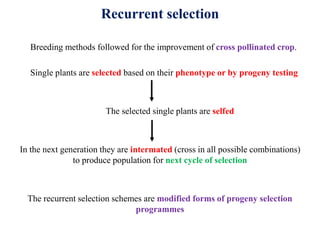
Recurrent selection
Breeding methods followed for the improvement of cross pollinated crop.
Single plants are selected based on their phenotype or by progeny testing
The selected single plants are selfed
In the next generation they are intermated (cross in all possible combinations)
to produce population for next cycle of selection
The recurrent selection schemes are modified forms of progeny selection
programmes
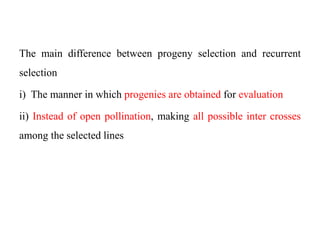
The main difference between progeny selection and recurrent
selection
i) The manner in which progenies are obtained for evaluation
ii) Instead of open pollination, making all possible inter crosses
among the selected lines
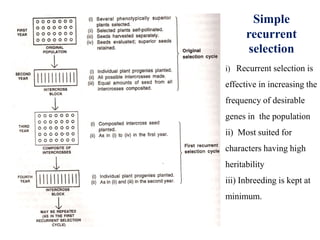
Simple
recurrent
selection
i) Recurrent selection is
effective in increasing the
frequency of desirable
genes in the population
ii) Most suited for
characters having high
heritability
iii) Inbreeding is kept at
minimum.
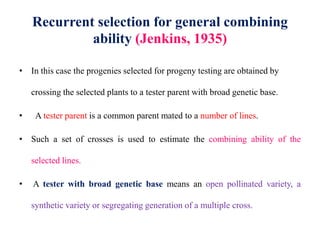
Recurrent selection for general combining
ability (Jenkins, 1935)
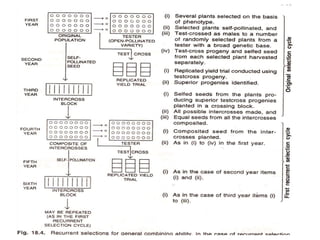
• In this case the progenies selected for progeny testing are obtained by
crossing the selected plants to a tester parent with broad genetic base.
• A tester parent is a common parent mated to a number of lines.
• Such a set of crosses is used to estimate the combining ability of the
selected lines.
• A tester with broad genetic base means an open pollinated variety, a
synthetic variety or segregating generation of a multiple cross.
Recurrent selection for GCA can be used for two basically
different purposes.
1. It may be used to improve the yielding ability and the
agronomic characteristics of a population.
2. In this case the end product will be a synthetic variety.
3. It may be used to concentrate genes for superior GCA.
4. Here the end product will be superior inbreds.
5. Such inbreds can be developed after a few cycles of RSGCA
Recurrent Selection for Specific Combining
Ability (Hull, 1945)
• This is similar to RSGCA except, that in the case of Tester.
• Here the tester will be an INBRED instead of open pollinated
variety.
• The other operations are similar to RSGCA.
• The objective of RSSCA is to isolate from population such
lines that will combine well with an inbred.
• These lines are expected to give best hybrids in heterosis
breeding.
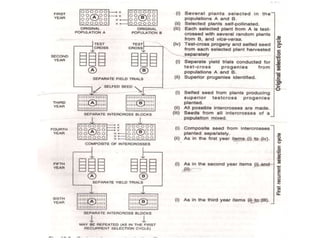
Reciprocal Recurrent selection
• Proposed by Comstock, Robinson and Harvey.
• The objective is to improve two different populations in their
ability to combine well with each other.
• In this method we can make selection for both GCA and SCA.
• Basically two populations A and B are used.
• Each serves as tester for the other.
Use of RRS
• Two populations are developed by this method
• They may be intermated to produce a superior population with
broad genetic base.
• This is similar to a varietal cross but in this case the
populations have been subjected to selection for combining
ability (GCA and SCA)
• Inbreds may be developed from populations A and B.
• These inbreds may be crossed to produce a single cross or
double cross hybrids.
Comparison among different recurrent selection
schemes
• When dominance is incomplete, RRS and RSGCA would be comparable in
their effectiveness and both will be superior to RSSCA
• When dominance is complete, RRS, RSGCA, RSSCA are equally effective
• Incase of overdominance, RRS and RSSCA would be comparable in their
effectiveness and both will be superior to RSGCA
• The above holds good, if there is no epistasis, absence of multiple alleles,
and linkage disequilibrium. In such cases, RRS is superior
• Practically RRS is the best
HETEROSIS
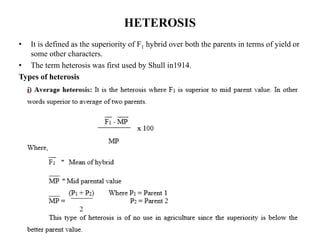
• It is defined as the superiority of F1 hybrid over both the parents in terms of yield or
some other characters.
• The term heterosis was first used by Shull in1914.
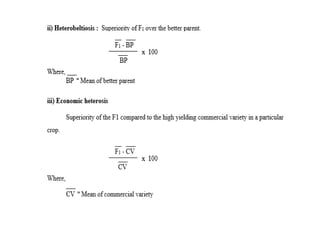
Types of heterosis
Heterosis or hybrid vigour
 Hybrid vigour is used as synonym of heterosis.
 In other words hybrid vigour is manifested effect of heterosis.
 Thus the term hybrid vigour is used to distinguish the F1 superiority from
negative heterosis.
Manifestation of heterosis
• Increased yield.
• Increased reproductive ability.
• Increase in size and vigour.
• Better quality
• Greater adaptability
Genetic basis of heterosis
1. Dominance hypothesis
2. Over dominance hypothesis.
Dominance hypothesis
 First proposed by Davenport in 1908.
 It was later on expanded by Bruce, Keeble and Pellow.
 According to this hypothesis at each locus the dominant allele has
favourable effect, while the recessive allele has unfavourable effect.
 In heterozygous state, the deleterious effect of recessive alleles are
masked by their dominant alleles.
 Inbreeding depression is produced by the harmful effects of recessive
alleles, which become homozygous due to inbreeding.
Objections
a) Failure of isolation of inbreds as vigorous as hybrids
 According to dominance hypothesis it is possible to isolate inbreds with all
the dominant genes E.g. AA.
 This inbreed should be as vigourous as that of hybrid. However in practice
such inbreds were not isolated.
b) Symmetrical distribution in F2
 In F2 dominant and recessive characters segregate in the ratio of 3: 1.
 Quantitative characters, according to dominance hypothesis should not
show symmetrical distribution.
 However, F2 nearly always show symmetrical distribution.
Explanation for the two objections
 In 1917 Jones suggested that since quantitative characters are governed by many
genes, they are likely to show linkage.
 In such a case, inbreds containing all dominant genes cannot be isolated. So
also the symmetrical distribution in F2 is due to linkage.
 This explanation is often known as Dominance of Linked Genes Hypothesis.
 The second objection was removed by Collins (1921). According to him trait like
yield is governed by large number of polygenes, which exhibit continuous variation
resulting in symmetrical distribution of genes.
Over dominance hypothesis
 This hypothesis was independently proposed by East and Shull in 1908.
 It is also known as single gene heterosis or super dominance theory.
 According to this hypothesis, heterozygotes at atleast some of the loci are superior
to both the homozygotes.
 Thus heterozygote Aa would be superior to AA and aa.
 In 1936 East proposed that at each locus there are several alleles at a1, a2 a3 & a4
etc, with increasingly different functions.
 Heterozygotes between more divergent alleles would be more heterotic E.g. a1a4
will be superior to a1a2 or a2 a4
Evidences for over dominance
 In maize the maturity genes in heterozygous conditions are
superior i.e. Ma ma.
 The heterozygote Mama is more vigorous than MaMa or mama
 The human beings sickle cell anaemia is caused by ss which is
lethal.
 But heterozygote individuals having Ss have advantage of
having resistance against malaria compared to SS
individuals.
INBREEDING DEPRESSION
• Cross pollinated species and species reproducing asexually are
highly heterozygous. When these species are subjected to
selfing or inbreeding they show severe reduction in vigour and
fertility. This phenomenon is known as inbreeding depression
Effects of inbreeding
• Appearance of lethal and sub lethal alleles:
• Chlorophyll deficiency, rootless seedlings and other malformations.
• Reduction in vigour : Appearance of dwarf plants.
• Reduction in reproductive ability - Less seed set, sterility
• Segregation of population in distinct lines.
• Increase in homozygosity
• Reduction in yield.
Degrees of inbreeding depression
• High inbreeding depression: E.g. Lucerne, Carrot. Inbreeding leads to severe
depression and exhibit lethal effects. After 3 or 4 generations of selfing, it is hard to
maintain lines.
• Moderate inbreeding depression: Eg. Maize, Jowar, Bajra. Though lethal effects
are there, lines can be separated and maintained.
• Low inbreeding depression: Eg. Cucurbits, Sunflower. Only a small
degree of inbreeding depression is observed.
• No inbreeding depression: The self-pollinated crops do not show inbreeding
depression.
HYBRIDS
• They are the first generation from crosses between two pure lines, inbreds, open
pollinated varieties of other populations that are genetically not similar.
• Pure line hybrids: Tomato.
• Inbred hybrids: Maize, bajra.
Kinds of hybrids
• Single cross hybrids
AxB
Crossing two inbreeds or pure lines.
• Three way cross hybrid
(A x B) x C
A cross between a single cross hybrid and an inbred.
• Double cross hybrid
(A x B) x (C x D)
cross between two Fls.
• Double Top Cross hybrid
Double Cross hybrid crossed with open pollinated variety.
Operation in production of hybrids
• In production of hybrids inbreds are preferred rather than open pollinated varieties
for the following reasons.
1. Inbreds can be maintained without a change in the genotype. Whereas open
pollinated variety cannot be maintained pure. They may alter genotypically due to
natural selection etc.
2. The hybrids derived from inbreds will be uniform where as it may not be in case, of
open pollinated variety.
3. The inbreds are homogenous and their performance can be predicted where as open
pollinated variety are heterogenous and their prediction in performance cannot be
made.
Development of inbreds
• By inbreeding, selfing etc.
• Development of inbreds from haploids - rice,
sorghum, maize.
Evaluation of inbreds
a) Phenotypic evaluation: Based on phenotypic performance. Highly suitable for
characters with high heritability. .
b) Top cross test
• Top cross test provides a reliable estimate of GCA.
• The selected inbreds will be crossed to a tester parent with wide genetic base
i.e. open pollinated variety. The cross progenies will be evaluated in replicated
progeny rows. Based on results better inbreds can be selected.
c) Single cross evaluation
• The developed inbreds can be crossed and the single crosses can be estimated
in replicated trial.
• Out standing hybrids tested over years in different locations, then released.
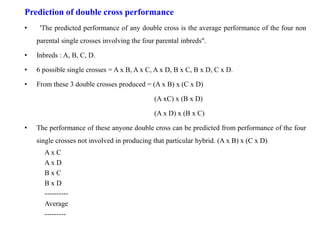
Prediction of double cross performance
• 'The predicted performance of any double cross is the average performance of the four non
parental single crosses involving the four parental inbreds".
• Inbreds : A, B, C, D.
• 6 possible single crosses = A x B, A x C, A x D, B x C, B x D, C x D.
• From these 3 double crosses produced = (A x B) x (C x D)
(A xC) x (B x D)
(A x D) x (B x C)
• The performance of these anyone double cross can be predicted from performance of the four
single crosses not involved in producing that particular hybrid. (A x B) x (C x D)
A x C
A x D
B x C
B x D
----------
Average
---------
PRODUCTION OF HYBRIDS
Methods
I. Hand emasculation and dusting - Cotton, Tomato, Chillies, Bhendi
2. Use of male sterile lines
a) Cytoplasmic male sterility - ornamentals
b) Genic male sterility - Redgram, Castor.
c) Cytoplasmic - genic male sterility Jowar, Bajra, Rice
3. Use of self in compatibility
• By planning cross compatible lines hybrids are produced. Here both are
hybrids.
• E.g. Brassicas.
Success of hybrids.
• Easy hand emasculation
• Abundant seed set to compensate cost of hand emasculation.
• Stable male sterile lines. .
• Effective restorers.
• Effective pollen dispersal.

Recurrent Selection.ppt

  • 1.
    Lecture 22 RECURRENT SELECTION-PRINCIPLES, TYPES, MERITS AND DEMERITS
  • 2.
    Recurrent selection Breeding methodsfollowed for the improvement of cross pollinated crop. Single plants are selected based on their phenotype or by progeny testing The selected single plants are selfed In the next generation they are intermated (cross in all possible combinations) to produce population for next cycle of selection The recurrent selection schemes are modified forms of progeny selection programmes
  • 3.
    The main differencebetween progeny selection and recurrent selection i) The manner in which progenies are obtained for evaluation ii) Instead of open pollination, making all possible inter crosses among the selected lines
  • 4.
    Simple recurrent selection i) Recurrent selectionis effective in increasing the frequency of desirable genes in the population ii) Most suited for characters having high heritability iii) Inbreeding is kept at minimum.
  • 5.
    Recurrent selection forgeneral combining ability (Jenkins, 1935) • In this case the progenies selected for progeny testing are obtained by crossing the selected plants to a tester parent with broad genetic base. • A tester parent is a common parent mated to a number of lines. • Such a set of crosses is used to estimate the combining ability of the selected lines. • A tester with broad genetic base means an open pollinated variety, a synthetic variety or segregating generation of a multiple cross.
  • 7.
    Recurrent selection forGCA can be used for two basically different purposes. 1. It may be used to improve the yielding ability and the agronomic characteristics of a population. 2. In this case the end product will be a synthetic variety. 3. It may be used to concentrate genes for superior GCA. 4. Here the end product will be superior inbreds. 5. Such inbreds can be developed after a few cycles of RSGCA
  • 8.
    Recurrent Selection forSpecific Combining Ability (Hull, 1945) • This is similar to RSGCA except, that in the case of Tester. • Here the tester will be an INBRED instead of open pollinated variety. • The other operations are similar to RSGCA. • The objective of RSSCA is to isolate from population such lines that will combine well with an inbred. • These lines are expected to give best hybrids in heterosis breeding.
  • 9.
    Reciprocal Recurrent selection •Proposed by Comstock, Robinson and Harvey. • The objective is to improve two different populations in their ability to combine well with each other. • In this method we can make selection for both GCA and SCA. • Basically two populations A and B are used. • Each serves as tester for the other.
  • 11.
    Use of RRS •Two populations are developed by this method • They may be intermated to produce a superior population with broad genetic base. • This is similar to a varietal cross but in this case the populations have been subjected to selection for combining ability (GCA and SCA) • Inbreds may be developed from populations A and B. • These inbreds may be crossed to produce a single cross or double cross hybrids.
  • 12.
    Comparison among differentrecurrent selection schemes • When dominance is incomplete, RRS and RSGCA would be comparable in their effectiveness and both will be superior to RSSCA • When dominance is complete, RRS, RSGCA, RSSCA are equally effective • Incase of overdominance, RRS and RSSCA would be comparable in their effectiveness and both will be superior to RSGCA • The above holds good, if there is no epistasis, absence of multiple alleles, and linkage disequilibrium. In such cases, RRS is superior • Practically RRS is the best
  • 13.
    HETEROSIS • It isdefined as the superiority of F1 hybrid over both the parents in terms of yield or some other characters. • The term heterosis was first used by Shull in1914. Types of heterosis
  • 15.
    Heterosis or hybridvigour  Hybrid vigour is used as synonym of heterosis.  In other words hybrid vigour is manifested effect of heterosis.  Thus the term hybrid vigour is used to distinguish the F1 superiority from negative heterosis.
  • 16.
    Manifestation of heterosis •Increased yield. • Increased reproductive ability. • Increase in size and vigour. • Better quality • Greater adaptability
  • 17.
    Genetic basis ofheterosis 1. Dominance hypothesis 2. Over dominance hypothesis.
  • 18.
    Dominance hypothesis  Firstproposed by Davenport in 1908.  It was later on expanded by Bruce, Keeble and Pellow.  According to this hypothesis at each locus the dominant allele has favourable effect, while the recessive allele has unfavourable effect.  In heterozygous state, the deleterious effect of recessive alleles are masked by their dominant alleles.  Inbreeding depression is produced by the harmful effects of recessive alleles, which become homozygous due to inbreeding.
  • 19.
    Objections a) Failure ofisolation of inbreds as vigorous as hybrids  According to dominance hypothesis it is possible to isolate inbreds with all the dominant genes E.g. AA.  This inbreed should be as vigourous as that of hybrid. However in practice such inbreds were not isolated. b) Symmetrical distribution in F2  In F2 dominant and recessive characters segregate in the ratio of 3: 1.  Quantitative characters, according to dominance hypothesis should not show symmetrical distribution.  However, F2 nearly always show symmetrical distribution.
  • 20.
    Explanation for thetwo objections  In 1917 Jones suggested that since quantitative characters are governed by many genes, they are likely to show linkage.  In such a case, inbreds containing all dominant genes cannot be isolated. So also the symmetrical distribution in F2 is due to linkage.  This explanation is often known as Dominance of Linked Genes Hypothesis.  The second objection was removed by Collins (1921). According to him trait like yield is governed by large number of polygenes, which exhibit continuous variation resulting in symmetrical distribution of genes.
  • 21.
    Over dominance hypothesis This hypothesis was independently proposed by East and Shull in 1908.  It is also known as single gene heterosis or super dominance theory.  According to this hypothesis, heterozygotes at atleast some of the loci are superior to both the homozygotes.  Thus heterozygote Aa would be superior to AA and aa.  In 1936 East proposed that at each locus there are several alleles at a1, a2 a3 & a4 etc, with increasingly different functions.  Heterozygotes between more divergent alleles would be more heterotic E.g. a1a4 will be superior to a1a2 or a2 a4
  • 22.
    Evidences for overdominance  In maize the maturity genes in heterozygous conditions are superior i.e. Ma ma.  The heterozygote Mama is more vigorous than MaMa or mama  The human beings sickle cell anaemia is caused by ss which is lethal.  But heterozygote individuals having Ss have advantage of having resistance against malaria compared to SS individuals.
  • 23.
    INBREEDING DEPRESSION • Crosspollinated species and species reproducing asexually are highly heterozygous. When these species are subjected to selfing or inbreeding they show severe reduction in vigour and fertility. This phenomenon is known as inbreeding depression
  • 24.
    Effects of inbreeding •Appearance of lethal and sub lethal alleles: • Chlorophyll deficiency, rootless seedlings and other malformations. • Reduction in vigour : Appearance of dwarf plants. • Reduction in reproductive ability - Less seed set, sterility • Segregation of population in distinct lines. • Increase in homozygosity • Reduction in yield.
  • 25.
    Degrees of inbreedingdepression • High inbreeding depression: E.g. Lucerne, Carrot. Inbreeding leads to severe depression and exhibit lethal effects. After 3 or 4 generations of selfing, it is hard to maintain lines. • Moderate inbreeding depression: Eg. Maize, Jowar, Bajra. Though lethal effects are there, lines can be separated and maintained. • Low inbreeding depression: Eg. Cucurbits, Sunflower. Only a small degree of inbreeding depression is observed. • No inbreeding depression: The self-pollinated crops do not show inbreeding depression.
  • 26.
    HYBRIDS • They arethe first generation from crosses between two pure lines, inbreds, open pollinated varieties of other populations that are genetically not similar. • Pure line hybrids: Tomato. • Inbred hybrids: Maize, bajra.
  • 27.
    Kinds of hybrids •Single cross hybrids AxB Crossing two inbreeds or pure lines. • Three way cross hybrid (A x B) x C A cross between a single cross hybrid and an inbred. • Double cross hybrid (A x B) x (C x D) cross between two Fls. • Double Top Cross hybrid Double Cross hybrid crossed with open pollinated variety.
  • 28.
    Operation in productionof hybrids • In production of hybrids inbreds are preferred rather than open pollinated varieties for the following reasons. 1. Inbreds can be maintained without a change in the genotype. Whereas open pollinated variety cannot be maintained pure. They may alter genotypically due to natural selection etc. 2. The hybrids derived from inbreds will be uniform where as it may not be in case, of open pollinated variety. 3. The inbreds are homogenous and their performance can be predicted where as open pollinated variety are heterogenous and their prediction in performance cannot be made.
  • 29.
    Development of inbreds •By inbreeding, selfing etc. • Development of inbreds from haploids - rice, sorghum, maize.
  • 30.
    Evaluation of inbreds a)Phenotypic evaluation: Based on phenotypic performance. Highly suitable for characters with high heritability. . b) Top cross test • Top cross test provides a reliable estimate of GCA. • The selected inbreds will be crossed to a tester parent with wide genetic base i.e. open pollinated variety. The cross progenies will be evaluated in replicated progeny rows. Based on results better inbreds can be selected. c) Single cross evaluation • The developed inbreds can be crossed and the single crosses can be estimated in replicated trial. • Out standing hybrids tested over years in different locations, then released.
  • 31.
    Prediction of doublecross performance • 'The predicted performance of any double cross is the average performance of the four non parental single crosses involving the four parental inbreds". • Inbreds : A, B, C, D. • 6 possible single crosses = A x B, A x C, A x D, B x C, B x D, C x D. • From these 3 double crosses produced = (A x B) x (C x D) (A xC) x (B x D) (A x D) x (B x C) • The performance of these anyone double cross can be predicted from performance of the four single crosses not involved in producing that particular hybrid. (A x B) x (C x D) A x C A x D B x C B x D ---------- Average ---------
  • 32.
    PRODUCTION OF HYBRIDS Methods I.Hand emasculation and dusting - Cotton, Tomato, Chillies, Bhendi 2. Use of male sterile lines a) Cytoplasmic male sterility - ornamentals b) Genic male sterility - Redgram, Castor. c) Cytoplasmic - genic male sterility Jowar, Bajra, Rice 3. Use of self in compatibility • By planning cross compatible lines hybrids are produced. Here both are hybrids. • E.g. Brassicas.
  • 33.
    Success of hybrids. •Easy hand emasculation • Abundant seed set to compensate cost of hand emasculation. • Stable male sterile lines. . • Effective restorers. • Effective pollen dispersal.