Prepared by,
Nirmal Raj
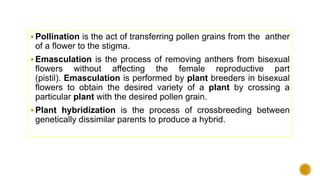
 Pollination is the act of transferring pollen grains from the anther
of a flower to the stigma.
 Emasculation is the process of removing anthers from bisexual
flowers without affecting the female reproductive part
(pistil). Emasculation is performed by plant breeders in bisexual
flowers to obtain the desired variety of a plant by crossing a
particular plant with the desired pollen grain.
 Plant hybridization is the process of crossbreeding between
genetically dissimilar parents to produce a hybrid.
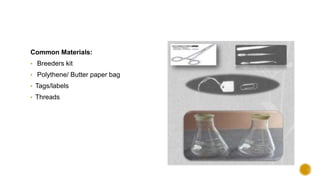
Common Materials:
• Breeders kit
• Polythene/ Butter paper bag
• Tags/labels
• Threads
 Selfing and crossing are the essential procedures in crop improvement process.
 The exact procedure that he may use to ensure self or cross pollination of specific
plants will depend on the particular species with which he is working. This depends on
the floral structure and mode of pollination.
 Effecting cross-pollination in a strictly self-pollinating species is more difficult than
effecting self pollination in a cross pollinated crop. For instance, preventing self-
pollination occurring inside the unopened flowers is cumbersome.
1. Hand Emasculation
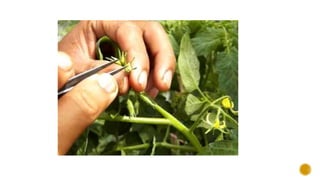
 In species with large flowers such as cotton, removal of anthers is possible with the
help of forceps. It is done before anther dehiscence.
 It is generally done between 4 and 6 p.m. on the previous day before anthers dehisce.
It is always desirable to remove other young flowers located close to the emasculated
flower to avoid confusion.
 The corolla of the selected flower is opened with the help of forceps and the anthers
are carefully removed with the help of forceps. In crops such as gingelly, which have
epipetalous stamens, the corolla may be totally removed along with epipetalous
stamens.
 In cereals, the top one third of the glumes will be clipped off with scissors to expose
anthers.
 In wheat and oats, the florets are retained after removing the anthers without
damaging the spikelets.
 An efficient emasculation technique should prevent self pollination and produce high
percentage of seed set on cross pollination.
2. Suction Method
 It is useful in species with small flowers. Emasculation is done in the morning
immediately after the flowers open.
 A thin rubber or a glass tube attached to a suction hose is used to suck the anthers
from the flowers. The amount of suction used is very important which should be
sufficient to suck the pollen and anthers but not gynoecium.
 In this method, considerable self-pollination, upto 10% is likely to occur. Washing the
stigma with a jet of water may help in reducing self-pollination; however self pollination
cannot be eliminated in this method.
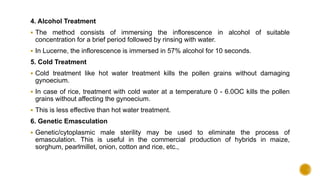
3. Hot Water Treatment
 Pollen grains are more sensitive than female reproductive organs to both genetic and
environmental factors.
 In case of hot water emasculation, the temperature of water and duration of treatment
vary from crop to crop.
 For sorghum, 42-48OC for 10 minutes is found to be suitable. In the case of rice, 10
minutes treatment with 40-44OC is adequate.
 Treatment is given before the anther dehiscence and prior to the opening of the flower.
4. Alcohol Treatment
 The method consists of immersing the inflorescence in alcohol of suitable
concentration for a brief period followed by rinsing with water.
 In Lucerne, the inflorescence is immersed in 57% alcohol for 10 seconds.
5. Cold Treatment
 Cold treatment like hot water treatment kills the pollen grains without damaging
gynoecium.
 In case of rice, treatment with cold water at a temperature 0 - 6.0OC kills the pollen
grains without affecting the gynoecium.
 This is less effective than hot water treatment.
6. Genetic Emasculation
 Genetic/cytoplasmic male sterility may be used to eliminate the process of
emasculation. This is useful in the commercial production of hybrids in maize,
sorghum, pearlmillet, onion, cotton and rice, etc.,
7. Use of male gametocide
 Male gametocides are also known as chemical hybridizing agents (CHA).
 They are chemicals which selectively kill the male gamete without affecting the female
gamete.
 e.g. Ethrel, Sodium methyl arsenate, Zinc methyl arsenate in rice, Maleic hydrazide for
cotton and wheat.
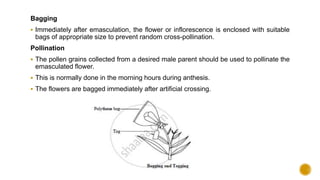
Bagging
 Immediately after emasculation, the flower or inflorescence is enclosed with suitable
bags of appropriate size to prevent random cross-pollination.
Pollination
 The pollen grains collected from a desired male parent should be used to pollinate the
emasculated flower.
 This is normally done in the morning hours during anthesis.
 The flowers are bagged immediately after artificial crossing.
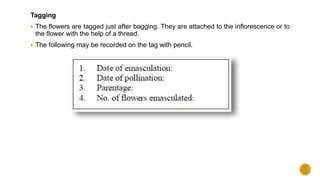
Tagging
 The flowers are tagged just after bagging. They are attached to the inflorescence or to
the flower with the help of a thread.
 The following may be recorded on the tag with pencil.
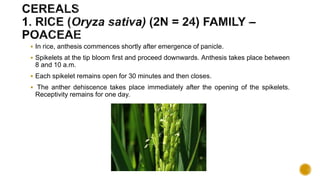
 In rice, anthesis commences shortly after emergence of panicle.
 Spikelets at the tip bloom first and proceed downwards. Anthesis takes place between
8 and 10 a.m.
 Each spikelet remains open for 30 minutes and then closes.
 The anther dehiscence takes place immediately after the opening of the spikelets.
Receptivity remains for one day.
SELFING TECHNIQUE
 Rice is a self- pollinated crop.
 An hour before blooming (7a.m.) butter paper bag is placed over the panicle to avoid
any contamination from foreign pollen and to ensure selfing.
 The bag may be removed after 2-3 days.
EMASCULATION AND CROSSING TECHNIQUES
 Emasculation is necessarily followed by controlled pollination.
 Emasculation is done during early morning between 6 and 8 a.m. in spikelets, due to
opening of the gynoecium on the same day.
 Emasculation should be over, well ahead of the time of anthesis.
 Crossing techniques in rice differ based on the method of emasculation. Since
maximum number of spikelets open on the 3rd or 4th day of anthesis, panicles of that
stage are selected for emasculation.
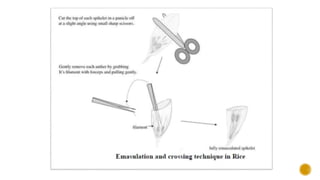
1) Clipping method
 On the previous day evening, top 1/3rd and bottom 1/3rd portions in the panicle of the
desired female parent are clipped off by using scissors leaving the middle spikelets.
 With the help of scissors again, top 1/3rd portion in each spikelet is clipped-off in a
slanting position.
 The six anthers present in each spikelet are removed with the help of the needle
(Emasculation).
 Then to prevent contamination from the foreign pollen, the emasculated spikelets are
covered with a butter paper bag.
 In the next day morning (usually at 9.00 a.m.), the bloomed panicle from the desired male
parent is taken.
 The top portion of the butter paper bag which was originally inserted in the emasculated
female parent is now cut to expose the panicle.
 The male parent panicle is inserted in an inverted position into the butter paper bag and
churned in both ways in order to disperse the pollen.
 After ensuring the abundant disbursement of pollen, the opened butter paper bag is
closed using a pin.
 Coloured thread may be tied at the base of the panicle to identify the crossed ones. After
ensuring pollination, the bag may be removed.
2) Hot water method
 Panicles in 3rd (or) 4th day of blooming are chosen as female parents.
 One hour before blooming i.e. normally at 7 a.m., the panicle is selected and
underdeveloped and opened spikelets are removed.
 Now, the tiller is bent over (carefully to avoid breaking) and the selected panicle is
immersed in hot water contained in a thermos bottle at 40-440C for a period of 5 to 10
minutes.
 This treatment causes the florets to open in a normal manner and avoids injury.
 Then, emasculation is done by removing the six stamens by fine forceps or needles
and then dusting should be done.
3) Dr. Ramiah method
 Panicles on the 3rd or 4th day of its blooming are selected; top and lower spikelets are
removed leaving only the middle.
 It is covered with a wet cloth and air is blown from mouth.
 This facilitates opening of spikelets.
 After 2-3 minutes, wet cloth is removed and spikelets are found to be open. Then, the
six anthers are removed.
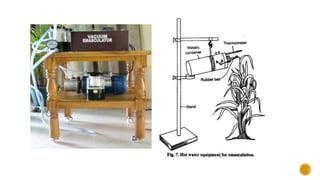
4) Vacuum emasculation method
 This works on the principle of suction pressure.
 The top 1/3rd portion of each selected spikelet is clipped off prior to operation.
 A minute pipette is to be shown at the point of clipping and pollen is sucked in. Six
panicles can be emasculated at a time.
 By hand emasculation, 100 flowers can be emasculated by a person.
 With the vacuum emasculator, six persons can operate and emasculate 3000 to 3600
florets/hour.
5) Cuttack Method
 This technique was developed at ICAR- National Rice Research Institute, Cuttack.
 The panicle to be emasculated is inserted into a hollow piece of bamboo closed at
one end and plugged with cotton wool and split cork at the other end.
 The flowers thus enclosed will open within 5-10 minutes and the anthers are removed
6) Brown paper method
 The panicles are enclosed in a brown paper cover before a couple of hours of
blooming.
 Heat develops inside due to which the anthers extrude, but do not dehisce.
 This happens in 15-30 minutes. Then the anthers are easily clipped off.
7) Rhind’s method
 In this method, hot water is kept in a flask for some time and then poured outside.
 After pouring out the water, the inner region of the flask will be warm and humid.
 The panicle to be emasculated will be inserted into the flask and kept for some time.
 Due to high temperature and humidity, the spikelets will open and the anthers get
exposed which can be removed with the help of forceps.
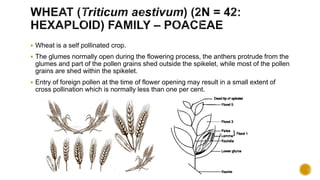
 Wheat is a self pollinated crop.
 The glumes normally open during the flowering process, the anthers protrude from the
glumes and part of the pollen grains shed outside the spikelet, while most of the pollen
grains are shed within the spikelet.
 Entry of foreign pollen at the time of flower opening may result in a small extent of
cross pollination which is normally less than one per cent.
SELFING
 The inflorescence is covered with a butter paper cover prior to anthesis and kept
undisturbed till the flower opening is completed.
EMASCULATION
 When the inflorescence (ear) emerges, upper 1/3rd of the spikelet is cut and lower
spikelets are also removed.
 Of the remaining spikelets, alternate ones on both sides of the axis are removed.
 The top spikelet is held with forceps and pulled downwards and upwards to remove
the upper florets of the spikelets.
 The glumes are separated and anthers left exposed are removed carefully and
covered with butter paper cover.
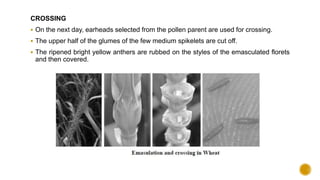
CROSSING
 On the next day, earheads selected from the pollen parent are used for crossing.
 The upper half of the glumes of the few medium spikelets are cut off.
 The ripened bright yellow anthers are rubbed on the styles of the emasculated florets
and then covered.
 Maize is predominantly a cross pollinated crop.
 Wind pollination (Anemophily) is the general rule. Pollination by insects also takes
place to certain extent.
 The following are the adaptations for cross pollination, i.e., Monoecious inflorescence,
unisexual flower, differences in the time of maturity of the male and female
inflorescences, silk is receptive on entire length and abundant pollen production.
 It exhibits protandry and the tassel anthesis extends for 2-14 days.
 Pollen viability remains for 24 hours.
 Anthesis of female spikelets starts after the completion of tassel opening and extends
up to 2-5 days.
 The stigma is receptive throughout its length for 14 days.
SELFING
 Bag the tassel before anthesis with a paper cover. Bagging of tassels should be done in the
previous day evening to avoid contamination from foreign pollen.
 Cut the tip of the cob before the silks emerges and cover with a paper cover.
 After 3-4 days, the silks will emerge in the form of a ‘shaving brush’ in which the silks will be of
the same height and stand erect.
 Remove the cover of the tassel containing pollen and insert it over the cob after removing the
cob-cover. The inserted cover is then tied.
CROSSING TECHNIQUE
Female parent
 Detasseling
 Cut the tip of the cob before the silks emerge and cover with a butter paper cover.
Male parent
 Cover the tassel before anthesis begins or as soon as the tassel emerges.
 When the silk emerges in the female parent in the form of a brush, pollination is done by
transferring the freshly shed pollen collected from the male parent in a cover and inserting it
over the cob of the female parent after removing the cover from the cob.
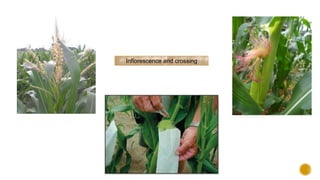
Inflorescence and crossing

Emasculation, crossing techniques in cereals (Rice, Wheat, Maize)

  • 1.
  • 2.
     Pollination isthe act of transferring pollen grains from the anther of a flower to the stigma.  Emasculation is the process of removing anthers from bisexual flowers without affecting the female reproductive part (pistil). Emasculation is performed by plant breeders in bisexual flowers to obtain the desired variety of a plant by crossing a particular plant with the desired pollen grain.  Plant hybridization is the process of crossbreeding between genetically dissimilar parents to produce a hybrid.
  • 3.
    Common Materials: • Breederskit • Polythene/ Butter paper bag • Tags/labels • Threads
  • 4.
     Selfing andcrossing are the essential procedures in crop improvement process.  The exact procedure that he may use to ensure self or cross pollination of specific plants will depend on the particular species with which he is working. This depends on the floral structure and mode of pollination.  Effecting cross-pollination in a strictly self-pollinating species is more difficult than effecting self pollination in a cross pollinated crop. For instance, preventing self- pollination occurring inside the unopened flowers is cumbersome.
  • 5.
    1. Hand Emasculation In species with large flowers such as cotton, removal of anthers is possible with the help of forceps. It is done before anther dehiscence.  It is generally done between 4 and 6 p.m. on the previous day before anthers dehisce. It is always desirable to remove other young flowers located close to the emasculated flower to avoid confusion.  The corolla of the selected flower is opened with the help of forceps and the anthers are carefully removed with the help of forceps. In crops such as gingelly, which have epipetalous stamens, the corolla may be totally removed along with epipetalous stamens.  In cereals, the top one third of the glumes will be clipped off with scissors to expose anthers.  In wheat and oats, the florets are retained after removing the anthers without damaging the spikelets.  An efficient emasculation technique should prevent self pollination and produce high percentage of seed set on cross pollination.
  • 7.
    2. Suction Method It is useful in species with small flowers. Emasculation is done in the morning immediately after the flowers open.  A thin rubber or a glass tube attached to a suction hose is used to suck the anthers from the flowers. The amount of suction used is very important which should be sufficient to suck the pollen and anthers but not gynoecium.  In this method, considerable self-pollination, upto 10% is likely to occur. Washing the stigma with a jet of water may help in reducing self-pollination; however self pollination cannot be eliminated in this method. 3. Hot Water Treatment  Pollen grains are more sensitive than female reproductive organs to both genetic and environmental factors.  In case of hot water emasculation, the temperature of water and duration of treatment vary from crop to crop.  For sorghum, 42-48OC for 10 minutes is found to be suitable. In the case of rice, 10 minutes treatment with 40-44OC is adequate.  Treatment is given before the anther dehiscence and prior to the opening of the flower.
  • 9.
    4. Alcohol Treatment The method consists of immersing the inflorescence in alcohol of suitable concentration for a brief period followed by rinsing with water.  In Lucerne, the inflorescence is immersed in 57% alcohol for 10 seconds. 5. Cold Treatment  Cold treatment like hot water treatment kills the pollen grains without damaging gynoecium.  In case of rice, treatment with cold water at a temperature 0 - 6.0OC kills the pollen grains without affecting the gynoecium.  This is less effective than hot water treatment. 6. Genetic Emasculation  Genetic/cytoplasmic male sterility may be used to eliminate the process of emasculation. This is useful in the commercial production of hybrids in maize, sorghum, pearlmillet, onion, cotton and rice, etc.,
  • 10.
    7. Use ofmale gametocide  Male gametocides are also known as chemical hybridizing agents (CHA).  They are chemicals which selectively kill the male gamete without affecting the female gamete.  e.g. Ethrel, Sodium methyl arsenate, Zinc methyl arsenate in rice, Maleic hydrazide for cotton and wheat.
  • 11.
    Bagging  Immediately afteremasculation, the flower or inflorescence is enclosed with suitable bags of appropriate size to prevent random cross-pollination. Pollination  The pollen grains collected from a desired male parent should be used to pollinate the emasculated flower.  This is normally done in the morning hours during anthesis.  The flowers are bagged immediately after artificial crossing.
  • 12.
    Tagging  The flowersare tagged just after bagging. They are attached to the inflorescence or to the flower with the help of a thread.  The following may be recorded on the tag with pencil.
  • 13.
     In rice,anthesis commences shortly after emergence of panicle.  Spikelets at the tip bloom first and proceed downwards. Anthesis takes place between 8 and 10 a.m.  Each spikelet remains open for 30 minutes and then closes.  The anther dehiscence takes place immediately after the opening of the spikelets. Receptivity remains for one day.
  • 14.
    SELFING TECHNIQUE  Riceis a self- pollinated crop.  An hour before blooming (7a.m.) butter paper bag is placed over the panicle to avoid any contamination from foreign pollen and to ensure selfing.  The bag may be removed after 2-3 days. EMASCULATION AND CROSSING TECHNIQUES  Emasculation is necessarily followed by controlled pollination.  Emasculation is done during early morning between 6 and 8 a.m. in spikelets, due to opening of the gynoecium on the same day.  Emasculation should be over, well ahead of the time of anthesis.  Crossing techniques in rice differ based on the method of emasculation. Since maximum number of spikelets open on the 3rd or 4th day of anthesis, panicles of that stage are selected for emasculation.
  • 15.
    1) Clipping method On the previous day evening, top 1/3rd and bottom 1/3rd portions in the panicle of the desired female parent are clipped off by using scissors leaving the middle spikelets.  With the help of scissors again, top 1/3rd portion in each spikelet is clipped-off in a slanting position.  The six anthers present in each spikelet are removed with the help of the needle (Emasculation).  Then to prevent contamination from the foreign pollen, the emasculated spikelets are covered with a butter paper bag.  In the next day morning (usually at 9.00 a.m.), the bloomed panicle from the desired male parent is taken.  The top portion of the butter paper bag which was originally inserted in the emasculated female parent is now cut to expose the panicle.  The male parent panicle is inserted in an inverted position into the butter paper bag and churned in both ways in order to disperse the pollen.  After ensuring the abundant disbursement of pollen, the opened butter paper bag is closed using a pin.  Coloured thread may be tied at the base of the panicle to identify the crossed ones. After ensuring pollination, the bag may be removed.
  • 17.
    2) Hot watermethod  Panicles in 3rd (or) 4th day of blooming are chosen as female parents.  One hour before blooming i.e. normally at 7 a.m., the panicle is selected and underdeveloped and opened spikelets are removed.  Now, the tiller is bent over (carefully to avoid breaking) and the selected panicle is immersed in hot water contained in a thermos bottle at 40-440C for a period of 5 to 10 minutes.  This treatment causes the florets to open in a normal manner and avoids injury.  Then, emasculation is done by removing the six stamens by fine forceps or needles and then dusting should be done. 3) Dr. Ramiah method  Panicles on the 3rd or 4th day of its blooming are selected; top and lower spikelets are removed leaving only the middle.  It is covered with a wet cloth and air is blown from mouth.  This facilitates opening of spikelets.  After 2-3 minutes, wet cloth is removed and spikelets are found to be open. Then, the six anthers are removed.
  • 18.
    4) Vacuum emasculationmethod  This works on the principle of suction pressure.  The top 1/3rd portion of each selected spikelet is clipped off prior to operation.  A minute pipette is to be shown at the point of clipping and pollen is sucked in. Six panicles can be emasculated at a time.  By hand emasculation, 100 flowers can be emasculated by a person.  With the vacuum emasculator, six persons can operate and emasculate 3000 to 3600 florets/hour. 5) Cuttack Method  This technique was developed at ICAR- National Rice Research Institute, Cuttack.  The panicle to be emasculated is inserted into a hollow piece of bamboo closed at one end and plugged with cotton wool and split cork at the other end.  The flowers thus enclosed will open within 5-10 minutes and the anthers are removed
  • 19.
    6) Brown papermethod  The panicles are enclosed in a brown paper cover before a couple of hours of blooming.  Heat develops inside due to which the anthers extrude, but do not dehisce.  This happens in 15-30 minutes. Then the anthers are easily clipped off. 7) Rhind’s method  In this method, hot water is kept in a flask for some time and then poured outside.  After pouring out the water, the inner region of the flask will be warm and humid.  The panicle to be emasculated will be inserted into the flask and kept for some time.  Due to high temperature and humidity, the spikelets will open and the anthers get exposed which can be removed with the help of forceps.
  • 20.
     Wheat isa self pollinated crop.  The glumes normally open during the flowering process, the anthers protrude from the glumes and part of the pollen grains shed outside the spikelet, while most of the pollen grains are shed within the spikelet.  Entry of foreign pollen at the time of flower opening may result in a small extent of cross pollination which is normally less than one per cent.
  • 21.
    SELFING  The inflorescenceis covered with a butter paper cover prior to anthesis and kept undisturbed till the flower opening is completed. EMASCULATION  When the inflorescence (ear) emerges, upper 1/3rd of the spikelet is cut and lower spikelets are also removed.  Of the remaining spikelets, alternate ones on both sides of the axis are removed.  The top spikelet is held with forceps and pulled downwards and upwards to remove the upper florets of the spikelets.  The glumes are separated and anthers left exposed are removed carefully and covered with butter paper cover.
  • 22.
    CROSSING  On thenext day, earheads selected from the pollen parent are used for crossing.  The upper half of the glumes of the few medium spikelets are cut off.  The ripened bright yellow anthers are rubbed on the styles of the emasculated florets and then covered.
  • 23.
     Maize ispredominantly a cross pollinated crop.  Wind pollination (Anemophily) is the general rule. Pollination by insects also takes place to certain extent.  The following are the adaptations for cross pollination, i.e., Monoecious inflorescence, unisexual flower, differences in the time of maturity of the male and female inflorescences, silk is receptive on entire length and abundant pollen production.  It exhibits protandry and the tassel anthesis extends for 2-14 days.  Pollen viability remains for 24 hours.  Anthesis of female spikelets starts after the completion of tassel opening and extends up to 2-5 days.  The stigma is receptive throughout its length for 14 days.
  • 24.
    SELFING  Bag thetassel before anthesis with a paper cover. Bagging of tassels should be done in the previous day evening to avoid contamination from foreign pollen.  Cut the tip of the cob before the silks emerges and cover with a paper cover.  After 3-4 days, the silks will emerge in the form of a ‘shaving brush’ in which the silks will be of the same height and stand erect.  Remove the cover of the tassel containing pollen and insert it over the cob after removing the cob-cover. The inserted cover is then tied. CROSSING TECHNIQUE Female parent  Detasseling  Cut the tip of the cob before the silks emerge and cover with a butter paper cover. Male parent  Cover the tassel before anthesis begins or as soon as the tassel emerges.  When the silk emerges in the female parent in the form of a brush, pollination is done by transferring the freshly shed pollen collected from the male parent in a cover and inserting it over the cob of the female parent after removing the cover from the cob.
  • 25.