CONTENTS
1. Intoduction and Basic information of crop
2. Floral biology
3. Selfing and crossing techniques
4. Genetics of important qualitative and
quantitaive characters of crop
5. Breeding methods
6. Major Breeding objectives
7. Research centres of the crop
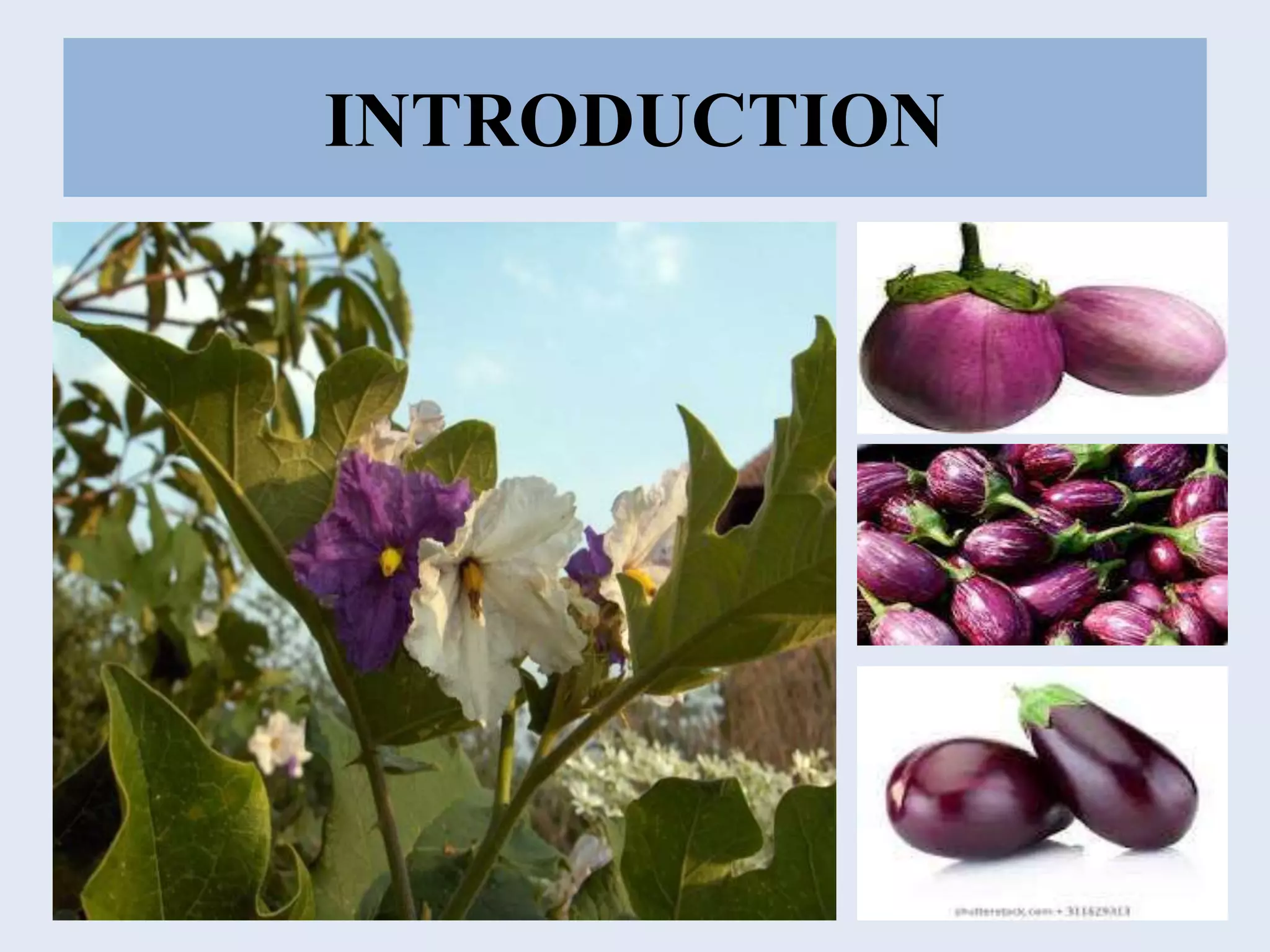
INTRODUCTION
BRINJAL
• Common Name: Brinjal, Eggplant
Aubergine.
• Botanical Name: - Solanum melongena L.
• Family:- Solanaceae
• Chromosome no. :- 2n = 24
• Mode of pollination:- Self-pollinated
• Out-crossing % :- < 5%
• Brinjal is one of the most common principle
vegetable in most parts of the world.
• In it’s natural habit, it is a perennial plant but
cultivated as annual.
• An erect bushy plant with compact and well
branched stem and deep root system.
• The brinjal is of much importance in the warm
areas of For East, being grown extensively in
India, Bangladesh, Pakistan, China and the
Philippines.
• It is also popular in Egypt, France, Italy and
United States.
Origin:
• Brinjal is native of India. According to A.
Decandolle.
• According to N.I. Vavilov, the eggplant
originated in the Indo-Burma region.
• More than 16 species of brinjal are found to
grow wild in various parts of the country.
Distribution:
• Brinjal is cultivated in most parts of the world.
• Leading countries are USA, China, India,
France, Bangladesh and Philippines.
TAXONOMY
• Kingdom : Plantae
• Class : Magnoliopsida
• Subclass : Asteridae
• Order : Solanales
• Family : Solanaceae
• Genus : Solanum
• Species : melongena
• Solanum is very large genus.
• Among the 22 Indian species, there is a group
of 5 related ones.
• All are prickly and diploid with 2n = 24.
• which are: -
1. Solanum melongena
2. Solanum coagulans
3. Solanum xanthocarpum
4. Solanum maccanii
5. Solanum indicum
Floral Biology
• INFLORESCENCE
• Inflorescence is
solitary or cluster of 2-
5 flowers.
Flower
• Flowers are
actinomorphic,
Hypogynous,
Hermaphrodite with
pistil sorrounded by the
stamens.
• White or pinkish in
colour, depending on
the cultivars.
• There are four types of flowers depending on
the length of the style and size of the ovary
viz:-
1.Long styled with big sized ovary.
2.Medium styled with medium sized ovary.
3.Pseudo styled with rudimentary ovary.
4.True short styled with very rudimentary ovary.
Diagram of Flower
CALYX
• 5 gamosepalous,
Light green in colour
and persistent.
• It forms a cup like
structure at the base.
COROLLA
• 5 gamopetalous,
• Purple or white in
colour.
• Lobes are short.
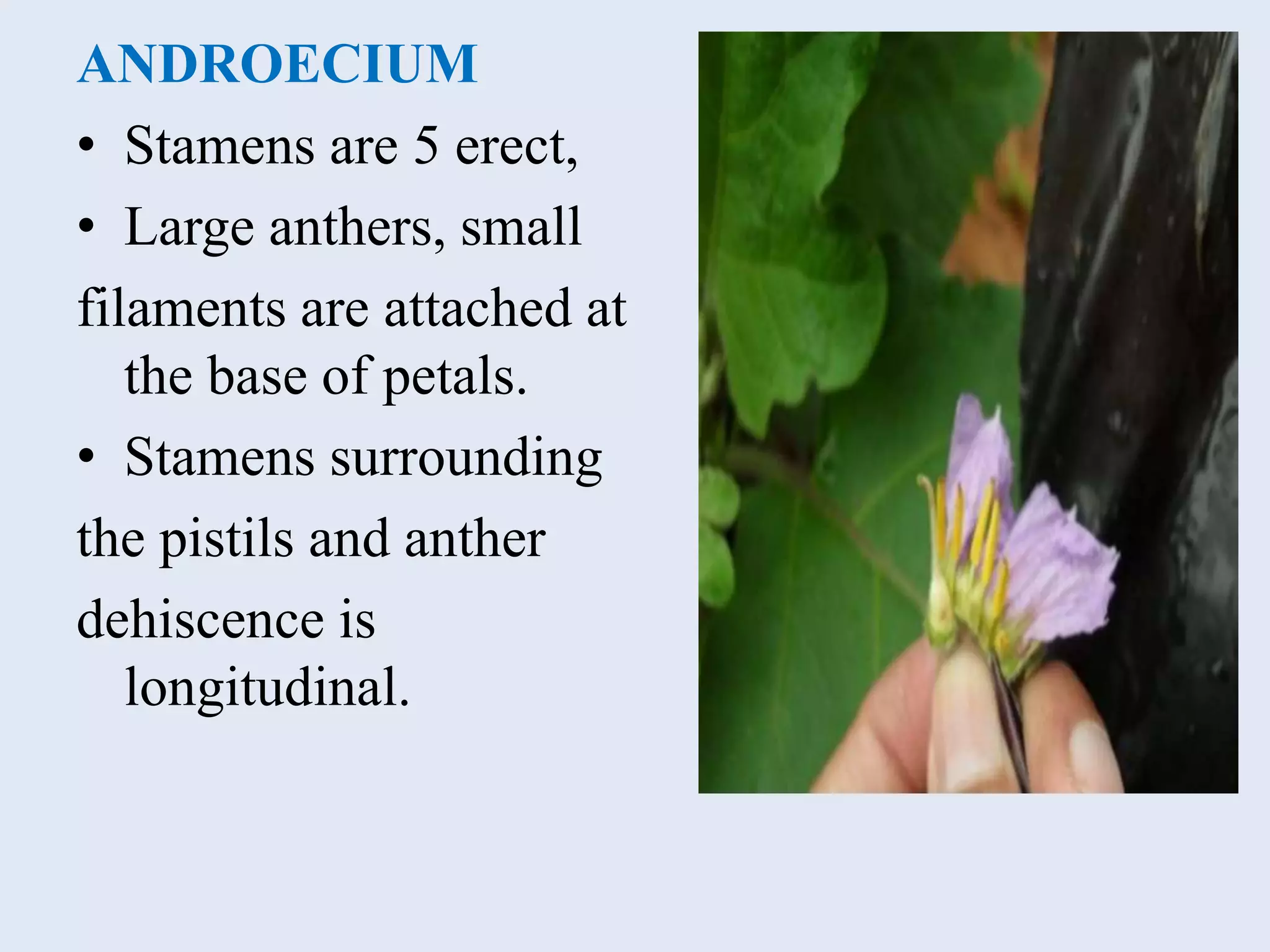
ANDROECIUM
• Stamens are 5 erect,
• Large anthers, small
filaments are attached at
the base of petals.
• Stamens surrounding
the pistils and anther
dehiscence is
longitudinal.
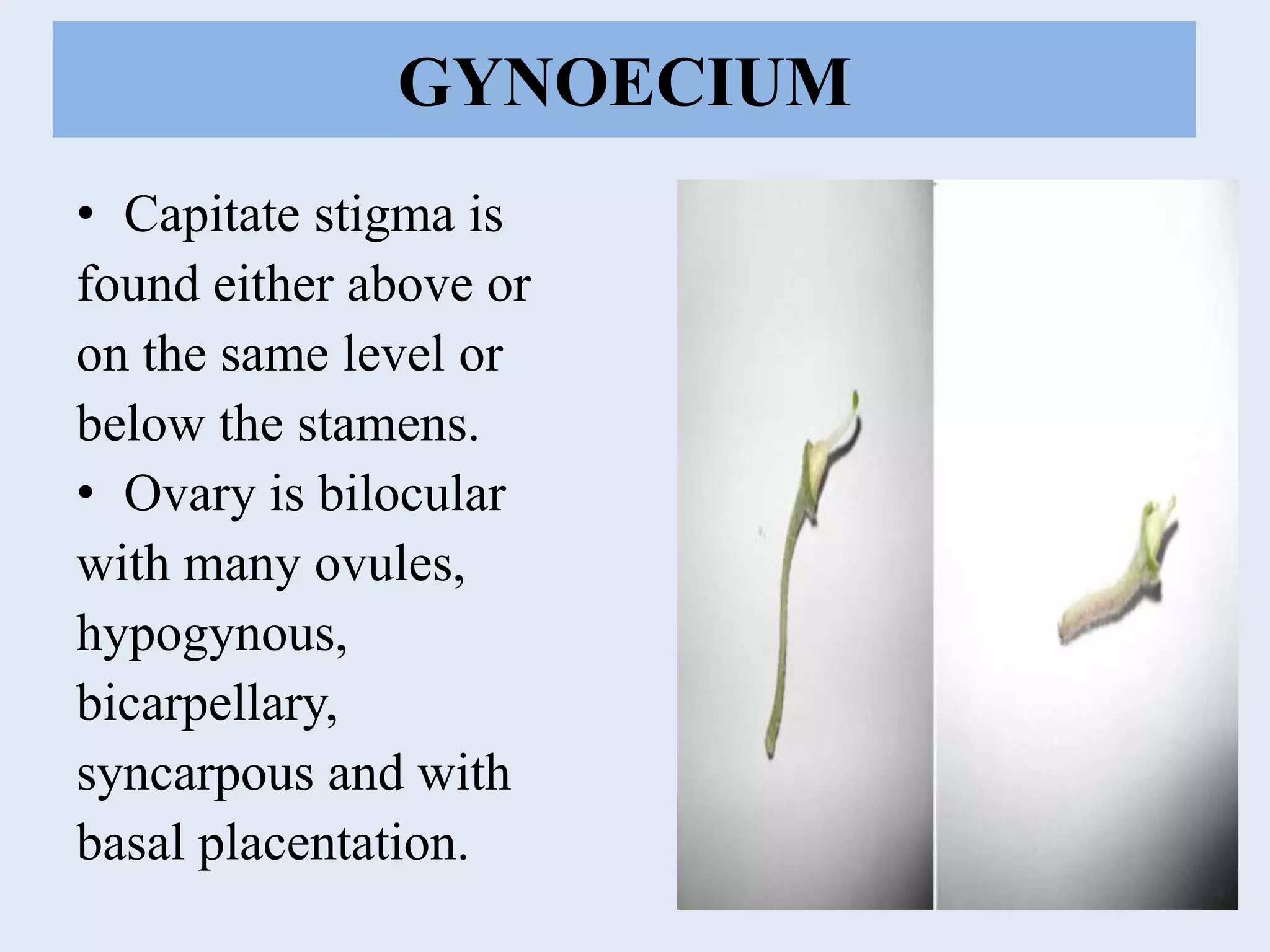
GYNOECIUM
• Capitate stigma is
found either above or
on the same level or
below the stamens.
• Ovary is bilocular
with many ovules,
hypogynous,
bicarpellary,
syncarpous and with
basal placentation.
Floral Formula and
Diagram
Anthesis and Pollination
• Flower generally emerge 40-45 days after transplanting.
• Anthesis occurs at about 6-8 am in august-September.
• Peak flower opening at 08:30 am to 10:30 am.
• Essentially a Self-Pollinated crop as stamens
surrounding the pistil &stamens dehisce at the same the
stigma is receptive.
• Self pollination varies between 80-92 %.
• Pollen viabiity is retained for 8-10 days at 20-30 degree
Celsius and R.H. of 50-55%.
Selfing techniques
• Bagging of young bud.
• Manual transfer of freshly collected pollen on
stigma of flowers of the same plant.
Crossing techniques
• Crossing techniques includes:
• Hand emasculation,
• Pollen collection,
• Artificial pollination or Pollen dusting.
• For emasculation, a healthy long or medium styled,
well developed bud from the central portion of the
plant is selected.
• The bud is opened gently with the help of fine pointed
forceps one or two days before the opening of the bud
and all the five anthers are carefully removed.
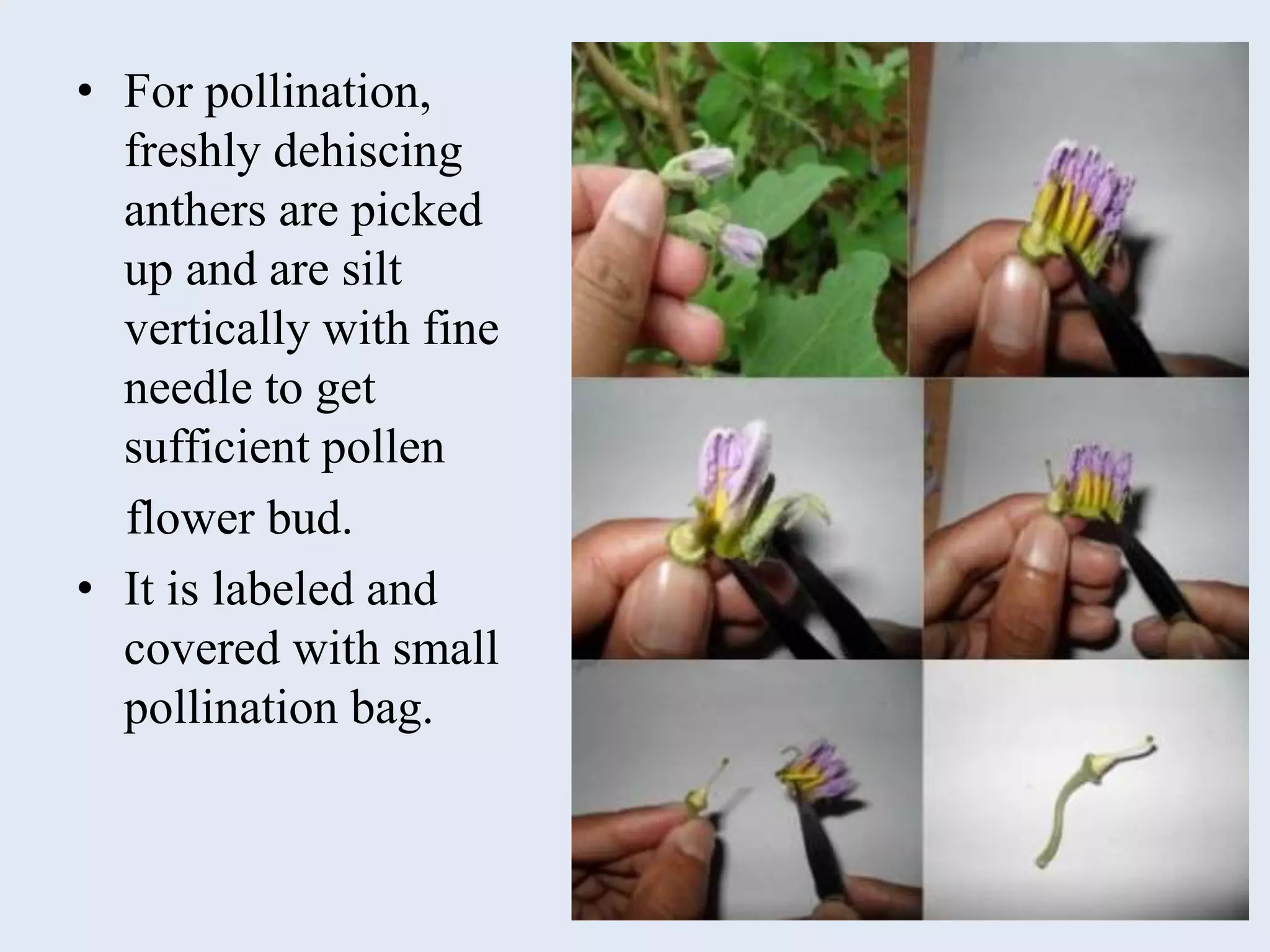
• For pollination,
freshly dehiscing
anthers are picked
up and are silt
vertically with fine
needle to get
sufficient pollen
flower bud.
• It is labeled and
covered with small
pollination bag.
Genetics of important qualitative
and quantitative characters
In India, the National Bureau of Plant Genetic
Research is the nodal institute for management
of germplasm resources of crop plants and
holds more than 2500 accessions of brinjal in its
gene bank.
The wide regional variations for plant, flower
and fruit descriptions revealed enough scope
for improvement of yield characters by selection.
Breeding objectives
The main objectives are to evolve hybrids that have
following traits.
High yield.
Earliness.
Fruit shape, size and colour as per the consumers
preference.
Low proportion of seed and more pulp.
Soft flesh.
Low olanine content.
Upright sturdy plant free from lodging.
 Give flowering and fruiting at very and high
Temperatures.
 Having straight growth habit
 Good attractive colour
 Less fruit thickness
 Resistance to:
1. Bacterial wilt (Pseudomonas solanacearum)
2. Phomopsis blight (Phomopsis vexans)
3. Little leaf (Mycoplasma like bodies)
4. Root knot nematodes
5. Shoot and fruit borer
6. To frost.
Breeding methods
• Pure Line Selection
• Pedigree Method
• Bulk Method
• Back Crossing Method
• Heterosis Breeding
• Mutation Breeding
• Resistant Breeding
Pure line selection
• Pureline is the progeny of a single self fertilized
homozygous individual.
• Pure line improvement is adopted to improve
heterogeneous foundation stocks and as a result, varietal
improvement is possible.
• Pusa Purple Long : -
• Selection from the Batia cultivar in Punjab.
• Long fruit, shine skin, early maturity.
• C.O.1:-
• Duration 160 days, fruits are oblong and medium sized
with pale green shade.
• Pant Samrat : -
• From GBPUAT, Pantnagar.
• Selection in local germplasm.
• Resistance to bacterial wilt.
• Tolerant to fruit and shoot borer.
• Pusa Purple Cluster : -
• IARI, Selection from local material.
• Medium early, erect, tall sturdy plant, fruit in
clusters of 4-9, 10-12 cm long, deep purple.
• Resistance to bacterial wilt.
Pedigree Method
• This method was adopted to develop material as
well a variety for high yield, earliness, quality and
resistance to pests, diseases and stress conditions.
• In this method, single plant selection is followed
up to F5 or F6generations and in advance.
generations, families are selected on the basis of
their phenotypic performance.
• Pusa Kranti : - PPL × Hyderpur × Wynad giant
• Plant medium tall, upright erect, less seeded.
Bulk method
• This method consists of growing large populations in
each generation and harvesting the seeds in bulk and
planting a sample of seeds in the following years.
• No selection is made in F2 and bulk populations
grown up to F5 or F6.
• No selection is made in F2 and bulk populations
grown up to F5 or F6.
• At the end of the bulking period, individual plants are
selected and evaluated in a similar manner as in the
pedigree method of breeding.
Back Crossing Method
• In the back cross method, the hybrid and the
progenies in the subsequent generations are
repeatedly back crossed to one of the parents.
• This method involves the selection of two parents
where one is the recurrent (agronomic) and the other
is the non-recurrent (donor) parent.
• The F1 population is grown in rows and tested for
resistance.
• This method is best executed in self-fertilized crops
than in cross fertilized crops and is usually applied to
transfer-resistance characteristics controlled by major
genes in cultivars.
Heterosis Breeding
• It is the superiority of F1 hybrid over both the parents in terms
of an increased vigour, size,growth rate, yield and a number of
other characteristics.
• Emasculation is done on buds, which are about to open on the
next day morning. Normally, single, long styled flowers are
selected for crossing.
• After emasculation, the flowers are covered with butter paper
cover and pollination is done on the next day morning.
• Arka Navneet : -
• Developed from IIHR, Bengaluru.
• Cross between IIHR 22-1 × Supreme.
• Fruit oval and free from bitterness, skin attractive,
deep purple, flesh soft, white with few seeds,
yield 650-700 q/ha (highest yielding variety in
India).
• COBHI : -
• It is a cross between EP45 x CO2.
• The fruits are medium sized, oblong and purple
deep in colour.
• Yield potential is 55-60 tones per hectare.
Mutation Breeding
• PKM-1 : -
• Developed at TNAU, Periakulam.
• It is an induced 1 mutant (gamma rays) of a local
type called Puzhuthi Kathiri.
• It is a drought tolerant and can with stand long
transportation.
• Yielding on an average 34.75 tones per hectare in
a duration of 150-155 days.
• The fruit weighs 45-to 65 g.
Resistance Breeding
• Brinjal like any other vegetable crop is susceptible to
number of diseases, pests and root knot nematode.
• Chakraborty and Choudhury (1975) –
reported selection of three brinjal lines viz. Sel.212-1,
Sel. 252-1 and Sel.252-1-2 as free from little leaf
disease out of 164 germplasms tested.
• According to Swaminathan and Srinivasan, 1971)
S.melongena var. insanum carries a single dominant
gene for resistance wilt and cultivar Black Beauty and
Vijaya are tolerant to root-knot nematodes (M. ncognito)
as reported by Yadav et al. (1975).
Research Centres
 World Vegetable Centre, Shanhua, Taiwan.
 Indian Institute of Horticultural Research (IIHR), Hassargatta, Bengaluru.
 Indian Institute of Vegetable Research (IIVR),Varanasi.
 Maharashtra Hybrid Seeds Company Ltd (MAHYCO), Jalna, M.H.
 National Research Centre on Plant Biotechnology (NRCPB), New Delhi.
 Main Vegetable Research Station, N.D.U.A.T., Faizabad, Uttar Pradesh.
 Vegetable Research Centre, G.B.P.U.A. & T., Pantnagar.
 Division of Vegetable Science, I.A.R.I., New Delhi.
 Vegetable Research Station, A.N.G.R.A.U., Rajendranagar, Hyderabad.
 Vegetable Research Scheme, M.A.U., Parbhani, Maharashtra.
 Main Vegetable Research Station, A.A.U., Anand.
 Vegetable Research Station, J.A.U., Junagadh.
Breeding Methods of Brinjal.

Breeding Methods of Brinjal.

  • 2.
    CONTENTS 1. Intoduction andBasic information of crop 2. Floral biology 3. Selfing and crossing techniques 4. Genetics of important qualitative and quantitaive characters of crop 5. Breeding methods 6. Major Breeding objectives 7. Research centres of the crop
  • 3.
  • 4.
    BRINJAL • Common Name:Brinjal, Eggplant Aubergine. • Botanical Name: - Solanum melongena L. • Family:- Solanaceae • Chromosome no. :- 2n = 24 • Mode of pollination:- Self-pollinated • Out-crossing % :- < 5%
  • 5.
    • Brinjal isone of the most common principle vegetable in most parts of the world. • In it’s natural habit, it is a perennial plant but cultivated as annual. • An erect bushy plant with compact and well branched stem and deep root system. • The brinjal is of much importance in the warm areas of For East, being grown extensively in India, Bangladesh, Pakistan, China and the Philippines. • It is also popular in Egypt, France, Italy and United States.
  • 6.
    Origin: • Brinjal isnative of India. According to A. Decandolle. • According to N.I. Vavilov, the eggplant originated in the Indo-Burma region. • More than 16 species of brinjal are found to grow wild in various parts of the country.
  • 7.
    Distribution: • Brinjal iscultivated in most parts of the world. • Leading countries are USA, China, India, France, Bangladesh and Philippines.
  • 8.
    TAXONOMY • Kingdom :Plantae • Class : Magnoliopsida • Subclass : Asteridae • Order : Solanales • Family : Solanaceae • Genus : Solanum • Species : melongena
  • 9.
    • Solanum isvery large genus. • Among the 22 Indian species, there is a group of 5 related ones. • All are prickly and diploid with 2n = 24. • which are: - 1. Solanum melongena 2. Solanum coagulans 3. Solanum xanthocarpum 4. Solanum maccanii 5. Solanum indicum
  • 10.
    Floral Biology • INFLORESCENCE •Inflorescence is solitary or cluster of 2- 5 flowers.
  • 11.
    Flower • Flowers are actinomorphic, Hypogynous, Hermaphroditewith pistil sorrounded by the stamens. • White or pinkish in colour, depending on the cultivars.
  • 12.
    • There arefour types of flowers depending on the length of the style and size of the ovary viz:- 1.Long styled with big sized ovary. 2.Medium styled with medium sized ovary. 3.Pseudo styled with rudimentary ovary. 4.True short styled with very rudimentary ovary.
  • 13.
  • 14.
    CALYX • 5 gamosepalous, Lightgreen in colour and persistent. • It forms a cup like structure at the base. COROLLA • 5 gamopetalous, • Purple or white in colour. • Lobes are short.
  • 15.
    ANDROECIUM • Stamens are5 erect, • Large anthers, small filaments are attached at the base of petals. • Stamens surrounding the pistils and anther dehiscence is longitudinal.
  • 16.
    GYNOECIUM • Capitate stigmais found either above or on the same level or below the stamens. • Ovary is bilocular with many ovules, hypogynous, bicarpellary, syncarpous and with basal placentation.
  • 17.
  • 18.
    Anthesis and Pollination •Flower generally emerge 40-45 days after transplanting. • Anthesis occurs at about 6-8 am in august-September. • Peak flower opening at 08:30 am to 10:30 am. • Essentially a Self-Pollinated crop as stamens surrounding the pistil &stamens dehisce at the same the stigma is receptive. • Self pollination varies between 80-92 %. • Pollen viabiity is retained for 8-10 days at 20-30 degree Celsius and R.H. of 50-55%.
  • 19.
    Selfing techniques • Baggingof young bud. • Manual transfer of freshly collected pollen on stigma of flowers of the same plant.
  • 20.
    Crossing techniques • Crossingtechniques includes: • Hand emasculation, • Pollen collection, • Artificial pollination or Pollen dusting. • For emasculation, a healthy long or medium styled, well developed bud from the central portion of the plant is selected. • The bud is opened gently with the help of fine pointed forceps one or two days before the opening of the bud and all the five anthers are carefully removed.
  • 21.
    • For pollination, freshlydehiscing anthers are picked up and are silt vertically with fine needle to get sufficient pollen flower bud. • It is labeled and covered with small pollination bag.
  • 22.
    Genetics of importantqualitative and quantitative characters In India, the National Bureau of Plant Genetic Research is the nodal institute for management of germplasm resources of crop plants and holds more than 2500 accessions of brinjal in its gene bank. The wide regional variations for plant, flower and fruit descriptions revealed enough scope for improvement of yield characters by selection.
  • 23.
    Breeding objectives The mainobjectives are to evolve hybrids that have following traits. High yield. Earliness. Fruit shape, size and colour as per the consumers preference. Low proportion of seed and more pulp. Soft flesh. Low olanine content. Upright sturdy plant free from lodging.
  • 24.
     Give floweringand fruiting at very and high Temperatures.  Having straight growth habit  Good attractive colour  Less fruit thickness  Resistance to: 1. Bacterial wilt (Pseudomonas solanacearum) 2. Phomopsis blight (Phomopsis vexans) 3. Little leaf (Mycoplasma like bodies) 4. Root knot nematodes 5. Shoot and fruit borer 6. To frost.
  • 25.
    Breeding methods • PureLine Selection • Pedigree Method • Bulk Method • Back Crossing Method • Heterosis Breeding • Mutation Breeding • Resistant Breeding
  • 26.
    Pure line selection •Pureline is the progeny of a single self fertilized homozygous individual. • Pure line improvement is adopted to improve heterogeneous foundation stocks and as a result, varietal improvement is possible. • Pusa Purple Long : - • Selection from the Batia cultivar in Punjab. • Long fruit, shine skin, early maturity. • C.O.1:- • Duration 160 days, fruits are oblong and medium sized with pale green shade.
  • 27.
    • Pant Samrat: - • From GBPUAT, Pantnagar. • Selection in local germplasm. • Resistance to bacterial wilt. • Tolerant to fruit and shoot borer. • Pusa Purple Cluster : - • IARI, Selection from local material. • Medium early, erect, tall sturdy plant, fruit in clusters of 4-9, 10-12 cm long, deep purple. • Resistance to bacterial wilt.
  • 28.
    Pedigree Method • Thismethod was adopted to develop material as well a variety for high yield, earliness, quality and resistance to pests, diseases and stress conditions. • In this method, single plant selection is followed up to F5 or F6generations and in advance. generations, families are selected on the basis of their phenotypic performance. • Pusa Kranti : - PPL × Hyderpur × Wynad giant • Plant medium tall, upright erect, less seeded.
  • 29.
    Bulk method • Thismethod consists of growing large populations in each generation and harvesting the seeds in bulk and planting a sample of seeds in the following years. • No selection is made in F2 and bulk populations grown up to F5 or F6. • No selection is made in F2 and bulk populations grown up to F5 or F6. • At the end of the bulking period, individual plants are selected and evaluated in a similar manner as in the pedigree method of breeding.
  • 30.
    Back Crossing Method •In the back cross method, the hybrid and the progenies in the subsequent generations are repeatedly back crossed to one of the parents. • This method involves the selection of two parents where one is the recurrent (agronomic) and the other is the non-recurrent (donor) parent. • The F1 population is grown in rows and tested for resistance. • This method is best executed in self-fertilized crops than in cross fertilized crops and is usually applied to transfer-resistance characteristics controlled by major genes in cultivars.
  • 31.
    Heterosis Breeding • Itis the superiority of F1 hybrid over both the parents in terms of an increased vigour, size,growth rate, yield and a number of other characteristics. • Emasculation is done on buds, which are about to open on the next day morning. Normally, single, long styled flowers are selected for crossing. • After emasculation, the flowers are covered with butter paper cover and pollination is done on the next day morning.
  • 32.
    • Arka Navneet: - • Developed from IIHR, Bengaluru. • Cross between IIHR 22-1 × Supreme. • Fruit oval and free from bitterness, skin attractive, deep purple, flesh soft, white with few seeds, yield 650-700 q/ha (highest yielding variety in India). • COBHI : - • It is a cross between EP45 x CO2. • The fruits are medium sized, oblong and purple deep in colour. • Yield potential is 55-60 tones per hectare.
  • 33.
    Mutation Breeding • PKM-1: - • Developed at TNAU, Periakulam. • It is an induced 1 mutant (gamma rays) of a local type called Puzhuthi Kathiri. • It is a drought tolerant and can with stand long transportation. • Yielding on an average 34.75 tones per hectare in a duration of 150-155 days. • The fruit weighs 45-to 65 g.
  • 34.
    Resistance Breeding • Brinjallike any other vegetable crop is susceptible to number of diseases, pests and root knot nematode. • Chakraborty and Choudhury (1975) – reported selection of three brinjal lines viz. Sel.212-1, Sel. 252-1 and Sel.252-1-2 as free from little leaf disease out of 164 germplasms tested. • According to Swaminathan and Srinivasan, 1971) S.melongena var. insanum carries a single dominant gene for resistance wilt and cultivar Black Beauty and Vijaya are tolerant to root-knot nematodes (M. ncognito) as reported by Yadav et al. (1975).
  • 35.
    Research Centres  WorldVegetable Centre, Shanhua, Taiwan.  Indian Institute of Horticultural Research (IIHR), Hassargatta, Bengaluru.  Indian Institute of Vegetable Research (IIVR),Varanasi.  Maharashtra Hybrid Seeds Company Ltd (MAHYCO), Jalna, M.H.  National Research Centre on Plant Biotechnology (NRCPB), New Delhi.  Main Vegetable Research Station, N.D.U.A.T., Faizabad, Uttar Pradesh.  Vegetable Research Centre, G.B.P.U.A. & T., Pantnagar.  Division of Vegetable Science, I.A.R.I., New Delhi.  Vegetable Research Station, A.N.G.R.A.U., Rajendranagar, Hyderabad.  Vegetable Research Scheme, M.A.U., Parbhani, Maharashtra.  Main Vegetable Research Station, A.A.U., Anand.  Vegetable Research Station, J.A.U., Junagadh.