
HANDLING OF SEGREGATION
POPULATION: BACKCROSS METHOD
DR. RAJENDRAGOUDA PATIL
ASSISTANT PROFESSOR
GENETICS AND PLANT BREEDING
SCHOOL OF AGRICULTURAL SCIENCES AND
TECHNOLOGY (SAST), NMIMS, MPTP SHIRPUR
• Hybridization: crossing between genetically dissimilar plants.
1. Intervarietal (two varieties or genotypes of same species)
2. Interspecific (two species of the same genus)
3. Intergeneric (two genera of the same family)
• Hybridization uses- 3 ways
• To combine several desirable traits in to single genotype
• To create vast genetic variability
• To develop hybrid varieties for commercial cultivation
• Methods to handle segregating population
• Pedigree breeding method
• Back cross breeding method
• Bulk breeding method
BACK CROSS
• Back cross is the crossing of F1 with either of its parents is called as
back cross
• Crossing F1 with its recessive parent is known as test cross
• Recurrent parent: the parent which is occurs repeatedly in the
crossing Programme, it is superior in all traits except trait of interest
• Donor parent: the parent which used only once in the breeding
Programme and Donets desirable genes, it is inferior to recurrent
parent in all the traits except trait of interest
• Recipient parent: well adapted, high yielding variety, lacking one or
two traits hence receives these lacking genes from other variety.
• Non recurrent parent: the donor parent,
REQUIREMENTS
• Good recurrent parent
• Suitable good donor
• High expressivity of traits
• Character should be highly heritable
• Simple testing techniques
• Recovery of recurrent parent in minimum back crosses
APPLICATIO
NS
1. Applicable to cross and self pollinated crops
2. Inter varietal transfer of simply inherited traits: (disease
resistances and colour)
1. Linkage drag: failure of transfer of simply inherited traits like disease
resistance by B C method due to tight linkage between the gene being
transferred and some other undesirable genes
3. Inter varietal transfer of Quantitative traits: (earliness, Plant
height, Seed size and shape, yield)
4. Interspecific transfer of simply inherited traits: leaf and stem
rust resistance from T. timopheevii, black arm from Gossypium
species to G. hirsutum
1. Transfer of cytoplasm: (CMS and CGMS) T. timophoovii to T.
aestivum
2. Transgressive segregation: 1. the F1 may be back crossed to
1 ot 2 time to recurrent parents
1. two or more recurrent parents may be used in BC method
3. Production of isogenic lines: isogenic lines are identical in
their genotypes, expect for one gene
4. Germplasm conversions: conversion of photosensitive lines
(using as recurrent parent) in to photo insensitive lines (donor
parents)
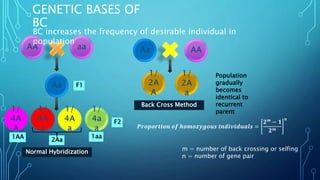
GENETIC BASES OF
BC
BC increases the frequency of desirable individual in
population
F1
F2
1AA 2Aa
1aa
Population
gradually
becomes
identical to
recurrent
parent
Normal Hybridization
Back Cross Method
𝑷𝒓𝒐𝒑𝒐𝒓𝒕𝒊𝒐𝒏 𝒐𝒇 𝒉𝒐𝒎𝒐𝒛𝒚𝒈𝒐𝒖𝒔 𝒊𝒏𝒅𝒊𝒗𝒊𝒅𝒖𝒂𝒍𝒔 =
𝟐 𝒎
− 𝟏
𝟐 𝒎
𝒏
m = number of back crossing or selfing
n = number of gene pair
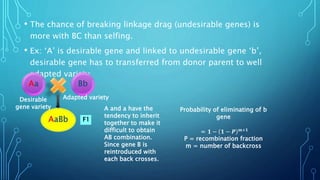
• The chance of breaking linkage drag (undesirable genes) is
more with BC than selfing.
• Ex: ‘A’ is desirable gene and linked to undesirable gene ‘b’,
desirable gene has to transferred from donor parent to well
adapted variety.
F1
Adapted varietyDesirable
gene variety A and a have the
tendency to inherit
together to make it
difficult to obtain
AB combination.
Since gene B is
reintroduced with
each back crosses.
Probability of eliminating of b
gene
= 𝟏 − 𝟏 − 𝑷 𝒎+𝟏
P = recombination fraction
m = number of backcross
TRANSFER OF DOMINANT
TRAITS
F1
(50%)
Stem
resistance
susceptibl
e
Non recurrent parent
‘B’
Recurrent parent
‘A’
Recurrent parent
Recurrent parent
Recurrent parent
Recurrent parent
BC1
(75%)
BC2
(87.5%)
BC3
(93.75%)
BC4
(96.875%)
BC6
(99.218%)
BC5
(98.438%)
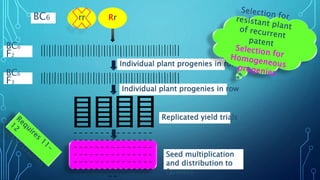
BC6
- - - - - - - - - - - - - - -
- - - - - - - - - - - - - - -
- - - - - - - - - - - - - - -
- - - - - - - - - - - - - - -
- - - - - - - - - - - - - - -
- - - - - - - - - - - - - - -
- -
BC6
F2
BC6
F3
Individual plant progenies in row
Replicated yield trials
Seed multiplication
and distribution to
farmers
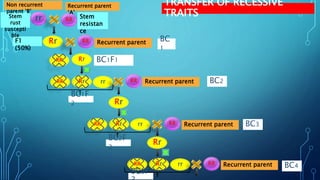
TRANSFER OF RECESSIVE
TRAITS
F1
(50%)
Stem
resistan
ce
Stem
rust
suscepti
ble
Non recurrent
parent ‘B’
Recurrent parent
‘A’
Recurrent parent
Recurrent parent
Recurrent parent
BC
1
BC2
BC1F
2
BC1F1
Recurrent parent
BC2F
2
BC3F
BC3
BC4
- - - - - - - - - - - - - - -
- - - - - - - - - - - - - - -
- - - - - - - - - - - - - - -
- - - - - - - - - - - - - - -
- - - - - - - - - - - - - - -
- - - - - - - - - - - - - - -
- -
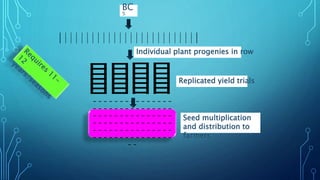
Individual plant progenies in row
Replicated yield trials
Seed multiplication
and distribution to
farmers
BC
5
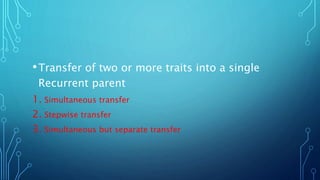
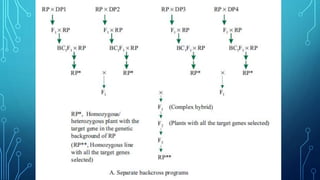
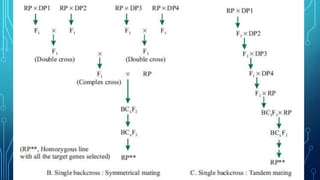
•Transfer of two or more traits into a single
Recurrent parent
1. Simultaneous transfer
2. Stepwise transfer
3. Simultaneous but separate transfer
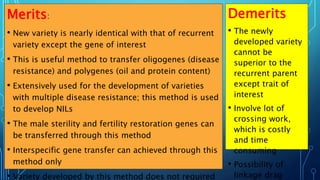
Merits:
• New variety is nearly identical with that of recurrent
variety except the gene of interest
• This is useful method to transfer oligogenes (disease
resistance) and polygenes (oil and protein content)
• Extensively used for the development of varieties
with multiple disease resistance; this method is used
to develop NILs
• The male sterility and fertility restoration genes can
be transferred through this method
• Interspecific gene transfer can achieved through this
method only
• Variety developed by this method does not required
Demerits
• The newly
developed variety
cannot be
superior to the
recurrent parent
except trait of
interest
• Involve lot of
crossing work,
which is costly
and time
consuming
• Possibility of
linkage drag
Achievements
Cotton: 170-co-2, 134-co-2m, V797, Digvijay
Wheat: Robin, K1, Blue bird, Tobari, HS-19
Bajra (Pearl millet): MS-521A, MS-541A, MS-570A
MULTILINE
BREEDING
• Mixture of several purelines of similar height, flowering and
maturity.
• It is mixture of isolines, closely related lines/genotypes and
variety which is developed for commercial cultivation from any
of these mixture is known as multiline variety.
• Isolines: refers to lines that are genetically similar except for
the allele at one locus.
• The use of multiline cultivar was first suggested in oats by
Jensen in 1952
• Borlaug and Gibler in 1953 in wheat
Characteristics of good multiline
1. It is applicable to self pollinated crops only (oat, wheat,
soybean, groundnut)
2. It is genetically divers because it is mixture of several
purelines (homozygous and heterogeneous)
3. More adaptable to environmental variations than pureline
(more buffering capacity to changing env.)
4. Very effective against multiracial disease.
5. In relation to quality, generally less uniform and less
attractive than that of pureline.
6. yield is also comparatively less than pureline
Types of MULTILINES
a) Mixture of isolines (developed by BC)-oats, soybean
in USA
b)Mixture of related lines (developed by crosses having
one parent common) KSML-3 was released from
Ludhiana- rust resistance
c) Mixture of unrelated lines (developed by pedigree,
bulk and SSD)
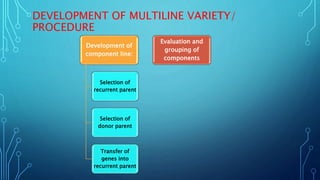
DEVELOPMENT OF MULTILINE VARIETY/
PROCEDURE
Development of
component line:
Selection of
recurrent parent
Selection of
donor parent
Transfer of
genes into
recurrent parent
Evaluation and
grouping of
components
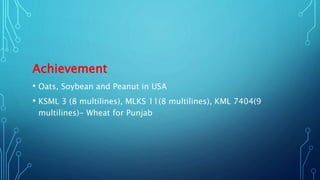
Achievement
• Oats, Soybean and Peanut in USA
• KSML 3 (8 multilines), MLKS 11(8 multilines), KML 7404(9
multilines)- Wheat for Punjab
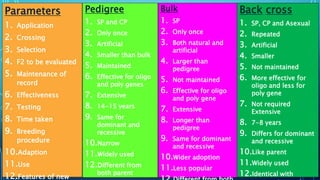
Parameters
1. Application
2. Crossing
3. Selection
4. F2 to be evaluated
5. Maintenance of
record
6. Effectiveness
7. Testing
8. Time taken
9. Breeding
procedure
10.Adaption
11.Use
12.Features of new
Pedigree
1. SP and CP
2. Only once
3. Artificial
4. Smaller than bulk
5. Maintained
6. Effective for oligo
and poly genes
7. Extensive
8. 14-15 years
9. Same for
dominant and
recessive
10.Narrow
11.Widely used
12.Different from
both parent
Bulk
1. SP
2. Only once
3. Both natural and
artificial
4. Larger than
pedigree
5. Not maintained
6. Effective for oligo
and poly gene
7. Extensive
8. Longer than
pedigree
9. Same for dominant
and recessive
10.Wider adoption
11.Less popular
Back cross
1. SP, CP and Asexual
2. Repeated
3. Artificial
4. Smaller
5. Not maintained
6. More effective for
oligo and less for
poly gene
7. Not required
Extensive
8. 7-8 years
9. Differs for dominant
and recessive
10.Like parent
11.Widely used
12.Identical with
THANK YOU

Back Cross Breeding Method

  • 1.
    HANDLING OF SEGREGATION POPULATION:BACKCROSS METHOD DR. RAJENDRAGOUDA PATIL ASSISTANT PROFESSOR GENETICS AND PLANT BREEDING SCHOOL OF AGRICULTURAL SCIENCES AND TECHNOLOGY (SAST), NMIMS, MPTP SHIRPUR
  • 2.
    • Hybridization: crossingbetween genetically dissimilar plants. 1. Intervarietal (two varieties or genotypes of same species) 2. Interspecific (two species of the same genus) 3. Intergeneric (two genera of the same family) • Hybridization uses- 3 ways • To combine several desirable traits in to single genotype • To create vast genetic variability • To develop hybrid varieties for commercial cultivation • Methods to handle segregating population • Pedigree breeding method • Back cross breeding method • Bulk breeding method
  • 3.
    BACK CROSS • Backcross is the crossing of F1 with either of its parents is called as back cross • Crossing F1 with its recessive parent is known as test cross • Recurrent parent: the parent which is occurs repeatedly in the crossing Programme, it is superior in all traits except trait of interest • Donor parent: the parent which used only once in the breeding Programme and Donets desirable genes, it is inferior to recurrent parent in all the traits except trait of interest • Recipient parent: well adapted, high yielding variety, lacking one or two traits hence receives these lacking genes from other variety. • Non recurrent parent: the donor parent,
  • 4.
    REQUIREMENTS • Good recurrentparent • Suitable good donor • High expressivity of traits • Character should be highly heritable • Simple testing techniques • Recovery of recurrent parent in minimum back crosses
  • 5.
    APPLICATIO NS 1. Applicable tocross and self pollinated crops 2. Inter varietal transfer of simply inherited traits: (disease resistances and colour) 1. Linkage drag: failure of transfer of simply inherited traits like disease resistance by B C method due to tight linkage between the gene being transferred and some other undesirable genes 3. Inter varietal transfer of Quantitative traits: (earliness, Plant height, Seed size and shape, yield) 4. Interspecific transfer of simply inherited traits: leaf and stem rust resistance from T. timopheevii, black arm from Gossypium species to G. hirsutum
  • 6.
    1. Transfer ofcytoplasm: (CMS and CGMS) T. timophoovii to T. aestivum 2. Transgressive segregation: 1. the F1 may be back crossed to 1 ot 2 time to recurrent parents 1. two or more recurrent parents may be used in BC method 3. Production of isogenic lines: isogenic lines are identical in their genotypes, expect for one gene 4. Germplasm conversions: conversion of photosensitive lines (using as recurrent parent) in to photo insensitive lines (donor parents)
  • 7.
    GENETIC BASES OF BC BCincreases the frequency of desirable individual in population F1 F2 1AA 2Aa 1aa Population gradually becomes identical to recurrent parent Normal Hybridization Back Cross Method 𝑷𝒓𝒐𝒑𝒐𝒓𝒕𝒊𝒐𝒏 𝒐𝒇 𝒉𝒐𝒎𝒐𝒛𝒚𝒈𝒐𝒖𝒔 𝒊𝒏𝒅𝒊𝒗𝒊𝒅𝒖𝒂𝒍𝒔 = 𝟐 𝒎 − 𝟏 𝟐 𝒎 𝒏 m = number of back crossing or selfing n = number of gene pair
  • 8.
    • The chanceof breaking linkage drag (undesirable genes) is more with BC than selfing. • Ex: ‘A’ is desirable gene and linked to undesirable gene ‘b’, desirable gene has to transferred from donor parent to well adapted variety. F1 Adapted varietyDesirable gene variety A and a have the tendency to inherit together to make it difficult to obtain AB combination. Since gene B is reintroduced with each back crosses. Probability of eliminating of b gene = 𝟏 − 𝟏 − 𝑷 𝒎+𝟏 P = recombination fraction m = number of backcross
  • 9.
    TRANSFER OF DOMINANT TRAITS F1 (50%) Stem resistance susceptibl e Nonrecurrent parent ‘B’ Recurrent parent ‘A’ Recurrent parent Recurrent parent Recurrent parent Recurrent parent BC1 (75%) BC2 (87.5%) BC3 (93.75%) BC4 (96.875%) BC6 (99.218%) BC5 (98.438%)
  • 10.
    BC6 - - -- - - - - - - - - - - - - - - - - - - - - - - - - - - - - - - - - - - - - - - - - - - - - - - - - - - - - - - - - - - - - - - - - - - - - - - - - - - - - - - - - - - - - - - - - BC6 F2 BC6 F3 Individual plant progenies in row Individual plant progenies in row Replicated yield trials Seed multiplication and distribution to farmers
  • 11.
    TRANSFER OF RECESSIVE TRAITS F1 (50%) Stem resistan ce Stem rust suscepti ble Nonrecurrent parent ‘B’ Recurrent parent ‘A’ Recurrent parent Recurrent parent Recurrent parent BC 1 BC2 BC1F 2 BC1F1 Recurrent parent BC2F 2 BC3F BC3 BC4
  • 12.
    - - -- - - - - - - - - - - - - - - - - - - - - - - - - - - - - - - - - - - - - - - - - - - - - - - - - - - - - - - - - - - - - - - - - - - - - - - - - - - - - - - - - - - - - - - - - Individual plant progenies in row Replicated yield trials Seed multiplication and distribution to farmers BC 5
  • 13.
    •Transfer of twoor more traits into a single Recurrent parent 1. Simultaneous transfer 2. Stepwise transfer 3. Simultaneous but separate transfer
  • 16.
    Merits: • New varietyis nearly identical with that of recurrent variety except the gene of interest • This is useful method to transfer oligogenes (disease resistance) and polygenes (oil and protein content) • Extensively used for the development of varieties with multiple disease resistance; this method is used to develop NILs • The male sterility and fertility restoration genes can be transferred through this method • Interspecific gene transfer can achieved through this method only • Variety developed by this method does not required Demerits • The newly developed variety cannot be superior to the recurrent parent except trait of interest • Involve lot of crossing work, which is costly and time consuming • Possibility of linkage drag
  • 17.
    Achievements Cotton: 170-co-2, 134-co-2m,V797, Digvijay Wheat: Robin, K1, Blue bird, Tobari, HS-19 Bajra (Pearl millet): MS-521A, MS-541A, MS-570A
  • 18.
    MULTILINE BREEDING • Mixture ofseveral purelines of similar height, flowering and maturity. • It is mixture of isolines, closely related lines/genotypes and variety which is developed for commercial cultivation from any of these mixture is known as multiline variety. • Isolines: refers to lines that are genetically similar except for the allele at one locus. • The use of multiline cultivar was first suggested in oats by Jensen in 1952 • Borlaug and Gibler in 1953 in wheat
  • 19.
    Characteristics of goodmultiline 1. It is applicable to self pollinated crops only (oat, wheat, soybean, groundnut) 2. It is genetically divers because it is mixture of several purelines (homozygous and heterogeneous) 3. More adaptable to environmental variations than pureline (more buffering capacity to changing env.) 4. Very effective against multiracial disease. 5. In relation to quality, generally less uniform and less attractive than that of pureline. 6. yield is also comparatively less than pureline
  • 20.
    Types of MULTILINES a)Mixture of isolines (developed by BC)-oats, soybean in USA b)Mixture of related lines (developed by crosses having one parent common) KSML-3 was released from Ludhiana- rust resistance c) Mixture of unrelated lines (developed by pedigree, bulk and SSD)
  • 21.
    DEVELOPMENT OF MULTILINEVARIETY/ PROCEDURE Development of component line: Selection of recurrent parent Selection of donor parent Transfer of genes into recurrent parent Evaluation and grouping of components
  • 22.
    Achievement • Oats, Soybeanand Peanut in USA • KSML 3 (8 multilines), MLKS 11(8 multilines), KML 7404(9 multilines)- Wheat for Punjab
  • 23.
    Parameters 1. Application 2. Crossing 3.Selection 4. F2 to be evaluated 5. Maintenance of record 6. Effectiveness 7. Testing 8. Time taken 9. Breeding procedure 10.Adaption 11.Use 12.Features of new Pedigree 1. SP and CP 2. Only once 3. Artificial 4. Smaller than bulk 5. Maintained 6. Effective for oligo and poly genes 7. Extensive 8. 14-15 years 9. Same for dominant and recessive 10.Narrow 11.Widely used 12.Different from both parent Bulk 1. SP 2. Only once 3. Both natural and artificial 4. Larger than pedigree 5. Not maintained 6. Effective for oligo and poly gene 7. Extensive 8. Longer than pedigree 9. Same for dominant and recessive 10.Wider adoption 11.Less popular Back cross 1. SP, CP and Asexual 2. Repeated 3. Artificial 4. Smaller 5. Not maintained 6. More effective for oligo and less for poly gene 7. Not required Extensive 8. 7-8 years 9. Differs for dominant and recessive 10.Like parent 11.Widely used 12.Identical with
  • 24.