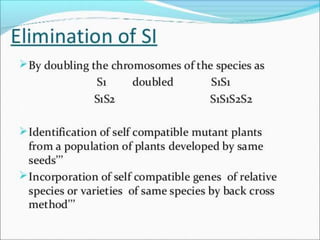
Assignment
on
Self-incompatibility
• self incompatibility refers to the inability of plant to
set seed with functional pollen after self polllination.
• Koelreuter -1st reported S.I in Verbascum phoeniceum
plants(18th century)
• Self incompatibility reported in about 70 family of
angiosperm including several crop spp.
• It is importnant for outbreeding mechanism(cross
pollintaion) for normal fruit set.
• It maintained high degree of heterozygosity and can
take place any stage between pollination and
fertilization.
• Self incompatible pollen grain may fail to germinate on
the stigmatic surface.
• Some may germinate but fails to penetrate the stigmatic
surface.
• Some pollen grains may produce pollen tube, which
enters through stigmatic surface, but its growth will be
too slow. By the time the pollen tube enters the ovule
the flower will drop.
• Some time fertilziation is effected but embryo
degenerates early.
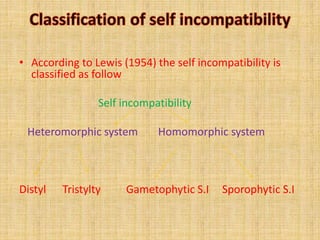
• According to Lewis (1954) the self incompatibility is
classified as follow
Self incompatibility
Heteromorphic system Homomorphic system
Distyl Tristylty Gametophytic S.I Sporophytic S.I
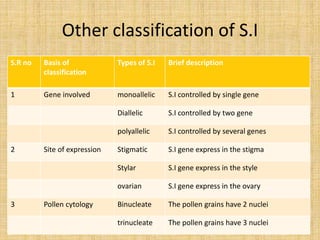
Other classification of S.I
S.R no Basis of
classification
Types of S.I Brief description
1 Gene involved monoallelic S.I controlled by single gene
Diallelic S.I controlled by two gene
polyallelic S.I controlled by several genes
2 Site of expression Stigmatic S.I gene express in the stigma
Stylar S.I gene express in the style
ovarian S.I gene express in the ovary
3 Pollen cytology Binucleate The pollen grains have 2 nuclei
trinucleate The pollen grains have 3 nuclei
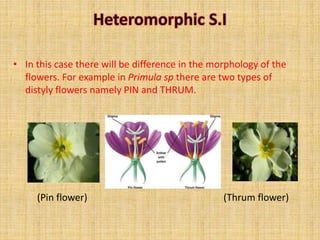
• In this case there will be difference in the morphology of the
flowers. For example in Primula sp there are two types of
distyly flowers namely PIN and THRUM.
(Pin flower) (Thrum flower)
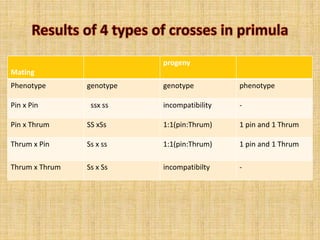
Mating
progeny
Phenotype genotype genotype phenotype
Pin x Pin ssx ss incompatibility -
Pin x Thrum SS xSs 1:1(pin:Thrum) 1 pin and 1 Thrum
Thrum x Pin Ss x ss 1:1(pin:Thrum) 1 pin and 1 Thrum
Thrum x Thrum Ss x Ss incompatibilty -
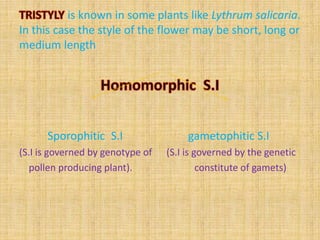
is known in some plants like Lythrum salicaria.
In this case the style of the flower may be short, long or
medium length
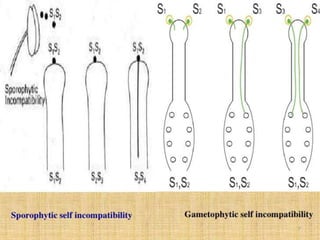
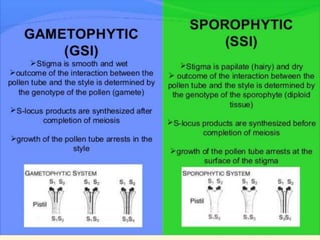
Sporophitic S.I gametophitic S.I
(S.I is governed by genotype of (S.I is governed by the genetic
pollen producing plant). constitute of gamets)
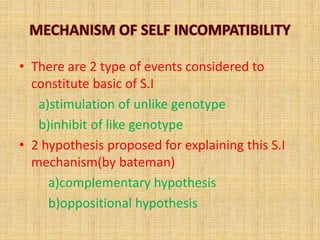
• There are 2 type of events considered to
constitute basic of S.I
a)stimulation of unlike genotype
b)inhibit of like genotype
• 2 hypothesis proposed for explaining this S.I
mechanism(by bateman)
a)complementary hypothesis
b)oppositional hypothesis
• Proposed by bateman in 1952.
• S.I due to absence of stimulation by the pistil
on pollen growth in the like
genotype(S1S2xS1S2)
• Means S.I is due to absence of substance in
the pistil or pollen which are essential for
pollen tube penetration.
• It states that interaction between like
alleles(S1S2xS1S2) leads to production of
inhibitor which inhibit the growth of pollen tube
in the pistil.
• Interaction between like alleles, a substance is
produced in pollen and pistil which property to
interfere with normal metabolism of pollen grain
and tube(inhibit enzyme or auxin, block pollen
tube membrane, inhibit enzyme necessary for
penetration.)
1) Bud pollination:-pollination of immature buds
with mature pollen.
2) Delay pollination:-pollination of aged pistls
several days after maturity with normal
incompatible pollen.
3) Late season pollination:-self pollination at end
of flowering season also lead to seed set.
1) Irradiation:-irradiation of style with X-ray immediately
before selfing reulst in break down of S.I.
2) High temp.:-treatment of high temp ranging from 30-60
degree leads to break down of S.I.
3) Mutilation of style:-S.I could be broken by mutilating
the stigma with steel wire brush during pollination.
4) Invitro-fertilization:-placing the pollen grains in direct
contact with ovules result in break down of S.I.
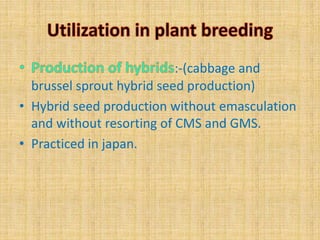
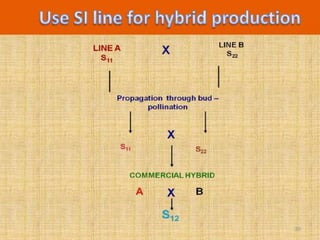
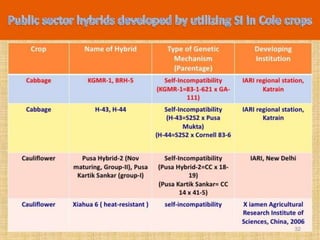
:-(cabbage and
brussel sprout hybrid seed production)
• Hybrid seed production without emasculation
and without resorting of CMS and GMS.
• Practiced in japan.
• S.I system permits combining of desirable
genes in a single genotype from two or more
different sources through natural cross
pollination which is not possible in self-
compatible spp.
 very difficult to produce homozygous inbreed
lines in a S.I spp.
 S.I is affected by environment factor i.e
Temperature and humidity and photo period.
 Sometimes, bees visit only one parental line
in the seed production plot resulting in sib
matting.
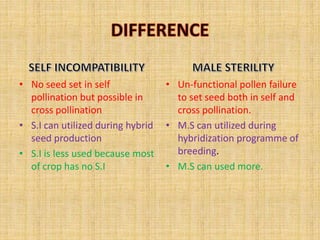
• No seed set in self
pollination but possible in
cross pollination
• S.I can utilized during hybrid
seed production
• S.I is less used because most
of crop has no S.I
• Un-functional pollen failure
to set seed both in self and
cross pollination.
• M.S can utilized during
hybridization programme of
breeding.
• M.S can used more.
Self incompatibility ppt

Self incompatibility ppt

  • 1.
  • 2.
    • self incompatibilityrefers to the inability of plant to set seed with functional pollen after self polllination. • Koelreuter -1st reported S.I in Verbascum phoeniceum plants(18th century) • Self incompatibility reported in about 70 family of angiosperm including several crop spp. • It is importnant for outbreeding mechanism(cross pollintaion) for normal fruit set. • It maintained high degree of heterozygosity and can take place any stage between pollination and fertilization.
  • 4.
    • Self incompatiblepollen grain may fail to germinate on the stigmatic surface. • Some may germinate but fails to penetrate the stigmatic surface. • Some pollen grains may produce pollen tube, which enters through stigmatic surface, but its growth will be too slow. By the time the pollen tube enters the ovule the flower will drop. • Some time fertilziation is effected but embryo degenerates early.
  • 8.
    • According toLewis (1954) the self incompatibility is classified as follow Self incompatibility Heteromorphic system Homomorphic system Distyl Tristylty Gametophytic S.I Sporophytic S.I
  • 9.
    Other classification ofS.I S.R no Basis of classification Types of S.I Brief description 1 Gene involved monoallelic S.I controlled by single gene Diallelic S.I controlled by two gene polyallelic S.I controlled by several genes 2 Site of expression Stigmatic S.I gene express in the stigma Stylar S.I gene express in the style ovarian S.I gene express in the ovary 3 Pollen cytology Binucleate The pollen grains have 2 nuclei trinucleate The pollen grains have 3 nuclei
  • 10.
    • In thiscase there will be difference in the morphology of the flowers. For example in Primula sp there are two types of distyly flowers namely PIN and THRUM. (Pin flower) (Thrum flower)
  • 11.
    Mating progeny Phenotype genotype genotypephenotype Pin x Pin ssx ss incompatibility - Pin x Thrum SS xSs 1:1(pin:Thrum) 1 pin and 1 Thrum Thrum x Pin Ss x ss 1:1(pin:Thrum) 1 pin and 1 Thrum Thrum x Thrum Ss x Ss incompatibilty -
  • 12.
    is known insome plants like Lythrum salicaria. In this case the style of the flower may be short, long or medium length Sporophitic S.I gametophitic S.I (S.I is governed by genotype of (S.I is governed by the genetic pollen producing plant). constitute of gamets)
  • 15.
    • There are2 type of events considered to constitute basic of S.I a)stimulation of unlike genotype b)inhibit of like genotype • 2 hypothesis proposed for explaining this S.I mechanism(by bateman) a)complementary hypothesis b)oppositional hypothesis
  • 16.
    • Proposed bybateman in 1952. • S.I due to absence of stimulation by the pistil on pollen growth in the like genotype(S1S2xS1S2) • Means S.I is due to absence of substance in the pistil or pollen which are essential for pollen tube penetration.
  • 17.
    • It statesthat interaction between like alleles(S1S2xS1S2) leads to production of inhibitor which inhibit the growth of pollen tube in the pistil. • Interaction between like alleles, a substance is produced in pollen and pistil which property to interfere with normal metabolism of pollen grain and tube(inhibit enzyme or auxin, block pollen tube membrane, inhibit enzyme necessary for penetration.)
  • 18.
    1) Bud pollination:-pollinationof immature buds with mature pollen. 2) Delay pollination:-pollination of aged pistls several days after maturity with normal incompatible pollen. 3) Late season pollination:-self pollination at end of flowering season also lead to seed set.
  • 19.
    1) Irradiation:-irradiation ofstyle with X-ray immediately before selfing reulst in break down of S.I. 2) High temp.:-treatment of high temp ranging from 30-60 degree leads to break down of S.I. 3) Mutilation of style:-S.I could be broken by mutilating the stigma with steel wire brush during pollination. 4) Invitro-fertilization:-placing the pollen grains in direct contact with ovules result in break down of S.I.
  • 21.
    :-(cabbage and brussel sprouthybrid seed production) • Hybrid seed production without emasculation and without resorting of CMS and GMS. • Practiced in japan.
  • 24.
    • S.I systempermits combining of desirable genes in a single genotype from two or more different sources through natural cross pollination which is not possible in self- compatible spp.
  • 25.
     very difficultto produce homozygous inbreed lines in a S.I spp.  S.I is affected by environment factor i.e Temperature and humidity and photo period.  Sometimes, bees visit only one parental line in the seed production plot resulting in sib matting.
  • 28.
    • No seedset in self pollination but possible in cross pollination • S.I can utilized during hybrid seed production • S.I is less used because most of crop has no S.I • Un-functional pollen failure to set seed both in self and cross pollination. • M.S can utilized during hybridization programme of breeding. • M.S can used more.