Breeding methods in
cross pollinated
crops
Breeding methods in
cross pollinated crops
Sam Higginbottom University of
Agriculture, Technology And Sciences
VIJAYPAL SINGH THAKUR 22MSAGPB042
Contents: • Introduction
• Characters of cross pollinated crops
• Methods of breeding in cross pollinated crops
• Mass selection
• Recurrent selection
• Progeny selection (or) ear-to-row method
• Modified ear-to-row method
• Hybrid varieties
• Synthetic varieties
Introduction
Populations of cross-pollinated crops are highly
heterozygous. When inbreeding is practiced, they
show severe inbreeding depression. So, to avoid
inbreeding depression and its undesirable effects,
the breeding methods in the crop is designed in
such a way that there will be a minimum
inbreeding. The breeding methods commonly
used in cross pollinated crops.
Characters of cross pollinated plants
 Each genotypes has equal chances of mating with all
other genotypes.
 Individuals are heterozygous in nature.
 Higher degree of inbreeding depression.
 Wide adaptability and more flexibility to environmental
changes due to heterozygosity and heterogeneity.
 Cross pollination permits new gene combinations from
different sources.
 Individuals have deleterious recessive gene which are
concealed by masking effect of dominant genes.
Methods of breeding in cross pollinated crops
Population Improvement
Population improvement In cross pollinated crops,
population improvement is used to enhance the
frequency of desirable alleles in a population.
Population improvement without progeny test: Mass
selection,
Population improvement with progeny testing
includes Recurrent selection,
Without progeny testing
 Mass selection
This is similar to the one, which is practiced, in self-
pollinated crops. A number of plants are selected
based on their phenotype and open pollinated seed
from them are bulked together to raise the next
generation. The selection cycle is repeated one or
more times to increase the frequency of favourable
alleles. Such a selection is known as phenotypic
recurrent selection.
Merits
• Simple and less time consuming
• Highly effective for character that are easily
heritable. Eg. Plant height, duration.
• It will have high adaptability because the base
population is locally adapted one.
Demerits
• Selection is based on phenotype only which is
influenced by environment
• The selected plants are pollinated both by superior
and inferior pollens present in the population.
• High intensity of selection may lead reduction in
population there by leading to inbreeding.
Recurrent selection
This is one of the breeding methods followed for the
improvement of cross-pollinated crop. Here single plants
are selected based on their phenotype or by progeny
testing. The selected single plants are selfed. In the next
generation they are intermated (cross in all possible
combinations) to produce population for next cycle of
selection. The recurrent selection schemes are modified
forms of progeny selection programmes.
i) The manner in which progenies are obtained for
evaluation.
ii) Instead of open pollination, making all possible inter
crosses among the selected lines.
The recurrent selection schemes are of 4 different
types:
 Simple Recurrent Selection
 Recurrent Selection for GCA
 Recurrent Selection for SCA
 Reciprocal Recurrent Selection
• Simple Recurrent Selection
 A type of recurrent selection that does not
include tester is referred as simple recurrent
selection.
 It is also known as phenotypic recurrent
selection as it is based on the phenotype of the
parent
 It does not measure the combining ability
 Used for characters having high heritability
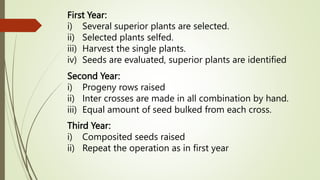
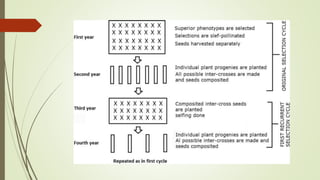
First Year:
i) Several superior plants are selected.
ii) Selected plants selfed.
iii) Harvest the single plants.
iv) Seeds are evaluated, superior plants are identified
Second Year:
i) Progeny rows raised
ii) Inter crosses are made in all combination by hand.
iii) Equal amount of seed bulked from each cross.
Third Year:
i) Composited seeds raised
ii) Repeat the operation as in first year
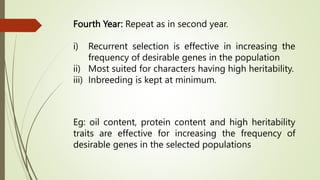
Fourth Year: Repeat as in second year.
i) Recurrent selection is effective in increasing the
frequency of desirable genes in the population
ii) Most suited for characters having high heritability.
iii) Inbreeding is kept at minimum.
Eg: oil content, protein content and high heritability
traits are effective for increasing the frequency of
desirable genes in the selected populations
Recurrent Selection for GCA
Combining ability Ability of a strain to produce superior
progeny when crossed with other strains.
• General combining ability (GCA)
Average performance of a strain in a series of cross
combinations. The GCA is estimated from the
performance of F1 S from the crosses. The tester
will have a broad genetic base.
Recurrent Selection for SCA
• Specific combining ability (SCA)
Deviation in performance of a cross combination from
that predicted on the basis of general combining
ability of the parents involved in the cross. The testing
will be on inbred
Reciprocal Recurrent Selection (RRS)
• used to improve both GCA and SCA of a
population for a character
• using two heterozygous testers.
• Comstock et al in 1949, proposed this method.
Main Features of these Methods:
1) It is used for improvement of polygenic
characters.
2) Selection is made on the basis of test cross
performance.
3) Two heterozygous tester are used as a source of
population.
Hybrids
They are the first generation from crosses between
two pure lines, inbreds, open pollinated varieties of
other populations that are genetically not similar. Pure
line hybrids: Tomato. Inbred hybrids: Maize, bajra.
Kinds of hybrids:
1. Single cross hybrids (A x B) Crossing two
inbreeds or pure lines.
2. Three-way cross hybrid (A x B) x C A cross
between a single cross hybrid and an inbred.
3. Double cross hybrid (A x B) x (C x D) cross
between two F1s.
4. Double Top Cross hybrid Double cross hybrid
crossed with open pollinated variety
Operation in production of
hybrids:
In production of hybrids inbreds are preferred rather than
open pollinated varieties for the following reasons:
1. Inbreds can be maintained without a change in the
genotype. Whereas open pollinated variety cannot be
maintained pure. They may alter genotypically due to
natural selection etc.
2. The hybrids derived from inbreds will be uniform
where as it may not be in case, of open pollinated
variety.
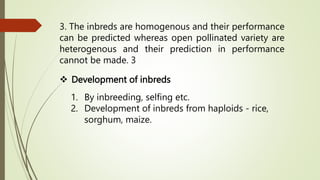
 Development of inbreds
1. By inbreeding, selfing etc.
2. Development of inbreds from haploids - rice,
sorghum, maize.
3. The inbreds are homogenous and their performance
can be predicted whereas open pollinated variety are
heterogenous and their prediction in performance
cannot be made. 3
Evaluation of inbreds
a) Phenotypic evaluation
b) Top cross test
c) Single cross evaluation
d) Prediction of double cross performance
 Phenotypic evaluation
Based on phenotypic performance. Highly suitable
for characters with high heritability.
 Top cross test
Top cross test provides a reliable estimate of GCA. The
selected inbreds will be crossed to a tester parent with
wide genetic base i.e. open pollinated variety. The
cross progenies will be evaluated in replicated
progeny rows. Based on results better inbreds can be
selected.
 Single cross evaluation
The developed inbreds can be crossed and the
single crosses can be estimated in replicated trial.
Outstanding hybrids tested over years in different
locations, then released.
 Prediction of double cross performance
The predicted performance of any double cross is the average
performance of the four non parental single crosses involving the
four parental inbreds. Inbreds: A, B, C, D.
6 possible single crosses = A x B, A x C, A x D, B x C, B x D, C x D.
From these 3 double crosses produced = (A x B) x (C x D), A x C) x
(B x D), (A x D) x (B x C)
The performance of these anyone double cross can be predicted
from performance of the four single crosses not involved in
producing that particular hybrid.
(A x B) x (C x D) = [(A x C) + (A x D) + (B x C) + (B x D)]/4
Production of Hybrids:
 Methods:
I. Hand emasculation and dusting - Cotton,
Tomato, Chillies, Bhendi
II. Use of male sterile lines a) Cytoplasmic male
sterility – ornamentals b) Genic male sterility -
Redgram, Castor. c) Cytoplasmic - genic male
sterility Jowar, Bajra, Rice
III. Use of self in compatibility By planting cross
compatible lines hybrids are produced. Here
both are hybrids. E.g. Brassicas.
 Success of hybrids:
• Easy hand emasculation
• Abundant seed set to compensate cost of hand
emasculation.
• Stable male sterile lines.
• Effective restorers.
• Effective pollen dispersal.
Synthetic Varieties
A synthetic variety is produced by crossing in all
combinations a number of inbreds (4-6) that combine
well with each other. The inbreds are tested for their
GCA. Once synthesised, a synthetic is maintained by
open pollination. The lines that make up a synthetic
may be usually inbred line but open pollinated variety,
or other population tested for general combining ability
are also be used.
Synthetic varieties are common in grasses, clover,
maize and sugar beets. The normal procedure is
equal amounts of seeds from parental lines (Syn0) is
mixed and planted in isolation. Open pollination is
allowed. The progeny obtained is Syn1. This is
distributed as synthetic variety or it may be grown in
isolation for one more season and Syn2 is
distributed.
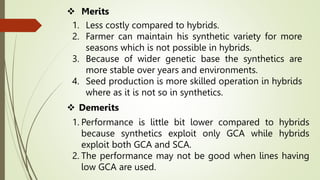
1. Less costly compared to hybrids.
2. Farmer can maintain his synthetic variety for more
seasons which is not possible in hybrids.
3. Because of wider genetic base the synthetics are
more stable over years and environments.
4. Seed production is more skilled operation in hybrids
where as it is not so in synthetics.
 Merits
 Demerits
1. Performance is little bit lower compared to hybrids
because synthetics exploit only GCA while hybrids
exploit both GCA and SCA.
2. The performance may not be good when lines having
low GCA are used.
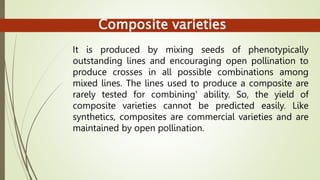
Composite varieties
It is produced by mixing seeds of phenotypically
outstanding lines and encouraging open pollination to
produce crosses in all possible combinations among
mixed lines. The lines used to produce a composite are
rarely tested for combining' ability. So, the yield of
composite varieties cannot be predicted easily. Like
synthetics, composites are commercial varieties and are
maintained by open pollination.
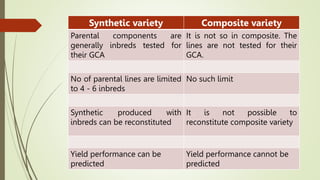
Synthetic variety Composite variety
Parental components are
generally inbreds tested for
their GCA
It is not so in composite. The
lines are not tested for their
GCA.
No of parental lines are limited
to 4 - 6 inbreds
No such limit
Synthetic produced with
inbreds can be reconstituted
It is not possible to
reconstitute composite variety
Yield performance can be
predicted
Yield performance cannot be
predicted
BREEDING METHOD IN CROSS POLLINATED CROPS.pptx

BREEDING METHOD IN CROSS POLLINATED CROPS.pptx

  • 1.
    Breeding methods in crosspollinated crops Breeding methods in cross pollinated crops Sam Higginbottom University of Agriculture, Technology And Sciences VIJAYPAL SINGH THAKUR 22MSAGPB042
  • 2.
    Contents: • Introduction •Characters of cross pollinated crops • Methods of breeding in cross pollinated crops • Mass selection • Recurrent selection • Progeny selection (or) ear-to-row method • Modified ear-to-row method • Hybrid varieties • Synthetic varieties
  • 3.
    Introduction Populations of cross-pollinatedcrops are highly heterozygous. When inbreeding is practiced, they show severe inbreeding depression. So, to avoid inbreeding depression and its undesirable effects, the breeding methods in the crop is designed in such a way that there will be a minimum inbreeding. The breeding methods commonly used in cross pollinated crops.
  • 4.
    Characters of crosspollinated plants  Each genotypes has equal chances of mating with all other genotypes.  Individuals are heterozygous in nature.  Higher degree of inbreeding depression.  Wide adaptability and more flexibility to environmental changes due to heterozygosity and heterogeneity.  Cross pollination permits new gene combinations from different sources.  Individuals have deleterious recessive gene which are concealed by masking effect of dominant genes.
  • 5.
    Methods of breedingin cross pollinated crops Population Improvement Population improvement In cross pollinated crops, population improvement is used to enhance the frequency of desirable alleles in a population. Population improvement without progeny test: Mass selection, Population improvement with progeny testing includes Recurrent selection,
  • 6.
    Without progeny testing Mass selection This is similar to the one, which is practiced, in self- pollinated crops. A number of plants are selected based on their phenotype and open pollinated seed from them are bulked together to raise the next generation. The selection cycle is repeated one or more times to increase the frequency of favourable alleles. Such a selection is known as phenotypic recurrent selection.
  • 7.
    Merits • Simple andless time consuming • Highly effective for character that are easily heritable. Eg. Plant height, duration. • It will have high adaptability because the base population is locally adapted one.
  • 8.
    Demerits • Selection isbased on phenotype only which is influenced by environment • The selected plants are pollinated both by superior and inferior pollens present in the population. • High intensity of selection may lead reduction in population there by leading to inbreeding.
  • 9.
    Recurrent selection This isone of the breeding methods followed for the improvement of cross-pollinated crop. Here single plants are selected based on their phenotype or by progeny testing. The selected single plants are selfed. In the next generation they are intermated (cross in all possible combinations) to produce population for next cycle of selection. The recurrent selection schemes are modified forms of progeny selection programmes.
  • 10.
    i) The mannerin which progenies are obtained for evaluation. ii) Instead of open pollination, making all possible inter crosses among the selected lines. The recurrent selection schemes are of 4 different types:  Simple Recurrent Selection  Recurrent Selection for GCA  Recurrent Selection for SCA  Reciprocal Recurrent Selection
  • 11.
    • Simple RecurrentSelection  A type of recurrent selection that does not include tester is referred as simple recurrent selection.  It is also known as phenotypic recurrent selection as it is based on the phenotype of the parent  It does not measure the combining ability  Used for characters having high heritability
  • 12.
    First Year: i) Severalsuperior plants are selected. ii) Selected plants selfed. iii) Harvest the single plants. iv) Seeds are evaluated, superior plants are identified Second Year: i) Progeny rows raised ii) Inter crosses are made in all combination by hand. iii) Equal amount of seed bulked from each cross. Third Year: i) Composited seeds raised ii) Repeat the operation as in first year
  • 13.
    Fourth Year: Repeatas in second year. i) Recurrent selection is effective in increasing the frequency of desirable genes in the population ii) Most suited for characters having high heritability. iii) Inbreeding is kept at minimum. Eg: oil content, protein content and high heritability traits are effective for increasing the frequency of desirable genes in the selected populations
  • 15.
    Recurrent Selection forGCA Combining ability Ability of a strain to produce superior progeny when crossed with other strains. • General combining ability (GCA) Average performance of a strain in a series of cross combinations. The GCA is estimated from the performance of F1 S from the crosses. The tester will have a broad genetic base.
  • 16.
    Recurrent Selection forSCA • Specific combining ability (SCA) Deviation in performance of a cross combination from that predicted on the basis of general combining ability of the parents involved in the cross. The testing will be on inbred
  • 17.
    Reciprocal Recurrent Selection(RRS) • used to improve both GCA and SCA of a population for a character • using two heterozygous testers. • Comstock et al in 1949, proposed this method. Main Features of these Methods: 1) It is used for improvement of polygenic characters. 2) Selection is made on the basis of test cross performance. 3) Two heterozygous tester are used as a source of population.
  • 18.
    Hybrids They are thefirst generation from crosses between two pure lines, inbreds, open pollinated varieties of other populations that are genetically not similar. Pure line hybrids: Tomato. Inbred hybrids: Maize, bajra.
  • 19.
    Kinds of hybrids: 1.Single cross hybrids (A x B) Crossing two inbreeds or pure lines. 2. Three-way cross hybrid (A x B) x C A cross between a single cross hybrid and an inbred. 3. Double cross hybrid (A x B) x (C x D) cross between two F1s. 4. Double Top Cross hybrid Double cross hybrid crossed with open pollinated variety
  • 20.
    Operation in productionof hybrids: In production of hybrids inbreds are preferred rather than open pollinated varieties for the following reasons: 1. Inbreds can be maintained without a change in the genotype. Whereas open pollinated variety cannot be maintained pure. They may alter genotypically due to natural selection etc. 2. The hybrids derived from inbreds will be uniform where as it may not be in case, of open pollinated variety.
  • 21.
     Development ofinbreds 1. By inbreeding, selfing etc. 2. Development of inbreds from haploids - rice, sorghum, maize. 3. The inbreds are homogenous and their performance can be predicted whereas open pollinated variety are heterogenous and their prediction in performance cannot be made. 3
  • 22.
    Evaluation of inbreds a)Phenotypic evaluation b) Top cross test c) Single cross evaluation d) Prediction of double cross performance  Phenotypic evaluation Based on phenotypic performance. Highly suitable for characters with high heritability.
  • 23.
     Top crosstest Top cross test provides a reliable estimate of GCA. The selected inbreds will be crossed to a tester parent with wide genetic base i.e. open pollinated variety. The cross progenies will be evaluated in replicated progeny rows. Based on results better inbreds can be selected.  Single cross evaluation The developed inbreds can be crossed and the single crosses can be estimated in replicated trial. Outstanding hybrids tested over years in different locations, then released.
  • 24.
     Prediction ofdouble cross performance The predicted performance of any double cross is the average performance of the four non parental single crosses involving the four parental inbreds. Inbreds: A, B, C, D. 6 possible single crosses = A x B, A x C, A x D, B x C, B x D, C x D. From these 3 double crosses produced = (A x B) x (C x D), A x C) x (B x D), (A x D) x (B x C) The performance of these anyone double cross can be predicted from performance of the four single crosses not involved in producing that particular hybrid. (A x B) x (C x D) = [(A x C) + (A x D) + (B x C) + (B x D)]/4
  • 25.
    Production of Hybrids: Methods: I. Hand emasculation and dusting - Cotton, Tomato, Chillies, Bhendi II. Use of male sterile lines a) Cytoplasmic male sterility – ornamentals b) Genic male sterility - Redgram, Castor. c) Cytoplasmic - genic male sterility Jowar, Bajra, Rice III. Use of self in compatibility By planting cross compatible lines hybrids are produced. Here both are hybrids. E.g. Brassicas.
  • 26.
     Success ofhybrids: • Easy hand emasculation • Abundant seed set to compensate cost of hand emasculation. • Stable male sterile lines. • Effective restorers. • Effective pollen dispersal.
  • 27.
    Synthetic Varieties A syntheticvariety is produced by crossing in all combinations a number of inbreds (4-6) that combine well with each other. The inbreds are tested for their GCA. Once synthesised, a synthetic is maintained by open pollination. The lines that make up a synthetic may be usually inbred line but open pollinated variety, or other population tested for general combining ability are also be used.
  • 28.
    Synthetic varieties arecommon in grasses, clover, maize and sugar beets. The normal procedure is equal amounts of seeds from parental lines (Syn0) is mixed and planted in isolation. Open pollination is allowed. The progeny obtained is Syn1. This is distributed as synthetic variety or it may be grown in isolation for one more season and Syn2 is distributed.
  • 29.
    1. Less costlycompared to hybrids. 2. Farmer can maintain his synthetic variety for more seasons which is not possible in hybrids. 3. Because of wider genetic base the synthetics are more stable over years and environments. 4. Seed production is more skilled operation in hybrids where as it is not so in synthetics.  Merits  Demerits 1. Performance is little bit lower compared to hybrids because synthetics exploit only GCA while hybrids exploit both GCA and SCA. 2. The performance may not be good when lines having low GCA are used.
  • 30.
    Composite varieties It isproduced by mixing seeds of phenotypically outstanding lines and encouraging open pollination to produce crosses in all possible combinations among mixed lines. The lines used to produce a composite are rarely tested for combining' ability. So, the yield of composite varieties cannot be predicted easily. Like synthetics, composites are commercial varieties and are maintained by open pollination.
  • 31.
    Synthetic variety Compositevariety Parental components are generally inbreds tested for their GCA It is not so in composite. The lines are not tested for their GCA. No of parental lines are limited to 4 - 6 inbreds No such limit Synthetic produced with inbreds can be reconstituted It is not possible to reconstitute composite variety Yield performance can be predicted Yield performance cannot be predicted