PRESENTATION
ON
CHILLIES BREEDING

PRESENTED BY:
F.Z
ROLL NO: 08

PLANT BREEDING
&GENETICS
CLASSIFICATION
 Kingdom: Plantae
 Division:

 Class:
 Order:
 Family:
 Genus:
 Specie:

Magnoliophyta
Magnoliopsida
Solanales
Solanaceae (night shade family)
Capsicum
annum, frutescence, baccatum,
pubescence, chinense
Capsicum annum
Ccapsicum
baccatum

Capsicum
frutescens

Capsicum chinense

Capsicum pubescens
INTRODUCTION
 Chillie is both a vegetable crop & a spice crop.
 It is rich source of Vitamin A & C.
 There are more than 400 varieties of chillies found all
over the world.
 It is also called as hot pepper, sweet pepper, bell
pepper etc.

 Its fruit is called as peprika.
 Both Chillie & Capsicum belong to the same
genus,i.e; Capsicum.

 Pungency in chillies is due to alkaloid capsaicin.
 Red color of chillies is due to the pigment capsanthin.
 Capsicum/Shimla mirch/bell pepper, is less pungent.
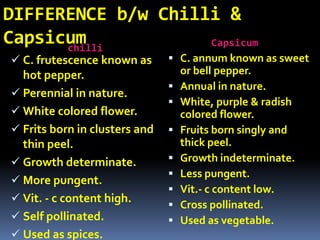
DIFFERENCE b/w Chilli &
Capsicum
Capsicum
chilli
 C. frutescence known as
hot pepper.
 Perennial in nature.
 White colored flower.

 C. annum known as sweet




 Frits born in clusters and
thin peel.



 Growth determinate.







 More pungent.

 Vit. - c content high.
 Self pollinated.
 Used as spices.

or bell pepper.
Annual in nature.
White, purple & radish
colored flower.
Fruits born singly and
thick peel.
Growth indeterminate.
Less pungent.
Vit.- c content low.
Cross pollinated.
Used as vegetable.
HISTORY

 Its species are native to
America ,where they
have been cultivated for

thousands of years.
 The three species C.
annuum, C. frutescens
and C. chinense evolved
from a common ancestor
located in the North of
the Amazon basin.
CLIMATE
 Growing chillies require warm growin





environment.
It is raised from sea level to 2000 meter
above sea level.
Optimum temperature for fruit set is 24 C.
Night temperature below 10 C fruit set
restricted.
Fruit weight, length, girth and pericarp
thickness were high at 25 C day and 18 C
night temperature.
SOIL & FIELD PREPARATION
 Chilli can be grown all

types of soils from light
sandy to heavy clay.
 Optimum soil pH for
chilli is 5.8 to 6.5.
 Very sensitive to water
logging.
 Thoroughly plough the
land 3-4 times followed
by planking to level the
field
IRRIGATION
 Chilli plant cannot withstand water

stagnation & excess moisture.
 Hence light irrigation &proper drainage is
recommended.
 Generally crop is irrigated at an interval of
5-6days in summer and 9-10 days in winter.
 Sandy soil require frequent irrigation than
clay soil.

INTRUSTING
BHUT JOLOKIA IS

THE WORLDS
HOTTEST
PEPPER.
 Chilli is self-pollinating crop.
 In which pollen grains transfer to stigma of

same flower or different flower in same plant.
 Such crops are highly homozygous.
Breeding methods for self
pollinating crops;
COMMONLY USED
METHODS/ GENERAL
BREEDING METHODS

RARELY USED
METHODS

Plant introduction

Mutation breeding

Selection(pureline, mass
selection, )

polyploidy

Hybridization(pedigree,
bulk, single seed descent,
backcross)

Transgenic breeding
PLANT INTRODUCTION: It is introducing a plant into new regions

from its growing locality.
 Proper management is very important.
 Material which is to be introduced should
not carry any pest and disease.
MASS SELECTION: It is oldest method.
 M.S refers to the selection of superior plants

on the basis of phenotype from a mixed
population. Their seeds are bulked &used to
raise the next generation.

 MERIT: Good for improvement of old cultivars&

landraces.
 For purification of improved cultivars.
 Mass selected varieties provide good
protection against diseases.
 Mass selected varieties are more stable in

performance than pure line varieties.

 DEMERITS: Progeny test is not carried out.
 The product is less uniform than pure line.

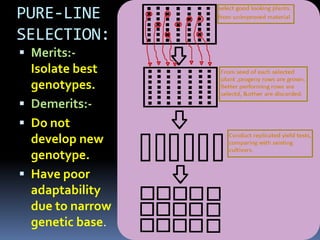
PURE-LINE
SELECTION:
 Merits:-

Isolate best
genotypes.
 Demerits: Do not
develop new
genotype.
 Have poor
adaptability
due to narrow
genetic base.
HYBRIDIZATION: Crossing of two dissimilar plants is known as

Hybridization.
 A cross is made b/w male parent of one
genotype & female parent of other genotype.
 We get F1 hybrid.

 BULK METHOD: F2 &subsequent generations are harvested in

bulk, &at the end individual plant selection
&evaluation is made in F8.
 Superior progenies are released as new
cultivar.
SINGLE SEED DESCENT METHOD: A breeding procedure used with segreggating

populations of self pollinated species in which
plants are advanced by single seed from one
generation to the next is referred to as SSD
method.
 In this method, a single seed from each of 10002000 plants are bulked to raise nnext generation.
 In F3 & subsequent generations one random
seed is selected from every plant in population &
harvested in bulk to raise the next generation
VARIETIES OF CAPSICUM ANNUM
VARIETIES OF CAPSICUM CHINENSE
VARIETIES OF CAPSICUM FRUTESCENS
Presentation on chillie breeding

Presentation on chillie breeding

  • 1.
  • 3.
    CLASSIFICATION  Kingdom: Plantae Division:  Class:  Order:  Family:  Genus:  Specie: Magnoliophyta Magnoliopsida Solanales Solanaceae (night shade family) Capsicum annum, frutescence, baccatum, pubescence, chinense
  • 4.
  • 6.
    INTRODUCTION  Chillie isboth a vegetable crop & a spice crop.  It is rich source of Vitamin A & C.  There are more than 400 varieties of chillies found all over the world.  It is also called as hot pepper, sweet pepper, bell pepper etc.  Its fruit is called as peprika.  Both Chillie & Capsicum belong to the same genus,i.e; Capsicum.  Pungency in chillies is due to alkaloid capsaicin.  Red color of chillies is due to the pigment capsanthin.  Capsicum/Shimla mirch/bell pepper, is less pungent.
  • 7.
    DIFFERENCE b/w Chilli& Capsicum Capsicum chilli  C. frutescence known as hot pepper.  Perennial in nature.  White colored flower.  C. annum known as sweet    Frits born in clusters and thin peel.   Growth determinate.       More pungent.  Vit. - c content high.  Self pollinated.  Used as spices. or bell pepper. Annual in nature. White, purple & radish colored flower. Fruits born singly and thick peel. Growth indeterminate. Less pungent. Vit.- c content low. Cross pollinated. Used as vegetable.
  • 8.
    HISTORY  Its speciesare native to America ,where they have been cultivated for thousands of years.  The three species C. annuum, C. frutescens and C. chinense evolved from a common ancestor located in the North of the Amazon basin.
  • 9.
    CLIMATE  Growing chilliesrequire warm growin     environment. It is raised from sea level to 2000 meter above sea level. Optimum temperature for fruit set is 24 C. Night temperature below 10 C fruit set restricted. Fruit weight, length, girth and pericarp thickness were high at 25 C day and 18 C night temperature.
  • 10.
    SOIL & FIELDPREPARATION  Chilli can be grown all types of soils from light sandy to heavy clay.  Optimum soil pH for chilli is 5.8 to 6.5.  Very sensitive to water logging.  Thoroughly plough the land 3-4 times followed by planking to level the field
  • 11.
    IRRIGATION  Chilli plantcannot withstand water stagnation & excess moisture.  Hence light irrigation &proper drainage is recommended.  Generally crop is irrigated at an interval of 5-6days in summer and 9-10 days in winter.  Sandy soil require frequent irrigation than clay soil.
  • 12.
  • 14.
     Chilli isself-pollinating crop.  In which pollen grains transfer to stigma of same flower or different flower in same plant.  Such crops are highly homozygous.
  • 15.
    Breeding methods forself pollinating crops; COMMONLY USED METHODS/ GENERAL BREEDING METHODS RARELY USED METHODS Plant introduction Mutation breeding Selection(pureline, mass selection, ) polyploidy Hybridization(pedigree, bulk, single seed descent, backcross) Transgenic breeding
  • 16.
    PLANT INTRODUCTION: Itis introducing a plant into new regions from its growing locality.  Proper management is very important.  Material which is to be introduced should not carry any pest and disease.
  • 17.
    MASS SELECTION: Itis oldest method.  M.S refers to the selection of superior plants on the basis of phenotype from a mixed population. Their seeds are bulked &used to raise the next generation.  MERIT: Good for improvement of old cultivars& landraces.  For purification of improved cultivars.  Mass selected varieties provide good protection against diseases.
  • 18.
     Mass selectedvarieties are more stable in performance than pure line varieties.  DEMERITS: Progeny test is not carried out.  The product is less uniform than pure line. 
  • 20.
    PURE-LINE SELECTION:  Merits:- Isolate best genotypes. Demerits: Do not develop new genotype.  Have poor adaptability due to narrow genetic base.
  • 21.
    HYBRIDIZATION: Crossing oftwo dissimilar plants is known as Hybridization.  A cross is made b/w male parent of one genotype & female parent of other genotype.  We get F1 hybrid.  BULK METHOD: F2 &subsequent generations are harvested in bulk, &at the end individual plant selection &evaluation is made in F8.  Superior progenies are released as new cultivar.
  • 24.
    SINGLE SEED DESCENTMETHOD: A breeding procedure used with segreggating populations of self pollinated species in which plants are advanced by single seed from one generation to the next is referred to as SSD method.  In this method, a single seed from each of 10002000 plants are bulked to raise nnext generation.  In F3 & subsequent generations one random seed is selected from every plant in population & harvested in bulk to raise the next generation
  • 26.
  • 27.
  • 28.