By
DR KHALED SALEH ALGARIRI
November 2015
HORMONE:
MECHANISM & ACTION
HORMONE
A hormone is chemical regulatory substance,
secreted by endocrine glands.
It passes through blood stream to reach the
tissues on which it acts. These tissues are called
“target tissues”.
TARGET TISSUE
Target tissue of a certain hormone is the
tissue, which contains the specific receptors
of that hormone
• Trophic hormone:- A hormone that has its primary function the
regulation of hormone secretion by another endocrine gland
• Synergism-when different hormones work together and have a
greater effect than individual hormone action
• Permissiveness-a small amount of one hormone allows a second
hormone to have its full effect on a target cell; i.e. first hormone
‘permits’ the full action of the second hormone
• Antagonism-one hormone produces the opposite effect of the
other
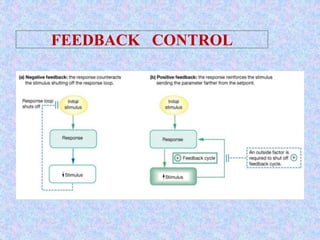
• The processes involve in both negative and positive feedback.
For example, if A>B>C>D, increase in D causes inhibition of A i.e.
negative feedback. If D decreases, A production is triggered, i.e.
positive feedback.
GENERAL PRINCIPLES OF HORMONE
ACTION
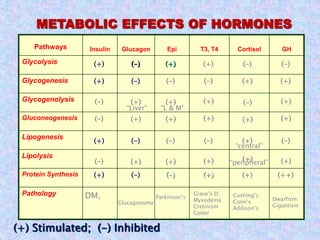
Pathways Insulin Glucagon Epi T3, T4 Cortisol GH
Glycolysis
Glycogenesis
Glycogenolysis
Gluconeogenesis
Lipogenesis
Lipolysis
Protein Synthesis
Pathology
(+)
(+)
(+)
(+)
(-)
(-)
(-)
(-)
(-)
(-)
(-)
(+)
(+)
(+)
(+)
(-)
(-)
(-)
(+)
(+)
(+)
(+)
(-)
(-)
(+)
(+)
(+)
(+)
(-)
(+)
(+)
(+)
(-)
(+)
(+)
(-)
(+)
(-)
(++)
(+)
(+)
(+)
“central”
“peripheral”
“Liver” “L & M”
DM,
Glucagonoma
Parkinson’s
Grave’s D.
Myxedema
Cretinism
Goiter
Cushing’s
Conn’s
Addison’s
Dwarfism
Gigantism
METABOLIC EFFECTS OF HORMONES
(+) Stimulated; (-) Inhibited
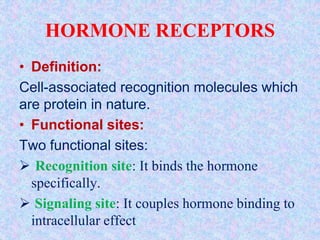
HORMONE RECEPTORS
• Definition:
Cell-associated recognition molecules which
are protein in nature.
• Functional sites:
Two functional sites:
 Recognition site: It binds the hormone
specifically.
 Signaling site: It couples hormone binding to
intracellular effect
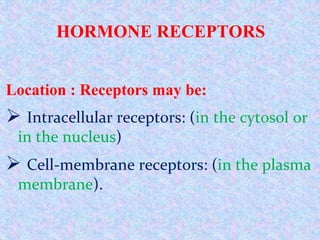
HORMONE RECEPTORS
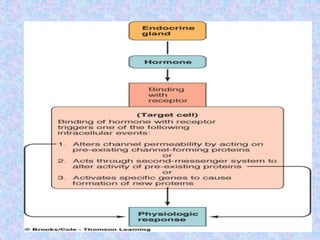
Location : Receptors may be:
 Intracellular receptors: (in the cytosol or
in the nucleus)
 Cell-membrane receptors: (in the plasma
membrane).
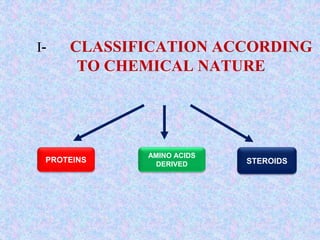
I- CLASSIFICATION ACCORDING
TO CHEMICAL NATURE
PROTEINS
AMINO ACIDS
DERIVED STEROIDS
I- CLASSIFICATION ACCORDING
TO CHEMICAL NATURE
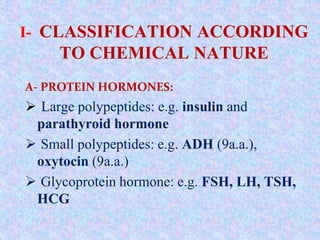
A- PROTEIN HORMONES:
 Large polypeptides: e.g. insulin and
parathyroid hormone
 Small polypeptides: e.g. ADH (9a.a.),
oxytocin (9a.a.)
 Glycoprotein hormone: e.g. FSH, LH, TSH,
HCG
I- CLASSIFICATION ACCORDING TO
CHEMICAL NATURE
B- AMINO ACID DERIVED HORMONES:
Thyroid hormones and catecholamines are
derived from tyrosine.
Melatonin is derived from tryptophan
I- CLASSIFICATION ACCORDING TO
CHEMICAL NATURE
C- Steroid hormones:
• These hormones are derived from cholesterol. e.g.
 Glucocorticoids.
 Mineralocorticoids.
 Sex hormones.
II-CLASSIFICATION ACCORDING TO
MECHANISM OF ACTION
A- Hormones, which bind to intracellular
receptors.
B- Hormones, which bind to membrane receptors
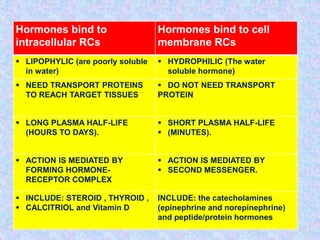
Hormones bind to
intracellular RCs
Hormones bind to cell
membrane RCs
 LIPOPHYLIC (are poorly soluble
in water)
 HYDROPHILIC (The water
soluble hormone)
 NEED TRANSPORT PROTEINS
TO REACH TARGET TISSUES
 DO NOT NEED TRANSPORT
PROTEIN
 LONG PLASMA HALF-LIFE
(HOURS TO DAYS).
 SHORT PLASMA HALF-LIFE
 (MINUTES).
 ACTION IS MEDIATED BY
FORMING HORMONE-
RECEPTOR COMPLEX
 ACTION IS MEDIATED BY
 SECOND MESSENGER.
 INCLUDE: STEROID , THYROID ,
 CALCITRIOL and Vitamin D
INCLUDE: the catecholamines
(epinephrine and norepinephrine)
and peptide/protein hormones
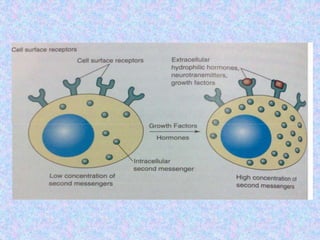
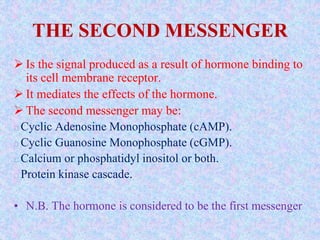
THE SECOND MESSENGER
 Is the signal produced as a result of hormone binding to
its cell membrane receptor.
 It mediates the effects of the hormone.
 The second messenger may be:
Cyclic Adenosine Monophosphate (cAMP).
Cyclic Guanosine Monophosphate (cGMP).
Calcium or phosphatidyl inositol or both.
Protein kinase cascade.
• N.B. The hormone is considered to be the first messenger
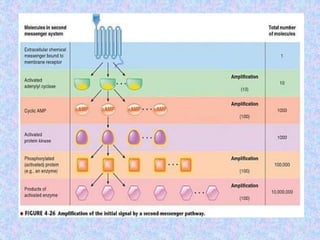
Signal Amplification Via 2nd Messenger
Pathways
Initial signal is in the form of hormone
which acts as ligand whose concentration
is just one/per receptor. The hormonal
response has got multiple steps, and each
step multiplies the signal (cascading
effect) that finally leading to million fold
amplification, i.e. one hormone molecule
mediating its effect through million of
molecules. This process is known as
signal amplification.
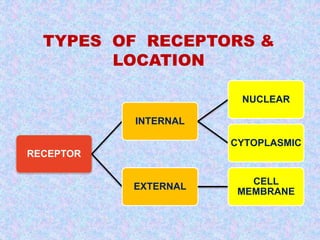
RECEPTOR
INTERNAL
NUCLEAR
CYTOPLASMIC
EXTERNAL
CELL
MEMBRANE
TYPES OF RECEPTORS &
LOCATION
• Binding to specific cell receptor in the cell
membrane and form hormone-cell receptor
complex, which diffuses to nucleus
• The receptor is eventually released for re-use
• Steroid activates a specific gene to produce
mRNA
• mRNA pass out into the cytoplasm and initiates
protein [enzyme] synthesis
why do they penetrate the cell?
 the whole process is called mobile-receptor
hypothesis in which a steroid hormone is not
attached to the plasma membrane, but seem to move
freely in the nucleoplasm
HOW LIPID-SOLUBLE HORMONES WORK?
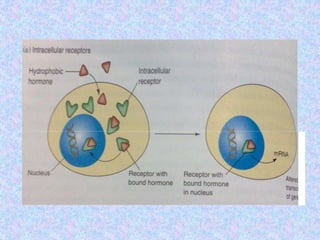
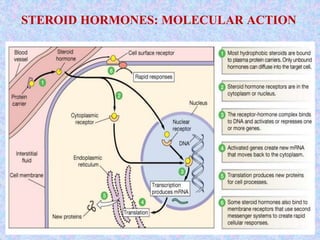
• Step1: Free lipophilic hormone (hormone not bound with its
plasma protein carrier) diffuses through the plasma
membrane of the target cell and binds with the receptor which
is intracellularly located inside the cytosol/or in the nucleus.
• Step2. Each receptor has specific binding region with
hormone and another region with binding with DNA. Receptor
alone cannot bind to DNA unless it binds to hormone. Once
the hormone is bound to receptor, the hormone receptor
complex binds to specific region of DNA known as Hormone
response element(HRE).
• Step3: Transcription of gene
• Step4: m RNA transported out of nucleus into the cytoplasm
• Step5: Translation at Ribosome
• Step6: Protein/enzyme released from ribosome
• Step7: protein/enzyme mediate ultimate response
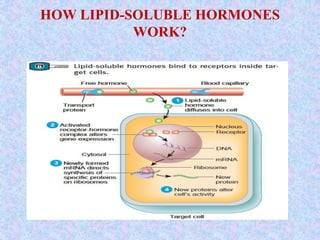
HOW LIPID-SOLUBLE HORMONES
WORK?
STEROID HORMONES: MOLECULAR ACTION
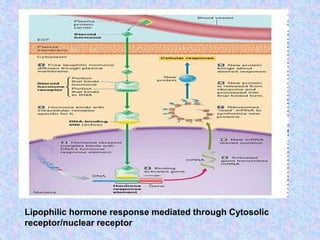
Lipophilic hormone response mediated through Cytosolic
receptor/nuclear receptor
HOW LIPID-SOLUBLE HORMONES
WORK?
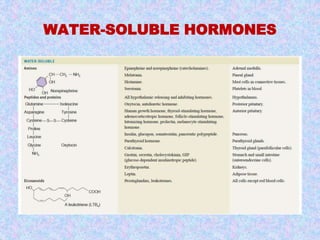
WATER-SOLUBLE HORMONES
HOW WATER-SOLUBLE HORMONES
WORK?
HOW WATER-SOLUBLE
HORMONES WORK?
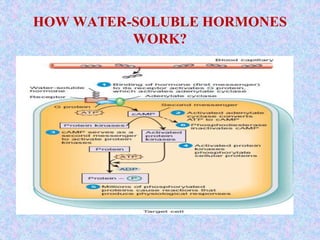
• ●1 A water-soluble hormone (the first messenger) diffuses from
the blood through interstitial fluid and then binds to its receptor at the
exterior surface of a target cell’s plasma membrane. The hormone–
receptor complex activates a membrane protein called a G protein.
The activated G protein in turn activates adenylate cyclase.
• ●2 Adenylate cyclase converts ATP into cyclic AMP (cAMP).
Because the enzyme’s active site is on the inner surface of the
plasma membrane, this reaction occurs in the cytosol of the cell.
• ●3 Cyclic AMP (the second messenger) activates one or more
protein kinases, which may be free in the cytosol or bound to the
plasma membrane. A protein kinase is an enzyme that
phosphorylates (adds a phosphate group to) other cellular proteins
(such as enzymes). The donor of the phosphate group is ATP,
which is converted to ADP.
HOW WATER-SOLUBLE
HORMONES WORK?
• ●4 Activated protein kinases phosphorylate one or more cellular
proteins. Phosphorylation activates some of these proteins and
inactivates others, rather like turning a switch on or off.
• ●5 Phosphorylated proteins in turn cause reactions that produce
physiological responses. Different protein kinases exist within different
target cells and within different organelles of the same target cell. Thus,
one protein kinase might trigger glycogen synthesis, a second might
cause the breakdown of triglyceride, a third may promote protein
synthesis, and so forth. As noted in step ●4 phosphorylation by a
protein kinase can also inhibit certain proteins. For example, some of the
kinases unleashed when epinephrine binds to liver cells inactivate an
enzyme needed for glycogen synthesis
.
• ●6 After a brief period, an enzyme called phosphodiesterase inactivates
cAMP. Thus, the cell’s response is turned off unless new hormone
molecules continue to bind to their receptors in the plasma membrane
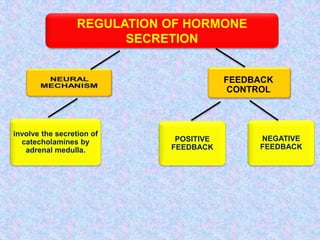
REGULATION OF HORMONE
SECRETION
FEEDBACK
CONTROL
involve the secretion of
catecholamines by
adrenal medulla.
NEGATIVE
FEEDBACK
POSITIVE
FEEDBACK
FEEDBACK CONTROL
REGULATION OF HORMONE SECRETION
Hormone Metabolism
Feedback Control
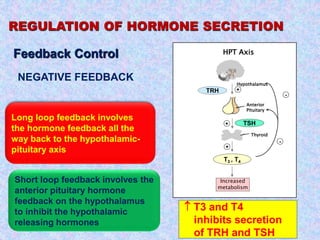
NEGATIVE FEEDBACK
HPT Axis
Hypothalamus
TRH
TSH
T3 , T4
+
-
+
+
-
Anterior
Pituitary
Thyroid
Increased
metabolism
 T3 and T4
inhibits secretion
of TRH and TSH
Long loop feedback involves
the hormone feedback all the
way back to the hypothalamic-
pituitary axis
Short loop feedback involves the
anterior pituitary hormone
feedback on the hypothalamus
to inhibit the hypothalamic
releasing hormones
Hormone Metabolism
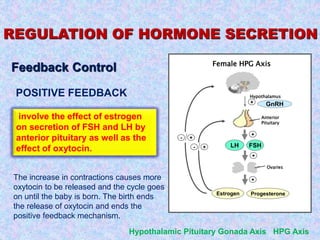
Female HPG Axis
+
+
Hypothalamus
+
Anterior
Pituitary
Ovaries
Estrogen Progesterone
+
+
+
-
- FSHLH
GnRH
REGULATION OF HORMONE SECRETION
Feedback Control
involve the effect of estrogen
on secretion of FSH and LH by
anterior pituitary as well as the
effect of oxytocin.
Hypothalamic Pituitary Gonada Axis HPG Axis
POSITIVE FEEDBACK
The increase in contractions causes more
oxytocin to be released and the cycle goes
on until the baby is born. The birth ends
the release of oxytocin and ends the
positive feedback mechanism.
CLEARANCE OF HORMONES
Hormones are cleared by:
1.Metabolic destruction by tissues/ target cells.
2.Binding with the tissues
3.Excretion by liver into bile.
4.Excretion by kidneys into urine.
Water soluble hormones(peptides and
catecholamines) are degraded by enzymes in the
blood or tissues and are excreted by kidneys or liver.
They have a short half life.
Lipid soluble hormones(steroids) are protein
bound and are cleared slowly.
hormones: mechanism amd action 2

hormones: mechanism amd action 2

  • 1.
    By DR KHALED SALEHALGARIRI November 2015 HORMONE: MECHANISM & ACTION
  • 2.
    HORMONE A hormone ischemical regulatory substance, secreted by endocrine glands. It passes through blood stream to reach the tissues on which it acts. These tissues are called “target tissues”.
  • 3.
    TARGET TISSUE Target tissueof a certain hormone is the tissue, which contains the specific receptors of that hormone
  • 4.
    • Trophic hormone:-A hormone that has its primary function the regulation of hormone secretion by another endocrine gland • Synergism-when different hormones work together and have a greater effect than individual hormone action • Permissiveness-a small amount of one hormone allows a second hormone to have its full effect on a target cell; i.e. first hormone ‘permits’ the full action of the second hormone • Antagonism-one hormone produces the opposite effect of the other • The processes involve in both negative and positive feedback. For example, if A>B>C>D, increase in D causes inhibition of A i.e. negative feedback. If D decreases, A production is triggered, i.e. positive feedback. GENERAL PRINCIPLES OF HORMONE ACTION
  • 5.
    Pathways Insulin GlucagonEpi T3, T4 Cortisol GH Glycolysis Glycogenesis Glycogenolysis Gluconeogenesis Lipogenesis Lipolysis Protein Synthesis Pathology (+) (+) (+) (+) (-) (-) (-) (-) (-) (-) (-) (+) (+) (+) (+) (-) (-) (-) (+) (+) (+) (+) (-) (-) (+) (+) (+) (+) (-) (+) (+) (+) (-) (+) (+) (-) (+) (-) (++) (+) (+) (+) “central” “peripheral” “Liver” “L & M” DM, Glucagonoma Parkinson’s Grave’s D. Myxedema Cretinism Goiter Cushing’s Conn’s Addison’s Dwarfism Gigantism METABOLIC EFFECTS OF HORMONES (+) Stimulated; (-) Inhibited
  • 6.
    HORMONE RECEPTORS • Definition: Cell-associatedrecognition molecules which are protein in nature. • Functional sites: Two functional sites:  Recognition site: It binds the hormone specifically.  Signaling site: It couples hormone binding to intracellular effect
  • 7.
    HORMONE RECEPTORS Location :Receptors may be:  Intracellular receptors: (in the cytosol or in the nucleus)  Cell-membrane receptors: (in the plasma membrane).
  • 10.
    I- CLASSIFICATION ACCORDING TOCHEMICAL NATURE PROTEINS AMINO ACIDS DERIVED STEROIDS
  • 11.
    I- CLASSIFICATION ACCORDING TOCHEMICAL NATURE A- PROTEIN HORMONES:  Large polypeptides: e.g. insulin and parathyroid hormone  Small polypeptides: e.g. ADH (9a.a.), oxytocin (9a.a.)  Glycoprotein hormone: e.g. FSH, LH, TSH, HCG
  • 12.
    I- CLASSIFICATION ACCORDINGTO CHEMICAL NATURE B- AMINO ACID DERIVED HORMONES: Thyroid hormones and catecholamines are derived from tyrosine. Melatonin is derived from tryptophan
  • 13.
    I- CLASSIFICATION ACCORDINGTO CHEMICAL NATURE C- Steroid hormones: • These hormones are derived from cholesterol. e.g.  Glucocorticoids.  Mineralocorticoids.  Sex hormones.
  • 14.
    II-CLASSIFICATION ACCORDING TO MECHANISMOF ACTION A- Hormones, which bind to intracellular receptors. B- Hormones, which bind to membrane receptors
  • 15.
    Hormones bind to intracellularRCs Hormones bind to cell membrane RCs  LIPOPHYLIC (are poorly soluble in water)  HYDROPHILIC (The water soluble hormone)  NEED TRANSPORT PROTEINS TO REACH TARGET TISSUES  DO NOT NEED TRANSPORT PROTEIN  LONG PLASMA HALF-LIFE (HOURS TO DAYS).  SHORT PLASMA HALF-LIFE  (MINUTES).  ACTION IS MEDIATED BY FORMING HORMONE- RECEPTOR COMPLEX  ACTION IS MEDIATED BY  SECOND MESSENGER.  INCLUDE: STEROID , THYROID ,  CALCITRIOL and Vitamin D INCLUDE: the catecholamines (epinephrine and norepinephrine) and peptide/protein hormones
  • 16.
    THE SECOND MESSENGER Is the signal produced as a result of hormone binding to its cell membrane receptor.  It mediates the effects of the hormone.  The second messenger may be: Cyclic Adenosine Monophosphate (cAMP). Cyclic Guanosine Monophosphate (cGMP). Calcium or phosphatidyl inositol or both. Protein kinase cascade. • N.B. The hormone is considered to be the first messenger
  • 17.
    Signal Amplification Via2nd Messenger Pathways Initial signal is in the form of hormone which acts as ligand whose concentration is just one/per receptor. The hormonal response has got multiple steps, and each step multiplies the signal (cascading effect) that finally leading to million fold amplification, i.e. one hormone molecule mediating its effect through million of molecules. This process is known as signal amplification.
  • 19.
  • 21.
    • Binding tospecific cell receptor in the cell membrane and form hormone-cell receptor complex, which diffuses to nucleus • The receptor is eventually released for re-use • Steroid activates a specific gene to produce mRNA • mRNA pass out into the cytoplasm and initiates protein [enzyme] synthesis why do they penetrate the cell?  the whole process is called mobile-receptor hypothesis in which a steroid hormone is not attached to the plasma membrane, but seem to move freely in the nucleoplasm HOW LIPID-SOLUBLE HORMONES WORK?
  • 22.
    • Step1: Freelipophilic hormone (hormone not bound with its plasma protein carrier) diffuses through the plasma membrane of the target cell and binds with the receptor which is intracellularly located inside the cytosol/or in the nucleus. • Step2. Each receptor has specific binding region with hormone and another region with binding with DNA. Receptor alone cannot bind to DNA unless it binds to hormone. Once the hormone is bound to receptor, the hormone receptor complex binds to specific region of DNA known as Hormone response element(HRE). • Step3: Transcription of gene • Step4: m RNA transported out of nucleus into the cytoplasm • Step5: Translation at Ribosome • Step6: Protein/enzyme released from ribosome • Step7: protein/enzyme mediate ultimate response HOW LIPID-SOLUBLE HORMONES WORK?
  • 23.
  • 24.
    Lipophilic hormone responsemediated through Cytosolic receptor/nuclear receptor
  • 25.
  • 26.
  • 27.
  • 28.
    HOW WATER-SOLUBLE HORMONES WORK? •●1 A water-soluble hormone (the first messenger) diffuses from the blood through interstitial fluid and then binds to its receptor at the exterior surface of a target cell’s plasma membrane. The hormone– receptor complex activates a membrane protein called a G protein. The activated G protein in turn activates adenylate cyclase. • ●2 Adenylate cyclase converts ATP into cyclic AMP (cAMP). Because the enzyme’s active site is on the inner surface of the plasma membrane, this reaction occurs in the cytosol of the cell. • ●3 Cyclic AMP (the second messenger) activates one or more protein kinases, which may be free in the cytosol or bound to the plasma membrane. A protein kinase is an enzyme that phosphorylates (adds a phosphate group to) other cellular proteins (such as enzymes). The donor of the phosphate group is ATP, which is converted to ADP.
  • 29.
    HOW WATER-SOLUBLE HORMONES WORK? •●4 Activated protein kinases phosphorylate one or more cellular proteins. Phosphorylation activates some of these proteins and inactivates others, rather like turning a switch on or off. • ●5 Phosphorylated proteins in turn cause reactions that produce physiological responses. Different protein kinases exist within different target cells and within different organelles of the same target cell. Thus, one protein kinase might trigger glycogen synthesis, a second might cause the breakdown of triglyceride, a third may promote protein synthesis, and so forth. As noted in step ●4 phosphorylation by a protein kinase can also inhibit certain proteins. For example, some of the kinases unleashed when epinephrine binds to liver cells inactivate an enzyme needed for glycogen synthesis . • ●6 After a brief period, an enzyme called phosphodiesterase inactivates cAMP. Thus, the cell’s response is turned off unless new hormone molecules continue to bind to their receptors in the plasma membrane
  • 30.
    REGULATION OF HORMONE SECRETION FEEDBACK CONTROL involvethe secretion of catecholamines by adrenal medulla. NEGATIVE FEEDBACK POSITIVE FEEDBACK
  • 31.
  • 32.
    REGULATION OF HORMONESECRETION Hormone Metabolism Feedback Control NEGATIVE FEEDBACK HPT Axis Hypothalamus TRH TSH T3 , T4 + - + + - Anterior Pituitary Thyroid Increased metabolism  T3 and T4 inhibits secretion of TRH and TSH Long loop feedback involves the hormone feedback all the way back to the hypothalamic- pituitary axis Short loop feedback involves the anterior pituitary hormone feedback on the hypothalamus to inhibit the hypothalamic releasing hormones
  • 33.
    Hormone Metabolism Female HPGAxis + + Hypothalamus + Anterior Pituitary Ovaries Estrogen Progesterone + + + - - FSHLH GnRH REGULATION OF HORMONE SECRETION Feedback Control involve the effect of estrogen on secretion of FSH and LH by anterior pituitary as well as the effect of oxytocin. Hypothalamic Pituitary Gonada Axis HPG Axis POSITIVE FEEDBACK The increase in contractions causes more oxytocin to be released and the cycle goes on until the baby is born. The birth ends the release of oxytocin and ends the positive feedback mechanism.
  • 34.
    CLEARANCE OF HORMONES Hormonesare cleared by: 1.Metabolic destruction by tissues/ target cells. 2.Binding with the tissues 3.Excretion by liver into bile. 4.Excretion by kidneys into urine. Water soluble hormones(peptides and catecholamines) are degraded by enzymes in the blood or tissues and are excreted by kidneys or liver. They have a short half life. Lipid soluble hormones(steroids) are protein bound and are cleared slowly.