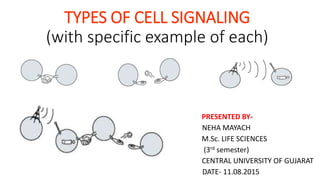
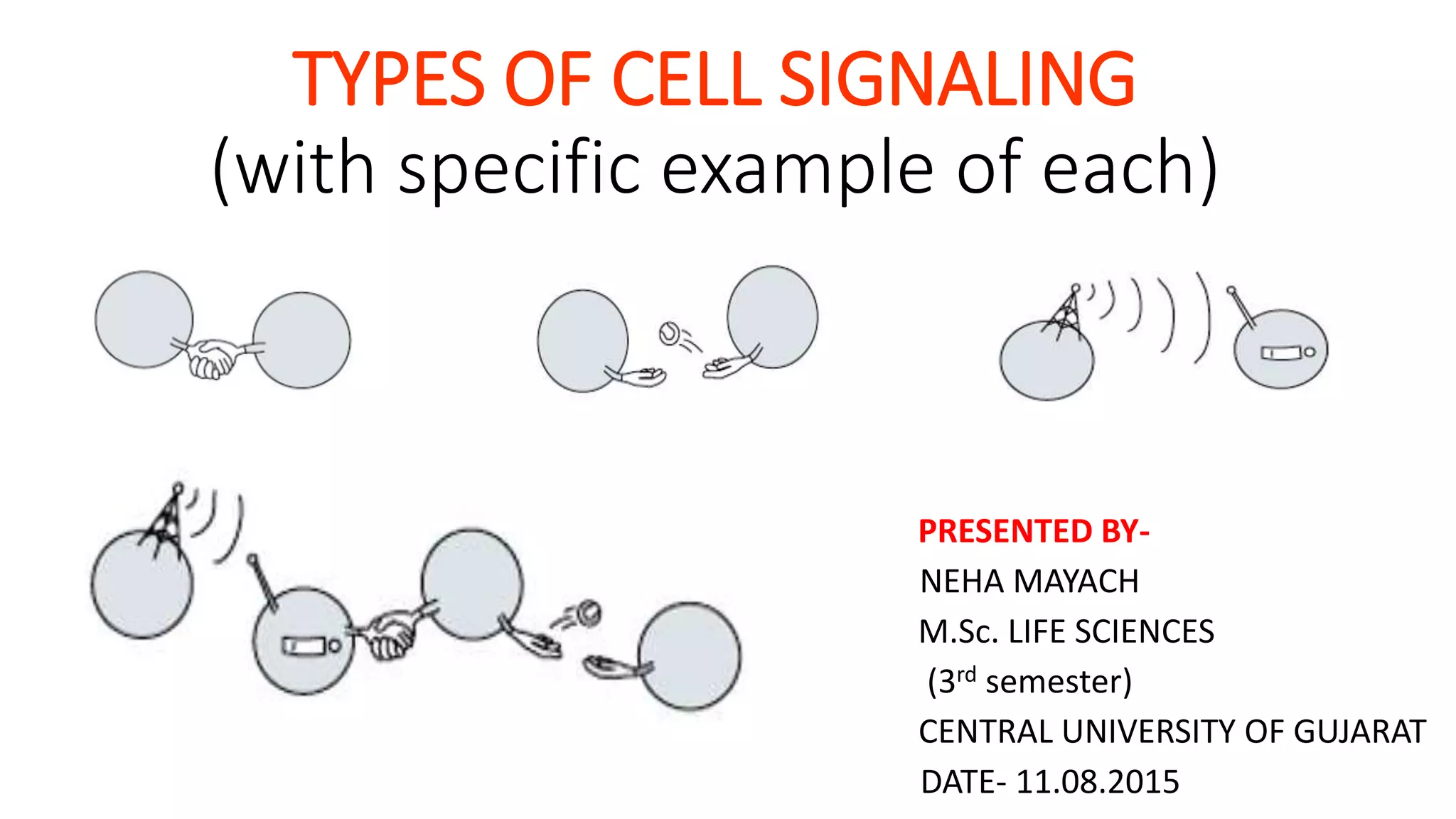
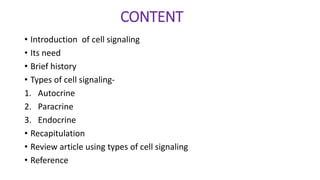
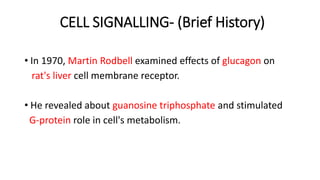
TYPES OF CELL SIGNALING
(with specific example of each)
PRESENTED BY-
NEHA MAYACH
M.Sc. LIFE SCIENCES
(3rd semester)
CENTRAL UNIVERSITY OF GUJARAT
DATE- 11.08.2015
CONTENT
• Introduction of cell signaling
• Its need
• Brief history
• Types of cell signaling-
1. Autocrine
2. Paracrine
3. Endocrine
• Recapitulation
• Review article using types of cell signaling
• Reference
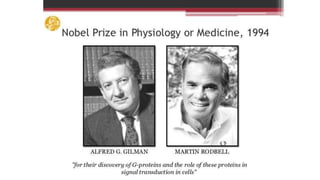
CELL SIGNALLING- (Brief History)
• In 1970, Martin Rodbell examined effects of glucagon on
rat's liver cell membrane receptor.
• He revealed about guanosine triphosphate and stimulated
G-protein role in cell's metabolism.
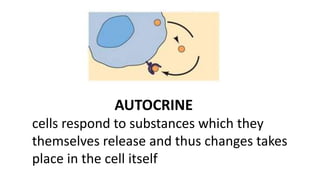
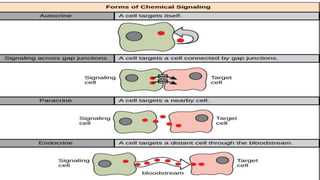
AUTOCRINE
cells respond to substances which they
themselves release and thus changes takes
place in the cell itself
EXAMPLE:-
• Tumour cells
release growth factors for their own survival and proliferation
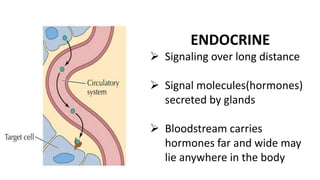
ENDOCRINE
 Signaling over long distance
 Signal molecules(hormones)
secreted by glands
 Bloodstream carries
hormones far and wide may
lie anywhere in the body
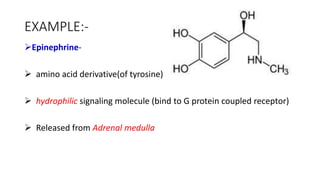
EXAMPLE:-
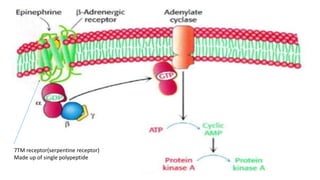
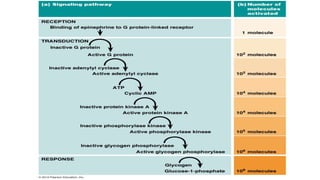
Epinephrine-
 amino acid derivative(of tyrosine)
 hydrophilic signaling molecule (bind to G protein coupled receptor)
 Released from Adrenal medulla
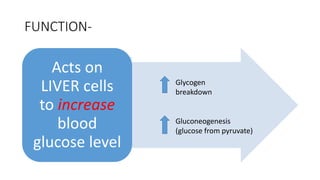
FUNCTION-
Acts on
LIVER cells
to increase
blood
glucose level
Glycogen
breakdown
Gluconeogenesis
(glucose from pyruvate)
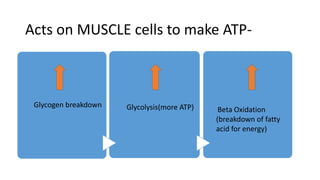
Glycogen breakdown Glycolysis(more ATP) Beta Oxidation
(breakdown of fatty
acid for energy)
Acts on MUSCLE cells to make ATP-
FIGHT OR FLIGHT
(The physiological response to a threatening situation, which readies
one either to resist forcibly or to run away)
• Muscle needs energy!
• So liver makes glucose and muscle breaks glucose down to ATP.
• Available for use to fight and flight.
7TM receptor(serpentine receptor)
Made up of single polypeptide
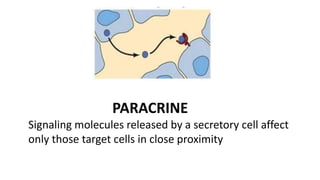
PARACRINE
Signaling molecules released by a secretory cell affect
only those target cells in close proximity
•For paracrine signals to act locally , secreted molecules
must not be allowed to diffuse to far.
•Rapidly taken up by neighboring target cells or
immobilized by ECM.
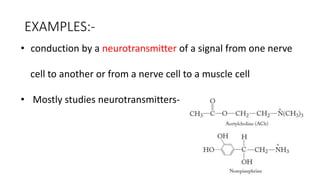
EXAMPLES:-
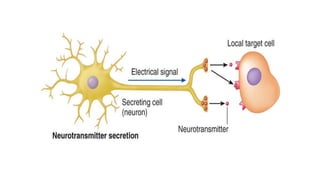
• conduction by a neurotransmitter of a signal from one nerve
cell to another or from a nerve cell to a muscle cell
• Mostly studies neurotransmitters-
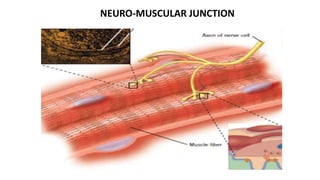
NEURO-MUSCULAR JUNCTION
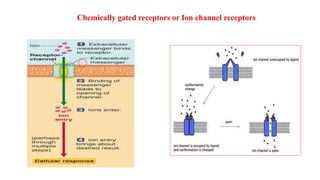
Chemically gated receptors or Ion channel receptors
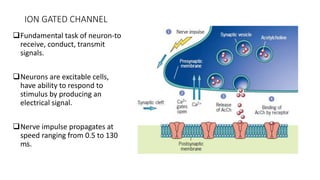
ION GATED CHANNEL
Fundamental task of neuron-to
receive, conduct, transmit
signals.
Neurons are excitable cells,
have ability to respond to
stimulus by producing an
electrical signal.
Nerve impulse propagates at
speed ranging from 0.5 to 130
ms.
REVIEW ARTICLE
Autocrine insulin-like growth factor-I signaling promotes growth
survival of human acute myeloid leukemia cells via the
phosphoinositide 3-kinase/Akt pathway
• role for autocrine IGF-I signaling in the growth and survival of primary
AML cells.
• IGF-IR inhibitors in combination with chemotherapeutic agents may
represent a novel approach to target human AML(Acute myeloid
leukemia)
RECAPITULATE
AUTOCRINE CELL SIGNALING-
normal cell ,cancer cell
ENDOCRINE CELL SIGNALING-
epinephrine, GPCR, G protein, adenylate cyclase, cAMP
fight and flight response
PARACRINE CELL SIGNALING-
Neurotransmitter, neuro-muscular transmitter, ion gated channels
REFERENCES:-
I. THE CELL- Geoffrey M.Cooper and Robert E.Hausman (5th edition)
II. BIOCHEMISTRY- Lubert Stryer (6th edition)
III. THE CELL- Alberts (5th edition)
IV. Review(Nature) Leukemia (2007) Nature Publishing Group
www.nature.com/leu
THANK YOU

Types of signaling

  • 1.
    TYPES OF CELLSIGNALING (with specific example of each) PRESENTED BY- NEHA MAYACH M.Sc. LIFE SCIENCES (3rd semester) CENTRAL UNIVERSITY OF GUJARAT DATE- 11.08.2015
  • 2.
    CONTENT • Introduction ofcell signaling • Its need • Brief history • Types of cell signaling- 1. Autocrine 2. Paracrine 3. Endocrine • Recapitulation • Review article using types of cell signaling • Reference
  • 3.
    CELL SIGNALLING- (BriefHistory) • In 1970, Martin Rodbell examined effects of glucagon on rat's liver cell membrane receptor. • He revealed about guanosine triphosphate and stimulated G-protein role in cell's metabolism.
  • 5.
    AUTOCRINE cells respond tosubstances which they themselves release and thus changes takes place in the cell itself
  • 7.
    EXAMPLE:- • Tumour cells releasegrowth factors for their own survival and proliferation
  • 8.
    ENDOCRINE  Signaling overlong distance  Signal molecules(hormones) secreted by glands  Bloodstream carries hormones far and wide may lie anywhere in the body
  • 10.
    EXAMPLE:- Epinephrine-  amino acidderivative(of tyrosine)  hydrophilic signaling molecule (bind to G protein coupled receptor)  Released from Adrenal medulla
  • 11.
    FUNCTION- Acts on LIVER cells toincrease blood glucose level Glycogen breakdown Gluconeogenesis (glucose from pyruvate)
  • 12.
    Glycogen breakdown Glycolysis(moreATP) Beta Oxidation (breakdown of fatty acid for energy) Acts on MUSCLE cells to make ATP-
  • 13.
    FIGHT OR FLIGHT (Thephysiological response to a threatening situation, which readies one either to resist forcibly or to run away) • Muscle needs energy! • So liver makes glucose and muscle breaks glucose down to ATP. • Available for use to fight and flight.
  • 14.
  • 16.
    PARACRINE Signaling molecules releasedby a secretory cell affect only those target cells in close proximity
  • 17.
    •For paracrine signalsto act locally , secreted molecules must not be allowed to diffuse to far. •Rapidly taken up by neighboring target cells or immobilized by ECM.
  • 18.
    EXAMPLES:- • conduction bya neurotransmitter of a signal from one nerve cell to another or from a nerve cell to a muscle cell • Mostly studies neurotransmitters-
  • 19.
  • 21.
    Chemically gated receptorsor Ion channel receptors
  • 22.
    ION GATED CHANNEL Fundamentaltask of neuron-to receive, conduct, transmit signals. Neurons are excitable cells, have ability to respond to stimulus by producing an electrical signal. Nerve impulse propagates at speed ranging from 0.5 to 130 ms.
  • 23.
    REVIEW ARTICLE Autocrine insulin-likegrowth factor-I signaling promotes growth survival of human acute myeloid leukemia cells via the phosphoinositide 3-kinase/Akt pathway • role for autocrine IGF-I signaling in the growth and survival of primary AML cells. • IGF-IR inhibitors in combination with chemotherapeutic agents may represent a novel approach to target human AML(Acute myeloid leukemia)
  • 24.
    RECAPITULATE AUTOCRINE CELL SIGNALING- normalcell ,cancer cell ENDOCRINE CELL SIGNALING- epinephrine, GPCR, G protein, adenylate cyclase, cAMP fight and flight response PARACRINE CELL SIGNALING- Neurotransmitter, neuro-muscular transmitter, ion gated channels
  • 26.
    REFERENCES:- I. THE CELL-Geoffrey M.Cooper and Robert E.Hausman (5th edition) II. BIOCHEMISTRY- Lubert Stryer (6th edition) III. THE CELL- Alberts (5th edition) IV. Review(Nature) Leukemia (2007) Nature Publishing Group www.nature.com/leu
  • 27.