Preceptors:
Dr. Rakesh Sharma
Dr. Achint Juneja
Presented by: Dr. Tanvi Verma
Content
• Definition
• Classification
• Pathways initiated by lipid soluble messengers
• Pathways initiated by water soluble messengers
• Signal transduction in Orthodontics
• References
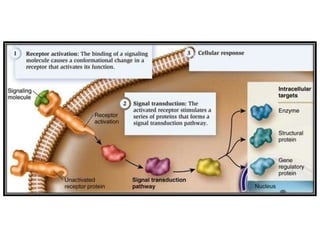
Cell Signalling Pathways
Various diverse events between cell stimulation
and final response are called
SIGNALLING PATHWAYS
They are also known as Signal transduction pathways
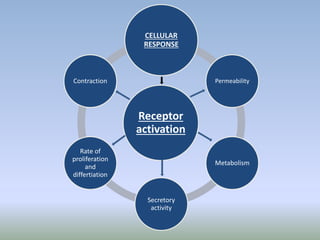
Receptor
activation
CELLULAR
RESPONSE
Permeability
Metabolism
Secretory
activity
Rate of
proliferation
and
differtiation
Contraction
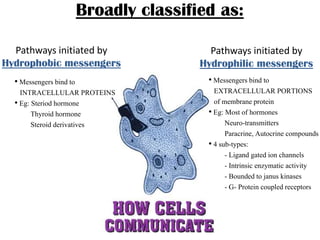
Broadly classified as:
Pathways initiated by
Hydrophobic messengers
Pathways initiated by
Hydrophilic messengers
• Messengers bind to
INTRACELLULAR PROTEINS
• Eg: Steriod hormone
Thyroid hormone
Steroid derivatives
• Messengers bind to
EXTRACELLULAR PORTIONS
of membrane protein
• Eg: Most of hormones
Neuro-transmitters
Paracrine, Autocrine compounds
• 4 sub-types:
- Ligand gated ion channels
- Intrinsic enzymatic activity
- Bounded to janus kinases
- G- Protein coupled receptors
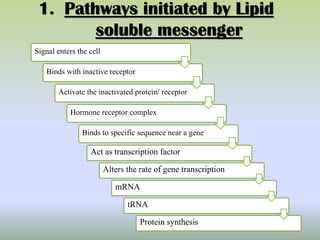
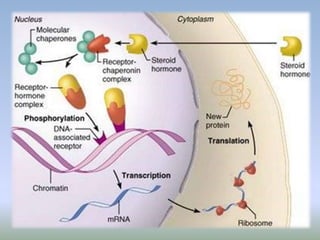
1. Pathways initiated by Lipid
soluble messenger
Signal enters the cell
Binds with inactive receptor
Activate the inactivated protein/ receptor
Hormone receptor complex
Binds to specific sequence near a gene
Act as transcription factor
Alters the rate of gene transcription
mRNA
tRNA
Protein synthesis
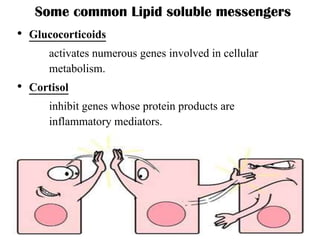
Some common Lipid soluble messengers
• Glucocorticoids
activates numerous genes involved in cellular
metabolism.
• Cortisol
inhibit genes whose protein products are
inflammatory mediators.
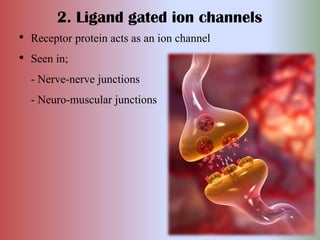
2. Ligand gated ion channels
• Receptor protein acts as an ion channel
• Seen in;
- Nerve-nerve junctions
- Neuro-muscular junctions
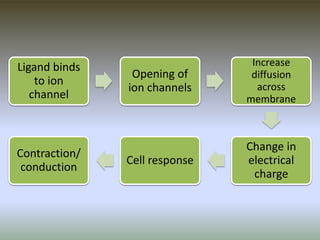
Ligand binds
to ion
channel
Opening of
ion channels
Increase
diffusion
across
membrane
Change in
electrical
charge
Cell response
Contraction/
conduction
3. Receptors with intrinsic enzymatic
capacity
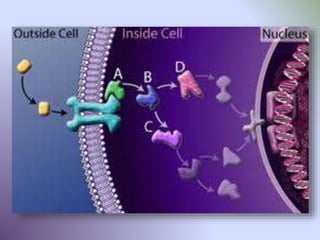
• Generally all enzymatic receptors are TYROSINE
KINASE with one exception i.e. GUANYLYL
CYCLASE
• Guanylyl cyclase catalyses the formation of cGMP (in
cytosol) which in turn acts as a second messenger and
then leads to phosphorylation.
4. Cytokines receptors
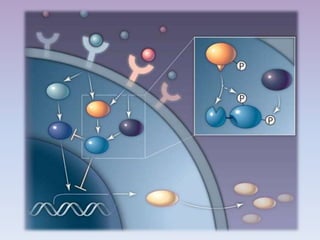
• There are regulatory proteins
• These receptors does not have any enzymatic activity of
their own but their enzymatic action lies in a family of
separate cytoplasmic kinases.
• Cascade of phosphorylation leads to cellular response to
stimulus
• Mainly involves the Immune system
5. G-protein coupled receptors
• Largest category
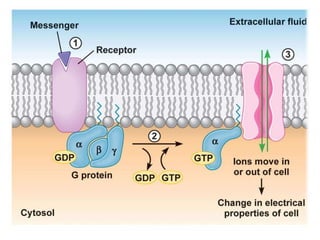
• G-protein
– heterotrimeric protein
– 3 sub-units; alpha, beta, gamma
– alpha binds with GDP and GTP
– beta and gamma anchor to membrane
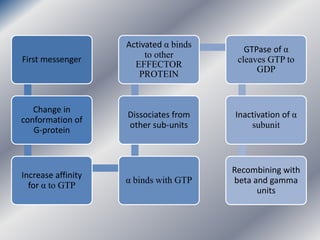
First messenger
Change in
conformation of
G-protein
Increase affinity
for α to GTP
α binds with GTP
Dissociates from
other sub-units
Activated α binds
to other
EFFECTOR
PROTEIN
GTPase of α
cleaves GTP to
GDP
Inactivation of α
subunit
Recombining with
beta and gamma
units
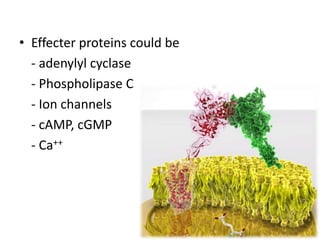
• Effecter proteins could be
- adenylyl cyclase
- Phospholipase C
- Ion channels
- cAMP, cGMP
- Ca++
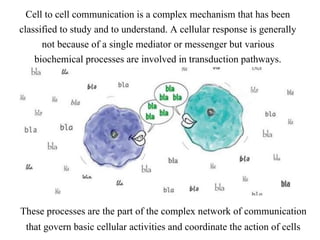
Cell to cell communication is a complex mechanism that has been
classified to study and to understand. A cellular response is generally
not because of a single mediator or messenger but various
biochemical processes are involved in transduction pathways.
These processes are the part of the complex network of communication
that govern basic cellular activities and coordinate the action of cells
Cell Signalling
for
an Orthodontist
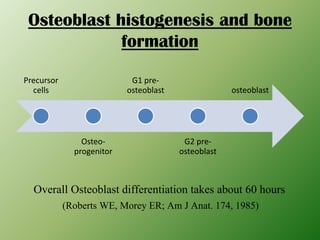
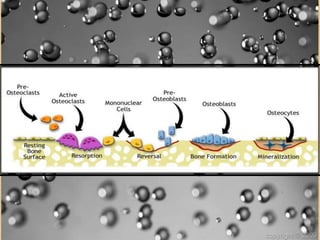
Osteoblast histogenesis and bone
formation
Precursor
cells
Osteo-
progenitor
G1 pre-
osteoblast
G2 pre-
osteoblast
osteoblast
Overall Osteoblast differentiation takes about 60 hours
(Roberts WE, Morey ER; Am J Anat. 174, 1985)
• G2 pro-osteoblast; D cell is the immediate
proliferating progenitor of Osteoblast.
(Robert, Mozsary, Klinger: Am J Anat. 165; 1984)
• In unstimulated PDL most of the cells are in Go
Stage.
• This cell reserve gets stimulated under mechanical
stimuli.
Osteoclast recruitment and bone
resorption
• There is no evidence to suggests that
osteoclasts are produced in PDL.
• Their activity is regulated by:
- mechanical stimulus
- metabolic stimulus
Robert WE, Chase; 1981 showed that metabolic stimuli
produces a rapid response of osteoclast but mechanical
stimulation produces a slow but more sustained response.
• Pro-osteoclasts are derived from marrow by
circulating Promonocytes derivatives. (mechanically
controlled)
• Osteoclasts are relatively inert cells, they have few
biochemical receptor.
• Local mediators are;
- PG
- Interleukins
- Neuro-secretory agents
- Growth factors
- Calcitonin
References…
• Orthodontics, current principles and techniques.Graber 5th edition
• wiley online library
• EJO.oxfordjournals.org
• jortho.maneyjournal.org
• www.ajodo.org
• ncbi.nlm.mih.gov
• scholar.google.com
• wikipedia
Thank you…

Cell signalling

  • 1.
    Preceptors: Dr. Rakesh Sharma Dr.Achint Juneja Presented by: Dr. Tanvi Verma
  • 2.
    Content • Definition • Classification •Pathways initiated by lipid soluble messengers • Pathways initiated by water soluble messengers • Signal transduction in Orthodontics • References
  • 3.
    Cell Signalling Pathways Variousdiverse events between cell stimulation and final response are called SIGNALLING PATHWAYS They are also known as Signal transduction pathways
  • 5.
  • 6.
    Broadly classified as: Pathwaysinitiated by Hydrophobic messengers Pathways initiated by Hydrophilic messengers • Messengers bind to INTRACELLULAR PROTEINS • Eg: Steriod hormone Thyroid hormone Steroid derivatives • Messengers bind to EXTRACELLULAR PORTIONS of membrane protein • Eg: Most of hormones Neuro-transmitters Paracrine, Autocrine compounds • 4 sub-types: - Ligand gated ion channels - Intrinsic enzymatic activity - Bounded to janus kinases - G- Protein coupled receptors
  • 7.
    1. Pathways initiatedby Lipid soluble messenger Signal enters the cell Binds with inactive receptor Activate the inactivated protein/ receptor Hormone receptor complex Binds to specific sequence near a gene Act as transcription factor Alters the rate of gene transcription mRNA tRNA Protein synthesis
  • 9.
    Some common Lipidsoluble messengers • Glucocorticoids activates numerous genes involved in cellular metabolism. • Cortisol inhibit genes whose protein products are inflammatory mediators.
  • 10.
    2. Ligand gatedion channels • Receptor protein acts as an ion channel • Seen in; - Nerve-nerve junctions - Neuro-muscular junctions
  • 11.
    Ligand binds to ion channel Openingof ion channels Increase diffusion across membrane Change in electrical charge Cell response Contraction/ conduction
  • 12.
    3. Receptors withintrinsic enzymatic capacity • Generally all enzymatic receptors are TYROSINE KINASE with one exception i.e. GUANYLYL CYCLASE • Guanylyl cyclase catalyses the formation of cGMP (in cytosol) which in turn acts as a second messenger and then leads to phosphorylation.
  • 14.
    4. Cytokines receptors •There are regulatory proteins • These receptors does not have any enzymatic activity of their own but their enzymatic action lies in a family of separate cytoplasmic kinases. • Cascade of phosphorylation leads to cellular response to stimulus • Mainly involves the Immune system
  • 16.
    5. G-protein coupledreceptors • Largest category • G-protein – heterotrimeric protein – 3 sub-units; alpha, beta, gamma – alpha binds with GDP and GTP – beta and gamma anchor to membrane
  • 17.
    First messenger Change in conformationof G-protein Increase affinity for α to GTP α binds with GTP Dissociates from other sub-units Activated α binds to other EFFECTOR PROTEIN GTPase of α cleaves GTP to GDP Inactivation of α subunit Recombining with beta and gamma units
  • 18.
    • Effecter proteinscould be - adenylyl cyclase - Phospholipase C - Ion channels - cAMP, cGMP - Ca++
  • 20.
    Cell to cellcommunication is a complex mechanism that has been classified to study and to understand. A cellular response is generally not because of a single mediator or messenger but various biochemical processes are involved in transduction pathways. These processes are the part of the complex network of communication that govern basic cellular activities and coordinate the action of cells
  • 21.
  • 22.
    Osteoblast histogenesis andbone formation Precursor cells Osteo- progenitor G1 pre- osteoblast G2 pre- osteoblast osteoblast Overall Osteoblast differentiation takes about 60 hours (Roberts WE, Morey ER; Am J Anat. 174, 1985)
  • 23.
    • G2 pro-osteoblast;D cell is the immediate proliferating progenitor of Osteoblast. (Robert, Mozsary, Klinger: Am J Anat. 165; 1984) • In unstimulated PDL most of the cells are in Go Stage. • This cell reserve gets stimulated under mechanical stimuli.
  • 24.
    Osteoclast recruitment andbone resorption • There is no evidence to suggests that osteoclasts are produced in PDL. • Their activity is regulated by: - mechanical stimulus - metabolic stimulus Robert WE, Chase; 1981 showed that metabolic stimuli produces a rapid response of osteoclast but mechanical stimulation produces a slow but more sustained response.
  • 25.
    • Pro-osteoclasts arederived from marrow by circulating Promonocytes derivatives. (mechanically controlled) • Osteoclasts are relatively inert cells, they have few biochemical receptor. • Local mediators are; - PG - Interleukins - Neuro-secretory agents - Growth factors - Calcitonin
  • 27.
    References… • Orthodontics, currentprinciples and techniques.Graber 5th edition • wiley online library • EJO.oxfordjournals.org • jortho.maneyjournal.org • www.ajodo.org • ncbi.nlm.mih.gov • scholar.google.com • wikipedia
  • 28.