SIDE-LOOKING
AIRBORNE RADAR
1
Contents
• Introduction
• Remote sensing
• Types of remote sensing
• Radars
• Doppler radar
• Side looking airborne radar
• Ground resolution
• Azimutal resolution
• Synthetic aperture radar
• Working of synthetic aperture radar
• Applications
• Conclusion 2
Introduction
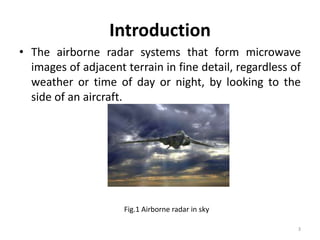
• The airborne radar systems that form microwave
images of adjacent terrain in fine detail, regardless of
weather or time of day or night, by looking to the
side of an aircraft.
3
Fig.1 Airborne radar in sky
Remote sensing
• Remote sensing is a technology used for obtaining
information about a target through the analysis of
data acquired from the target at a distance. It is
composed of three parts,
• The targets
• The data acquisition
• The data analysis
4
Types of Remote Sensing
• Based on Source of energy
1. Active sensors
2. Passive sensors
• Based on Range of Electromagnetic Spectrum
1. Optical Remote Sensing
2. Thermal Remote Sensing
3. Microwave Remote Sensing
5
Radars
• Radar represents "radio detection and ranging".
• A radar system transmits pulses in the direction of
interest and records the strength and origin of
reflection received from objects
• Radar systems may or may not produce images
6
Doppler radar
• Doppler radar is a specialized radar that uses
the Doppler effect to produce velocity data about
objects at a distance.
• It does this by bouncing a microwave signal off a
desired target and analyzing how the object's motion
has altered the frequency of the returned signal.
• This variation gives direct and highly accurate
measurements of the radial component of a target's
velocity relative to the radar.
7
Side-looking airborne radar
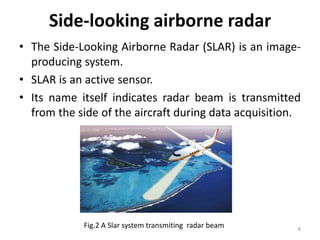
• The Side-Looking Airborne Radar (SLAR) is an image-
producing system.
• SLAR is an active sensor.
• Its name itself indicates radar beam is transmitted
from the side of the aircraft during data acquisition.
8
Fig.2 A Slar system transmiting radar beam
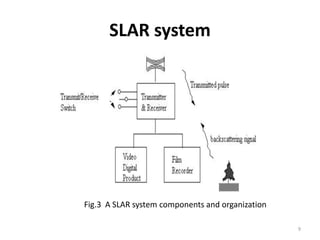
SLAR system
9
Fig.3 A SLAR system components and organization
Ground resolution
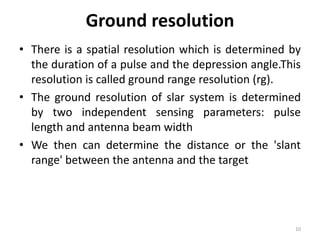
• There is a spatial resolution which is determined by
the duration of a pulse and the depression angle.This
resolution is called ground range resolution (rg).
• The ground resolution of slar system is determined
by two independent sensing parameters: pulse
length and antenna beam width
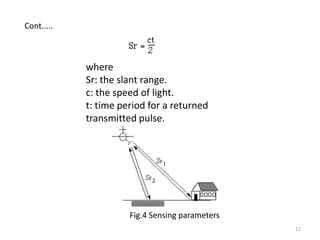
• We then can determine the distance or the 'slant
range' between the antenna and the target
10
11
where
Sr: the slant range.
c: the speed of light.
t: time period for a returned
transmitted pulse.
Fig.4 Sensing parameters
Cont.....
12
Fig.5 The across track spatial resolution
Cont......
Azimuth Resolution
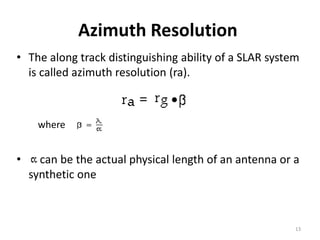
• The along track distinguishing ability of a SLAR system
is called azimuth resolution (ra).
where
• can be the actual physical length of an antenna or a
synthetic one
13
Synthetic aperture radar
• Synthetic aperture radar (SAR) an advance version of
SLAR
• SAR is used to create images of objects, such as
landscapes – these images can be either two or three
dimensional representations of the object.
• SAR is typically mounted on a moving platform such
as an aircraft or spacecraft
• The larger the aperture is, the higher the image
resolution will be.
14
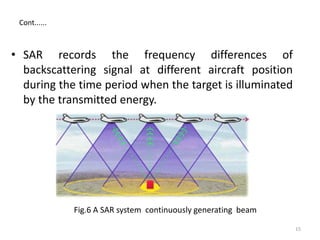
• SAR records the frequency differences of
backscattering signal at different aircraft position
during the time period when the target is illuminated
by the transmitted energy.
15
Fig.6 A SAR system continuously generating beam
Cont......
Working of SAR
16
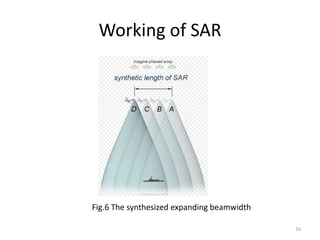
Fig.6 The synthesized expanding beamwidth
• The SAR works similar of a phased array .
• The SAR-processor stores all the radar returned signals,
as amplitudes and phases, for the time period T from
position A to D.
• Now it is possible to reconstruct the signal which
would have been obtained by an antenna of length v ·
T, where v is the platform speed.
• As the line of sight direction changes along the radar
platform trajectory, a synthetic aperture is produced by
signal processing that has the effect of lengthening the
antenna.
• Making T large makes the „synthetic aperture” large
and hence a higher resolution can be achieved
17
Cont......
Applications
• Synthetic aperture Radar produces images of
high-resolution at great distances, that appear
to be taken from above
• Sensor Operators
• Command, Control, Intelligence training
• Research & Development
18
Conclusion
• Side looking airborne radar systems that form
microwave images of adjacent terrain in fine
detail, regardless of weather or time of day or
night, by looking to the side of an aircraft with
good resolution.
19
20
21
Any Queries

side-looking airborne radar

  • 1.
  • 2.
    Contents • Introduction • Remotesensing • Types of remote sensing • Radars • Doppler radar • Side looking airborne radar • Ground resolution • Azimutal resolution • Synthetic aperture radar • Working of synthetic aperture radar • Applications • Conclusion 2
  • 3.
    Introduction • The airborneradar systems that form microwave images of adjacent terrain in fine detail, regardless of weather or time of day or night, by looking to the side of an aircraft. 3 Fig.1 Airborne radar in sky
  • 4.
    Remote sensing • Remotesensing is a technology used for obtaining information about a target through the analysis of data acquired from the target at a distance. It is composed of three parts, • The targets • The data acquisition • The data analysis 4
  • 5.
    Types of RemoteSensing • Based on Source of energy 1. Active sensors 2. Passive sensors • Based on Range of Electromagnetic Spectrum 1. Optical Remote Sensing 2. Thermal Remote Sensing 3. Microwave Remote Sensing 5
  • 6.
    Radars • Radar represents"radio detection and ranging". • A radar system transmits pulses in the direction of interest and records the strength and origin of reflection received from objects • Radar systems may or may not produce images 6
  • 7.
    Doppler radar • Dopplerradar is a specialized radar that uses the Doppler effect to produce velocity data about objects at a distance. • It does this by bouncing a microwave signal off a desired target and analyzing how the object's motion has altered the frequency of the returned signal. • This variation gives direct and highly accurate measurements of the radial component of a target's velocity relative to the radar. 7
  • 8.
    Side-looking airborne radar •The Side-Looking Airborne Radar (SLAR) is an image- producing system. • SLAR is an active sensor. • Its name itself indicates radar beam is transmitted from the side of the aircraft during data acquisition. 8 Fig.2 A Slar system transmiting radar beam
  • 9.
    SLAR system 9 Fig.3 ASLAR system components and organization
  • 10.
    Ground resolution • Thereis a spatial resolution which is determined by the duration of a pulse and the depression angle.This resolution is called ground range resolution (rg). • The ground resolution of slar system is determined by two independent sensing parameters: pulse length and antenna beam width • We then can determine the distance or the 'slant range' between the antenna and the target 10
  • 11.
    11 where Sr: the slantrange. c: the speed of light. t: time period for a returned transmitted pulse. Fig.4 Sensing parameters Cont.....
  • 12.
    12 Fig.5 The acrosstrack spatial resolution Cont......
  • 13.
    Azimuth Resolution • Thealong track distinguishing ability of a SLAR system is called azimuth resolution (ra). where • can be the actual physical length of an antenna or a synthetic one 13
  • 14.
    Synthetic aperture radar •Synthetic aperture radar (SAR) an advance version of SLAR • SAR is used to create images of objects, such as landscapes – these images can be either two or three dimensional representations of the object. • SAR is typically mounted on a moving platform such as an aircraft or spacecraft • The larger the aperture is, the higher the image resolution will be. 14
  • 15.
    • SAR recordsthe frequency differences of backscattering signal at different aircraft position during the time period when the target is illuminated by the transmitted energy. 15 Fig.6 A SAR system continuously generating beam Cont......
  • 16.
    Working of SAR 16 Fig.6The synthesized expanding beamwidth
  • 17.
    • The SARworks similar of a phased array . • The SAR-processor stores all the radar returned signals, as amplitudes and phases, for the time period T from position A to D. • Now it is possible to reconstruct the signal which would have been obtained by an antenna of length v · T, where v is the platform speed. • As the line of sight direction changes along the radar platform trajectory, a synthetic aperture is produced by signal processing that has the effect of lengthening the antenna. • Making T large makes the „synthetic aperture” large and hence a higher resolution can be achieved 17 Cont......
  • 18.
    Applications • Synthetic apertureRadar produces images of high-resolution at great distances, that appear to be taken from above • Sensor Operators • Command, Control, Intelligence training • Research & Development 18
  • 19.
    Conclusion • Side lookingairborne radar systems that form microwave images of adjacent terrain in fine detail, regardless of weather or time of day or night, by looking to the side of an aircraft with good resolution. 19
  • 20.
  • 21.