Karakterisasi Letusan Merapi
menggunakan Data SAR (Synthetic
Aperture Radar)
Saepuloh et al., (2013), Interpretation of ground surface changes prior to the 2010 large
eruption of Merapi volcano using ALOS/PALSAR, ASTER TIR and gas emission data,
Journal of Volcanology and Geothermal Research, Vol. 261, pp. 130-143.
Saepuloh et al., (2010), SAR- and gravity change-based characterization of the
distribution pattern of pyroclastic flow deposits at Mt. Merapi during the past ten years,
Bulletin of Volcanology, Vol. 72, No. 2, pp. 221-232.
Asep Saepuloh, Dr. Eng.
FITB, ITB
Content
1. An overview of Mt. Merapi Eruption 1996-2006
2. ALOS/PALSAR Observed 2010 Eruption
3. Eruption precursor using time series of D-InSAR
and ASTER TIR
Interaction of Microwave Signal to Surface
𝑃𝑅 = 𝑃 𝑇 𝜎0 𝐴
𝐺2 𝜆2
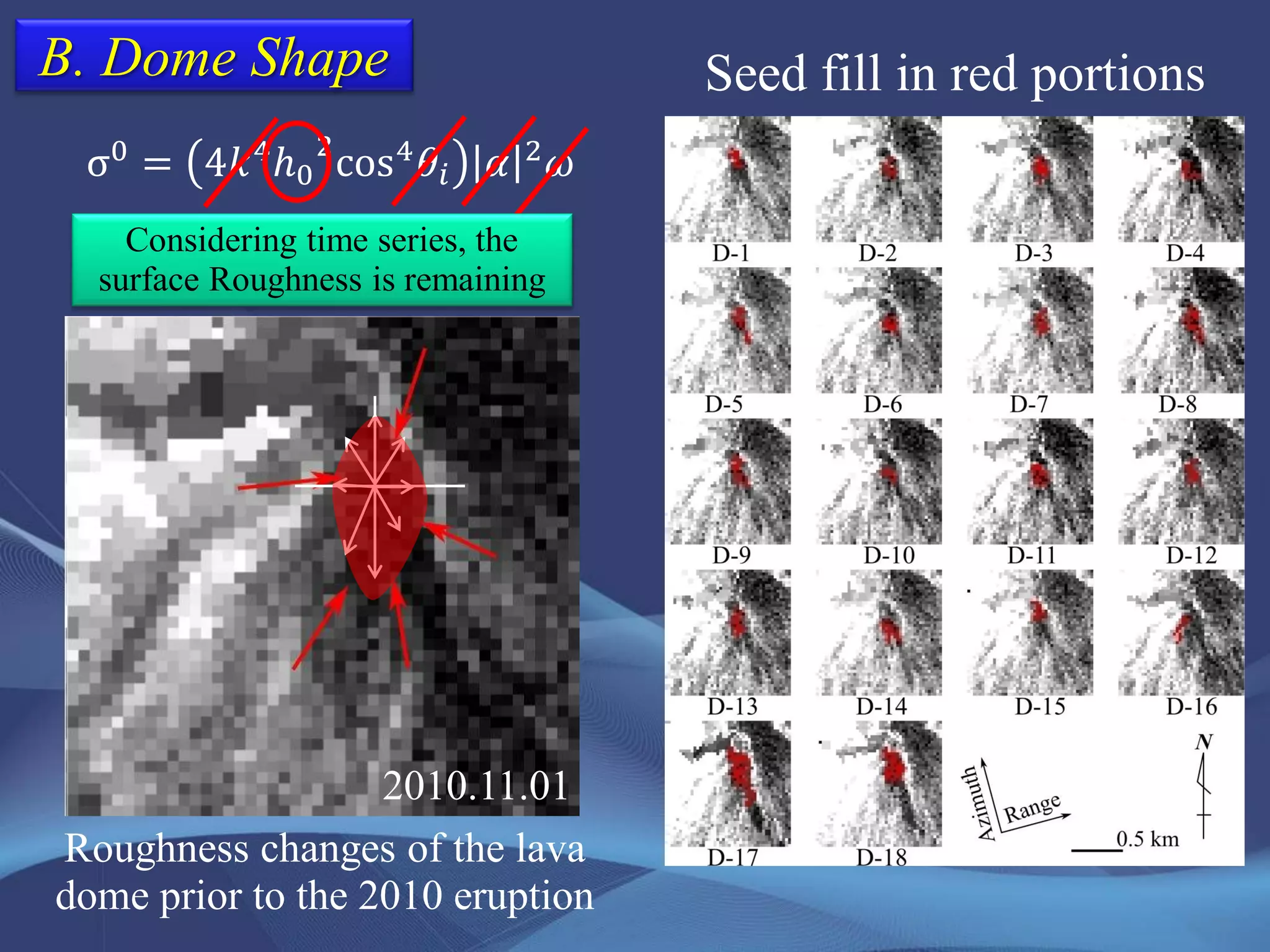
4𝜋 3 𝑅4
The radar equation
Dielectric permittivity
Incident
angle
Roughness funct.
σ0 = 4𝑘4ℎ0
2
cos4 𝜃𝑖 𝛼 2 𝜔
αℎℎ =
𝜇 𝑟 − 1 𝜖 𝑟 𝜇 𝑟 − sin2 𝜃𝑖 + 𝜇 𝑟 sin2 𝜃𝑖 + 𝜇 𝑟
2 𝜖 𝑟 − 1
π 𝜇 𝑟 cos 𝜃𝑖 + 𝜖 𝑟 𝜇 𝑟 − sin2 𝜃𝑖
4
α 𝑣𝑣 =
𝜖 𝑟 − 1 𝜖 𝑟 𝜇 𝑟 − sin2 𝜃𝑖 + 𝜖 𝑟 sin2 𝜃𝑖 + 𝜖 𝑟
2 𝜇 𝑟 − 1
π 𝜖 𝑟 cos 𝜃𝑖 + 𝜖 𝑟 𝜇 𝑟 − sin2 𝜃𝑖
4
Magnetic permeability
SmallPerturbationModel
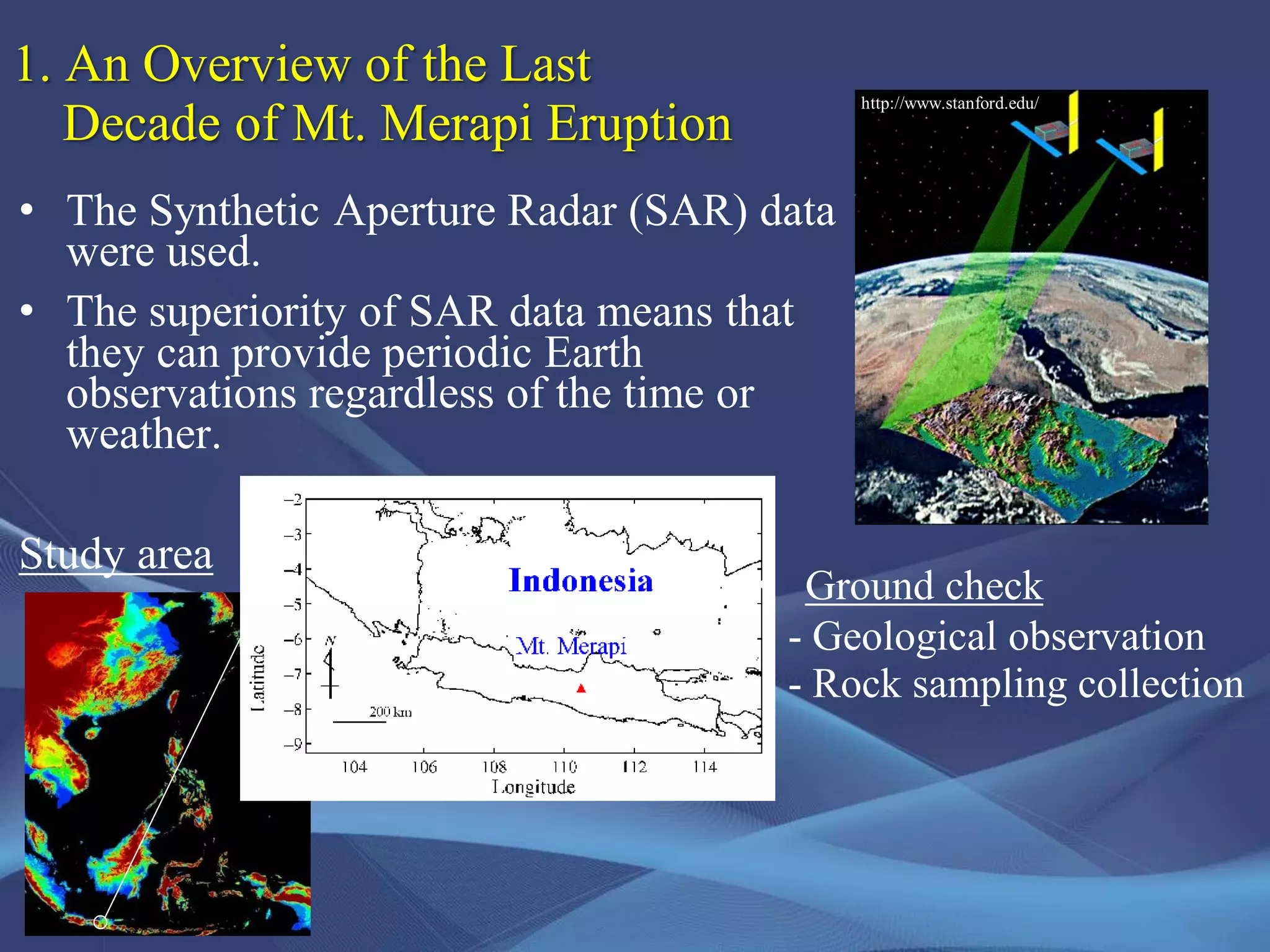
• The Synthetic Aperture Radar (SAR) data
were used.
• The superiority of SAR data means that
they can provide periodic Earth
observations regardless of the time or
weather.
Study area
http://www.stanford.edu/
1. An Overview of the Last
Decade of Mt. Merapi Eruption
• Ground check
- Geological observation
- Rock sampling collection
Objectives and Data Used
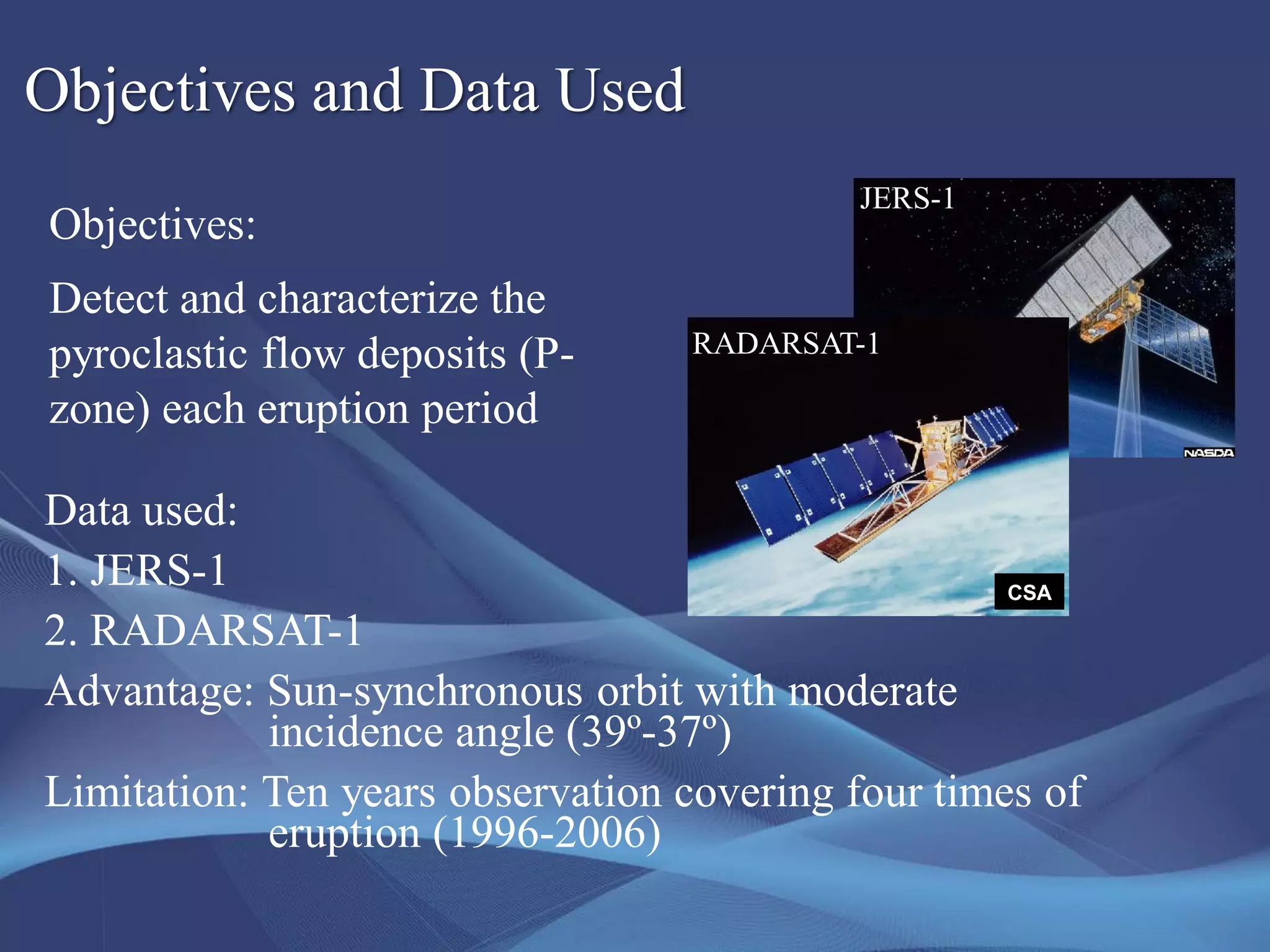
Data used:
1. JERS-1
2. RADARSAT-1
Advantage: Sun-synchronous orbit with moderate
incidence angle (39º-37º)
Limitation: Ten years observation covering four times of
eruption (1996-2006)
JERS-1
RADARSAT-1
CSA
Objectives:
Detect and characterize the
pyroclastic flow deposits (P-
zone) each eruption period
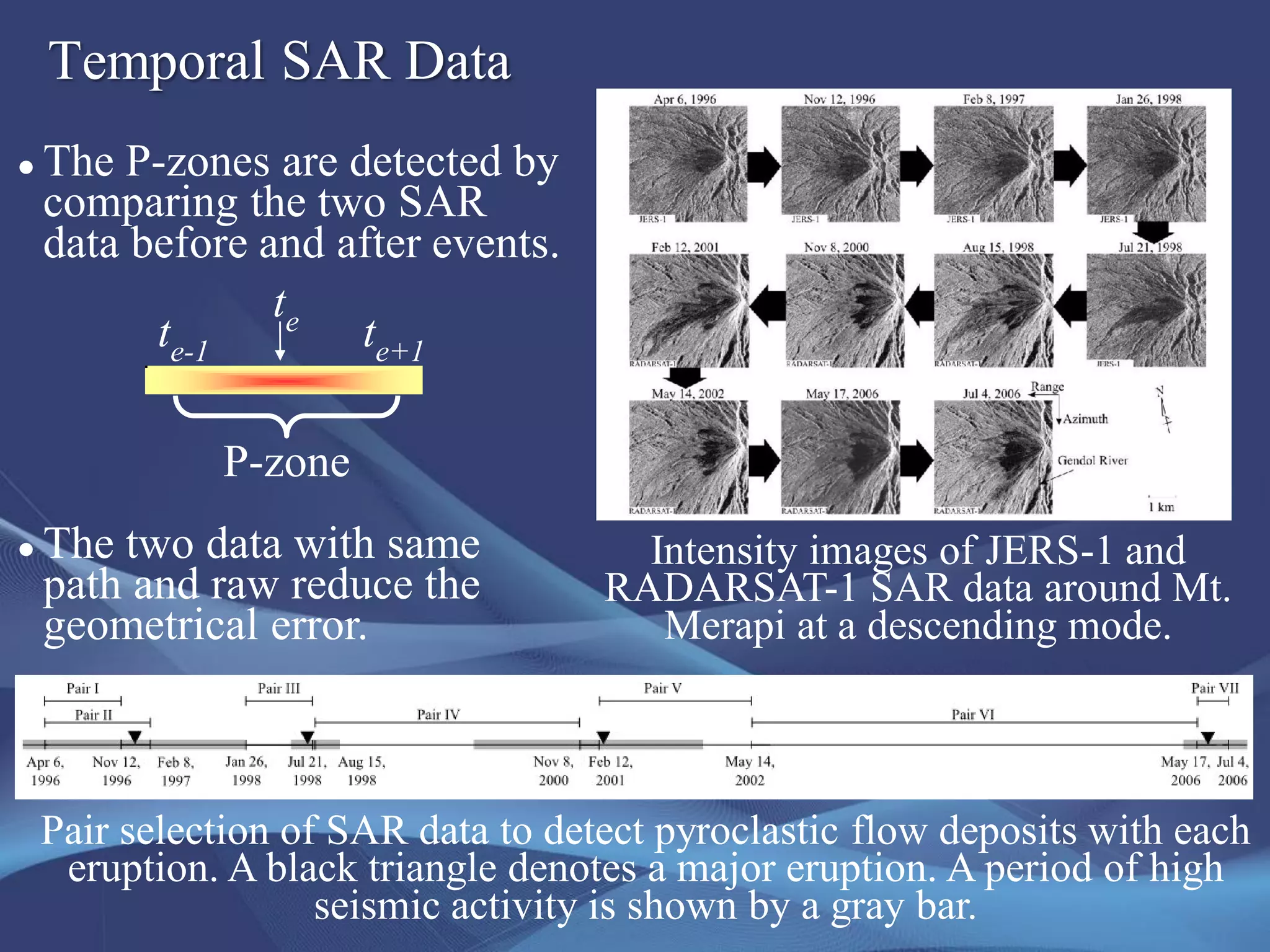
Temporal SAR Data
Pair selection of SAR data to detect pyroclastic flow deposits with each
eruption. A black triangle denotes a major eruption. A period of high
seismic activity is shown by a gray bar.
Intensity images of JERS-1 and
RADARSAT-1 SAR data around Mt.
Merapi at a descending mode.
 The P-zones are detected by
comparing the two SAR
data before and after events.
 The two data with same
path and raw reduce the
geometrical error.
te-1 te+1
P-zone
te
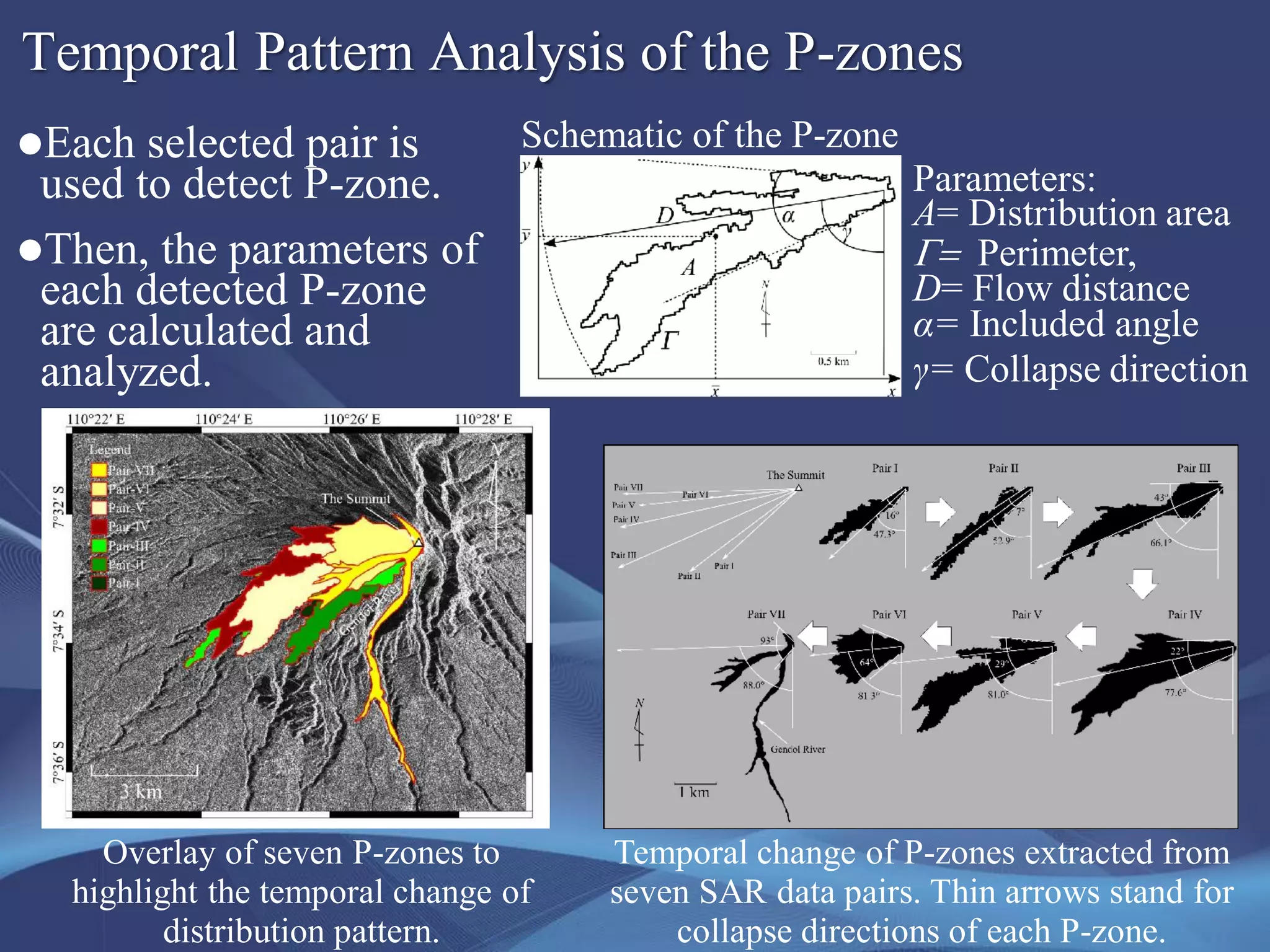
Temporal Pattern Analysis of the P-zones
Schematic of the P-zone
Parameters:
A= Distribution area
= Perimeter,
D= Flow distance
α= Included angle
γ= Collapse direction
Each selected pair is
used to detect P-zone.
Then, the parameters of
each detected P-zone
are calculated and
analyzed.
Temporal change of P-zones extracted from
seven SAR data pairs. Thin arrows stand for
collapse directions of each P-zone.
Overlay of seven P-zones to
highlight the temporal change of
distribution pattern.
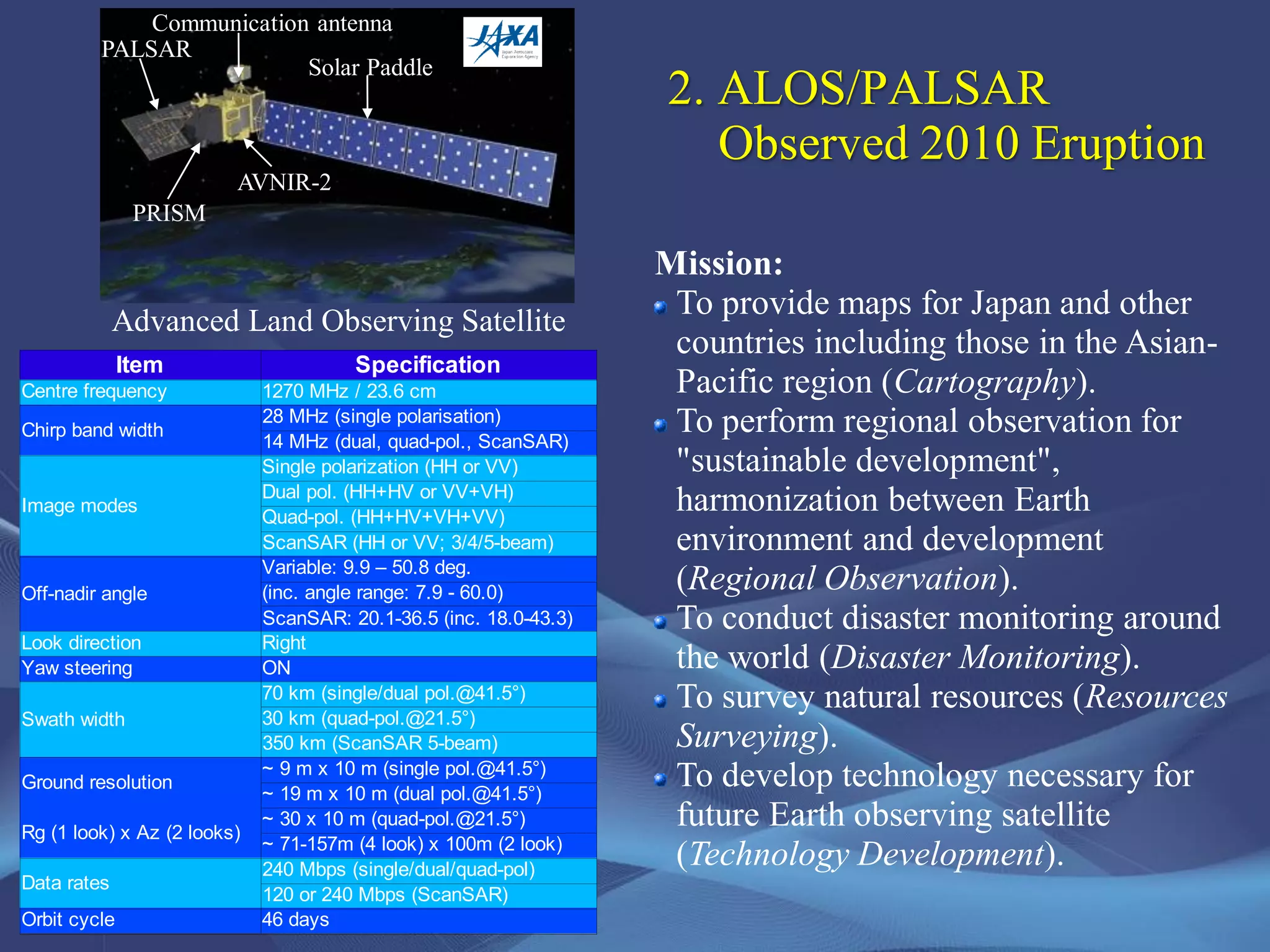
2. ALOS/PALSAR
Observed 2010 Eruption
Advanced Land Observing Satellite
Communication antenna
Solar Paddle
PALSAR
PRISM
AVNIR-2
Item Specification
1270 MHz / 23.6 cm
Chirp band width
Image modes
Single polarization (HH or VV)
Dual pol. (HH+HV or VV+VH)
Quad-pol. (HH+HV+VH+VV)
Off-nadir angle
Variable: 9.9 – 50.8 deg.
(inc. angle range: 7.9 - 60.0)
Look direction Right
Yaw steering ON
Swath width
70 km (single/dual pol.@41.5°)
30 km (quad-pol.@21.5°)
Ground resolution
~ 9 m x 10 m (single pol.@41.5°)
~ 19 m x 10 m (dual pol.@41.5°)
~ 30 x 10 m (quad-pol.@21.5°)
~ 71-157m (4 look) x 100m (2 look)
Data rates
Orbit cycle 46 days
Centre frequency
28 MHz (single polarisation)
14 MHz (dual, quad-pol., ScanSAR)
ScanSAR (HH or VV; 3/4/5-beam)
ScanSAR: 20.1-36.5 (inc. 18.0-43.3)
350 km (ScanSAR 5-beam)
Rg (1 look) x Az (2 looks)
240 Mbps (single/dual/quad-pol)
120 or 240 Mbps (ScanSAR)
Mission:
To provide maps for Japan and other
countries including those in the Asian-
Pacific region (Cartography).
To perform regional observation for
"sustainable development",
harmonization between Earth
environment and development
(Regional Observation).
To conduct disaster monitoring around
the world (Disaster Monitoring).
To survey natural resources (Resources
Surveying).
To develop technology necessary for
future Earth observing satellite
(Technology Development).
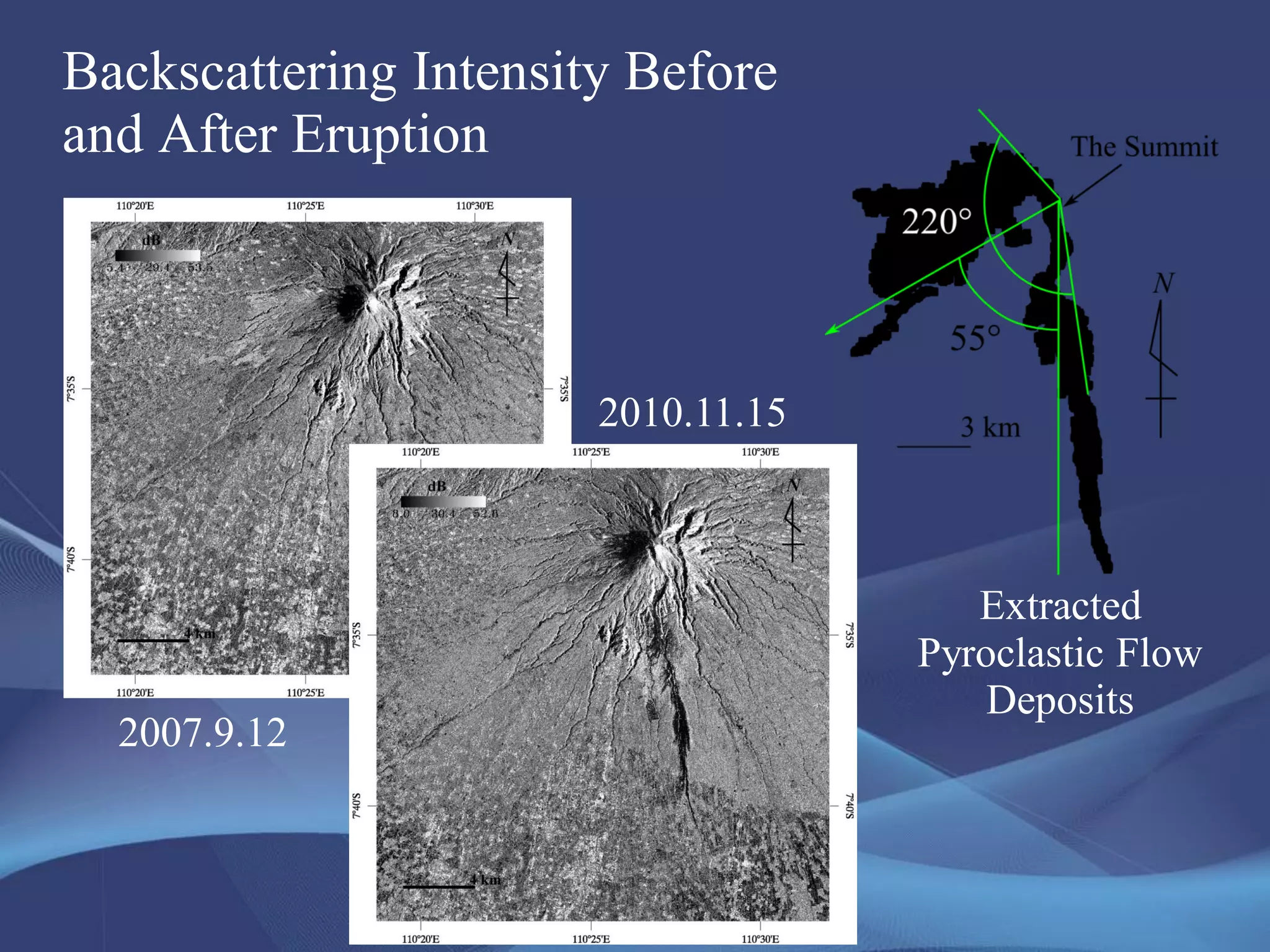
Backscattering Intensity Before
and After Eruption
2007.9.12
2010.11.15
Extracted
Pyroclastic Flow
Deposits
Pyroclastic Flow Deposits 1996-2010
The eruption of Mt. Merapi in November 2010 has a different characteristic
in comparison with the last decade of eruption. The coverage area of the
pyroclastic flow deposits is about 7 times larger than the eruption in 2006.
3. Eruption precursor using time series
of ALOS/PALSAR and ASTER TIR
Three point of view:
A. Deformation
B. Lava dome shape
C. Surface thermal
D. EDM measurement
A. Deformation
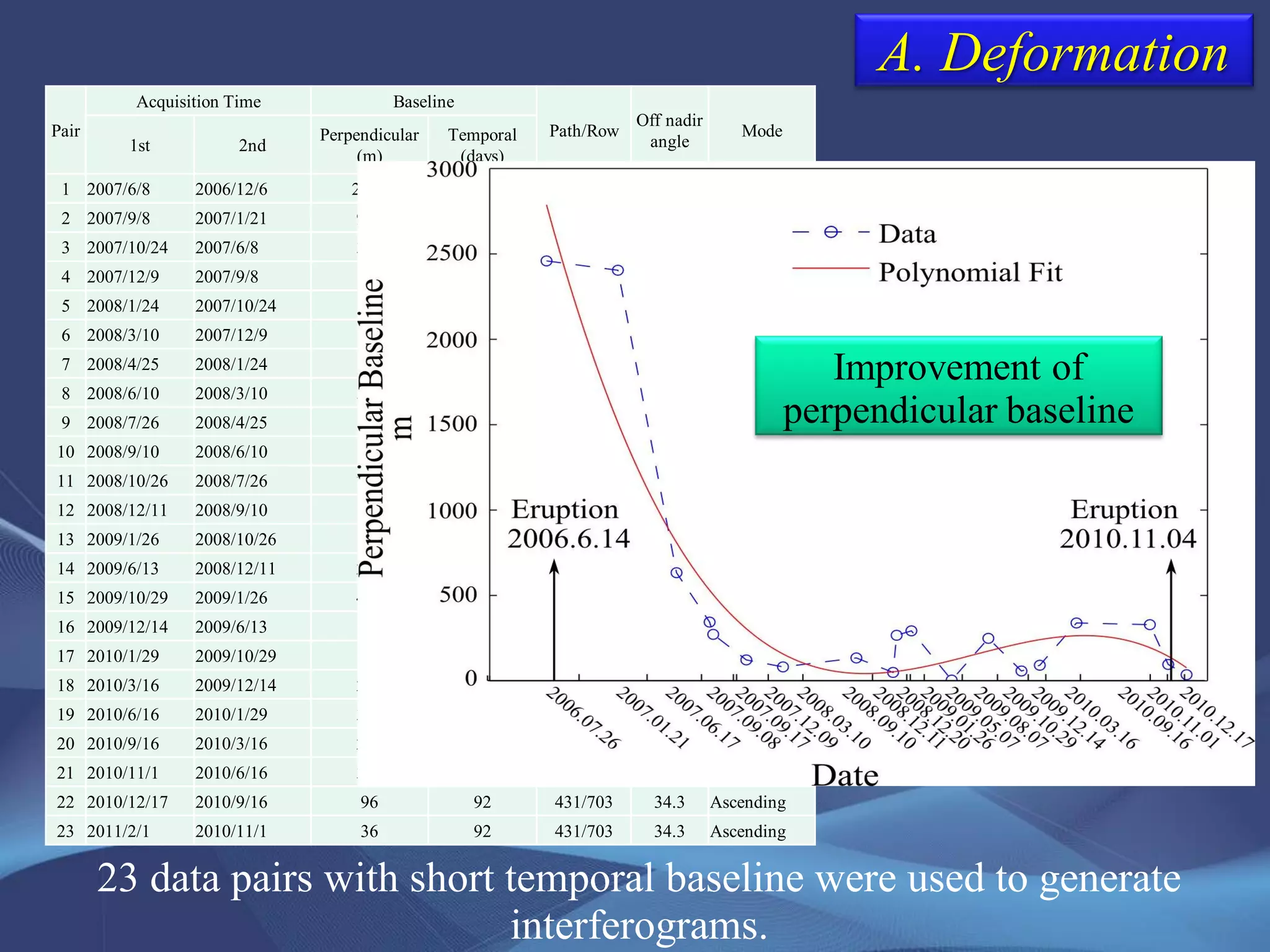
23 data pairs with short temporal baseline were used to generate
interferograms.
Pair
Acquisition Time Baseline
Path/Row
Off nadir
angle
Mode
1st 2nd
Perpendicular
(m)
Temporal
(days)
1 2007/6/8 2006/12/6 2598 184 431/703 34.3 Ascending
2 2007/9/8 2007/1/21 979 230 431/703 34.3 Ascending
3 2007/10/24 2007/6/8 344 138 431/703 34.3 Ascending
4 2007/12/9 2007/9/8 140 92 431/703 34.3 Ascending
5 2008/1/24 2007/10/24 180 92 431/703 34.3 Ascending
6 2008/3/10 2007/12/9 188 92 431/703 34.3 Ascending
7 2008/4/25 2008/1/24 172 92 431/703 34.3 Ascending
8 2008/6/10 2008/3/10 553 92 431/703 34.3 Ascending
9 2008/7/26 2008/4/25 162 92 431/703 34.3 Ascending
10 2008/9/10 2008/6/10 78 92 431/703 34.3 Ascending
11 2008/10/26 2008/7/26 742 92 431/703 34.3 Ascending
12 2008/12/11 2008/9/10 109 92 431/703 34.3 Ascending
13 2009/1/26 2008/10/26 32 92 431/703 34.3 Ascending
14 2009/6/13 2008/12/11 292 184 431/703 34.3 Ascending
15 2009/10/29 2009/1/26 432 276 431/703 34.3 Ascending
16 2009/12/14 2009/6/13 56 184 431/703 34.3 Ascending
17 2010/1/29 2009/10/29 141 92 431/703 34.3 Ascending
18 2010/3/16 2009/12/14 216 92 431/703 34.3 Ascending
19 2010/6/16 2010/1/29 342 138 431/703 34.3 Ascending
20 2010/9/16 2010/3/16 218 184 431/703 34.3 Ascending
21 2010/11/1 2010/6/16 329 138 431/703 34.3 Ascending
22 2010/12/17 2010/9/16 96 92 431/703 34.3 Ascending
23 2011/2/1 2010/11/1 36 92 431/703 34.3 Ascending
Improvement of
perpendicular baseline
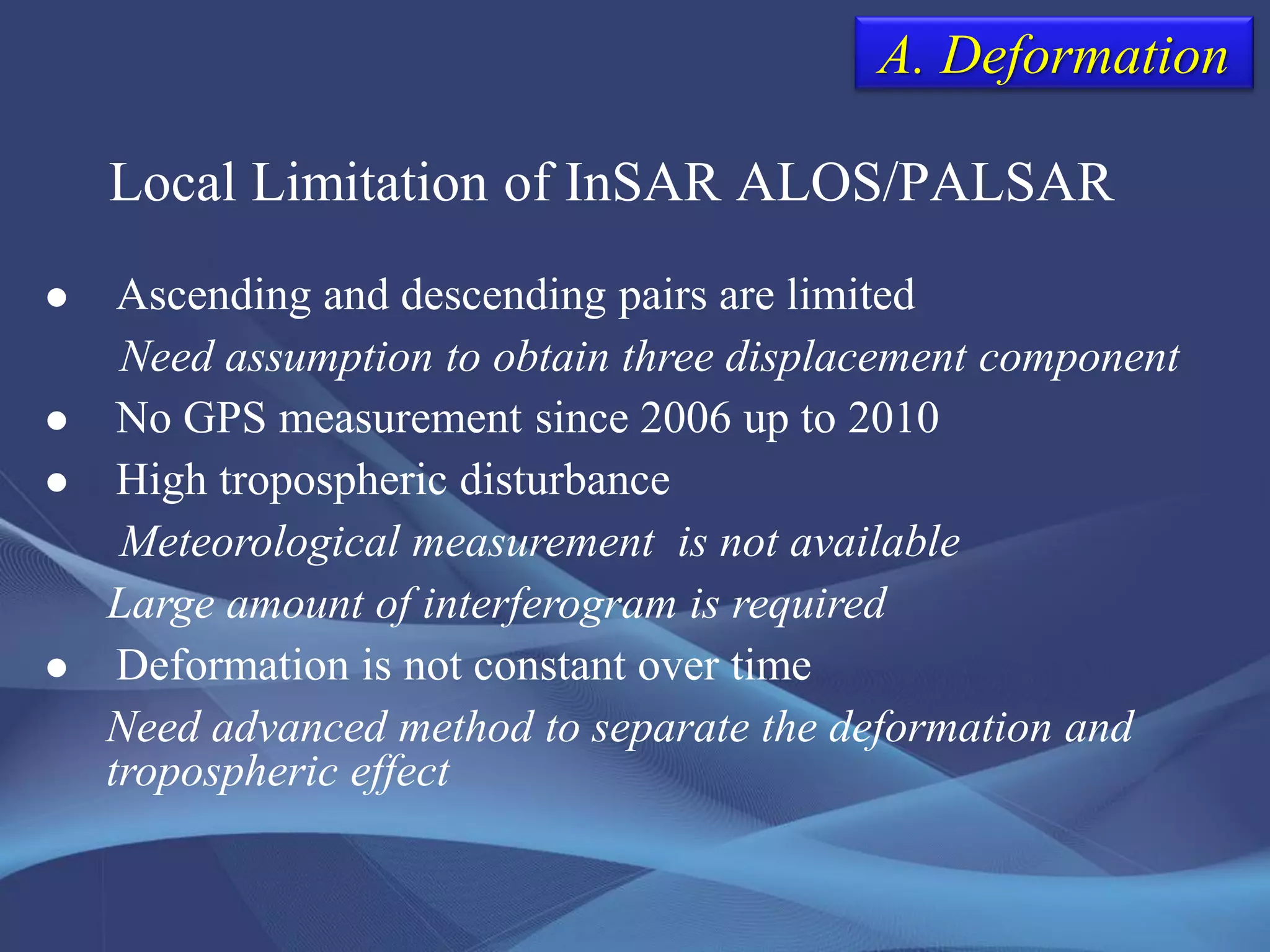
Local Limitation of InSAR ALOS/PALSAR
 Ascending and descending pairs are limited
Need assumption to obtain three displacement component
 No GPS measurement since 2006 up to 2010
 High tropospheric disturbance
Meteorological measurement is not available
Large amount of interferogram is required
 Deformation is not constant over time
Need advanced method to separate the deformation and
tropospheric effect
A. Deformation
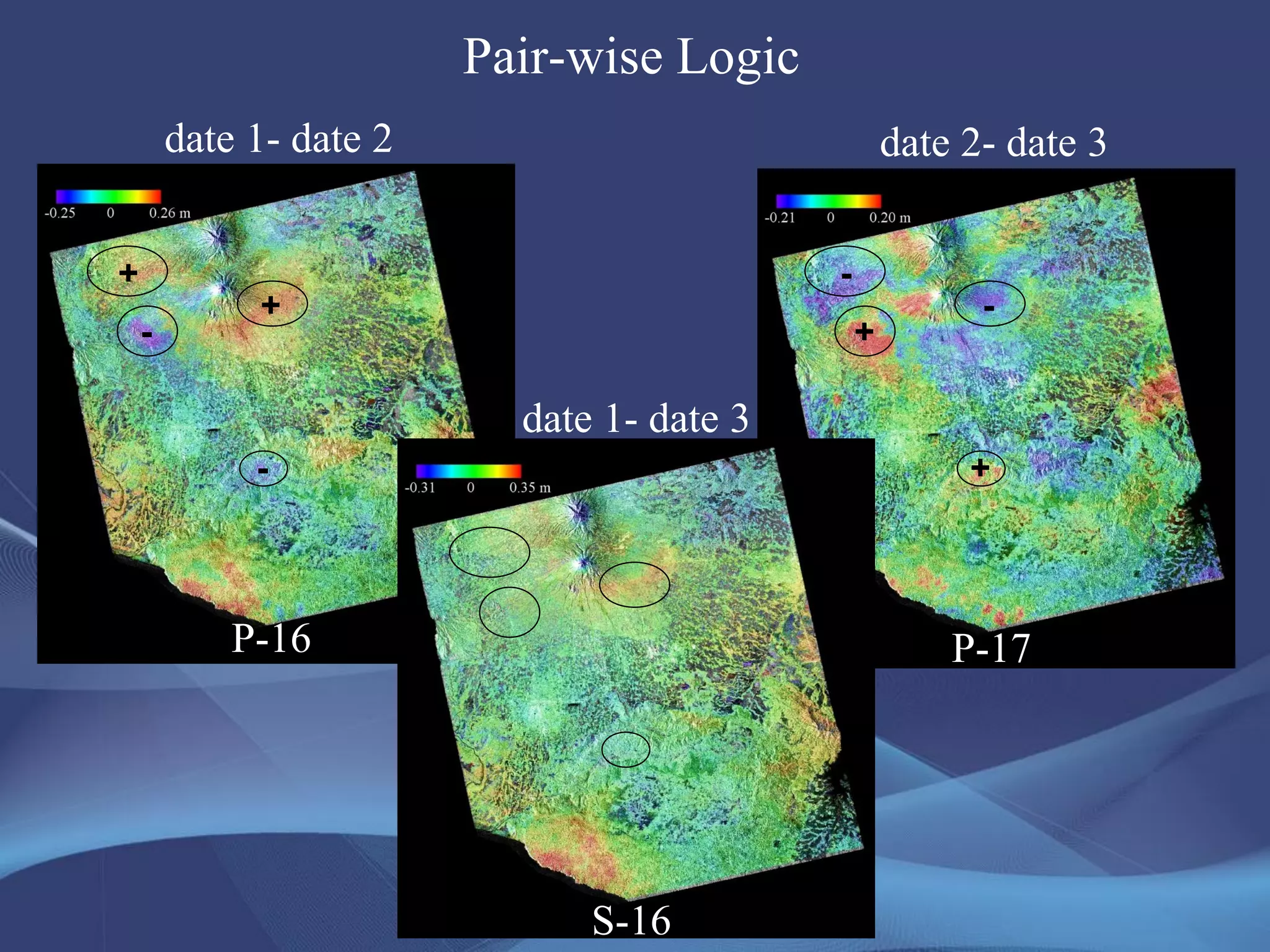
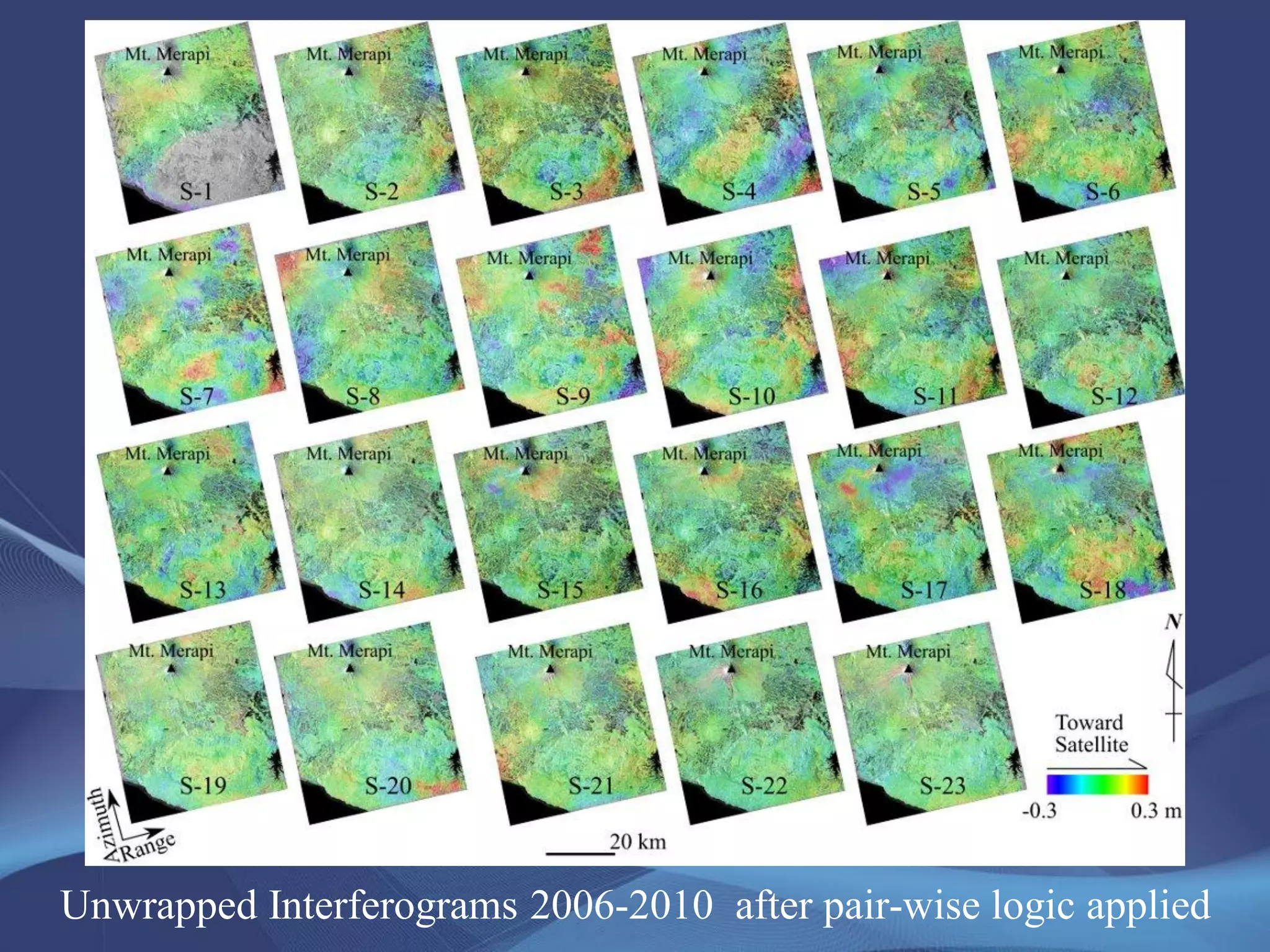
Pair-wise Logic
 Pair-wise logic method (Massonnet and Feigl, 1995) was
applied to the 24 pair data to reduce the atmospheric phase
delay from atmosphere.
 The two interferograms with shared data were paired.
 The atmospheric signal during that acquisition will
contaminate the displacement signal in both interferograms.
 The addition of both interferograms caused doubled
deformation signal and removed the atmospheric signal
(Hanssen, 2001).
A. Deformation
Pair-wise Logic
P-16
date 1- date 2
S-16
date 1- date 3
+
+
-
-
P-17
date 2- date 3
-
-
+
+
Unwrapped Interferograms 2006-2010 after pair-wise logic applied
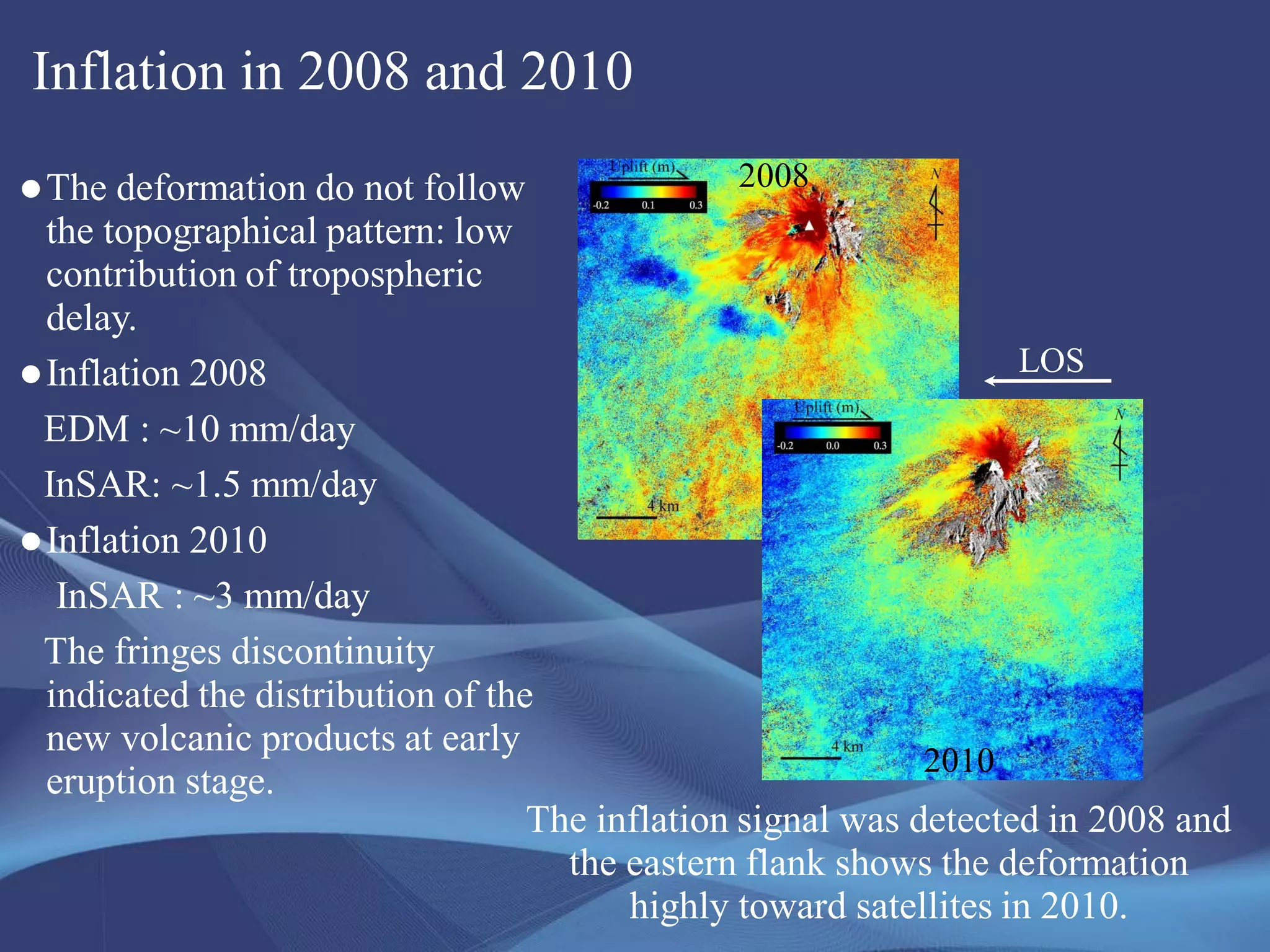
Inflation in 2008 and 2010
The deformation do not follow
the topographical pattern: low
contribution of tropospheric
delay.
Inflation 2008
EDM : ~10 mm/day
InSAR: ~1.5 mm/day
Inflation 2010
InSAR : ~3 mm/day
The fringes discontinuity
indicated the distribution of the
new volcanic products at early
eruption stage.
The inflation signal was detected in 2008 and
the eastern flank shows the deformation
highly toward satellites in 2010.
2008
2010
LOS
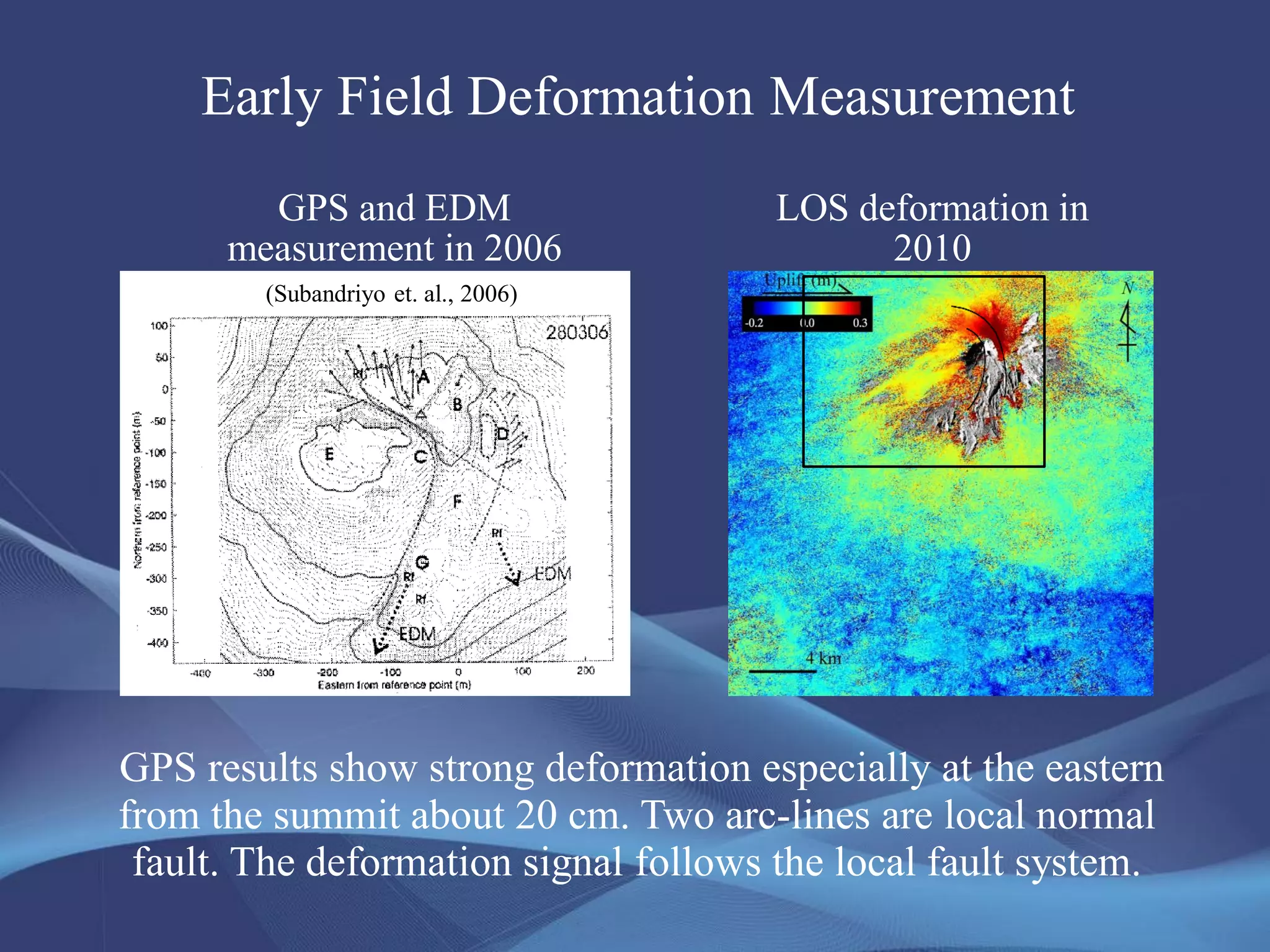
GPS results show strong deformation especially at the eastern
from the summit about 20 cm. Two arc-lines are local normal
fault. The deformation signal follows the local fault system.
Early Field Deformation Measurement
(Subandriyo et. al., 2006)
GPS and EDM
measurement in 2006
LOS deformation in
2010
B. Dome Shape
 The seed fill method (Revol and Jourlin, 1997) was applied
to detect surface changes of lava dome
 The backscattering intensity data between 2006 and 2010
were used
 The seed fill method defines a simplest single linkage scheme
such that the pixel’s seed P and neighborhood pixel P' are
considered as related ℜ if their gray levels f(P) and f(P') are
under threshold value α and connected to eight neighborhood
pixel ∁8 as follows:
Seed-fill method
𝑃 ℜ 𝑃′
=
𝑡𝑟𝑢𝑒, 𝑖𝑓 𝑓 𝑃 − 𝑓 𝑃′ ≤ 𝛼 ⋀ ∁8= 1
𝑓𝑎𝑙𝑠𝑒, 𝑂𝑡ℎ𝑒𝑟𝑤𝑖𝑠𝑒
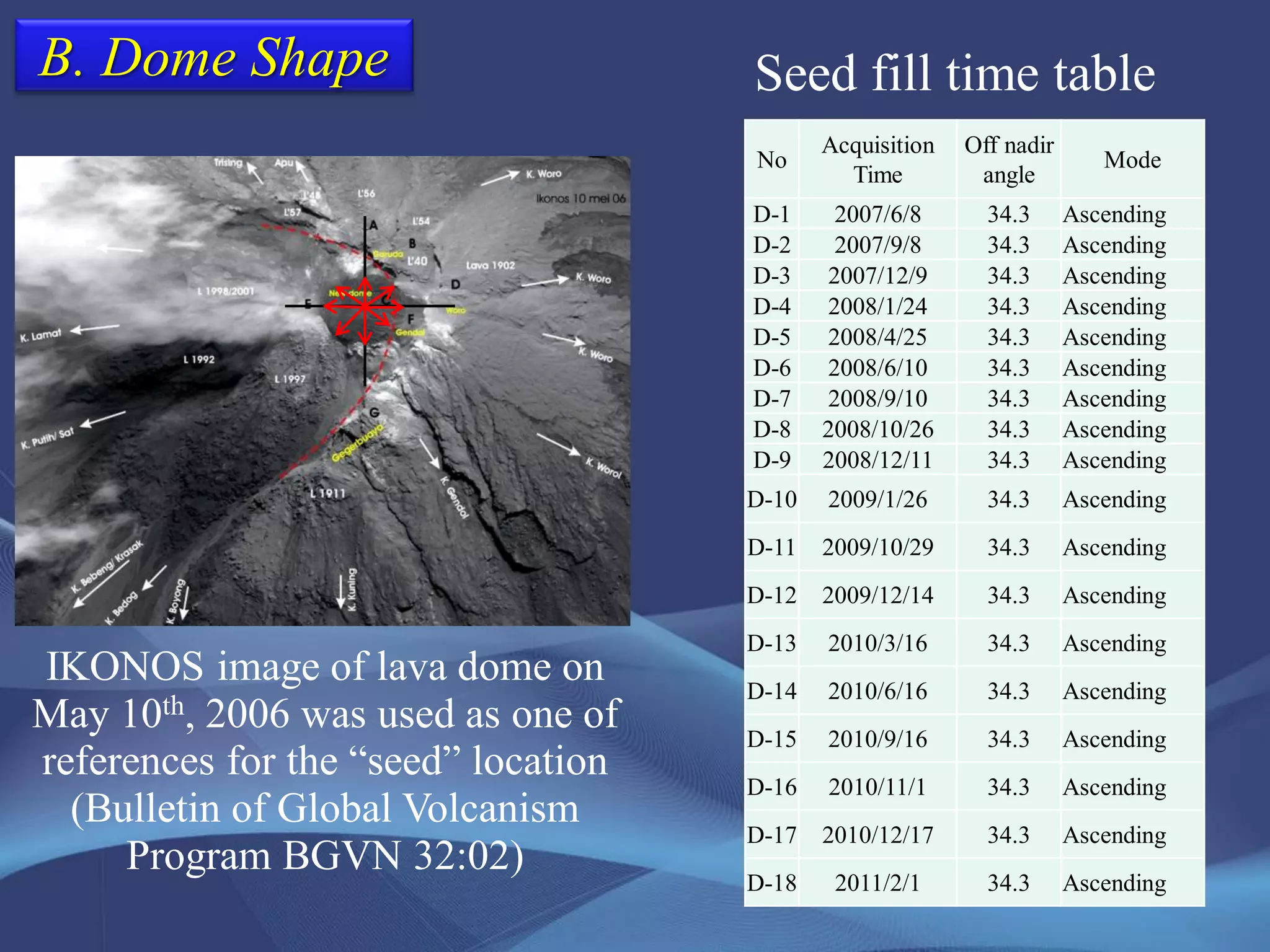
B. Dome Shape Seed fill time table
IKONOS image of lava dome on
May 10th, 2006 was used as one of
references for the “seed” location
(Bulletin of Global Volcanism
Program BGVN 32:02)
No
Acquisition
Time
Off nadir
angle
Mode
D-1 2007/6/8 34.3 Ascending
D-2 2007/9/8 34.3 Ascending
D-3 2007/12/9 34.3 Ascending
D-4 2008/1/24 34.3 Ascending
D-5 2008/4/25 34.3 Ascending
D-6 2008/6/10 34.3 Ascending
D-7 2008/9/10 34.3 Ascending
D-8 2008/10/26 34.3 Ascending
D-9 2008/12/11 34.3 Ascending
D-10 2009/1/26 34.3 Ascending
D-11 2009/10/29 34.3 Ascending
D-12 2009/12/14 34.3 Ascending
D-13 2010/3/16 34.3 Ascending
D-14 2010/6/16 34.3 Ascending
D-15 2010/9/16 34.3 Ascending
D-16 2010/11/1 34.3 Ascending
D-17 2010/12/17 34.3 Ascending
D-18 2011/2/1 34.3 Ascending
B. Dome Shape Seed fill in red portions
Roughness changes of the lava
dome prior to the 2010 eruption
2010.09.162010.11.01
σ0
= 4𝑘4
ℎ0
2
cos4
𝜃𝑖 𝛼 2
𝜔
Considering time series, the
surface Roughness is remaining
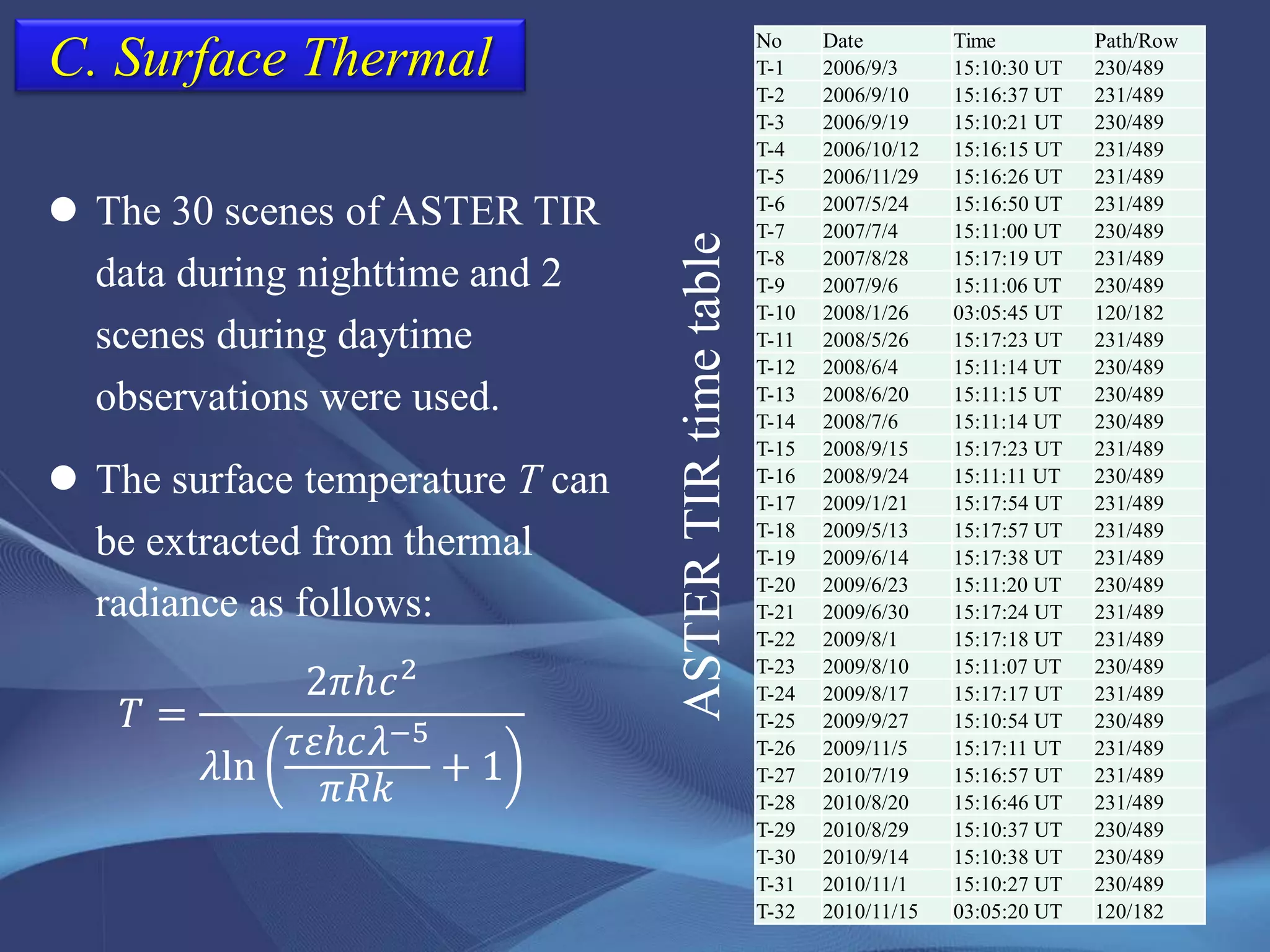
C. Surface Thermal
 The 30 scenes of ASTER TIR
data during nighttime and 2
scenes during daytime
observations were used.
 The surface temperature T can
be extracted from thermal
radiance as follows:
𝑇 =
2𝜋ℎ𝑐2
𝜆ln
𝜏𝜀ℎ𝑐𝜆−5
𝜋𝑅𝑘
+ 1
No Date Time Path/Row
T-1 2006/9/3 15:10:30 UT 230/489
T-2 2006/9/10 15:16:37 UT 231/489
T-3 2006/9/19 15:10:21 UT 230/489
T-4 2006/10/12 15:16:15 UT 231/489
T-5 2006/11/29 15:16:26 UT 231/489
T-6 2007/5/24 15:16:50 UT 231/489
T-7 2007/7/4 15:11:00 UT 230/489
T-8 2007/8/28 15:17:19 UT 231/489
T-9 2007/9/6 15:11:06 UT 230/489
T-10 2008/1/26 03:05:45 UT 120/182
T-11 2008/5/26 15:17:23 UT 231/489
T-12 2008/6/4 15:11:14 UT 230/489
T-13 2008/6/20 15:11:15 UT 230/489
T-14 2008/7/6 15:11:14 UT 230/489
T-15 2008/9/15 15:17:23 UT 231/489
T-16 2008/9/24 15:11:11 UT 230/489
T-17 2009/1/21 15:17:54 UT 231/489
T-18 2009/5/13 15:17:57 UT 231/489
T-19 2009/6/14 15:17:38 UT 231/489
T-20 2009/6/23 15:11:20 UT 230/489
T-21 2009/6/30 15:17:24 UT 231/489
T-22 2009/8/1 15:17:18 UT 231/489
T-23 2009/8/10 15:11:07 UT 230/489
T-24 2009/8/17 15:17:17 UT 231/489
T-25 2009/9/27 15:10:54 UT 230/489
T-26 2009/11/5 15:17:11 UT 231/489
T-27 2010/7/19 15:16:57 UT 231/489
T-28 2010/8/20 15:16:46 UT 231/489
T-29 2010/8/29 15:10:37 UT 230/489
T-30 2010/9/14 15:10:38 UT 230/489
T-31 2010/11/1 15:10:27 UT 230/489
T-32 2010/11/15 03:05:20 UT 120/182
ASTERTIRtimetable
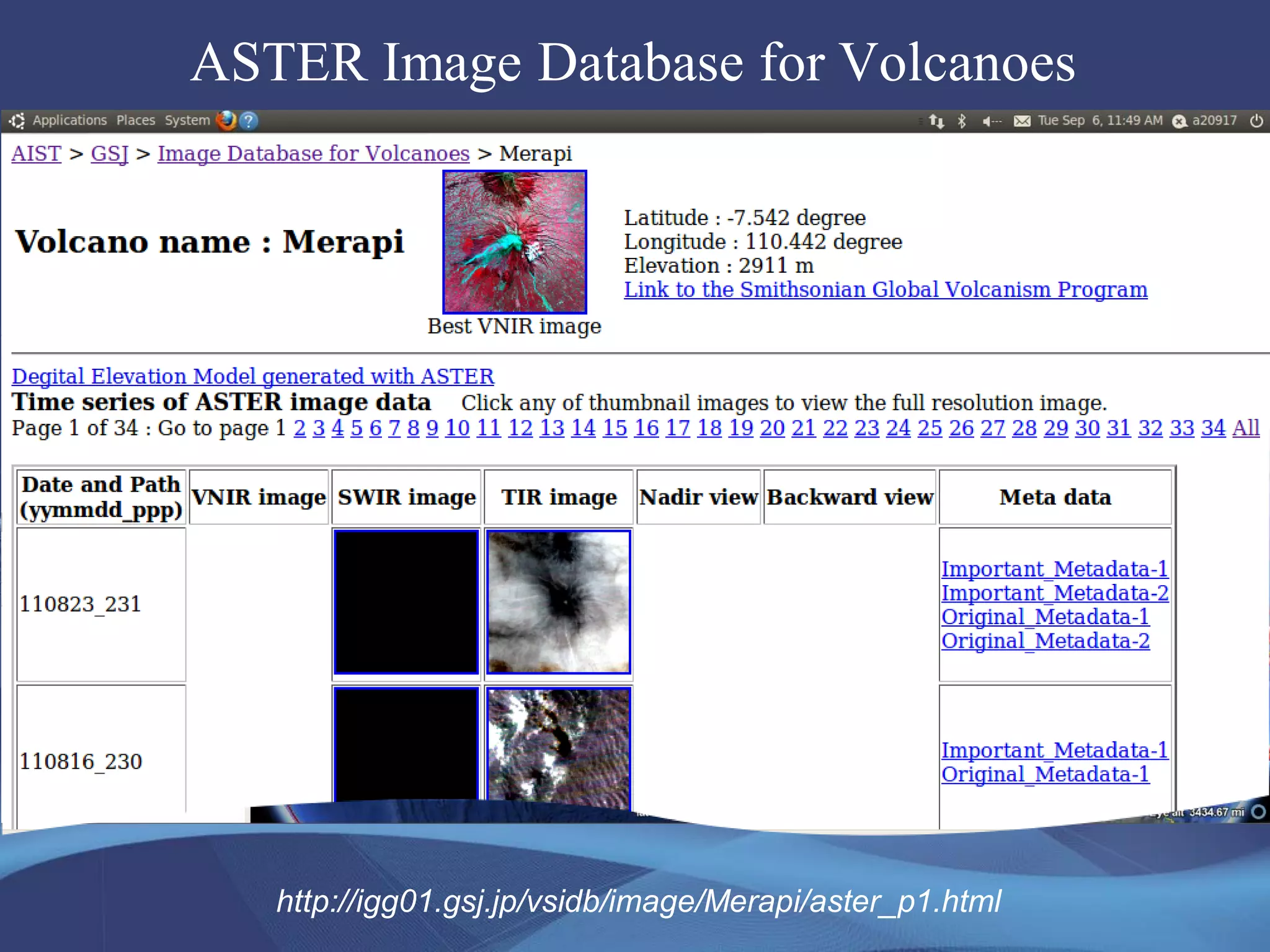
ASTER Image Database for Volcanoes
http://igg01.gsj.jp/vsidb/image/Merapi/aster_p1.html
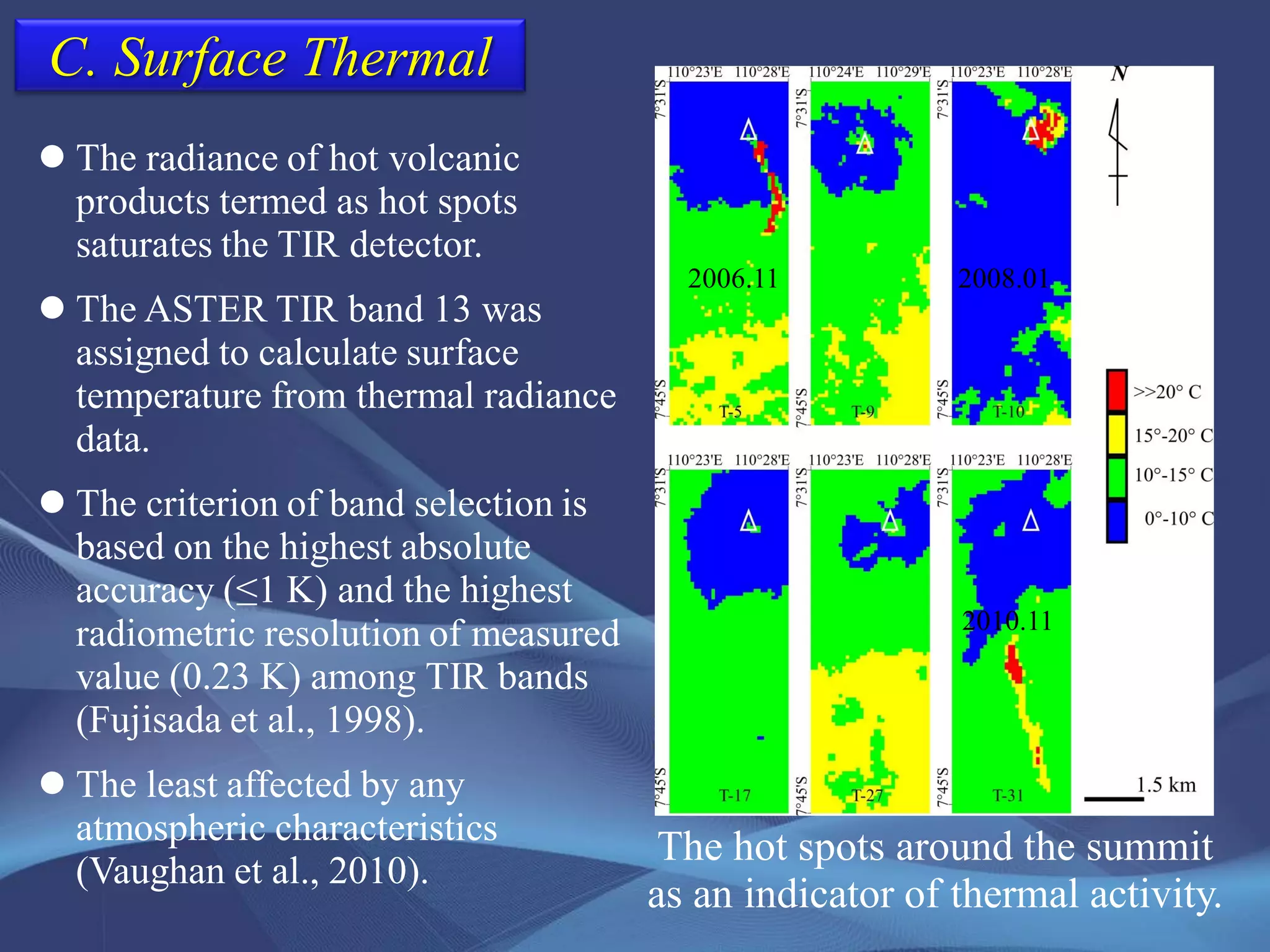
C. Surface Thermal
The hot spots around the summit
as an indicator of thermal activity.
 The radiance of hot volcanic
products termed as hot spots
saturates the TIR detector.
 The ASTER TIR band 13 was
assigned to calculate surface
temperature from thermal radiance
data.
 The criterion of band selection is
based on the highest absolute
accuracy (≤1 K) and the highest
radiometric resolution of measured
value (0.23 K) among TIR bands
(Fujisada et al., 1998).
 The least affected by any
atmospheric characteristics
(Vaughan et al., 2010).
2006.11 2008.01
2010.11
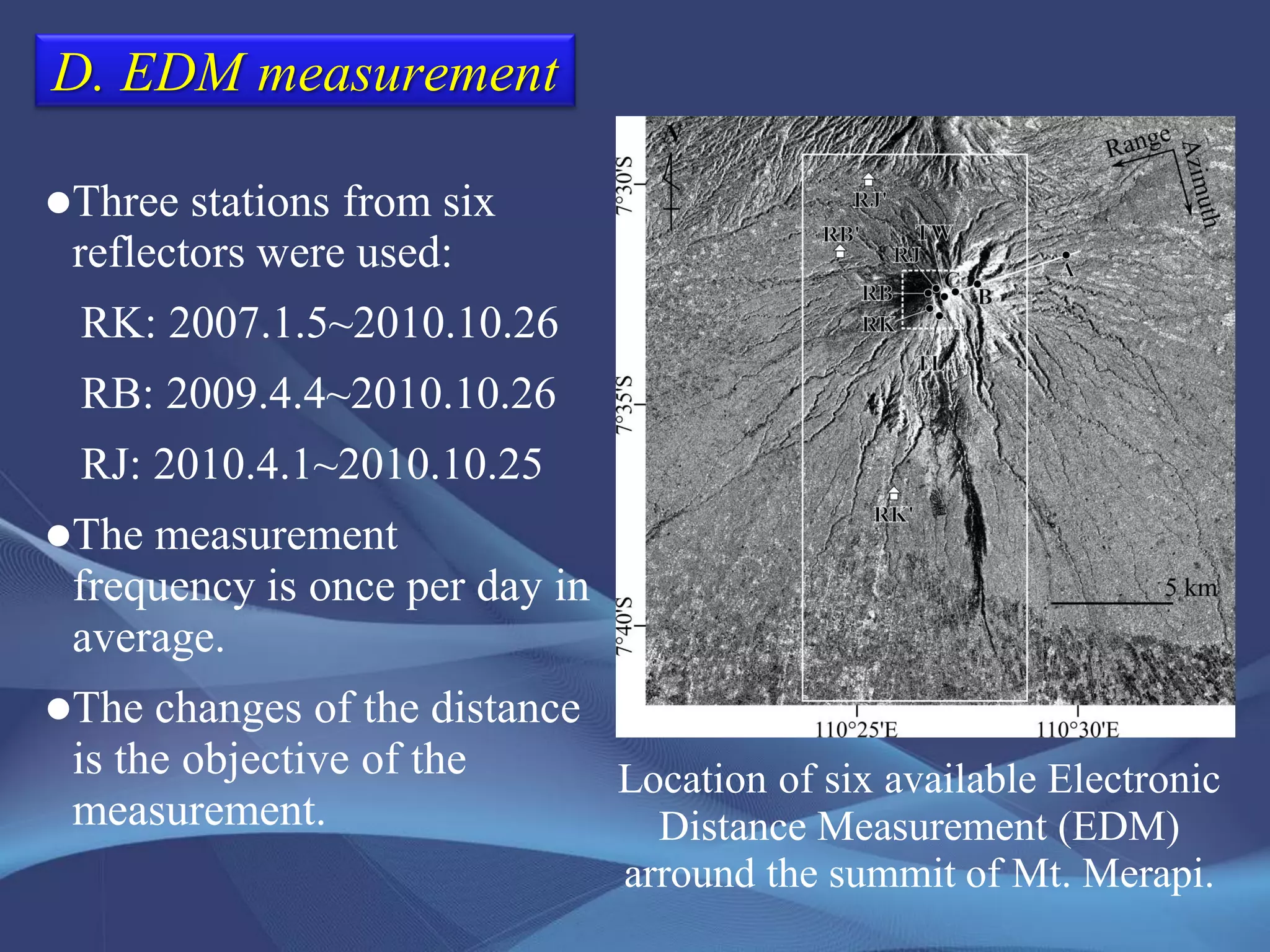
Location of six available Electronic
Distance Measurement (EDM)
arround the summit of Mt. Merapi.
Three stations from six
reflectors were used:
RK: 2007.1.5~2010.10.26
RB: 2009.4.4~2010.10.26
RJ: 2010.4.1~2010.10.25
The measurement
frequency is once per day in
average.
The changes of the distance
is the objective of the
measurement.
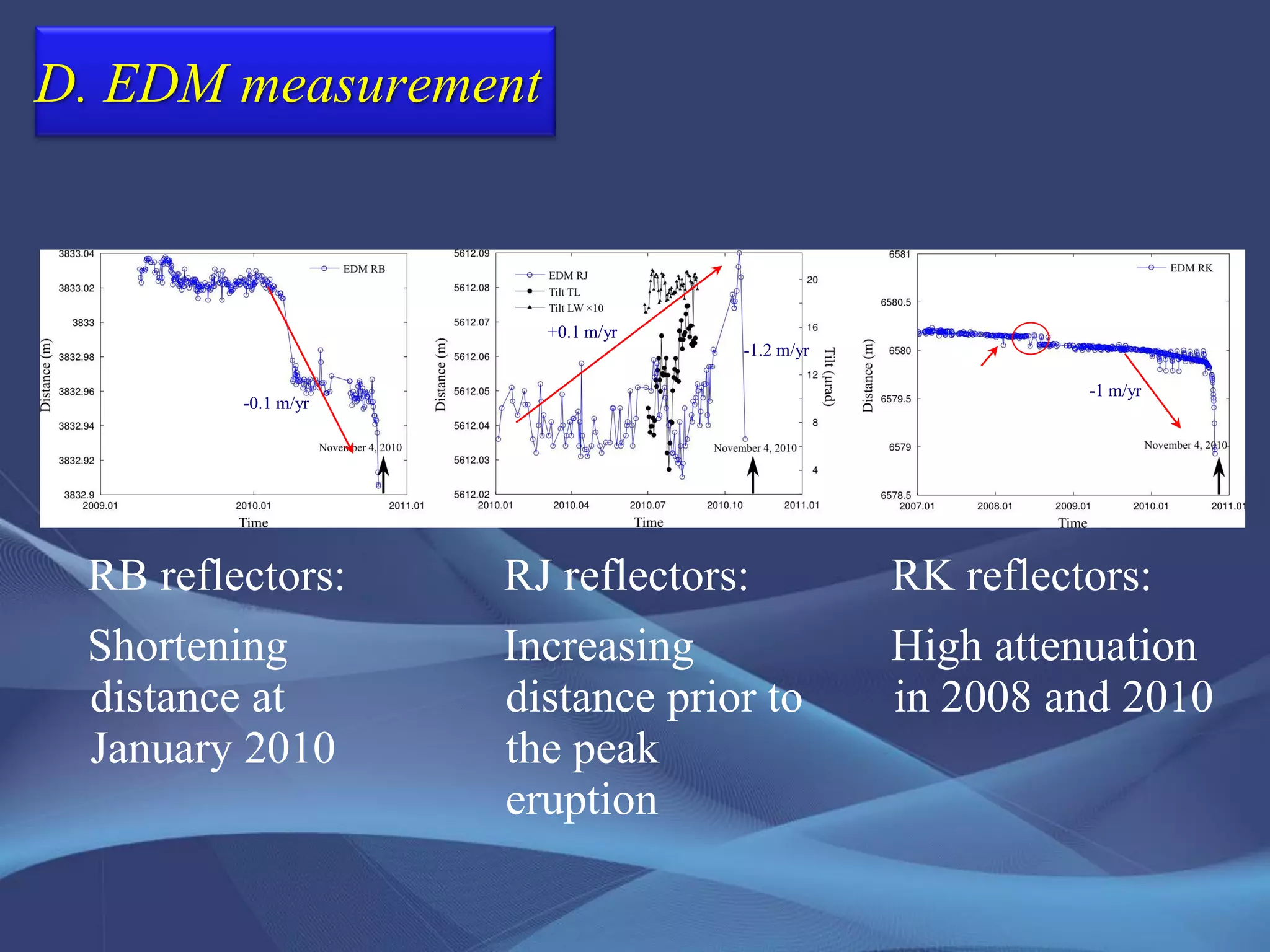
D. EDM measurement
RK reflectors:
High attenuation
in 2008 and 2010
D. EDM measurement
-1 m/yr
-0.1 m/yr
-1.2 m/yr
+0.1 m/yr
RB reflectors:
Shortening
distance at
January 2010
RJ reflectors:
Increasing
distance prior to
the peak
eruption
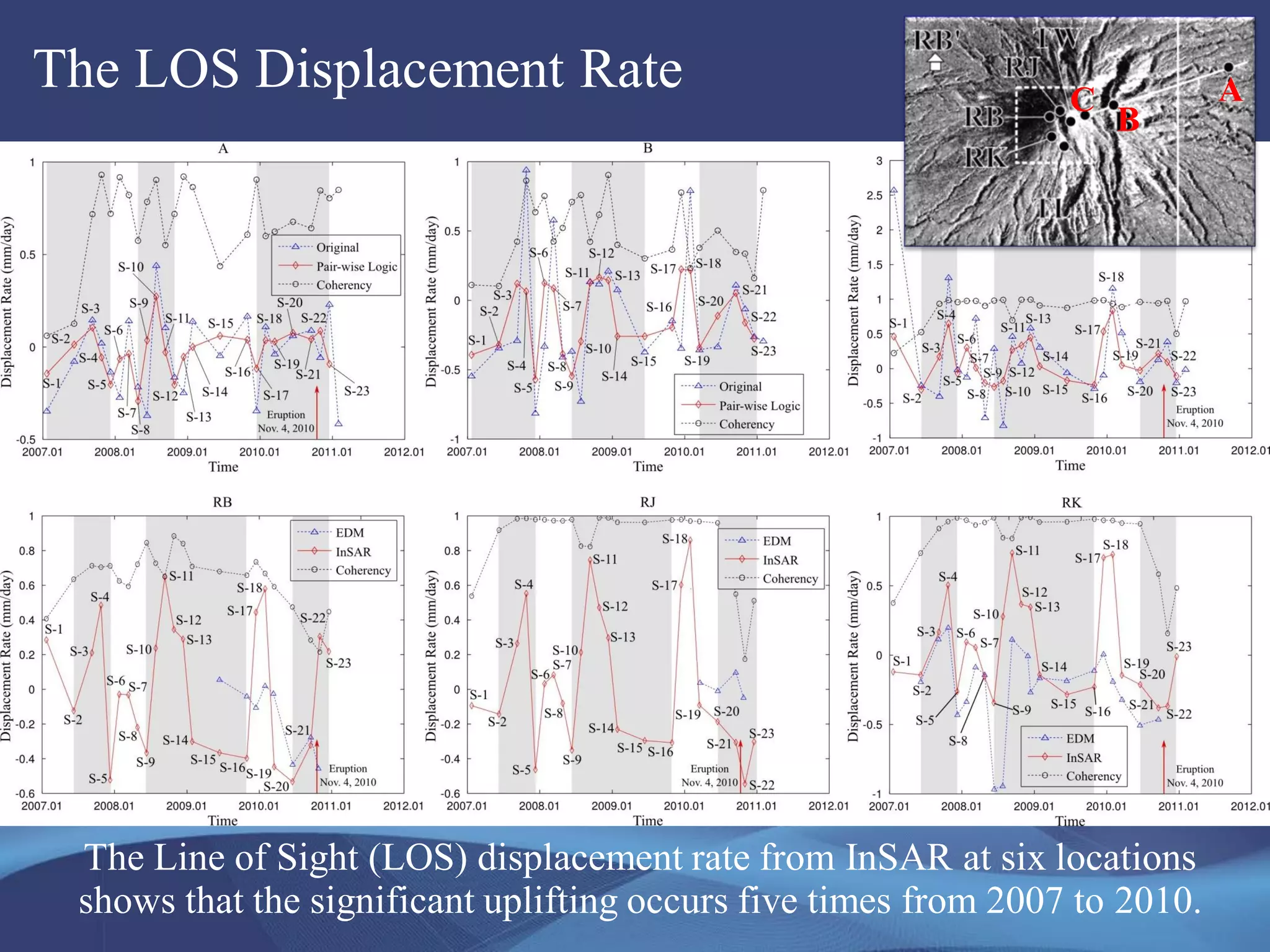
The LOS Displacement Rate
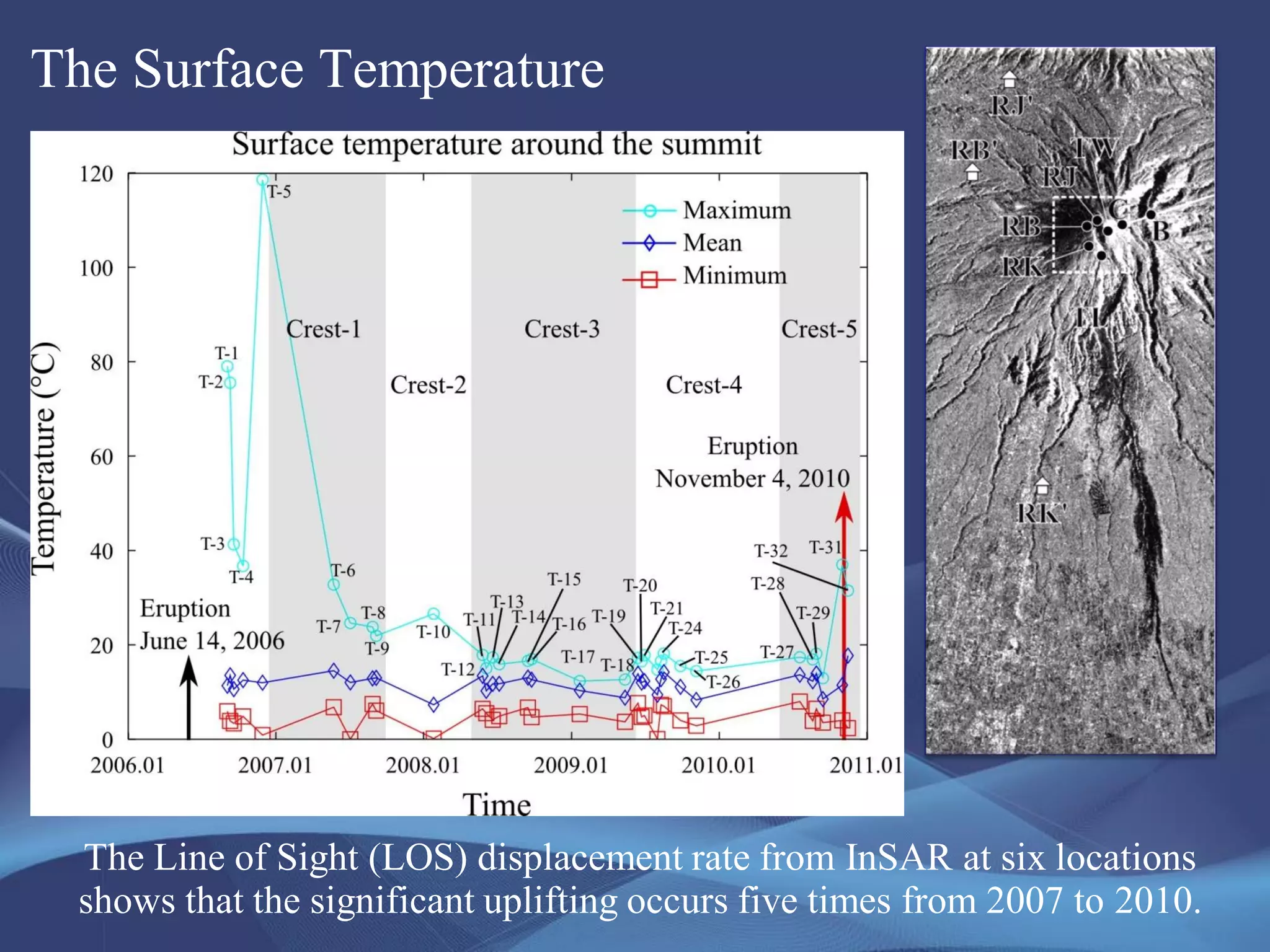
The Line of Sight (LOS) displacement rate from InSAR at six locations
shows that the significant uplifting occurs five times from 2007 to 2010.
A
B
C
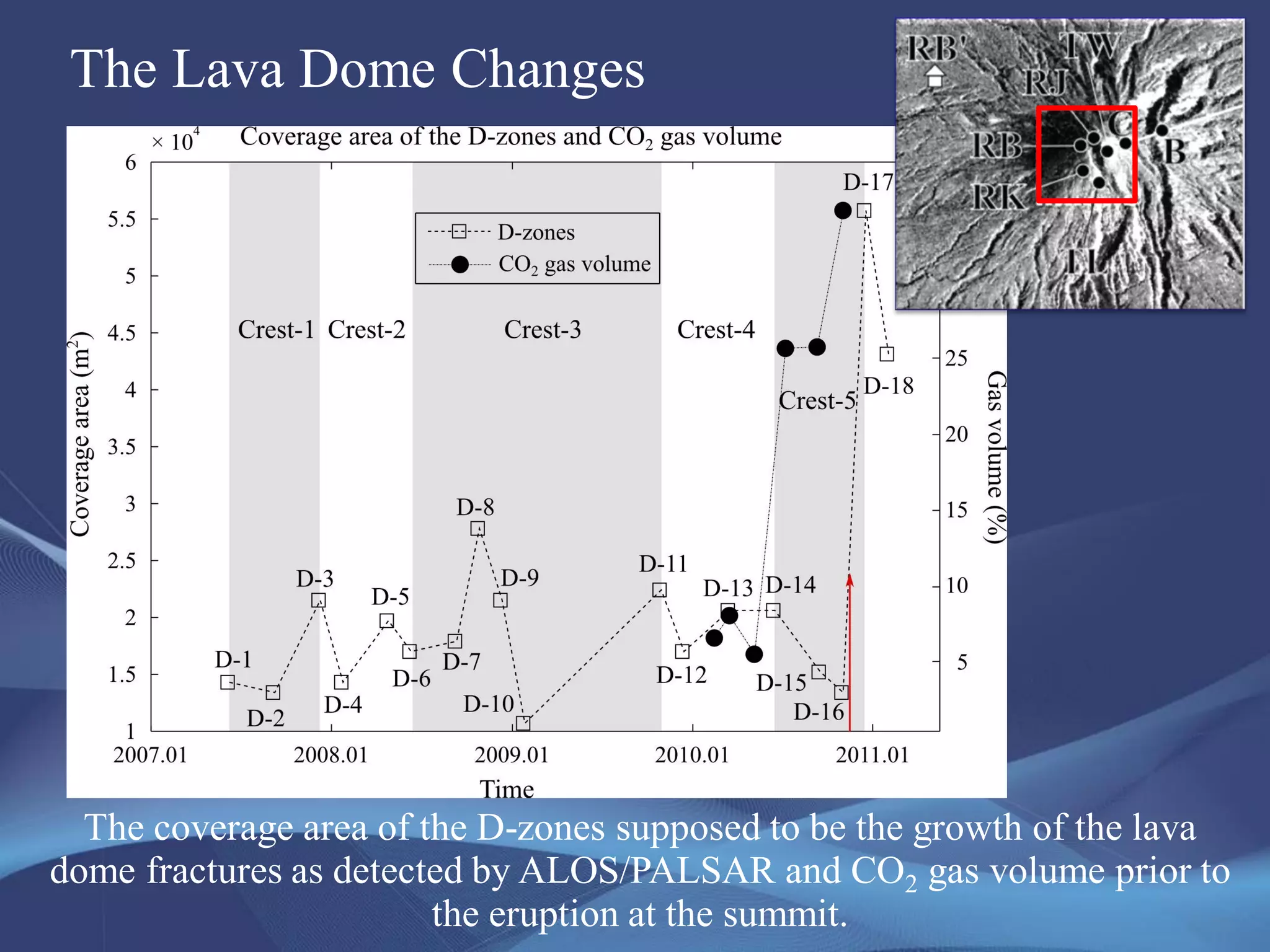
The Lava Dome Changes
The coverage area of the D-zones supposed to be the growth of the lava
dome fractures as detected by ALOS/PALSAR and CO2 gas volume prior to
the eruption at the summit.
The Surface Temperature
The Line of Sight (LOS) displacement rate from InSAR at six locations
shows that the significant uplifting occurs five times from 2007 to 2010.
W E
W E
InSARmeasurement
Shaded map
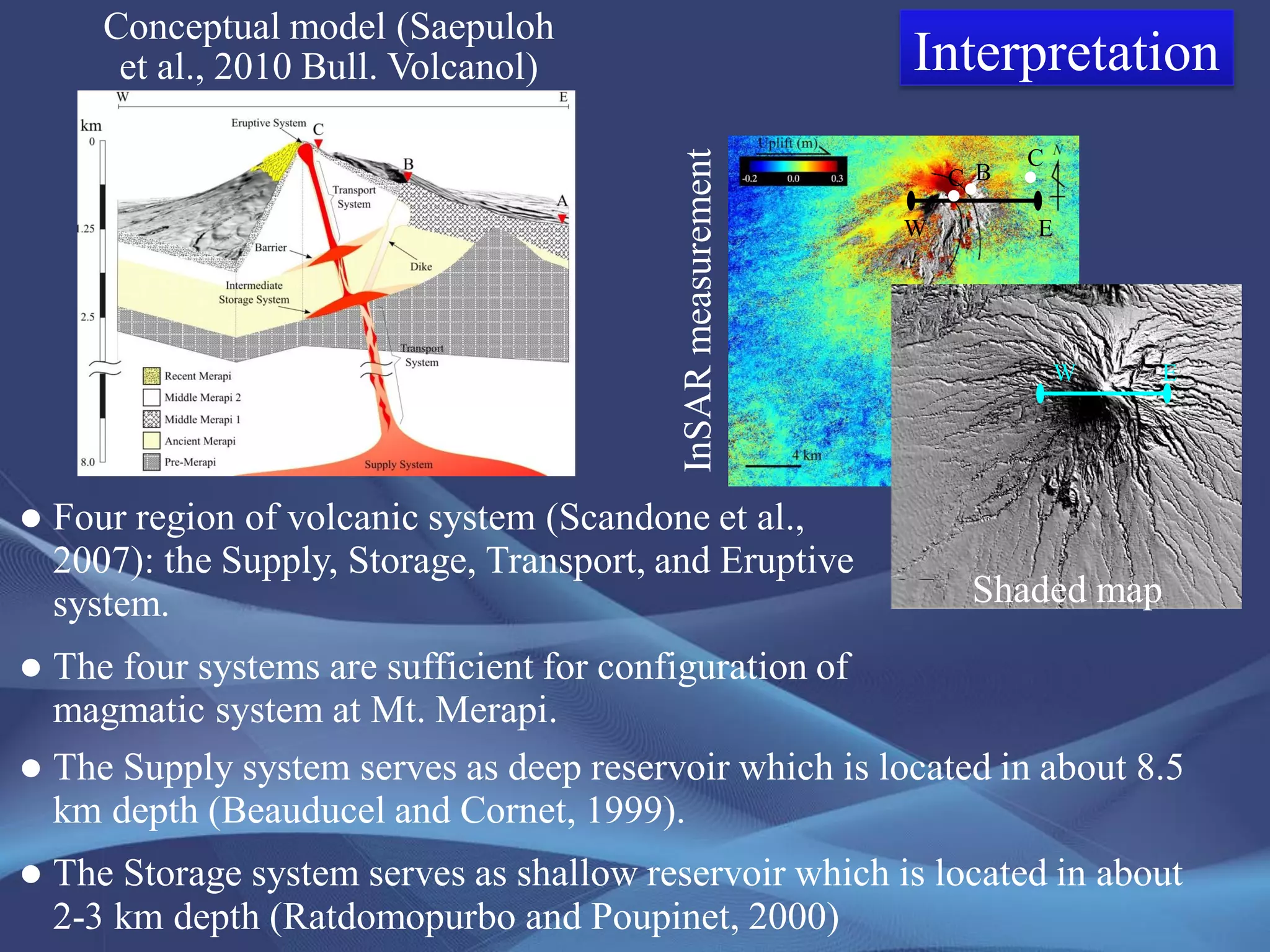
 Four region of volcanic system (Scandone et al.,
2007): the Supply, Storage, Transport, and Eruptive
system.
 The four systems are sufficient for configuration of
magmatic system at Mt. Merapi.
 The Supply system serves as deep reservoir which is located in about 8.5
km depth (Beauducel and Cornet, 1999).
 The Storage system serves as shallow reservoir which is located in about
2-3 km depth (Ratdomopurbo and Poupinet, 2000)
Interpretation
C B
C
Conceptual model (Saepuloh
et al., 2010 Bull. Volcanol)
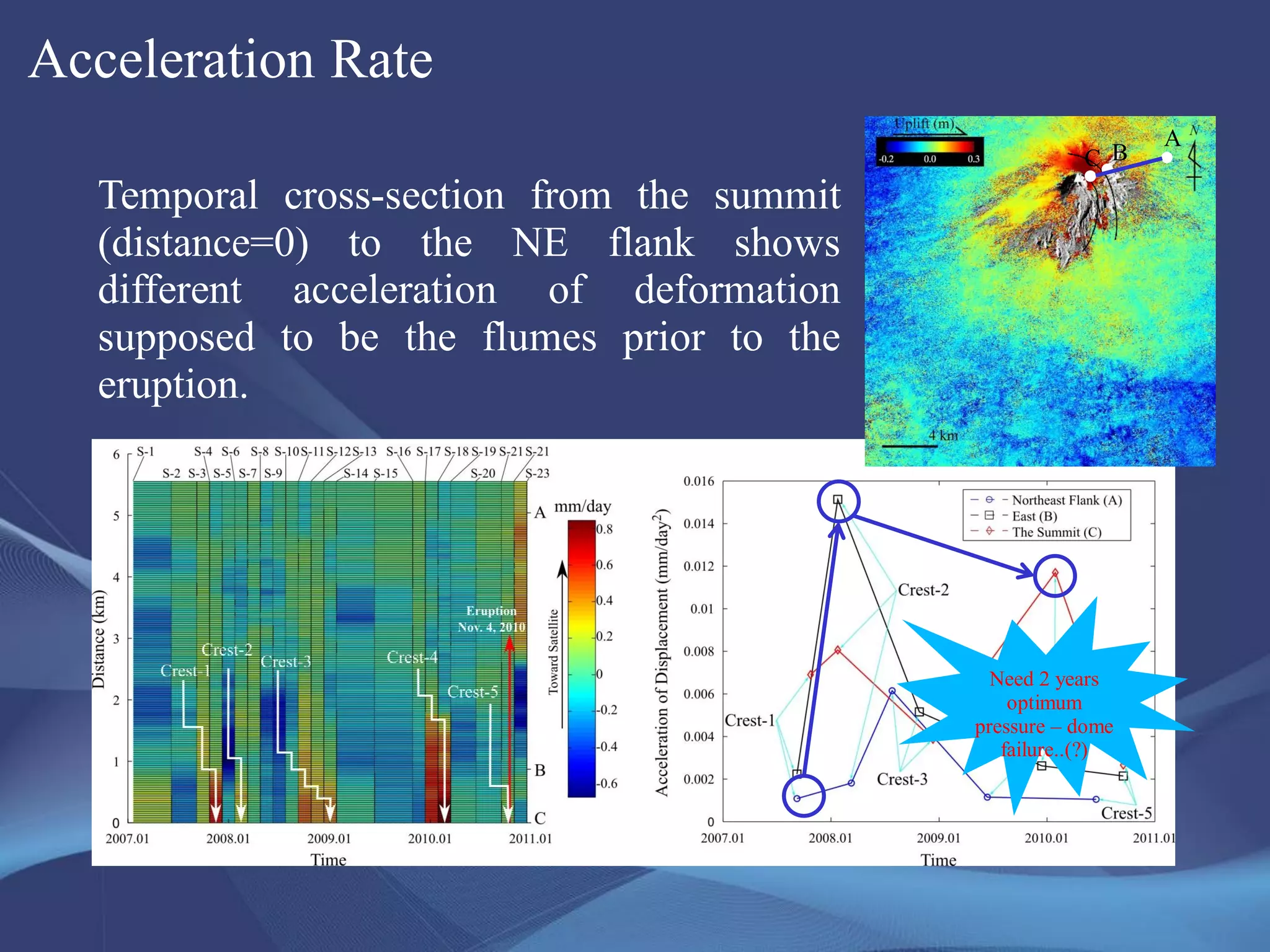
Acceleration Rate
C B
A
Temporal cross-section from the summit
(distance=0) to the NE flank shows
different acceleration of deformation
supposed to be the flumes prior to the
eruption.
Need 2 years
optimum
pressure – dome
failure..(?)
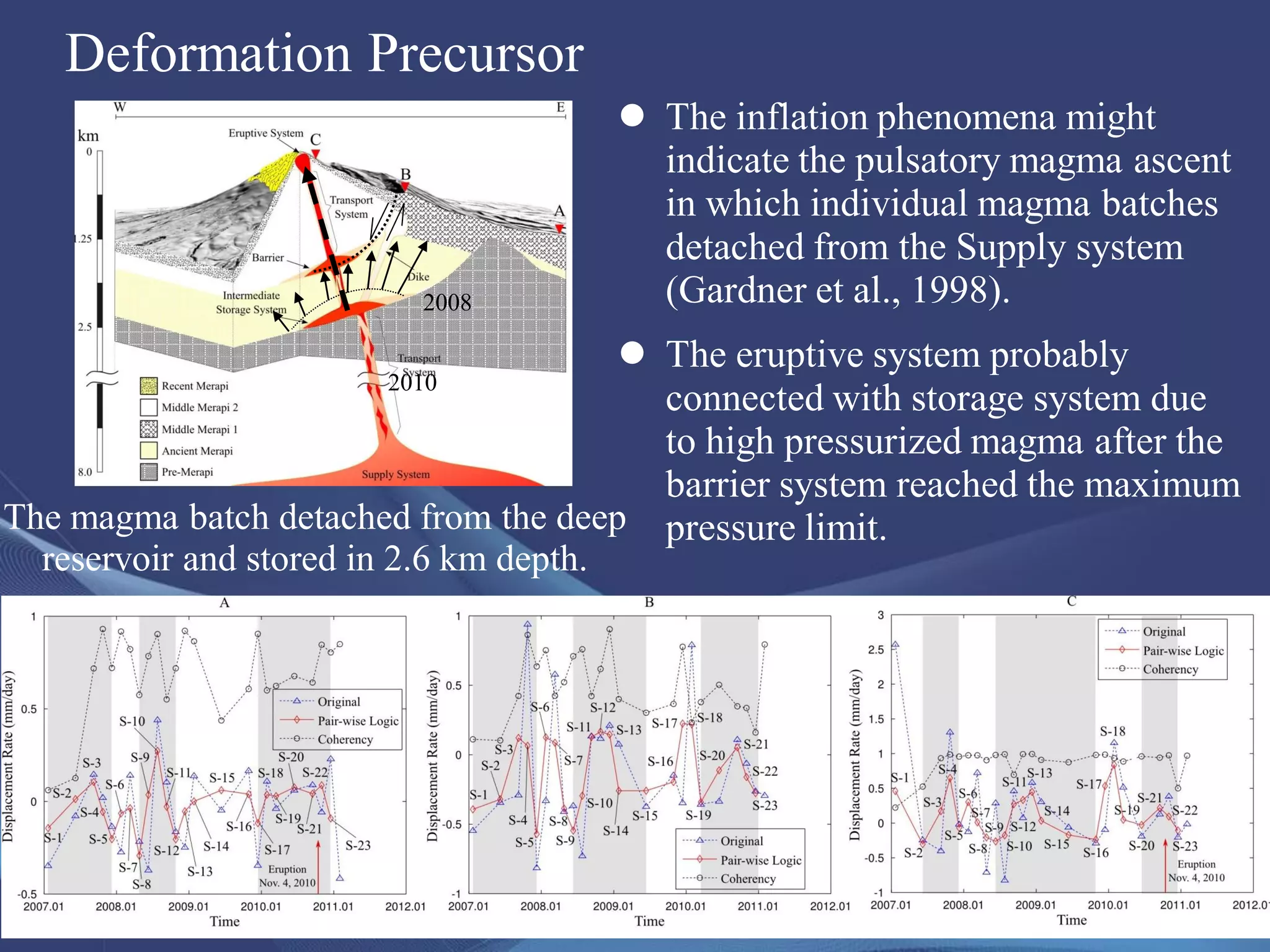
Deformation Precursor
 The inflation phenomena might
indicate the pulsatory magma ascent
in which individual magma batches
detached from the Supply system
(Gardner et al., 1998).
 The eruptive system probably
connected with storage system due
to high pressurized magma after the
barrier system reached the maximum
pressure limit.
2008
2010
The magma batch detached from the deep
reservoir and stored in 2.6 km depth.
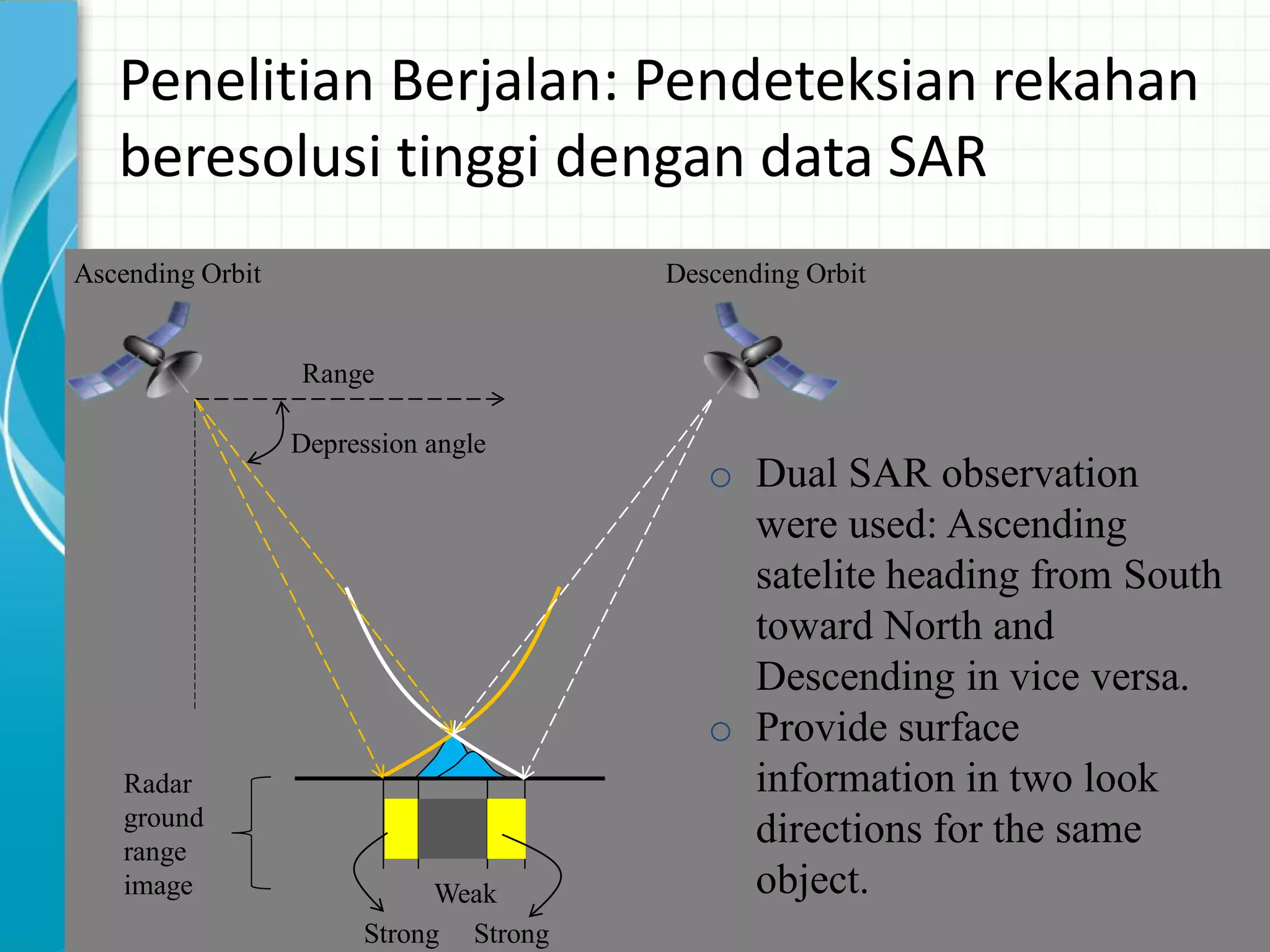
Penelitian Berjalan: Pendeteksian rekahan
beresolusi tinggi dengan data SAR
Range
Depression angle
Ascending Orbit Descending Orbit
Weak
Radar
ground
range
image
o Dual SAR observation
were used: Ascending
satelite heading from South
toward North and
Descending in vice versa.
o Provide surface
information in two look
directions for the same
object.
Strong Strong
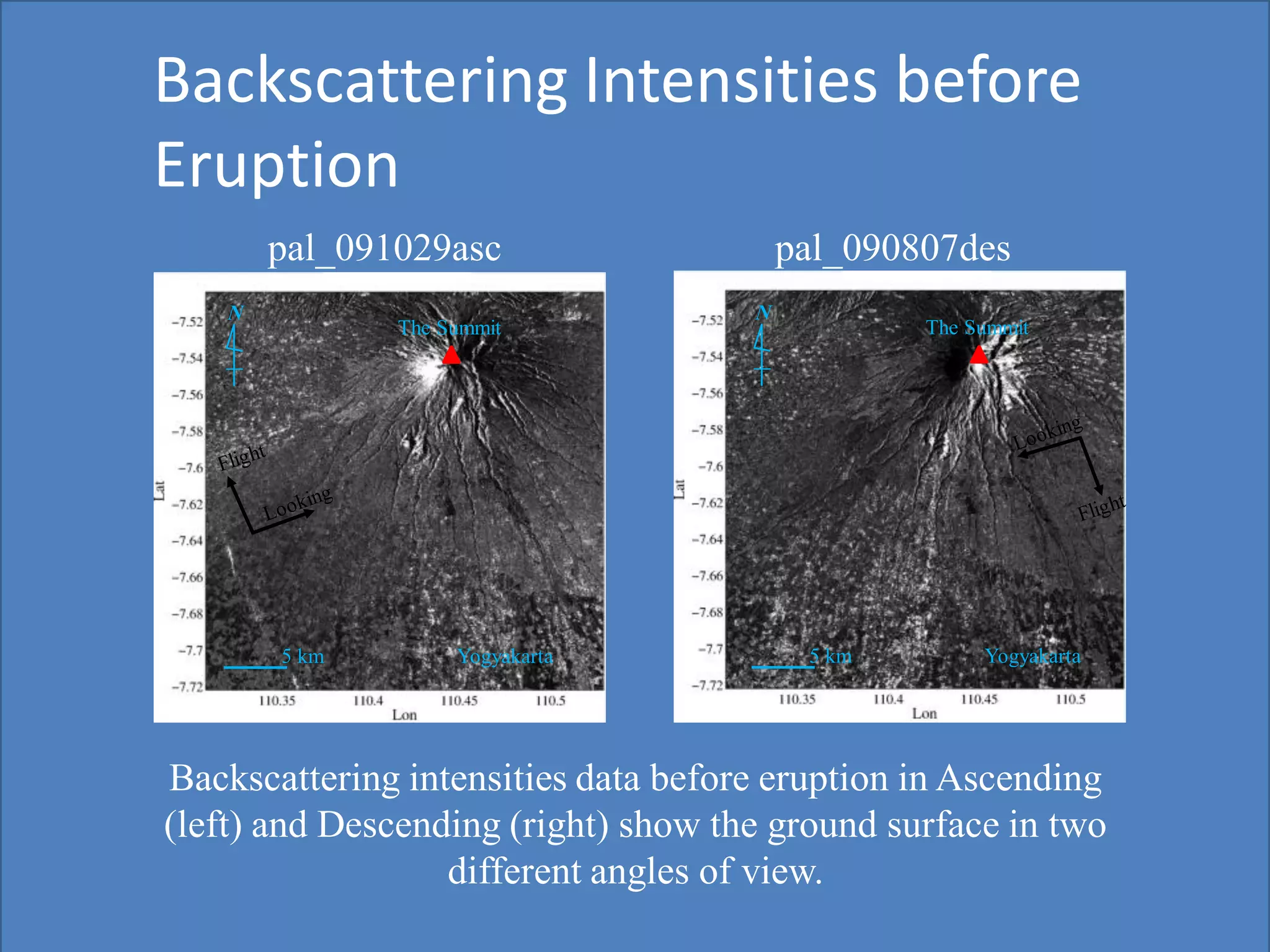
Backscattering Intensities before
Eruption
The Summit
Yogyakarta5 km
N
The Summit
Yogyakarta5 km
N
pal_091029asc pal_090807des
Backscattering intensities data before eruption in Ascending
(left) and Descending (right) show the ground surface in two
different angles of view.
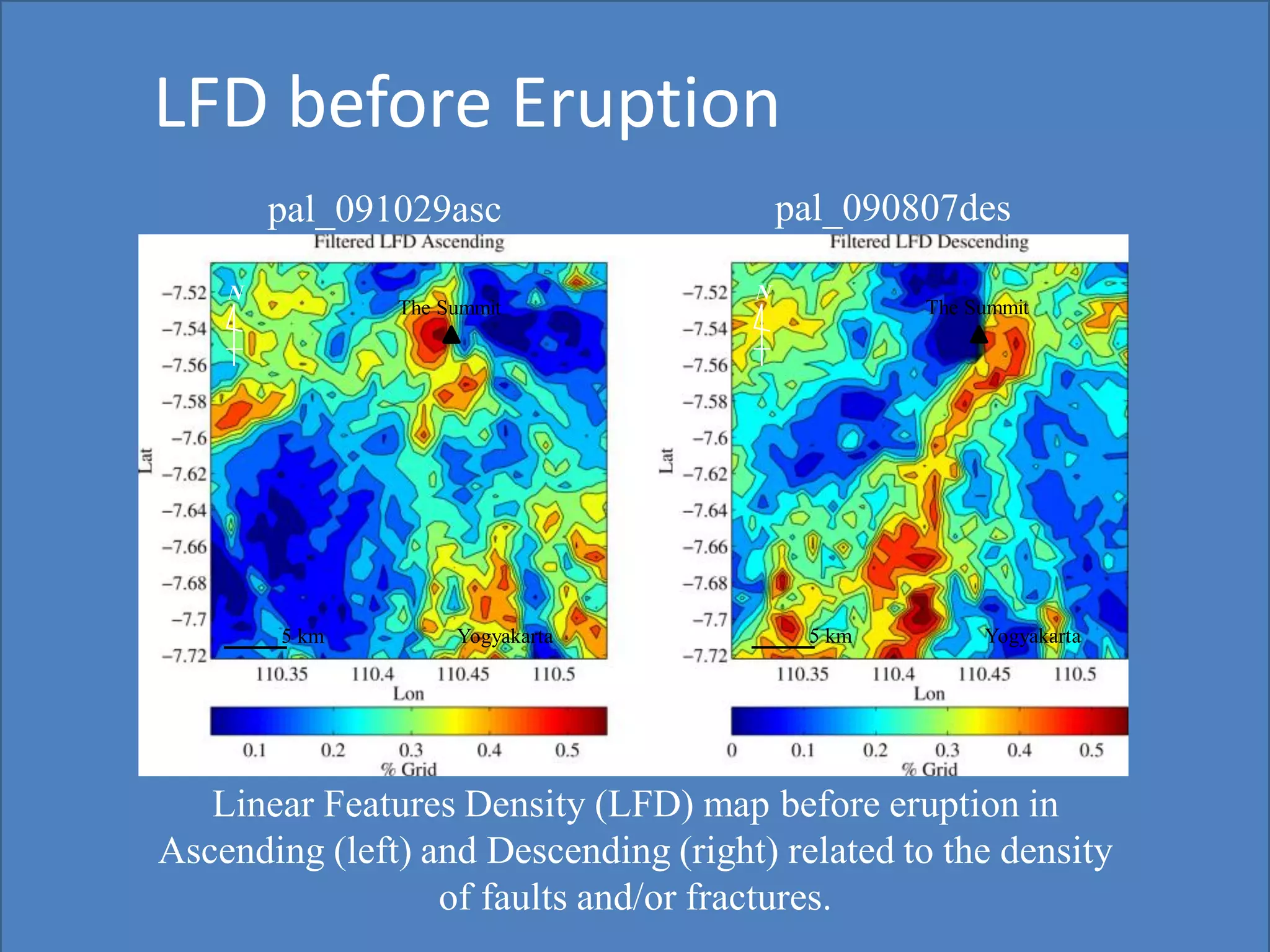
LFD before Eruption
The Summit
Yogyakarta5 km
N
The Summit
Yogyakarta5 km
N
pal_091029asc pal_090807des
Linear Features Density (LFD) map before eruption in
Ascending (left) and Descending (right) related to the density
of faults and/or fractures.
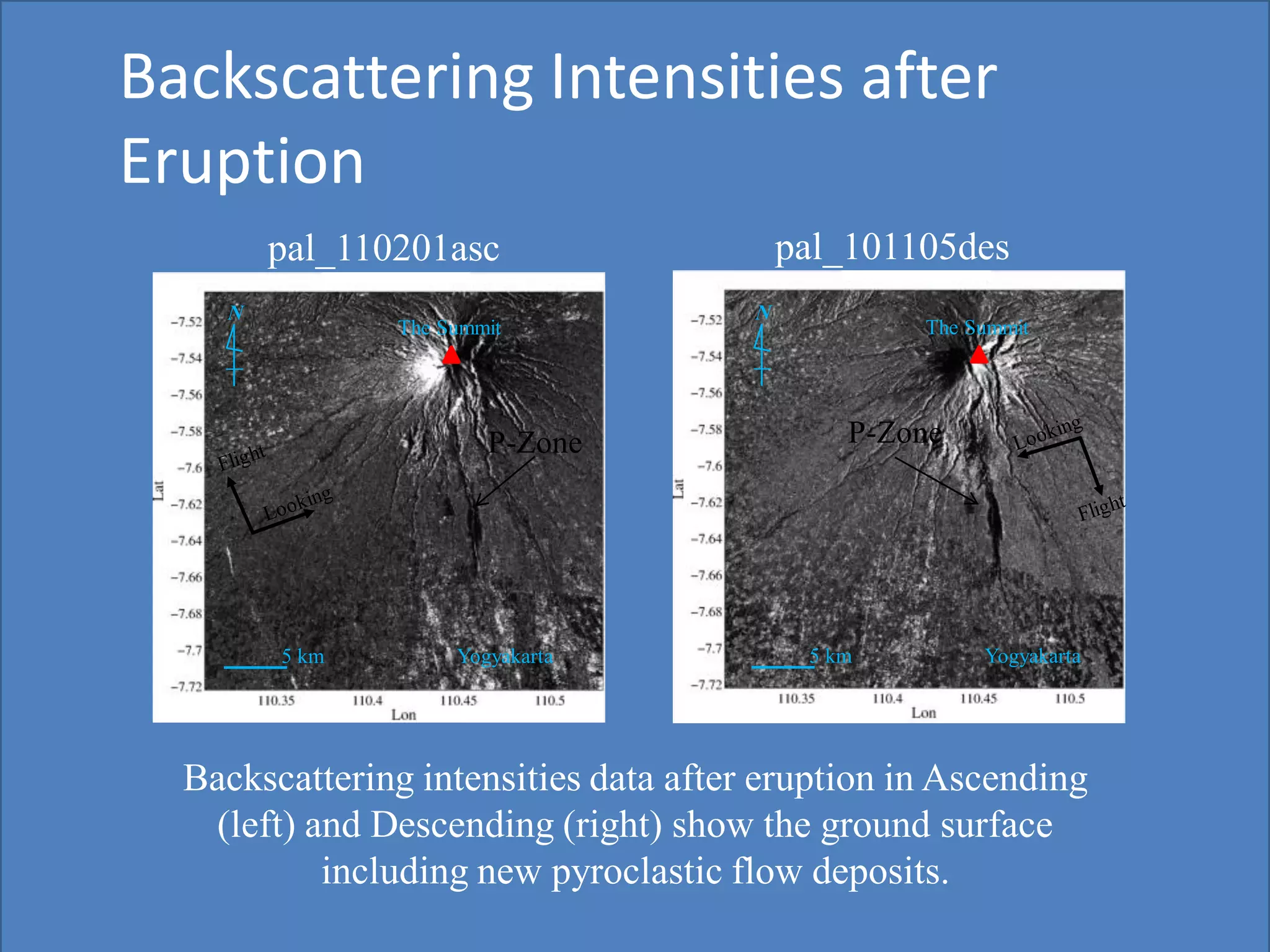
Backscattering Intensities after
Eruption
The Summit
Yogyakarta5 km
N
The Summit
Yogyakarta5 km
N
pal_110201asc pal_101105des
Backscattering intensities data after eruption in Ascending
(left) and Descending (right) show the ground surface
including new pyroclastic flow deposits.
P-Zone P-Zone
LFD after Eruption
The Summit
Yogyakarta5 km
N
The Summit
Yogyakarta5 km
N
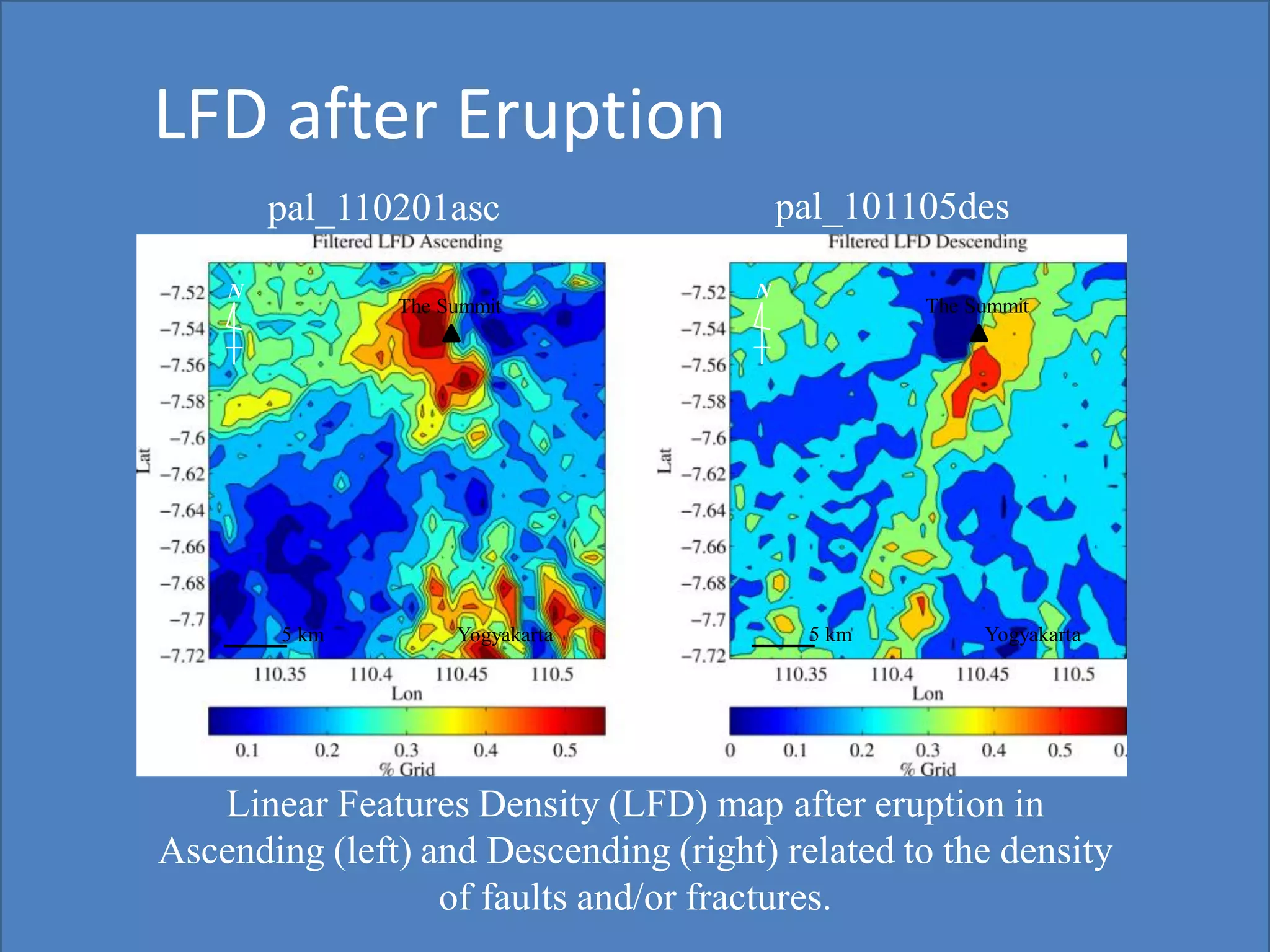
pal_110201asc pal_101105des
Linear Features Density (LFD) map after eruption in
Ascending (left) and Descending (right) related to the density
of faults and/or fractures.
Tota LFD Before and After
Eruption
The Summit
Yogyakarta5 km
N
Before After
The Summit
Yogyakarta5 km
N
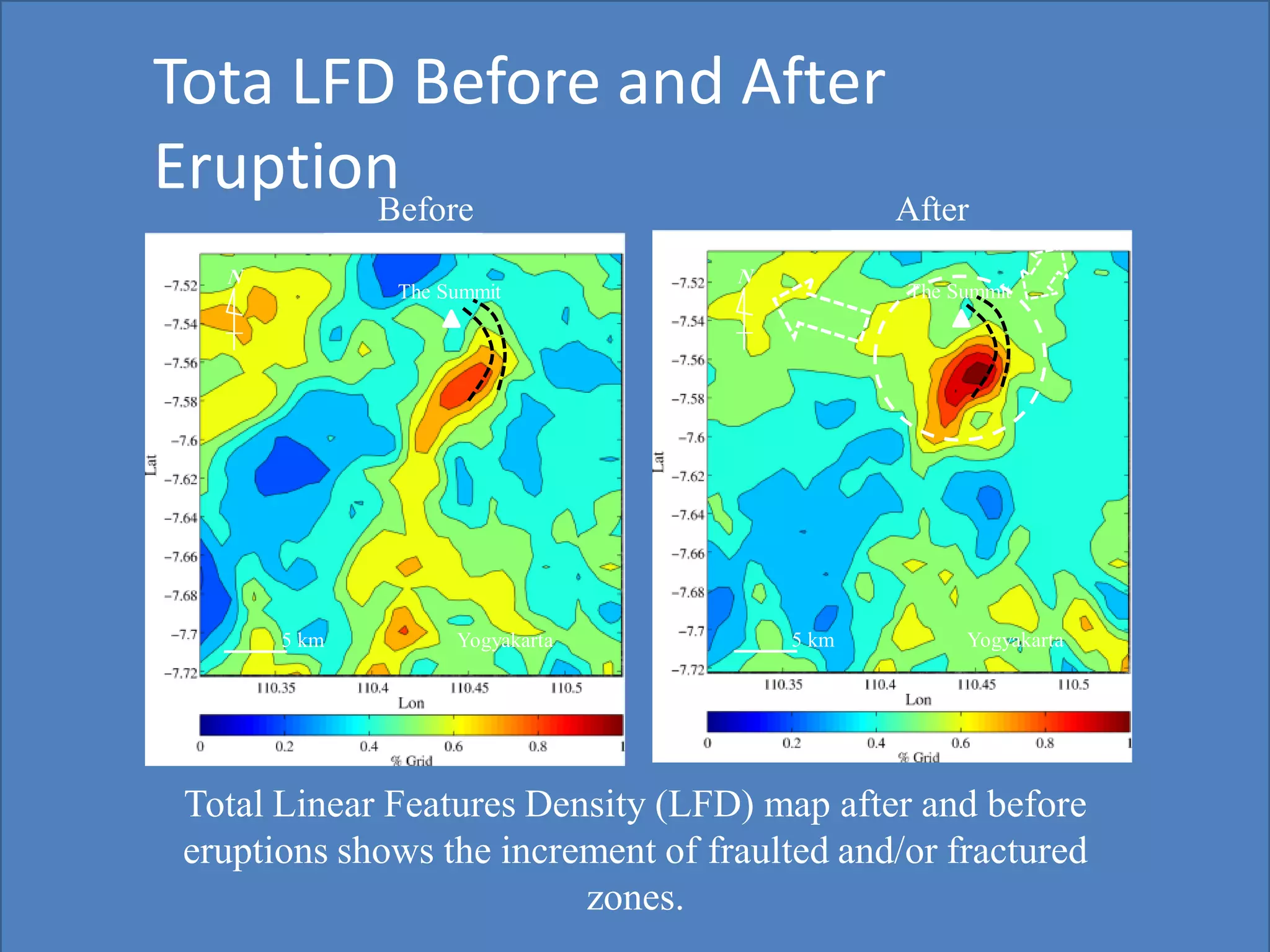
Total Linear Features Density (LFD) map after and before
eruptions shows the increment of fraulted and/or fractured
zones.

Karakterisasi Letusan Merapi menggunakan Data SAR (Synthetic Aperture Radar)

  • 1.
    Karakterisasi Letusan Merapi menggunakanData SAR (Synthetic Aperture Radar) Saepuloh et al., (2013), Interpretation of ground surface changes prior to the 2010 large eruption of Merapi volcano using ALOS/PALSAR, ASTER TIR and gas emission data, Journal of Volcanology and Geothermal Research, Vol. 261, pp. 130-143. Saepuloh et al., (2010), SAR- and gravity change-based characterization of the distribution pattern of pyroclastic flow deposits at Mt. Merapi during the past ten years, Bulletin of Volcanology, Vol. 72, No. 2, pp. 221-232. Asep Saepuloh, Dr. Eng. FITB, ITB
  • 2.
    Content 1. An overviewof Mt. Merapi Eruption 1996-2006 2. ALOS/PALSAR Observed 2010 Eruption 3. Eruption precursor using time series of D-InSAR and ASTER TIR
  • 3.
    Interaction of MicrowaveSignal to Surface 𝑃𝑅 = 𝑃 𝑇 𝜎0 𝐴 𝐺2 𝜆2 4𝜋 3 𝑅4 The radar equation Dielectric permittivity Incident angle Roughness funct. σ0 = 4𝑘4ℎ0 2 cos4 𝜃𝑖 𝛼 2 𝜔 αℎℎ = 𝜇 𝑟 − 1 𝜖 𝑟 𝜇 𝑟 − sin2 𝜃𝑖 + 𝜇 𝑟 sin2 𝜃𝑖 + 𝜇 𝑟 2 𝜖 𝑟 − 1 π 𝜇 𝑟 cos 𝜃𝑖 + 𝜖 𝑟 𝜇 𝑟 − sin2 𝜃𝑖 4 α 𝑣𝑣 = 𝜖 𝑟 − 1 𝜖 𝑟 𝜇 𝑟 − sin2 𝜃𝑖 + 𝜖 𝑟 sin2 𝜃𝑖 + 𝜖 𝑟 2 𝜇 𝑟 − 1 π 𝜖 𝑟 cos 𝜃𝑖 + 𝜖 𝑟 𝜇 𝑟 − sin2 𝜃𝑖 4 Magnetic permeability SmallPerturbationModel
  • 4.
    • The SyntheticAperture Radar (SAR) data were used. • The superiority of SAR data means that they can provide periodic Earth observations regardless of the time or weather. Study area http://www.stanford.edu/ 1. An Overview of the Last Decade of Mt. Merapi Eruption • Ground check - Geological observation - Rock sampling collection
  • 5.
    Objectives and DataUsed Data used: 1. JERS-1 2. RADARSAT-1 Advantage: Sun-synchronous orbit with moderate incidence angle (39º-37º) Limitation: Ten years observation covering four times of eruption (1996-2006) JERS-1 RADARSAT-1 CSA Objectives: Detect and characterize the pyroclastic flow deposits (P- zone) each eruption period
  • 6.
    Temporal SAR Data Pairselection of SAR data to detect pyroclastic flow deposits with each eruption. A black triangle denotes a major eruption. A period of high seismic activity is shown by a gray bar. Intensity images of JERS-1 and RADARSAT-1 SAR data around Mt. Merapi at a descending mode.  The P-zones are detected by comparing the two SAR data before and after events.  The two data with same path and raw reduce the geometrical error. te-1 te+1 P-zone te
  • 7.
    Temporal Pattern Analysisof the P-zones Schematic of the P-zone Parameters: A= Distribution area = Perimeter, D= Flow distance α= Included angle γ= Collapse direction Each selected pair is used to detect P-zone. Then, the parameters of each detected P-zone are calculated and analyzed. Temporal change of P-zones extracted from seven SAR data pairs. Thin arrows stand for collapse directions of each P-zone. Overlay of seven P-zones to highlight the temporal change of distribution pattern.
  • 8.
    2. ALOS/PALSAR Observed 2010Eruption Advanced Land Observing Satellite Communication antenna Solar Paddle PALSAR PRISM AVNIR-2 Item Specification 1270 MHz / 23.6 cm Chirp band width Image modes Single polarization (HH or VV) Dual pol. (HH+HV or VV+VH) Quad-pol. (HH+HV+VH+VV) Off-nadir angle Variable: 9.9 – 50.8 deg. (inc. angle range: 7.9 - 60.0) Look direction Right Yaw steering ON Swath width 70 km (single/dual pol.@41.5°) 30 km (quad-pol.@21.5°) Ground resolution ~ 9 m x 10 m (single pol.@41.5°) ~ 19 m x 10 m (dual pol.@41.5°) ~ 30 x 10 m (quad-pol.@21.5°) ~ 71-157m (4 look) x 100m (2 look) Data rates Orbit cycle 46 days Centre frequency 28 MHz (single polarisation) 14 MHz (dual, quad-pol., ScanSAR) ScanSAR (HH or VV; 3/4/5-beam) ScanSAR: 20.1-36.5 (inc. 18.0-43.3) 350 km (ScanSAR 5-beam) Rg (1 look) x Az (2 looks) 240 Mbps (single/dual/quad-pol) 120 or 240 Mbps (ScanSAR) Mission: To provide maps for Japan and other countries including those in the Asian- Pacific region (Cartography). To perform regional observation for "sustainable development", harmonization between Earth environment and development (Regional Observation). To conduct disaster monitoring around the world (Disaster Monitoring). To survey natural resources (Resources Surveying). To develop technology necessary for future Earth observing satellite (Technology Development).
  • 9.
    Backscattering Intensity Before andAfter Eruption 2007.9.12 2010.11.15 Extracted Pyroclastic Flow Deposits
  • 10.
    Pyroclastic Flow Deposits1996-2010 The eruption of Mt. Merapi in November 2010 has a different characteristic in comparison with the last decade of eruption. The coverage area of the pyroclastic flow deposits is about 7 times larger than the eruption in 2006.
  • 11.
    3. Eruption precursorusing time series of ALOS/PALSAR and ASTER TIR Three point of view: A. Deformation B. Lava dome shape C. Surface thermal D. EDM measurement
  • 12.
    A. Deformation 23 datapairs with short temporal baseline were used to generate interferograms. Pair Acquisition Time Baseline Path/Row Off nadir angle Mode 1st 2nd Perpendicular (m) Temporal (days) 1 2007/6/8 2006/12/6 2598 184 431/703 34.3 Ascending 2 2007/9/8 2007/1/21 979 230 431/703 34.3 Ascending 3 2007/10/24 2007/6/8 344 138 431/703 34.3 Ascending 4 2007/12/9 2007/9/8 140 92 431/703 34.3 Ascending 5 2008/1/24 2007/10/24 180 92 431/703 34.3 Ascending 6 2008/3/10 2007/12/9 188 92 431/703 34.3 Ascending 7 2008/4/25 2008/1/24 172 92 431/703 34.3 Ascending 8 2008/6/10 2008/3/10 553 92 431/703 34.3 Ascending 9 2008/7/26 2008/4/25 162 92 431/703 34.3 Ascending 10 2008/9/10 2008/6/10 78 92 431/703 34.3 Ascending 11 2008/10/26 2008/7/26 742 92 431/703 34.3 Ascending 12 2008/12/11 2008/9/10 109 92 431/703 34.3 Ascending 13 2009/1/26 2008/10/26 32 92 431/703 34.3 Ascending 14 2009/6/13 2008/12/11 292 184 431/703 34.3 Ascending 15 2009/10/29 2009/1/26 432 276 431/703 34.3 Ascending 16 2009/12/14 2009/6/13 56 184 431/703 34.3 Ascending 17 2010/1/29 2009/10/29 141 92 431/703 34.3 Ascending 18 2010/3/16 2009/12/14 216 92 431/703 34.3 Ascending 19 2010/6/16 2010/1/29 342 138 431/703 34.3 Ascending 20 2010/9/16 2010/3/16 218 184 431/703 34.3 Ascending 21 2010/11/1 2010/6/16 329 138 431/703 34.3 Ascending 22 2010/12/17 2010/9/16 96 92 431/703 34.3 Ascending 23 2011/2/1 2010/11/1 36 92 431/703 34.3 Ascending Improvement of perpendicular baseline
  • 13.
    Local Limitation ofInSAR ALOS/PALSAR  Ascending and descending pairs are limited Need assumption to obtain three displacement component  No GPS measurement since 2006 up to 2010  High tropospheric disturbance Meteorological measurement is not available Large amount of interferogram is required  Deformation is not constant over time Need advanced method to separate the deformation and tropospheric effect A. Deformation
  • 14.
    Pair-wise Logic  Pair-wiselogic method (Massonnet and Feigl, 1995) was applied to the 24 pair data to reduce the atmospheric phase delay from atmosphere.  The two interferograms with shared data were paired.  The atmospheric signal during that acquisition will contaminate the displacement signal in both interferograms.  The addition of both interferograms caused doubled deformation signal and removed the atmospheric signal (Hanssen, 2001). A. Deformation
  • 15.
    Pair-wise Logic P-16 date 1-date 2 S-16 date 1- date 3 + + - - P-17 date 2- date 3 - - + +
  • 16.
    Unwrapped Interferograms 2006-2010after pair-wise logic applied
  • 17.
    Inflation in 2008and 2010 The deformation do not follow the topographical pattern: low contribution of tropospheric delay. Inflation 2008 EDM : ~10 mm/day InSAR: ~1.5 mm/day Inflation 2010 InSAR : ~3 mm/day The fringes discontinuity indicated the distribution of the new volcanic products at early eruption stage. The inflation signal was detected in 2008 and the eastern flank shows the deformation highly toward satellites in 2010. 2008 2010 LOS
  • 18.
    GPS results showstrong deformation especially at the eastern from the summit about 20 cm. Two arc-lines are local normal fault. The deformation signal follows the local fault system. Early Field Deformation Measurement (Subandriyo et. al., 2006) GPS and EDM measurement in 2006 LOS deformation in 2010
  • 19.
    B. Dome Shape The seed fill method (Revol and Jourlin, 1997) was applied to detect surface changes of lava dome  The backscattering intensity data between 2006 and 2010 were used  The seed fill method defines a simplest single linkage scheme such that the pixel’s seed P and neighborhood pixel P' are considered as related ℜ if their gray levels f(P) and f(P') are under threshold value α and connected to eight neighborhood pixel ∁8 as follows: Seed-fill method 𝑃 ℜ 𝑃′ = 𝑡𝑟𝑢𝑒, 𝑖𝑓 𝑓 𝑃 − 𝑓 𝑃′ ≤ 𝛼 ⋀ ∁8= 1 𝑓𝑎𝑙𝑠𝑒, 𝑂𝑡ℎ𝑒𝑟𝑤𝑖𝑠𝑒
  • 20.
    B. Dome ShapeSeed fill time table IKONOS image of lava dome on May 10th, 2006 was used as one of references for the “seed” location (Bulletin of Global Volcanism Program BGVN 32:02) No Acquisition Time Off nadir angle Mode D-1 2007/6/8 34.3 Ascending D-2 2007/9/8 34.3 Ascending D-3 2007/12/9 34.3 Ascending D-4 2008/1/24 34.3 Ascending D-5 2008/4/25 34.3 Ascending D-6 2008/6/10 34.3 Ascending D-7 2008/9/10 34.3 Ascending D-8 2008/10/26 34.3 Ascending D-9 2008/12/11 34.3 Ascending D-10 2009/1/26 34.3 Ascending D-11 2009/10/29 34.3 Ascending D-12 2009/12/14 34.3 Ascending D-13 2010/3/16 34.3 Ascending D-14 2010/6/16 34.3 Ascending D-15 2010/9/16 34.3 Ascending D-16 2010/11/1 34.3 Ascending D-17 2010/12/17 34.3 Ascending D-18 2011/2/1 34.3 Ascending
  • 21.
    B. Dome ShapeSeed fill in red portions Roughness changes of the lava dome prior to the 2010 eruption 2010.09.162010.11.01 σ0 = 4𝑘4 ℎ0 2 cos4 𝜃𝑖 𝛼 2 𝜔 Considering time series, the surface Roughness is remaining
  • 22.
    C. Surface Thermal The 30 scenes of ASTER TIR data during nighttime and 2 scenes during daytime observations were used.  The surface temperature T can be extracted from thermal radiance as follows: 𝑇 = 2𝜋ℎ𝑐2 𝜆ln 𝜏𝜀ℎ𝑐𝜆−5 𝜋𝑅𝑘 + 1 No Date Time Path/Row T-1 2006/9/3 15:10:30 UT 230/489 T-2 2006/9/10 15:16:37 UT 231/489 T-3 2006/9/19 15:10:21 UT 230/489 T-4 2006/10/12 15:16:15 UT 231/489 T-5 2006/11/29 15:16:26 UT 231/489 T-6 2007/5/24 15:16:50 UT 231/489 T-7 2007/7/4 15:11:00 UT 230/489 T-8 2007/8/28 15:17:19 UT 231/489 T-9 2007/9/6 15:11:06 UT 230/489 T-10 2008/1/26 03:05:45 UT 120/182 T-11 2008/5/26 15:17:23 UT 231/489 T-12 2008/6/4 15:11:14 UT 230/489 T-13 2008/6/20 15:11:15 UT 230/489 T-14 2008/7/6 15:11:14 UT 230/489 T-15 2008/9/15 15:17:23 UT 231/489 T-16 2008/9/24 15:11:11 UT 230/489 T-17 2009/1/21 15:17:54 UT 231/489 T-18 2009/5/13 15:17:57 UT 231/489 T-19 2009/6/14 15:17:38 UT 231/489 T-20 2009/6/23 15:11:20 UT 230/489 T-21 2009/6/30 15:17:24 UT 231/489 T-22 2009/8/1 15:17:18 UT 231/489 T-23 2009/8/10 15:11:07 UT 230/489 T-24 2009/8/17 15:17:17 UT 231/489 T-25 2009/9/27 15:10:54 UT 230/489 T-26 2009/11/5 15:17:11 UT 231/489 T-27 2010/7/19 15:16:57 UT 231/489 T-28 2010/8/20 15:16:46 UT 231/489 T-29 2010/8/29 15:10:37 UT 230/489 T-30 2010/9/14 15:10:38 UT 230/489 T-31 2010/11/1 15:10:27 UT 230/489 T-32 2010/11/15 03:05:20 UT 120/182 ASTERTIRtimetable
  • 23.
    ASTER Image Databasefor Volcanoes http://igg01.gsj.jp/vsidb/image/Merapi/aster_p1.html
  • 24.
    C. Surface Thermal Thehot spots around the summit as an indicator of thermal activity.  The radiance of hot volcanic products termed as hot spots saturates the TIR detector.  The ASTER TIR band 13 was assigned to calculate surface temperature from thermal radiance data.  The criterion of band selection is based on the highest absolute accuracy (≤1 K) and the highest radiometric resolution of measured value (0.23 K) among TIR bands (Fujisada et al., 1998).  The least affected by any atmospheric characteristics (Vaughan et al., 2010). 2006.11 2008.01 2010.11
  • 25.
    Location of sixavailable Electronic Distance Measurement (EDM) arround the summit of Mt. Merapi. Three stations from six reflectors were used: RK: 2007.1.5~2010.10.26 RB: 2009.4.4~2010.10.26 RJ: 2010.4.1~2010.10.25 The measurement frequency is once per day in average. The changes of the distance is the objective of the measurement. D. EDM measurement
  • 26.
    RK reflectors: High attenuation in2008 and 2010 D. EDM measurement -1 m/yr -0.1 m/yr -1.2 m/yr +0.1 m/yr RB reflectors: Shortening distance at January 2010 RJ reflectors: Increasing distance prior to the peak eruption
  • 27.
    The LOS DisplacementRate The Line of Sight (LOS) displacement rate from InSAR at six locations shows that the significant uplifting occurs five times from 2007 to 2010. A B C
  • 28.
    The Lava DomeChanges The coverage area of the D-zones supposed to be the growth of the lava dome fractures as detected by ALOS/PALSAR and CO2 gas volume prior to the eruption at the summit.
  • 29.
    The Surface Temperature TheLine of Sight (LOS) displacement rate from InSAR at six locations shows that the significant uplifting occurs five times from 2007 to 2010.
  • 30.
    W E W E InSARmeasurement Shadedmap  Four region of volcanic system (Scandone et al., 2007): the Supply, Storage, Transport, and Eruptive system.  The four systems are sufficient for configuration of magmatic system at Mt. Merapi.  The Supply system serves as deep reservoir which is located in about 8.5 km depth (Beauducel and Cornet, 1999).  The Storage system serves as shallow reservoir which is located in about 2-3 km depth (Ratdomopurbo and Poupinet, 2000) Interpretation C B C Conceptual model (Saepuloh et al., 2010 Bull. Volcanol)
  • 31.
    Acceleration Rate C B A Temporalcross-section from the summit (distance=0) to the NE flank shows different acceleration of deformation supposed to be the flumes prior to the eruption. Need 2 years optimum pressure – dome failure..(?)
  • 32.
    Deformation Precursor  Theinflation phenomena might indicate the pulsatory magma ascent in which individual magma batches detached from the Supply system (Gardner et al., 1998).  The eruptive system probably connected with storage system due to high pressurized magma after the barrier system reached the maximum pressure limit. 2008 2010 The magma batch detached from the deep reservoir and stored in 2.6 km depth.
  • 33.
    Penelitian Berjalan: Pendeteksianrekahan beresolusi tinggi dengan data SAR Range Depression angle Ascending Orbit Descending Orbit Weak Radar ground range image o Dual SAR observation were used: Ascending satelite heading from South toward North and Descending in vice versa. o Provide surface information in two look directions for the same object. Strong Strong
  • 34.
    Backscattering Intensities before Eruption TheSummit Yogyakarta5 km N The Summit Yogyakarta5 km N pal_091029asc pal_090807des Backscattering intensities data before eruption in Ascending (left) and Descending (right) show the ground surface in two different angles of view.
  • 35.
    LFD before Eruption TheSummit Yogyakarta5 km N The Summit Yogyakarta5 km N pal_091029asc pal_090807des Linear Features Density (LFD) map before eruption in Ascending (left) and Descending (right) related to the density of faults and/or fractures.
  • 36.
    Backscattering Intensities after Eruption TheSummit Yogyakarta5 km N The Summit Yogyakarta5 km N pal_110201asc pal_101105des Backscattering intensities data after eruption in Ascending (left) and Descending (right) show the ground surface including new pyroclastic flow deposits. P-Zone P-Zone
  • 37.
    LFD after Eruption TheSummit Yogyakarta5 km N The Summit Yogyakarta5 km N pal_110201asc pal_101105des Linear Features Density (LFD) map after eruption in Ascending (left) and Descending (right) related to the density of faults and/or fractures.
  • 38.
    Tota LFD Beforeand After Eruption The Summit Yogyakarta5 km N Before After The Summit Yogyakarta5 km N Total Linear Features Density (LFD) map after and before eruptions shows the increment of fraulted and/or fractured zones.