

Laxmi Institute of Technology, Sarigam
Department of Electronics & Communication Engineering
(7 SEM)
SUB: Microwave Engineering (2171001)
Presentation
On
Radiometers Systems
Submitted by:-
Name: EnrollnmentNo.
 Jay Baria 150860111003
Approved by AICTE, New Delhi; Affiliated to Gujarat Technological University,
Ahmedabad
Content
• Remote sensing
• Types of Remote sensing
• Active Remote sensing
• Passive Remote sensing
• Radiometers
• Principle of operation
• Design
• Types of Radiometers
Remote Sensing:
• It is a technique with good potential to help the
nations economic growth and solve some of its
problems.
• It includes better management of natural resources
like,
1. Wasteland mapping
2. Identifying flood prone area
3. Estimating forest area
Types of Remote Sensing :
1. Active microwave remote sensing
2. Passive microwave remote sensing
Active Remote Sensing
• It uses active sensors like camera to sense the
natural calamities
• The main advantage is that we can retrieve the
information at any time i.e, day, night or any
season.
Passive Remote Sensing
• Passive microwave remote sensing are known as radiometers.
They sense natural radiations originating from earth surface.
• This sensing is also known as atmospheric sounding.
• The atmospheric sounding gives vertical profile of temperature &
molecular constituents with respect to the molecular resonance
frequency.
Radiometers
• Microwave radiometers are very sensitive receivers designed to
measure thermal electromagnetic radiation emitted by
atmospheric gases.
• Microwave radiometers are utilized in a variety of
environmental and engineering applications, includes weather
forecasting, climate monitoring, radio astronomy and radio
propagation studies.
• It performance depends on the object size, different obstacles in
the path of signal, atmosphere temperature.
Principle of operation
• Solids, liquids but also gases emit and absorb microwave
radiation.
• The amount of radiation a microwave radiometer
receives is expressed as the equivalent blackbody
temperature also called brightness temperature.
• In the microwave range several atmospheric gases exhibit
rotational lines.
• They provide specific absorption features which allow
to derive information about their abundance and vertical
structure.
Radiometer Applications
• Soil moisture
• Snow water equivalent
• Sea/lake ice extent, concentration and type
• Sea surface temperature
• Atmospheric water vapor
• Surface wind speed
• Cloud liquid water
• Rainfall rate
only over the oceans
Difference between Passive and Active
Systems
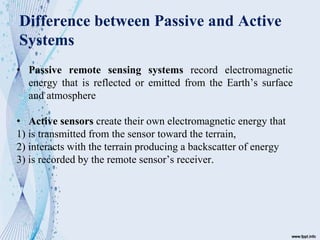
• Passive remote sensing systems record electromagnetic
energy that is reflected or emitted from the Earth’s surface
and atmosphere
• Active sensors create their own electromagnetic energy that
1) is transmitted from the sensor toward the terrain,
2) interacts with the terrain producing a backscatter of energy
3) is recorded by the remote sensor’s receiver.
Design
Design
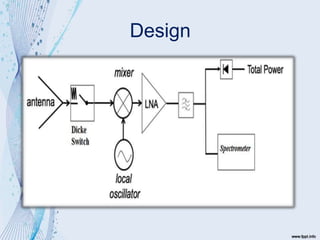
• A microwave radiometer consists of an antenna system,
microwave radio-frequency components (front-end) and a
back-end for signal processing at intermediate frequencies.
• The atmospheric signal is very weak and the signal needs to be
amplified by around 80 dB.
• Therefore, often heteorodyne techniques are used to convert
the signal down to lower frequencies that allow the use of
commercial amplifiers and signal processing. Increasingly low
noise amplifiers become available at higher frequencies, i.e. up
to 100 GHz, making heteorodyne techniques obsolete.
• Thermal stabilization is highly important to avoid receiver
drifts.
Types of Radiometers
1. Total power radiometer
2. Dicke radiometer
3. Satellite borne radiometer
4. Pushbroom and synthetic aperture radiometer
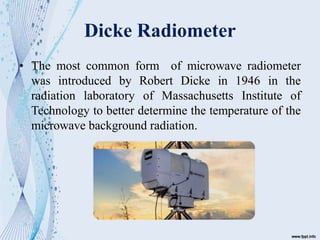
Dicke Radiometer
• The most common form of microwave radiometer
was introduced by Robert Dicke in 1946 in the
radiation laboratory of Massachusetts Institute of
Technology to better determine the temperature of the
microwave background radiation.
Synthetic-aperture radiometers
•The underlying idea of the synthetic-aperture radiometer is that
with an array of receiving elements, multiple beams can be
formed simultaneously to image a swath.
•This is accomplished by cross-correlated signals from a pair of
antennas with overlapping fields of view.
Satellite Borne radiometer
•Soil moisture is a key factor in determining humidity in the
atmosphere and the formation of precipitation. These data will also
aid researchers studying plant growth and vegetation distributions.
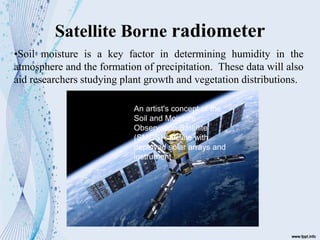
An artist's concept of the
Soil and Moisture
Observation Satellite
(SMOS) satellite with
deployed solar arrays and
instrument
Satellite borne radiometer
•These radiometer operates in the L-band of the electromagnetic
spectrum in a band (1400-1427 MHz) reserved (by the
International Telecommunications Union) for space research, radio
astronomy and a radio communication service between Earth
stations and space, known as the Earth Exploration Satellite
Service.
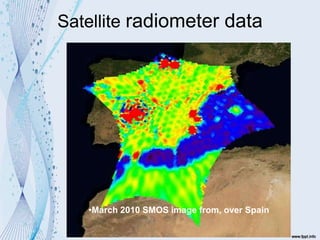
•Since its 2009 launch and system check out, project scientists
noticed that over certain areas the MIRAS radiometer data were
badly contaminated by radio-frequency interference (RFI).
•The unwanted signals have mainly come from TV transmitters,
radio links and networks such as security systems. Terrestrial
radars appear to also cause some problems.
Satellite radiometer data
•March 2010 SMOS image from, over Spain
Microwave Radiometer Ground-Based
Networks:
• MWRnet is a network established in 2009 of scientists
working with ground-based microwave radiometers.
• MWRnet aims to facilitate the exchange of information in the
MWR user community fostering the participation to
coordinated international projects.
• In the long run, MWRnet’s mission aims at setting up
operational software, quality control procedures, data formats,
etc. Similar to other successful networks.
References
• www.google.co.in
• www.slideshare.com
• www.wikipidia.com
Thank you!

Remote sensing & Radiometers Systems

  • 1.
    Laxmi Institute ofTechnology, Sarigam Department of Electronics & Communication Engineering (7 SEM) SUB: Microwave Engineering (2171001) Presentation On Radiometers Systems Submitted by:- Name: EnrollnmentNo.  Jay Baria 150860111003 Approved by AICTE, New Delhi; Affiliated to Gujarat Technological University, Ahmedabad
  • 2.
    Content • Remote sensing •Types of Remote sensing • Active Remote sensing • Passive Remote sensing • Radiometers • Principle of operation • Design • Types of Radiometers
  • 3.
    Remote Sensing: • Itis a technique with good potential to help the nations economic growth and solve some of its problems. • It includes better management of natural resources like, 1. Wasteland mapping 2. Identifying flood prone area 3. Estimating forest area
  • 4.
    Types of RemoteSensing : 1. Active microwave remote sensing 2. Passive microwave remote sensing
  • 5.
    Active Remote Sensing •It uses active sensors like camera to sense the natural calamities • The main advantage is that we can retrieve the information at any time i.e, day, night or any season.
  • 6.
    Passive Remote Sensing •Passive microwave remote sensing are known as radiometers. They sense natural radiations originating from earth surface. • This sensing is also known as atmospheric sounding. • The atmospheric sounding gives vertical profile of temperature & molecular constituents with respect to the molecular resonance frequency.
  • 7.
    Radiometers • Microwave radiometersare very sensitive receivers designed to measure thermal electromagnetic radiation emitted by atmospheric gases. • Microwave radiometers are utilized in a variety of environmental and engineering applications, includes weather forecasting, climate monitoring, radio astronomy and radio propagation studies. • It performance depends on the object size, different obstacles in the path of signal, atmosphere temperature.
  • 8.
    Principle of operation •Solids, liquids but also gases emit and absorb microwave radiation. • The amount of radiation a microwave radiometer receives is expressed as the equivalent blackbody temperature also called brightness temperature. • In the microwave range several atmospheric gases exhibit rotational lines. • They provide specific absorption features which allow to derive information about their abundance and vertical structure.
  • 9.
    Radiometer Applications • Soilmoisture • Snow water equivalent • Sea/lake ice extent, concentration and type • Sea surface temperature • Atmospheric water vapor • Surface wind speed • Cloud liquid water • Rainfall rate only over the oceans
  • 10.
    Difference between Passiveand Active Systems • Passive remote sensing systems record electromagnetic energy that is reflected or emitted from the Earth’s surface and atmosphere • Active sensors create their own electromagnetic energy that 1) is transmitted from the sensor toward the terrain, 2) interacts with the terrain producing a backscatter of energy 3) is recorded by the remote sensor’s receiver.
  • 11.
  • 12.
    Design • A microwaveradiometer consists of an antenna system, microwave radio-frequency components (front-end) and a back-end for signal processing at intermediate frequencies. • The atmospheric signal is very weak and the signal needs to be amplified by around 80 dB. • Therefore, often heteorodyne techniques are used to convert the signal down to lower frequencies that allow the use of commercial amplifiers and signal processing. Increasingly low noise amplifiers become available at higher frequencies, i.e. up to 100 GHz, making heteorodyne techniques obsolete. • Thermal stabilization is highly important to avoid receiver drifts.
  • 13.
    Types of Radiometers 1.Total power radiometer 2. Dicke radiometer 3. Satellite borne radiometer 4. Pushbroom and synthetic aperture radiometer
  • 14.
    Dicke Radiometer • Themost common form of microwave radiometer was introduced by Robert Dicke in 1946 in the radiation laboratory of Massachusetts Institute of Technology to better determine the temperature of the microwave background radiation.
  • 15.
    Synthetic-aperture radiometers •The underlyingidea of the synthetic-aperture radiometer is that with an array of receiving elements, multiple beams can be formed simultaneously to image a swath. •This is accomplished by cross-correlated signals from a pair of antennas with overlapping fields of view.
  • 16.
    Satellite Borne radiometer •Soilmoisture is a key factor in determining humidity in the atmosphere and the formation of precipitation. These data will also aid researchers studying plant growth and vegetation distributions. An artist's concept of the Soil and Moisture Observation Satellite (SMOS) satellite with deployed solar arrays and instrument
  • 17.
    Satellite borne radiometer •Theseradiometer operates in the L-band of the electromagnetic spectrum in a band (1400-1427 MHz) reserved (by the International Telecommunications Union) for space research, radio astronomy and a radio communication service between Earth stations and space, known as the Earth Exploration Satellite Service. •Since its 2009 launch and system check out, project scientists noticed that over certain areas the MIRAS radiometer data were badly contaminated by radio-frequency interference (RFI). •The unwanted signals have mainly come from TV transmitters, radio links and networks such as security systems. Terrestrial radars appear to also cause some problems.
  • 18.
    Satellite radiometer data •March2010 SMOS image from, over Spain
  • 19.
    Microwave Radiometer Ground-Based Networks: •MWRnet is a network established in 2009 of scientists working with ground-based microwave radiometers. • MWRnet aims to facilitate the exchange of information in the MWR user community fostering the participation to coordinated international projects. • In the long run, MWRnet’s mission aims at setting up operational software, quality control procedures, data formats, etc. Similar to other successful networks.
  • 20.
  • 21.