349 Berkshire Drive • Riva, Maryland 21140
888-501-2100 • 410-956-8805
Website: www.ATIcourses.com • Email: ATI@ATIcourses.com
http://www.ATIcourses.com/schedule.htm
http://www.aticourses.com/advanced_synthetic_aperture_radar.htm
ATI Course Schedule:
ATI's Synthetic Aperture Radar:
Professional Development Short Course On:
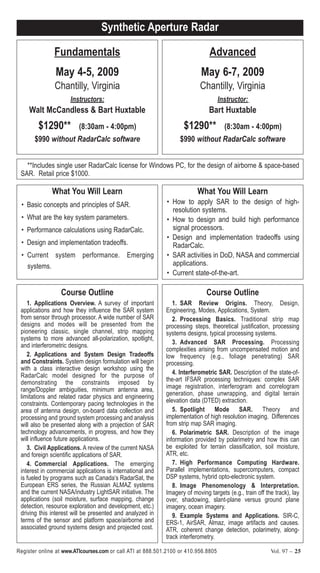
Advanced Synthetic Aperture Radar
Instructor:
Barton D. Huxtable, Ph.D
Register online at www.ATIcourses.com or call ATI at 888.501.2100 or 410.956.8805 Vol. 97 – 25
**Includes single user RadarCalc license for Windows PC, for the design of airborne & space-based
SAR. Retail price $1000.
What You Will Learn
• Basic concepts and principles of SAR.
• What are the key system parameters.
• Performance calculations using RadarCalc.
• Design and implementation tradeoffs.
• Current system performance. Emerging
systems.
What You Will Learn
• How to apply SAR to the design of high-
resolution systems.
• How to design and build high performance
signal processors.
• Design and implementation tradeoffs using
RadarCalc.
• SAR activities in DoD, NASA and commercial
applications.
• Current state-of-the-art.
Synthetic Aperture Radar
Fundamentals
May 4-5, 2009
Chantilly, Virginia
Instructors:
Walt McCandless & Bart Huxtable
$1290** (8:30am - 4:00pm)
$990 without RadarCalc software
Advanced
May 6-7, 2009
Chantilly, Virginia
Instructor:
Bart Huxtable
$1290** (8:30am - 4:00pm)
$990 without RadarCalc software
Course Outline
1. Applications Overview. A survey of important
applications and how they influence the SAR system
from sensor through processor. A wide number of SAR
designs and modes will be presented from the
pioneering classic, single channel, strip mapping
systems to more advanced all-polarization, spotlight,
and interferometric designs.
2. Applications and System Design Tradeoffs
and Constraints. System design formulation will begin
with a class interactive design workshop using the
RadarCalc model designed for the purpose of
demonstrating the constraints imposed by
range/Doppler ambiguities, minimum antenna area,
limitations and related radar physics and engineering
constraints. Contemporary pacing technologies in the
area of antenna design, on-board data collection and
processing and ground system processing and analysis
will also be presented along with a projection of SAR
technology advancements, in progress, and how they
will influence future applications.
3. Civil Applications. A review of the current NASA
and foreign scientific applications of SAR.
4. Commercial Applications. The emerging
interest in commercial applications is international and
is fueled by programs such as Canada’s RadarSat, the
European ERS series, the Russian ALMAZ systems
and the current NASA/industry LightSAR initiative. The
applications (soil moisture, surface mapping, change
detection, resource exploration and development, etc.)
driving this interest will be presented and analyzed in
terms of the sensor and platform space/airborne and
associated ground systems design and projected cost.
Course Outline
1. SAR Review Origins. Theory, Design,
Engineering, Modes, Applications, System.
2. Processing Basics. Traditional strip map
processing steps, theoretical justification, processing
systems designs, typical processing systems.
3. Advanced SAR Processing. Processing
complexities arising from uncompensated motion and
low frequency (e.g., foliage penetrating) SAR
processing.
4. Interferometric SAR. Description of the state-of-
the-art IFSAR processing techniques: complex SAR
image registration, interferogram and correlogram
generation, phase unwrapping, and digital terrain
elevation data (DTED) extraction.
5. Spotlight Mode SAR. Theory and
implementation of high resolution imaging. Differences
from strip map SAR imaging.
6. Polarimetric SAR. Description of the image
information provided by polarimetry and how this can
be exploited for terrain classification, soil moisture,
ATR, etc.
7. High Performance Computing Hardware.
Parallel implementations, supercomputers, compact
DSP systems, hybrid opto-electronic system.
8. Image Phenomenology & Interpretation.
Imagery of moving targets (e.g., train off the track), lay
over, shadowing, slant-plane versus ground plane
imagery, ocean imagery.
9. Example Systems and Applications. SIR-C,
ERS-1, AirSAR, Almaz, image artifacts and causes.
ATR, coherent change detection, polarimetry, along-
track interferometry.
www.ATIcourses.com
Boost Your Skills
with On-Site Courses
Tailored to Your Needs
The Applied Technology Institute specializes in training programs for technical professionals. Our courses keep you
current in the state-of-the-art technology that is essential to keep your company on the cutting edge in today’s highly
competitive marketplace. Since 1984, ATI has earned the trust of training departments nationwide, and has presented
on-site training at the major Navy, Air Force and NASA centers, and for a large number of contractors. Our training
increases effectiveness and productivity. Learn from the proven best.
For a Free On-Site Quote Visit Us At: http://www.ATIcourses.com/free_onsite_quote.asp
For Our Current Public Course Schedule Go To: http://www.ATIcourses.com/schedule.htm
349 Berkshire Drive
Riva, Maryland 21140
Telephone 1-888-501-2100 / (410) 965-8805
Fax (410) 956-5785
Email: ATI@ATIcourses.com
Advanced SAR
Processing
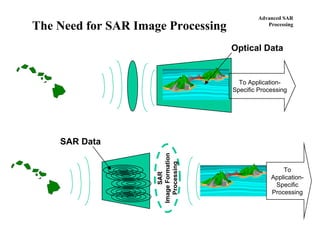
The Need for SAR Image Processing
To Application-
Specific Processing
SAR
ImageFormation
Processing
Optical Data
SAR Data
To
Application-
Specific
Processing
Advanced SAR
Processing
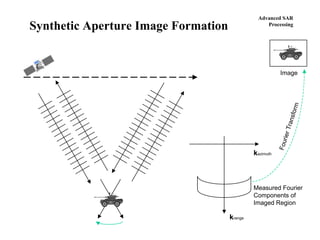
Synthetic Aperture Image Formation
krange
kazimuth
Measured Fourier
Components of
Imaged Region
Image
FourierTransform
Advanced SAR
Processing
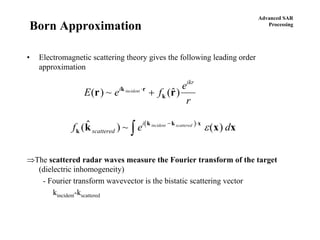
Born Approximation
• Electromagnetic scattering theory gives the following leading order
approximation
⇒The scattered radar waves measure the Fourier transform of the target
(dielectric inhomogeneity)
- Fourier transform wavevector is the bistatic scattering vector
kincident-kscattered
E e f
e
r
i
ikr
incident
( ) ~ ($)r rk r
k
⋅
+
( )
f e dscattered
i incident scattered
k
k k x
k x x( $ ) ~ ( )− ⋅
∫ ε
Advanced SAR
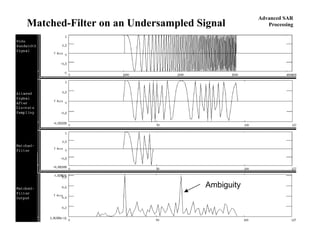
ProcessingMatched-Filter on an Undersampled Signal
Ambiguity
Advanced SAR
Processing
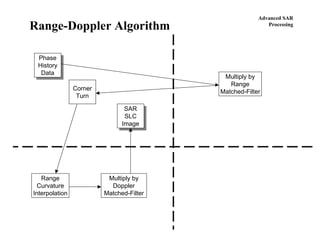
Range-Doppler Algorithm
Phase
History
Data
Phase
History
Data
Multiply by
Range
Matched-Filter
Corner
Turn
Range
Curvature
Interpolation
Multiply by
Doppler
Matched-Filter
SAR
SLC
Image
SAR
SLC
Image
Advanced SAR
Processing
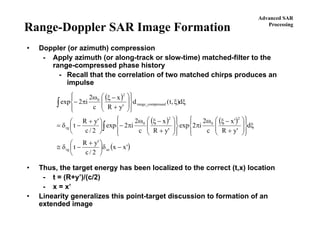
Range-Doppler SAR Image Formation
• Doppler (or azimuth) compression
- Apply azimuth (or along-track or slow-time) matched-filter to the
range-compressed phase history
- Recall that the correlation of two matched chirps produces an
impulse
• Thus, the target energy has been localized to the correct (t,x) location
- t = (R+y’)/(c/2)
- x = x’
• Linearity generalizes this point-target discussion to formation of an
extended image
( )
( ) ( )
( )'xx
2/c
'yR
t
d
'yR
'x
c
2
i2exp
'yR
x
c
2
i2exp
2/c
'yR
t
d),t(d
'yR
x
c
2
i2exp
azrg
2
0
2
0
rg
ressedrange_comp
2
0
−δ⎟
⎠
⎞
⎜
⎝
⎛ +
−δ≅
ξ
⎪⎭
⎪
⎬
⎫
⎪⎩
⎪
⎨
⎧
⎟
⎟
⎠
⎞
⎜
⎜
⎝
⎛
+
−ξω
π
⎪⎭
⎪
⎬
⎫
⎪⎩
⎪
⎨
⎧
⎟
⎟
⎠
⎞
⎜
⎜
⎝
⎛
+
−ξω
π−⎟
⎠
⎞
⎜
⎝
⎛ +
−δ=
ξξ
⎪⎭
⎪
⎬
⎫
⎪⎩
⎪
⎨
⎧
⎟
⎟
⎠
⎞
⎜
⎜
⎝
⎛
+
−ξω
π−
∫
∫
Advanced SAR
Processing
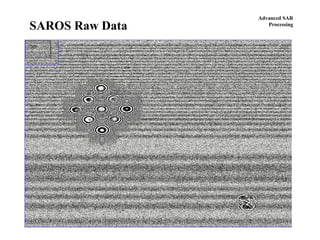
SAROS Raw Data
Advanced SAR
Processing
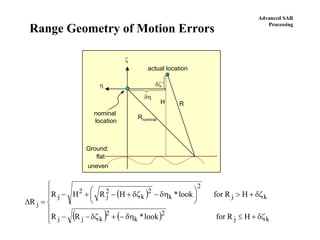
Range Geometry of Motion Errors
ζ
η
H
δζ
δη
R
Rnominal
Ground:
actual location
nominal
location
flat
uneven
( )
( ) ( )⎪
⎪
⎩
⎪⎪
⎨
⎧
δζ+≤δη−+δζ−−
δζ+>⎟
⎠
⎞
⎜
⎝
⎛ δη−δζ+−+−
=∆
kj
2
k
2
kjj
kj
2
k
2
k
2
j
2
j
j
HRforlook*RR
HRforlook*HRHR
R
Advanced SAR
Processing
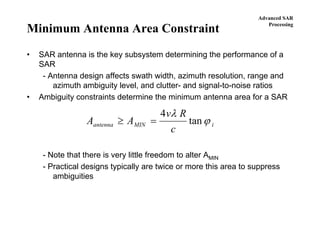
Minimum Antenna Area Constraint
• SAR antenna is the key subsystem determining the performance of a
SAR
- Antenna design affects swath width, azimuth resolution, range and
azimuth ambiguity level, and clutter- and signal-to-noise ratios
• Ambiguity constraints determine the minimum antenna area for a SAR
- Note that there is very little freedom to alter AMIN
- Practical designs typically are twice or more this area to suppress
ambiguities
A A
v R
c
antenna MIN i≥ =
4 λ
ϕtan
Advanced SAR
Processing
Seismic Migration Algorithm
in four elegant steps
Step 1: Fourier transform the range compressed[1] phase history data
Step 2: Interpolate the transformed phase history
This is the so-called “Stolt interpolation,” which effectively corrects for range curvature.
Step 3
Multiply the interpolated, transformed phase history by a phase factor
This is effectively the azimuth matched-filter.
Step 4
Inverse transform the Fourier transform of the image
which produces the complex image.
Fine Points
Range compression may conveniently be done by multiplying D(κ,ω) by the complex conjugate of the range reference function[2] in Step 1.
Windows, spectral filters, equalization factors, etc., may be multiplied onto I(kx,ky) or D(κ,ω) anywhere between the Fourier transforms in Steps 1
and 4. This enables custom shaping of the impulse response, compensation of antenna patterns, transmit pulse equalization, etc.
[1] “Range compressed” phase history data because we don’t want to mix in any phase modulation included with the transmit pulse, e.g., the
quadratic phase of a chirped pulse.
[2] The range reference function is the Fourier transform of the transmitted pulse.
{ } ξττξκξωτπωκ dddiD ∫∫ +−= ),()(2exp),(
⎟⎟
⎟
⎠
⎞
⎜⎜
⎜
⎝
⎛
⎥
⎥
⎦
⎤
⎢
⎢
⎣
⎡
−+⎟
⎠
⎞
⎜
⎝
⎛
+=⎟
⎠
⎞
⎜
⎝
⎛
λλ
22
2
,
2
,' 2
2
xyxyx kk
c
kDk
c
kD
⎟
⎠
⎞
⎜
⎝
⎛
⎪⎭
⎪
⎬
⎫
⎪⎩
⎪
⎨
⎧
⎥
⎥
⎦
⎤
⎢
⎢
⎣
⎡
−
λ
−+⎟
⎠
⎞
⎜
⎝
⎛
+
λ
π−= yxy
2
x
2
y0yx k
2
c
,k'Dk
2
kk
2
iR2exp)k,k(I
{ } yxyxyx dkdkkkIykxkiyxi ∫∫ ++= ),()(2exp),( π
Advanced SAR
Processing
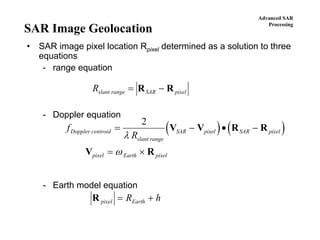
SAR Image Geolocation
• SAR image pixel location Rpixel determined as a solution to three
equations
- range equation
- Doppler equation
- Earth model equation
Rslant range SAR pixel= −R R
( ) ( )f
R
Doppler centroid
slant range
SAR pixel SAR pixel
pixel Earth pixel
= − • −
= ×
2
λ
ω
V V R R
V R
R pixel EarthR h= +
Advanced SAR
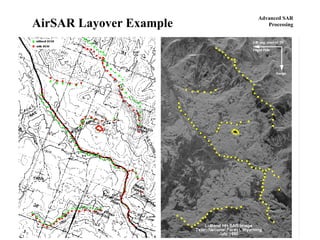
ProcessingAirSAR Layover Example
Advanced SAR
Processing
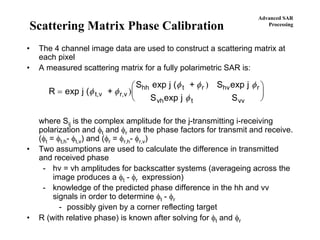
Scattering Matrix Phase Calibration
• The 4 channel image data are used to construct a scattering matrix at
each pixel
• A measured scattering matrix for a fully polarimetric SAR is:
where Sij is the complex amplitude for the j-transmitting i-receiving
polarization and φt and φr are the phase factors for transmit and receive.
(φt = φt,h- φt,v) and (φr = φr,h- φr,v)
• Two assumptions are used to calculate the difference in transmitted
and received phase
- hv = vh amplitudes for backscatter systems (averageing across the
image produces a φt - φr expression)
- knowledge of the predicted phase difference in the hh and vv
signals in order to determine φt - φr
- possibly given by a corner reflecting target
• R (with relative phase) is known after solving for φt and φr
R exp j ( +
S exp j ( + S exp j
S exp j St,v r,v
hh t r hv r
vh t vv
=
⎛
⎝
⎜
⎞
⎠
⎟φ φ
φ φ φ
φ
)
)
Advanced SAR
Processing
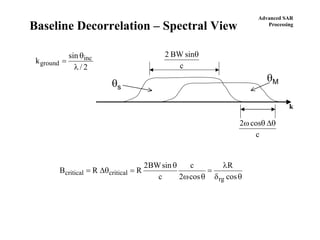
Baseline Decorrelation – Spectral View
c
sinBW2 θ
k
c
cos2 θ∆θω
2/
sin
k inc
ground
λ
θ
=
θs
θM
θδ
λ
=
θω
θ
=θ∆=
cos
R
cos2
c
c
sinBW2
RRB
rg
criticalcritical
Advanced SAR
Processing
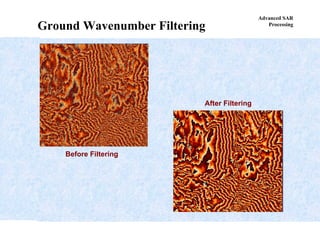
Ground Wavenumber Filtering
Before Filtering
After Filtering
Advanced SAR
Processing
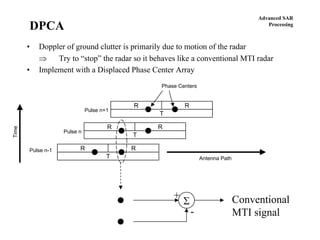
DPCA
• Doppler of ground clutter is primarily due to motion of the radar
⇒ Try to “stop” the radar so it behaves like a conventional MTI radar
• Implement with a Displaced Phase Center Array
Phase Centers
R R
T
Time
Pulse n+1
R R
T
R R
T
Pulse n
Pulse n-1
Antenna Path
Σ
+
-
Conventional
MTI signal
Advanced SAR
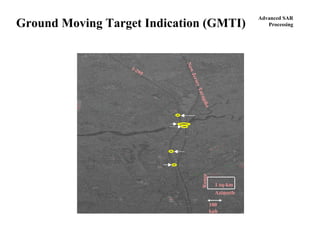
ProcessingGround Moving Target Indication (GMTI)
100
kph
1 sq-km
Azimuth
Range
NewJerseyTurnpike
I-295
Register online at www.aticourses.com or call ATI at 888.501.2100 or 410.531.6034
BoostYour Skills
with On-Site Courses
Tailored toYour Needs
The Applied Technology Institute specializes in training programs for technical
professionals. Our courses keep you current in the state-of-the-art technology that is
essential to keep your company on the cutting edge in today’s highly competitive
marketplace. For 20 years, we have earned the trust of training departments nationwide,
and have presented on-site training at the major Navy, Air Force and NASA centers, and for a
large number of contractors. Our training increases effectiveness and productivity. Learn
from the proven best.
ATI’s on-site courses offer these cost-effective advantages:
• You design, control, and schedule the course.
• Since the program involves only your personnel, confidentiality is maintained. You can
freely discuss company issues and programs. Classified programs can also be arranged.
• Your employees may attend all or only the most relevant part of the course.
• Our instructors are the best in the business, averaging 25 to 35 years of practical, real-
world experience. Carefully selected for both technical expertise and teaching ability, they
provide information that is practical and ready to use immediately.
• Our on-site programs can save your facility 30% to 50%, plus additional savings by
eliminating employee travel time and expenses.
• The ATI Satisfaction Guarantee: You must be completely satisfied with our program.
We suggest you look at ATI course descriptions in this catalog and on the ATI website.
Visit and bookmark ATI’s website at http://www.ATIcourses.com for descriptions of all
of our courses in these areas:
• Communications & Computer Programming
• Radar/EW/Combat Systems
• Signal Processing & Information Technology
• Sonar & Acoustic Engineering
• Spacecraft & Satellite Engineering
I suggest that you read through these course descriptions and then call me personally, Jim
Jenkins, at (410) 531-6034, and I’ll explain what we can do for you, what it will cost, and what
you can expect in results and future capabilities.
Our training helps you and your organization
remain competitive in this changing world.

Synthetic aperture radar_advanced

  • 1.
    349 Berkshire Drive• Riva, Maryland 21140 888-501-2100 • 410-956-8805 Website: www.ATIcourses.com • Email: ATI@ATIcourses.com http://www.ATIcourses.com/schedule.htm http://www.aticourses.com/advanced_synthetic_aperture_radar.htm ATI Course Schedule: ATI's Synthetic Aperture Radar: Professional Development Short Course On: Advanced Synthetic Aperture Radar Instructor: Barton D. Huxtable, Ph.D
  • 2.
    Register online atwww.ATIcourses.com or call ATI at 888.501.2100 or 410.956.8805 Vol. 97 – 25 **Includes single user RadarCalc license for Windows PC, for the design of airborne & space-based SAR. Retail price $1000. What You Will Learn • Basic concepts and principles of SAR. • What are the key system parameters. • Performance calculations using RadarCalc. • Design and implementation tradeoffs. • Current system performance. Emerging systems. What You Will Learn • How to apply SAR to the design of high- resolution systems. • How to design and build high performance signal processors. • Design and implementation tradeoffs using RadarCalc. • SAR activities in DoD, NASA and commercial applications. • Current state-of-the-art. Synthetic Aperture Radar Fundamentals May 4-5, 2009 Chantilly, Virginia Instructors: Walt McCandless & Bart Huxtable $1290** (8:30am - 4:00pm) $990 without RadarCalc software Advanced May 6-7, 2009 Chantilly, Virginia Instructor: Bart Huxtable $1290** (8:30am - 4:00pm) $990 without RadarCalc software Course Outline 1. Applications Overview. A survey of important applications and how they influence the SAR system from sensor through processor. A wide number of SAR designs and modes will be presented from the pioneering classic, single channel, strip mapping systems to more advanced all-polarization, spotlight, and interferometric designs. 2. Applications and System Design Tradeoffs and Constraints. System design formulation will begin with a class interactive design workshop using the RadarCalc model designed for the purpose of demonstrating the constraints imposed by range/Doppler ambiguities, minimum antenna area, limitations and related radar physics and engineering constraints. Contemporary pacing technologies in the area of antenna design, on-board data collection and processing and ground system processing and analysis will also be presented along with a projection of SAR technology advancements, in progress, and how they will influence future applications. 3. Civil Applications. A review of the current NASA and foreign scientific applications of SAR. 4. Commercial Applications. The emerging interest in commercial applications is international and is fueled by programs such as Canada’s RadarSat, the European ERS series, the Russian ALMAZ systems and the current NASA/industry LightSAR initiative. The applications (soil moisture, surface mapping, change detection, resource exploration and development, etc.) driving this interest will be presented and analyzed in terms of the sensor and platform space/airborne and associated ground systems design and projected cost. Course Outline 1. SAR Review Origins. Theory, Design, Engineering, Modes, Applications, System. 2. Processing Basics. Traditional strip map processing steps, theoretical justification, processing systems designs, typical processing systems. 3. Advanced SAR Processing. Processing complexities arising from uncompensated motion and low frequency (e.g., foliage penetrating) SAR processing. 4. Interferometric SAR. Description of the state-of- the-art IFSAR processing techniques: complex SAR image registration, interferogram and correlogram generation, phase unwrapping, and digital terrain elevation data (DTED) extraction. 5. Spotlight Mode SAR. Theory and implementation of high resolution imaging. Differences from strip map SAR imaging. 6. Polarimetric SAR. Description of the image information provided by polarimetry and how this can be exploited for terrain classification, soil moisture, ATR, etc. 7. High Performance Computing Hardware. Parallel implementations, supercomputers, compact DSP systems, hybrid opto-electronic system. 8. Image Phenomenology & Interpretation. Imagery of moving targets (e.g., train off the track), lay over, shadowing, slant-plane versus ground plane imagery, ocean imagery. 9. Example Systems and Applications. SIR-C, ERS-1, AirSAR, Almaz, image artifacts and causes. ATR, coherent change detection, polarimetry, along- track interferometry.
  • 3.
    www.ATIcourses.com Boost Your Skills withOn-Site Courses Tailored to Your Needs The Applied Technology Institute specializes in training programs for technical professionals. Our courses keep you current in the state-of-the-art technology that is essential to keep your company on the cutting edge in today’s highly competitive marketplace. Since 1984, ATI has earned the trust of training departments nationwide, and has presented on-site training at the major Navy, Air Force and NASA centers, and for a large number of contractors. Our training increases effectiveness and productivity. Learn from the proven best. For a Free On-Site Quote Visit Us At: http://www.ATIcourses.com/free_onsite_quote.asp For Our Current Public Course Schedule Go To: http://www.ATIcourses.com/schedule.htm 349 Berkshire Drive Riva, Maryland 21140 Telephone 1-888-501-2100 / (410) 965-8805 Fax (410) 956-5785 Email: ATI@ATIcourses.com
  • 4.
    Advanced SAR Processing The Needfor SAR Image Processing To Application- Specific Processing SAR ImageFormation Processing Optical Data SAR Data To Application- Specific Processing
  • 5.
    Advanced SAR Processing Synthetic ApertureImage Formation krange kazimuth Measured Fourier Components of Imaged Region Image FourierTransform
  • 6.
    Advanced SAR Processing Born Approximation •Electromagnetic scattering theory gives the following leading order approximation ⇒The scattered radar waves measure the Fourier transform of the target (dielectric inhomogeneity) - Fourier transform wavevector is the bistatic scattering vector kincident-kscattered E e f e r i ikr incident ( ) ~ ($)r rk r k ⋅ + ( ) f e dscattered i incident scattered k k k x k x x( $ ) ~ ( )− ⋅ ∫ ε
  • 7.
    Advanced SAR ProcessingMatched-Filter onan Undersampled Signal Ambiguity
  • 8.
    Advanced SAR Processing Range-Doppler Algorithm Phase History Data Phase History Data Multiplyby Range Matched-Filter Corner Turn Range Curvature Interpolation Multiply by Doppler Matched-Filter SAR SLC Image SAR SLC Image
  • 9.
    Advanced SAR Processing Range-Doppler SARImage Formation • Doppler (or azimuth) compression - Apply azimuth (or along-track or slow-time) matched-filter to the range-compressed phase history - Recall that the correlation of two matched chirps produces an impulse • Thus, the target energy has been localized to the correct (t,x) location - t = (R+y’)/(c/2) - x = x’ • Linearity generalizes this point-target discussion to formation of an extended image ( ) ( ) ( ) ( )'xx 2/c 'yR t d 'yR 'x c 2 i2exp 'yR x c 2 i2exp 2/c 'yR t d),t(d 'yR x c 2 i2exp azrg 2 0 2 0 rg ressedrange_comp 2 0 −δ⎟ ⎠ ⎞ ⎜ ⎝ ⎛ + −δ≅ ξ ⎪⎭ ⎪ ⎬ ⎫ ⎪⎩ ⎪ ⎨ ⎧ ⎟ ⎟ ⎠ ⎞ ⎜ ⎜ ⎝ ⎛ + −ξω π ⎪⎭ ⎪ ⎬ ⎫ ⎪⎩ ⎪ ⎨ ⎧ ⎟ ⎟ ⎠ ⎞ ⎜ ⎜ ⎝ ⎛ + −ξω π−⎟ ⎠ ⎞ ⎜ ⎝ ⎛ + −δ= ξξ ⎪⎭ ⎪ ⎬ ⎫ ⎪⎩ ⎪ ⎨ ⎧ ⎟ ⎟ ⎠ ⎞ ⎜ ⎜ ⎝ ⎛ + −ξω π− ∫ ∫
  • 10.
  • 11.
    Advanced SAR Processing Range Geometryof Motion Errors ζ η H δζ δη R Rnominal Ground: actual location nominal location flat uneven ( ) ( ) ( )⎪ ⎪ ⎩ ⎪⎪ ⎨ ⎧ δζ+≤δη−+δζ−− δζ+>⎟ ⎠ ⎞ ⎜ ⎝ ⎛ δη−δζ+−+− =∆ kj 2 k 2 kjj kj 2 k 2 k 2 j 2 j j HRforlook*RR HRforlook*HRHR R
  • 12.
    Advanced SAR Processing Minimum AntennaArea Constraint • SAR antenna is the key subsystem determining the performance of a SAR - Antenna design affects swath width, azimuth resolution, range and azimuth ambiguity level, and clutter- and signal-to-noise ratios • Ambiguity constraints determine the minimum antenna area for a SAR - Note that there is very little freedom to alter AMIN - Practical designs typically are twice or more this area to suppress ambiguities A A v R c antenna MIN i≥ = 4 λ ϕtan
  • 13.
    Advanced SAR Processing Seismic MigrationAlgorithm in four elegant steps Step 1: Fourier transform the range compressed[1] phase history data Step 2: Interpolate the transformed phase history This is the so-called “Stolt interpolation,” which effectively corrects for range curvature. Step 3 Multiply the interpolated, transformed phase history by a phase factor This is effectively the azimuth matched-filter. Step 4 Inverse transform the Fourier transform of the image which produces the complex image. Fine Points Range compression may conveniently be done by multiplying D(κ,ω) by the complex conjugate of the range reference function[2] in Step 1. Windows, spectral filters, equalization factors, etc., may be multiplied onto I(kx,ky) or D(κ,ω) anywhere between the Fourier transforms in Steps 1 and 4. This enables custom shaping of the impulse response, compensation of antenna patterns, transmit pulse equalization, etc. [1] “Range compressed” phase history data because we don’t want to mix in any phase modulation included with the transmit pulse, e.g., the quadratic phase of a chirped pulse. [2] The range reference function is the Fourier transform of the transmitted pulse. { } ξττξκξωτπωκ dddiD ∫∫ +−= ),()(2exp),( ⎟⎟ ⎟ ⎠ ⎞ ⎜⎜ ⎜ ⎝ ⎛ ⎥ ⎥ ⎦ ⎤ ⎢ ⎢ ⎣ ⎡ −+⎟ ⎠ ⎞ ⎜ ⎝ ⎛ +=⎟ ⎠ ⎞ ⎜ ⎝ ⎛ λλ 22 2 , 2 ,' 2 2 xyxyx kk c kDk c kD ⎟ ⎠ ⎞ ⎜ ⎝ ⎛ ⎪⎭ ⎪ ⎬ ⎫ ⎪⎩ ⎪ ⎨ ⎧ ⎥ ⎥ ⎦ ⎤ ⎢ ⎢ ⎣ ⎡ − λ −+⎟ ⎠ ⎞ ⎜ ⎝ ⎛ + λ π−= yxy 2 x 2 y0yx k 2 c ,k'Dk 2 kk 2 iR2exp)k,k(I { } yxyxyx dkdkkkIykxkiyxi ∫∫ ++= ),()(2exp),( π
  • 14.
    Advanced SAR Processing SAR ImageGeolocation • SAR image pixel location Rpixel determined as a solution to three equations - range equation - Doppler equation - Earth model equation Rslant range SAR pixel= −R R ( ) ( )f R Doppler centroid slant range SAR pixel SAR pixel pixel Earth pixel = − • − = × 2 λ ω V V R R V R R pixel EarthR h= +
  • 15.
  • 16.
    Advanced SAR Processing Scattering MatrixPhase Calibration • The 4 channel image data are used to construct a scattering matrix at each pixel • A measured scattering matrix for a fully polarimetric SAR is: where Sij is the complex amplitude for the j-transmitting i-receiving polarization and φt and φr are the phase factors for transmit and receive. (φt = φt,h- φt,v) and (φr = φr,h- φr,v) • Two assumptions are used to calculate the difference in transmitted and received phase - hv = vh amplitudes for backscatter systems (averageing across the image produces a φt - φr expression) - knowledge of the predicted phase difference in the hh and vv signals in order to determine φt - φr - possibly given by a corner reflecting target • R (with relative phase) is known after solving for φt and φr R exp j ( + S exp j ( + S exp j S exp j St,v r,v hh t r hv r vh t vv = ⎛ ⎝ ⎜ ⎞ ⎠ ⎟φ φ φ φ φ φ ) )
  • 17.
    Advanced SAR Processing Baseline Decorrelation– Spectral View c sinBW2 θ k c cos2 θ∆θω 2/ sin k inc ground λ θ = θs θM θδ λ = θω θ =θ∆= cos R cos2 c c sinBW2 RRB rg criticalcritical
  • 18.
    Advanced SAR Processing Ground WavenumberFiltering Before Filtering After Filtering
  • 19.
    Advanced SAR Processing DPCA • Dopplerof ground clutter is primarily due to motion of the radar ⇒ Try to “stop” the radar so it behaves like a conventional MTI radar • Implement with a Displaced Phase Center Array Phase Centers R R T Time Pulse n+1 R R T R R T Pulse n Pulse n-1 Antenna Path Σ + - Conventional MTI signal
  • 20.
    Advanced SAR ProcessingGround MovingTarget Indication (GMTI) 100 kph 1 sq-km Azimuth Range NewJerseyTurnpike I-295
  • 21.
    Register online atwww.aticourses.com or call ATI at 888.501.2100 or 410.531.6034 BoostYour Skills with On-Site Courses Tailored toYour Needs The Applied Technology Institute specializes in training programs for technical professionals. Our courses keep you current in the state-of-the-art technology that is essential to keep your company on the cutting edge in today’s highly competitive marketplace. For 20 years, we have earned the trust of training departments nationwide, and have presented on-site training at the major Navy, Air Force and NASA centers, and for a large number of contractors. Our training increases effectiveness and productivity. Learn from the proven best. ATI’s on-site courses offer these cost-effective advantages: • You design, control, and schedule the course. • Since the program involves only your personnel, confidentiality is maintained. You can freely discuss company issues and programs. Classified programs can also be arranged. • Your employees may attend all or only the most relevant part of the course. • Our instructors are the best in the business, averaging 25 to 35 years of practical, real- world experience. Carefully selected for both technical expertise and teaching ability, they provide information that is practical and ready to use immediately. • Our on-site programs can save your facility 30% to 50%, plus additional savings by eliminating employee travel time and expenses. • The ATI Satisfaction Guarantee: You must be completely satisfied with our program. We suggest you look at ATI course descriptions in this catalog and on the ATI website. Visit and bookmark ATI’s website at http://www.ATIcourses.com for descriptions of all of our courses in these areas: • Communications & Computer Programming • Radar/EW/Combat Systems • Signal Processing & Information Technology • Sonar & Acoustic Engineering • Spacecraft & Satellite Engineering I suggest that you read through these course descriptions and then call me personally, Jim Jenkins, at (410) 531-6034, and I’ll explain what we can do for you, what it will cost, and what you can expect in results and future capabilities. Our training helps you and your organization remain competitive in this changing world.