AIRBORNE RADAR

Presented by
JIJU S. JOHN
2012610035
INTRODUCTION
• Self contained radar systems installed within the aircraft.
• Airborne radar system is designed to detect aircraft, ships and
vehicles at long ranges and perform control and command of the
battle space in an air engagement by directing fighter and attack
aircraft strikes.
• The primary applications are:
▫ Radar altimeter
▫ Weather radar
▫ Terrain mapping
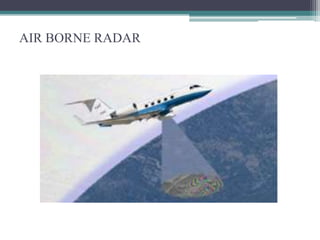
AIR BORNE RADAR
AIR-BORNE DETECTION OF GROUND
MOVING TARGETS
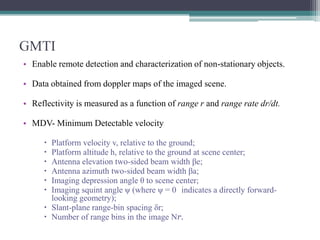
• 4 methods for detection of ground moving targets

1.
2.
3.
4.

GMTI- Ground Moving Target Indication
SLAR- Side Looking Airborne Radar with non-coherent MTI
SAR- Synthetic Aperture radar with doppler filtering
InSAR- Interferometric SAR
GMTI
• Enable remote detection and characterization of non-stationary objects.

• Data obtained from doppler maps of the imaged scene.
• Reflectivity is measured as a function of range r and range rate dr/dt.
• MDV- Minimum Detectable velocity







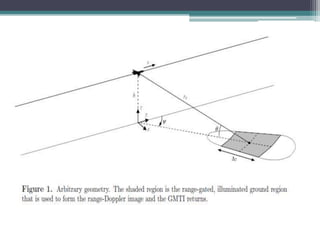
Platform velocity v, relative to the ground;
Platform altitude h, relative to the ground at scene center;
Antenna elevation two-sided beam width βe;
Antenna azimuth two-sided beam width βa;
Imaging depression angle θ to scene center;
Imaging squint angle ψ (where ψ = 0 indicates a directly forwardlooking geometry);
 Slant-plane range-bin spacing δr;
 Number of range bins in the image Nr.
SLAR
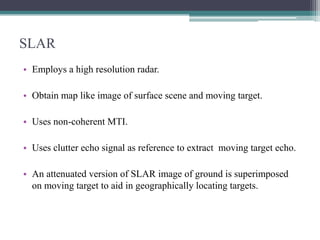
• Employs a high resolution radar.
• Obtain map like image of surface scene and moving target.
• Uses non-coherent MTI.
• Uses clutter echo signal as reference to extract moving target echo.
• An attenuated version of SLAR image of ground is superimposed
on moving target to aid in geographically locating targets.
InSAR
• Interferometry—The use of interference phenomena for purposes of
measurement.
• In radar, one use of interferometric techniques is to determine the
angle of arrival of a wave by comparing the phases of the signals
received at separate antennas or at separate points on the same
antenna.
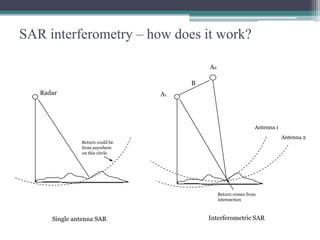
SAR interferometry – how does it work?
A2
B
Radar

A1

Antenna 1
Antenna 2

Return could be
from anywhere
on this circle

Return comes from
intersection

Single antenna SAR

Interferometric SAR
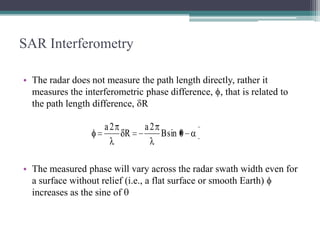
SAR Interferometry
• The radar does not measure the path length directly, rather it
measures the interferometric phase difference, , that is related to
the path length difference, R

a2

R

a2

B sin

• The measured phase will vary across the radar swath width even for
a surface without relief (i.e., a flat surface or smooth Earth)
increases as the sine of
WEATHER RADAR
• Works as the same principle of PSR- Primary Surveillance Radar

• A directional antenna which sweeps side to side (usually 90 )
transmits SHF(3 to 30GHZ) energy which is reflected back to the
receiver by reflective objects.
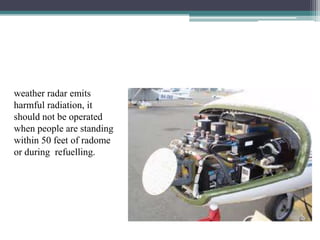
• The antenna is housed in a radome made of composite materials
located in the nose of the aircraft. (on the wing for a single engine
aircraft.)
• The returns (echo) are displayed to the pilot on the aircrafts radar
screen.
• Weather radar is used for severe weather avoidance
weather radar emits
harmful radiation, it
should not be operated
when people are standing
within 50 feet of radome
or during refuelling.
• Antenna – array of yagi end fire radiator in UHF band.
• Ultra low sidelobe array of slotted wave guides in S-band.
• Rotodome should be mounted high above the aircraft fuselage to
minimize blockage from wings and engines which results in
unwanted sidelobes.

• Used in AEW aircraft that must have 360 coverage.
REFLECTIVITY
• The goal of weather radar is to display areas of heavy
precipitation, which generally indicates areas of turbulence.
• Different types of precipitation have different reflective qualities.
• Reflectivity of precipitation is directly related to moisture content.
• Large water droplets show the strongest returns, while dry hail or
snow will show light returns, or no returns at all.
• Weather radar detects raindrops, not clouds or fog.
LEVELS OF REFLECTIVITY
MOST REFLECTIVE
WET HAIL
RAIN
WET SNOW
DRY HAIL
DRY SNOW
LEAST REFLECTIVE
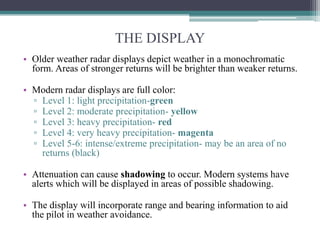
THE DISPLAY
• Older weather radar displays depict weather in a monochromatic
form. Areas of stronger returns will be brighter than weaker returns.
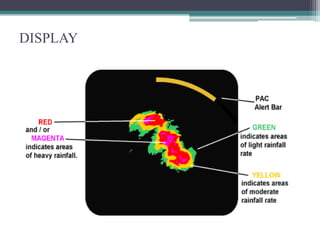
• Modern radar displays are full color:
▫ Level 1: light precipitation-green
▫ Level 2: moderate precipitation- yellow
▫ Level 3: heavy precipitation- red
▫ Level 4: very heavy precipitation- magenta
▫ Level 5-6: intense/extreme precipitation- may be an area of no
returns (black)
• Attenuation can cause shadowing to occur. Modern systems have
alerts which will be displayed in areas of possible shadowing.
• The display will incorporate range and bearing information to aid
the pilot in weather avoidance.
DISPLAY
RANGE/GAIN/TILT
• Weather avoidance depends on proper interpretation of the returns
displayed.
• In order to achieve an accurate display the radar must be adjusted
properly for the given flight situation.

• Airborne weather radar is controlled using the range, gain, and tilt
selector knobs
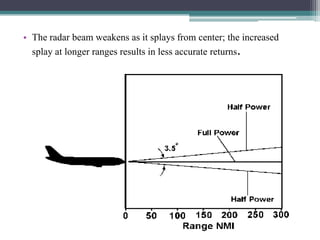
• The radar beam weakens as it splays from center; the increased
splay at longer ranges results in less accurate returns.
RADAR ALTIMETER
• Radar altimeter (radio altimeter) gives the pilot an indication of the
aircrafts absolute altitude above the surface.
• Determines height by measuring the time delay between
transmission and reflection of downward directed radio waves.
• Usually generates readings below 2000ft AGL.
• A desired altitude is pre-selected (DH, MDA) and the unit will
provide visual and/or audio warning to the pilot.
• Altitude is displayed in analog or digital form.
• Inaccuracies may occur over mediums with less than perfect
reflectivity qualities (deep snow, ice) or over rapidly changing
terrain.

Airborne radar

  • 1.
  • 2.
    INTRODUCTION • Self containedradar systems installed within the aircraft. • Airborne radar system is designed to detect aircraft, ships and vehicles at long ranges and perform control and command of the battle space in an air engagement by directing fighter and attack aircraft strikes. • The primary applications are: ▫ Radar altimeter ▫ Weather radar ▫ Terrain mapping
  • 3.
  • 4.
    AIR-BORNE DETECTION OFGROUND MOVING TARGETS • 4 methods for detection of ground moving targets 1. 2. 3. 4. GMTI- Ground Moving Target Indication SLAR- Side Looking Airborne Radar with non-coherent MTI SAR- Synthetic Aperture radar with doppler filtering InSAR- Interferometric SAR
  • 5.
    GMTI • Enable remotedetection and characterization of non-stationary objects. • Data obtained from doppler maps of the imaged scene. • Reflectivity is measured as a function of range r and range rate dr/dt. • MDV- Minimum Detectable velocity       Platform velocity v, relative to the ground; Platform altitude h, relative to the ground at scene center; Antenna elevation two-sided beam width βe; Antenna azimuth two-sided beam width βa; Imaging depression angle θ to scene center; Imaging squint angle ψ (where ψ = 0 indicates a directly forwardlooking geometry);  Slant-plane range-bin spacing δr;  Number of range bins in the image Nr.
  • 7.
    SLAR • Employs ahigh resolution radar. • Obtain map like image of surface scene and moving target. • Uses non-coherent MTI. • Uses clutter echo signal as reference to extract moving target echo. • An attenuated version of SLAR image of ground is superimposed on moving target to aid in geographically locating targets.
  • 8.
    InSAR • Interferometry—The useof interference phenomena for purposes of measurement. • In radar, one use of interferometric techniques is to determine the angle of arrival of a wave by comparing the phases of the signals received at separate antennas or at separate points on the same antenna.
  • 9.
    SAR interferometry –how does it work? A2 B Radar A1 Antenna 1 Antenna 2 Return could be from anywhere on this circle Return comes from intersection Single antenna SAR Interferometric SAR
  • 10.
    SAR Interferometry • Theradar does not measure the path length directly, rather it measures the interferometric phase difference, , that is related to the path length difference, R a2 R a2 B sin • The measured phase will vary across the radar swath width even for a surface without relief (i.e., a flat surface or smooth Earth) increases as the sine of
  • 11.
    WEATHER RADAR • Worksas the same principle of PSR- Primary Surveillance Radar • A directional antenna which sweeps side to side (usually 90 ) transmits SHF(3 to 30GHZ) energy which is reflected back to the receiver by reflective objects. • The antenna is housed in a radome made of composite materials located in the nose of the aircraft. (on the wing for a single engine aircraft.) • The returns (echo) are displayed to the pilot on the aircrafts radar screen. • Weather radar is used for severe weather avoidance
  • 12.
    weather radar emits harmfulradiation, it should not be operated when people are standing within 50 feet of radome or during refuelling.
  • 13.
    • Antenna –array of yagi end fire radiator in UHF band. • Ultra low sidelobe array of slotted wave guides in S-band. • Rotodome should be mounted high above the aircraft fuselage to minimize blockage from wings and engines which results in unwanted sidelobes. • Used in AEW aircraft that must have 360 coverage.
  • 14.
    REFLECTIVITY • The goalof weather radar is to display areas of heavy precipitation, which generally indicates areas of turbulence. • Different types of precipitation have different reflective qualities. • Reflectivity of precipitation is directly related to moisture content. • Large water droplets show the strongest returns, while dry hail or snow will show light returns, or no returns at all. • Weather radar detects raindrops, not clouds or fog.
  • 15.
    LEVELS OF REFLECTIVITY MOSTREFLECTIVE WET HAIL RAIN WET SNOW DRY HAIL DRY SNOW LEAST REFLECTIVE
  • 16.
    THE DISPLAY • Olderweather radar displays depict weather in a monochromatic form. Areas of stronger returns will be brighter than weaker returns. • Modern radar displays are full color: ▫ Level 1: light precipitation-green ▫ Level 2: moderate precipitation- yellow ▫ Level 3: heavy precipitation- red ▫ Level 4: very heavy precipitation- magenta ▫ Level 5-6: intense/extreme precipitation- may be an area of no returns (black) • Attenuation can cause shadowing to occur. Modern systems have alerts which will be displayed in areas of possible shadowing. • The display will incorporate range and bearing information to aid the pilot in weather avoidance.
  • 17.
  • 18.
    RANGE/GAIN/TILT • Weather avoidancedepends on proper interpretation of the returns displayed. • In order to achieve an accurate display the radar must be adjusted properly for the given flight situation. • Airborne weather radar is controlled using the range, gain, and tilt selector knobs
  • 19.
    • The radarbeam weakens as it splays from center; the increased splay at longer ranges results in less accurate returns.
  • 20.
    RADAR ALTIMETER • Radaraltimeter (radio altimeter) gives the pilot an indication of the aircrafts absolute altitude above the surface. • Determines height by measuring the time delay between transmission and reflection of downward directed radio waves. • Usually generates readings below 2000ft AGL. • A desired altitude is pre-selected (DH, MDA) and the unit will provide visual and/or audio warning to the pilot. • Altitude is displayed in analog or digital form. • Inaccuracies may occur over mediums with less than perfect reflectivity qualities (deep snow, ice) or over rapidly changing terrain.