Synthetic Aperture Radar

 Manojkumar patley
 M.Tech_Geoinformatics (II)
 mpatley7@gmail.com
INTRODUCTION….
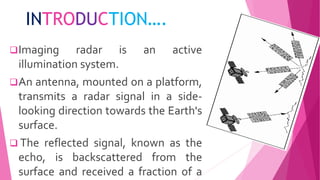
Imaging radar is an active
illumination system.
An antenna, mounted on a platform,
transmits a radar signal in a side-
looking direction towards the Earth's
surface.
 The reflected signal, known as the
echo, is backscattered from the
surface and received a fraction of a
INTRODUCTION…..
The term synthetic aperture radar (SAR)
derives from the fact that the motion of an
aircraft (airplane, satellite, UAV, etc.) is
used to artificially create, or synthesize a
very long, linear array.
The reason for creating a long array is to
provide the ability to resolve targets that
are closely spaced in angle, or cross range
(usually azimuth).
The SAR works similar of a phased
array, but contrary of a large number
of the parallel antenna elements of a
phased array, SAR uses one antenna
in time-multiplex.
The different geometric positions of
the antenna elements are result of the
Synthetic Aperture Radar
SAR, is a coherent mostly airborne
or spaceborne sidelooking radar
system which utilizes the flight
path of the platform to simulate an
extremely large antenna or
aperture electronically, and that
generates high-resolution remote
RADAR Geometry
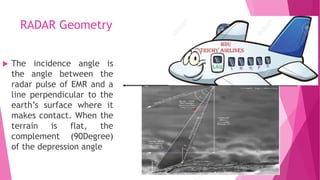
 The incidence angle is
the angle between the
radar pulse of EMR and a
line perpendicular to the
earth’s surface where it
makes contact. When the
terrain is flat, the
complement (90Degree)
of the depression angle
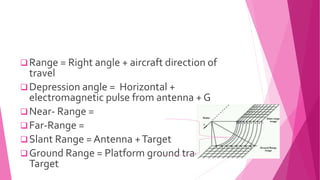
Range = Right angle + aircraft direction of
travel
Depression angle = Horizontal +
electromagnetic pulse from antenna + G
Near- Range =
Far-Range =
Slant Range = Antenna +Target
Ground Range = Platform ground track +
Target
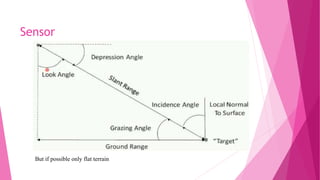
Sensor
But if possible only flat terrain
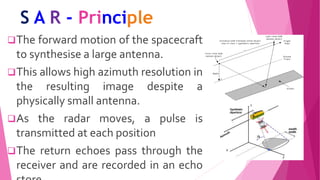
S A R - Principle
The forward motion of the spacecraft
to synthesise a large antenna.
This allows high azimuth resolution in
the resulting image despite a
physically small antenna.
As the radar moves, a pulse is
transmitted at each position
The return echoes pass through the
receiver and are recorded in an echo
S A R – Range Resolution
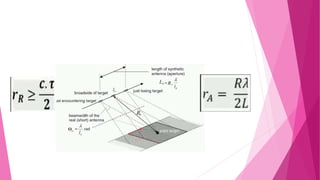
The range resolution of a pulsed radar
system is limited fundamentally by the
bandwidth of the transmitted pulse.
A wide bandwidth can be achieved by a short
duration pulse.
 The shorter the pulse, the lower the
transmitted energy and the poorer the
radiometric resolution.
S A R – Azimuth Resolution
Azimuth Resolution describes the ability of an
imaging radar to separate two closely spaced
scatters in the direction parallel to the motion
vector of the sensorThe smaller the antenna, the
larger is the beamwidth ( β = λ/D)
 Thus, the azimuthal resolution becomes
better, the smaller the antenna length D.
 Here, the smaller the antenna, the better the
resolution.
 Azimuth resolution is Xa =D/2
 The azimuthal resolution of a SAR is
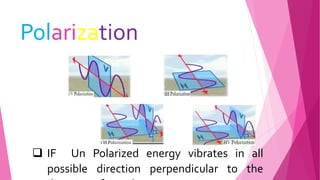
Polarization
 IF Un Polarized energy vibrates in all
possible direction perpendicular to the
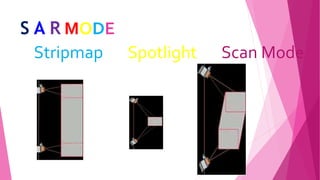
S A R MODE
Stripmap Spotlight Scan Mode
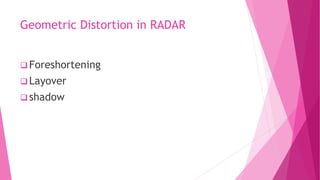
Geometric Distortion in RADAR
 Foreshortening
 Layover
 shadow
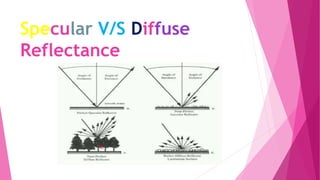
Specular V/S Diffuse
Reflectance
ResPonse of Pine tree
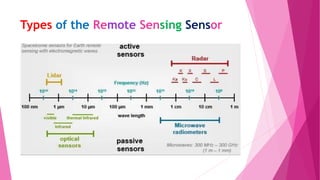
Types of the Remote Sensing Sensor
Commonly Used Frequency Bands
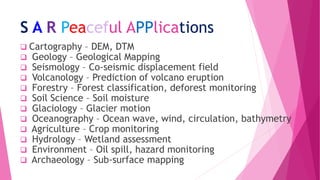
S A R Peaceful APPlications
 Cartography – DEM, DTM
 Geology – Geological Mapping
 Seismology – Co-seismic displacement field
 Volcanology – Prediction of volcano eruption
 Forestry – Forest classification, deforest monitoring
 Soil Science – Soil moisture
 Glaciology – Glacier motion
 Oceanography – Ocean wave, wind, circulation, bathymetry
 Agriculture – Crop monitoring
 Hydrology – Wetland assessment
 Environment – Oil spill, hazard monitoring
 Archaeology – Sub-surface mapping
Software
DEPARTMENT OF GEOGRAPHY GREEN TRICHY-CLEAN TRICHY

Synthetic aperature radar

  • 1.
    Synthetic Aperture Radar  Manojkumar patley  M.Tech_Geoinformatics (II)  mpatley7@gmail.com
  • 2.
    INTRODUCTION…. Imaging radar isan active illumination system. An antenna, mounted on a platform, transmits a radar signal in a side- looking direction towards the Earth's surface.  The reflected signal, known as the echo, is backscattered from the surface and received a fraction of a
  • 3.
    INTRODUCTION….. The term syntheticaperture radar (SAR) derives from the fact that the motion of an aircraft (airplane, satellite, UAV, etc.) is used to artificially create, or synthesize a very long, linear array. The reason for creating a long array is to provide the ability to resolve targets that are closely spaced in angle, or cross range (usually azimuth).
  • 4.
    The SAR workssimilar of a phased array, but contrary of a large number of the parallel antenna elements of a phased array, SAR uses one antenna in time-multiplex. The different geometric positions of the antenna elements are result of the
  • 5.
    Synthetic Aperture Radar SAR,is a coherent mostly airborne or spaceborne sidelooking radar system which utilizes the flight path of the platform to simulate an extremely large antenna or aperture electronically, and that generates high-resolution remote
  • 6.
    RADAR Geometry  Theincidence angle is the angle between the radar pulse of EMR and a line perpendicular to the earth’s surface where it makes contact. When the terrain is flat, the complement (90Degree) of the depression angle
  • 7.
    Range = Rightangle + aircraft direction of travel Depression angle = Horizontal + electromagnetic pulse from antenna + G Near- Range = Far-Range = Slant Range = Antenna +Target Ground Range = Platform ground track + Target
  • 8.
    Sensor But if possibleonly flat terrain
  • 9.
    S A R- Principle The forward motion of the spacecraft to synthesise a large antenna. This allows high azimuth resolution in the resulting image despite a physically small antenna. As the radar moves, a pulse is transmitted at each position The return echoes pass through the receiver and are recorded in an echo
  • 10.
    S A R– Range Resolution The range resolution of a pulsed radar system is limited fundamentally by the bandwidth of the transmitted pulse. A wide bandwidth can be achieved by a short duration pulse.  The shorter the pulse, the lower the transmitted energy and the poorer the radiometric resolution.
  • 11.
    S A R– Azimuth Resolution Azimuth Resolution describes the ability of an imaging radar to separate two closely spaced scatters in the direction parallel to the motion vector of the sensorThe smaller the antenna, the larger is the beamwidth ( β = λ/D)  Thus, the azimuthal resolution becomes better, the smaller the antenna length D.  Here, the smaller the antenna, the better the resolution.  Azimuth resolution is Xa =D/2  The azimuthal resolution of a SAR is
  • 13.
    Polarization  IF UnPolarized energy vibrates in all possible direction perpendicular to the
  • 14.
    S A RMODE Stripmap Spotlight Scan Mode
  • 15.
    Geometric Distortion inRADAR  Foreshortening  Layover  shadow
  • 16.
  • 17.
  • 18.
    Types of theRemote Sensing Sensor
  • 19.
  • 20.
    S A RPeaceful APPlications  Cartography – DEM, DTM  Geology – Geological Mapping  Seismology – Co-seismic displacement field  Volcanology – Prediction of volcano eruption  Forestry – Forest classification, deforest monitoring  Soil Science – Soil moisture  Glaciology – Glacier motion  Oceanography – Ocean wave, wind, circulation, bathymetry  Agriculture – Crop monitoring  Hydrology – Wetland assessment  Environment – Oil spill, hazard monitoring  Archaeology – Sub-surface mapping
  • 21.
  • 23.
    DEPARTMENT OF GEOGRAPHYGREEN TRICHY-CLEAN TRICHY