Persistent scatterersarinterferometry application on berkeley hills landslidesLing Lei1,2, Yinqing Zhou1, Jingwen Li, Roland Bürgmann21 Beijing University of Aeronautics and Astronautics(Beihang University)2 Berkeley Seismological Lab, University of California
Background: Bay Area and Berkeley Hills
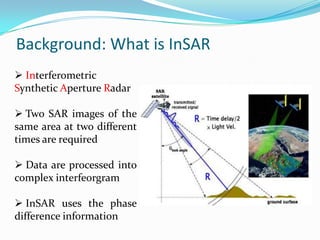
Background: What is InSARInterferometricSynthetic Aperture Radar
 Two SAR images of the same area at two different times are required
 Data are processed into complex interfeorgram
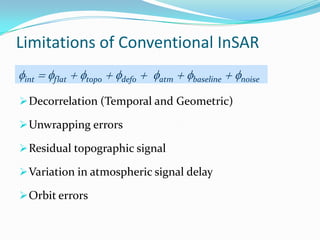
InSAR uses the phase difference information Limitations of Conventional InSARintflattopodefo  atmbaselinenoise Decorrelation (Temporal and Geometric)
Unwrapping errors
Residual topographic signal
Variation in atmospheric signal delay
Orbit errorsPersistent ScattererInSARPotential method of time series analysis
Independent from surrounding incoherent pixels, applicable in vegetated areas
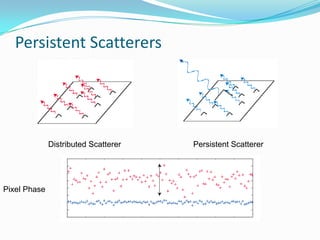
Elevation values with sub-m accuracy and surface movements with mm accuracy Persistent ScatterersDistributed ScattererPersistent ScattererPixel Phase
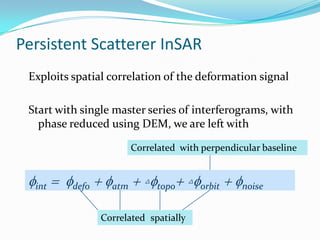
Persistent ScattererInSARExploits spatial correlation of the deformation signalStart with single master series of interferograms, with phase reduced using DEM, we are left with Correlated  with perpendicular baselineintdefoatm△topo△orbitnoise Correlatedspatially
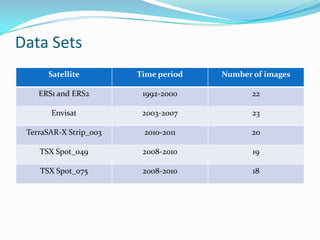
Data Sets
Amplitude Image
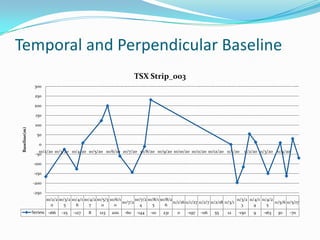
Temporal and Perpendicular Baseline
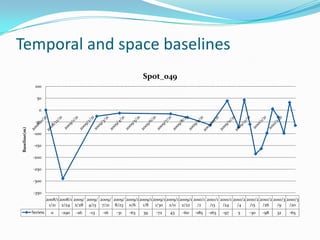
Temporal and space baselines
Envisat interferograms
Wrapped interferograms
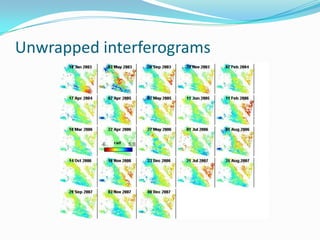
Unwrapped interferograms

PERSISTENT SCATTERER SAR INTERFEROMETRY APPLICATION.pptx