Prepared by: Umair Khan
B.S Pathology 3rd semester 03149714825
Shigella and its classification
Shigellosis and its symptoms
 Life Cycle andTransmission
Cultural characteristics and Prevention.
Umair Khan 2
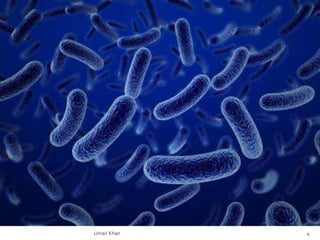
Shigella is a genus of Gram-negative ,
facultative anaerobic , non-spore-forming
, non-motile, rod-shaped bacteria closely
related to Salmonella.
Umair Khan 3
Umair Khan 4
Kingdom: Bacteria
Phylum: Proteobacteria
Class: Gammaproteobacteria
Order: Enterobacteriales
Family: Enterobacteriaceae
Genus: Shigella
Umair Khan 5
1- S. boydii
2- S. dysenteriae
3- S. flexneri
4- S. Sonnei
Shigella Dysentery is the most common.
Umair Khan 6
Shigellosis, also known as bacillary
dysentery or Marlow Syndrome.
Shigellosis is a disease caused by bacteria
of the genus Shigella.
Shigellosis rarely occurs in animals other
than humans.
It is usually resolves in 5-7 days.
Umair Khan 7
Shigellosis Cont....
 Shigella is one of the most common infectious
bacteria and infection will cause when we ingest
100-200 organism.
 Shigella can servive up to 30 days in Milk, Egg
and Cheese.
Umair Khan 8
The global burden of shigellosis has been estimated
at 165 million cases per year,
of which 163 million are in developing countries.
More than one million deaths occur in the
developing world yearly due to Shigella infection. By
one estimate, Shigella infections are responsible for
300,000 illnesses and 600 deaths per year in the
United States
Umair Khan 9
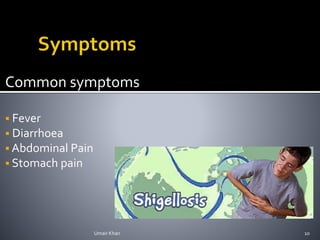
Common symptoms
 Fever
 Diarrhoea
 Abdominal Pain
 Stomach pain
Umair Khan 10
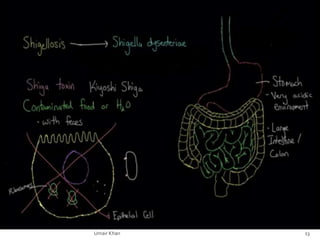
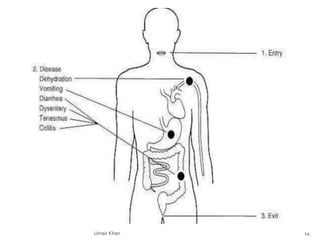
Fecal-oral transmission is the main route of
Shigella infection. Other modes of
transmission include ingestion of
contaminated food or water, contact with
infected objects, or sexual contact. Outbreaks
of Shigella infection are common in places
with poor sanitation standards.
Umair Khan 11
The Shigella life cycle begins with penetration of
colonic mucosa.
This results in degradation of the epithelium and
acute inflammatory colitis in the lamina propria.
This causes leakage of blood, inflammation in the
colon, and mucus into the intestinal lumen.
Umair Khan 12
Umair Khan 13
Umair Khan 14
 All memeber of shigella aerobic and facultative
anerobes.
 Grow readily in culture media at pH 6.4 to 7.8 at 10-40
Oc.
 After incubation of 24 hours, shigella collinies reaches a
diameter of 2mm.
 In XLD medium they appear pinkish to reddish colonies
while in Heaktoen Enteric Agar ( HEA), they give green to
blue green colonies
Umair Khan 15
Umair Khan 16
 Supply of pure water.
 Insects control.
 Food Hygiene.
 Vacccine- 6 months
Umair Khan 17
Umair Khan 18

Shigella

  • 1.
    Prepared by: UmairKhan B.S Pathology 3rd semester 03149714825
  • 2.
    Shigella and itsclassification Shigellosis and its symptoms  Life Cycle andTransmission Cultural characteristics and Prevention. Umair Khan 2
  • 3.
    Shigella is agenus of Gram-negative , facultative anaerobic , non-spore-forming , non-motile, rod-shaped bacteria closely related to Salmonella. Umair Khan 3
  • 4.
  • 5.
    Kingdom: Bacteria Phylum: Proteobacteria Class:Gammaproteobacteria Order: Enterobacteriales Family: Enterobacteriaceae Genus: Shigella Umair Khan 5
  • 6.
    1- S. boydii 2-S. dysenteriae 3- S. flexneri 4- S. Sonnei Shigella Dysentery is the most common. Umair Khan 6
  • 7.
    Shigellosis, also knownas bacillary dysentery or Marlow Syndrome. Shigellosis is a disease caused by bacteria of the genus Shigella. Shigellosis rarely occurs in animals other than humans. It is usually resolves in 5-7 days. Umair Khan 7
  • 8.
    Shigellosis Cont....  Shigellais one of the most common infectious bacteria and infection will cause when we ingest 100-200 organism.  Shigella can servive up to 30 days in Milk, Egg and Cheese. Umair Khan 8
  • 9.
    The global burdenof shigellosis has been estimated at 165 million cases per year, of which 163 million are in developing countries. More than one million deaths occur in the developing world yearly due to Shigella infection. By one estimate, Shigella infections are responsible for 300,000 illnesses and 600 deaths per year in the United States Umair Khan 9
  • 10.
    Common symptoms  Fever Diarrhoea  Abdominal Pain  Stomach pain Umair Khan 10
  • 11.
    Fecal-oral transmission isthe main route of Shigella infection. Other modes of transmission include ingestion of contaminated food or water, contact with infected objects, or sexual contact. Outbreaks of Shigella infection are common in places with poor sanitation standards. Umair Khan 11
  • 12.
    The Shigella lifecycle begins with penetration of colonic mucosa. This results in degradation of the epithelium and acute inflammatory colitis in the lamina propria. This causes leakage of blood, inflammation in the colon, and mucus into the intestinal lumen. Umair Khan 12
  • 13.
  • 14.
  • 15.
     All memeberof shigella aerobic and facultative anerobes.  Grow readily in culture media at pH 6.4 to 7.8 at 10-40 Oc.  After incubation of 24 hours, shigella collinies reaches a diameter of 2mm.  In XLD medium they appear pinkish to reddish colonies while in Heaktoen Enteric Agar ( HEA), they give green to blue green colonies Umair Khan 15
  • 16.
  • 17.
     Supply ofpure water.  Insects control.  Food Hygiene.  Vacccine- 6 months Umair Khan 17
  • 18.