By
Chakra Bhandari
www.chakrapanibhandari.com.np
chakra.jwala@gmail.com
Amrit Science College,
Department Of Microbiology
Tribhuvan University Nepal
Introduction:
Shigella is named after the Japanese microbiologist Kiyoshi
Shiga who isolated the first member of the group in 1896
from epidemic dysentery in Japan which was then called
Shigella shiga and is now called as S. dysenteriae.
Shigella is an enterobacteriaceae
 Gram negative, Non motile
 Facultative anaerobes
 Non spore forming
 Non capsulated
 Non lactose fermenting except S. sonnei.
 Catalase positive except S. dysenteriae type1 and Oxidase
negative.
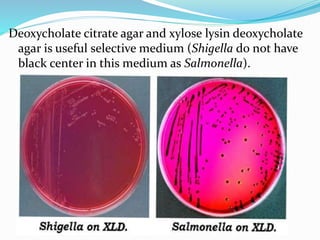
Deoxycholate citrate agar and xylose lysin deoxycholate
agar is useful selective medium (Shigella do not have
black center in this medium as Salmonella).
Cultural characteristics
Temperature range for growth 10-40°C(Optimum temp 37 °C)
In Nutrient Agar (After overnight culture)
• 2 mm in diameter, circular, convex, smooth and
translucent.
In MacConkey agar
• Colorless Colony except S. sonnei (Pink colony)
In Shigella-Salmonella agar
• Colorless Colony
Viability: Death point (56°C for 1 hour), 1% phenol for 30
min,
Viable in water for days and in ice for 1-6 months, In faeces it
dies within few hour due to acidity produced by growth of
coliform.
Biochemical reactions
 Catalase positive except S. dysenteriae type 1.
 Methyl red positive
 VP negative
 Urease negative
 Citrate negative
 Oxidase negative
 No production of H2S
 S. sonnei is a late lactose fermenter.
Classification: based on biochemical and antigenic
characteristics.
1. Subgroup A: S. dysenteriae: 15
serotypes:
2. Subgroup B: S. flexneri: 8
serotypes.
3. Subgroup C: S. boydii: 19 serotypes
4. Subgroup D: S. sonnei: only one
serotypes
Taxonomy
Family Enterobacteriaceae
1. Shigella dysenteriae: most serious form of
bacillary dysentery (Shiga toxin)
2. Shigella flexneri: shigellosis in
underdeveloped countries
3. Shigella sonnei: shigellosis in developed
countries
4. Shigella boydii : Less frequently isolated from
dysentry patients.
Virulence factors:
 Plasmid antigens: Effectors of plasmid transmit from
the bacterial cytoplasm to epithelial cell cytoplasm of
colon.
 Invasiveness: Virulent Shigella penetrate the mucosa
and epithelial cells of the colon in an uneven manner.
Intracellular multiplication leads to invasion of adjacent
cells, inflammation and cell death. Cell death is probably
due to cytotoxic properties of shiga toxin that interfere
with protein synthesis. The cellular death and resulting
phagocytosis response by the host accounts for the
bloody discharge of mucus and pus and shallow ulcers
characteristic of the disease.
 Other toxins: It has a Shiga toxin toxin which may be
neurotoxic, cytotoxic, and enterotoxic. The enterotoxic
property is responsible for watery diarrhea.
Clinical symptoms
Ranges from asymptomatic infection to severe
bacillary dysentery
Two-stage disease: watery diarrhea changing to
dysentery with frequent small stools with blood
and mucus, tenesmus, cramps, fever
Early stage:
 Watery diarrhoea attributed to the enterotoxic
activity of Shiga toxin
 Fever attributed to neurotoxic activity of toxin
Clinical symptoms
Process involves:
 Ingestion
 Non-invasive colonization and cell multiplication
 Production of the enterotoxin by the pathogenic bacteria
in the small intestine;
Second stage:
 Adherence to tissue invasion of large intestine
 Typical symptoms of dysentery
 Cytotoxic activity of Shiga toxin increases severity
Pathogenesis
SOURCE : MAN: CASE OR CARRIER
MODE OF SPREAD: CONTAMINATED
FINGERS, FOOD, FLIES, FOMITES
PERSON TO PERSON TRANSMISSION
INFECTIVE DOSE: 10-100 VIABLE BACILLI
HIGHEST CONCENTRATION IN STOOL
DURING EARLY/ACUTE INFECTION 103
TO 109 VIABLE BACILLI PER GRAM OF
STOOL
Laboratory diagnosis
Sampling: fresh stool, mucus flakes and rectal swabs
Selenite F broth(0.4%) is used as enrichment and
transport media (for 9-12 hours)
Culture media: Non Selective Bromocresol purpe
lactose agar, Low selective MacConkey agar, High
selective Deoxycholate citrate agar and SS agar.
Biochemical test:
Epidemiology:
Reservoir: Man only
Transmission: Faeco-oral route
Distribution: Developing country: S. flexneri
Developed country; S. sonnei
Treatment and control:
Ciprofloxacin, Fluoroquinol, Azithromycin, Pivmecillinam, Ceftriaxone
 Preventing infected individuals from handling food
 Thoroughly washing hands after changing and disposing of an infant’s
diaper
 Disinfecting surfaces handled by infected individuals
 Not allowing infected children to play in community swimming areas
 If traveling, consuming boiled or filtered water, fruits peeled by self, and
hot meals
 Proper storage of food
Thank you
Please visit: www.chakrapanibhandari.com.np
Send your comment on chakra.jwala@gmail.com

Shigella

  • 1.
    By Chakra Bhandari www.chakrapanibhandari.com.np chakra.jwala@gmail.com Amrit ScienceCollege, Department Of Microbiology Tribhuvan University Nepal
  • 2.
    Introduction: Shigella is namedafter the Japanese microbiologist Kiyoshi Shiga who isolated the first member of the group in 1896 from epidemic dysentery in Japan which was then called Shigella shiga and is now called as S. dysenteriae. Shigella is an enterobacteriaceae  Gram negative, Non motile  Facultative anaerobes  Non spore forming  Non capsulated  Non lactose fermenting except S. sonnei.  Catalase positive except S. dysenteriae type1 and Oxidase negative.
  • 3.
    Deoxycholate citrate agarand xylose lysin deoxycholate agar is useful selective medium (Shigella do not have black center in this medium as Salmonella).
  • 4.
    Cultural characteristics Temperature rangefor growth 10-40°C(Optimum temp 37 °C) In Nutrient Agar (After overnight culture) • 2 mm in diameter, circular, convex, smooth and translucent. In MacConkey agar • Colorless Colony except S. sonnei (Pink colony) In Shigella-Salmonella agar • Colorless Colony Viability: Death point (56°C for 1 hour), 1% phenol for 30 min, Viable in water for days and in ice for 1-6 months, In faeces it dies within few hour due to acidity produced by growth of coliform.
  • 5.
    Biochemical reactions  Catalasepositive except S. dysenteriae type 1.  Methyl red positive  VP negative  Urease negative  Citrate negative  Oxidase negative  No production of H2S  S. sonnei is a late lactose fermenter.
  • 6.
    Classification: based onbiochemical and antigenic characteristics. 1. Subgroup A: S. dysenteriae: 15 serotypes: 2. Subgroup B: S. flexneri: 8 serotypes. 3. Subgroup C: S. boydii: 19 serotypes 4. Subgroup D: S. sonnei: only one serotypes
  • 7.
    Taxonomy Family Enterobacteriaceae 1. Shigelladysenteriae: most serious form of bacillary dysentery (Shiga toxin) 2. Shigella flexneri: shigellosis in underdeveloped countries 3. Shigella sonnei: shigellosis in developed countries 4. Shigella boydii : Less frequently isolated from dysentry patients.
  • 8.
    Virulence factors:  Plasmidantigens: Effectors of plasmid transmit from the bacterial cytoplasm to epithelial cell cytoplasm of colon.  Invasiveness: Virulent Shigella penetrate the mucosa and epithelial cells of the colon in an uneven manner. Intracellular multiplication leads to invasion of adjacent cells, inflammation and cell death. Cell death is probably due to cytotoxic properties of shiga toxin that interfere with protein synthesis. The cellular death and resulting phagocytosis response by the host accounts for the bloody discharge of mucus and pus and shallow ulcers characteristic of the disease.  Other toxins: It has a Shiga toxin toxin which may be neurotoxic, cytotoxic, and enterotoxic. The enterotoxic property is responsible for watery diarrhea.
  • 9.
    Clinical symptoms Ranges fromasymptomatic infection to severe bacillary dysentery Two-stage disease: watery diarrhea changing to dysentery with frequent small stools with blood and mucus, tenesmus, cramps, fever Early stage:  Watery diarrhoea attributed to the enterotoxic activity of Shiga toxin  Fever attributed to neurotoxic activity of toxin
  • 10.
    Clinical symptoms Process involves: Ingestion  Non-invasive colonization and cell multiplication  Production of the enterotoxin by the pathogenic bacteria in the small intestine; Second stage:  Adherence to tissue invasion of large intestine  Typical symptoms of dysentery  Cytotoxic activity of Shiga toxin increases severity
  • 11.
    Pathogenesis SOURCE : MAN:CASE OR CARRIER MODE OF SPREAD: CONTAMINATED FINGERS, FOOD, FLIES, FOMITES PERSON TO PERSON TRANSMISSION INFECTIVE DOSE: 10-100 VIABLE BACILLI HIGHEST CONCENTRATION IN STOOL DURING EARLY/ACUTE INFECTION 103 TO 109 VIABLE BACILLI PER GRAM OF STOOL
  • 12.
    Laboratory diagnosis Sampling: freshstool, mucus flakes and rectal swabs Selenite F broth(0.4%) is used as enrichment and transport media (for 9-12 hours) Culture media: Non Selective Bromocresol purpe lactose agar, Low selective MacConkey agar, High selective Deoxycholate citrate agar and SS agar. Biochemical test:
  • 13.
    Epidemiology: Reservoir: Man only Transmission:Faeco-oral route Distribution: Developing country: S. flexneri Developed country; S. sonnei Treatment and control: Ciprofloxacin, Fluoroquinol, Azithromycin, Pivmecillinam, Ceftriaxone  Preventing infected individuals from handling food  Thoroughly washing hands after changing and disposing of an infant’s diaper  Disinfecting surfaces handled by infected individuals  Not allowing infected children to play in community swimming areas  If traveling, consuming boiled or filtered water, fruits peeled by self, and hot meals  Proper storage of food
  • 14.
    Thank you Please visit:www.chakrapanibhandari.com.np Send your comment on chakra.jwala@gmail.com