Enterobacteriaceae
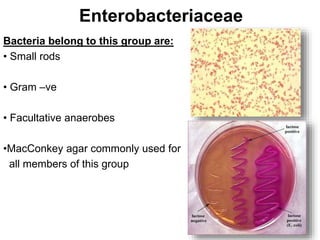
Bacteria belong to this group are:
• Small rods
• Gram –ve
• Facultative anaerobes
•MacConkey agar commonly used for
all members of this group
Enterobacteriaceae
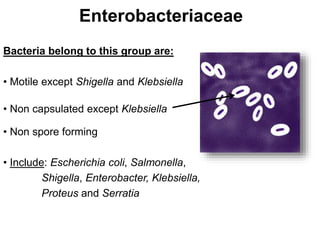
Bacteria belong to this group are:
• Motile except Shigella and Klebsiella
• Non capsulated except Klebsiella
• Non spore forming
• Include: Escherichia coli, Salmonella,
Shigella, Enterobacter, Klebsiella,
Proteus and Serratia
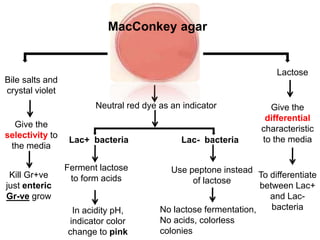
Bile salts and
crystal violet
Lactose
Give the
selectivity to
the media
Kill Gr+ve
just enteric
Gr-ve grow
Give the
differential
characteristic
to the media
To differentiate
between Lac+
and Lac-
bacteria
Neutral red dye as an indicator
MacConkey agar
Lac+ bacteria Lac- bacteria
Ferment lactose
to form acids
Use peptone instead
of lactose
In acidity pH,
indicator color
change to pink
No lactose fermentation,
No acids, colorless
colonies
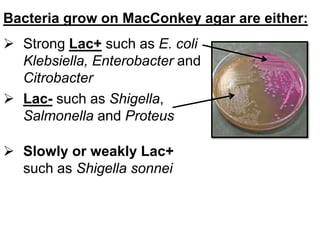
Bacteria grow on MacConkey agar are either:
 Strong Lac+ such as E. coli
Klebsiella, Enterobacter and
Citrobacter
 Lac- such as Shigella,
Salmonella and Proteus
 Slowly or weakly Lac+
such as Shigella sonnei
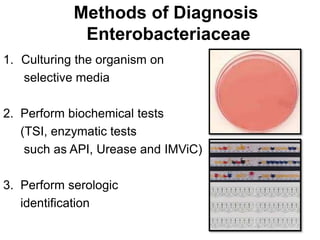
Methods of Diagnosis
Enterobacteriaceae
1. Culturing the organism on
selective media
2. Perform biochemical tests
(TSI, enzymatic tests
such as API, Urease and IMViC)
3. Perform serologic
identification
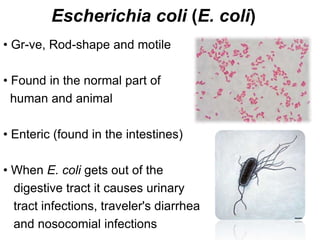
Escherichia coli (E. coli)
• Gr-ve, Rod-shape and motile
• Found in the normal part of
human and animal
• Enteric (found in the intestines)
• When E. coli gets out of the
digestive tract it causes urinary
tract infections, traveler's diarrhea
and nosocomial infections
Cultural characteristics of E coli
• Aerobic and facultative anaerobes
• Its colonies are 2- 4 mm in diameter
• Smooth, convex with an entire edge
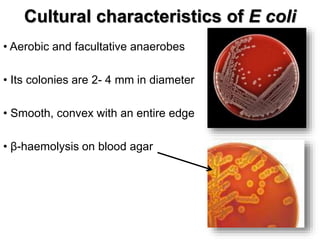
• β-haemolysis on blood agar
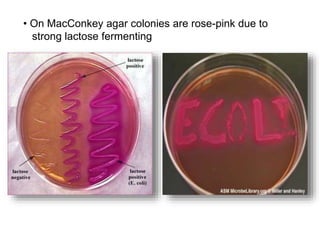
• On MacConkey agar colonies are rose-pink due to
strong lactose fermenting
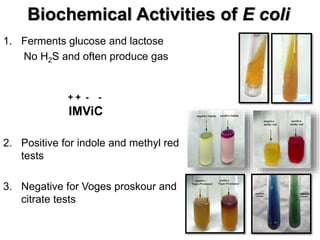
Biochemical Activities of E coli
1. Ferments glucose and lactose
No H2S and often produce gas
IMViC
2. Positive for indole and methyl red
tests
3. Negative for Voges proskour and
citrate tests
+ + - -
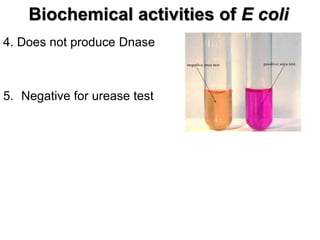
Biochemical activities of E coli
4. Does not produce Dnase
5. Negative for urease test
Klebsiella
Klebsiella
• Gr-ve, rod shaped
• non-motile
• Encapsulated bacterium
• Found in the normal flora of
the mouth, and intestines
• Klebsiella pneumoniae is most
common spp of pathogenic one
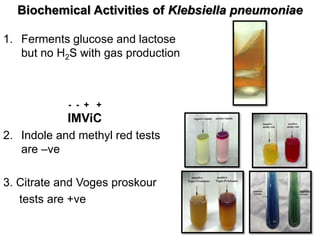
Biochemical Activities of Klebsiella pneumoniae
1. Ferments glucose and lactose
but no H2S with gas production
IMViC
2. Indole and methyl red tests
are –ve
3. Citrate and Voges proskour
tests are +ve
- - + +
Biochemical Activities of Klebsiella pneumoniae
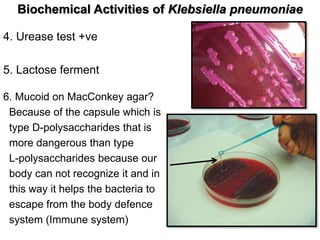
4. Urease test +ve
5. Lactose ferment
6. Mucoid on MacConkey agar?
Because of the capsule which is
type D-polysaccharides that is
more dangerous than type
L-polysaccharides because our
body can not recognize it and in
this way it helps the bacteria to
escape from the body defence
system (Immune system)
Proteus
Proteus
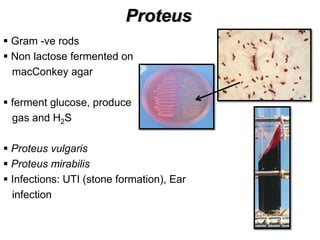
 Gram -ve rods
 Non lactose fermented on
macConkey agar
 ferment glucose, produce
gas and H2S
 Proteus vulgaris
 Proteus mirabilis
 Infections: UTI (stone formation), Ear
infection
Proteus
 Urease +ve
 The production of fishy odor
 Motile (swarming phenomena)
Proteus
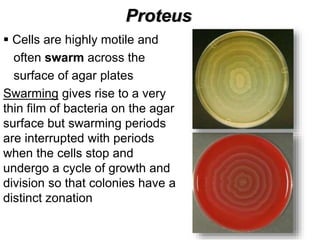
 Cells are highly motile and
often swarm across the
surface of agar plates
Swarming gives rise to a very
thin film of bacteria on the agar
surface but swarming periods
are interrupted with periods
when the cells stop and
undergo a cycle of growth and
division so that colonies have a
distinct zonation
CLED,MacConkey agar (swarming inhibitors media)
Proteus colonies on CLED
appear blue
Proteus colonies on
MacConkey appear colorless
CLED,MacConkey agar (swarming inhibitor)
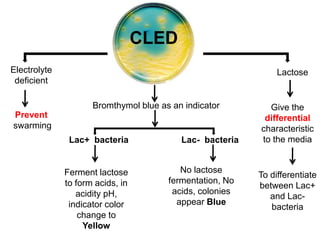
 CLED (Cystine Lactose Electrolyte Deficient) agar
 Is a valuable non-inhibitory growth medium used in the
isolation and differentiation of urinary organisms
 Being electrolyte deficient prevents the swarming of
Proteus species
 Cystine promotes the formation of cystine-dependent
colonies
 Lactose fermenters produce yellow colonies while non-
lactose fermenters appear blue
 Bromthymol blue is the indicator dye
 In macConkey agar (bile salts) inhibit Proteus to swarm
Electrolyte
deficient
Lactose
Prevent
swarming
Give the
differential
characteristic
to the media
To differentiate
between Lac+
and Lac-
bacteria
Bromthymol blue as an indicator
Lac+ bacteria Lac- bacteria
Ferment lactose
to form acids, in
acidity pH,
indicator color
change to
Yellow
No lactose
fermentation, No
acids, colonies
appear Blue
CLED

enterobacteracae

  • 2.
    Enterobacteriaceae Bacteria belong tothis group are: • Small rods • Gram –ve • Facultative anaerobes •MacConkey agar commonly used for all members of this group
  • 3.
    Enterobacteriaceae Bacteria belong tothis group are: • Motile except Shigella and Klebsiella • Non capsulated except Klebsiella • Non spore forming • Include: Escherichia coli, Salmonella, Shigella, Enterobacter, Klebsiella, Proteus and Serratia
  • 4.
    Bile salts and crystalviolet Lactose Give the selectivity to the media Kill Gr+ve just enteric Gr-ve grow Give the differential characteristic to the media To differentiate between Lac+ and Lac- bacteria Neutral red dye as an indicator MacConkey agar Lac+ bacteria Lac- bacteria Ferment lactose to form acids Use peptone instead of lactose In acidity pH, indicator color change to pink No lactose fermentation, No acids, colorless colonies
  • 5.
    Bacteria grow onMacConkey agar are either:  Strong Lac+ such as E. coli Klebsiella, Enterobacter and Citrobacter  Lac- such as Shigella, Salmonella and Proteus  Slowly or weakly Lac+ such as Shigella sonnei
  • 6.
    Methods of Diagnosis Enterobacteriaceae 1.Culturing the organism on selective media 2. Perform biochemical tests (TSI, enzymatic tests such as API, Urease and IMViC) 3. Perform serologic identification
  • 7.
  • 8.
    Escherichia coli (E.coli) • Gr-ve, Rod-shape and motile • Found in the normal part of human and animal • Enteric (found in the intestines) • When E. coli gets out of the digestive tract it causes urinary tract infections, traveler's diarrhea and nosocomial infections
  • 9.
    Cultural characteristics ofE coli • Aerobic and facultative anaerobes • Its colonies are 2- 4 mm in diameter • Smooth, convex with an entire edge • β-haemolysis on blood agar
  • 10.
    • On MacConkeyagar colonies are rose-pink due to strong lactose fermenting
  • 11.
    Biochemical Activities ofE coli 1. Ferments glucose and lactose No H2S and often produce gas IMViC 2. Positive for indole and methyl red tests 3. Negative for Voges proskour and citrate tests + + - -
  • 12.
    Biochemical activities ofE coli 4. Does not produce Dnase 5. Negative for urease test
  • 13.
  • 14.
    Klebsiella • Gr-ve, rodshaped • non-motile • Encapsulated bacterium • Found in the normal flora of the mouth, and intestines • Klebsiella pneumoniae is most common spp of pathogenic one
  • 15.
    Biochemical Activities ofKlebsiella pneumoniae 1. Ferments glucose and lactose but no H2S with gas production IMViC 2. Indole and methyl red tests are –ve 3. Citrate and Voges proskour tests are +ve - - + +
  • 16.
    Biochemical Activities ofKlebsiella pneumoniae 4. Urease test +ve 5. Lactose ferment 6. Mucoid on MacConkey agar? Because of the capsule which is type D-polysaccharides that is more dangerous than type L-polysaccharides because our body can not recognize it and in this way it helps the bacteria to escape from the body defence system (Immune system)
  • 17.
  • 18.
    Proteus  Gram -verods  Non lactose fermented on macConkey agar  ferment glucose, produce gas and H2S  Proteus vulgaris  Proteus mirabilis  Infections: UTI (stone formation), Ear infection
  • 19.
    Proteus  Urease +ve The production of fishy odor  Motile (swarming phenomena)
  • 20.
    Proteus  Cells arehighly motile and often swarm across the surface of agar plates Swarming gives rise to a very thin film of bacteria on the agar surface but swarming periods are interrupted with periods when the cells stop and undergo a cycle of growth and division so that colonies have a distinct zonation
  • 21.
    CLED,MacConkey agar (swarminginhibitors media) Proteus colonies on CLED appear blue Proteus colonies on MacConkey appear colorless
  • 22.
    CLED,MacConkey agar (swarminginhibitor)  CLED (Cystine Lactose Electrolyte Deficient) agar  Is a valuable non-inhibitory growth medium used in the isolation and differentiation of urinary organisms  Being electrolyte deficient prevents the swarming of Proteus species  Cystine promotes the formation of cystine-dependent colonies  Lactose fermenters produce yellow colonies while non- lactose fermenters appear blue  Bromthymol blue is the indicator dye  In macConkey agar (bile salts) inhibit Proteus to swarm
  • 23.
    Electrolyte deficient Lactose Prevent swarming Give the differential characteristic to themedia To differentiate between Lac+ and Lac- bacteria Bromthymol blue as an indicator Lac+ bacteria Lac- bacteria Ferment lactose to form acids, in acidity pH, indicator color change to Yellow No lactose fermentation, No acids, colonies appear Blue CLED