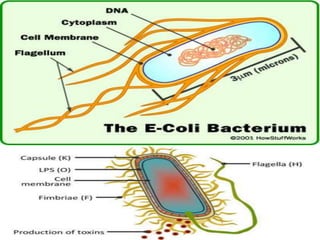
ļ‚ž Escherichia coli is a Gram negative, facultative
anaerobic, rod-shaped bacteria.
ļ‚ž It is a commensal that is found inhabiting the lower
intestine of warm blooded animals.
ļ‚ž A small proportion of E. coli strains are pathogenic.
ļ‚ž The harmless strains produce vitamin K and prevent
colonization of the intestine by pathogenic bacteria.
ļ‚ž E. coli is classified into serotypes based on cell wall
(O), capsular (K), fimbrial (F) and flagellar (H)
antigens. Example E. coli O157:H7
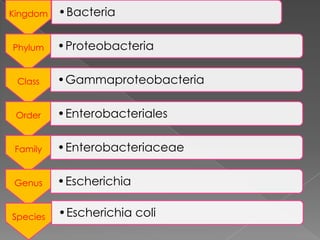
Kingdom •Bacteria
Phylum •Proteobacteria
Class •Gammaproteobacteria
Order •Enterobacteriales
Family •Enterobacteriaceae
Genus •Escherichia
Species •Escherichia coli
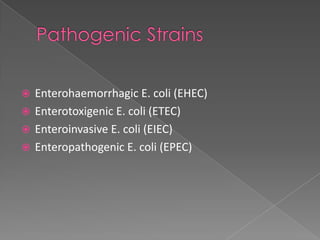
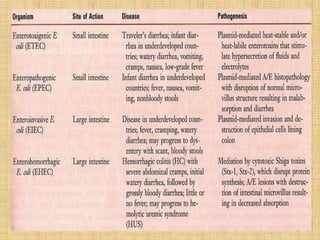
ļ‚ž Enterohaemorrhagic E. coli (EHEC)
ļ‚ž Enterotoxigenic E. coli (ETEC)
ļ‚ž Enteroinvasive E. coli (EIEC)
ļ‚ž Enteropathogenic E. coli (EPEC)
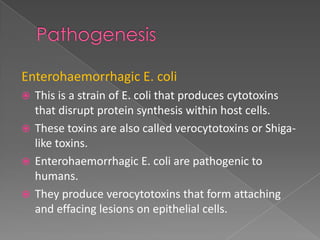
Enterohaemorrhagic E. coli
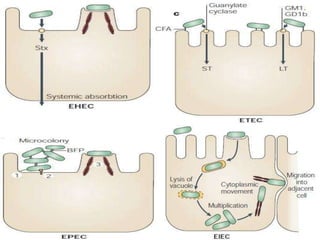
ļ‚ž This is a strain of E. coli that produces cytotoxins
that disrupt protein synthesis within host cells.
ļ‚ž These toxins are also called verocytotoxins or Shiga-
like toxins.
ļ‚ž Enterohaemorrhagic E. coli are pathogenic to
humans.
ļ‚ž They produce verocytotoxins that form attaching
and effacing lesions on epithelial cells.
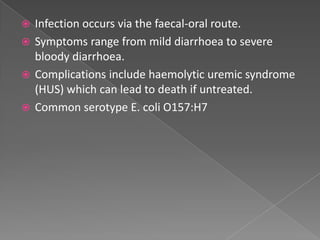
ļ‚ž Infection occurs via the faecal-oral route.
ļ‚ž Symptoms range from mild diarrhoea to severe
bloody diarrhoea.
ļ‚ž Complications include haemolytic uremic syndrome
(HUS) which can lead to death if untreated.
ļ‚ž Common serotype E. coli O157:H7
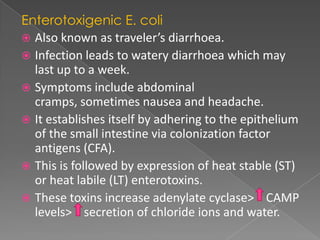
Enterotoxigenic E. coli
ļ‚ž Also known as traveler’s diarrhoea.
ļ‚ž Infection leads to watery diarrhoea which may
last up to a week.
ļ‚ž Symptoms include abdominal
cramps, sometimes nausea and headache.
ļ‚ž It establishes itself by adhering to the epithelium
of the small intestine via colonization factor
antigens (CFA).
ļ‚ž This is followed by expression of heat stable (ST)
or heat labile (LT) enterotoxins.
ļ‚ž These toxins increase adenylate cyclase> CAMP
levels> secretion of chloride ions and water.
Enteroinvasive E. coli
ļ‚ž Transmitted through faecal-oral route.
ļ‚ž Following ingestion, organisms invade epithelial cells
of the intestine resulting in a mild form of dysentery.
ļ‚ž Illness is characterized by presence of blood and
mucus in stools of infected individuals.
ļ‚ž Characteristic features of EIEC are their ability to
induce entry into epithelial cells and disseminate
from cell to cell.
ļ‚ž EIEC infection can occur through contaminated food
or water or through mechanical factors such as flies.
ļ‚ž The genes required for entry is clustered on a
virulence-associated invasion plasmid in EIEC strains.
Enteropathogenic E. coli
ļ‚ž Following ingestion, organisms adhere to the epithelial
cells of the intestine causing watery or bloody
diarrhoea.
ļ‚ž Adherence is mediated by EPEC adherence factor (EAF)
and intimin- a non-fimbrial adhesin.
ļ‚ž EPEC attach to and alter the integrity of the intestine.
ļ‚ž Bloody diarrhoea is associated with attachment and an
acute tissue-destructive process.
ļ‚ž EPEC do not produce toxins.
ļ‚ž Their virulence mechanism involves the formation of
attaching and effacing lesions followed by interference
with host cell signal transduction.
ļ‚ž This strain is most commonly associated with
paediatrics/kids.
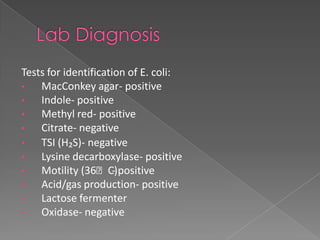
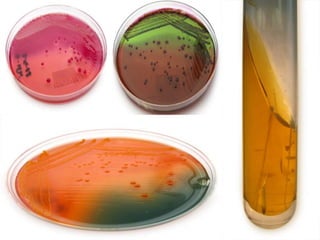
Tests for identification of E. coli:
• MacConkey agar- positive
• Indole- positive
• Methyl red- positive
• Citrate- negative
• TSI (Hā‚‚S)- negative
• Lysine decarboxylase- positive
• Motility (36įµ’C)- positive
• Acid/gas production- positive
• Lactose fermenter
• Oxidase- negative
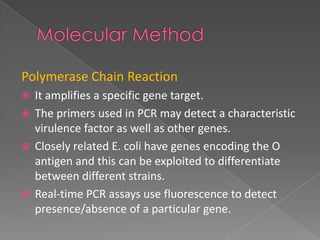
Polymerase Chain Reaction
ļ‚ž It amplifies a specific gene target.
ļ‚ž The primers used in PCR may detect a characteristic
virulence factor as well as other genes.
ļ‚ž Closely related E. coli have genes encoding the O
antigen and this can be exploited to differentiate
between different strains.
ļ‚ž Real-time PCR assays use fluorescence to detect
presence/absence of a particular gene.
ļ‚ž Patients, especially healthy adults need no
treatment for E. coli infection because it is self-
limited.
ļ‚ž In some studies, it has been noticed that treatment
with antibiotics increases the chances of getting
HUS.
ļ‚ž This effect occurs because antibiotics destroys the
bacterial cell wall, causing them to release even
more toxin.
ļ‚ž When necessary, treatment includes the
replacement of fluids and electrolytes to treat or
prevent dehydration.
1. http://en.wikipedia.org/wiki/Escherichia_coli
2. http://www.antimicrobialresistance.dk/data/im
ages/e.%20coli%20o157_1_pdf.pdf
3. Stephen A., William J., Elmer K., Gary P., Paul
S., Gail W. Koneman’s Color Atlas & Textbook of
Diagnostic Microbiology. 6th ed. China:
Lippincott Williams & Wilkins; 2006.

E. coli

  • 2.
    ļ‚ž Escherichia coliis a Gram negative, facultative anaerobic, rod-shaped bacteria. ļ‚ž It is a commensal that is found inhabiting the lower intestine of warm blooded animals. ļ‚ž A small proportion of E. coli strains are pathogenic. ļ‚ž The harmless strains produce vitamin K and prevent colonization of the intestine by pathogenic bacteria. ļ‚ž E. coli is classified into serotypes based on cell wall (O), capsular (K), fimbrial (F) and flagellar (H) antigens. Example E. coli O157:H7
  • 4.
    Kingdom •Bacteria Phylum •Proteobacteria Class•Gammaproteobacteria Order •Enterobacteriales Family •Enterobacteriaceae Genus •Escherichia Species •Escherichia coli
  • 5.
    ļ‚ž Enterohaemorrhagic E.coli (EHEC) ļ‚ž Enterotoxigenic E. coli (ETEC) ļ‚ž Enteroinvasive E. coli (EIEC) ļ‚ž Enteropathogenic E. coli (EPEC)
  • 6.
    Enterohaemorrhagic E. coli ļ‚žThis is a strain of E. coli that produces cytotoxins that disrupt protein synthesis within host cells. ļ‚ž These toxins are also called verocytotoxins or Shiga- like toxins. ļ‚ž Enterohaemorrhagic E. coli are pathogenic to humans. ļ‚ž They produce verocytotoxins that form attaching and effacing lesions on epithelial cells.
  • 7.
    ļ‚ž Infection occursvia the faecal-oral route. ļ‚ž Symptoms range from mild diarrhoea to severe bloody diarrhoea. ļ‚ž Complications include haemolytic uremic syndrome (HUS) which can lead to death if untreated. ļ‚ž Common serotype E. coli O157:H7
  • 8.
    Enterotoxigenic E. coli ļ‚žAlso known as traveler’s diarrhoea. ļ‚ž Infection leads to watery diarrhoea which may last up to a week. ļ‚ž Symptoms include abdominal cramps, sometimes nausea and headache. ļ‚ž It establishes itself by adhering to the epithelium of the small intestine via colonization factor antigens (CFA). ļ‚ž This is followed by expression of heat stable (ST) or heat labile (LT) enterotoxins. ļ‚ž These toxins increase adenylate cyclase> CAMP levels> secretion of chloride ions and water.
  • 9.
    Enteroinvasive E. coli ļ‚žTransmitted through faecal-oral route. ļ‚ž Following ingestion, organisms invade epithelial cells of the intestine resulting in a mild form of dysentery. ļ‚ž Illness is characterized by presence of blood and mucus in stools of infected individuals. ļ‚ž Characteristic features of EIEC are their ability to induce entry into epithelial cells and disseminate from cell to cell. ļ‚ž EIEC infection can occur through contaminated food or water or through mechanical factors such as flies. ļ‚ž The genes required for entry is clustered on a virulence-associated invasion plasmid in EIEC strains.
  • 10.
    Enteropathogenic E. coli ļ‚žFollowing ingestion, organisms adhere to the epithelial cells of the intestine causing watery or bloody diarrhoea. ļ‚ž Adherence is mediated by EPEC adherence factor (EAF) and intimin- a non-fimbrial adhesin. ļ‚ž EPEC attach to and alter the integrity of the intestine. ļ‚ž Bloody diarrhoea is associated with attachment and an acute tissue-destructive process. ļ‚ž EPEC do not produce toxins. ļ‚ž Their virulence mechanism involves the formation of attaching and effacing lesions followed by interference with host cell signal transduction. ļ‚ž This strain is most commonly associated with paediatrics/kids.
  • 13.
    Tests for identificationof E. coli: • MacConkey agar- positive • Indole- positive • Methyl red- positive • Citrate- negative • TSI (Hā‚‚S)- negative • Lysine decarboxylase- positive • Motility (36įµ’C)- positive • Acid/gas production- positive • Lactose fermenter • Oxidase- negative
  • 14.
    Polymerase Chain Reaction ļ‚žIt amplifies a specific gene target. ļ‚ž The primers used in PCR may detect a characteristic virulence factor as well as other genes. ļ‚ž Closely related E. coli have genes encoding the O antigen and this can be exploited to differentiate between different strains. ļ‚ž Real-time PCR assays use fluorescence to detect presence/absence of a particular gene.
  • 16.
    ļ‚ž Patients, especiallyhealthy adults need no treatment for E. coli infection because it is self- limited. ļ‚ž In some studies, it has been noticed that treatment with antibiotics increases the chances of getting HUS. ļ‚ž This effect occurs because antibiotics destroys the bacterial cell wall, causing them to release even more toxin. ļ‚ž When necessary, treatment includes the replacement of fluids and electrolytes to treat or prevent dehydration.
  • 17.
    1. http://en.wikipedia.org/wiki/Escherichia_coli 2. http://www.antimicrobialresistance.dk/data/im ages/e.%20coli%20o157_1_pdf.pdf 3.Stephen A., William J., Elmer K., Gary P., Paul S., Gail W. Koneman’s Color Atlas & Textbook of Diagnostic Microbiology. 6th ed. China: Lippincott Williams & Wilkins; 2006.