WelcomeTO OUR PRESENTATION
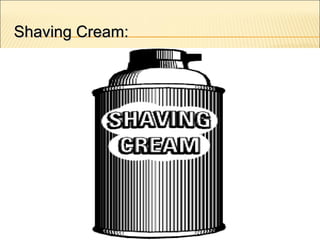
Shaving Cream:Shaving Cream:
Presented By:Presented By:
 Priya Baishnab(14/1312)
 Rajon Sarkar(60/1267)
 Tanvir Rafe Siddique(65/1274)
 Sirazul Islam(66/1289)
 Md. Nazmul Kabir(67/1198)
 Jannatul Ferdaus(68/1193)
 Jarin Fatema(69/1217)
 Sifat Jahan Juthi(70/1265)
 Umma Jannatul Ara(72/1290)
Department Of Pharmacy, Gono Bishwabidyalay.Department Of Pharmacy, Gono Bishwabidyalay.
Contents:Contents:
1. Introduction
2. Definition
3. History
4. Types of Shaving Preparation
5. Raw Materials
6. Manufacturing Process
7. Quality Control Process
8. Criteria
9. Application
10. Ill Effects
11. Comparisons between Shaving Cream,
Shaving Foam & Shaving Gel
12. Popular Brand
13. Review
14. Reference
Introduction:Introduction:
What is Creams?
Answer- Creams are thought of as ointments but usually contain a water
soluble base due to which they can be easily removed from the skin.
When applied to the skin, leave no visible evidence of their presence on
the skin.
What is shaving ?
Answer- Shaving is the removal of hair, by using a razor or any other kind
of bladed implement, to slice it down to the level of the skin.
Is it necessary ( Scientifically ) ?
Answer – No ,it is not necessary . There are many peoples in the field
who have never think of shaving their hairs . Infect a lot of your body
hair though is to help keep you cool, keep dirt out of certain areas, and
can also help you to feel things when something moves or touches
them.
Shaving cream is applied to the skin to facilitate
removal of hair. Shaving cream softens and
moistens the skin and the hair, thus making
shaving more comfortable and contributing to
smoother skin.
Shaving Cream:Shaving Cream:
Shaving Cream achieve three effects: lubricate the
cutting process; swell keratin and desensitize skin.
Shaving creams commonly consist of an emulsion of
oils, soaps or surfactants and water.
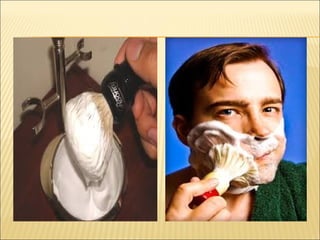
Shaving cream that are in tubes are commonly used
with a shaving brush to produce a rich lather.
History:History:
 A rudimentary form of shaving cream was documented in
Sumer around3000 BC. This substance combined wood
alkali and animal fat and was applied to a beard as a
shaving preparation.
 Until the early 20th century, bars or sticks of hard shaving
soap were used. Later, tubes containing compounds of oils
and soft soap were sold. Newer creams introduced in the
1940s neither produced lather nor required brushes, often
referred to as brushless creams.
History:History:
 Modern commercial creams are often sold in spray cans,
but can also be purchased in tubs or tubes.
 Shaving creams in a can are commonly dispensed as a
foam or a gel.
 Creams that are in tubes or tubs are commonly used with a
shaving brush to produce a rich lather (most often used in
wet shaving).
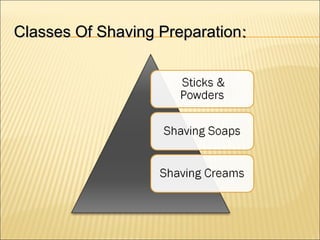
Classes Of Shaving PreparationClasses Of Shaving Preparation::
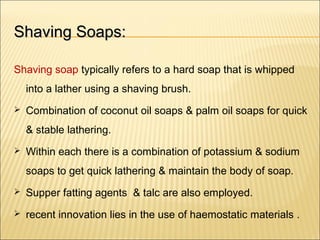
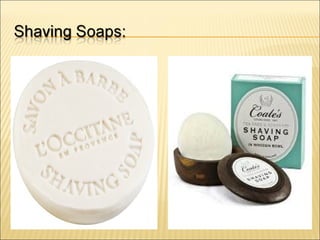
Shaving Soaps:Shaving Soaps:
Shaving soap typically refers to a hard soap that is whipped
into a lather using a shaving brush.
 Combination of coconut oil soaps & palm oil soaps for quick
& stable lathering.
 Within each there is a combination of potassium & sodium
soaps to get quick lathering & maintain the body of soap.
 Supper fatting agents & talc are also employed.
 recent innovation lies in the use of haemostatic materials .
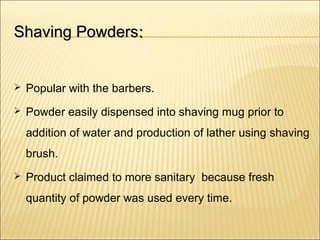
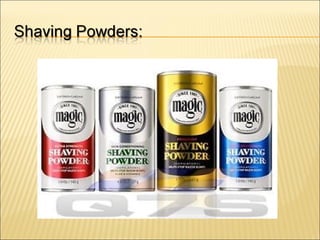
Shaving PowdersShaving Powders::
 Popular with the barbers.
 Powder easily dispensed into shaving mug prior to
addition of water and production of lather using shaving
brush.
 Product claimed to more sanitary because fresh
quantity of powder was used every time.
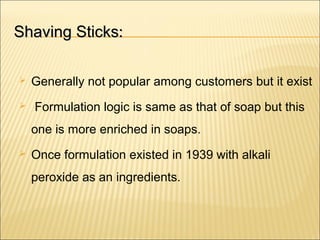
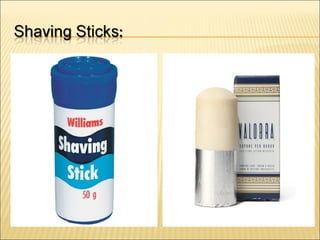
Shaving SticksShaving Sticks::
 Generally not popular among customers but it exist
 Formulation logic is same as that of soap but this
one is more enriched in soaps.
 Once formulation existed in 1939 with alkali
peroxide as an ingredients.
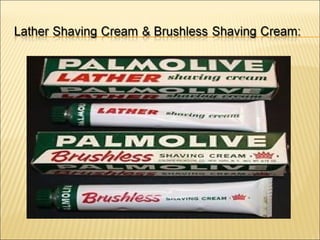
Lather Shaving Cream:Lather Shaving Cream:
 Have same ingredients as that of soap with
inclusion of greater amount of water to give creamy
consistency.
 Playing with the ratio of Na/K soaps not only affect
lather but also consistency and stability of cream.
 Supper fatting agents and borax are added to
maintain stability.
Brushless Shaving Cream:Brushless Shaving Cream:
 Not meant to produce foam
 It is o/w emulsion.
 Comfortable shave is because of greater lubricating
ability and subsequent reduction in razor pull or drag.
 Leaves face with thin coating of oil.
 Wetting agents are employed to improve beard
softening.
Raw Materials:Raw Materials:
A standard recipe contains approximately
i. Aqua/water
ii. Stearic Acid,
iii. Triethanolamine,
iv. Lanolin,
v. Glycerin,
vi. Polyoxyethylene sorbitan monostearate,
vii. Laureth 23,
viii. Lauryl Sulfate,
ix. Waxes and cocamides.
x. Methyl paraben
xi. Ethyl paraben
Raw Materials:Raw Materials:
Two major ingredients in this formula are common in many of
today's preparations.
Stearic acid is one of the main ingredients in soap making, and
triethanolamine is a surfactant, which does the job of soap.
Lanolin and polyoxyethylene sorbitan monostearate are both
emulsifiers which hold water to the skin,
While glycerin, a solvent and an emollient, renders skin softer
and more supple.
Raw Materials:Raw Materials:
Common substitutes for the third, fourth, and fifth ingredients
listed above include laureth 23 and lauryl sulfate are both
sudsing and foaming agents.
Waxes and cocamides which cleanse and aid foaming.
Most ingredients are powdered or flaked, although lanolin,
lanolin derivatives, and cocamides are liquids.
Raw Materials:Raw Materials:
The differences between one brand of shaving cream and
another amount to adjustments in the proportions of
ingredients and in the processing method and choice of
ingredients such as emulsifiers or perfumes. Also important
is the choice of aerosol propellant. Some mixtures contain
more than one propellant; most common are butane,
isobutane and propane.
The Manufacturing Process:The Manufacturing Process:
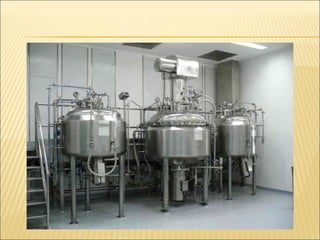
The modern manufacture of shaving cream is a carefully controlled
process. There are two main phases to the manufacturing
process.
1. In the first phase, the fatty or oily portions of the formula—stearic
acid, lanolin, and polyoxyethylene sorbitan monostearate—are
heated in a jacketed kettle to a temperature of approximately 179
to 188°F (80 to 85°C) for 40 minutes.
2. Then the steam is released from the outer container of the kettle,
and the mixture is allowed to cool.
The Manufacturing Process:The Manufacturing Process:
3. The second phase of manufacture begins when the mixture has
cooled to about 152°F (65°C). Most of the remaining ingredients
—water, glycerin and triethanolamine—are added now, and
mixing continues for approximately 40 minutes.
4. When the mixture reaches a temperature of 125 to 134°F
(50 to 55°C), preservatives and perfumes or other scents can
be added. Because perfumes consist primarily of highly
volatile oils, they would evaporate if added when the blend
was still warm.
The Manufacturing Process:The Manufacturing Process:
5. The mixture, still being stirred, is allowed to cool
further, until it reaches a temperature of 89°F (30°C).
6. Then the mixture is ready for filling and sealing.
Quality Control:Quality Control:
o Today's soaps, shaving creams, and lotions are all
manufactured under strict quality control, and regulated by
various federal agencies including the Food and Drug
Administration (FDA).
o Batches of shaving cream are examined and analyzed both
at the manufacturing site and in the laboratory. Individual
containers of shaving preparations are coded so that a
manufacturer knows exactly which batch any given can or
tube came from, and can identify its distribution history.
Quality Control:Quality Control:
o A manufacturer of shaving cream needs to be certain that
each batch meets quality standards. Among the things
tested for are pH value (the acidity or alkalinity of the
product). The pH value of shaving cream is 8 to 9.
o Water quality must also be checked carefully. Most
manufacturers make sure the water they use is pure by
exposing the water to ultraviolet light or using distilled water.
Having a microbiologist on site to test the water and the final
product is common in the industry.
Criteria:Criteria:
 Must have well lubricant properties, skin protection
against razor.
 Must have hydrating properties and softening
properties.
 Should be smooth and non-dumpy.
 Must be well tolerated and should be non-irritant.
 Must have good wetting properties & resistance to
rapid drying.
Criteria:Criteria:
 Rapid softening of beard & sufficient viscosity to
hold & should not change viscosity according to
temperature.
 Easy application, easy spread.
 Small quantity should produce desired lather.
 Should be non-corrosive.
 Must be economical.
AApplication:pplication:
We all know that shaving cream can be very useful for aiding in
unwanted hair maintenance. However, it also has many excellent
uses for cleaning many things around the house as well. Just check
out some of these helpful uses!
oRemoves Carpet Stains
oCleans Dirt From Under Your Nails
oCleans Dirty Hands
oClean Your Bathroom Mirror
oCleans and Shines Water Devices
oThat Old Door Shall Squeak No More
oClean jewelries
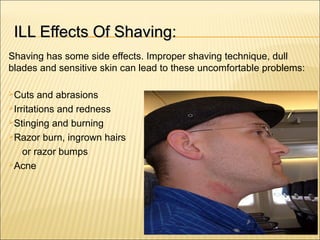
ILL Effects Of Shaving:ILL Effects Of Shaving:
Shaving has some side effects. Improper shaving technique, dull
blades and sensitive skin can lead to these uncomfortable problems:
Cuts and abrasions
Irritations and redness
Stinging and burning
Razor burn, ingrown hairs
or razor bumps
Acne
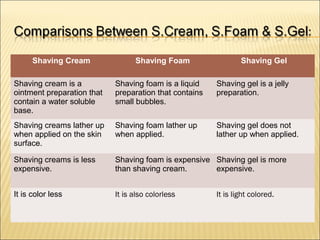
Shaving Cream Shaving Foam Shaving Gel
Shaving cream is a
ointment preparation that
contain a water soluble
base.
Shaving foam is a liquid
preparation that contains
small bubbles.
Shaving gel is a jelly
preparation.
Shaving creams lather up
when applied on the skin
surface.
Shaving foam lather up
when applied.
Shaving gel does not
lather up when applied.
Shaving creams is less
expensive.
Shaving foam is expensive
than shaving cream.
Shaving gel is more
expensive.
It is color less It is also colorless It is light colored.
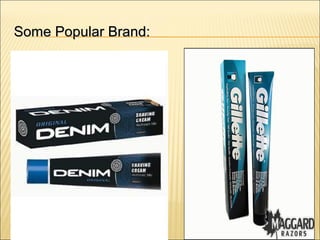
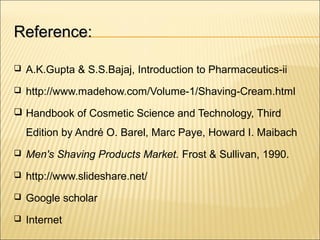
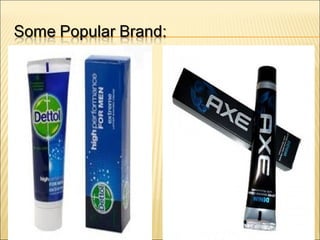
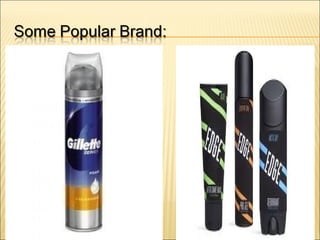
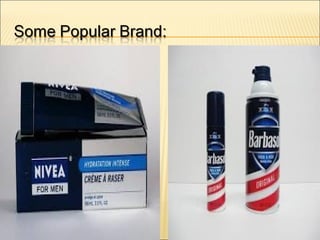
Some Popular Brand:Some Popular Brand:
Review:Review:
I. Introduction: Cream, Shaving, Shaving Cream
II. History
III. Types of Shaving preparation
IV. S.Soap, S.Powder, S.Sticks, Lather & Brashless S.Cream
V. Raw Materials
VI. Manufacturing Process
VII. Quality Control Process
VIII. Criteria
IX. Application
X. Ill Effects
XI. Comparisons between S.Cream, S.Foam & S.Gel
XII. Some Popular Brands
Reference:Reference:
 A.K.Gupta & S.S.Bajaj, Introduction to Pharmaceutics-ii
 http://www.madehow.com/Volume-1/Shaving-Cream.html
 Handbook of Cosmetic Science and Technology, Third
Edition by André O. Barel, Marc Paye, Howard I. Maibach
 Men's Shaving Products Market. Frost & Sullivan, 1990.
 http://www.slideshare.net/
 Google scholar
 Internet
Shaving Cream
Shaving Cream

Shaving Cream

  • 1.
  • 2.
  • 3.
    Presented By:Presented By: Priya Baishnab(14/1312)  Rajon Sarkar(60/1267)  Tanvir Rafe Siddique(65/1274)  Sirazul Islam(66/1289)  Md. Nazmul Kabir(67/1198)  Jannatul Ferdaus(68/1193)  Jarin Fatema(69/1217)  Sifat Jahan Juthi(70/1265)  Umma Jannatul Ara(72/1290) Department Of Pharmacy, Gono Bishwabidyalay.Department Of Pharmacy, Gono Bishwabidyalay.
  • 4.
    Contents:Contents: 1. Introduction 2. Definition 3.History 4. Types of Shaving Preparation 5. Raw Materials 6. Manufacturing Process 7. Quality Control Process 8. Criteria 9. Application 10. Ill Effects 11. Comparisons between Shaving Cream, Shaving Foam & Shaving Gel 12. Popular Brand 13. Review 14. Reference
  • 5.
    Introduction:Introduction: What is Creams? Answer-Creams are thought of as ointments but usually contain a water soluble base due to which they can be easily removed from the skin. When applied to the skin, leave no visible evidence of their presence on the skin. What is shaving ? Answer- Shaving is the removal of hair, by using a razor or any other kind of bladed implement, to slice it down to the level of the skin. Is it necessary ( Scientifically ) ? Answer – No ,it is not necessary . There are many peoples in the field who have never think of shaving their hairs . Infect a lot of your body hair though is to help keep you cool, keep dirt out of certain areas, and can also help you to feel things when something moves or touches them.
  • 6.
    Shaving cream isapplied to the skin to facilitate removal of hair. Shaving cream softens and moistens the skin and the hair, thus making shaving more comfortable and contributing to smoother skin.
  • 7.
    Shaving Cream:Shaving Cream: ShavingCream achieve three effects: lubricate the cutting process; swell keratin and desensitize skin. Shaving creams commonly consist of an emulsion of oils, soaps or surfactants and water. Shaving cream that are in tubes are commonly used with a shaving brush to produce a rich lather.
  • 9.
    History:History:  A rudimentaryform of shaving cream was documented in Sumer around3000 BC. This substance combined wood alkali and animal fat and was applied to a beard as a shaving preparation.  Until the early 20th century, bars or sticks of hard shaving soap were used. Later, tubes containing compounds of oils and soft soap were sold. Newer creams introduced in the 1940s neither produced lather nor required brushes, often referred to as brushless creams.
  • 10.
    History:History:  Modern commercialcreams are often sold in spray cans, but can also be purchased in tubs or tubes.  Shaving creams in a can are commonly dispensed as a foam or a gel.  Creams that are in tubes or tubs are commonly used with a shaving brush to produce a rich lather (most often used in wet shaving).
  • 11.
    Classes Of ShavingPreparationClasses Of Shaving Preparation::
  • 12.
    Shaving Soaps:Shaving Soaps: Shavingsoap typically refers to a hard soap that is whipped into a lather using a shaving brush.  Combination of coconut oil soaps & palm oil soaps for quick & stable lathering.  Within each there is a combination of potassium & sodium soaps to get quick lathering & maintain the body of soap.  Supper fatting agents & talc are also employed.  recent innovation lies in the use of haemostatic materials .
  • 14.
    Shaving PowdersShaving Powders:: Popular with the barbers.  Powder easily dispensed into shaving mug prior to addition of water and production of lather using shaving brush.  Product claimed to more sanitary because fresh quantity of powder was used every time.
  • 16.
    Shaving SticksShaving Sticks:: Generally not popular among customers but it exist  Formulation logic is same as that of soap but this one is more enriched in soaps.  Once formulation existed in 1939 with alkali peroxide as an ingredients.
  • 18.
    Lather Shaving Cream:LatherShaving Cream:  Have same ingredients as that of soap with inclusion of greater amount of water to give creamy consistency.  Playing with the ratio of Na/K soaps not only affect lather but also consistency and stability of cream.  Supper fatting agents and borax are added to maintain stability.
  • 19.
    Brushless Shaving Cream:BrushlessShaving Cream:  Not meant to produce foam  It is o/w emulsion.  Comfortable shave is because of greater lubricating ability and subsequent reduction in razor pull or drag.  Leaves face with thin coating of oil.  Wetting agents are employed to improve beard softening.
  • 21.
    Raw Materials:Raw Materials: Astandard recipe contains approximately i. Aqua/water ii. Stearic Acid, iii. Triethanolamine, iv. Lanolin, v. Glycerin, vi. Polyoxyethylene sorbitan monostearate, vii. Laureth 23, viii. Lauryl Sulfate, ix. Waxes and cocamides. x. Methyl paraben xi. Ethyl paraben
  • 22.
    Raw Materials:Raw Materials: Twomajor ingredients in this formula are common in many of today's preparations. Stearic acid is one of the main ingredients in soap making, and triethanolamine is a surfactant, which does the job of soap. Lanolin and polyoxyethylene sorbitan monostearate are both emulsifiers which hold water to the skin, While glycerin, a solvent and an emollient, renders skin softer and more supple.
  • 23.
    Raw Materials:Raw Materials: Commonsubstitutes for the third, fourth, and fifth ingredients listed above include laureth 23 and lauryl sulfate are both sudsing and foaming agents. Waxes and cocamides which cleanse and aid foaming. Most ingredients are powdered or flaked, although lanolin, lanolin derivatives, and cocamides are liquids.
  • 24.
    Raw Materials:Raw Materials: Thedifferences between one brand of shaving cream and another amount to adjustments in the proportions of ingredients and in the processing method and choice of ingredients such as emulsifiers or perfumes. Also important is the choice of aerosol propellant. Some mixtures contain more than one propellant; most common are butane, isobutane and propane.
  • 25.
    The Manufacturing Process:TheManufacturing Process: The modern manufacture of shaving cream is a carefully controlled process. There are two main phases to the manufacturing process. 1. In the first phase, the fatty or oily portions of the formula—stearic acid, lanolin, and polyoxyethylene sorbitan monostearate—are heated in a jacketed kettle to a temperature of approximately 179 to 188°F (80 to 85°C) for 40 minutes. 2. Then the steam is released from the outer container of the kettle, and the mixture is allowed to cool.
  • 26.
    The Manufacturing Process:TheManufacturing Process: 3. The second phase of manufacture begins when the mixture has cooled to about 152°F (65°C). Most of the remaining ingredients —water, glycerin and triethanolamine—are added now, and mixing continues for approximately 40 minutes. 4. When the mixture reaches a temperature of 125 to 134°F (50 to 55°C), preservatives and perfumes or other scents can be added. Because perfumes consist primarily of highly volatile oils, they would evaporate if added when the blend was still warm.
  • 27.
    The Manufacturing Process:TheManufacturing Process: 5. The mixture, still being stirred, is allowed to cool further, until it reaches a temperature of 89°F (30°C). 6. Then the mixture is ready for filling and sealing.
  • 29.
    Quality Control:Quality Control: oToday's soaps, shaving creams, and lotions are all manufactured under strict quality control, and regulated by various federal agencies including the Food and Drug Administration (FDA). o Batches of shaving cream are examined and analyzed both at the manufacturing site and in the laboratory. Individual containers of shaving preparations are coded so that a manufacturer knows exactly which batch any given can or tube came from, and can identify its distribution history.
  • 30.
    Quality Control:Quality Control: oA manufacturer of shaving cream needs to be certain that each batch meets quality standards. Among the things tested for are pH value (the acidity or alkalinity of the product). The pH value of shaving cream is 8 to 9. o Water quality must also be checked carefully. Most manufacturers make sure the water they use is pure by exposing the water to ultraviolet light or using distilled water. Having a microbiologist on site to test the water and the final product is common in the industry.
  • 31.
    Criteria:Criteria:  Must havewell lubricant properties, skin protection against razor.  Must have hydrating properties and softening properties.  Should be smooth and non-dumpy.  Must be well tolerated and should be non-irritant.  Must have good wetting properties & resistance to rapid drying.
  • 32.
    Criteria:Criteria:  Rapid softeningof beard & sufficient viscosity to hold & should not change viscosity according to temperature.  Easy application, easy spread.  Small quantity should produce desired lather.  Should be non-corrosive.  Must be economical.
  • 33.
    AApplication:pplication: We all knowthat shaving cream can be very useful for aiding in unwanted hair maintenance. However, it also has many excellent uses for cleaning many things around the house as well. Just check out some of these helpful uses! oRemoves Carpet Stains oCleans Dirt From Under Your Nails oCleans Dirty Hands oClean Your Bathroom Mirror oCleans and Shines Water Devices oThat Old Door Shall Squeak No More oClean jewelries
  • 34.
    ILL Effects OfShaving:ILL Effects Of Shaving: Shaving has some side effects. Improper shaving technique, dull blades and sensitive skin can lead to these uncomfortable problems: Cuts and abrasions Irritations and redness Stinging and burning Razor burn, ingrown hairs or razor bumps Acne
  • 35.
    Shaving Cream ShavingFoam Shaving Gel Shaving cream is a ointment preparation that contain a water soluble base. Shaving foam is a liquid preparation that contains small bubbles. Shaving gel is a jelly preparation. Shaving creams lather up when applied on the skin surface. Shaving foam lather up when applied. Shaving gel does not lather up when applied. Shaving creams is less expensive. Shaving foam is expensive than shaving cream. Shaving gel is more expensive. It is color less It is also colorless It is light colored.
  • 36.
  • 40.
    Review:Review: I. Introduction: Cream,Shaving, Shaving Cream II. History III. Types of Shaving preparation IV. S.Soap, S.Powder, S.Sticks, Lather & Brashless S.Cream V. Raw Materials VI. Manufacturing Process VII. Quality Control Process VIII. Criteria IX. Application X. Ill Effects XI. Comparisons between S.Cream, S.Foam & S.Gel XII. Some Popular Brands
  • 41.
    Reference:Reference:  A.K.Gupta &S.S.Bajaj, Introduction to Pharmaceutics-ii  http://www.madehow.com/Volume-1/Shaving-Cream.html  Handbook of Cosmetic Science and Technology, Third Edition by André O. Barel, Marc Paye, Howard I. Maibach  Men's Shaving Products Market. Frost & Sullivan, 1990.  http://www.slideshare.net/  Google scholar  Internet