Faraza Javed
Mphil Pharmacology
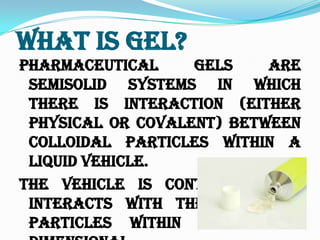
What is Gel?
Pharmaceutical gels are
semisolid systems in which
there is interaction (either
physical or covalent) between
colloidal particles within a
liquid vehicle.
The vehicle is continuous and
interacts with the colloidal
particles within the three-
The vehicle may be:
 Aqueous
 Hydroalcoholic
 Alcohol based Or
Non Aqueous
Brief History
Franceso Selmi studied
Inorganic Colloids in 1840.
Modern Colloid Sciences- 1861.
Thomas Graham introduced
Colloids, Gels, Syneresis etc.
Freundlick Research
Weiser research on Gel- 1950
Gels Criteria
 The term Gel represents a
physical state with properties
intermediate b/w those of
solids and liquids.
It is often wrongly used to
describe any fluid system that
exhibit some degree of rigidity.
Gels Criteria
Hermans in 1949 suggested some
criteria for Gels:
They are colloidal systems of
at least two components (the
Gelling agent and the fluid
component).
They exhibit the mechanical
characteristics of the solid
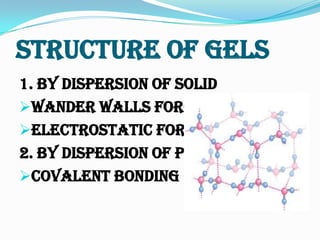
Structure Of Gels
1. By Dispersion Of Solid
Wander walls forces
Electrostatic forces
2. By Dispersion Of Polymers
Covalent Bonding
Types Of Gels
Gels are classified in 2 ways.
On the Basis of Continuous
Phase.
On the Basis of Nature of Bond
involved in 3 Dimensional Solid
Network.
Types Of Gels
On the basis of continuous
phase, gels are classified as:
Organogels
Hydrogels
Xerogels
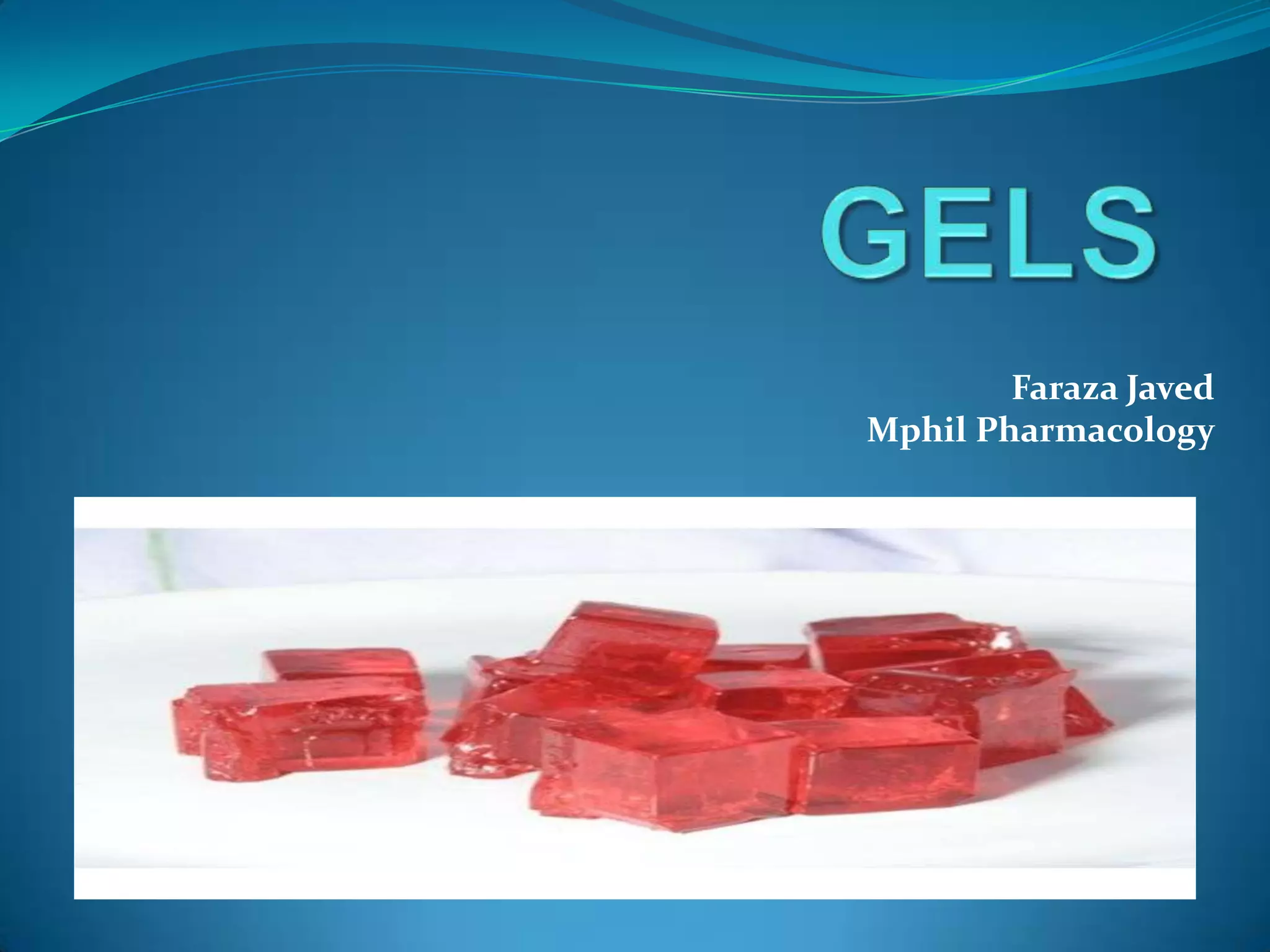
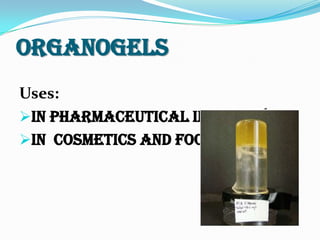
Organogels
Solid material composed of
liquid organic phase entrapped
in three dimensional cross
linked network.
Non-crystalline
Non-greasy
Thermoplastic
Organogels
Uses:
In pharmaceutical industry.
In cosmetics and food industry.
Hydrogels
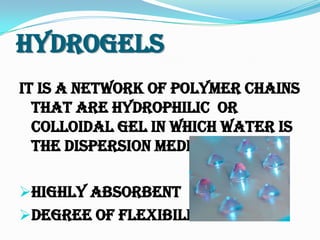
It is a network of polymer chains
that are hydrophilic or
colloidal gel in which water is
the dispersion medium.
Highly absorbent
Degree of flexibility
Hydrogels
Uses:
As scaffolds in tissue
engineering.
As environment sensitivity
detector.
Sustained release DDS.
Provide absorption and
debriding.
Contact lenses.
ECG medical electrode.
Xerogels
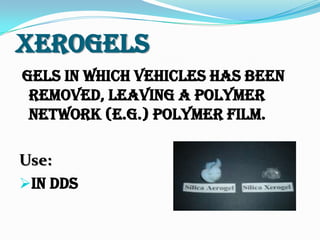
Gels in which vehicles has been
removed, leaving a polymer
network (e.g.) polymer film.
Use:
In DDS
Types Of Gels
On the Basis of Nature of Bond
involved in 3 Dimensional Solid
Network.
1)Dispersed solids
2)Hydrophilic polymers
i) Type I
ii) Type II
Dispersed Solids
Dispersed solids will undergo
flocculation. The nature of
interaction between particles
in network may be vander
waals or electrostatics
interaction.
Examples:
Al-hydroxide gel USP
Hydrophilic
Polymers
Hydrophilic polymers are
dispersed within appropriate
aqueous phase.
a)Type I:
Irreversible system with 3
dimensional network formed by
a covalent bonds between
macromolecules.
Example:
Network is formed by
b) Type II:
Reversible system in which
interaction occurred between
polymers by a hydrogen
bonding.
Temporary destruction of
bonds when stress applied thus
formulation enable to flow.
Pharmaceutical
Consideration Of
Pharmaceutical Gels
 Choice of vehicles
Inclusion of buffers
Preservatives
Antioxidants
Flavoring and coloring agents
Gelling Agent
These are substances which,
when added to an aqueous
mixture, increase its viscosity
without substantially
modifying its other properties,
such as taste. They provide
body, increase stability, and
improve suspension of added
Gelling Agent
3 types of Gelling Agents:
1. Natural Polymers
 Proteins
 Polysaccharides
2. Semi synthetic Polymers
 Cellulose Derivatives
3. Synthetic Polymers
Formulation
There are 3 methods:
Fusion Method
Cold Method
Dispersion Method
Fusion Method
In this method various waxy
materials employed as gellant
in non polar media. Drug was
added when waxy
materials melted by fusion.
stirred slowly until uniform
gel formed.
Cold Method
Water was cooled to 4-10ºc and
placed it in mixing container.
Gelling agent was slowly
added and agitating until
solution is complete.
Maintained temperature below
10ºc . Drug was added in
solution form slowly with
gentle mixing. Immediately
Dispersion Method
Gelling agent was dispersed in
water with stirring at 1200 rpm
for 30 min . Drug was dissolved
in non-aqueous solvent with
preservative. This solution was
added in above gel with
continuous stirring.
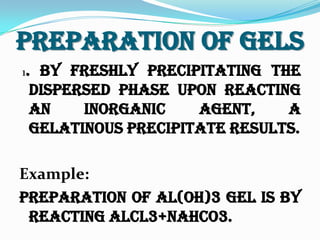
Preparation Of Gels
1. By freshly precipitating the
dispersed phase upon reacting
an inorganic agent, a
gelatinous precipitate results.
Example:
Preparation of Al(OH)3 gel is by
reacting AlCl3+NaHCo3.
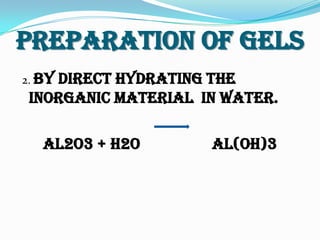
Preparation Of Gels
2. By direct hydrating the
inorganic material in water.
Al2O3 + H2O Al(OH)3
Manufacturing
Parameters
Order of Mixing:
The order of mixing of these
ingredients with the gelling
agent is based on their
influence on the gelling
process. If they are likely to
influence the rate and extent
of swelling of the gelling
agent, they are mixed after
Manufacturing
Parameters
In the absence of such
interference, the drug and
other additives are mixed prior
to the swelling process. In this
case, the effects of mixing
temperature, swelling
duration, and other processing
conditions on the
physicochemical stability of
Manufacturing
Parameters
Ideally the drug and other
additives are dissolved in the
swelling solvent, and the
swelling agent is added to this
solution and allowed to swell .
Manufacturing
Parameters
Gelling Medium:
Purified water is the most widely
used dispersion medium in the
preparation of gels. Under
certain circumstances, gels
may also contain co solvents
or dispersing agents.
A mixture of ethanol and
toluene improves the dispersion
Manufacturing
Parameters
Alcohol improves the
rheological stability of
polyethylene oxide gels.
Inclusion of glycerin,
propylene glycol, sucrose, and
alcohol improves the dispersion
of sodium alginate dispersions.
Processing
Condition
The processing temperature, pH
of the dispersion, and duration
of swelling are critical
parameters in the preparation
of gels. These conditions vary
with each gelling agent.
Processing
Condition
For instance, hot water is
preferred for gelatin and
polyvinyl alcohol, and cold
water is preferred for
methylcellulose dispersions.
Carbomers, guar gum,
hydroxypropyl cellulose,
poloxamer, and tragacanth
Duration Of
Swelling
A swelling duration of about 24
– 48 hours generally helps in
obtaining homogeneous gels.
Natural gums need about 24
hours and cellulose polymers
require about 48 hours for
complete hydration.
Removal Of
Entrapped Air
Entrapment of air bubbles in
the gel matrix is a common
issue. Especially when the
swelling process involves a
mixing procedure or the drug
and other additives are added
after the swelling process.
Removal Of
Entrapped Air
 Positioning the propeller at
the bottom of the mixing
container minimizes this issue
to a larger extent. Further
removal of air bubbles can be
achieved by long - term
standing, low-temperature
storage, sonication, or
inclusion of silicon antifoaming
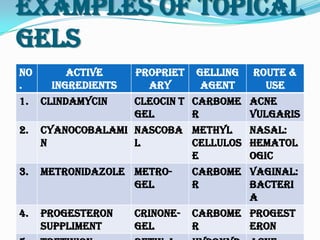
Examples Of Topical
Gels
No
.
Active
Ingredients
Propriet
ary
Gelling
Agent
Route &
Use
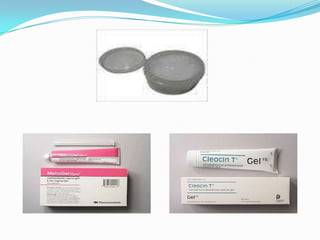
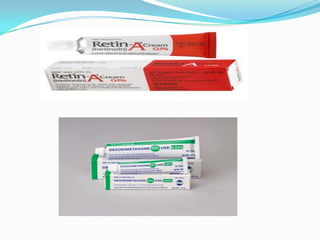
1. Clindamycin Cleocin T
Gel
Carbome
r
Acne
Vulgaris
2. Cyanocobalami
n
Nascoba
l
Methyl
Cellulos
e
Nasal:
Hematol
ogic
3. Metronidazole Metro-
Gel
Carbome
r
Vaginal:
Bacteri
a
4. Progesteron
Suppliment
Crinone-
Gel
Carbome
r
Progest
eron
Properties Of Gels
 Swelling
Syneresis
Ageing
Adsorption of vapours by
Xerogel
Rheological properties
Chemical reactions in gels
Diffusion in gels
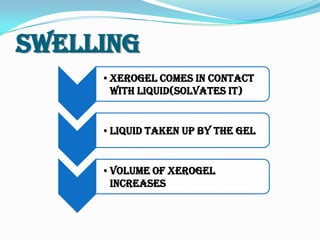
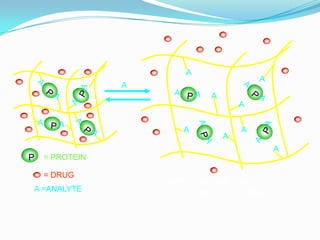
Swelling
•Xerogel comes in contact
with liquid(solvates it)
•Liquid taken up by the gel
•Volume of xerogel
increases
A
A
A
A
A
A
A
A
A
NETWORK SWELLING:
DRUG CAN BE RELEASED
= DRUG
A =ANALYTE
P = PROTEIN
Depends On:
 No. of linkages b/w molecules
of gelling agent.
 Strength of linkages e.g. iso-
electric point
 Presence of ions in swelling
liquid e.g. Sulphate ions
increases resistance to
swelling by forming additional
Network consisting of primary
valence bond e.g. in SILICIC ACID
GEL the strength of bond is
sufficient to prevent swelling.
Syneresis
“ The contraction of the gel to
exude some of the fluid medium”
Depends On:
 Conc. Of the gelling agent i.e.
syneresis decreases as the
conc. of gelling agent
increases.
 Thermodynamic stability or
Ageing
“ The slow spontaneous
aggregation”
In gels ageing results in
formation of denser network of
gelling agent.
Experiment:
Theimer (1960) observed
formation of additional thin
Adsorption Of
Vapors By Xerogels
Porous nature of xerogel leads
to increased surface
area as well as increased
adsorption e.g. SILICA GEL
used therefore as drying agent.
The hysteresis loop b/w curves
showing
absorption and desorption shows
Reason
Pores are filled with liquid in
ABSORPTION.
Pores are emptied in
DESORPTION.
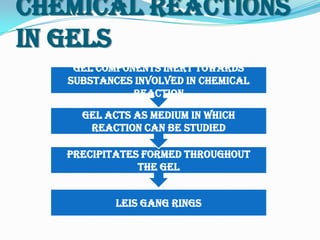
Chemical Reactions
In Gels
Leis gang rings
Precipitates formed throughout
the gel
Gel acts as medium in which
reaction can be studied
Gel components inert towards
substances involved in chemical
reaction
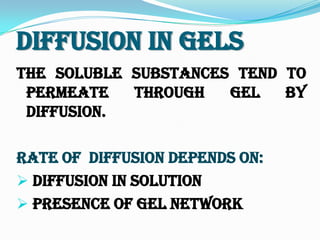
Diffusion In Gels
The soluble substances tend to
permeate through gel by
diffusion.
Rate Of Diffusion Depends On:
 Diffusion in solution
 Presence of gel network
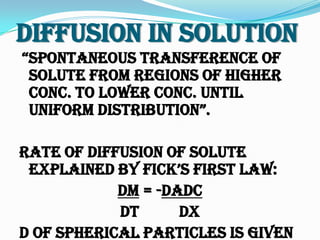
Diffusion In Solution
“SpontaneouS tranSference of
solute from regions of higher
conc. to lower conc. until
uniform diStribution”.
Rate Of diffusion of solute
explained by fick’S first law:
dm = -DAdc
dt dx
D of spherical particles is given
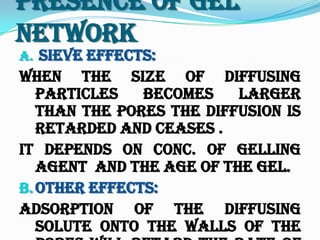
Presence Of Gel
Network
a. Sieve Effects:
When the size of diffusing
particles becomes larger
than the pores the diffusion is
retarded and ceases .
It depends on conc. of gelling
agent and the age of the gel.
b.Other Effects:
Adsorption of the diffusing
solute onto the walls of the
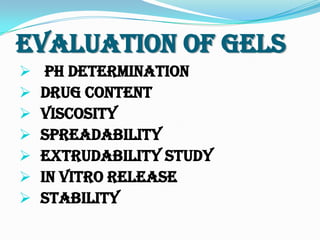
Evaluation Of Gels
 pH determination
 Drug content
 Viscosity
 Spreadability
 Extrudability study
 In vitro release
 Stability
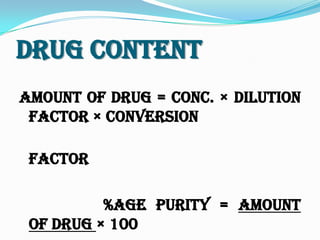
Drug content
Amount of drug = conc. × dilution
factor × conversion
factor
%age purity = Amount
of drug × 100
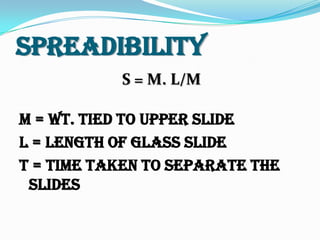
Spreadibility
S = M. L/M
M = wt. tied to upper slide
L = Length of glass slide
T = Time taken to separate the
slides
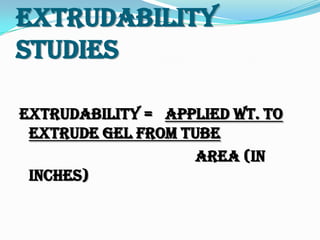
Extrudability
Studies
Extrudability = Applied wt. to
extrude gel from tube
Area (in
inches)
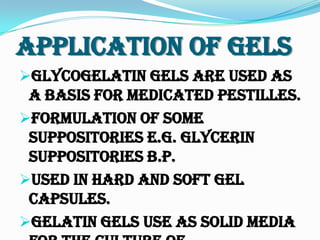
Application Of Gels
Glycogelatin gels are used as
a basis for medicated pestilles.
Formulation of some
suppositories e.g. Glycerin
suppositories B.P.
Used in Hard and soft gel
capsules.
Gelatin gels use as solid media
Application Of Gels
 Avoid oral drug degradation
Extend the product for
economical reasons e.g. paint
Used in gel filtration
Aerogels
References
Tutorial Pharmacy Edited by S.J. Carter.
Pharmaceutical Dosage Form by Howard
C. Ansel.
bentley’S Book Of Pharmaceutics, 8th
Edition, Edited by E.A Rawlion.
 aulton’S Pharmaceutics, 3rd Edition,
Edited by E. Aulton.
 Pharmaceutics Dosage Form & Design by
David Jones.
www.pubmed.com

Gels

  • 1.
  • 2.
    What is Gel? Pharmaceuticalgels are semisolid systems in which there is interaction (either physical or covalent) between colloidal particles within a liquid vehicle. The vehicle is continuous and interacts with the colloidal particles within the three-
  • 3.
    The vehicle maybe:  Aqueous  Hydroalcoholic  Alcohol based Or Non Aqueous
  • 4.
    Brief History Franceso Selmistudied Inorganic Colloids in 1840. Modern Colloid Sciences- 1861. Thomas Graham introduced Colloids, Gels, Syneresis etc. Freundlick Research Weiser research on Gel- 1950
  • 5.
    Gels Criteria  Theterm Gel represents a physical state with properties intermediate b/w those of solids and liquids. It is often wrongly used to describe any fluid system that exhibit some degree of rigidity.
  • 6.
    Gels Criteria Hermans in1949 suggested some criteria for Gels: They are colloidal systems of at least two components (the Gelling agent and the fluid component). They exhibit the mechanical characteristics of the solid
  • 7.
    Structure Of Gels 1.By Dispersion Of Solid Wander walls forces Electrostatic forces 2. By Dispersion Of Polymers Covalent Bonding
  • 8.
    Types Of Gels Gelsare classified in 2 ways. On the Basis of Continuous Phase. On the Basis of Nature of Bond involved in 3 Dimensional Solid Network.
  • 9.
    Types Of Gels Onthe basis of continuous phase, gels are classified as: Organogels Hydrogels Xerogels
  • 10.
    Organogels Solid material composedof liquid organic phase entrapped in three dimensional cross linked network. Non-crystalline Non-greasy Thermoplastic
  • 11.
  • 12.
    Hydrogels It is anetwork of polymer chains that are hydrophilic or colloidal gel in which water is the dispersion medium. Highly absorbent Degree of flexibility
  • 13.
    Hydrogels Uses: As scaffolds intissue engineering. As environment sensitivity detector. Sustained release DDS. Provide absorption and debriding. Contact lenses. ECG medical electrode.
  • 14.
    Xerogels Gels in whichvehicles has been removed, leaving a polymer network (e.g.) polymer film. Use: In DDS
  • 15.
    Types Of Gels Onthe Basis of Nature of Bond involved in 3 Dimensional Solid Network. 1)Dispersed solids 2)Hydrophilic polymers i) Type I ii) Type II
  • 16.
    Dispersed Solids Dispersed solidswill undergo flocculation. The nature of interaction between particles in network may be vander waals or electrostatics interaction. Examples: Al-hydroxide gel USP
  • 17.
    Hydrophilic Polymers Hydrophilic polymers are dispersedwithin appropriate aqueous phase. a)Type I: Irreversible system with 3 dimensional network formed by a covalent bonds between macromolecules. Example: Network is formed by
  • 18.
    b) Type II: Reversiblesystem in which interaction occurred between polymers by a hydrogen bonding. Temporary destruction of bonds when stress applied thus formulation enable to flow.
  • 19.
    Pharmaceutical Consideration Of Pharmaceutical Gels Choice of vehicles Inclusion of buffers Preservatives Antioxidants Flavoring and coloring agents
  • 20.
    Gelling Agent These aresubstances which, when added to an aqueous mixture, increase its viscosity without substantially modifying its other properties, such as taste. They provide body, increase stability, and improve suspension of added
  • 21.
    Gelling Agent 3 typesof Gelling Agents: 1. Natural Polymers  Proteins  Polysaccharides 2. Semi synthetic Polymers  Cellulose Derivatives 3. Synthetic Polymers
  • 22.
    Formulation There are 3methods: Fusion Method Cold Method Dispersion Method
  • 23.
    Fusion Method In thismethod various waxy materials employed as gellant in non polar media. Drug was added when waxy materials melted by fusion. stirred slowly until uniform gel formed.
  • 24.
    Cold Method Water wascooled to 4-10ºc and placed it in mixing container. Gelling agent was slowly added and agitating until solution is complete. Maintained temperature below 10ºc . Drug was added in solution form slowly with gentle mixing. Immediately
  • 25.
    Dispersion Method Gelling agentwas dispersed in water with stirring at 1200 rpm for 30 min . Drug was dissolved in non-aqueous solvent with preservative. This solution was added in above gel with continuous stirring.
  • 26.
    Preparation Of Gels 1.By freshly precipitating the dispersed phase upon reacting an inorganic agent, a gelatinous precipitate results. Example: Preparation of Al(OH)3 gel is by reacting AlCl3+NaHCo3.
  • 27.
    Preparation Of Gels 2.By direct hydrating the inorganic material in water. Al2O3 + H2O Al(OH)3
  • 28.
    Manufacturing Parameters Order of Mixing: Theorder of mixing of these ingredients with the gelling agent is based on their influence on the gelling process. If they are likely to influence the rate and extent of swelling of the gelling agent, they are mixed after
  • 29.
    Manufacturing Parameters In the absenceof such interference, the drug and other additives are mixed prior to the swelling process. In this case, the effects of mixing temperature, swelling duration, and other processing conditions on the physicochemical stability of
  • 30.
    Manufacturing Parameters Ideally the drugand other additives are dissolved in the swelling solvent, and the swelling agent is added to this solution and allowed to swell .
  • 31.
    Manufacturing Parameters Gelling Medium: Purified wateris the most widely used dispersion medium in the preparation of gels. Under certain circumstances, gels may also contain co solvents or dispersing agents. A mixture of ethanol and toluene improves the dispersion
  • 32.
    Manufacturing Parameters Alcohol improves the rheologicalstability of polyethylene oxide gels. Inclusion of glycerin, propylene glycol, sucrose, and alcohol improves the dispersion of sodium alginate dispersions.
  • 33.
    Processing Condition The processing temperature,pH of the dispersion, and duration of swelling are critical parameters in the preparation of gels. These conditions vary with each gelling agent.
  • 34.
    Processing Condition For instance, hotwater is preferred for gelatin and polyvinyl alcohol, and cold water is preferred for methylcellulose dispersions. Carbomers, guar gum, hydroxypropyl cellulose, poloxamer, and tragacanth
  • 35.
    Duration Of Swelling A swellingduration of about 24 – 48 hours generally helps in obtaining homogeneous gels. Natural gums need about 24 hours and cellulose polymers require about 48 hours for complete hydration.
  • 36.
    Removal Of Entrapped Air Entrapmentof air bubbles in the gel matrix is a common issue. Especially when the swelling process involves a mixing procedure or the drug and other additives are added after the swelling process.
  • 37.
    Removal Of Entrapped Air Positioning the propeller at the bottom of the mixing container minimizes this issue to a larger extent. Further removal of air bubbles can be achieved by long - term standing, low-temperature storage, sonication, or inclusion of silicon antifoaming
  • 38.
    Examples Of Topical Gels No . Active Ingredients Propriet ary Gelling Agent Route& Use 1. Clindamycin Cleocin T Gel Carbome r Acne Vulgaris 2. Cyanocobalami n Nascoba l Methyl Cellulos e Nasal: Hematol ogic 3. Metronidazole Metro- Gel Carbome r Vaginal: Bacteri a 4. Progesteron Suppliment Crinone- Gel Carbome r Progest eron
  • 41.
    Properties Of Gels Swelling Syneresis Ageing Adsorption of vapours by Xerogel Rheological properties Chemical reactions in gels Diffusion in gels
  • 42.
    Swelling •Xerogel comes incontact with liquid(solvates it) •Liquid taken up by the gel •Volume of xerogel increases
  • 43.
    A A A A A A A A A NETWORK SWELLING: DRUG CANBE RELEASED = DRUG A =ANALYTE P = PROTEIN
  • 44.
    Depends On:  No.of linkages b/w molecules of gelling agent.  Strength of linkages e.g. iso- electric point  Presence of ions in swelling liquid e.g. Sulphate ions increases resistance to swelling by forming additional
  • 45.
    Network consisting ofprimary valence bond e.g. in SILICIC ACID GEL the strength of bond is sufficient to prevent swelling.
  • 46.
    Syneresis “ The contractionof the gel to exude some of the fluid medium” Depends On:  Conc. Of the gelling agent i.e. syneresis decreases as the conc. of gelling agent increases.  Thermodynamic stability or
  • 47.
    Ageing “ The slowspontaneous aggregation” In gels ageing results in formation of denser network of gelling agent. Experiment: Theimer (1960) observed formation of additional thin
  • 48.
    Adsorption Of Vapors ByXerogels Porous nature of xerogel leads to increased surface area as well as increased adsorption e.g. SILICA GEL used therefore as drying agent. The hysteresis loop b/w curves showing absorption and desorption shows
  • 49.
    Reason Pores are filledwith liquid in ABSORPTION. Pores are emptied in DESORPTION.
  • 50.
    Chemical Reactions In Gels Leisgang rings Precipitates formed throughout the gel Gel acts as medium in which reaction can be studied Gel components inert towards substances involved in chemical reaction
  • 51.
    Diffusion In Gels Thesoluble substances tend to permeate through gel by diffusion. Rate Of Diffusion Depends On:  Diffusion in solution  Presence of gel network
  • 52.
    Diffusion In Solution “SpontaneouStranSference of solute from regions of higher conc. to lower conc. until uniform diStribution”. Rate Of diffusion of solute explained by fick’S first law: dm = -DAdc dt dx D of spherical particles is given
  • 53.
    Presence Of Gel Network a.Sieve Effects: When the size of diffusing particles becomes larger than the pores the diffusion is retarded and ceases . It depends on conc. of gelling agent and the age of the gel. b.Other Effects: Adsorption of the diffusing solute onto the walls of the
  • 54.
    Evaluation Of Gels pH determination  Drug content  Viscosity  Spreadability  Extrudability study  In vitro release  Stability
  • 55.
    Drug content Amount ofdrug = conc. × dilution factor × conversion factor %age purity = Amount of drug × 100
  • 56.
    Spreadibility S = M.L/M M = wt. tied to upper slide L = Length of glass slide T = Time taken to separate the slides
  • 57.
    Extrudability Studies Extrudability = Appliedwt. to extrude gel from tube Area (in inches)
  • 58.
    Application Of Gels Glycogelatingels are used as a basis for medicated pestilles. Formulation of some suppositories e.g. Glycerin suppositories B.P. Used in Hard and soft gel capsules. Gelatin gels use as solid media
  • 59.
    Application Of Gels Avoid oral drug degradation Extend the product for economical reasons e.g. paint Used in gel filtration Aerogels
  • 60.
    References Tutorial Pharmacy Editedby S.J. Carter. Pharmaceutical Dosage Form by Howard C. Ansel. bentley’S Book Of Pharmaceutics, 8th Edition, Edited by E.A Rawlion.  aulton’S Pharmaceutics, 3rd Edition, Edited by E. Aulton.  Pharmaceutics Dosage Form & Design by David Jones. www.pubmed.com