N.Karami, MIS-Spring 2012 
Management Information Systems 
IS Development 
Graduate School of 
Management & Economics 
1 
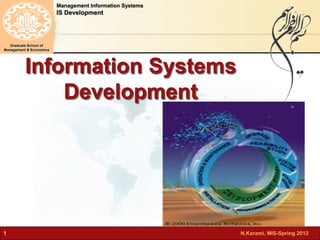
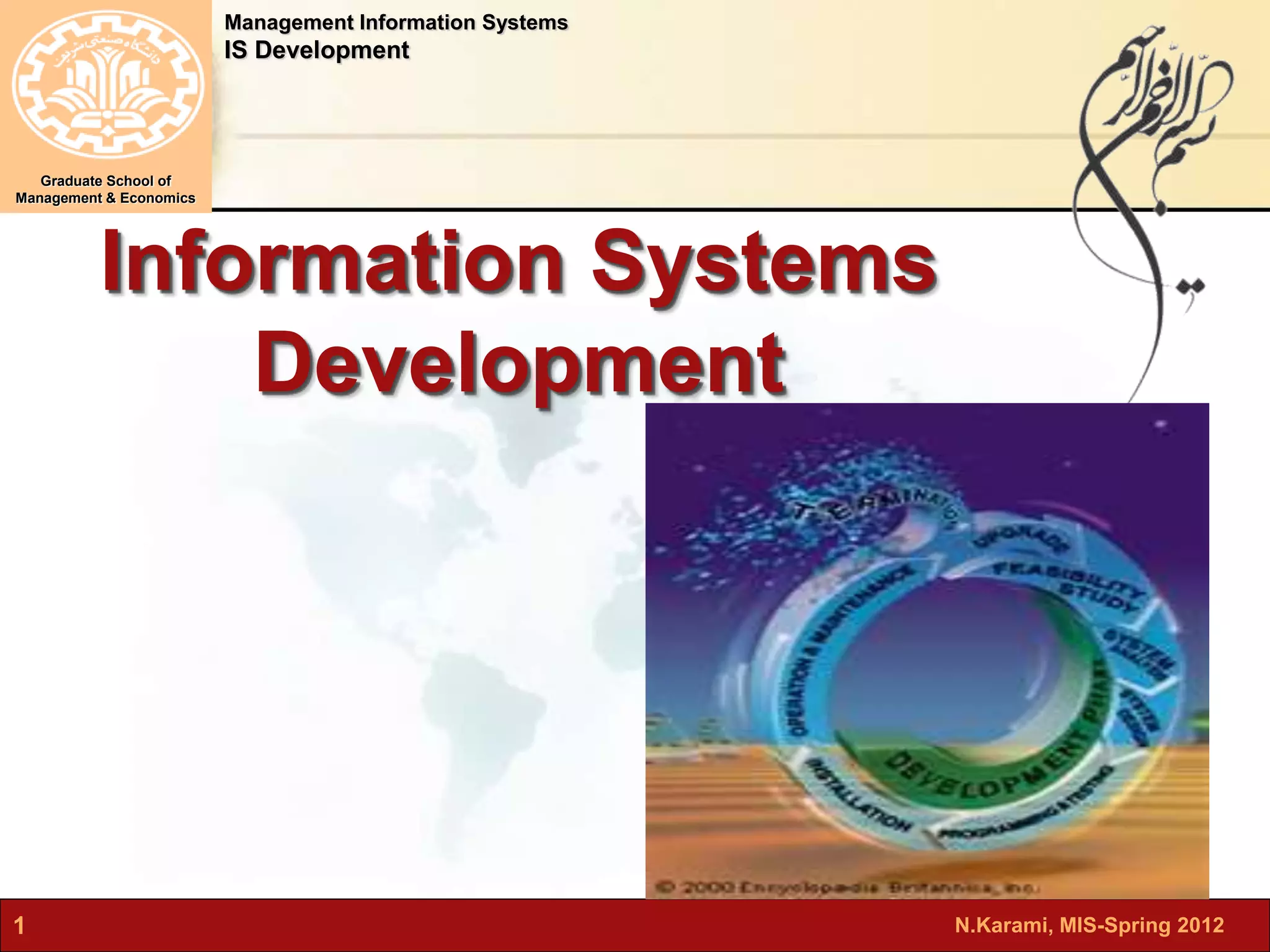
Information Systems 
Development
N.Karami, MIS-Spring 2012 
Management Information Systems 
IS Development 
Graduate School of 
Management & Economics 
2 
Learning Objectives 
• Describe the IT planning process. 
• Describe IS development & system approach 
• Describe Strategies for Acquiring IT Applications 
• Describe the SDLC and its advantages and 
limitations. 
• Describe the major alternative methods and tools for 
building information systems.
N.Karami, MIS-Spring 2012 
Management Information Systems 
IS Development 
Graduate School of 
Management & Economics 
3 
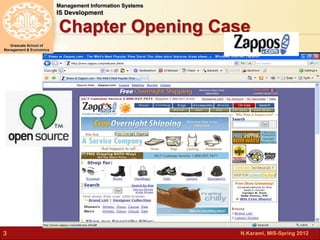
Chapter Opening Case
N.Karami, MIS-Spring 2012 
Management Information Systems 
IS Development 
Graduate School of 
Management & Economics 
4 
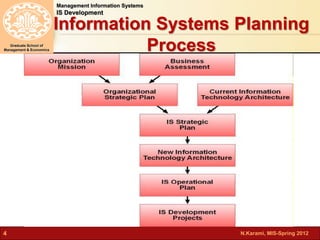
Information Systems Planning 
Process
N.Karami, MIS-Spring 2012 
Management Information Systems 
IS Development 
Graduate School of 
Management & Economics 
5 
Information Systems Planning 
(continued) 
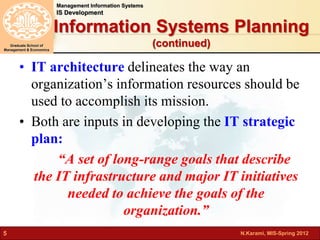
• IT architecture delineates the way an 
organization’s information resources should be 
used to accomplish its mission. 
• Both are inputs in developing the IT strategic 
plan: 
“A set of long-range goals that describe 
the IT infrastructure and major IT initiatives 
needed to achieve the goals of the 
organization.”
N.Karami, MIS-Spring 2012 
Management Information Systems 
IS Development 
Graduate School of 
Management & Economics 
6 
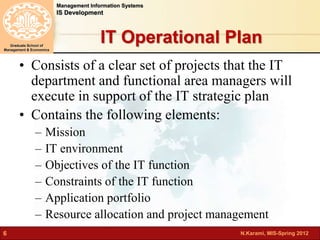
IT Operational Plan 
• Consists of a clear set of projects that the IT 
department and functional area managers will 
execute in support of the IT strategic plan 
• Contains the following elements: 
– Mission 
– IT environment 
– Objectives of the IT function 
– Constraints of the IT function 
– Application portfolio 
– Resource allocation and project management
N.Karami, MIS-Spring 2012 
Management Information Systems 
IS Development 
Graduate School of 
Management & Economics 
7 
IS Development 
• When the systems approach is applied to 
the development of an information systems solution 
to business problems, it is called information 
systems development or application 
development.
The Systems Approach 
N.Karami, MIS-Spring 2012 
Management Information Systems 
IS Development 
Graduate School of 
Management & Economics 
8 
• During the late 1960s/early 1970s, interest in systematic 
problem solving strengthened. 
• The systems approach to problem solving applied to the 
development of information system solutions to business 
problems. 
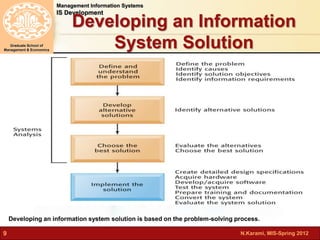
• Systems approach: A series of problem-solving steps 
that ensure the problem is first understood, alternative 
solutions are considered, and the selected solution works.
Developing an Information 
System Solution 
N.Karami, MIS-Spring 2012 
Management Information Systems 
IS Development 
Graduate School of 
Management & Economics 
9 
Developing an information system solution is based on the problem-solving process.
Systems Approach, SDLC 
N.Karami, MIS-Spring 2012 
Management Information Systems 
IS Development 
Graduate School of 
Management & Economics 
10 
Strategies for Acquiring IT 
Applications 
• Options for Obtaining Information Systems 
• Build your own 
– Insourcing: Using IT specialists within your organization 
– Selfsourcing: Using knowledge workers such as yourself 
• Outsourcing: Using another organization 
– Buy a prepackaged system 
– Outsource development to a 3rd party
N.Karami, MIS-Spring 2012 
Management Information Systems 
IS Development 
Graduate School of 
Management & Economics 
11 
The Systems Development 
Lifecycle 
• Systems development life cycle (SDLC) is an 
application of the systems approach to the 
development of an information system. 
• Oldest method for building information systems 
• Phased approach with formal stages 
• Waterfall approach 
• Formal division of labor 
• Used for building large, complex systems 
• Time consuming and expensive to use
N.Karami, MIS-Spring 2012 
Management Information Systems 
IS Development 
Graduate School of 
Management & Economics 
12 
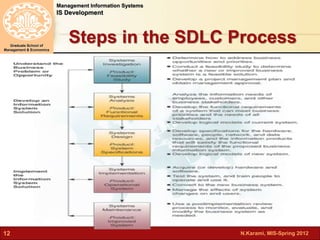
Steps in the SDLC Process
SDLC Process (1) 
N.Karami, MIS-Spring 2012 
Management Information Systems 
IS Development 
Graduate School of 
Management & Economics 
13 
• Systems Investigation 
– The first step in the systems development 
process 
– May involve consideration of proposals 
generated by a business/IT planning process 
– Also includes the preliminary feasibility study 
of proposed information system solutions: 
• Technical feasibility 
• Economic feasibility 
• Organizational feasibility 
• Behavioral feasibility
SDLC Process (2) 
N.Karami, MIS-Spring 2012 
Management Information Systems 
IS Development 
Graduate School of 
Management & Economics 
14 
• Systems Analysis 
– An in-depth study of end user information needs 
• It produces the functional requirements used as the 
basis for the design of an IS 
– It typically involves a detailed study of the 
• Information needs of a company and end users 
• Activities, resources, and products of one or more of 
the information systems currently being used 
• Information system capabilities required to meet the 
information needs of business stakeholders
N.Karami, MIS-Spring 2012 
Management Information Systems 
IS Development 
Graduate School of 
Management & Economics 
15 
Systems Analysis (Continued) 
• Logical Analysis 
– A logical model is a blueprint of the current system 
• It displays what the current system does, without regard to how it 
does it 
• It allows an analyst to understand the processes, functions, and data 
associated with a system without getting bogged down with 
hardware and software 
• Functional Requirements 
– This step of systems analysis is one of the most difficult 
• Determine what type of information each business activity requires 
• Try to determine the information processing capabilities required for 
each system activity 
• The goal is to identify what should be done, not how to do it
N.Karami, MIS-Spring 2012 
Management Information Systems 
IS Development 
Graduate School of 
Management & Economics 
16 
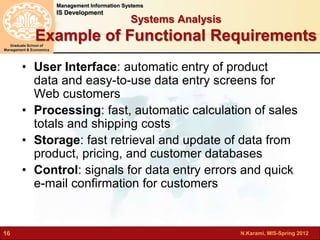
Systems Analysis 
Example of Functional Requirements 
• User Interface: automatic entry of product 
data and easy-to-use data entry screens for 
Web customers 
• Processing: fast, automatic calculation of sales 
totals and shipping costs 
• Storage: fast retrieval and update of data from 
product, pricing, and customer databases 
• Control: signals for data entry errors and quick 
e-mail confirmation for customers
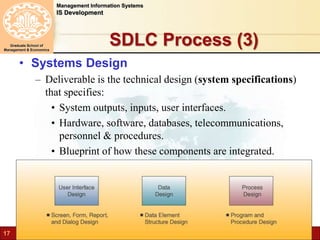
SDLC Process (3) 
N.Karami, MIS-Spring 2012 
Management Information Systems 
IS Development 
Graduate School of 
Management & Economics 
17 
• Systems Design 
– Deliverable is the technical design (system specifications) 
that specifies: 
• System outputs, inputs, user interfaces. 
• Hardware, software, databases, telecommunications, 
personnel & procedures. 
• Blueprint of how these components are integrated.
N.Karami, MIS-Spring 2012 
Management Information Systems 
IS Development 
Graduate School of 
Management & Economics 
18 
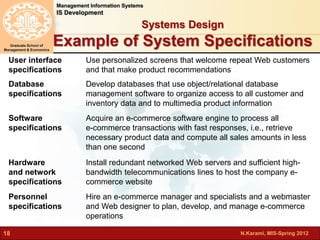
Systems Design 
Example of System Specifications 
User interface 
specifications 
Use personalized screens that welcome repeat Web customers 
and that make product recommendations 
Database 
specifications 
Develop databases that use object/relational database 
management software to organize access to all customer and 
inventory data and to multimedia product information 
Software 
specifications 
Acquire an e-commerce software engine to process all 
e-commerce transactions with fast responses, i.e., retrieve 
necessary product data and compute all sales amounts in less 
than one second 
Hardware 
and network 
specifications 
Install redundant networked Web servers and sufficient high-bandwidth 
telecommunications lines to host the company e-commerce 
website 
Personnel 
specifications 
Hire an e-commerce manager and specialists and a webmaster 
and Web designer to plan, develop, and manage e-commerce 
operations
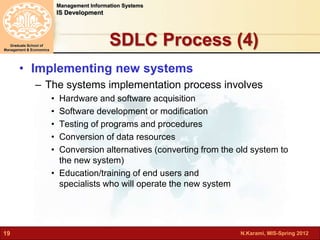
SDLC Process (4) 
N.Karami, MIS-Spring 2012 
Management Information Systems 
IS Development 
Graduate School of 
Management & Economics 
19 
• Implementing new systems 
– The systems implementation process involves 
• Hardware and software acquisition 
• Software development or modification 
• Testing of programs and procedures 
• Conversion of data resources 
• Conversion alternatives (converting from the old system to 
the new system) 
• Education/training of end users and 
specialists who will operate the new system
N.Karami, MIS-Spring 2012 
Management Information Systems 
IS Development 
Graduate School of 
Management & Economics 
20 
Systems Implementation 
System Testing 
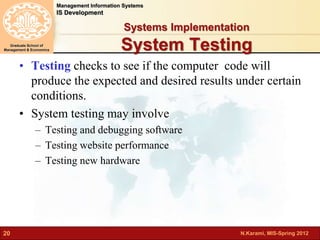
• Testing checks to see if the computer code will 
produce the expected and desired results under certain 
conditions. 
• System testing may involve 
– Testing and debugging software 
– Testing website performance 
– Testing new hardware
N.Karami, MIS-Spring 2012 
Management Information Systems 
IS Development 
Graduate School of 
Management & Economics 
21 
Systems Implementation 
Data Conversion 
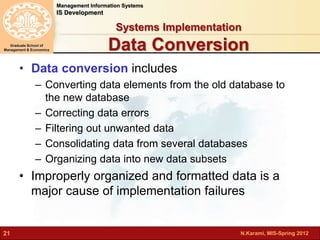
• Data conversion includes 
– Converting data elements from the old database to 
the new database 
– Correcting data errors 
– Filtering out unwanted data 
– Consolidating data from several databases 
– Organizing data into new data subsets 
• Improperly organized and formatted data is a 
major cause of implementation failures
N.Karami, MIS-Spring 2012 
Management Information Systems 
IS Development 
Graduate School of 
Management & Economics 
22 
Systems Implementation 
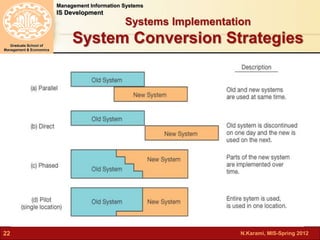
System Conversion Strategies
N.Karami, MIS-Spring 2012 
Management Information Systems 
IS Development 
Graduate School of 
Management & Economics 
23 
Systems Implementation 
Training 
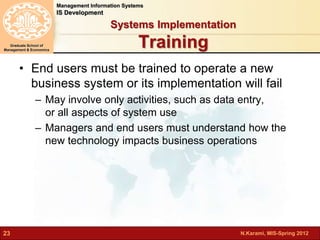
• End users must be trained to operate a new 
business system or its implementation will fail 
– May involve only activities, such as data entry, 
or all aspects of system use 
– Managers and end users must understand how the 
new technology impacts business operations
SDLC Process (5) 
N.Karami, MIS-Spring 2012 
Management Information Systems 
IS Development 
Graduate School of 
Management & Economics 
24 
• Systems Maintenance 
– Audits are performed to assess the system’s 
capabilities and to determine if it is being used 
correctly. 
– There are four basic categories of system 
maintenance 
• Corrective: fix bugs and logical errors 
• Adaptive: add new functionality 
• Perfective: improve performance 
• Preventive: reduce chances of failure
N.Karami, MIS-Spring 2012 
Management Information Systems 
IS Development 
Graduate School of 
Management & Economics 
25 
Alternative Methods & Tools for 
Systems Development (1) 
• Prototyping 
• Joint application design (JAD) 
– A group –based tool for collecting user requirements and 
creating system designs. 
• Computer-assisted software engineering 
tools (CASE) 
– A development approach that uses specialized tools to 
automate many of the tasks in the SDLC; upper CASE tools 
in SDLC automate the early stages of the SDLC, and lower 
case tools automate the later stages.
N.Karami, MIS-Spring 2012 
Management Information Systems 
IS Development 
Graduate School of 
Management & Economics 
26 
Alternative Methods & Tools for 
Systems Development (2) 
• Integrated computer-assisted software 
engineering tools (ICASE) 
– CASE tools that provide links between upper CASE and 
lower CASE tools. 
• Rapid application development (RAD) 
• End-user development 
– A development method that has the actually user develop 
their own application(s) for use. 
• Component-based development
N.Karami, MIS-Spring 2012 
Management Information Systems 
IS Development 
Graduate School of 
Management & Economics 
27 
Alternative Methods & Tools for 
Systems Development (3) 
• Object-oriented development 
– Based on concepts of class and inheritance 
– Component-based development and Web services 
• Object-Oriented Analysis & Design (OOA&D) 
– Data and processing are integrated (logical and 
physical model)

Session#6; information systems development

  • 1.
    N.Karami, MIS-Spring 2012 Management Information Systems IS Development Graduate School of Management & Economics 1 Information Systems Development
  • 2.
    N.Karami, MIS-Spring 2012 Management Information Systems IS Development Graduate School of Management & Economics 2 Learning Objectives • Describe the IT planning process. • Describe IS development & system approach • Describe Strategies for Acquiring IT Applications • Describe the SDLC and its advantages and limitations. • Describe the major alternative methods and tools for building information systems.
  • 3.
    N.Karami, MIS-Spring 2012 Management Information Systems IS Development Graduate School of Management & Economics 3 Chapter Opening Case
  • 4.
    N.Karami, MIS-Spring 2012 Management Information Systems IS Development Graduate School of Management & Economics 4 Information Systems Planning Process
  • 5.
    N.Karami, MIS-Spring 2012 Management Information Systems IS Development Graduate School of Management & Economics 5 Information Systems Planning (continued) • IT architecture delineates the way an organization’s information resources should be used to accomplish its mission. • Both are inputs in developing the IT strategic plan: “A set of long-range goals that describe the IT infrastructure and major IT initiatives needed to achieve the goals of the organization.”
  • 6.
    N.Karami, MIS-Spring 2012 Management Information Systems IS Development Graduate School of Management & Economics 6 IT Operational Plan • Consists of a clear set of projects that the IT department and functional area managers will execute in support of the IT strategic plan • Contains the following elements: – Mission – IT environment – Objectives of the IT function – Constraints of the IT function – Application portfolio – Resource allocation and project management
  • 7.
    N.Karami, MIS-Spring 2012 Management Information Systems IS Development Graduate School of Management & Economics 7 IS Development • When the systems approach is applied to the development of an information systems solution to business problems, it is called information systems development or application development.
  • 8.
    The Systems Approach N.Karami, MIS-Spring 2012 Management Information Systems IS Development Graduate School of Management & Economics 8 • During the late 1960s/early 1970s, interest in systematic problem solving strengthened. • The systems approach to problem solving applied to the development of information system solutions to business problems. • Systems approach: A series of problem-solving steps that ensure the problem is first understood, alternative solutions are considered, and the selected solution works.
  • 9.
    Developing an Information System Solution N.Karami, MIS-Spring 2012 Management Information Systems IS Development Graduate School of Management & Economics 9 Developing an information system solution is based on the problem-solving process.
  • 10.
    Systems Approach, SDLC N.Karami, MIS-Spring 2012 Management Information Systems IS Development Graduate School of Management & Economics 10 Strategies for Acquiring IT Applications • Options for Obtaining Information Systems • Build your own – Insourcing: Using IT specialists within your organization – Selfsourcing: Using knowledge workers such as yourself • Outsourcing: Using another organization – Buy a prepackaged system – Outsource development to a 3rd party
  • 11.
    N.Karami, MIS-Spring 2012 Management Information Systems IS Development Graduate School of Management & Economics 11 The Systems Development Lifecycle • Systems development life cycle (SDLC) is an application of the systems approach to the development of an information system. • Oldest method for building information systems • Phased approach with formal stages • Waterfall approach • Formal division of labor • Used for building large, complex systems • Time consuming and expensive to use
  • 12.
    N.Karami, MIS-Spring 2012 Management Information Systems IS Development Graduate School of Management & Economics 12 Steps in the SDLC Process
  • 13.
    SDLC Process (1) N.Karami, MIS-Spring 2012 Management Information Systems IS Development Graduate School of Management & Economics 13 • Systems Investigation – The first step in the systems development process – May involve consideration of proposals generated by a business/IT planning process – Also includes the preliminary feasibility study of proposed information system solutions: • Technical feasibility • Economic feasibility • Organizational feasibility • Behavioral feasibility
  • 14.
    SDLC Process (2) N.Karami, MIS-Spring 2012 Management Information Systems IS Development Graduate School of Management & Economics 14 • Systems Analysis – An in-depth study of end user information needs • It produces the functional requirements used as the basis for the design of an IS – It typically involves a detailed study of the • Information needs of a company and end users • Activities, resources, and products of one or more of the information systems currently being used • Information system capabilities required to meet the information needs of business stakeholders
  • 15.
    N.Karami, MIS-Spring 2012 Management Information Systems IS Development Graduate School of Management & Economics 15 Systems Analysis (Continued) • Logical Analysis – A logical model is a blueprint of the current system • It displays what the current system does, without regard to how it does it • It allows an analyst to understand the processes, functions, and data associated with a system without getting bogged down with hardware and software • Functional Requirements – This step of systems analysis is one of the most difficult • Determine what type of information each business activity requires • Try to determine the information processing capabilities required for each system activity • The goal is to identify what should be done, not how to do it
  • 16.
    N.Karami, MIS-Spring 2012 Management Information Systems IS Development Graduate School of Management & Economics 16 Systems Analysis Example of Functional Requirements • User Interface: automatic entry of product data and easy-to-use data entry screens for Web customers • Processing: fast, automatic calculation of sales totals and shipping costs • Storage: fast retrieval and update of data from product, pricing, and customer databases • Control: signals for data entry errors and quick e-mail confirmation for customers
  • 17.
    SDLC Process (3) N.Karami, MIS-Spring 2012 Management Information Systems IS Development Graduate School of Management & Economics 17 • Systems Design – Deliverable is the technical design (system specifications) that specifies: • System outputs, inputs, user interfaces. • Hardware, software, databases, telecommunications, personnel & procedures. • Blueprint of how these components are integrated.
  • 18.
    N.Karami, MIS-Spring 2012 Management Information Systems IS Development Graduate School of Management & Economics 18 Systems Design Example of System Specifications User interface specifications Use personalized screens that welcome repeat Web customers and that make product recommendations Database specifications Develop databases that use object/relational database management software to organize access to all customer and inventory data and to multimedia product information Software specifications Acquire an e-commerce software engine to process all e-commerce transactions with fast responses, i.e., retrieve necessary product data and compute all sales amounts in less than one second Hardware and network specifications Install redundant networked Web servers and sufficient high-bandwidth telecommunications lines to host the company e-commerce website Personnel specifications Hire an e-commerce manager and specialists and a webmaster and Web designer to plan, develop, and manage e-commerce operations
  • 19.
    SDLC Process (4) N.Karami, MIS-Spring 2012 Management Information Systems IS Development Graduate School of Management & Economics 19 • Implementing new systems – The systems implementation process involves • Hardware and software acquisition • Software development or modification • Testing of programs and procedures • Conversion of data resources • Conversion alternatives (converting from the old system to the new system) • Education/training of end users and specialists who will operate the new system
  • 20.
    N.Karami, MIS-Spring 2012 Management Information Systems IS Development Graduate School of Management & Economics 20 Systems Implementation System Testing • Testing checks to see if the computer code will produce the expected and desired results under certain conditions. • System testing may involve – Testing and debugging software – Testing website performance – Testing new hardware
  • 21.
    N.Karami, MIS-Spring 2012 Management Information Systems IS Development Graduate School of Management & Economics 21 Systems Implementation Data Conversion • Data conversion includes – Converting data elements from the old database to the new database – Correcting data errors – Filtering out unwanted data – Consolidating data from several databases – Organizing data into new data subsets • Improperly organized and formatted data is a major cause of implementation failures
  • 22.
    N.Karami, MIS-Spring 2012 Management Information Systems IS Development Graduate School of Management & Economics 22 Systems Implementation System Conversion Strategies
  • 23.
    N.Karami, MIS-Spring 2012 Management Information Systems IS Development Graduate School of Management & Economics 23 Systems Implementation Training • End users must be trained to operate a new business system or its implementation will fail – May involve only activities, such as data entry, or all aspects of system use – Managers and end users must understand how the new technology impacts business operations
  • 24.
    SDLC Process (5) N.Karami, MIS-Spring 2012 Management Information Systems IS Development Graduate School of Management & Economics 24 • Systems Maintenance – Audits are performed to assess the system’s capabilities and to determine if it is being used correctly. – There are four basic categories of system maintenance • Corrective: fix bugs and logical errors • Adaptive: add new functionality • Perfective: improve performance • Preventive: reduce chances of failure
  • 25.
    N.Karami, MIS-Spring 2012 Management Information Systems IS Development Graduate School of Management & Economics 25 Alternative Methods & Tools for Systems Development (1) • Prototyping • Joint application design (JAD) – A group –based tool for collecting user requirements and creating system designs. • Computer-assisted software engineering tools (CASE) – A development approach that uses specialized tools to automate many of the tasks in the SDLC; upper CASE tools in SDLC automate the early stages of the SDLC, and lower case tools automate the later stages.
  • 26.
    N.Karami, MIS-Spring 2012 Management Information Systems IS Development Graduate School of Management & Economics 26 Alternative Methods & Tools for Systems Development (2) • Integrated computer-assisted software engineering tools (ICASE) – CASE tools that provide links between upper CASE and lower CASE tools. • Rapid application development (RAD) • End-user development – A development method that has the actually user develop their own application(s) for use. • Component-based development
  • 27.
    N.Karami, MIS-Spring 2012 Management Information Systems IS Development Graduate School of Management & Economics 27 Alternative Methods & Tools for Systems Development (3) • Object-oriented development – Based on concepts of class and inheritance – Component-based development and Web services • Object-Oriented Analysis & Design (OOA&D) – Data and processing are integrated (logical and physical model)