



CONTENT 
 Introduction 
 Heuristic Types 
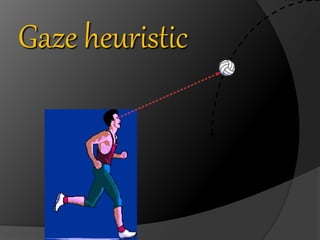
Gaze heuristic 
Recognition heuristic 
Social heuristic 
Heuristics Based on Reasons 
Take the best heuristic 
Tallying heuristic 
Hindsight bias 
Conclusion
Introduction
WHAT to DO ?
Heuristics Versus Rules 
Heuristic is a rule: 
A rule is not necessarily a 
heuristic, unless it embodies 
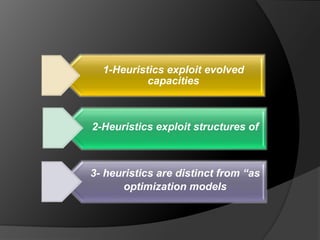
3 qualities
1-Heuristics exploit evolved 
capacities 
2-Heuristics exploit structures of 
3- heuristics are distinct from “as 
optimization models
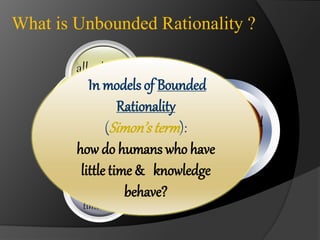
What is Unbounded Rationality ? 
all relevant 
infoInrm matoidonels of Bounded 
Unbounded 
Rationality 
Rationality 
(Simon’s term ): 
how do humans who have 
little time & knowledge 
infinite 
amount of 
time 
behave?
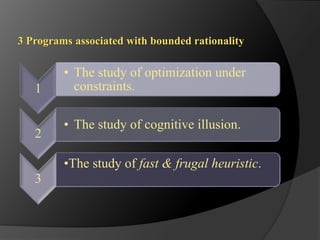
3 Programs associated with bounded rationality 
1 
• The study of optimization under 
constraints. 
2 
• The study of cognitive illusion. 
3 
•The study of fast & frugal heuristic.
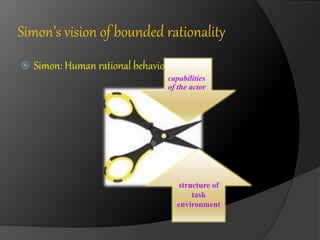
Simon’s vision of bounded rationality 
 Simon: Human rational behavior is 
capabilities 
of the actor 
structure of 
task 
environment
Heuristic Types 
Gaze Heuristic
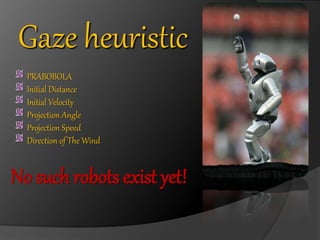
Gaze heuristic 
PRABOBOLA 
Initial Distance 
Initial Velocity 
Projection Angle 
Projection Speed 
Direction of The Wind 
No such robots exist yet!
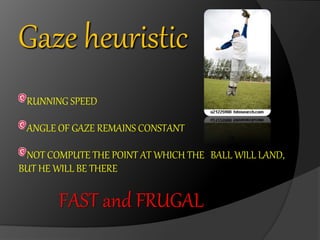
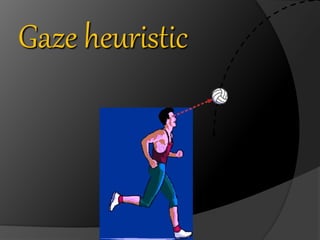
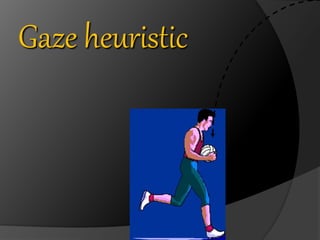
Gaze heuristic 
RUNNING SPEED 
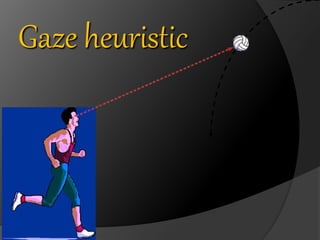
ANGLE OF GAZE REMAINS CONSTANT 
NOT COMPUTE THE POINT AT WHICH THE BALL WILL LAND, 
BUT HE WILL BE THERE 
FAST and FRUGAL
Gaze heuristic
Gaze heuristic
Gaze heuristic
Gaze heuristic
Heuristic Type 
Recognition Heuristics
TWO CITIES IN 
UNITED STATES 
San Antonio San Diego
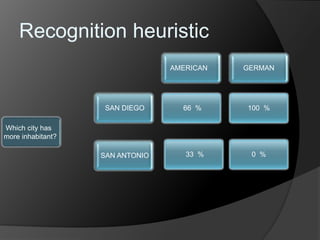
Recognition heuristic 
GERMAN 
Which city has 
more inhabitant? 
SAN DIEGO 66 % 
100 % 
33 % 
SAN ANTONIO 
0 % 
AMERICAN
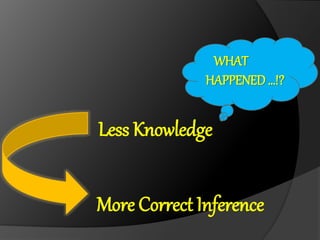
WHAT 
HAPPENED …!? 
Less Knowledge 
More Correct Inference
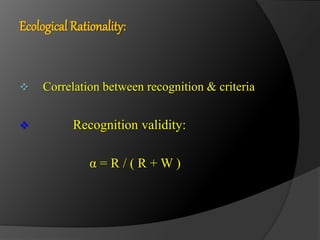
Ecological Rationality: 
 Correlation between recognition & criteria 
 Recognition validity: 
α = R / ( R + W )
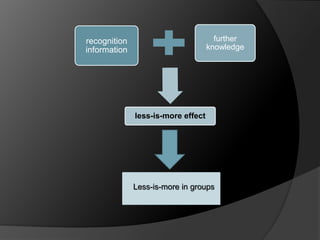
recognition 
information 
further 
knowledge 
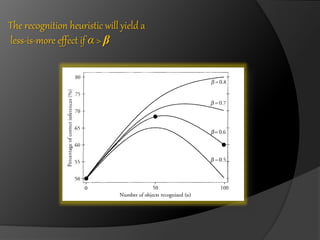
less-is-more effect 
Less-is-more in groups
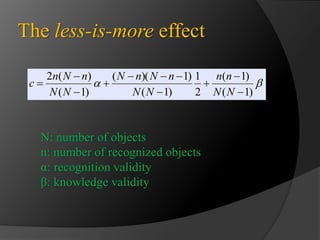
The less-is-more effect 
n n 
( 1) 
1 
N n N n 
( )( 1) 
 
   
  
( 1) 
2 
( 1) 
n N n 
2 (  
) 
( 1) 
 
 
 
 
 
 
N N 
N N 
N N 
c 
N: number of objects 
n: number of recognized objects 
α: recognition validity 
β: knowledge validity
The recognition heuristic will yield a 
less-is-more effect if α > β
Heuristic Type 
Social Heuristics
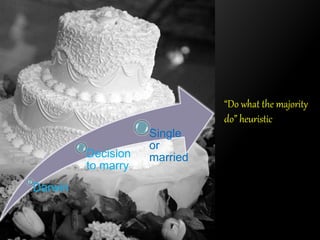
“Do what the majority 
do” heuristic 
Darwin 
Decision 
to marry 
Single 
or 
married
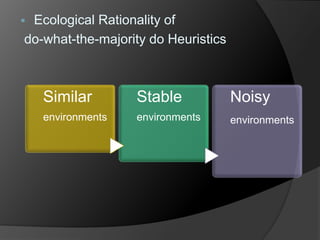
 Ecological Rationality of 
do-what-the-majority do Heuristics 
Similar 
environments 
Stable 
environments 
Noisy 
environments
Heuristic Type 
Take the Best &Tallying
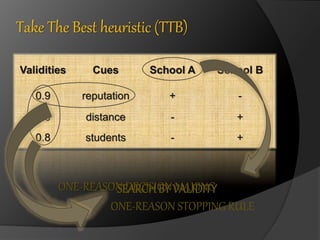
Take The Best heuristic (TTB) 
Validities Cues School A School B 
0.9 reputation + - 
0.6 distance - + 
0.8 students - + 
ONE-REASONSE DAERCCIHSI OBNY VMAALKIDINITGY 
ONE-REASON STOPPING RULE
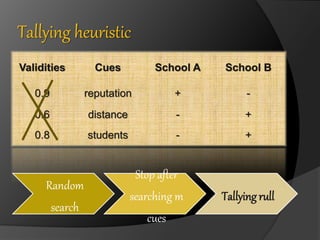
Validities Cues School A School B 
0.9 reputation + - 
0.6 distance - + 
0.8 students - + 
Random 
search 
Stop after 
searching m 
cues 
Tallying rull 
Tallying heuristic
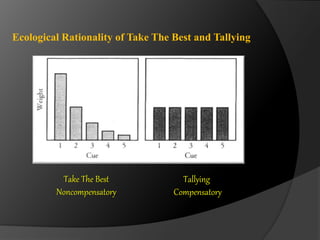
Ecological Rationality of Take The Best and Tallying 
Take The Best 
Noncompensatory 
Tallying 
Compensatory
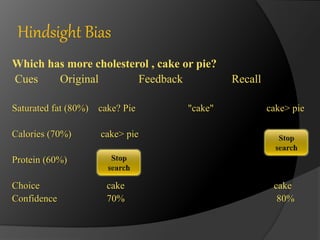
Hindsight Bias
Hindsight Bias 
Which has more cholesterol , cake or pie? 
Cues Original Feedback Recall 
Saturated fat (80%) cake? Pie "cake" cake> pie 
Calories (70%) cake> pie 
Protein (60%) 
Choice cake cake 
Confidence 70% 80%
Which heuristic to use?
 Using heuristic unconsciously 
 adapt heuristics to changing environment with 
feedback.
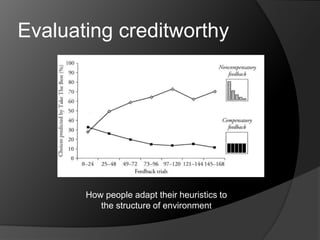
Evaluating creditworthy 
How people adapt their heuristics to 
the structure of environment
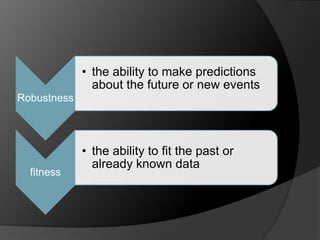
Robustness 
• the ability to make predictions 
about the future or new events 
fitness 
• the ability to fit the past or 
already known data
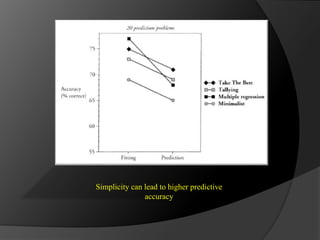
Simplicity can lead to higher predictive 
accuracy
The building Blocks of Heuristics
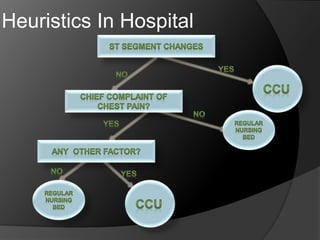
Heuristics In Hospital
CONCLUSION
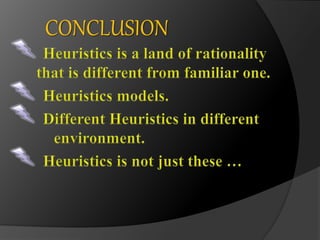
CONCLUSION
Presentation heuristics

Presentation heuristics

Editor's Notes

  • #2  یکی یکی خط ها می اید هایپرلینک فهرست
  • #22 Knoldge بلشذ بعد recognition به ان غلبه می کند