DIT 251
System Analysis
& Design
Chapter ONE
• Introduction Systems Analysis and Design
1.1 Software Development and Systems
Analysis and Design
The primary goal of systems analysis
and design is designing computerized
information systems to solve a problem
within organizations.
• The modern information systems service emphasis
changes from being merely an enabler of services to also
being a driver of change.
• Information systems have become a necessary component
in any organisation with increasing strategic significance.
• Business continuity is a key aspect as 99.5% of system
availability is no longer acceptable with increased reliance
on information systems.
• The information systems discipline is dynamic and always
changing.
• More complex system requirements have necessitated a whole
new set of tools.
• System, product, or service should be delivered without latent
defects, on schedule, and within budget.
• The key to successful system development is thorough
systems analysis and design.
• Systems analysts and designers perform information systems
analysis and design.
Successful system development is based on:
• understanding an organization’s objectives,
structure, and processes
• the analyst’s knowledge of how to exploit
information technology
Systems analysis is the process of understanding and
specifying in detail what the information system should
accomplish.
The analysis phase answers the questions of who will use
the system, what the system will do, and where and when
it will be used.
• It is important that the nature of the business and the
way it currently operates are clearly understood.
• The investigation or study conducted during the
analysis phase results in the production of a document
called requirements specification or functional
specification.
Systems design is the process of specifying in detail how
the many components of the information system should
be physically implemented.
This is concerned with:
• the hardware, software, and network infrastructure;
• the user interface, forms, and reports that will be used;
• the specific programs, databases, and files that will be
needed
Systems analysis and design is a systematic approach to
identify problems, opportunities, and objectives, analyse
the information flows in organizations, and design
computerized information systems to solve a problem
within organizations.
Why is systems analysis and design important?
• Success of information systems depends on good SAD
• It is proven techniques and widely used in computing
industry
• It is part of career growth in IT - lots of interesting and
well-paying jobs.
• Because of the increasing demand for systems analysis
skills
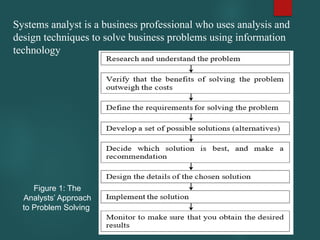
Systems analyst is a business professional who uses analysis and
design techniques to solve business problems using information
technology
Figure 1: The
Analysts’ Approach
to Problem Solving
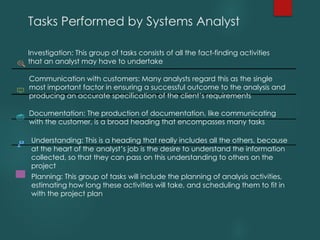
Tasks Performed by Systems Analyst
Investigation: This group of tasks consists of all the fact-finding activities
that an analyst may have to undertake
Communication with customers: Many analysts regard this as the single
most important factor in ensuring a successful outcome to the analysis and
producing an accurate specification of the client’s requirements
Documentation: The production of documentation, like communicating
with the customer, is a broad heading that encompasses many tasks
Understanding: This is a heading that really includes all the others, because
at the heart of the analyst’s job is the desire to understand the information
collected, so that they can pass on this understanding to others on the
project
Planning: This group of tasks will include the planning of analysis activities,
estimating how long these activities will take, and scheduling them to fit in
with the project plan
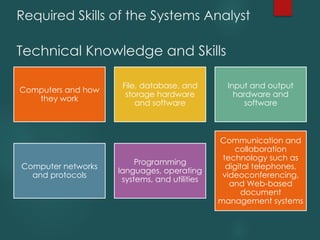
Technical Knowledge and Skills
Computers and how
they work
File, database, and
storage hardware
and software
Input and output
hardware and
software
Computer networks
and protocols
Programming
languages, operating
systems, and utilities
Communication and
collaboration
technology such as
digital telephones,
videoconferencing,
and Web-based
document
management systems
Required Skills of the Systems Analyst
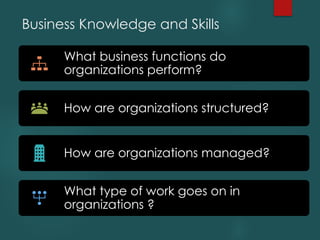
Business Knowledge and Skills
What business functions do
organizations perform?
How are organizations structured?
How are organizations managed?
What type of work goes on in
organizations ?
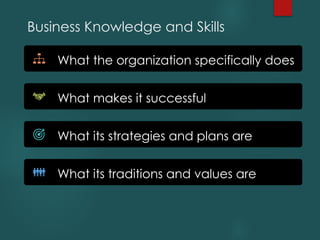
Business Knowledge and Skills
What the organization specifically does
What makes it successful
What its strategies and plans are
What its traditions and values are
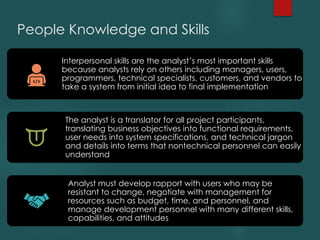
People Knowledge and Skills
Interpersonal skills are the analyst’s most important skills
because analysts rely on others including managers, users,
programmers, technical specialists, customers, and vendors to
take a system from initial idea to final implementation
The analyst is a translator for all project participants,
translating business objectives into functional requirements,
user needs into system specifications, and technical jargon
and details into terms that nontechnical personnel can easily
understand
Analyst must develop rapport with users who may be
resistant to change, negotiate with management for
resources such as budget, time, and personnel, and
manage development personnel with many different skills,
capabilities, and attitudes
Communication Skills
A systems analyst needs strong oral and written
communication skills, and the ability to interact with people
at all levels, from operational staff to senior executives
Analysts often coordinate Information Technology project
teams, where they use communication skills to guide and
motivate team members
Analytical skills
• Problem solving skills
• System thinking
 Ability to see organizations and
information systems as systems
What is a system?
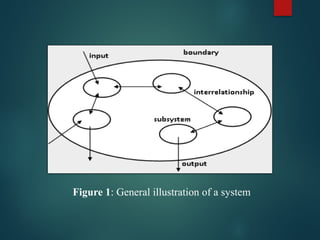
A system is composed of regularly interacting or
interrelating groups of activities to achieve a specific
goal.
Figure 1: General illustration of a system
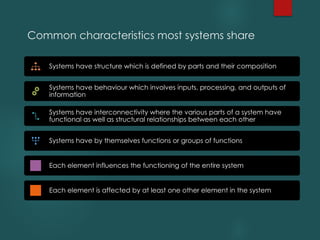
Common characteristics most systems share
Systems have structure which is defined by parts and their composition
Systems have behaviour which involves inputs, processing, and outputs of
information
Systems have interconnectivity where the various parts of a system have
functional as well as structural relationships between each other
Systems have by themselves functions or groups of functions
Each element influences the functioning of the entire system
Each element is affected by at least one other element in the system
Information systems
An information system is a collection of
interrelated components that collects,
processes, stores, analyses, and disseminates
information for a specific purpose
For this reason, the term information system is
typically used synonymously with computer-
based information system.
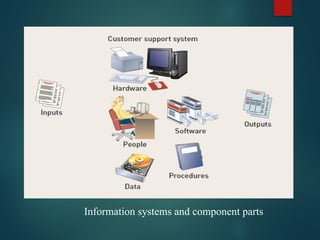
The basic components of computer-based
information systems are hardware, software,
network, database, procedures, and people
Information systems and component parts
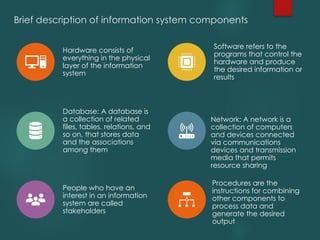
Brief description of information system components
Hardware consists of
everything in the physical
layer of the information
system
Software refers to the
programs that control the
hardware and produce
the desired information or
results
Database: A database is
a collection of related
files, tables, relations, and
so on, that stores data
and the associations
among them
Network: A network is a
collection of computers
and devices connected
via communications
devices and transmission
media that permits
resource sharing
People who have an
interest in an information
system are called
stakeholders
Procedures are the
instructions for combining
other components to
process data and
generate the desired
output
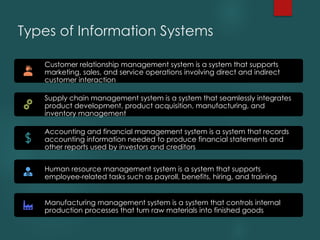
Types of Information Systems
Customer relationship management system is a system that supports
marketing, sales, and service operations involving direct and indirect
customer interaction
Supply chain management system is a system that seamlessly integrates
product development, product acquisition, manufacturing, and
inventory management
Accounting and financial management system is a system that records
accounting information needed to produce financial statements and
other reports used by investors and creditors
Human resource management system is a system that supports
employee-related tasks such as payroll, benefits, hiring, and training
Manufacturing management system is a system that controls internal
production processes that turn raw materials into finished goods
Types of Information Systems
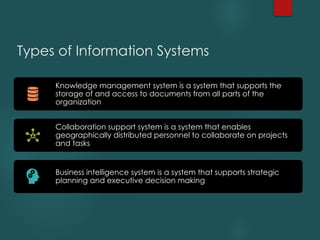
Knowledge management system is a system that supports the
storage of and access to documents from all parts of the
organization
Collaboration support system is a system that enables
geographically distributed personnel to collaborate on projects
and tasks
Business intelligence system is a system that supports strategic
planning and executive decision making
System Request
The starting point for most projects is called a system
request, which is a formal way of asking for IT support.
A systems request proposes:
• enhancements for an existing system
• correction of problems
• replacing an older system
• developing an entirely new information system
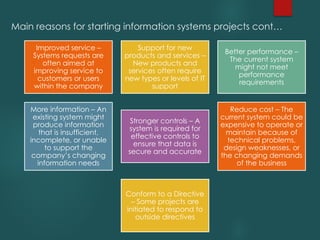
Main reasons for starting information systems projects cont…
Improved service –
Systems requests are
often aimed at
improving service to
customers or users
within the company
Support for new
products and services –
New products and
services often require
new types or levels of IT
support
Better performance –
The current system
might not meet
performance
requirements
More information – An
existing system might
produce information
that is insufficient,
incomplete, or unable
to support the
company’s changing
information needs
Stronger controls – A
system is required for
effective controls to
ensure that data is
secure and accurate
Reduce cost – The
current system could be
expensive to operate or
maintain because of
technical problems,
design weaknesses, or
the changing demands
of the business
Conform to a Directive
– Some projects are
initiated to respond to
outside directives
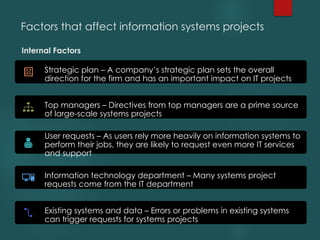
Internal Factors
Strategic plan – A company’s strategic plan sets the overall
direction for the firm and has an important impact on IT projects
Top managers – Directives from top managers are a prime source
of large-scale systems projects
User requests – As users rely more heavily on information systems to
perform their jobs, they are likely to request even more IT services
and support
Information technology department – Many systems project
requests come from the IT department
Existing systems and data – Errors or problems in existing systems
can trigger requests for systems projects
Factors that affect information systems projects
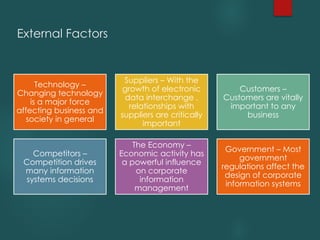
External Factors
Technology –
Changing technology
is a major force
affecting business and
society in general
Suppliers – With the
growth of electronic
data interchange ,
relationships with
suppliers are critically
important
Customers –
Customers are vitally
important to any
business
Competitors –
Competition drives
many information
systems decisions
The Economy –
Economic activity has
a powerful influence
on corporate
information
management
Government – Most
government
regulations affect the
design of corporate
information systems
END of Chapter 1

Chapter 1 Introduction.pptx - System Analysis

  • 1.
  • 2.
    Chapter ONE • IntroductionSystems Analysis and Design
  • 3.
    1.1 Software Developmentand Systems Analysis and Design The primary goal of systems analysis and design is designing computerized information systems to solve a problem within organizations.
  • 4.
    • The moderninformation systems service emphasis changes from being merely an enabler of services to also being a driver of change. • Information systems have become a necessary component in any organisation with increasing strategic significance. • Business continuity is a key aspect as 99.5% of system availability is no longer acceptable with increased reliance on information systems.
  • 5.
    • The informationsystems discipline is dynamic and always changing. • More complex system requirements have necessitated a whole new set of tools. • System, product, or service should be delivered without latent defects, on schedule, and within budget. • The key to successful system development is thorough systems analysis and design. • Systems analysts and designers perform information systems analysis and design.
  • 6.
    Successful system developmentis based on: • understanding an organization’s objectives, structure, and processes • the analyst’s knowledge of how to exploit information technology
  • 7.
    Systems analysis isthe process of understanding and specifying in detail what the information system should accomplish. The analysis phase answers the questions of who will use the system, what the system will do, and where and when it will be used. • It is important that the nature of the business and the way it currently operates are clearly understood. • The investigation or study conducted during the analysis phase results in the production of a document called requirements specification or functional specification.
  • 8.
    Systems design isthe process of specifying in detail how the many components of the information system should be physically implemented. This is concerned with: • the hardware, software, and network infrastructure; • the user interface, forms, and reports that will be used; • the specific programs, databases, and files that will be needed
  • 9.
    Systems analysis anddesign is a systematic approach to identify problems, opportunities, and objectives, analyse the information flows in organizations, and design computerized information systems to solve a problem within organizations.
  • 10.
    Why is systemsanalysis and design important? • Success of information systems depends on good SAD • It is proven techniques and widely used in computing industry • It is part of career growth in IT - lots of interesting and well-paying jobs. • Because of the increasing demand for systems analysis skills
  • 11.
    Systems analyst isa business professional who uses analysis and design techniques to solve business problems using information technology Figure 1: The Analysts’ Approach to Problem Solving
  • 12.
    Tasks Performed bySystems Analyst Investigation: This group of tasks consists of all the fact-finding activities that an analyst may have to undertake Communication with customers: Many analysts regard this as the single most important factor in ensuring a successful outcome to the analysis and producing an accurate specification of the client’s requirements Documentation: The production of documentation, like communicating with the customer, is a broad heading that encompasses many tasks Understanding: This is a heading that really includes all the others, because at the heart of the analyst’s job is the desire to understand the information collected, so that they can pass on this understanding to others on the project Planning: This group of tasks will include the planning of analysis activities, estimating how long these activities will take, and scheduling them to fit in with the project plan
  • 13.
    Technical Knowledge andSkills Computers and how they work File, database, and storage hardware and software Input and output hardware and software Computer networks and protocols Programming languages, operating systems, and utilities Communication and collaboration technology such as digital telephones, videoconferencing, and Web-based document management systems Required Skills of the Systems Analyst
  • 14.
    Business Knowledge andSkills What business functions do organizations perform? How are organizations structured? How are organizations managed? What type of work goes on in organizations ?
  • 15.
    Business Knowledge andSkills What the organization specifically does What makes it successful What its strategies and plans are What its traditions and values are
  • 16.
    People Knowledge andSkills Interpersonal skills are the analyst’s most important skills because analysts rely on others including managers, users, programmers, technical specialists, customers, and vendors to take a system from initial idea to final implementation The analyst is a translator for all project participants, translating business objectives into functional requirements, user needs into system specifications, and technical jargon and details into terms that nontechnical personnel can easily understand Analyst must develop rapport with users who may be resistant to change, negotiate with management for resources such as budget, time, and personnel, and manage development personnel with many different skills, capabilities, and attitudes
  • 17.
    Communication Skills A systemsanalyst needs strong oral and written communication skills, and the ability to interact with people at all levels, from operational staff to senior executives Analysts often coordinate Information Technology project teams, where they use communication skills to guide and motivate team members
  • 18.
    Analytical skills • Problemsolving skills • System thinking  Ability to see organizations and information systems as systems
  • 19.
    What is asystem? A system is composed of regularly interacting or interrelating groups of activities to achieve a specific goal.
  • 20.
    Figure 1: Generalillustration of a system
  • 21.
    Common characteristics mostsystems share Systems have structure which is defined by parts and their composition Systems have behaviour which involves inputs, processing, and outputs of information Systems have interconnectivity where the various parts of a system have functional as well as structural relationships between each other Systems have by themselves functions or groups of functions Each element influences the functioning of the entire system Each element is affected by at least one other element in the system
  • 22.
    Information systems An informationsystem is a collection of interrelated components that collects, processes, stores, analyses, and disseminates information for a specific purpose For this reason, the term information system is typically used synonymously with computer- based information system. The basic components of computer-based information systems are hardware, software, network, database, procedures, and people
  • 23.
    Information systems andcomponent parts
  • 24.
    Brief description ofinformation system components Hardware consists of everything in the physical layer of the information system Software refers to the programs that control the hardware and produce the desired information or results Database: A database is a collection of related files, tables, relations, and so on, that stores data and the associations among them Network: A network is a collection of computers and devices connected via communications devices and transmission media that permits resource sharing People who have an interest in an information system are called stakeholders Procedures are the instructions for combining other components to process data and generate the desired output
  • 25.
    Types of InformationSystems Customer relationship management system is a system that supports marketing, sales, and service operations involving direct and indirect customer interaction Supply chain management system is a system that seamlessly integrates product development, product acquisition, manufacturing, and inventory management Accounting and financial management system is a system that records accounting information needed to produce financial statements and other reports used by investors and creditors Human resource management system is a system that supports employee-related tasks such as payroll, benefits, hiring, and training Manufacturing management system is a system that controls internal production processes that turn raw materials into finished goods
  • 26.
    Types of InformationSystems Knowledge management system is a system that supports the storage of and access to documents from all parts of the organization Collaboration support system is a system that enables geographically distributed personnel to collaborate on projects and tasks Business intelligence system is a system that supports strategic planning and executive decision making
  • 27.
    System Request The startingpoint for most projects is called a system request, which is a formal way of asking for IT support. A systems request proposes: • enhancements for an existing system • correction of problems • replacing an older system • developing an entirely new information system
  • 28.
    Main reasons forstarting information systems projects cont… Improved service – Systems requests are often aimed at improving service to customers or users within the company Support for new products and services – New products and services often require new types or levels of IT support Better performance – The current system might not meet performance requirements More information – An existing system might produce information that is insufficient, incomplete, or unable to support the company’s changing information needs Stronger controls – A system is required for effective controls to ensure that data is secure and accurate Reduce cost – The current system could be expensive to operate or maintain because of technical problems, design weaknesses, or the changing demands of the business Conform to a Directive – Some projects are initiated to respond to outside directives
  • 29.
    Internal Factors Strategic plan– A company’s strategic plan sets the overall direction for the firm and has an important impact on IT projects Top managers – Directives from top managers are a prime source of large-scale systems projects User requests – As users rely more heavily on information systems to perform their jobs, they are likely to request even more IT services and support Information technology department – Many systems project requests come from the IT department Existing systems and data – Errors or problems in existing systems can trigger requests for systems projects Factors that affect information systems projects
  • 30.
    External Factors Technology – Changingtechnology is a major force affecting business and society in general Suppliers – With the growth of electronic data interchange , relationships with suppliers are critically important Customers – Customers are vitally important to any business Competitors – Competition drives many information systems decisions The Economy – Economic activity has a powerful influence on corporate information management Government – Most government regulations affect the design of corporate information systems
  • 31.