Chapter 2:Chapter 2:
The Project Management andThe Project Management and
Information Technology ContextInformation Technology Context
Information TechnologyInformation Technology
Project Management,Project Management,
Fifth EditionFifth Edition
Information Technology Project Management, Fifth Edition, Copyright 2007
2
Learning Objectives
 Describe the systems view of project
management and how it applies to information
technology projects
 Understand organizations, including the four
frames, organizational structures, and
organizational culture
 Explain why stakeholder management and top
management commitment are critical for a
project’s success
Information Technology Project Management, Fifth Edition, Copyright 2007
3
Learning Objectives (continued)
Understand the concept of a project phase and
the project life cycle and distinguish between
project development and product development
Discuss the unique attributes and diverse nature
of information technology projects
Information Technology Project Management, Fifth Edition, Copyright 2007
4
Projects Cannot Be Run in Isolation
Projects must operate in a broad organizational
environment
Project managers need to use systems thinking
Taking a holistic view of carrying out projects within the
context of the organization
Senior managers must make sure projects
continue to support current business needs
Information Technology Project Management, Fifth Edition, Copyright 2007
5
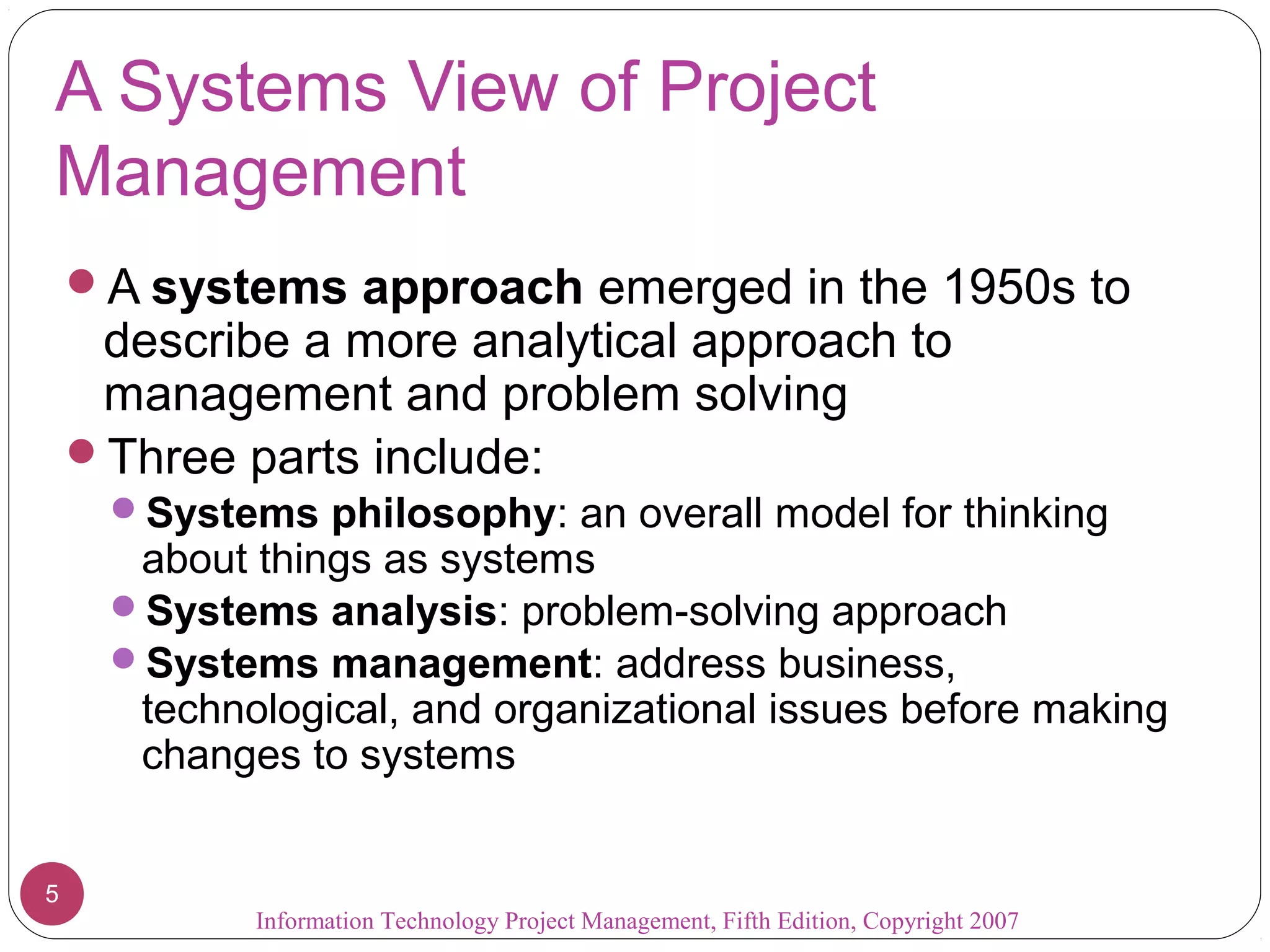
A Systems View of Project
Management
A systems approach emerged in the 1950s to
describe a more analytical approach to
management and problem solving
Three parts include:
Systems philosophy: an overall model for thinking
about things as systems
Systems analysis: problem-solving approach
Systems management: address business,
technological, and organizational issues before making
changes to systems
Information Technology Project Management, Fifth Edition, Copyright 2007
6
Media Snapshot
The Press Association Ltd, the largest news agency
in the United Kingdom, hired a consulting firm to help
turn things around after management noticed its
profit margins were sliding
The consultants suggested using a holistic view and
a top-down strategy to make sure projects supported
key business goals
They also suggested releasing short-term results to
accrue benefits on an incremental basis and
reviewing projects on a regular basis to ensure
strategic alignment
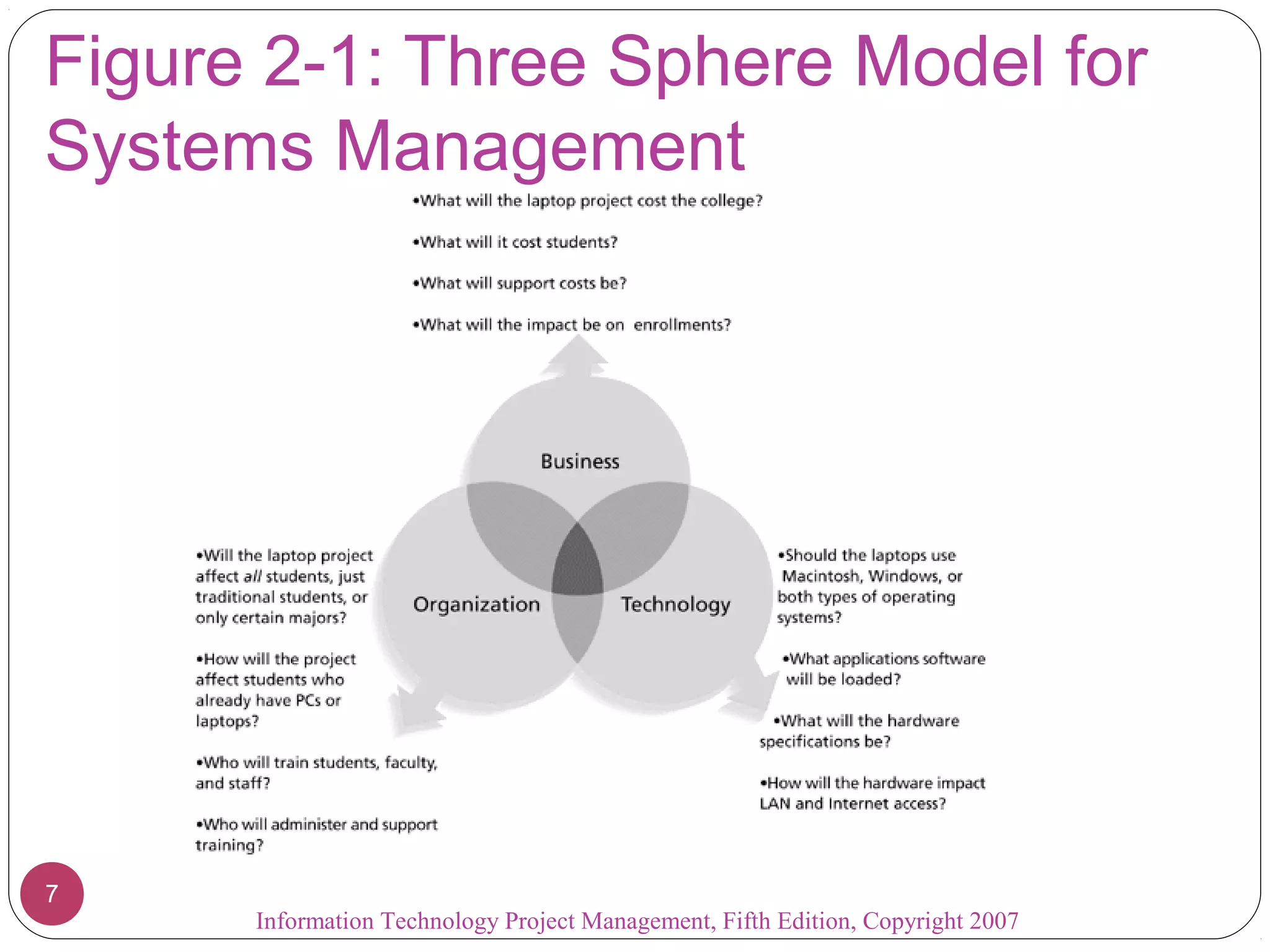
Figure 2-1: Three Sphere Model for
Systems Management
Information Technology Project Management, Fifth Edition, Copyright 2007
7
Information Technology Project Management, Fifth Edition, Copyright 2007
8
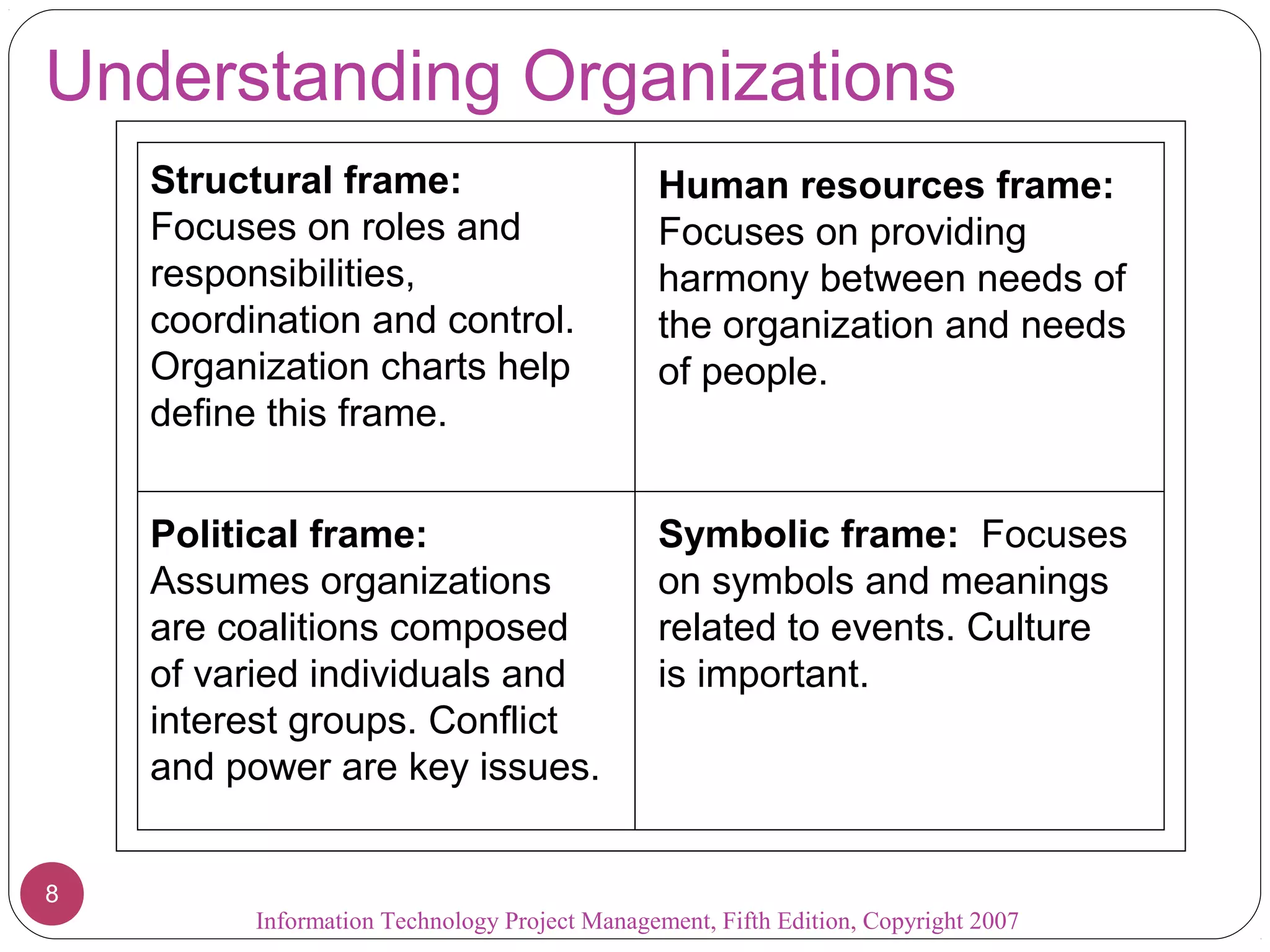
Understanding Organizations
Structural frame:
Focuses on roles and
responsibilities,
coordination and control.
Organization charts help
define this frame.
Human resources frame:
Focuses on providing
harmony between needs of
the organization and needs
of people.
Political frame:
Assumes organizations
are coalitions composed
of varied individuals and
interest groups. Conflict
and power are key issues.
Symbolic frame: Focuses
on symbols and meanings
related to events. Culture
is important.
What Went Wrong?
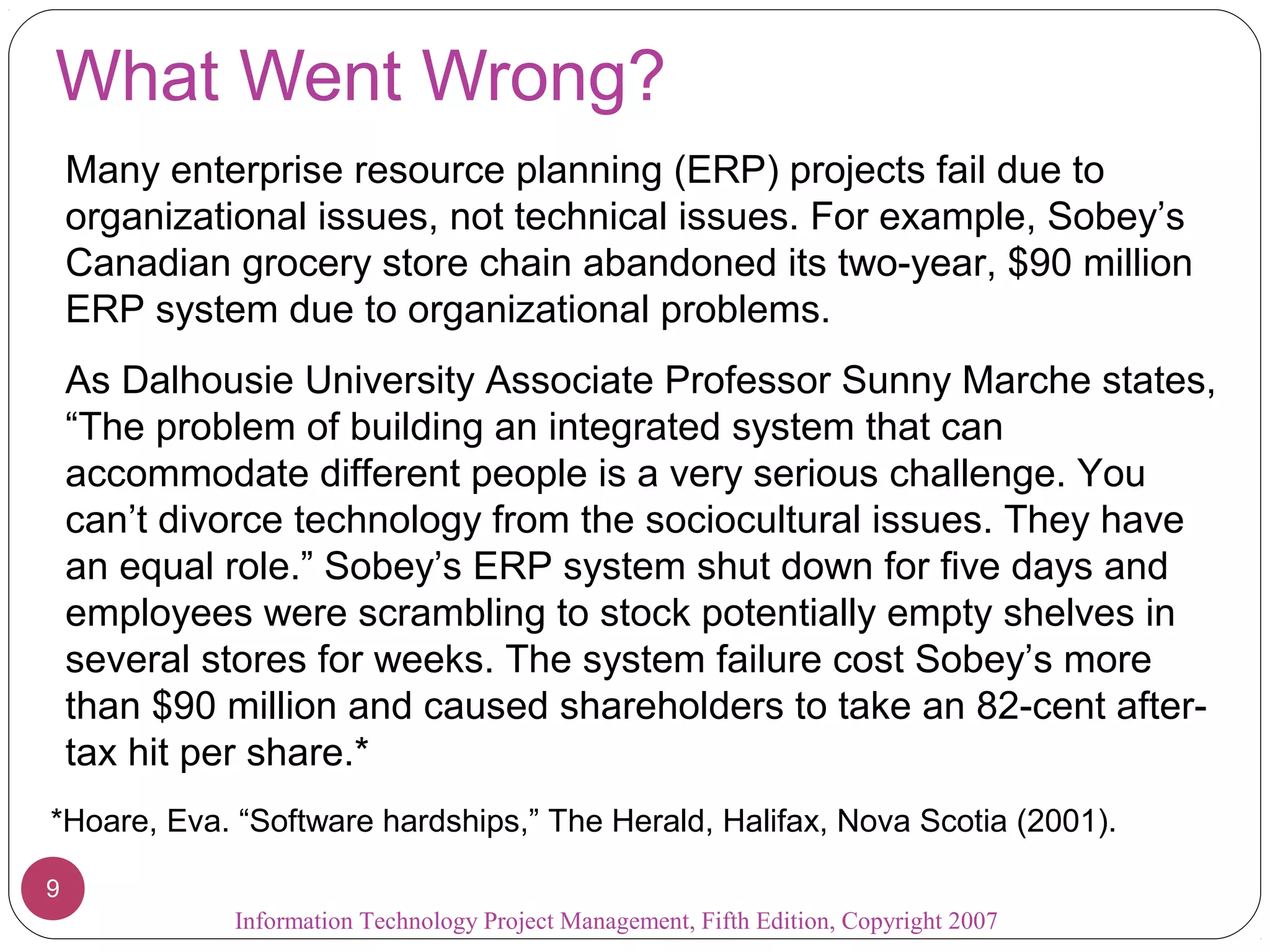
Many enterprise resource planning (ERP) projects fail due to
organizational issues, not technical issues. For example, Sobey’s
Canadian grocery store chain abandoned its two-year, $90 million
ERP system due to organizational problems.
As Dalhousie University Associate Professor Sunny Marche states,
“The problem of building an integrated system that can
accommodate different people is a very serious challenge. You
can’t divorce technology from the sociocultural issues. They have
an equal role.” Sobey’s ERP system shut down for five days and
employees were scrambling to stock potentially empty shelves in
several stores for weeks. The system failure cost Sobey’s more
than $90 million and caused shareholders to take an 82-cent after-
tax hit per share.*
*Hoare, Eva. “Software hardships,” The Herald, Halifax, Nova Scotia (2001).
Information Technology Project Management, Fifth Edition, Copyright 2007
9
Information Technology Project Management, Fifth Edition, Copyright 2007
10
Organizational Structures
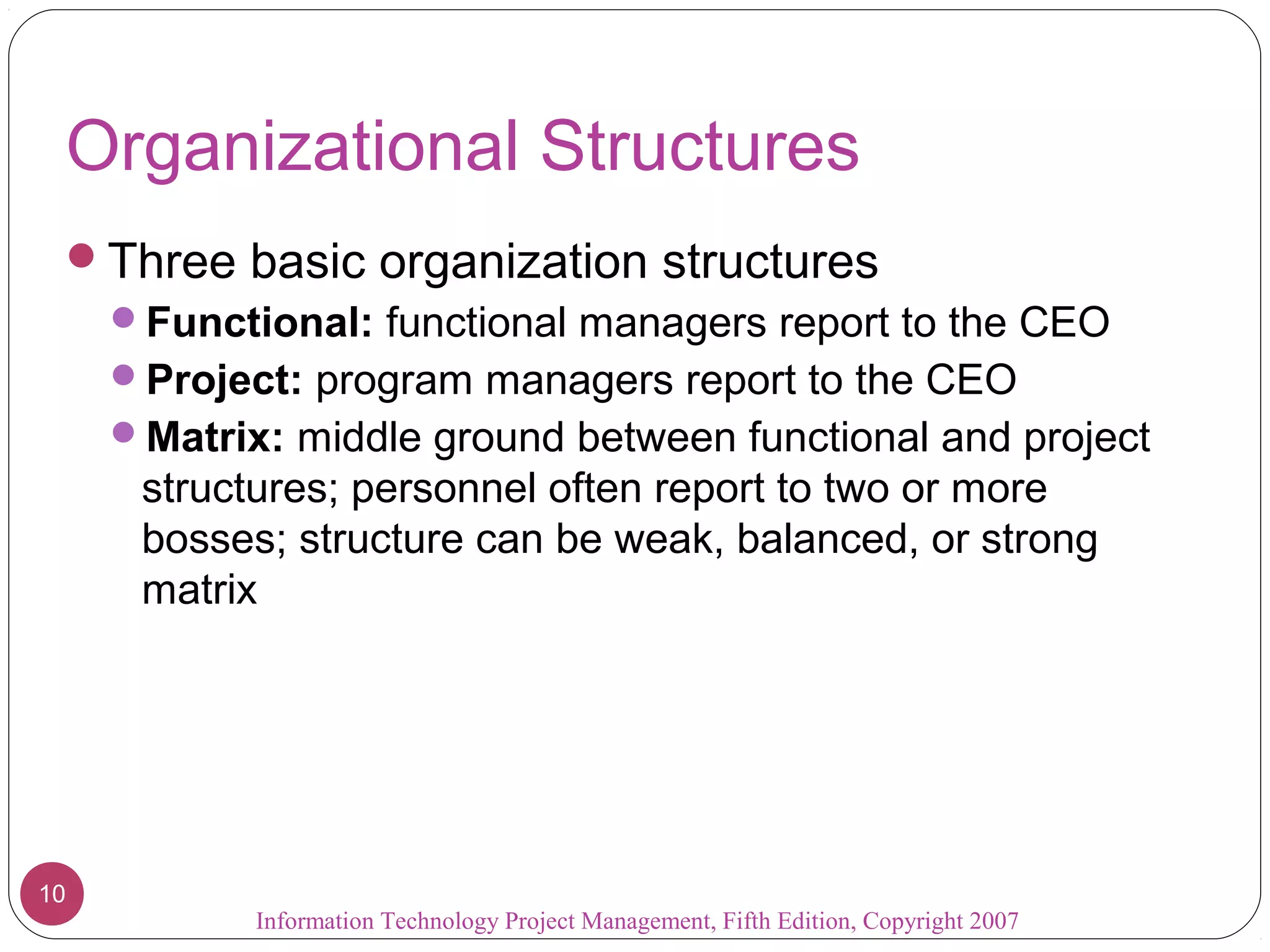
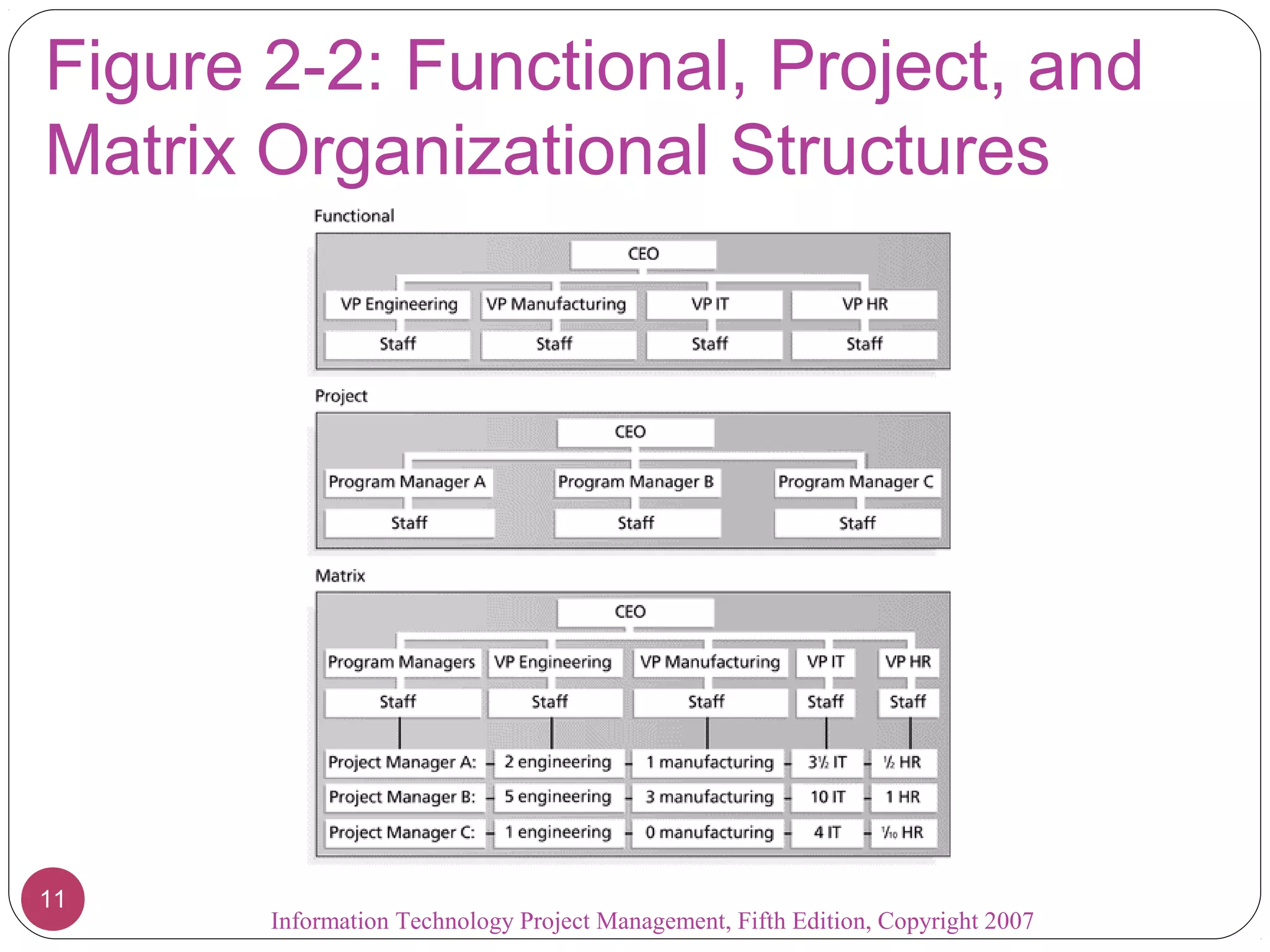
Three basic organization structures
Functional: functional managers report to the CEO
Project: program managers report to the CEO
Matrix: middle ground between functional and project
structures; personnel often report to two or more
bosses; structure can be weak, balanced, or strong
matrix
Figure 2-2: Functional, Project, and
Matrix Organizational Structures
Information Technology Project Management, Fifth Edition, Copyright 2007
11
Information Technology Project Management, Fifth Edition, Copyright 2007
12
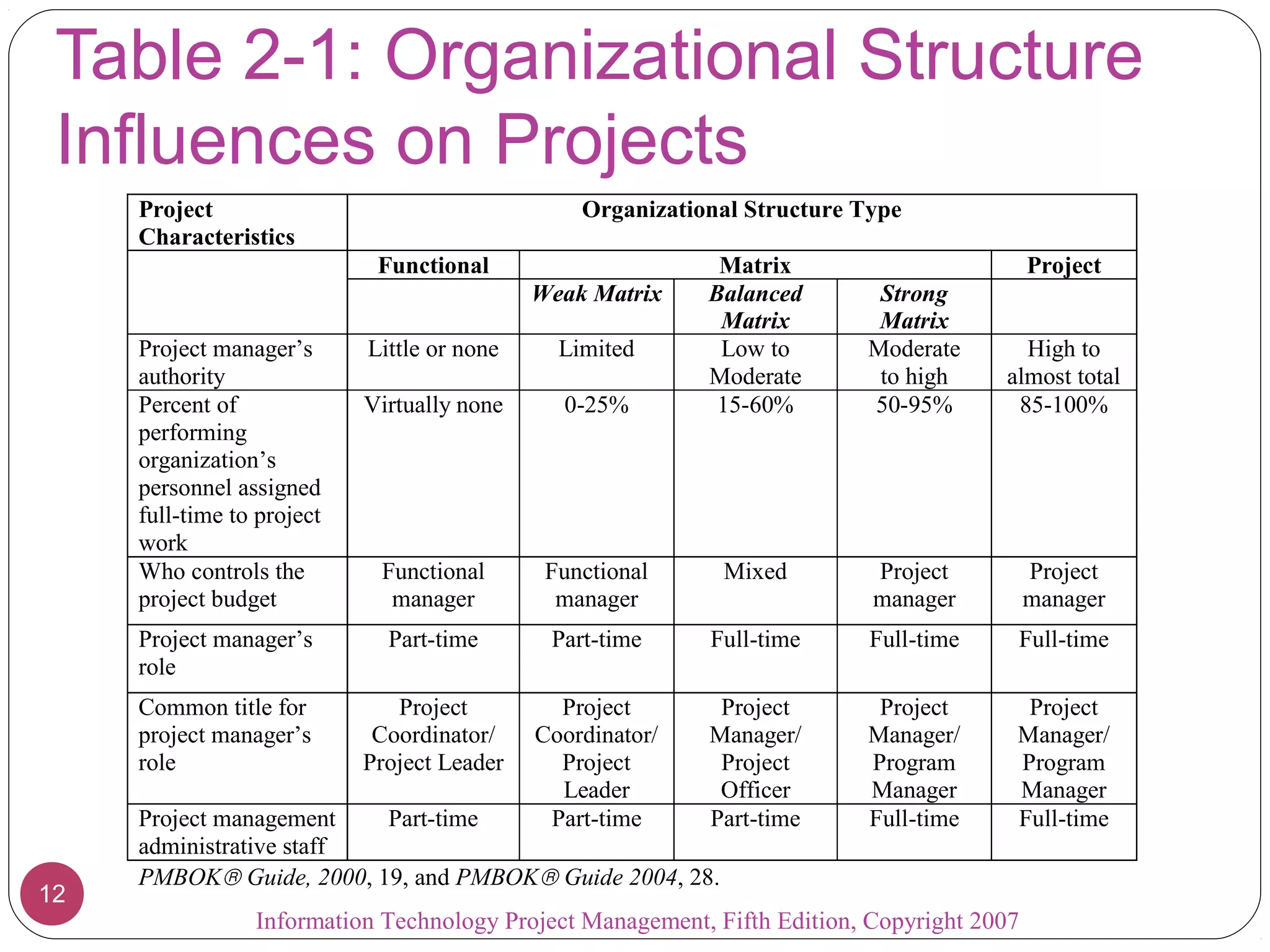
Table 2-1: Organizational Structure
Influences on Projects
Project
Characteristics
Organizational Structure Type
Functional Matrix Project
Weak Matrix Balanced
Matrix
Strong
Matrix
Project manager’s
authority
Little or none Limited Low to
Moderate
Moderate
to high
High to
almost total
Percent of
performing
organization’s
personnel assigned
full-time to project
work
Virtually none 0-25% 15-60% 50-95% 85-100%
Who controls the
project budget
Functional
manager
Functional
manager
Mixed Project
manager
Project
manager
Project manager’s
role
Part-time Part-time Full-time Full-time Full-time
Common title for
project manager’s
role
Project
Coordinator/
Project Leader
Project
Coordinator/
Project
Leader
Project
Manager/
Project
Officer
Project
Manager/
Program
Manager
Project
Manager/
Program
Manager
Project management
administrative staff
Part-time Part-time Part-time Full-time Full-time
PMBOK® Guide, 2000, 19, and PMBOK® Guide 2004, 28.
Information Technology Project Management, Fifth Edition, Copyright 2007
13
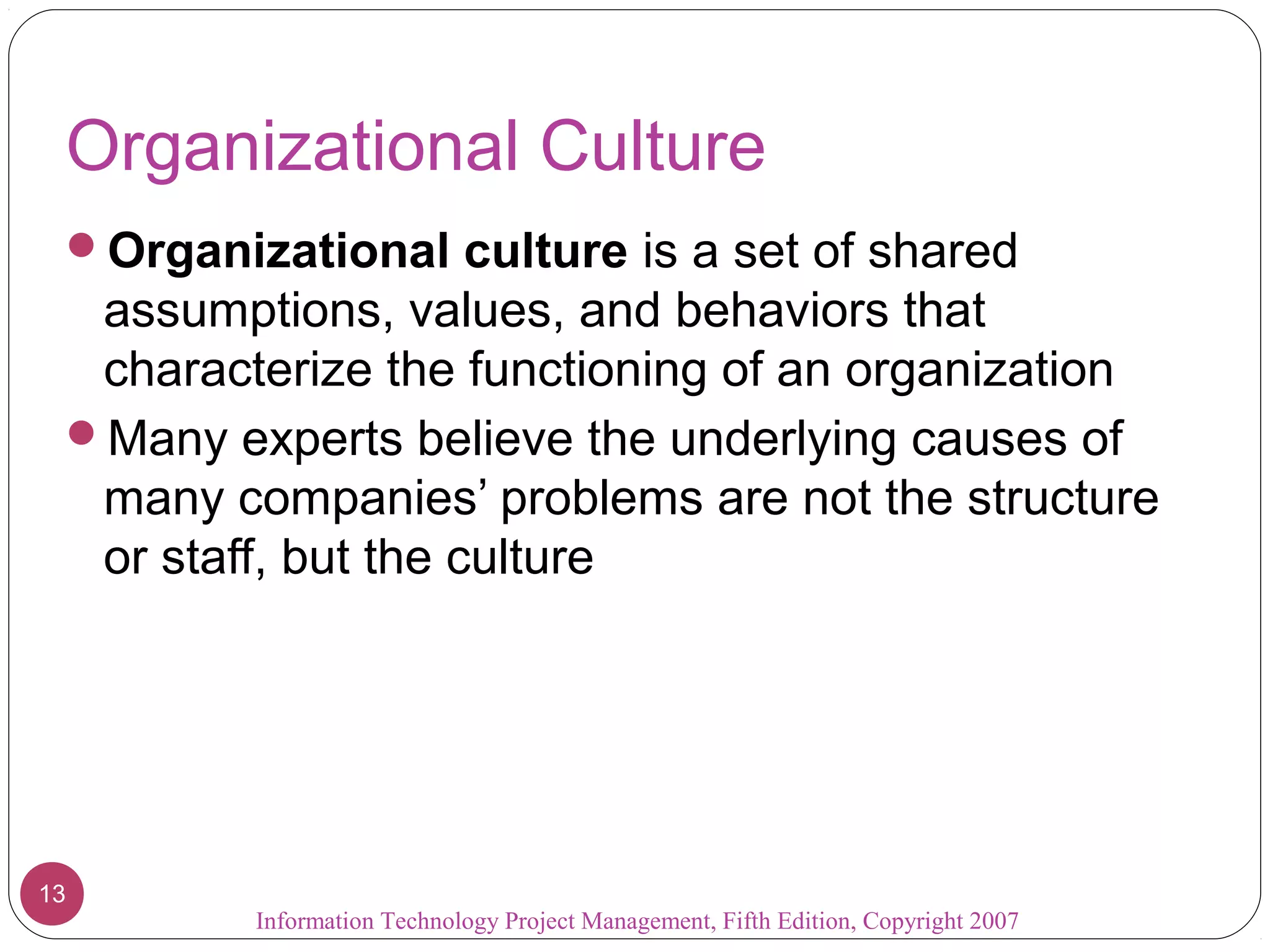
Organizational Culture
Organizational culture is a set of shared
assumptions, values, and behaviors that
characterize the functioning of an organization
Many experts believe the underlying causes of
many companies’ problems are not the structure
or staff, but the culture
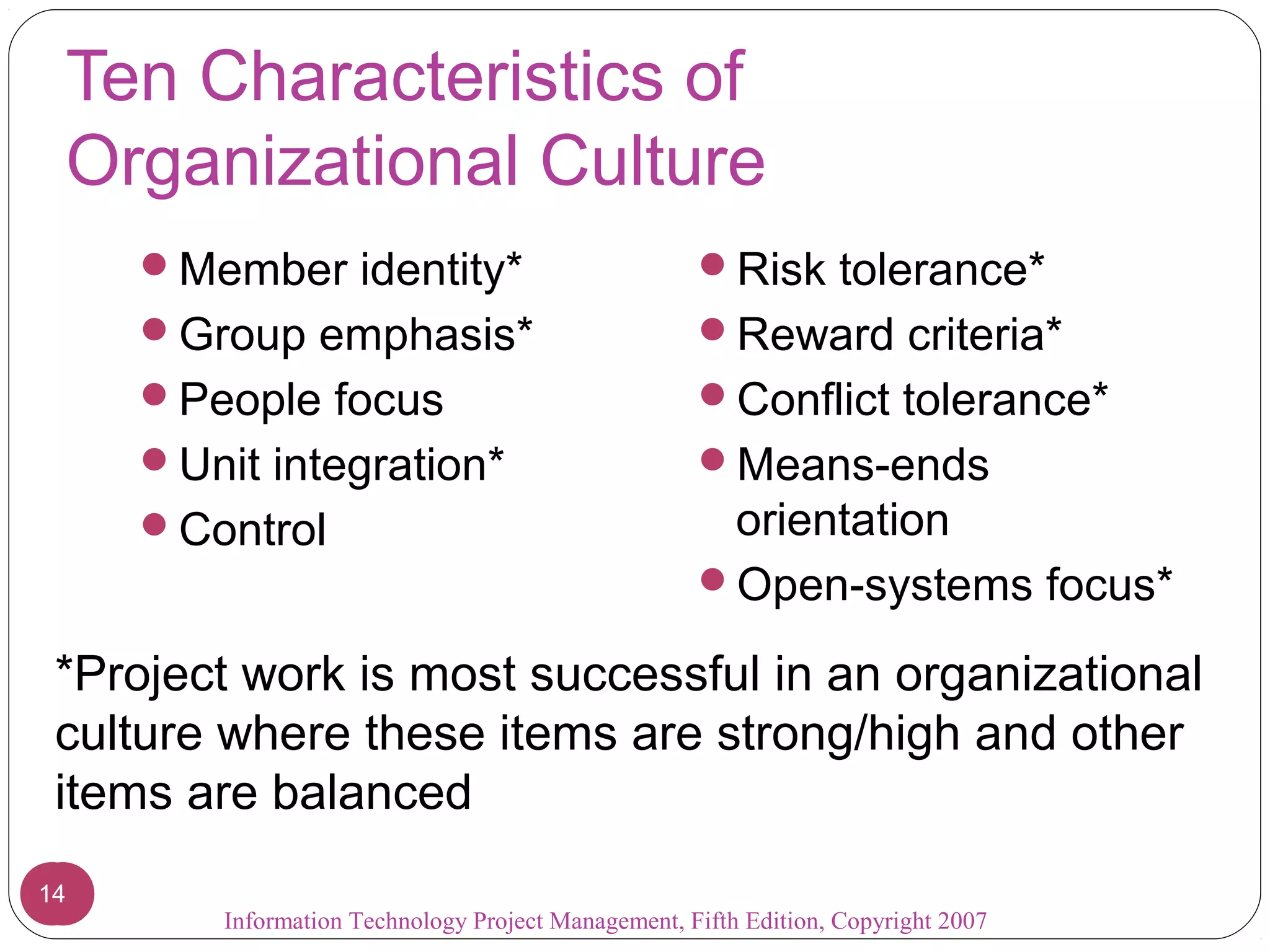
Ten Characteristics of
Organizational Culture
Member identity*
Group emphasis*
People focus
Unit integration*
Control
Risk tolerance*
Reward criteria*
Conflict tolerance*
Means-ends
orientation
Open-systems focus*
*Project work is most successful in an organizational
culture where these items are strong/high and other
items are balanced
1414
Information Technology Project Management, Fifth Edition, Copyright 2007
15
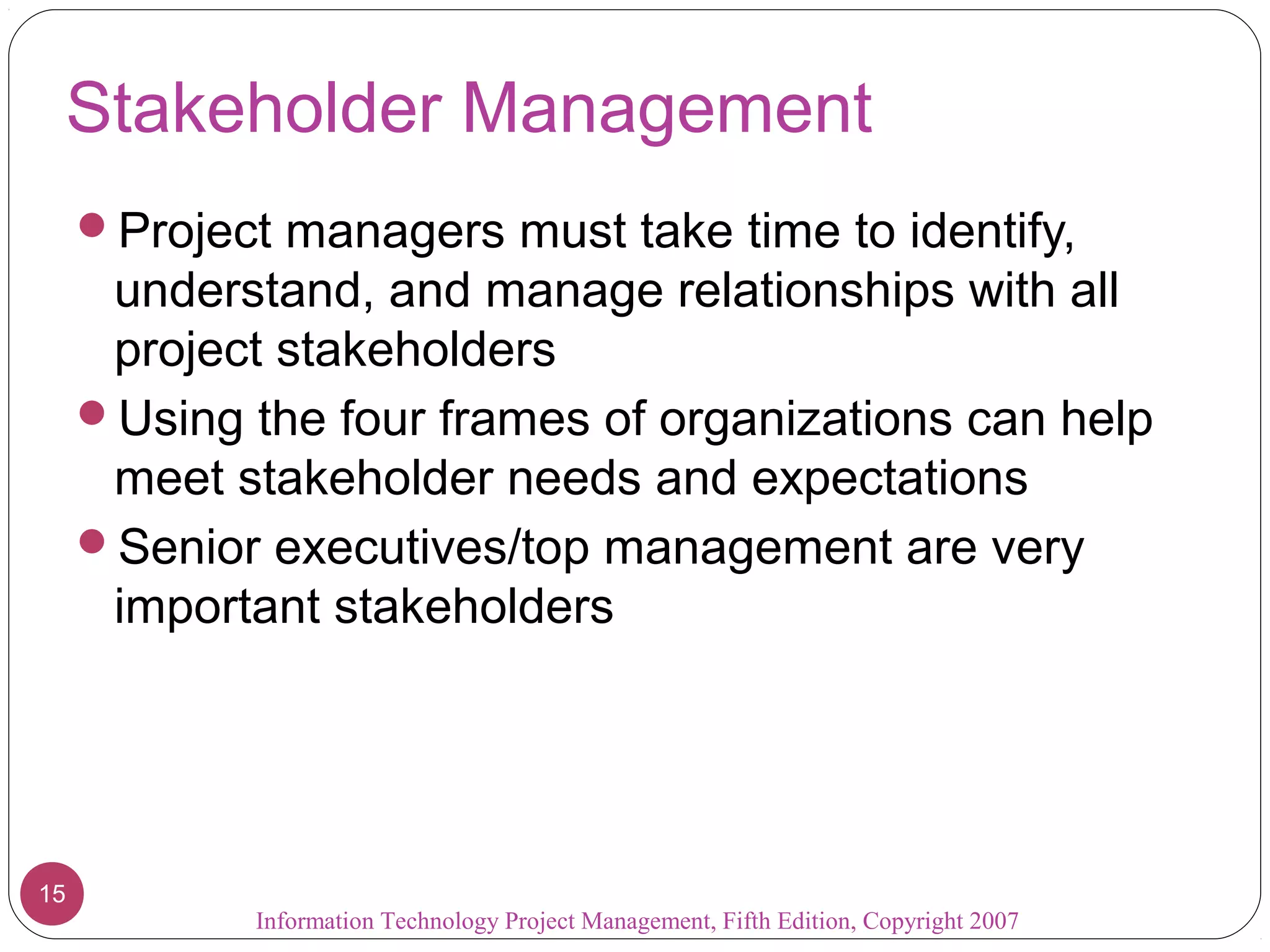
Stakeholder Management
Project managers must take time to identify,
understand, and manage relationships with all
project stakeholders
Using the four frames of organizations can help
meet stakeholder needs and expectations
Senior executives/top management are very
important stakeholders
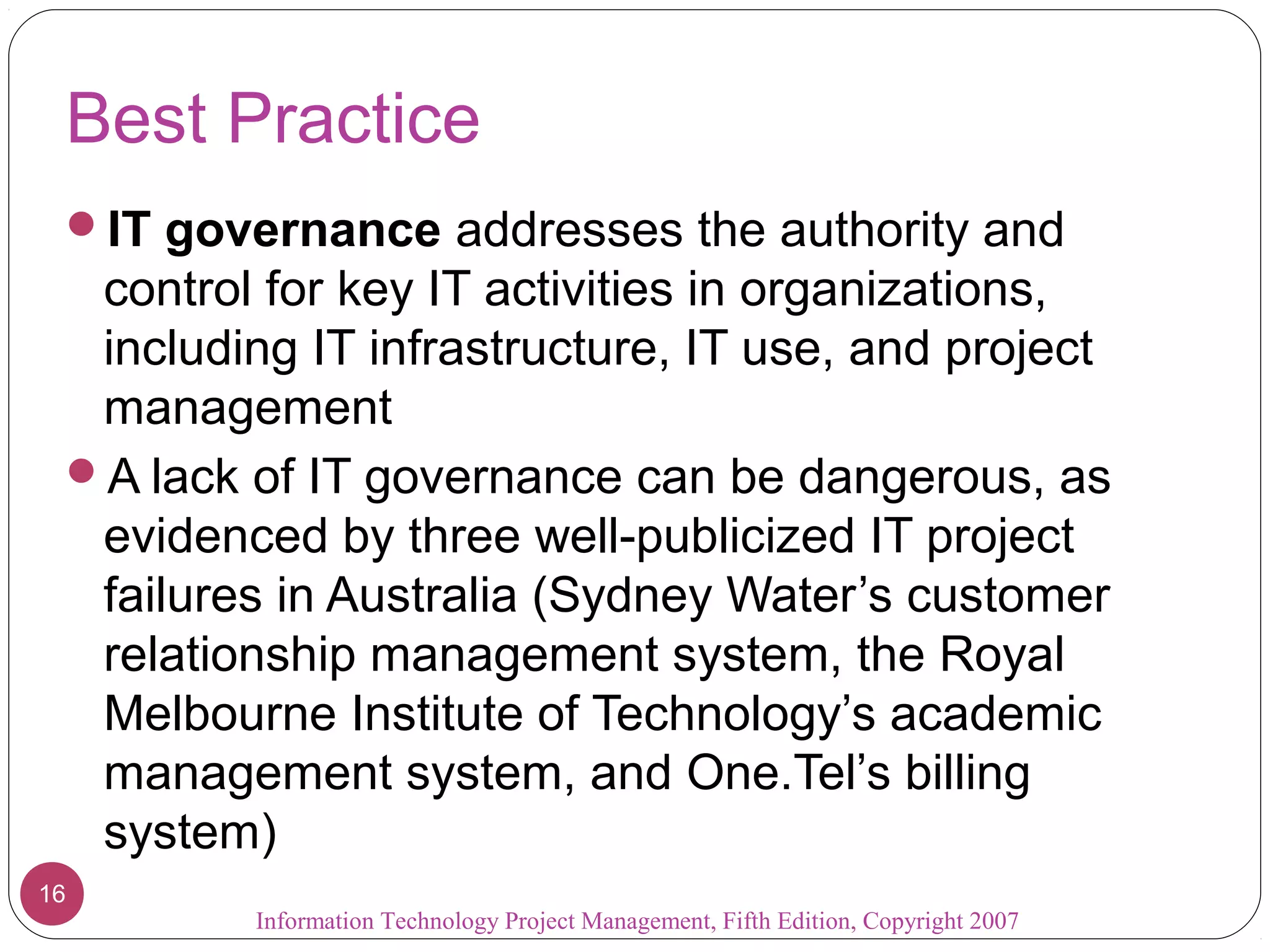
Best Practice
IT governance addresses the authority and
control for key IT activities in organizations,
including IT infrastructure, IT use, and project
management
A lack of IT governance can be dangerous, as
evidenced by three well-publicized IT project
failures in Australia (Sydney Water’s customer
relationship management system, the Royal
Melbourne Institute of Technology’s academic
management system, and One.Tel’s billing
system)
Information Technology Project Management, Fifth Edition, Copyright 2007
16
Information Technology Project Management, Fifth Edition, Copyright 2007
17
Need for Organizational Commitment to
Information Technology (IT)
If the organization has a negative attitude toward
IT, it will be difficult for an IT project to succeed
Having a Chief Information Officer (CIO) at a high
level in the organization helps IT projects
Assigning non-IT people to IT projects also
encourages more commitment
Information Technology Project Management, Fifth Edition, Copyright 2007
18
Need for Organizational Standards
Standards and guidelines help project managers
be more effective
Senior management can encourage:
The use of standard forms and software for project
management
The development and use of guidelines for writing
project plans or providing status information
The creation of a project management office or center
of excellence
Information Technology Project Management, Fifth Edition, Copyright 2007
19
Project Phases and the Project Life
Cycle
A project life cycle is a collection of project
phases that defines:
What work will be performed in each phase
What deliverables will be produced and when
Who is involved in each phase
How management will control and approve work
produced in each phase
A deliverable is a product or service produced or
provided as part of a project
Information Technology Project Management, Fifth Edition, Copyright 2007
20
More on Project Phases
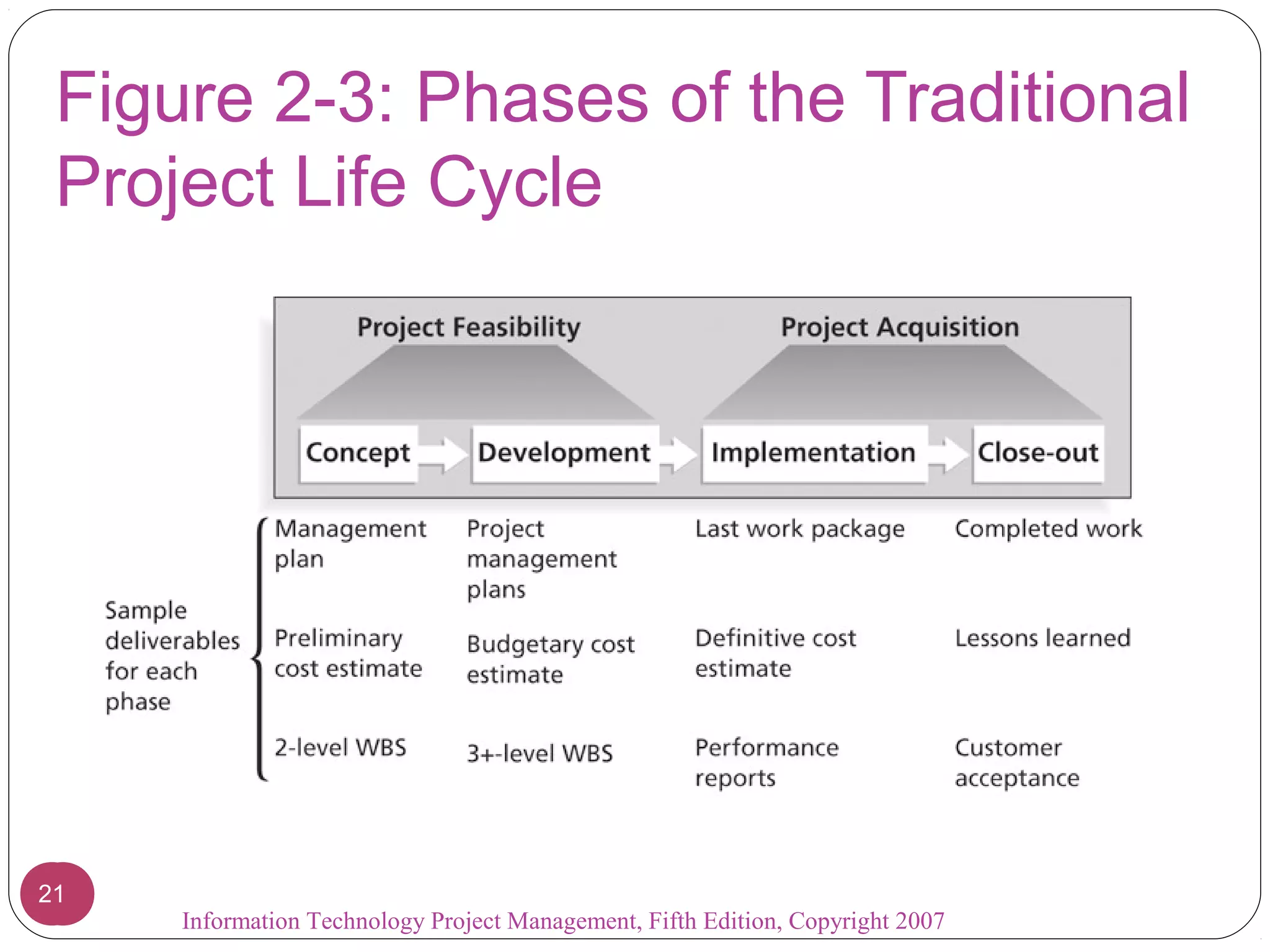
In early phases of a project life cycle:
Resource needs are usually lowest
The level of uncertainty (risk) is highest
Project stakeholders have the greatest opportunity to
influence the project
In middle phases of a project life cycle:
The certainty of completing a project improves
More resources are needed
The final phase of a project life cycle focuses on:
Ensuring that project requirements were met
The sponsor approves completion of the project
Figure 2-3: Phases of the Traditional
Project Life Cycle
2121
Information Technology Project Management, Fifth Edition, Copyright 2007
22
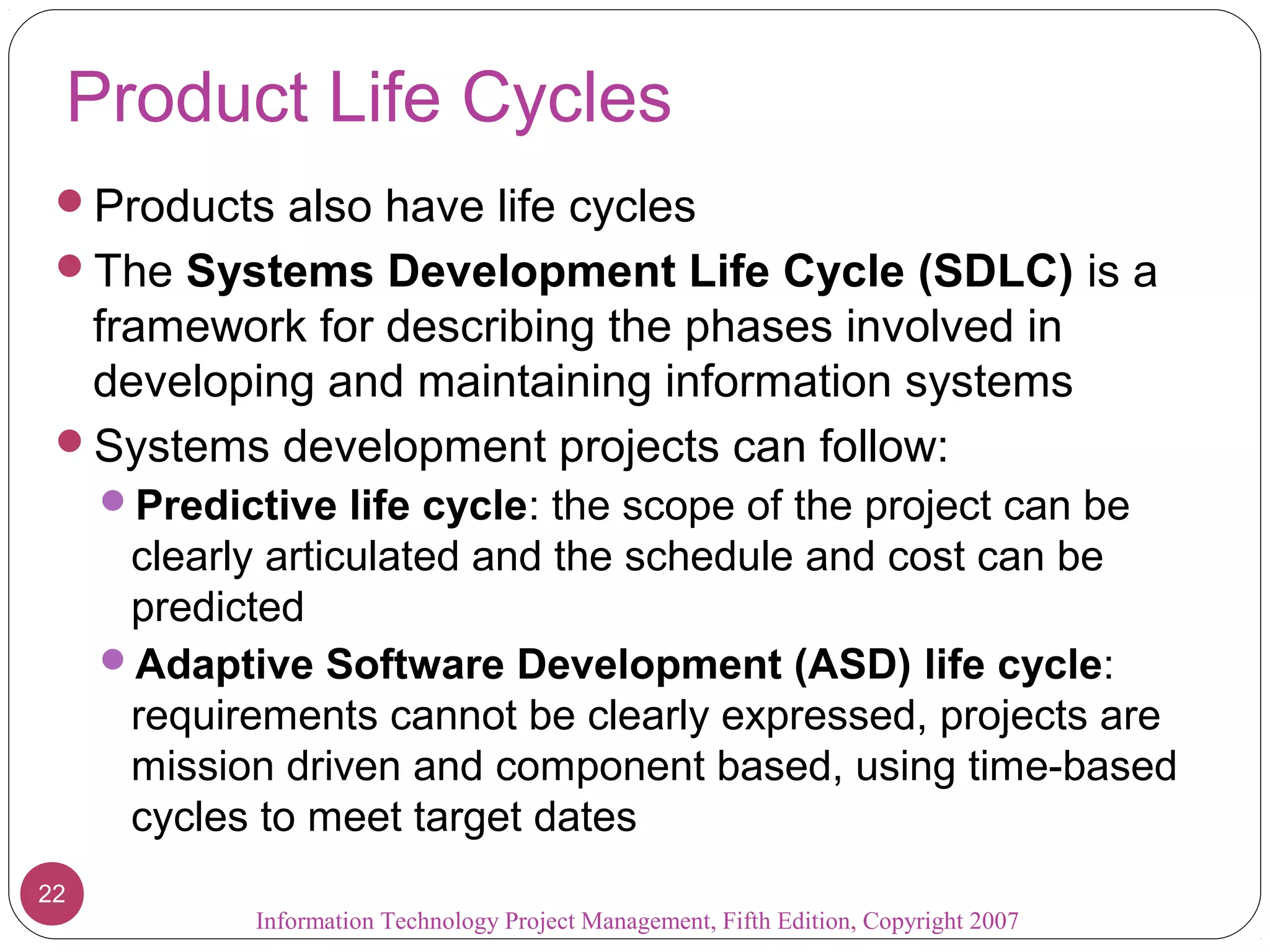
Product Life Cycles
Products also have life cycles
The Systems Development Life Cycle (SDLC) is a
framework for describing the phases involved in
developing and maintaining information systems
Systems development projects can follow:
Predictive life cycle: the scope of the project can be
clearly articulated and the schedule and cost can be
predicted
Adaptive Software Development (ASD) life cycle:
requirements cannot be clearly expressed, projects are
mission driven and component based, using time-based
cycles to meet target dates
Information Technology Project Management, Fifth Edition, Copyright 2007
23
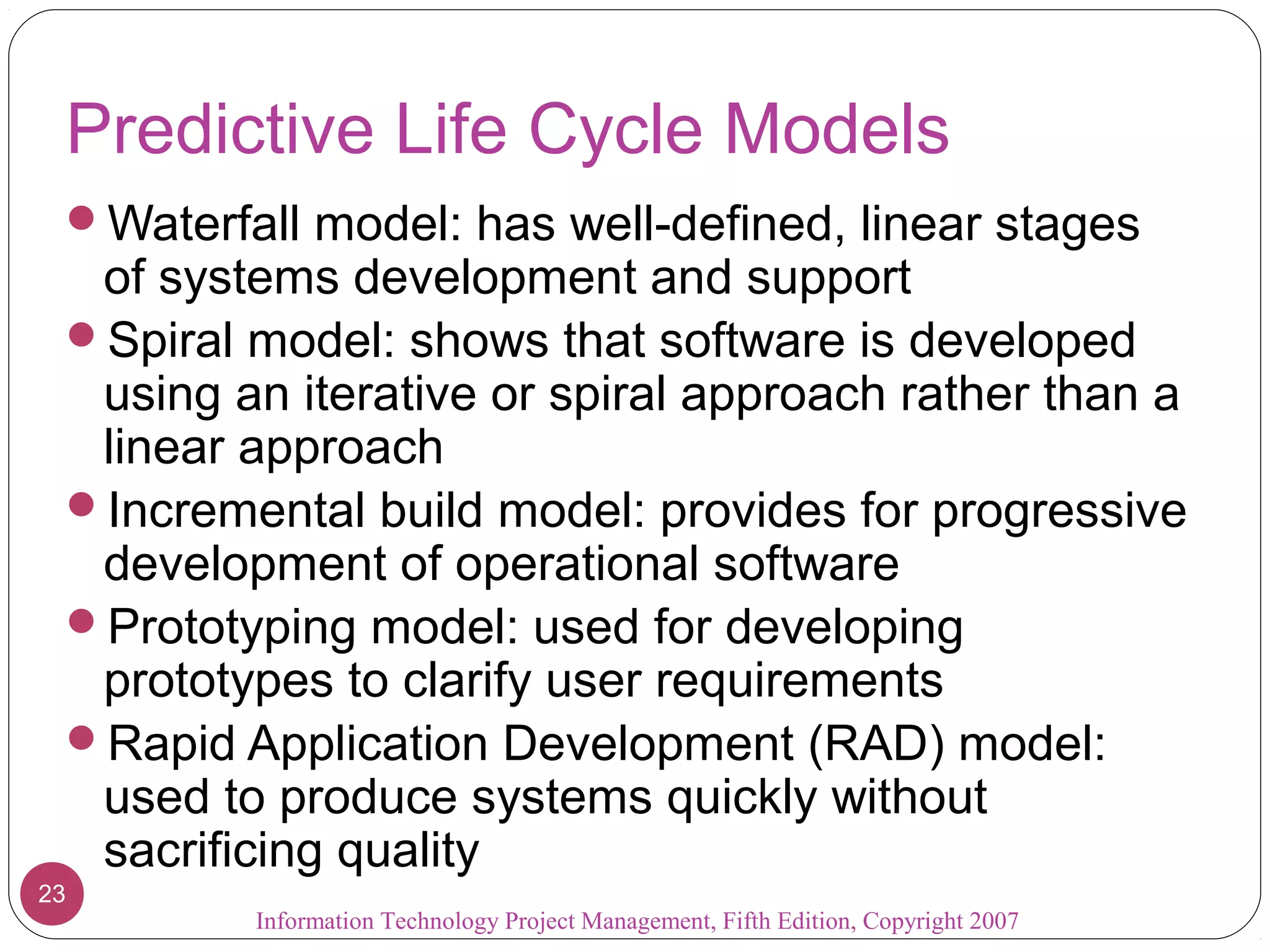
Predictive Life Cycle Models
Waterfall model: has well-defined, linear stages
of systems development and support
Spiral model: shows that software is developed
using an iterative or spiral approach rather than a
linear approach
Incremental build model: provides for progressive
development of operational software
Prototyping model: used for developing
prototypes to clarify user requirements
Rapid Application Development (RAD) model:
used to produce systems quickly without
sacrificing quality
Information Technology Project Management, Fifth Edition, Copyright 2007
24
The Importance of Project Phases
and Management Reviews
A project should successfully pass through each
of the project phases in order to continue on to
the next
Management reviews, also called phase exits or
kill points, should occur after each phase to
evaluate the project’s progress, likely success,
and continued compatibility with organizational
goals
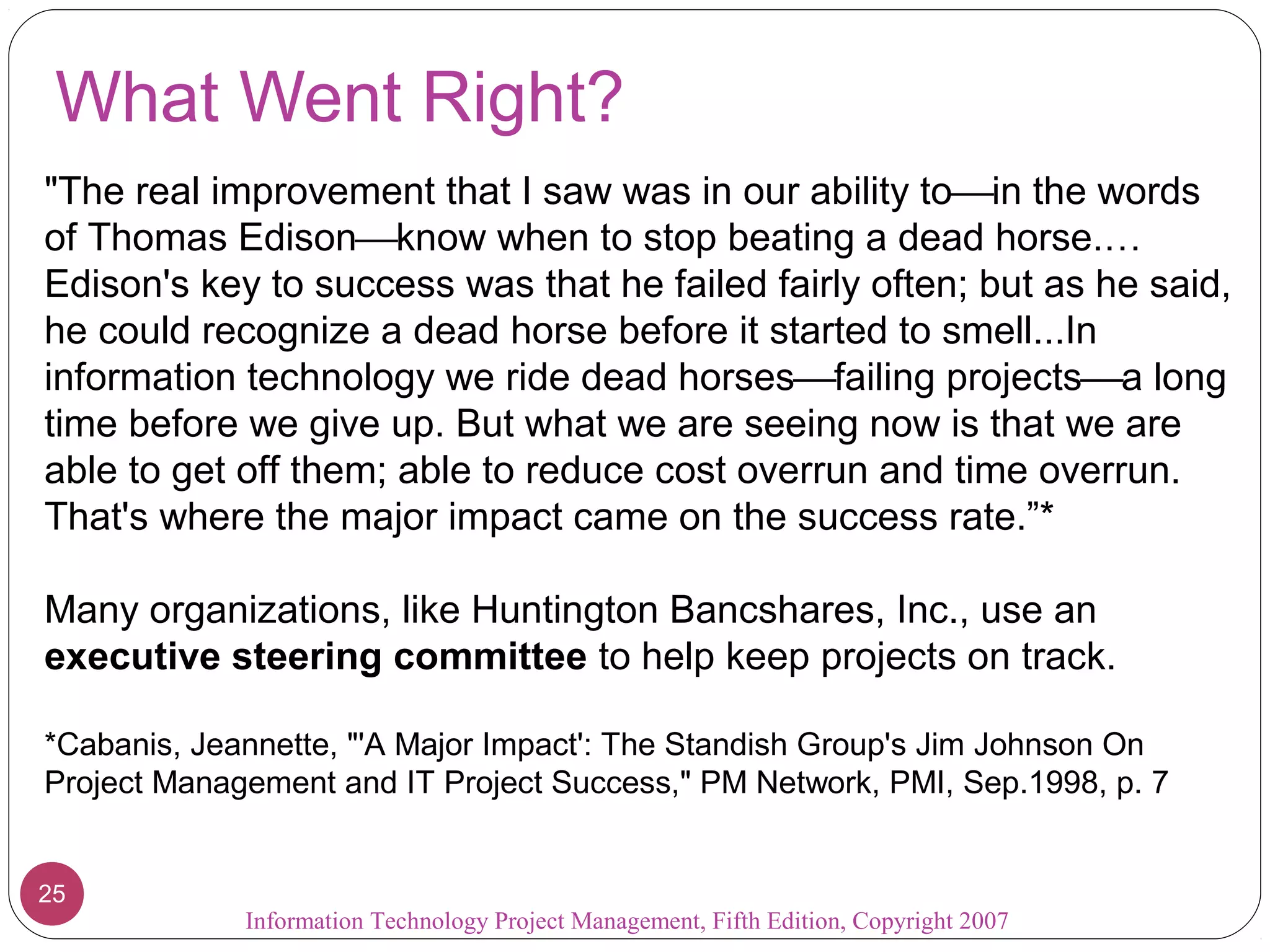
What Went Right?
"The real improvement that I saw was in our ability toin the words
of Thomas Edisonknow when to stop beating a dead horse.…
Edison's key to success was that he failed fairly often; but as he said,
he could recognize a dead horse before it started to smell...In
information technology we ride dead horsesfailing projectsa long
time before we give up. But what we are seeing now is that we are
able to get off them; able to reduce cost overrun and time overrun.
That's where the major impact came on the success rate.”*
Many organizations, like Huntington Bancshares, Inc., use an
executive steering committee to help keep projects on track.
*Cabanis, Jeannette, "'A Major Impact': The Standish Group's Jim Johnson On
Project Management and IT Project Success," PM Network, PMI, Sep.1998, p. 7
2525
Information Technology Project Management, Fifth Edition, Copyright 2007
26
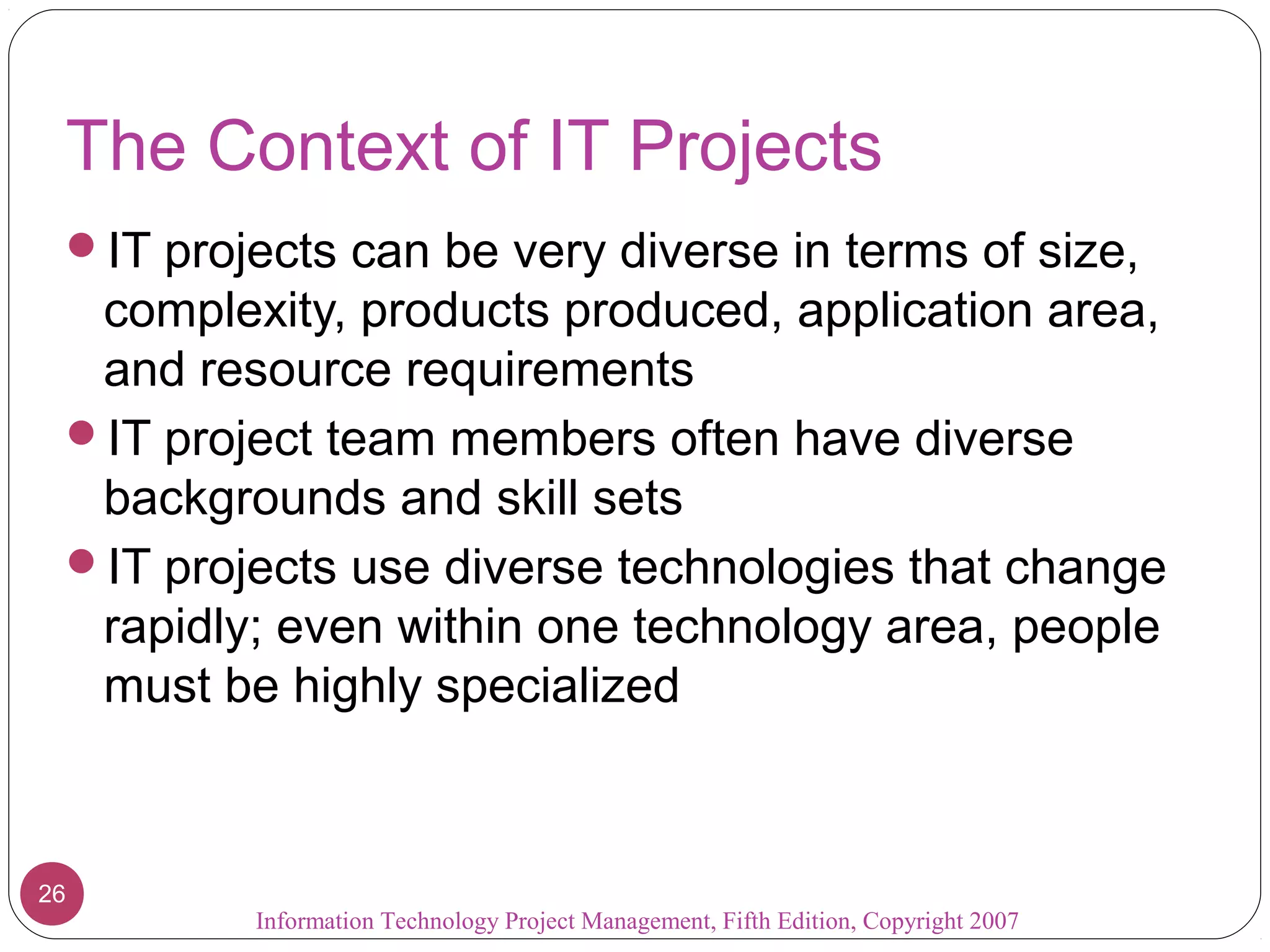
The Context of IT Projects
IT projects can be very diverse in terms of size,
complexity, products produced, application area,
and resource requirements
IT project team members often have diverse
backgrounds and skill sets
IT projects use diverse technologies that change
rapidly; even within one technology area, people
must be highly specialized
Information Technology Project Management, Fifth Edition, Copyright 2007
27
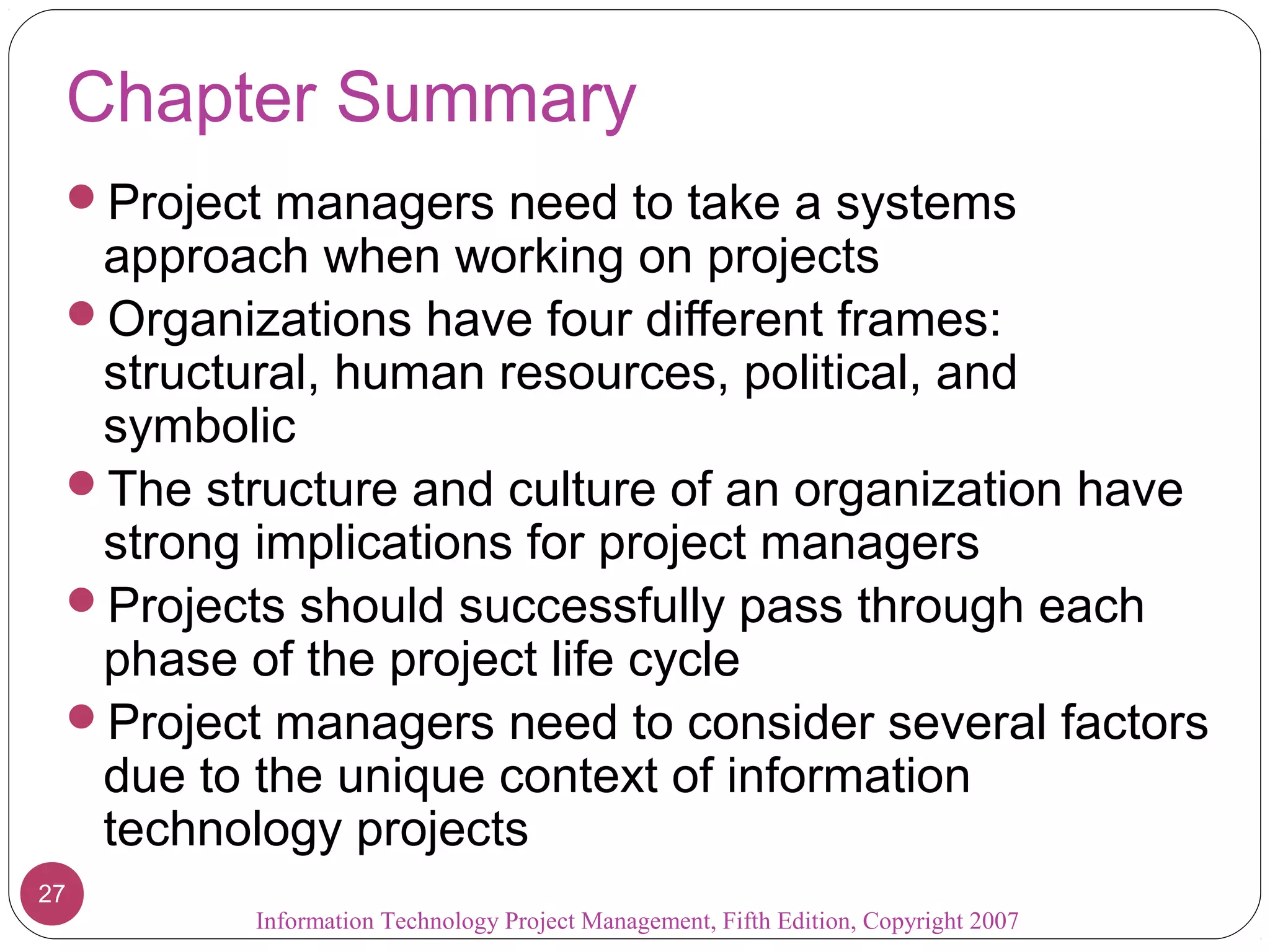
Chapter Summary
Project managers need to take a systems
approach when working on projects
Organizations have four different frames:
structural, human resources, political, and
symbolic
The structure and culture of an organization have
strong implications for project managers
Projects should successfully pass through each
phase of the project life cycle
Project managers need to consider several factors
due to the unique context of information
technology projects

Project management and information technology context

  • 1.
    Chapter 2:Chapter 2: TheProject Management andThe Project Management and Information Technology ContextInformation Technology Context Information TechnologyInformation Technology Project Management,Project Management, Fifth EditionFifth Edition
  • 2.
    Information Technology ProjectManagement, Fifth Edition, Copyright 2007 2 Learning Objectives  Describe the systems view of project management and how it applies to information technology projects  Understand organizations, including the four frames, organizational structures, and organizational culture  Explain why stakeholder management and top management commitment are critical for a project’s success
  • 3.
    Information Technology ProjectManagement, Fifth Edition, Copyright 2007 3 Learning Objectives (continued) Understand the concept of a project phase and the project life cycle and distinguish between project development and product development Discuss the unique attributes and diverse nature of information technology projects
  • 4.
    Information Technology ProjectManagement, Fifth Edition, Copyright 2007 4 Projects Cannot Be Run in Isolation Projects must operate in a broad organizational environment Project managers need to use systems thinking Taking a holistic view of carrying out projects within the context of the organization Senior managers must make sure projects continue to support current business needs
  • 5.
    Information Technology ProjectManagement, Fifth Edition, Copyright 2007 5 A Systems View of Project Management A systems approach emerged in the 1950s to describe a more analytical approach to management and problem solving Three parts include: Systems philosophy: an overall model for thinking about things as systems Systems analysis: problem-solving approach Systems management: address business, technological, and organizational issues before making changes to systems
  • 6.
    Information Technology ProjectManagement, Fifth Edition, Copyright 2007 6 Media Snapshot The Press Association Ltd, the largest news agency in the United Kingdom, hired a consulting firm to help turn things around after management noticed its profit margins were sliding The consultants suggested using a holistic view and a top-down strategy to make sure projects supported key business goals They also suggested releasing short-term results to accrue benefits on an incremental basis and reviewing projects on a regular basis to ensure strategic alignment
  • 7.
    Figure 2-1: ThreeSphere Model for Systems Management Information Technology Project Management, Fifth Edition, Copyright 2007 7
  • 8.
    Information Technology ProjectManagement, Fifth Edition, Copyright 2007 8 Understanding Organizations Structural frame: Focuses on roles and responsibilities, coordination and control. Organization charts help define this frame. Human resources frame: Focuses on providing harmony between needs of the organization and needs of people. Political frame: Assumes organizations are coalitions composed of varied individuals and interest groups. Conflict and power are key issues. Symbolic frame: Focuses on symbols and meanings related to events. Culture is important.
  • 9.
    What Went Wrong? Manyenterprise resource planning (ERP) projects fail due to organizational issues, not technical issues. For example, Sobey’s Canadian grocery store chain abandoned its two-year, $90 million ERP system due to organizational problems. As Dalhousie University Associate Professor Sunny Marche states, “The problem of building an integrated system that can accommodate different people is a very serious challenge. You can’t divorce technology from the sociocultural issues. They have an equal role.” Sobey’s ERP system shut down for five days and employees were scrambling to stock potentially empty shelves in several stores for weeks. The system failure cost Sobey’s more than $90 million and caused shareholders to take an 82-cent after- tax hit per share.* *Hoare, Eva. “Software hardships,” The Herald, Halifax, Nova Scotia (2001). Information Technology Project Management, Fifth Edition, Copyright 2007 9
  • 10.
    Information Technology ProjectManagement, Fifth Edition, Copyright 2007 10 Organizational Structures Three basic organization structures Functional: functional managers report to the CEO Project: program managers report to the CEO Matrix: middle ground between functional and project structures; personnel often report to two or more bosses; structure can be weak, balanced, or strong matrix
  • 11.
    Figure 2-2: Functional,Project, and Matrix Organizational Structures Information Technology Project Management, Fifth Edition, Copyright 2007 11
  • 12.
    Information Technology ProjectManagement, Fifth Edition, Copyright 2007 12 Table 2-1: Organizational Structure Influences on Projects Project Characteristics Organizational Structure Type Functional Matrix Project Weak Matrix Balanced Matrix Strong Matrix Project manager’s authority Little or none Limited Low to Moderate Moderate to high High to almost total Percent of performing organization’s personnel assigned full-time to project work Virtually none 0-25% 15-60% 50-95% 85-100% Who controls the project budget Functional manager Functional manager Mixed Project manager Project manager Project manager’s role Part-time Part-time Full-time Full-time Full-time Common title for project manager’s role Project Coordinator/ Project Leader Project Coordinator/ Project Leader Project Manager/ Project Officer Project Manager/ Program Manager Project Manager/ Program Manager Project management administrative staff Part-time Part-time Part-time Full-time Full-time PMBOK® Guide, 2000, 19, and PMBOK® Guide 2004, 28.
  • 13.
    Information Technology ProjectManagement, Fifth Edition, Copyright 2007 13 Organizational Culture Organizational culture is a set of shared assumptions, values, and behaviors that characterize the functioning of an organization Many experts believe the underlying causes of many companies’ problems are not the structure or staff, but the culture
  • 14.
    Ten Characteristics of OrganizationalCulture Member identity* Group emphasis* People focus Unit integration* Control Risk tolerance* Reward criteria* Conflict tolerance* Means-ends orientation Open-systems focus* *Project work is most successful in an organizational culture where these items are strong/high and other items are balanced 1414 Information Technology Project Management, Fifth Edition, Copyright 2007
  • 15.
    Information Technology ProjectManagement, Fifth Edition, Copyright 2007 15 Stakeholder Management Project managers must take time to identify, understand, and manage relationships with all project stakeholders Using the four frames of organizations can help meet stakeholder needs and expectations Senior executives/top management are very important stakeholders
  • 16.
    Best Practice IT governanceaddresses the authority and control for key IT activities in organizations, including IT infrastructure, IT use, and project management A lack of IT governance can be dangerous, as evidenced by three well-publicized IT project failures in Australia (Sydney Water’s customer relationship management system, the Royal Melbourne Institute of Technology’s academic management system, and One.Tel’s billing system) Information Technology Project Management, Fifth Edition, Copyright 2007 16
  • 17.
    Information Technology ProjectManagement, Fifth Edition, Copyright 2007 17 Need for Organizational Commitment to Information Technology (IT) If the organization has a negative attitude toward IT, it will be difficult for an IT project to succeed Having a Chief Information Officer (CIO) at a high level in the organization helps IT projects Assigning non-IT people to IT projects also encourages more commitment
  • 18.
    Information Technology ProjectManagement, Fifth Edition, Copyright 2007 18 Need for Organizational Standards Standards and guidelines help project managers be more effective Senior management can encourage: The use of standard forms and software for project management The development and use of guidelines for writing project plans or providing status information The creation of a project management office or center of excellence
  • 19.
    Information Technology ProjectManagement, Fifth Edition, Copyright 2007 19 Project Phases and the Project Life Cycle A project life cycle is a collection of project phases that defines: What work will be performed in each phase What deliverables will be produced and when Who is involved in each phase How management will control and approve work produced in each phase A deliverable is a product or service produced or provided as part of a project
  • 20.
    Information Technology ProjectManagement, Fifth Edition, Copyright 2007 20 More on Project Phases In early phases of a project life cycle: Resource needs are usually lowest The level of uncertainty (risk) is highest Project stakeholders have the greatest opportunity to influence the project In middle phases of a project life cycle: The certainty of completing a project improves More resources are needed The final phase of a project life cycle focuses on: Ensuring that project requirements were met The sponsor approves completion of the project
  • 21.
    Figure 2-3: Phasesof the Traditional Project Life Cycle 2121 Information Technology Project Management, Fifth Edition, Copyright 2007
  • 22.
    Information Technology ProjectManagement, Fifth Edition, Copyright 2007 22 Product Life Cycles Products also have life cycles The Systems Development Life Cycle (SDLC) is a framework for describing the phases involved in developing and maintaining information systems Systems development projects can follow: Predictive life cycle: the scope of the project can be clearly articulated and the schedule and cost can be predicted Adaptive Software Development (ASD) life cycle: requirements cannot be clearly expressed, projects are mission driven and component based, using time-based cycles to meet target dates
  • 23.
    Information Technology ProjectManagement, Fifth Edition, Copyright 2007 23 Predictive Life Cycle Models Waterfall model: has well-defined, linear stages of systems development and support Spiral model: shows that software is developed using an iterative or spiral approach rather than a linear approach Incremental build model: provides for progressive development of operational software Prototyping model: used for developing prototypes to clarify user requirements Rapid Application Development (RAD) model: used to produce systems quickly without sacrificing quality
  • 24.
    Information Technology ProjectManagement, Fifth Edition, Copyright 2007 24 The Importance of Project Phases and Management Reviews A project should successfully pass through each of the project phases in order to continue on to the next Management reviews, also called phase exits or kill points, should occur after each phase to evaluate the project’s progress, likely success, and continued compatibility with organizational goals
  • 25.
    What Went Right? "Thereal improvement that I saw was in our ability toin the words of Thomas Edisonknow when to stop beating a dead horse.… Edison's key to success was that he failed fairly often; but as he said, he could recognize a dead horse before it started to smell...In information technology we ride dead horsesfailing projectsa long time before we give up. But what we are seeing now is that we are able to get off them; able to reduce cost overrun and time overrun. That's where the major impact came on the success rate.”* Many organizations, like Huntington Bancshares, Inc., use an executive steering committee to help keep projects on track. *Cabanis, Jeannette, "'A Major Impact': The Standish Group's Jim Johnson On Project Management and IT Project Success," PM Network, PMI, Sep.1998, p. 7 2525 Information Technology Project Management, Fifth Edition, Copyright 2007
  • 26.
    Information Technology ProjectManagement, Fifth Edition, Copyright 2007 26 The Context of IT Projects IT projects can be very diverse in terms of size, complexity, products produced, application area, and resource requirements IT project team members often have diverse backgrounds and skill sets IT projects use diverse technologies that change rapidly; even within one technology area, people must be highly specialized
  • 27.
    Information Technology ProjectManagement, Fifth Edition, Copyright 2007 27 Chapter Summary Project managers need to take a systems approach when working on projects Organizations have four different frames: structural, human resources, political, and symbolic The structure and culture of an organization have strong implications for project managers Projects should successfully pass through each phase of the project life cycle Project managers need to consider several factors due to the unique context of information technology projects