1 
Procurement 
Management 
Sharif Project Management 
Session 11 – Fall 1390
Impossible to produce everything internally! 
Inputs to company must be procured/managed 
Contracts and relationships must be managed! 
2 
Procurement 
 Purchasing, Acquisition, Supply 
(Materials, Services, Results, Consultants) 
 Outsourcing, Sub-contractors 
 Contracts, Supplier Relationships
3 
Procurement 
Management 
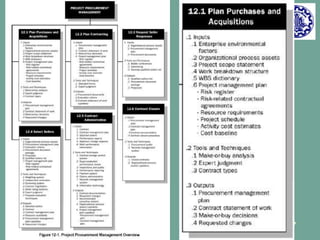
Includes the processes to purchase or inquire 
the products, services, or results needed from 
outside the project team to perform the work. 
Includes the contract management & change 
management processes needed to administer 
contracts or purchase orders issued. 
 Plan Purchases/Acquisitions o Plan Contracting 
 Request Seller Responses o Contract Closure 
 Select Sellers o Contract Administration
4 
The Make Decision 
 Less costly (but not always!!) 
 Easy integration of operations 
 Utilize existing capacity that is idle 
 Maintain direct control 
 Maintain design/production secrecy 
 Avoid unreliable supplier base 
 Stabilize existing workforce
5 
The Buy Decision 
 Less costly (but not always!!) 
 Utilize skills of suppliers 
 Small volume requirement (not cost 
effective to produce) 
 Having limited capacity or capability 
 Augment existing labor force 
 Maintain multiple sources (qualified 
vendor list) 
 Indirect control
6 
Procurement Strategies 
 Corporate procurement strategy: 
the relationship of specific procurement actions 
to the corporate strategy 
 Project procurement strategy: 
the relationship of specific procurement actions 
to the operating environment of the project 
 Procure all goods/services from a single source. 
 Procure all goods/services from multiple sources. 
 Procure only a small portion of the goods/ services. 
 Procure none of the goods/services.
7
8 
Procurement 
Management 
1. Requirement cycle: definition of the 
boundaries of the project 
2. Requisition cycle: analysis of sources 
3. Solicitation cycle: the bidding process 
4. Award cycle: contractor selection 
and contract award 
5. Contract administration cycle: 
managing the subcontractor until 
completion of the contract
9 
1. Requirement Cycle 
 Defining the need for the project 
 Development of the statement of work, 
specifications & work breakdown structure 
 Performing a make or buy analysis 
 Laying out the major milestones and the 
timing/schedule 
 Cost estimating, including life-cycle costing 
 Obtaining authorization/approval to proceed
10 
Specifications 
Specifications are written, pictorial, 
or graphic information that describe, 
define, or specify the services or 
items to be procured. There are 
three types of specifications: 
• Design 
• Performance 
• Functional
11 
Types of Specifications 
 Design specifications: These detail what is to be done in 
terms of physical characteristics. The risk of 
performance is on the buyer. 
 Performance specifications: These specify measurable 
capabilities the end product must achieve in terms of 
operational characteristics. The risk of performance is 
on the contractor. 
 Functional specifications: This is when the seller 
describes the end use of the item to stimulate competition 
among commercial items, at a lower overall cost. 
This is a subset of the performance specification. The 
risk of performance is on the contractor.
12 
2. Requisition Cycle 
 Evaluating/confirming specifications 
(are they current?) 
 Confirming sources 
 Reviewing past performance of 
sources 
 Producing solicitation package
13 
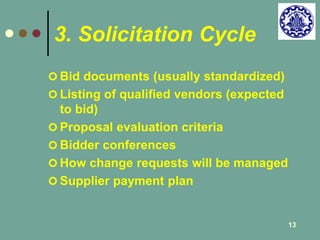
3. Solicitation Cycle 
 Bid documents (usually standardized) 
 Listing of qualified vendors (expected 
to bid) 
 Proposal evaluation criteria 
 Bidder conferences 
How change requests will be managed 
 Supplier payment plan
14 
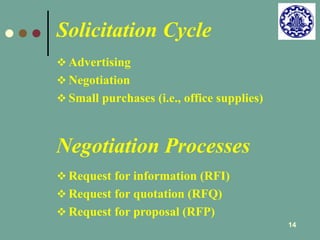
Solicitation Cycle 
 Advertising 
 Negotiation 
 Small purchases (i.e., office supplies) 
Negotiation Processes 
 Request for information (RFI) 
 Request for quotation (RFQ) 
 Request for proposal (RFP)
15 
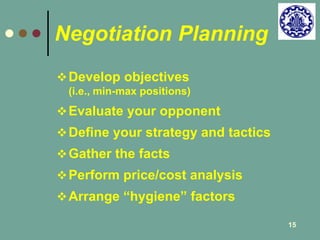
Negotiation Planning 
Develop objectives 
(i.e., min-max positions) 
Evaluate your opponent 
Define your strategy and tactics 
Gather the facts 
Perform price/cost analysis 
Arrange “hygiene” factors
16 
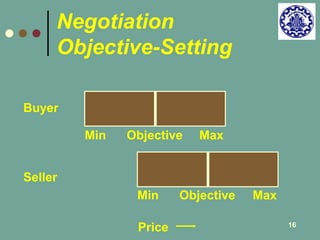
Negotiation 
Objective-Setting 
Buyer 
Seller 
Min 
Objective Max 
Min Objective 
Max 
Price
17 
Contract Negotiations Requires 
Knowing When to Speak and When 
to Be Quiet. 
Negotiation Factors 
 Compromise-ability 
 Adaptability 
 Good faith 
Research Your Supplier/ 
Customer Before Entering 
Into Contract Negotiations
18 
4. Award Cycle 
The objective of the award cycle is to 
negotiate a contract type and price that 
will result in reasonable contractor risk 
and provide the contractor with the 
greatest incentive for efficient and 
economic performance.
19 
Contract Elements 
 Mutual agreement 
 Consideration 
 Contract capability 
 Legal purpose 
 Form provided by law 
Contract Forms 
 Contract Completion 
 Contract Terms
20 
Contract Selection 
Criteria 
 Overall degree of cost and schedule risk 
 Type and complexity of requirement (technical risk) 
 Extent of price competition 
 Cost/price analysis 
 Urgency of the requirements 
 Performance period 
 Contractor’s responsibility (and risk) 
 Contractor’s accounting system (is it capable of 
earned value reporting?) 
 Concurrent contracts (will my contract take a back 
seat to existing work?) 
 Extent of subcontracting (how much work will the 
contractor outsource?)
21 
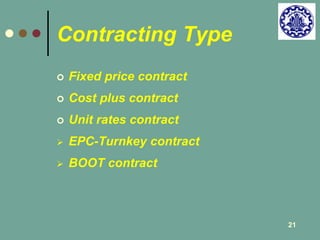
Contracting Type 
 Fixed price contract 
 Cost plus contract 
 Unit rates contract 
 EPC-Turnkey contract 
 BOOT contract
22 
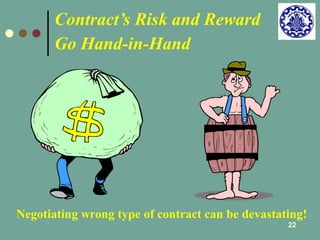
Contract’s Risk and Reward 
Go Hand-in-Hand 
Negotiating wrong type of contract can be devastating!
23 
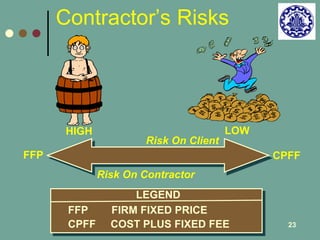
Contractor’s Risks 
HIGH LOW 
Risk On Client 
FFP CPFF 
Risk On Contractor 
LEGEND 
FFP FIRM FIXED PRICE 
CPFF COST PLUS FIXED FEE
24 
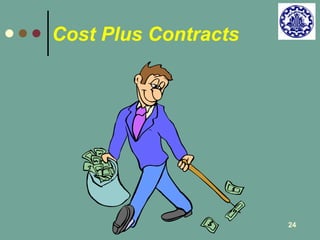
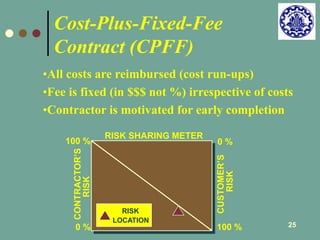
Cost Plus Contracts
•All costs are reimbursed (cost run-ups) 
•Fee is fixed (in $$$ not %) irrespective of costs 
•Contractor is motivated for early completion 
25 
Cost-Plus-Fixed-Fee 
Contract (CPFF) 
0 % 
0 % 
100 % 
100 % 
CONTRACTOR’S 
CUSTOMER’S 
RISK 
RISK 
RISK SHARING METER 
RISK 
LOCATION
26 
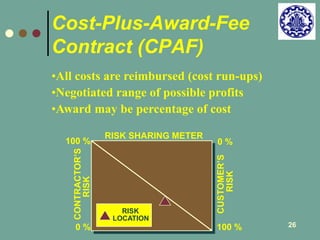
Cost-Plus-Award-Fee 
Contract (CPAF) 
•All costs are reimbursed (cost run-ups) 
•Negotiated range of possible profits 
•Award may be percentage of cost 
0 % 
0 % 
100 % 
100 % 
CONTRACTOR’S 
CUSTOMER’S 
RISK 
RISK 
RISK SHARING METER 
RISK 
LOCATION
27 
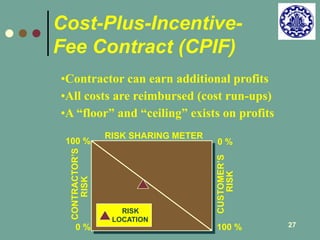
Cost-Plus-Incentive- 
Fee Contract (CPIF) 
•Contractor can earn additional profits 
•All costs are reimbursed (cost run-ups) 
•A “floor” and “ceiling” exists on profits 
0 % 
0 % 
100 % 
100 % 
CONTRACTOR’S 
CUSTOMER’S 
RISK 
RISK 
RISK SHARING METER 
RISK 
LOCATION
28 
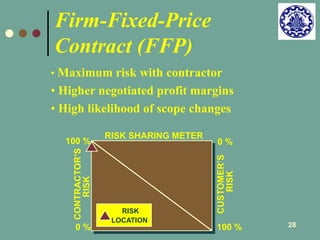
Firm-Fixed-Price 
Contract (FFP) 
• Maximum risk with contractor 
• Higher negotiated profit margins 
• High likelihood of scope changes 
0 % 
0 % 
100 % 
100 % 
CONTRACTOR’S 
CUSTOMER’S 
RISK 
RISK 
RISK SHARING METER 
RISK 
LOCATION
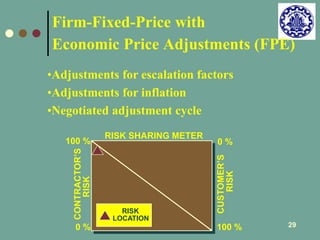
Firm-Fixed-Price with 
Economic Price Adjustments (FPE) 
29 
•Adjustments for escalation factors 
•Adjustments for inflation 
•Negotiated adjustment cycle 
0 % 
0 % 
100 % 
100 % 
CONTRACTOR’S 
CUSTOMER’S 
RISK 
RISK 
RISK SHARING METER 
RISK 
LOCATION
30 
Incentive Contracts 
• Additional profits are possible by lowering cost 
• Customer and contractor share cost savings
31 
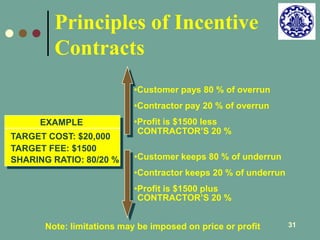
Principles of Incentive 
Contracts 
EXAMPLE 
TARGET COST: $20,000 
TARGET FEE: $1500 
SHARING RATIO: 80/20 % 
•Customer pays 80 % of overrun 
•Contractor pay 20 % of overrun 
•Profit is $1500 less 
CONTRACTOR’S 20 % 
•Customer keeps 80 % of underrun 
•Contractor keeps 20 % of underrun 
•Profit is $1500 plus 
CONTRACTOR’S 20 % 
Note: limitations may be imposed on price or profit
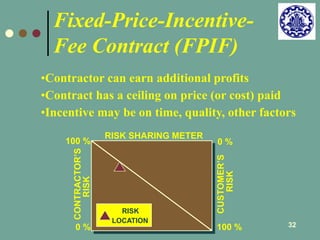
•Contractor can earn additional profits 
•Contract has a ceiling on price (or cost) paid 
•Incentive may be on time, quality, other factors 
32 
Fixed-Price-Incentive- 
Fee Contract (FPIF) 
0 % 
0 % 
100 % 
100 % 
CONTRACTOR’S 
CUSTOMER’S 
RISK 
RISK 
RISK SHARING METER 
RISK 
LOCATION
33 
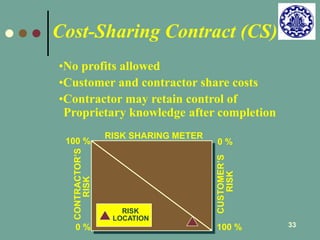
Cost-Sharing Contract (CS) 
•No profits allowed 
•Customer and contractor share costs 
•Contractor may retain control of 
Proprietary knowledge after completion 
0 % 
0 % 
100 % 
100 % 
CONTRACTOR’S 
CUSTOMER’S 
RISK 
RISK 
RISK SHARING METER 
RISK 
LOCATION
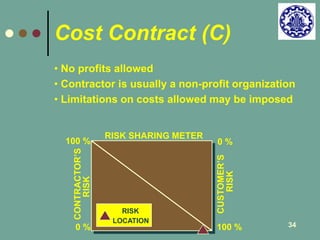
• No profits allowed 
• Contractor is usually a non-profit organization 
• Limitations on costs allowed may be imposed 
34 
Cost Contract (C) 
0 % 
0 % 
100 % 
100 % 
CONTRACTOR’S 
CUSTOMER’S 
RISK 
RISK 
RISK SHARING METER 
RISK 
LOCATION
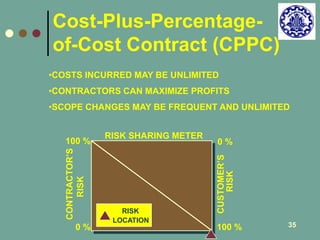
•COSTS INCURRED MAY BE UNLIMITED 
•CONTRACTORS CAN MAXIMIZE PROFITS 
•SCOPE CHANGES MAY BE FREQUENT AND UNLIMITED 
35 
Cost-Plus-Percentage-of- 
Cost Contract (CPPC) 
0 % 
0 % 
100 % 
100 % 
CONTRACTOR’S 
CUSTOMER’S 
RISK 
RISK 
RISK SHARING METER 
RISK 
LOCATION
CUSTOMER’S RISK 
36 
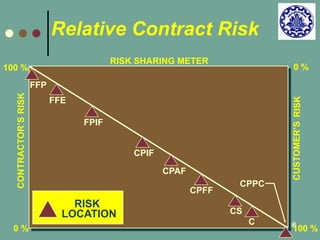
Relative Contract Risk 
RISK 
LOCATION 
FFP 
FFE 
FPIF 
CPIF 
CPAF 
CPFF 
CPPC 
CS 
C 
100 % 
CONTRACTOR’S RISK 
0 % 
0 % 
100 % 
RISK SHARING METER
There are several other types of 
contracts available. They may be 
derivatives of these contracts, 
combinations, or simply special 
contracts for special circumstances. 
37 
Other Types of Contracts
38 
5. Contract 
Administration Cycle 
 Change management 
 Specification interpretation 
 Adherence to quality 
 Warranties 
 Subcontractor management 
 Production surveillance 
 Waivers 
 Contract breach 
 Resolution of disputes 
 Project termination 
 Payment schedules 
 Project closeout
39 
Order of Precedence 
A. Specifications (first priority) 
B. Other instructions (second priority) 
C. Other documents, such as exhibits, 
attachments, appendices, SOW, contract 
date requirements list [CDRL], etc. 
(third priority) 
D. Contract clauses (fourth priority) 
E. The schedule (fifth priority)
40 
Type of Changes 
Administrative change 
Change order 
Contract modification 
Undefinitized contractual action 
Supplemental agreement 
Constructive change
41 
Causes of Constructive 
Changes 
 Defective specification with 
impossibility of performance 
 Erroneous interpretation of contract 
 Over-inspection of work 
 Failure to disclose superior knowledge 
 Acceleration of performance 
 Late or unsuitable owner or customer 
furnished property 
 Failure to cooperate 
 Improperly exercised options 
 Misusing proprietary data
42 
Reasons for Termination 
For Convenience of the Customer 
 Elimination of the requirement 
 Technological advances in the state-of-the- 
art 
 Budgetary changes 
 Related requirements and/or 
procurements 
 Anticipating profits not allowed
Reasons for Termination - 
For Default Due to Contractor’s Actions 
43 
 Contractor fails to make delivery on 
scheduled date. 
 Contractor fails to make progress so as to 
endanger performance of the contract 
and its terms. 
 Contractor fails to perform any other 
provisions of the contract.
44 
Contract Administration 
Rights 
 Reject the entire shipment 
 Accept the entire shipment (barring 
latent defects) 
 Accept part of the shipment

Pm session11

  • 1.
    1 Procurement Management Sharif Project Management Session 11 – Fall 1390
  • 2.
    Impossible to produceeverything internally! Inputs to company must be procured/managed Contracts and relationships must be managed! 2 Procurement  Purchasing, Acquisition, Supply (Materials, Services, Results, Consultants)  Outsourcing, Sub-contractors  Contracts, Supplier Relationships
  • 3.
    3 Procurement Management Includes the processes to purchase or inquire the products, services, or results needed from outside the project team to perform the work. Includes the contract management & change management processes needed to administer contracts or purchase orders issued.  Plan Purchases/Acquisitions o Plan Contracting  Request Seller Responses o Contract Closure  Select Sellers o Contract Administration
  • 4.
    4 The MakeDecision  Less costly (but not always!!)  Easy integration of operations  Utilize existing capacity that is idle  Maintain direct control  Maintain design/production secrecy  Avoid unreliable supplier base  Stabilize existing workforce
  • 5.
    5 The BuyDecision  Less costly (but not always!!)  Utilize skills of suppliers  Small volume requirement (not cost effective to produce)  Having limited capacity or capability  Augment existing labor force  Maintain multiple sources (qualified vendor list)  Indirect control
  • 6.
    6 Procurement Strategies  Corporate procurement strategy: the relationship of specific procurement actions to the corporate strategy  Project procurement strategy: the relationship of specific procurement actions to the operating environment of the project  Procure all goods/services from a single source.  Procure all goods/services from multiple sources.  Procure only a small portion of the goods/ services.  Procure none of the goods/services.
  • 7.
  • 8.
    8 Procurement Management 1. Requirement cycle: definition of the boundaries of the project 2. Requisition cycle: analysis of sources 3. Solicitation cycle: the bidding process 4. Award cycle: contractor selection and contract award 5. Contract administration cycle: managing the subcontractor until completion of the contract
  • 9.
    9 1. RequirementCycle  Defining the need for the project  Development of the statement of work, specifications & work breakdown structure  Performing a make or buy analysis  Laying out the major milestones and the timing/schedule  Cost estimating, including life-cycle costing  Obtaining authorization/approval to proceed
  • 10.
    10 Specifications Specificationsare written, pictorial, or graphic information that describe, define, or specify the services or items to be procured. There are three types of specifications: • Design • Performance • Functional
  • 11.
    11 Types ofSpecifications  Design specifications: These detail what is to be done in terms of physical characteristics. The risk of performance is on the buyer.  Performance specifications: These specify measurable capabilities the end product must achieve in terms of operational characteristics. The risk of performance is on the contractor.  Functional specifications: This is when the seller describes the end use of the item to stimulate competition among commercial items, at a lower overall cost. This is a subset of the performance specification. The risk of performance is on the contractor.
  • 12.
    12 2. RequisitionCycle  Evaluating/confirming specifications (are they current?)  Confirming sources  Reviewing past performance of sources  Producing solicitation package
  • 13.
    13 3. SolicitationCycle  Bid documents (usually standardized)  Listing of qualified vendors (expected to bid)  Proposal evaluation criteria  Bidder conferences How change requests will be managed  Supplier payment plan
  • 14.
    14 Solicitation Cycle  Advertising  Negotiation  Small purchases (i.e., office supplies) Negotiation Processes  Request for information (RFI)  Request for quotation (RFQ)  Request for proposal (RFP)
  • 15.
    15 Negotiation Planning Develop objectives (i.e., min-max positions) Evaluate your opponent Define your strategy and tactics Gather the facts Perform price/cost analysis Arrange “hygiene” factors
  • 16.
    16 Negotiation Objective-Setting Buyer Seller Min Objective Max Min Objective Max Price
  • 17.
    17 Contract NegotiationsRequires Knowing When to Speak and When to Be Quiet. Negotiation Factors  Compromise-ability  Adaptability  Good faith Research Your Supplier/ Customer Before Entering Into Contract Negotiations
  • 18.
    18 4. AwardCycle The objective of the award cycle is to negotiate a contract type and price that will result in reasonable contractor risk and provide the contractor with the greatest incentive for efficient and economic performance.
  • 19.
    19 Contract Elements  Mutual agreement  Consideration  Contract capability  Legal purpose  Form provided by law Contract Forms  Contract Completion  Contract Terms
  • 20.
    20 Contract Selection Criteria  Overall degree of cost and schedule risk  Type and complexity of requirement (technical risk)  Extent of price competition  Cost/price analysis  Urgency of the requirements  Performance period  Contractor’s responsibility (and risk)  Contractor’s accounting system (is it capable of earned value reporting?)  Concurrent contracts (will my contract take a back seat to existing work?)  Extent of subcontracting (how much work will the contractor outsource?)
  • 21.
    21 Contracting Type  Fixed price contract  Cost plus contract  Unit rates contract  EPC-Turnkey contract  BOOT contract
  • 22.
    22 Contract’s Riskand Reward Go Hand-in-Hand Negotiating wrong type of contract can be devastating!
  • 23.
    23 Contractor’s Risks HIGH LOW Risk On Client FFP CPFF Risk On Contractor LEGEND FFP FIRM FIXED PRICE CPFF COST PLUS FIXED FEE
  • 24.
    24 Cost PlusContracts
  • 25.
    •All costs arereimbursed (cost run-ups) •Fee is fixed (in $$$ not %) irrespective of costs •Contractor is motivated for early completion 25 Cost-Plus-Fixed-Fee Contract (CPFF) 0 % 0 % 100 % 100 % CONTRACTOR’S CUSTOMER’S RISK RISK RISK SHARING METER RISK LOCATION
  • 26.
    26 Cost-Plus-Award-Fee Contract(CPAF) •All costs are reimbursed (cost run-ups) •Negotiated range of possible profits •Award may be percentage of cost 0 % 0 % 100 % 100 % CONTRACTOR’S CUSTOMER’S RISK RISK RISK SHARING METER RISK LOCATION
  • 27.
    27 Cost-Plus-Incentive- FeeContract (CPIF) •Contractor can earn additional profits •All costs are reimbursed (cost run-ups) •A “floor” and “ceiling” exists on profits 0 % 0 % 100 % 100 % CONTRACTOR’S CUSTOMER’S RISK RISK RISK SHARING METER RISK LOCATION
  • 28.
    28 Firm-Fixed-Price Contract(FFP) • Maximum risk with contractor • Higher negotiated profit margins • High likelihood of scope changes 0 % 0 % 100 % 100 % CONTRACTOR’S CUSTOMER’S RISK RISK RISK SHARING METER RISK LOCATION
  • 29.
    Firm-Fixed-Price with EconomicPrice Adjustments (FPE) 29 •Adjustments for escalation factors •Adjustments for inflation •Negotiated adjustment cycle 0 % 0 % 100 % 100 % CONTRACTOR’S CUSTOMER’S RISK RISK RISK SHARING METER RISK LOCATION
  • 30.
    30 Incentive Contracts • Additional profits are possible by lowering cost • Customer and contractor share cost savings
  • 31.
    31 Principles ofIncentive Contracts EXAMPLE TARGET COST: $20,000 TARGET FEE: $1500 SHARING RATIO: 80/20 % •Customer pays 80 % of overrun •Contractor pay 20 % of overrun •Profit is $1500 less CONTRACTOR’S 20 % •Customer keeps 80 % of underrun •Contractor keeps 20 % of underrun •Profit is $1500 plus CONTRACTOR’S 20 % Note: limitations may be imposed on price or profit
  • 32.
    •Contractor can earnadditional profits •Contract has a ceiling on price (or cost) paid •Incentive may be on time, quality, other factors 32 Fixed-Price-Incentive- Fee Contract (FPIF) 0 % 0 % 100 % 100 % CONTRACTOR’S CUSTOMER’S RISK RISK RISK SHARING METER RISK LOCATION
  • 33.
    33 Cost-Sharing Contract(CS) •No profits allowed •Customer and contractor share costs •Contractor may retain control of Proprietary knowledge after completion 0 % 0 % 100 % 100 % CONTRACTOR’S CUSTOMER’S RISK RISK RISK SHARING METER RISK LOCATION
  • 34.
    • No profitsallowed • Contractor is usually a non-profit organization • Limitations on costs allowed may be imposed 34 Cost Contract (C) 0 % 0 % 100 % 100 % CONTRACTOR’S CUSTOMER’S RISK RISK RISK SHARING METER RISK LOCATION
  • 35.
    •COSTS INCURRED MAYBE UNLIMITED •CONTRACTORS CAN MAXIMIZE PROFITS •SCOPE CHANGES MAY BE FREQUENT AND UNLIMITED 35 Cost-Plus-Percentage-of- Cost Contract (CPPC) 0 % 0 % 100 % 100 % CONTRACTOR’S CUSTOMER’S RISK RISK RISK SHARING METER RISK LOCATION
  • 36.
    CUSTOMER’S RISK 36 Relative Contract Risk RISK LOCATION FFP FFE FPIF CPIF CPAF CPFF CPPC CS C 100 % CONTRACTOR’S RISK 0 % 0 % 100 % RISK SHARING METER
  • 37.
    There are severalother types of contracts available. They may be derivatives of these contracts, combinations, or simply special contracts for special circumstances. 37 Other Types of Contracts
  • 38.
    38 5. Contract Administration Cycle  Change management  Specification interpretation  Adherence to quality  Warranties  Subcontractor management  Production surveillance  Waivers  Contract breach  Resolution of disputes  Project termination  Payment schedules  Project closeout
  • 39.
    39 Order ofPrecedence A. Specifications (first priority) B. Other instructions (second priority) C. Other documents, such as exhibits, attachments, appendices, SOW, contract date requirements list [CDRL], etc. (third priority) D. Contract clauses (fourth priority) E. The schedule (fifth priority)
  • 40.
    40 Type ofChanges Administrative change Change order Contract modification Undefinitized contractual action Supplemental agreement Constructive change
  • 41.
    41 Causes ofConstructive Changes  Defective specification with impossibility of performance  Erroneous interpretation of contract  Over-inspection of work  Failure to disclose superior knowledge  Acceleration of performance  Late or unsuitable owner or customer furnished property  Failure to cooperate  Improperly exercised options  Misusing proprietary data
  • 42.
    42 Reasons forTermination For Convenience of the Customer  Elimination of the requirement  Technological advances in the state-of-the- art  Budgetary changes  Related requirements and/or procurements  Anticipating profits not allowed
  • 43.
    Reasons for Termination- For Default Due to Contractor’s Actions 43  Contractor fails to make delivery on scheduled date.  Contractor fails to make progress so as to endanger performance of the contract and its terms.  Contractor fails to perform any other provisions of the contract.
  • 44.
    44 Contract Administration Rights  Reject the entire shipment  Accept the entire shipment (barring latent defects)  Accept part of the shipment