Strategic Planning Overview Gaphor M. Panimbang [email_address] [email_address] March 26-28, 2007
What is Strategic Planning? A disciplined effort to produce fundamental DECISIONS and ACTIONS that SHAPE and GUIDE what a cooperative is, what it does, and why it does it with a focus on the FUTURE. A process by which a group defines its own  VMOSA  .
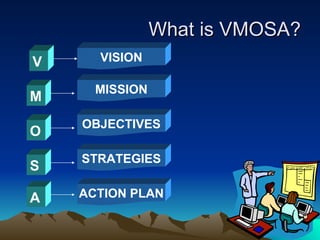
What is VMOSA? M O V S A VISION MISSION OBJECTIVES STRATEGIES ACTION PLAN
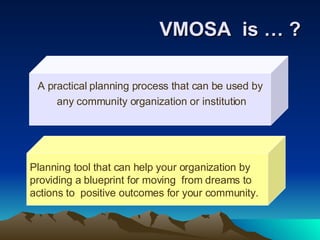
VMOSA  is … ? A practical planning process that can be used by any community organization or institution Planning tool that can help your organization by  providing a blueprint for moving  from dreams to  actions to  positive outcomes for your community.
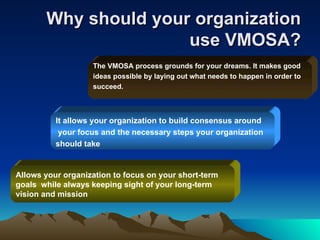
Why should your organization use VMOSA? It allows your organization to build consensus around your focus and the necessary steps your organization  should take Allows your organization to focus on your short-term  goals  while always keeping sight of your long-term  vision and mission The VMOSA process grounds for your dreams. It makes good  ideas possible by laying out what needs to happen in order to  succeed.
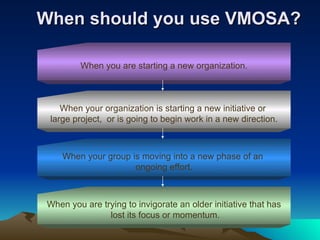
When should you use VMOSA? When you are starting a new organization. When you are trying to invigorate an older initiative that has lost its focus or momentum. When your organization is starting a new initiative or  large project,  or is going to begin work in a new direction. When your group is moving into a new phase of an  ongoing effort.
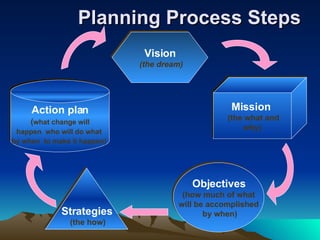
Planning Process Steps     Vision (the dream) Mission  (the what and  why) Objectives (how much of what will be accomplished by when) Strategies (the how) Action plan ( what change will  happen  who will do what  by when  to make it happen)
VISION  ( the dream) Vision statements should be:  Understood and shared by members of the community  Broad enough to allow a diverse variety of local perspectives to be encompassed within them  Inspiring and uplifting to everyone involved in your effort  Easy to communicate
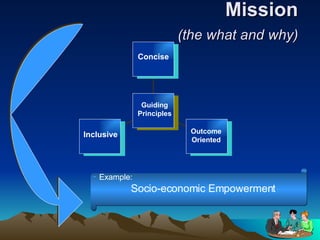
Mission  (the what and why)   Guiding Principles Example: Socio-economic Empowerment Concise Outcome Oriented Inclusive
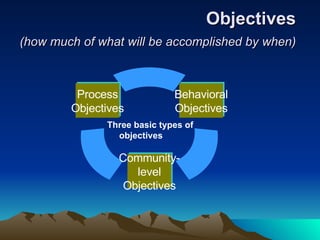
Objectives  (how much of what will be accomplished by when)   Three basic types of objectives Behavioral Objectives Community- level Objectives Process Objectives
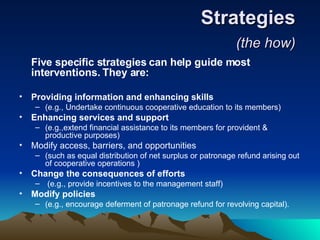
Strategies  (the how)   Five specific strategies can help guide most interventions. They are:   Providing information and enhancing skills  (e.g., Undertake continuous cooperative education to its members)  Enhancing services and support   (e.g.,extend financial assistance to its members for provident & productive purposes)  Modify access, barriers, and opportunities  (such as equal distribution of net surplus or patronage refund arising out of cooperative operations )  Change the consequences of efforts (e.g., provide incentives to the management staff)  Modify policies  (e.g., encourage deferment of patronage refund for revolving capital).
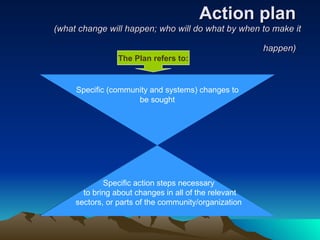
Action plan  (what change will happen; who will do what by when to make it happen)   Specific (community and systems) changes to be sought Specific action steps necessary to bring about changes in all of the relevant sectors, or parts of the community/organization The Plan refers to:
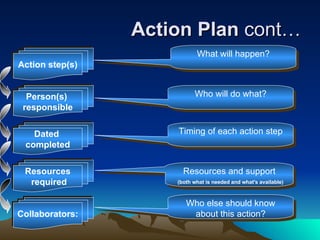
Action Plan  cont… Action step(s) Resources required Person(s)  responsible Collaborators: Dated  completed What will happen? Who will do what? Timing of each action step Resources and support (both what is needed and what's available) Who else should know about this action?
Thank You and Wassalam!

Strategic Planning: An Overview

  • 1.
    Strategic Planning OverviewGaphor M. Panimbang [email_address] [email_address] March 26-28, 2007
  • 2.
    What is StrategicPlanning? A disciplined effort to produce fundamental DECISIONS and ACTIONS that SHAPE and GUIDE what a cooperative is, what it does, and why it does it with a focus on the FUTURE. A process by which a group defines its own VMOSA .
  • 3.
    What is VMOSA?M O V S A VISION MISSION OBJECTIVES STRATEGIES ACTION PLAN
  • 4.
    VMOSA is… ? A practical planning process that can be used by any community organization or institution Planning tool that can help your organization by providing a blueprint for moving from dreams to actions to positive outcomes for your community.
  • 5.
    Why should yourorganization use VMOSA? It allows your organization to build consensus around your focus and the necessary steps your organization should take Allows your organization to focus on your short-term goals while always keeping sight of your long-term vision and mission The VMOSA process grounds for your dreams. It makes good ideas possible by laying out what needs to happen in order to succeed.
  • 6.
    When should youuse VMOSA? When you are starting a new organization. When you are trying to invigorate an older initiative that has lost its focus or momentum. When your organization is starting a new initiative or large project, or is going to begin work in a new direction. When your group is moving into a new phase of an ongoing effort.
  • 7.
    Planning Process Steps  Vision (the dream) Mission (the what and why) Objectives (how much of what will be accomplished by when) Strategies (the how) Action plan ( what change will happen who will do what by when to make it happen)
  • 8.
    VISION (the dream) Vision statements should be: Understood and shared by members of the community Broad enough to allow a diverse variety of local perspectives to be encompassed within them Inspiring and uplifting to everyone involved in your effort Easy to communicate
  • 9.
    Mission (thewhat and why) Guiding Principles Example: Socio-economic Empowerment Concise Outcome Oriented Inclusive
  • 10.
    Objectives (howmuch of what will be accomplished by when) Three basic types of objectives Behavioral Objectives Community- level Objectives Process Objectives
  • 11.
    Strategies (thehow) Five specific strategies can help guide most interventions. They are: Providing information and enhancing skills (e.g., Undertake continuous cooperative education to its members) Enhancing services and support (e.g.,extend financial assistance to its members for provident & productive purposes) Modify access, barriers, and opportunities (such as equal distribution of net surplus or patronage refund arising out of cooperative operations ) Change the consequences of efforts (e.g., provide incentives to the management staff) Modify policies (e.g., encourage deferment of patronage refund for revolving capital).
  • 12.
    Action plan (what change will happen; who will do what by when to make it happen) Specific (community and systems) changes to be sought Specific action steps necessary to bring about changes in all of the relevant sectors, or parts of the community/organization The Plan refers to:
  • 13.
    Action Plan cont… Action step(s) Resources required Person(s) responsible Collaborators: Dated completed What will happen? Who will do what? Timing of each action step Resources and support (both what is needed and what's available) Who else should know about this action?
  • 14.
    Thank You andWassalam!