MANAGEMENT 
INFORMATION SYSTEM
INTRODUCTION 
Like any other business activity, the long range plan for development as well as 
implementation is a basic necessity of MIS. In MIS, information is recognized as a major 
resource like capital, time and capacity. If the resource is to be managed well, it calls upon 
the management to plan for it and control it for the appropriate use in the organization. 
Computer technology has now become user-friendly in the manipulation of Information 
function of Storage, Communications, Intelligence and Language. Computers can now be 
used as a tool for information processing and communication. It can now be used for 
storing large database or knowledge base. It can be used for knowing the current status of 
any aspect of the business due to its on-line real time processing capability. Such a broad-based 
activity can be executed only when it is conceived as a system.
This system should deal with management information and not with 
data processing alone. It should provide support for management planning, 
decision making and action. It should support the needs of the lower 
management as well as that of the top management. It should provide support 
to the changing needs of business management. The plan of the MIS is 
concurrent to the Business Plan of the organization. To ensure that the 
information needs is concurrent with the implementation of the business plan, 
it is necessary that the business plan states the information needs. The 
information needs are then traced to the source data and the systems in 
organization which generate such a data. The details of information are 
provided to the operations management to assess the status of an activity and 
to find ways to make up, f necessary. Once the management needs are 
translated into information needs, it is left for the designer to evolve a plan of 
development and implementatio
DEVELOPMENT AND IMPLEMENTATION OF THE MIS 
The two Information System Development Models are: 
• Prototype Approach 
• Life Cycle Approach 
Prototype Approach 
When the system is complex, the development strategy is Prototyping of the system. 
Prototyping is the process of progressively ascertaining the information needs, developing methodology, trying it out 
on a smaller scale with respect to the data and the complexity, ensuring that it satisfies the needs of the users, and 
assess the problems of development and implementation.
This process, therefore, identifies the problem areas, inadequacies in the 
prototype vis-a-vis fulfillment of the information needs. 
The designer then takes steps to remove the inadequacies. This may call 
upon changing the prototype of the system, questioning the information 
needs, streamlining the operational systems and procedures and more 
user interaction.
Information System Development Model:Prototype Approach 
MISSION, 
GOALS 
IDENTIFY 
INFORMATION 
NEEDS 
DEFINE SYSTEM 
BOUNDARIES 
AND SCOPE 
DEFINE 
SYSTEM 
OBJECTIVE 
EXAMINE 
FEASIBILITY 
REFINE 
THE NEEDS 
DEVELOP AND 
TEST 
INITIAL 
PROTOTYPE 
DEVELOP 
INITIAL 
PROTOTYPE 
SPECIFICATIONS 
MODIFY 
PROTOTYPE 
SPECIFICATIONS 
DEVELOP 
REVISED 
PROTOTYPE 
IS 
THE USER 
SATISFIED? 
DEVELOP 
APPLICATION 
WITH FINAL 
SPECIFICATIONS 
REVIEW 
IMPLEMENT 
IN PARALLEL 
TRAINING 
DOCUMEN-TATION 
YES 
NO
In the prototyping approach, the designer’s task becomes difficult, when 
there are multiple users of the same system and the inputs they use are used by 
some other users as well. 
For example, a lot of input data comes from the purchase department, which is used in 
accounts and inventory management. 
The information has to be considered as a corporate resource wherein the functional, the 
departmental, the personal boundaries do not exist. 
Bringing the multiple users on the same platform and changing their attitudes towards 
information, as a corporate resource, is the managerial task of the system designer.
LIFE CYCLE APPROACH 
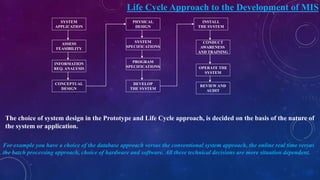
There are many systems or subsystems in the MIS which have a life cycle, that is, they have birth and death. 
They have hundred percent clarity of inputs and their sources, a definite set of outputs in terms of the 
contents and formats. 
These details more or less remain static from the day the system emerges and remains in that static mode for 
a long time. Minor modifications or changes do occur but they are not significant in terms of handling either 
by the designer or the user of the system. 
Such systems therefore have a life and they can be developed in a systematic manner, and can be reviewed 
after a year or two, for significant modification, if any. 
Examples of such systems are pay roll, share accounting, basic financial accounting, finished goods accounting 
and dispatching, order processing and so on. These systems have a fairly long duration of survival and they 
contribute in a big way as sources of data to the Corporate MIS.
Life Cycle Approach to the Development of MIS 
SYSTEM 
APPLICATION 
ASSESS 
FEASIBILITY 
INFORMATION 
REQ. ANALYSIS 
CONCEPTUAL 
DESIGN 
PHYSICAL 
DESIGN 
SYSTEM 
SPECIFICATIONS 
PROGRAM 
SPECIFICATIONS 
DEVELOP 
THE SYSTEM 
INSTALL 
THE SYSTEM 
CONDUCT 
AWARENESS 
AND TRAINING 
OPERATE THE 
SYSTEM 
REVIEW AND 
AUDIT 
The choice of system design in the Prototype and Life Cycle approach, is decided on the basis of the nature of 
the system or application. 
For example you have a choice of the database approach versus the conventional system approach, the online real time versus 
the batch processing approach, choice of hardware and software. All these technical decisions are more situation dependent.
Comparison of Approaches 
Prototyping Approach Life Cycle Approach 
Open system with a high degree of uncertainty about the 
information needs. 
Closed system with little or no uncertainty about the 
information needs. The system remains valid for a long 
time with no significant change. The design would remain 
stable. 
Necessary to try out the ideas, application and efficiency of 
the information as a decision support 
No need to try out the application of the information as it 
is already proven. 
Necessary to control the cost of the design and 
development before the scope of the system and its 
application is fully determined. Experimentation is 
necessary. 
Scope of the design and the application is fully determined 
wit clarity and experimentation is not necessary. 
User of the system wants to tryout the system before he 
commits the specification and the information 
requirements. 
The user is confident and confirms the specifications and 
the information needs. 
The system and application is highly custom oriented. The system and application is universal and governed by 
the principles and practices.
IMPLEMENTATION OF THE MIS 
The implementation of the MIS brings about organizational 
and behavioral change. It affects people and changes their work 
style .In the process of implementation, the system designer acts as 
a change agent or a catalyst. For a successful implementation he 
has to handle the human factors carefully. The user of the system 
has a certain fear complex when a certain cultural work change is 
occurring. The first and foremost fear is about the security to the 
person if the change-over from the old to new is not a smooth one. 
Care has to be taken to assure the user that such fears are baseless 
and the responsibility, therefore, rests with the designer.
There are certain guidelines for the systems designer for 
successful implementation of the system. The system designer 
should: 
1. Not question beyond a limit the information need of the user. 
2. Not forget that his role is to offer a service and not to demand terms. 
3. Remember that the system design is for the use of the user and it is not 
the designer’s prerogative to dictate the design features. In short, the 
designer should respect the demands of the user.
4. Not mix up technical needs with the information needs. 
5. Impress upon the user the global nature of the system design which is 
required to meet the current and prospective information need. 
6. Not challenge the application of the information in decision making. It is the 
sole right of the user to use the information the way he thinks. 
7. Impress upon the user that the quality of the information depends on the 
quality of input which he provides. 
8. Impress upon the user that he is one of the users in the organization and that 
the information is a corporate resource and he is expected to contribute to 
the development of the MIS.
9. Ensure that the user makes commitment to all the requirements of the system 
design specifications. 
10. Ensure that the overall system efforts has the management’s acceptance. 
11. Enlist the user’s participation from time to time,s o that he is emotionally 
involved in the process of development. 
12. Realize that through serving the user, he is his best guide on the complex path 
of development. 
13. Not expect perfect understanding from the user as he may be the user of non-computerized 
system. Hence, the designer should be prepared to change 
the system specifications or even the design during the course of 
development.
Implementation of the MIS in an organization is a process where organizational 
transformation takes place. This change can occur in a number of ways. 
Lewin’s model suggests three steps in this process. 
1. The first step is unfreezing the organization to make the people more receptive 
and interested in the change. 
2. The second step is choosing a course of action where the process begins and 
reaches the desired level. 
3. The third step is Refreezing, where the change is consolidated and equilibrium is 
reinforced.
Many a times, this process is implemented through an external change agent, 
such as a consultant, playing the role of a catalyst. 
The significant problem in this task is the resistance to change. 
The resistance can occur due to three reasons, viz., the factors internal to the users 
of information, the factors inherent in the design of the system and the factors 
arising out of the interaction between the system and its users. 
The problem of resistance can be handled through education, persuasion, and 
participation. This itself can be achieved by improving the human factors, and 
providing the incentives to the users, and eliminating the organizational problems 
before implementing the system.
ORGANIZATION FOR DEVELOPMENT OF THE MIS 
The organization structure of the MIS would differ from one organization to the other. 
The type, the size and the structure of corporate organization becomes the basis for the MIS 
organization for handling the MIS function and management alternatives. The major 
issues involved are: 
1. Whether the function should be handled as a centralized or decentralized activity. 
2. The allocation of the hardware and software resources. 
3. The maintenance of the service level at an appropriate level. 
4. Fitting the organization of the MIS in the corporate organization, its culture and the 
management philosophy.
The question of centralization versus decentralization is resolved by assessing 
the status of information resource in the organization, I.e., whether the status is the 
information systems management or the information resource management. 
When it is a case of information systems management then the organization of the 
MIS would be centralized, but if it is a case of information resource management, it 
will be decentralized organization. 
In a centralized system, the user of the information is free from the responsibility of 
designing the systems and also from deciding the hardware and the software.
However, if the information needs are varying and is more 
strategic in nature, the rliance on the centralized set-up becomes 
a difficult workable proposition. When such a situation arises, a 
decentralized organization is more effective. 
In a real life situation, the variations of these two approaches are 
found, mainly on account of the variety of hardware, software 
solutions. One can develop two models of the MIS organization.
Centralized Organization of MIS 
MANAGING 
DIRECTOR 
HEAD OF 
MIS 
HARDWARE AND 
SOFTWARE 
CENTRALIZED SYSTEM 
DEVELOPMENT 
OPERATIONS, 
MAINTENANCE 
SELECTION, UPGRADE, 
EXPANSION DECISIONS 
TECHNOLOGY 
UPGRADE DECISIONS 
INFORMATION SYSTEM 
PLANNING 
TRAINING 
MANAGEMENT AND 
DEVELOPMENT 
RUNNING DAY TO DAY 
OPERATIONS, BACK UP 
SYSTEM MAINTENANCE, 
SOFTWARE MAINTENANCE
MANAGING 
DIRECTOR 
Decentralized Organization of MIS 
HEAD OF 
MIS 
MANAGEMENT OF 
HARDWARE 
ADVISE ON HARDWARE 
AND SOFTWARE TECHNOLOGY 
TRAINING AND 
SUPPORT 
DISTRIBUTED OR 
DECENTRALIZED DECISION 
MAINTENANCE OF 
HARDWARE AND SOFTWARE 
SELECTION OF 
HARDWARE SOLUTION 
SELECTION OF 
LANGUAGE, OS. 
ASSISST USERS IN SYSTEM 
DEVELOPMENT 
TRAINING AND 
PROBLEM SOLVING 
CORPORATE 
DBMS
Thank Yooooo……..

Management information system

  • 1.
  • 2.
    INTRODUCTION Like anyother business activity, the long range plan for development as well as implementation is a basic necessity of MIS. In MIS, information is recognized as a major resource like capital, time and capacity. If the resource is to be managed well, it calls upon the management to plan for it and control it for the appropriate use in the organization. Computer technology has now become user-friendly in the manipulation of Information function of Storage, Communications, Intelligence and Language. Computers can now be used as a tool for information processing and communication. It can now be used for storing large database or knowledge base. It can be used for knowing the current status of any aspect of the business due to its on-line real time processing capability. Such a broad-based activity can be executed only when it is conceived as a system.
  • 3.
    This system shoulddeal with management information and not with data processing alone. It should provide support for management planning, decision making and action. It should support the needs of the lower management as well as that of the top management. It should provide support to the changing needs of business management. The plan of the MIS is concurrent to the Business Plan of the organization. To ensure that the information needs is concurrent with the implementation of the business plan, it is necessary that the business plan states the information needs. The information needs are then traced to the source data and the systems in organization which generate such a data. The details of information are provided to the operations management to assess the status of an activity and to find ways to make up, f necessary. Once the management needs are translated into information needs, it is left for the designer to evolve a plan of development and implementatio
  • 4.
    DEVELOPMENT AND IMPLEMENTATIONOF THE MIS The two Information System Development Models are: • Prototype Approach • Life Cycle Approach Prototype Approach When the system is complex, the development strategy is Prototyping of the system. Prototyping is the process of progressively ascertaining the information needs, developing methodology, trying it out on a smaller scale with respect to the data and the complexity, ensuring that it satisfies the needs of the users, and assess the problems of development and implementation.
  • 5.
    This process, therefore,identifies the problem areas, inadequacies in the prototype vis-a-vis fulfillment of the information needs. The designer then takes steps to remove the inadequacies. This may call upon changing the prototype of the system, questioning the information needs, streamlining the operational systems and procedures and more user interaction.
  • 6.
    Information System DevelopmentModel:Prototype Approach MISSION, GOALS IDENTIFY INFORMATION NEEDS DEFINE SYSTEM BOUNDARIES AND SCOPE DEFINE SYSTEM OBJECTIVE EXAMINE FEASIBILITY REFINE THE NEEDS DEVELOP AND TEST INITIAL PROTOTYPE DEVELOP INITIAL PROTOTYPE SPECIFICATIONS MODIFY PROTOTYPE SPECIFICATIONS DEVELOP REVISED PROTOTYPE IS THE USER SATISFIED? DEVELOP APPLICATION WITH FINAL SPECIFICATIONS REVIEW IMPLEMENT IN PARALLEL TRAINING DOCUMEN-TATION YES NO
  • 7.
    In the prototypingapproach, the designer’s task becomes difficult, when there are multiple users of the same system and the inputs they use are used by some other users as well. For example, a lot of input data comes from the purchase department, which is used in accounts and inventory management. The information has to be considered as a corporate resource wherein the functional, the departmental, the personal boundaries do not exist. Bringing the multiple users on the same platform and changing their attitudes towards information, as a corporate resource, is the managerial task of the system designer.
  • 8.
    LIFE CYCLE APPROACH There are many systems or subsystems in the MIS which have a life cycle, that is, they have birth and death. They have hundred percent clarity of inputs and their sources, a definite set of outputs in terms of the contents and formats. These details more or less remain static from the day the system emerges and remains in that static mode for a long time. Minor modifications or changes do occur but they are not significant in terms of handling either by the designer or the user of the system. Such systems therefore have a life and they can be developed in a systematic manner, and can be reviewed after a year or two, for significant modification, if any. Examples of such systems are pay roll, share accounting, basic financial accounting, finished goods accounting and dispatching, order processing and so on. These systems have a fairly long duration of survival and they contribute in a big way as sources of data to the Corporate MIS.
  • 9.
    Life Cycle Approachto the Development of MIS SYSTEM APPLICATION ASSESS FEASIBILITY INFORMATION REQ. ANALYSIS CONCEPTUAL DESIGN PHYSICAL DESIGN SYSTEM SPECIFICATIONS PROGRAM SPECIFICATIONS DEVELOP THE SYSTEM INSTALL THE SYSTEM CONDUCT AWARENESS AND TRAINING OPERATE THE SYSTEM REVIEW AND AUDIT The choice of system design in the Prototype and Life Cycle approach, is decided on the basis of the nature of the system or application. For example you have a choice of the database approach versus the conventional system approach, the online real time versus the batch processing approach, choice of hardware and software. All these technical decisions are more situation dependent.
  • 10.
    Comparison of Approaches Prototyping Approach Life Cycle Approach Open system with a high degree of uncertainty about the information needs. Closed system with little or no uncertainty about the information needs. The system remains valid for a long time with no significant change. The design would remain stable. Necessary to try out the ideas, application and efficiency of the information as a decision support No need to try out the application of the information as it is already proven. Necessary to control the cost of the design and development before the scope of the system and its application is fully determined. Experimentation is necessary. Scope of the design and the application is fully determined wit clarity and experimentation is not necessary. User of the system wants to tryout the system before he commits the specification and the information requirements. The user is confident and confirms the specifications and the information needs. The system and application is highly custom oriented. The system and application is universal and governed by the principles and practices.
  • 11.
    IMPLEMENTATION OF THEMIS The implementation of the MIS brings about organizational and behavioral change. It affects people and changes their work style .In the process of implementation, the system designer acts as a change agent or a catalyst. For a successful implementation he has to handle the human factors carefully. The user of the system has a certain fear complex when a certain cultural work change is occurring. The first and foremost fear is about the security to the person if the change-over from the old to new is not a smooth one. Care has to be taken to assure the user that such fears are baseless and the responsibility, therefore, rests with the designer.
  • 12.
    There are certainguidelines for the systems designer for successful implementation of the system. The system designer should: 1. Not question beyond a limit the information need of the user. 2. Not forget that his role is to offer a service and not to demand terms. 3. Remember that the system design is for the use of the user and it is not the designer’s prerogative to dictate the design features. In short, the designer should respect the demands of the user.
  • 13.
    4. Not mixup technical needs with the information needs. 5. Impress upon the user the global nature of the system design which is required to meet the current and prospective information need. 6. Not challenge the application of the information in decision making. It is the sole right of the user to use the information the way he thinks. 7. Impress upon the user that the quality of the information depends on the quality of input which he provides. 8. Impress upon the user that he is one of the users in the organization and that the information is a corporate resource and he is expected to contribute to the development of the MIS.
  • 14.
    9. Ensure thatthe user makes commitment to all the requirements of the system design specifications. 10. Ensure that the overall system efforts has the management’s acceptance. 11. Enlist the user’s participation from time to time,s o that he is emotionally involved in the process of development. 12. Realize that through serving the user, he is his best guide on the complex path of development. 13. Not expect perfect understanding from the user as he may be the user of non-computerized system. Hence, the designer should be prepared to change the system specifications or even the design during the course of development.
  • 15.
    Implementation of theMIS in an organization is a process where organizational transformation takes place. This change can occur in a number of ways. Lewin’s model suggests three steps in this process. 1. The first step is unfreezing the organization to make the people more receptive and interested in the change. 2. The second step is choosing a course of action where the process begins and reaches the desired level. 3. The third step is Refreezing, where the change is consolidated and equilibrium is reinforced.
  • 16.
    Many a times,this process is implemented through an external change agent, such as a consultant, playing the role of a catalyst. The significant problem in this task is the resistance to change. The resistance can occur due to three reasons, viz., the factors internal to the users of information, the factors inherent in the design of the system and the factors arising out of the interaction between the system and its users. The problem of resistance can be handled through education, persuasion, and participation. This itself can be achieved by improving the human factors, and providing the incentives to the users, and eliminating the organizational problems before implementing the system.
  • 17.
    ORGANIZATION FOR DEVELOPMENTOF THE MIS The organization structure of the MIS would differ from one organization to the other. The type, the size and the structure of corporate organization becomes the basis for the MIS organization for handling the MIS function and management alternatives. The major issues involved are: 1. Whether the function should be handled as a centralized or decentralized activity. 2. The allocation of the hardware and software resources. 3. The maintenance of the service level at an appropriate level. 4. Fitting the organization of the MIS in the corporate organization, its culture and the management philosophy.
  • 18.
    The question ofcentralization versus decentralization is resolved by assessing the status of information resource in the organization, I.e., whether the status is the information systems management or the information resource management. When it is a case of information systems management then the organization of the MIS would be centralized, but if it is a case of information resource management, it will be decentralized organization. In a centralized system, the user of the information is free from the responsibility of designing the systems and also from deciding the hardware and the software.
  • 19.
    However, if theinformation needs are varying and is more strategic in nature, the rliance on the centralized set-up becomes a difficult workable proposition. When such a situation arises, a decentralized organization is more effective. In a real life situation, the variations of these two approaches are found, mainly on account of the variety of hardware, software solutions. One can develop two models of the MIS organization.
  • 20.
    Centralized Organization ofMIS MANAGING DIRECTOR HEAD OF MIS HARDWARE AND SOFTWARE CENTRALIZED SYSTEM DEVELOPMENT OPERATIONS, MAINTENANCE SELECTION, UPGRADE, EXPANSION DECISIONS TECHNOLOGY UPGRADE DECISIONS INFORMATION SYSTEM PLANNING TRAINING MANAGEMENT AND DEVELOPMENT RUNNING DAY TO DAY OPERATIONS, BACK UP SYSTEM MAINTENANCE, SOFTWARE MAINTENANCE
  • 21.
    MANAGING DIRECTOR DecentralizedOrganization of MIS HEAD OF MIS MANAGEMENT OF HARDWARE ADVISE ON HARDWARE AND SOFTWARE TECHNOLOGY TRAINING AND SUPPORT DISTRIBUTED OR DECENTRALIZED DECISION MAINTENANCE OF HARDWARE AND SOFTWARE SELECTION OF HARDWARE SOLUTION SELECTION OF LANGUAGE, OS. ASSISST USERS IN SYSTEM DEVELOPMENT TRAINING AND PROBLEM SOLVING CORPORATE DBMS
  • 22.