

IT Governance
Capability Assessment using COBIT 5 PAM
Eryk Budi Pratama
Presented for Information System Faculty– Universitas Bakrie
Objectives
IT Governance
Governance of Enterprise IT
Domain, Product Family, Coverage
COBIT 5 Framework
PAM using COBIT 5
Process Assessment Model (PAM)
Self Assessment Guide using COBIT 5
Self Assessment
Methodology for IT Governance Engagement
Engagement Delivery Approach
IT Governance
Governance of Enterprise IT
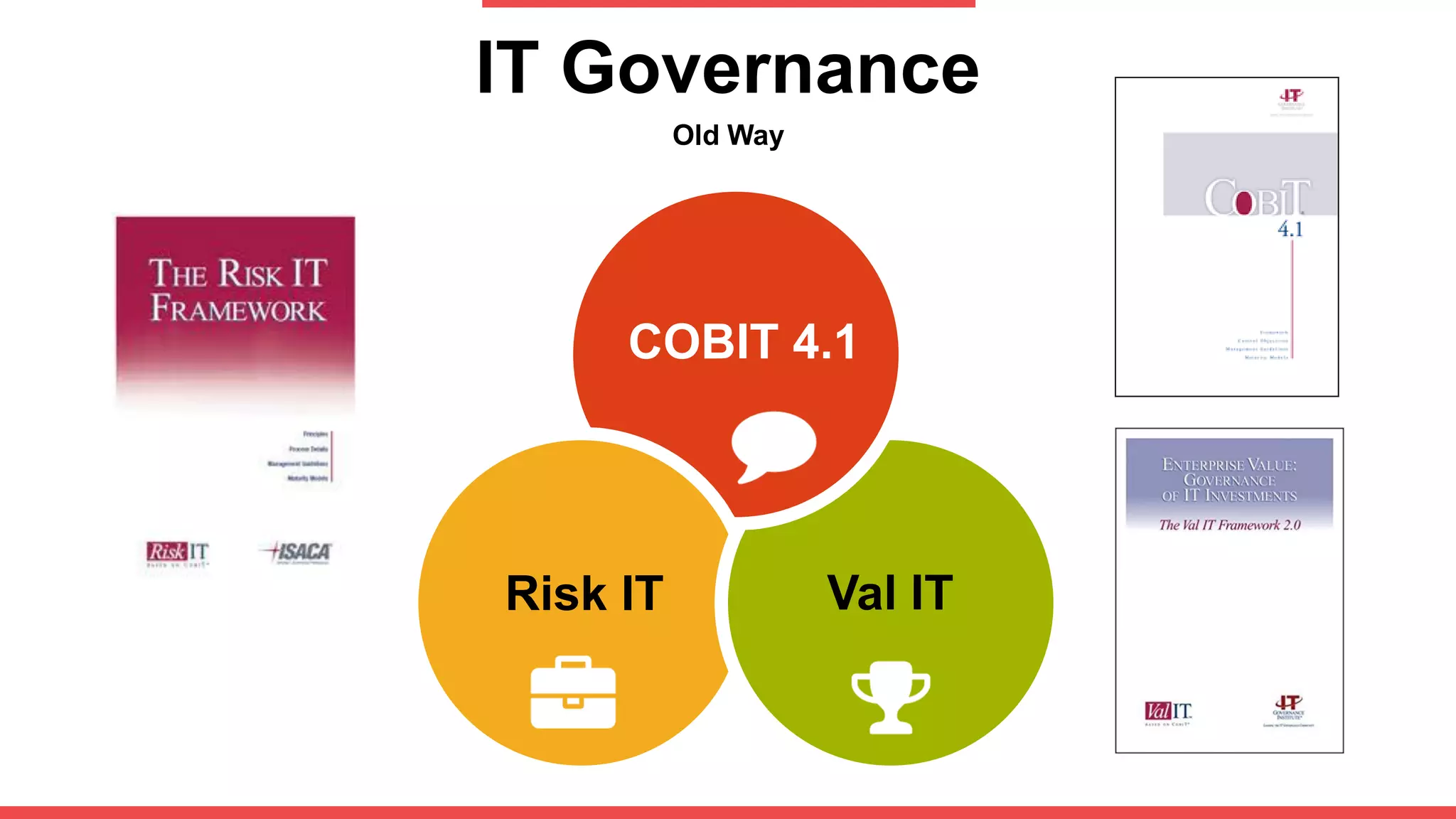
IT Governance
Old Way
COBIT 4.1
Val ITRisk IT
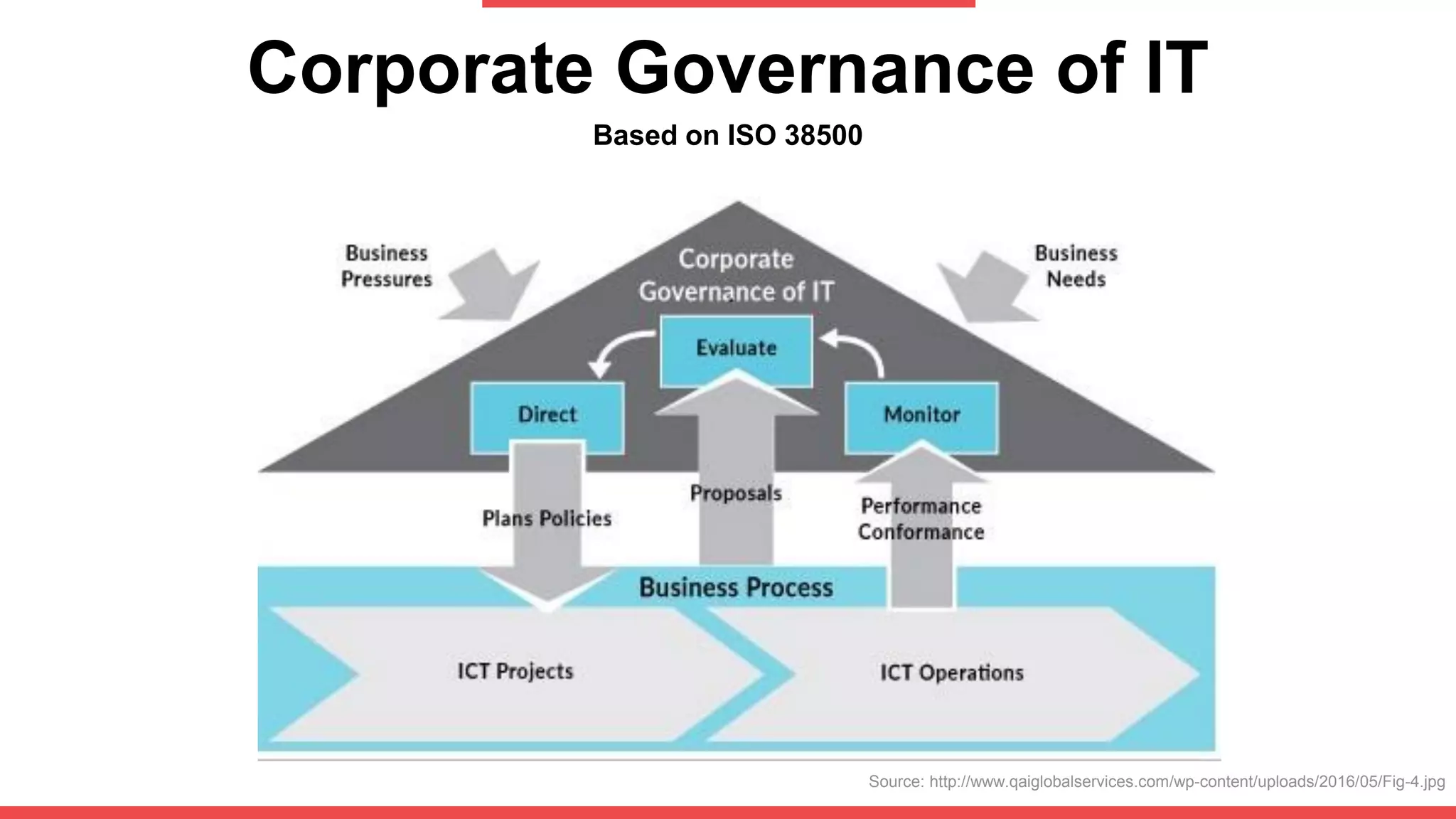
Corporate Governance of IT
Based on ISO 38500
Source: http://www.qaiglobalservices.com/wp-content/uploads/2016/05/Fig-4.jpg
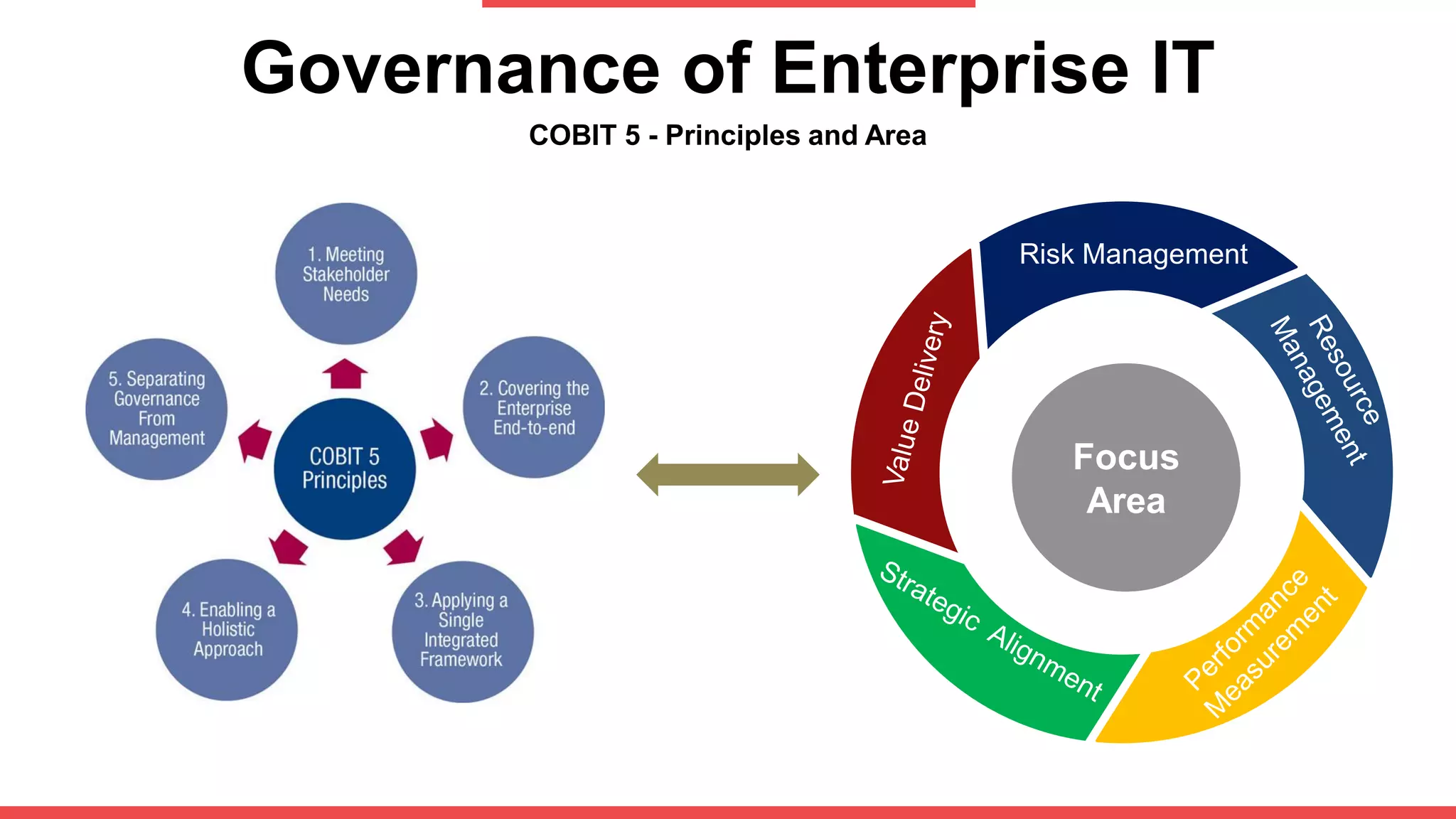
Governance of Enterprise IT
COBIT 5 - Principles and Area
Risk Management
Focus
Area
COBIT 5 Framework
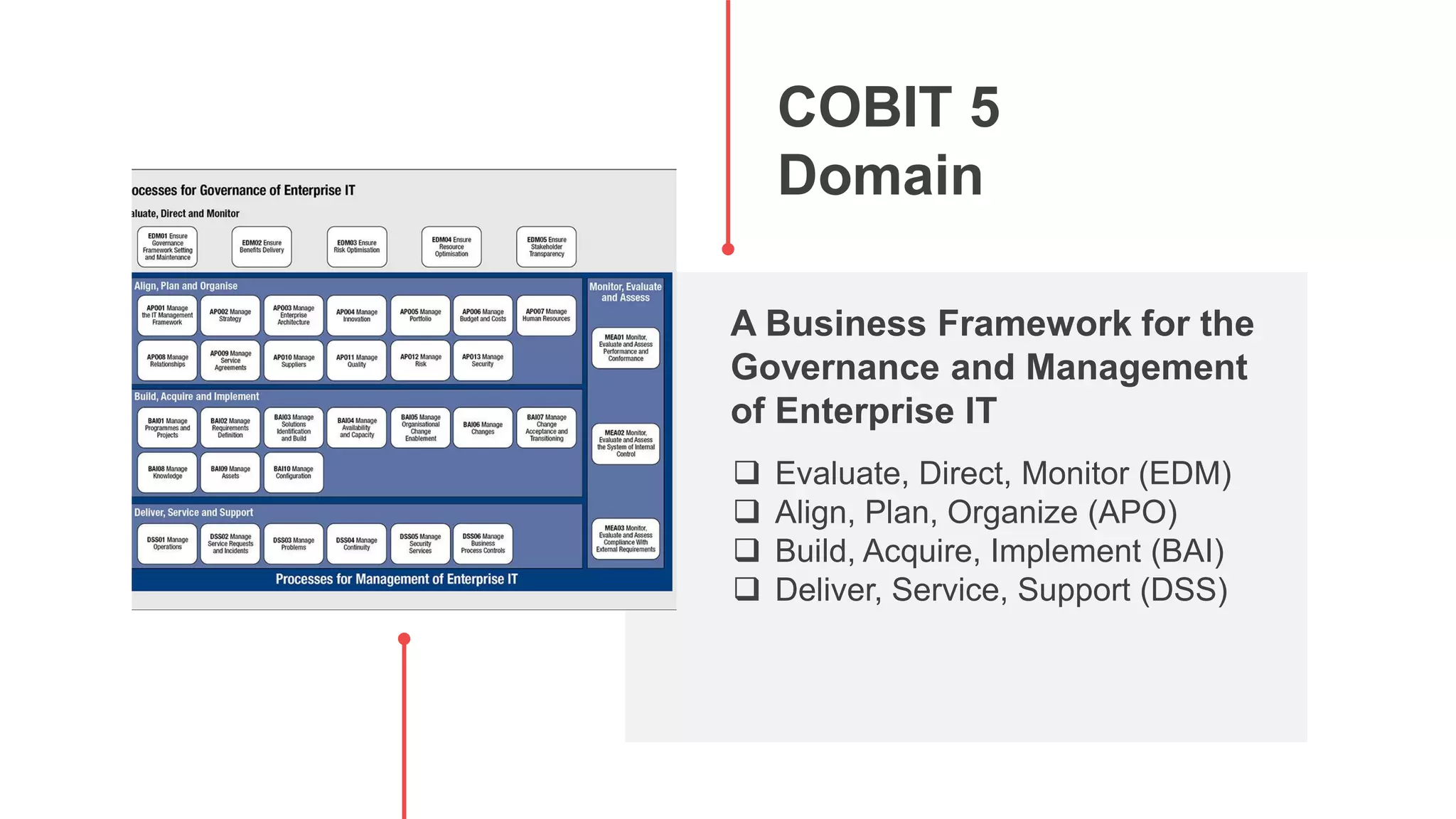
COBIT 5
Domain
❑ Evaluate, Direct, Monitor (EDM)
❑ Align, Plan, Organize (APO)
❑ Build, Acquire, Implement (BAI)
❑ Deliver, Service, Support (DSS)
A Business Framework for the
Governance and Management
of Enterprise IT
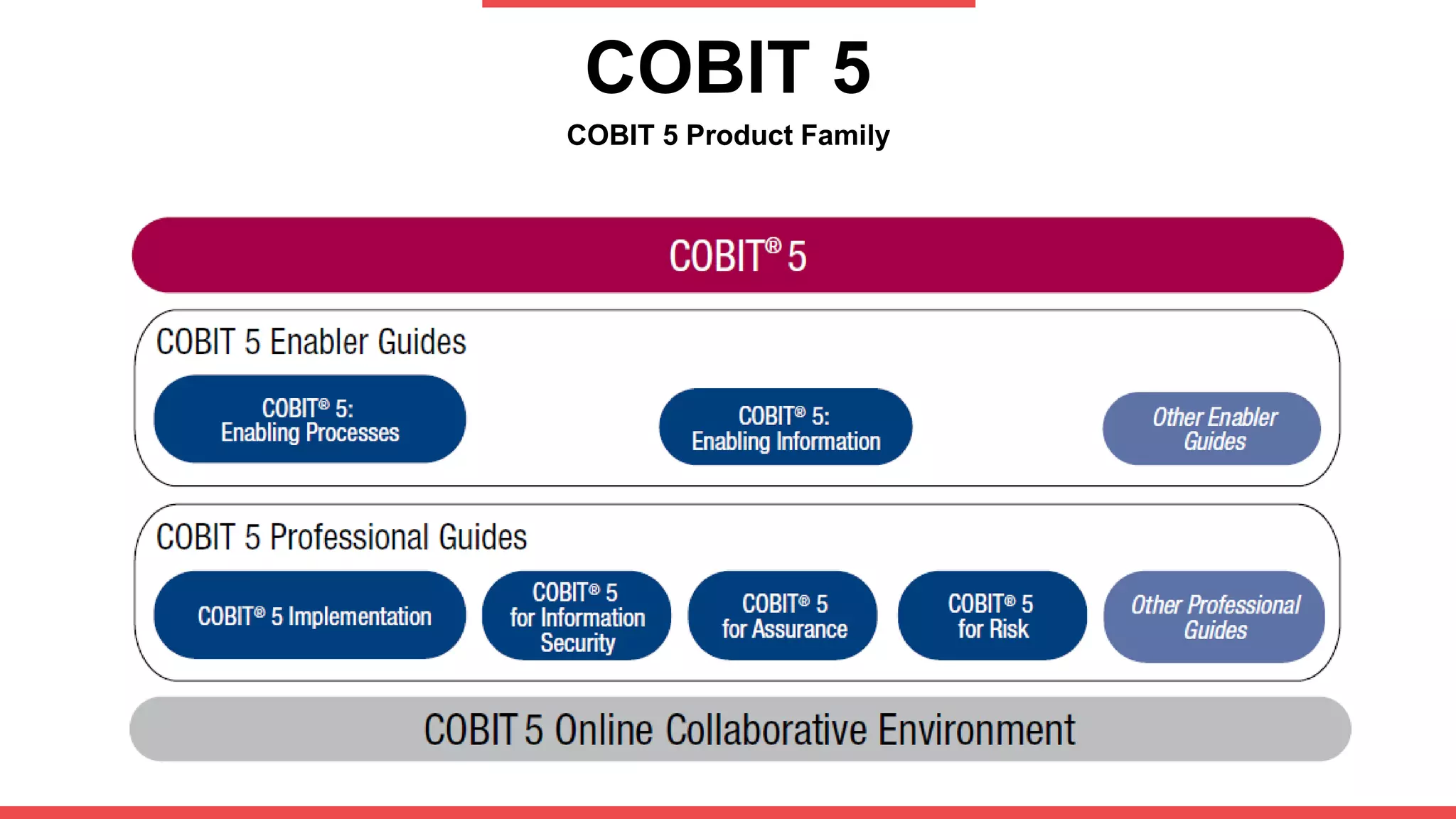
COBIT 5
COBIT 5 Product Family
COBIT 5
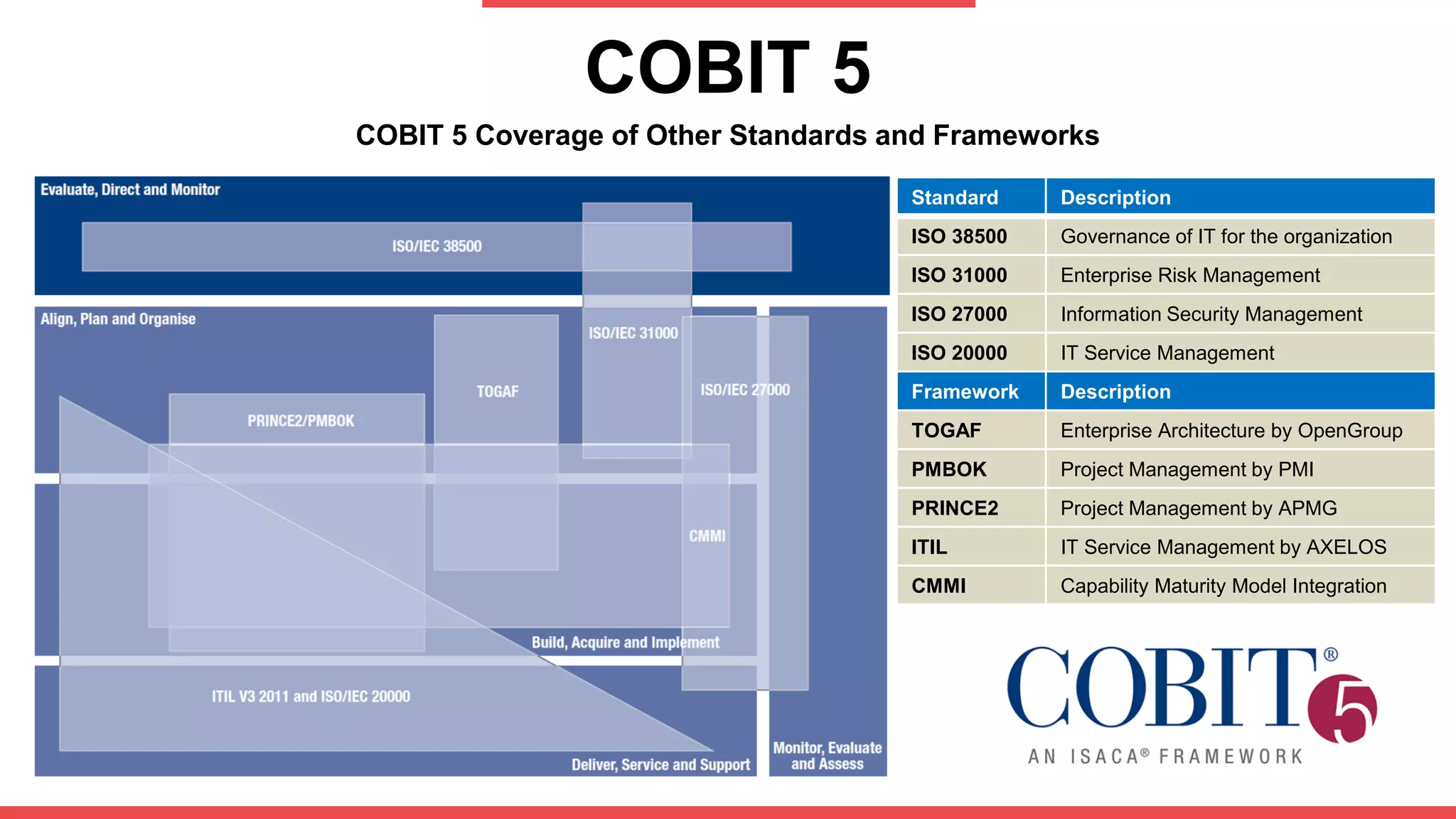
COBIT 5 Coverage of Other Standards and Frameworks
Standard Description
ISO 38500 Governance of IT for the organization
ISO 31000 Enterprise Risk Management
ISO 27000 Information Security Management
ISO 20000 IT Service Management
Framework Description
TOGAF Enterprise Architecture by OpenGroup
PMBOK Project Management by PMI
PRINCE2 Project Management by APMG
ITIL IT Service Management by AXELOS
CMMI Capability Maturity Model Integration
Process Assessment Model
(PAM)
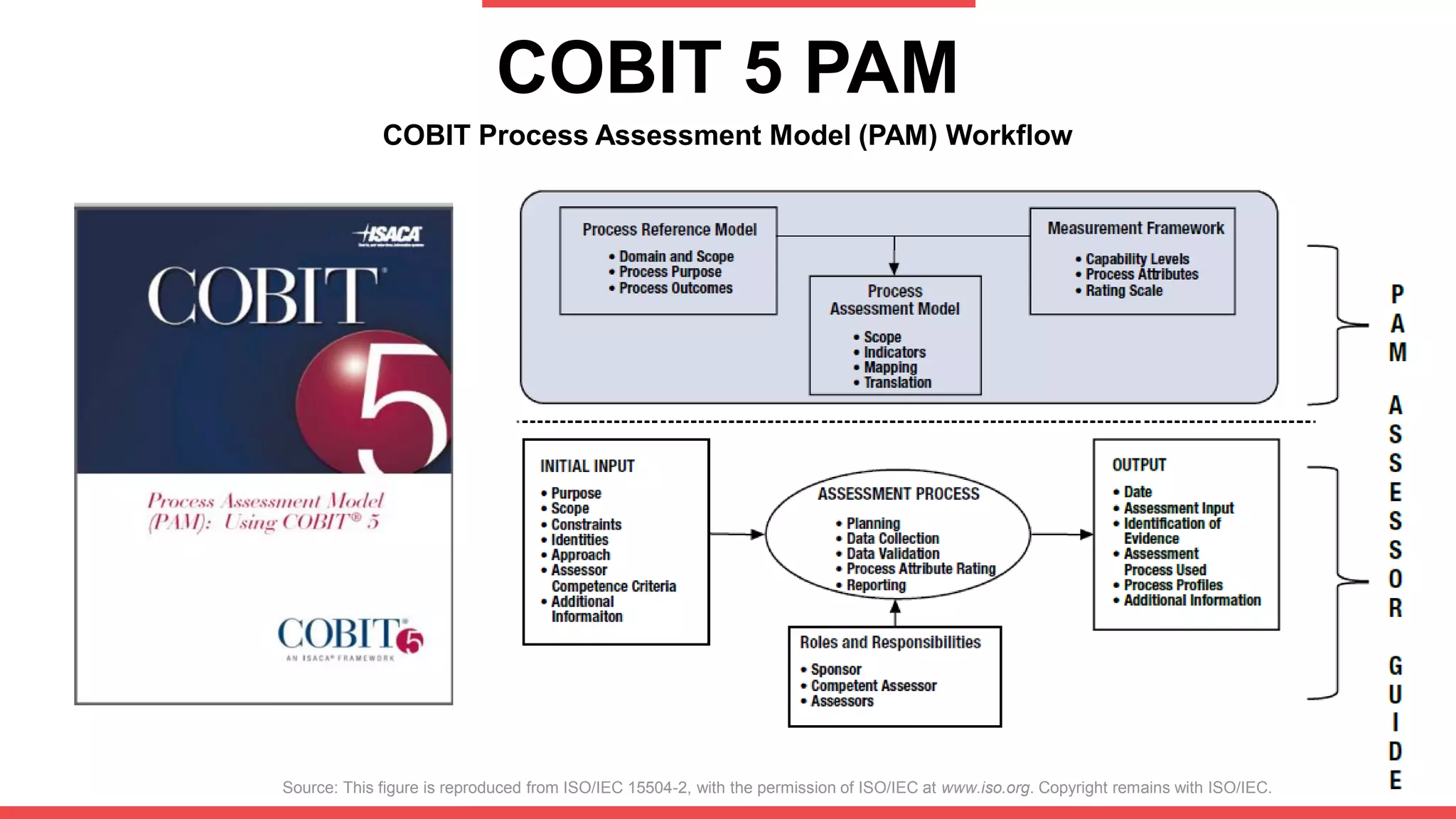
COBIT 5 PAM
COBIT Process Assessment Model (PAM) Workflow
Source: This figure is reproduced from ISO/IEC 15504-2, with the permission of ISO/IEC at www.iso.org. Copyright remains with ISO/IEC.
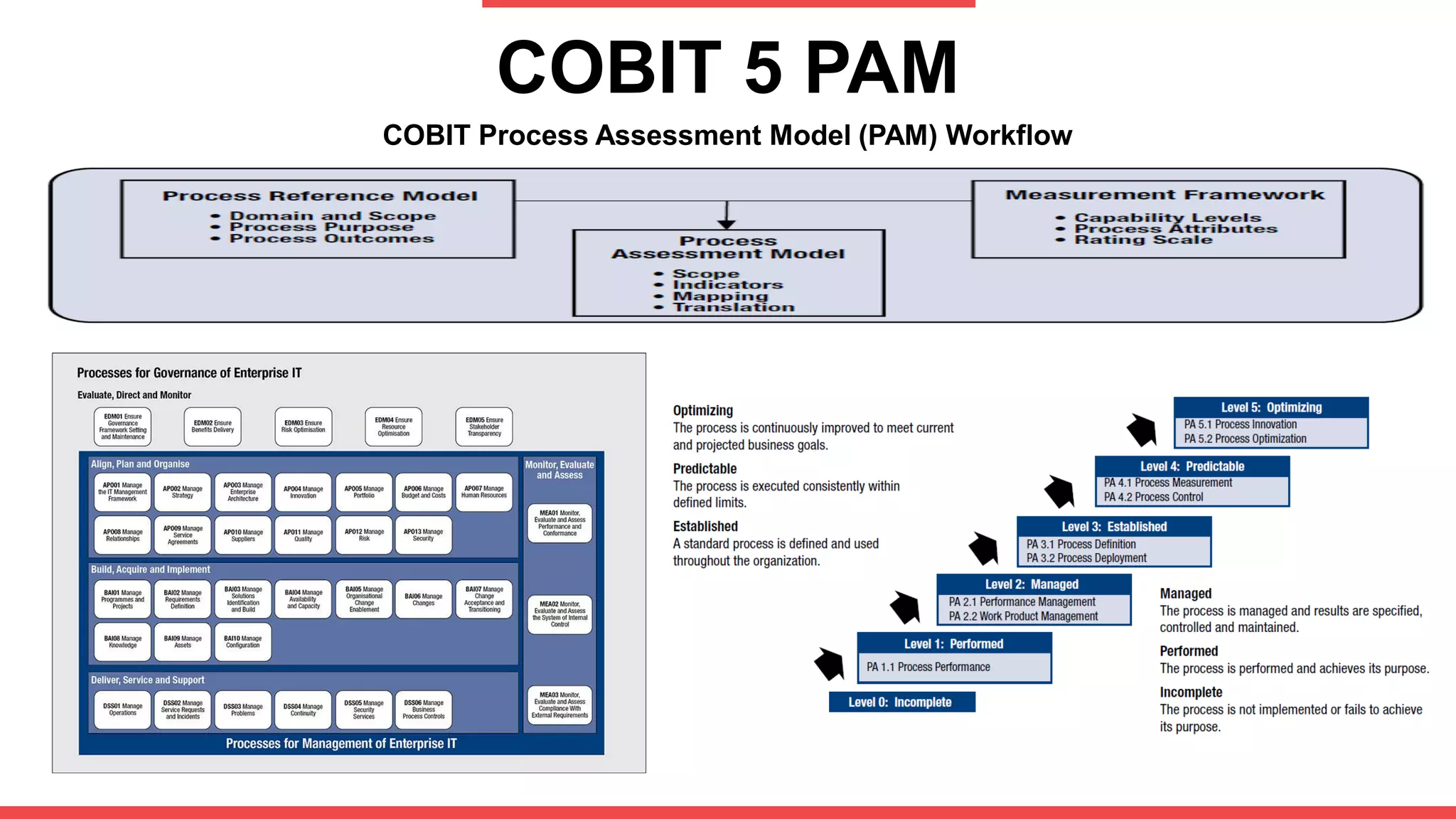
COBIT 5 PAM
COBIT Process Assessment Model (PAM) Workflow
COBIT 5 PAM
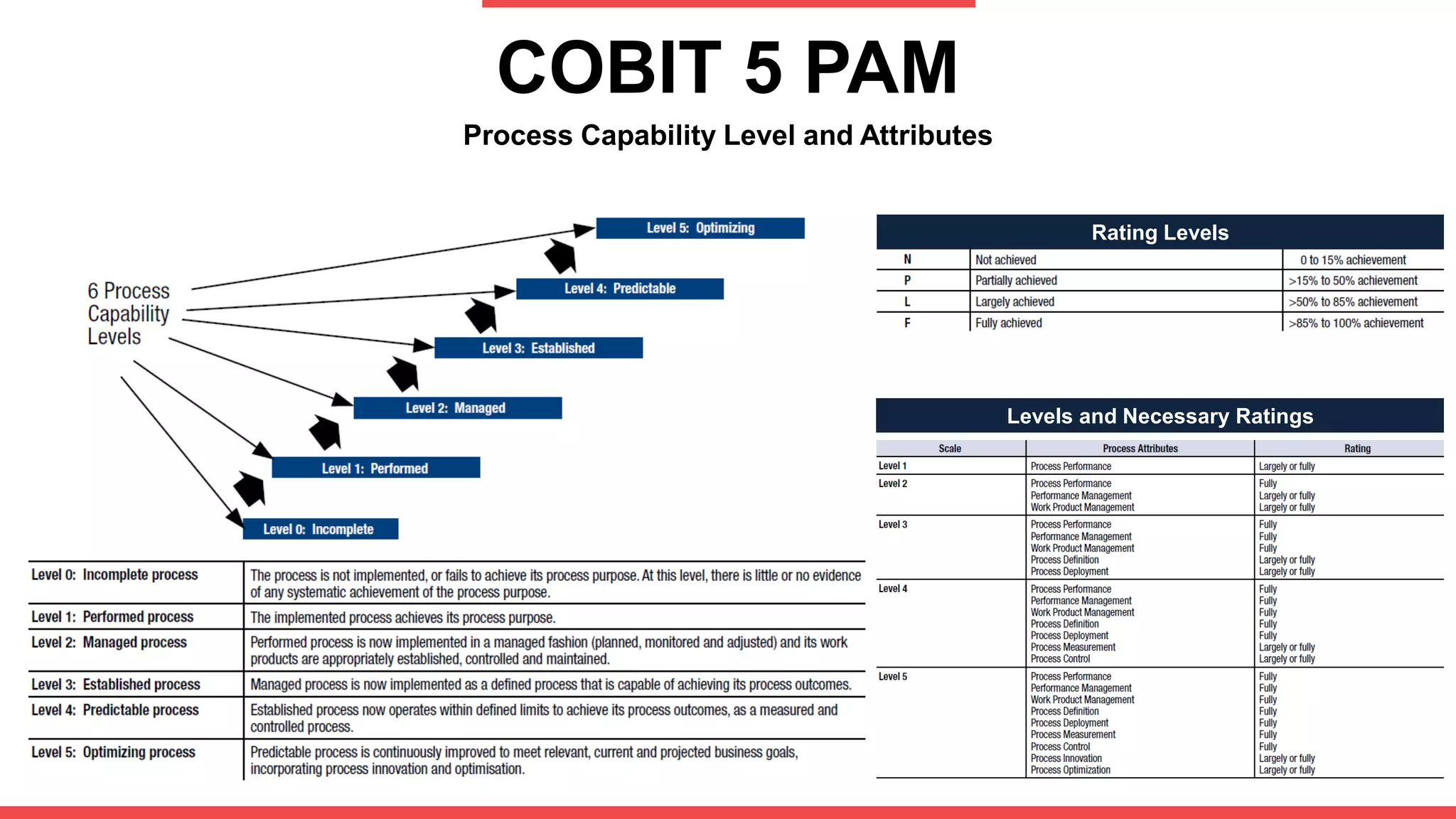
Process Capability Level and Attributes
Rating Levels
Levels and Necessary Ratings
COBIT 5 PAM
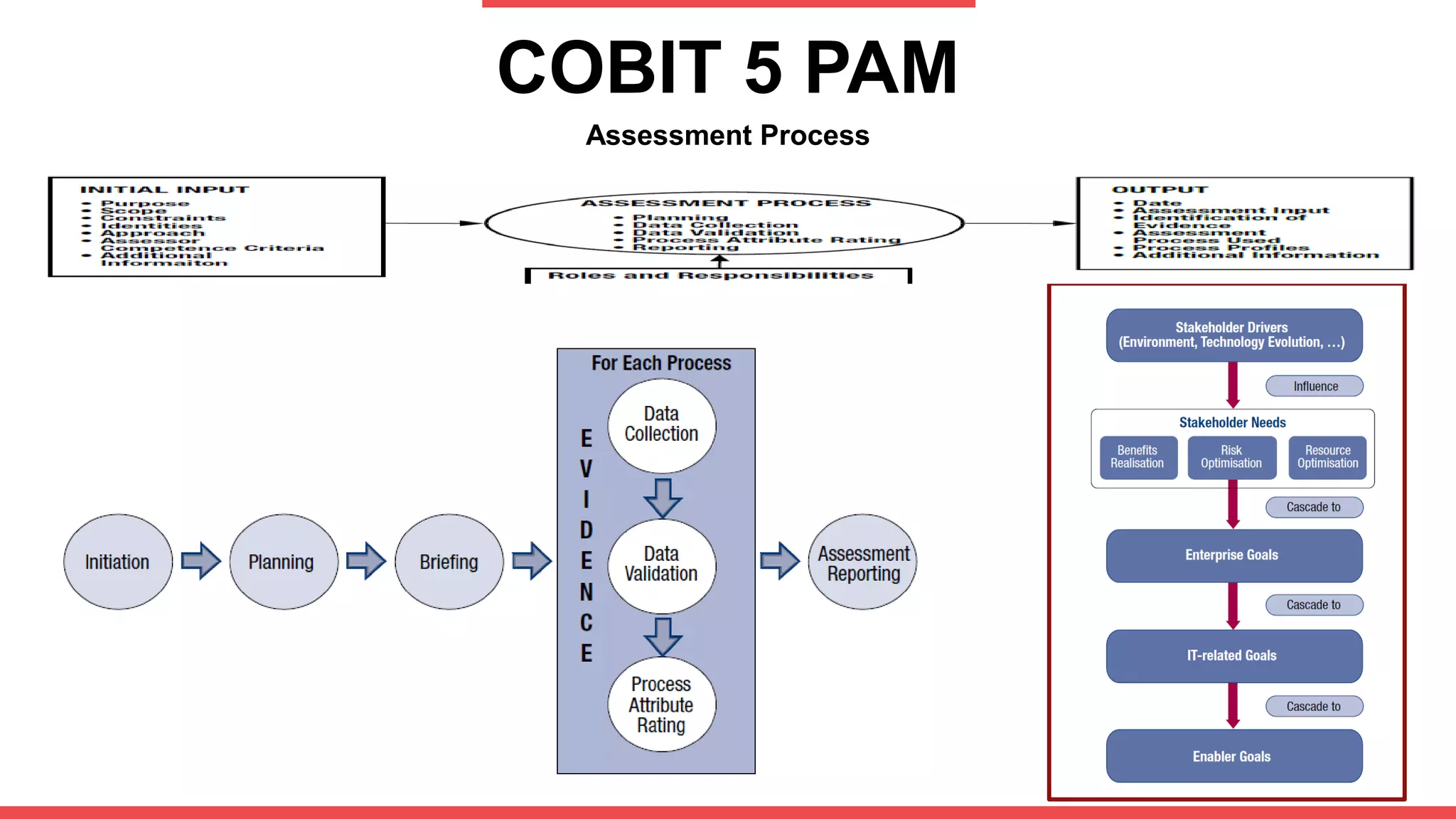
Assessment Process
Self Assessment
Self Assessment
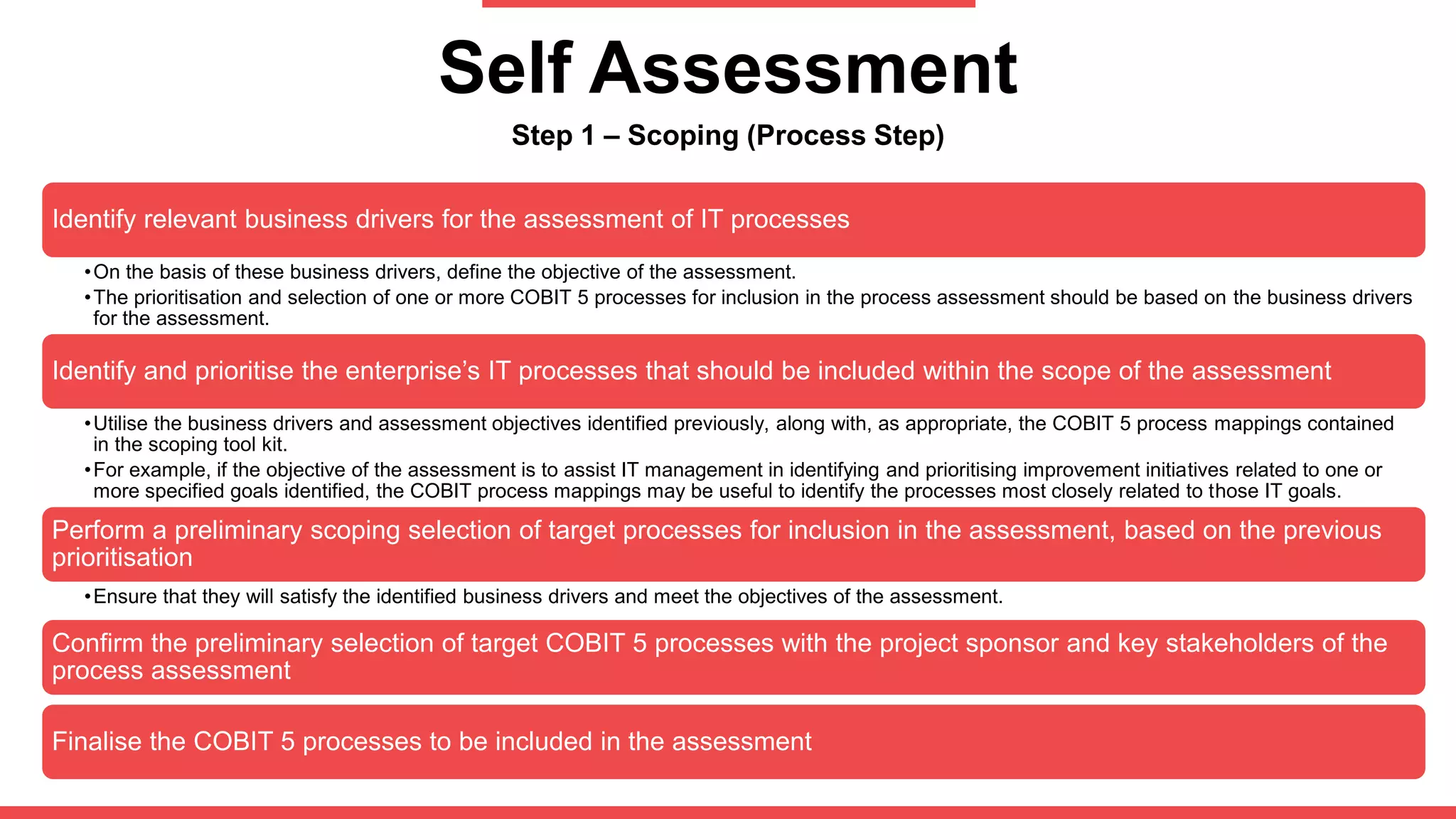
Step 1 – Scoping (Process Step)
Identify relevant business drivers for the assessment of IT processes
•On the basis of these business drivers, define the objective of the assessment.
•The prioritisation and selection of one or more COBIT 5 processes for inclusion in the process assessment should be based on the business drivers
for the assessment.
Identify and prioritise the enterprise’s IT processes that should be included within the scope of the assessment
•Utilise the business drivers and assessment objectives identified previously, along with, as appropriate, the COBIT 5 process mappings contained
in the scoping tool kit.
•For example, if the objective of the assessment is to assist IT management in identifying and prioritising improvement initiatives related to one or
more specified goals identified, the COBIT process mappings may be useful to identify the processes most closely related to those IT goals.
Perform a preliminary scoping selection of target processes for inclusion in the assessment, based on the previous
prioritisation
•Ensure that they will satisfy the identified business drivers and meet the objectives of the assessment.
Confirm the preliminary selection of target COBIT 5 processes with the project sponsor and key stakeholders of the
process assessment
Finalise the COBIT 5 processes to be included in the assessment
Self Assessment
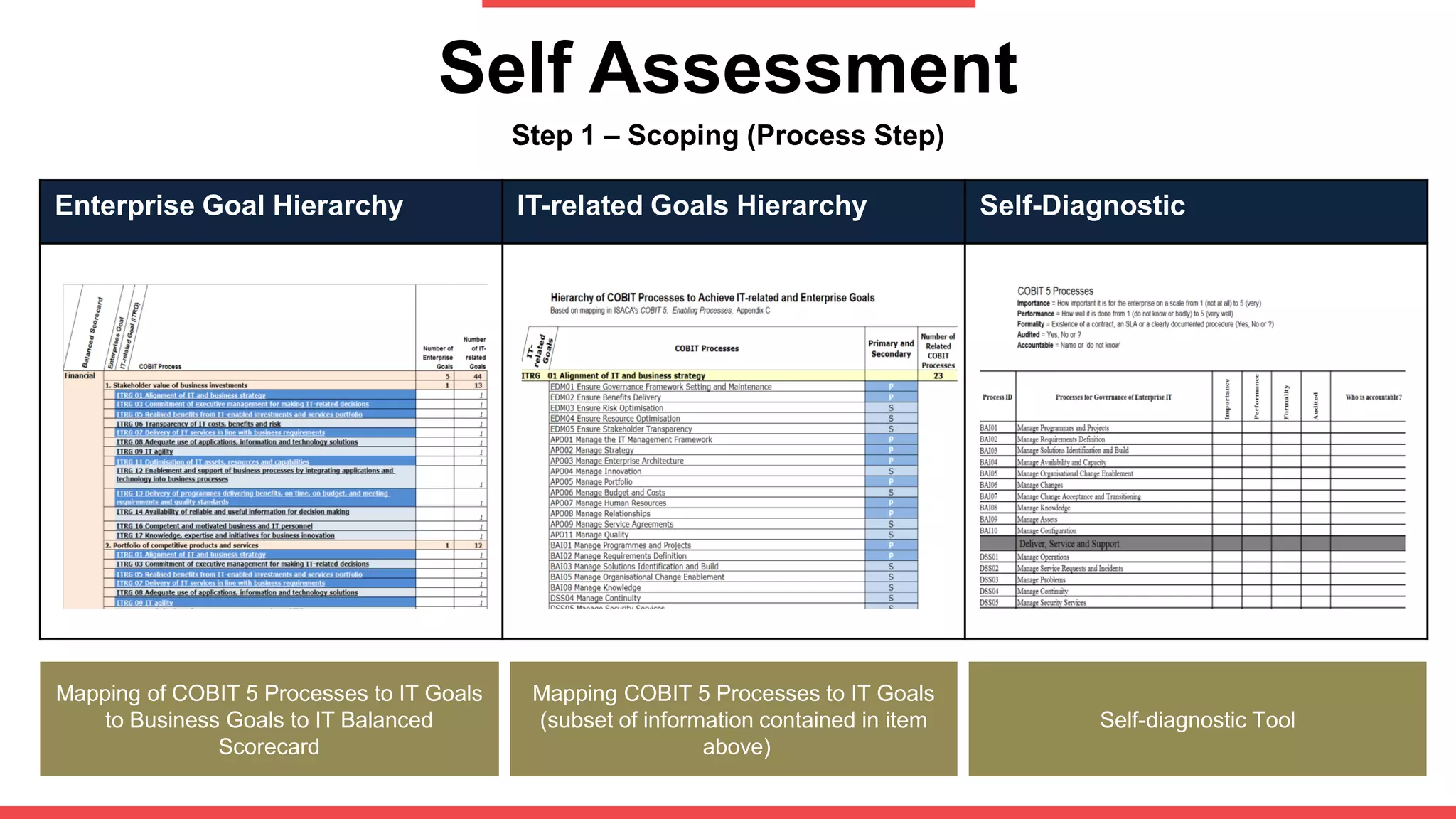
Step 1 – Scoping (Process Step)
Enterprise Goal Hierarchy IT-related Goals Hierarchy Self-Diagnostic
Mapping of COBIT 5 Processes to IT Goals
to Business Goals to IT Balanced
Scorecard
Mapping COBIT 5 Processes to IT Goals
(subset of information contained in item
above)
Self-diagnostic Tool
Self Assessment
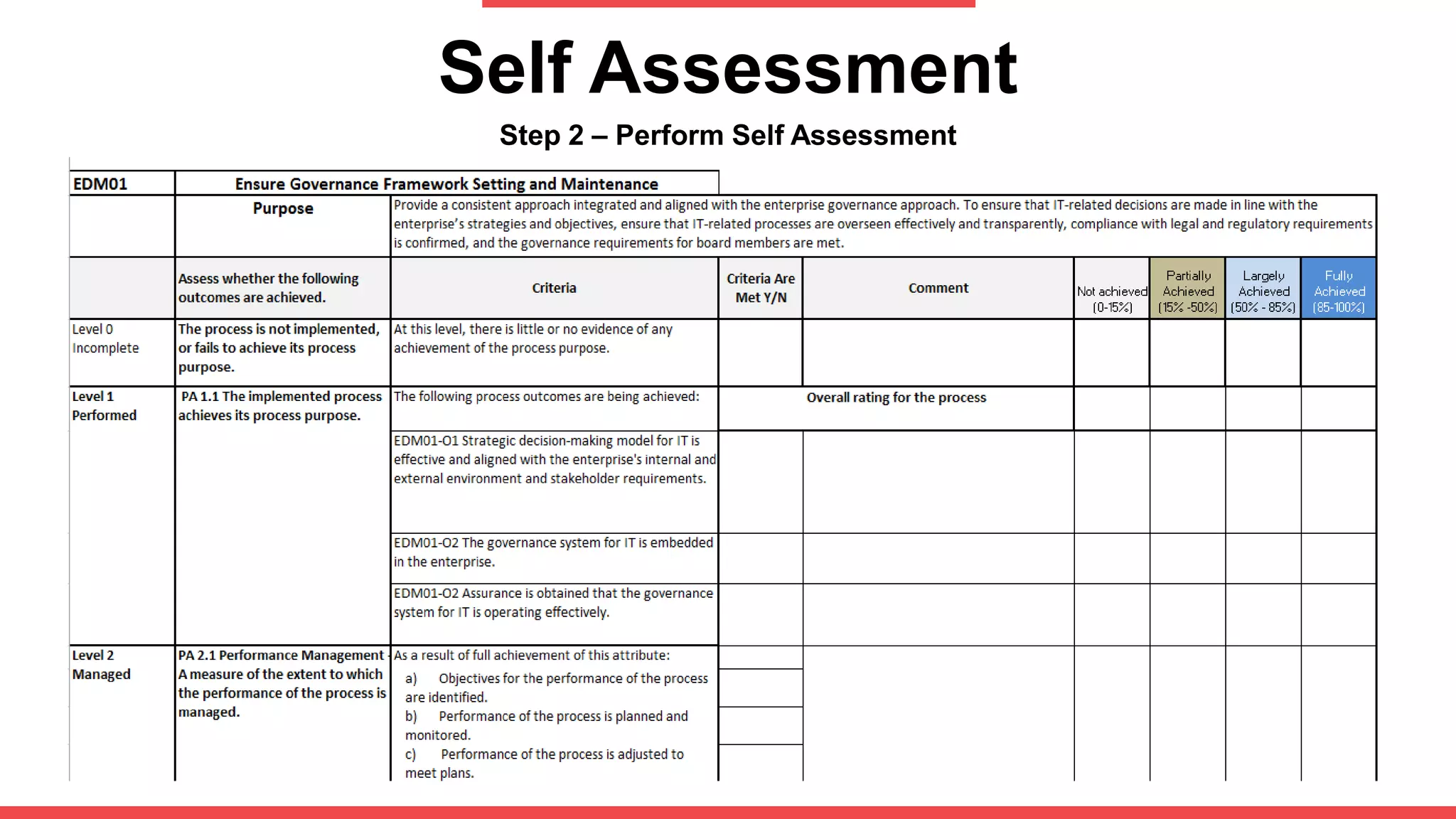
Step 2 – Perform Self Assessment
Self Assessment
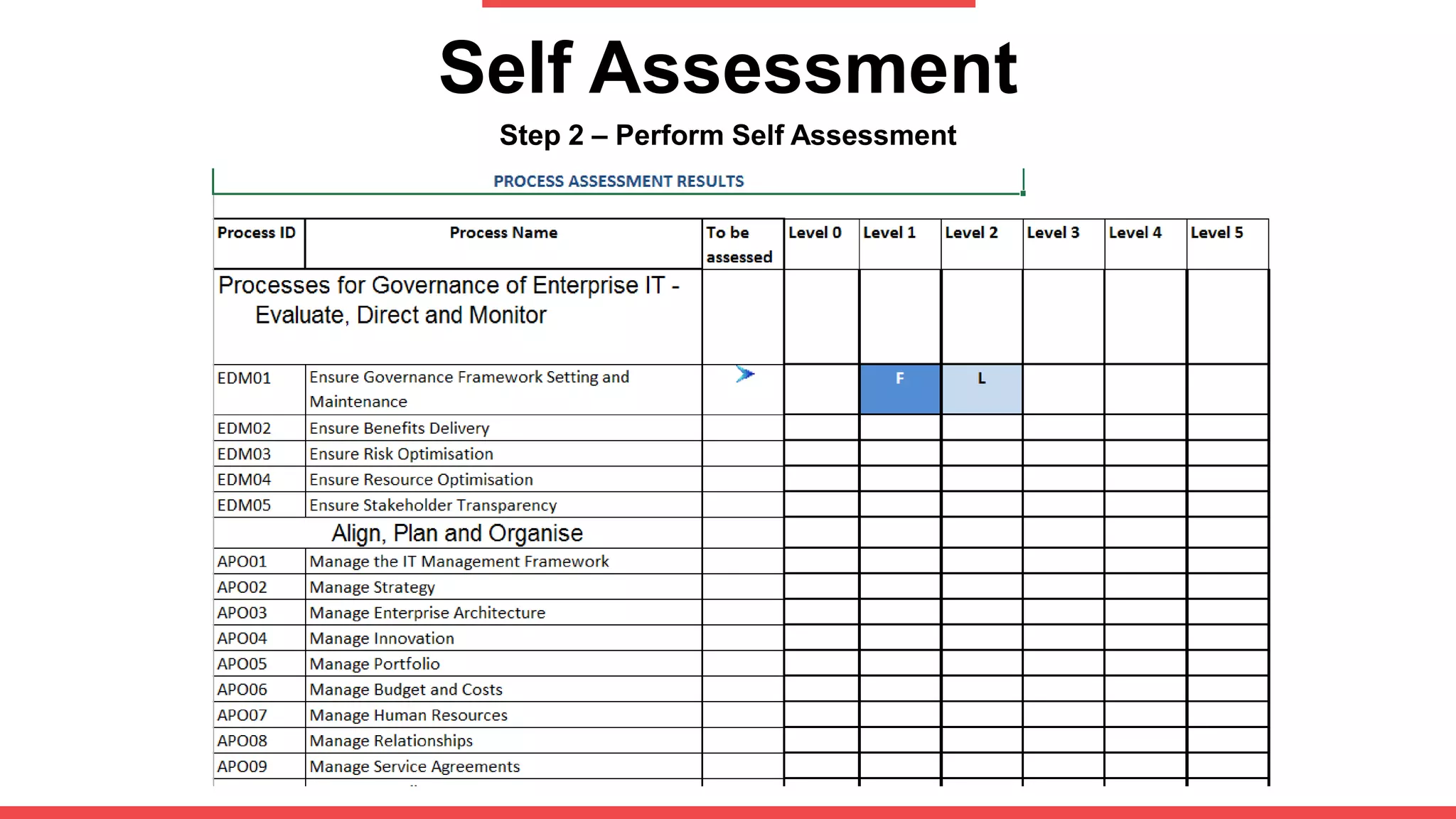
Step 2 – Perform Self Assessment
Engagement Delivery
Approach
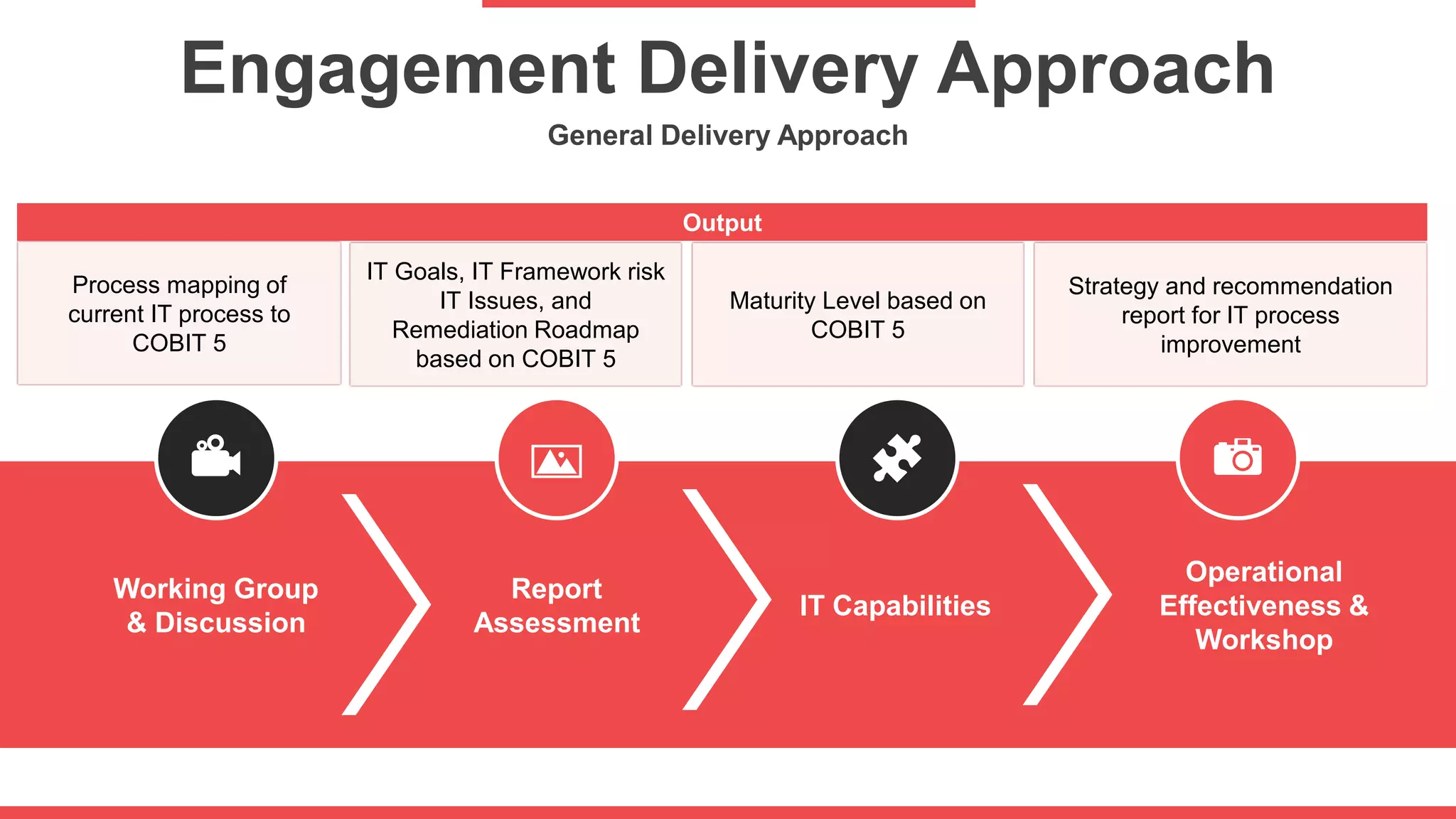
Engagement Delivery Approach
General Delivery Approach
Process mapping of
current IT process to
COBIT 5
Working Group
& Discussion
Report
Assessment
IT Capabilities
Operational
Effectiveness &
Workshop
IT Goals, IT Framework risk
IT Issues, and
Remediation Roadmap
based on COBIT 5
Maturity Level based on
COBIT 5
Strategy and recommendation
report for IT process
improvement
Output
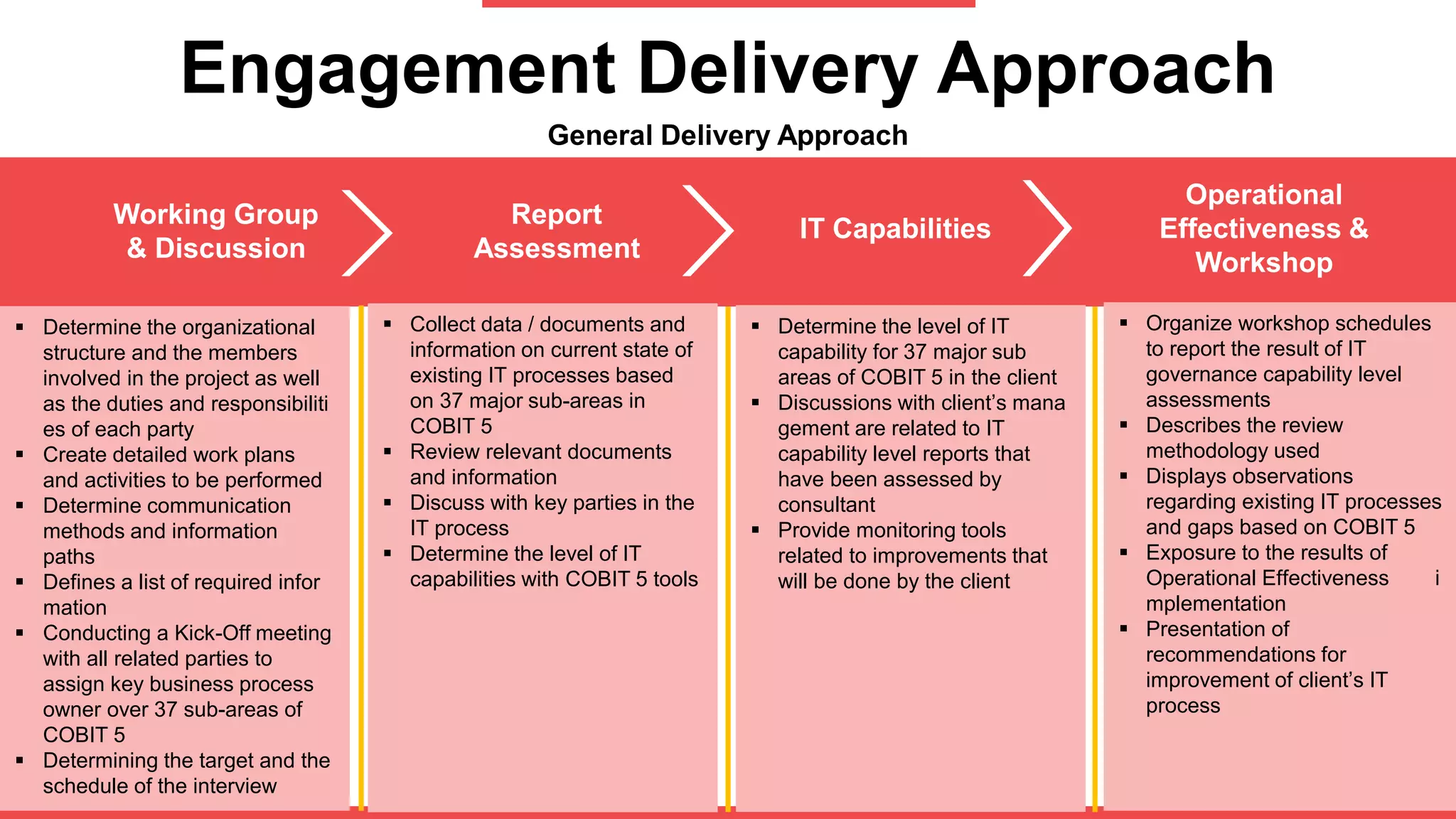
Engagement Delivery Approach
General Delivery Approach
Working Group
& Discussion
Report
Assessment
IT Capabilities
Operational
Effectiveness &
Workshop
▪ Determine the organizational
structure and the members
involved in the project as well
as the duties and responsibiliti
es of each party
▪ Create detailed work plans
and activities to be performed
▪ Determine communication
methods and information
paths
▪ Defines a list of required infor
mation
▪ Conducting a Kick-Off meeting
with all related parties to
assign key business process
owner over 37 sub-areas of
COBIT 5
▪ Determining the target and the
schedule of the interview
▪ Collect data / documents and
information on current state of
existing IT processes based
on 37 major sub-areas in
COBIT 5
▪ Review relevant documents
and information
▪ Discuss with key parties in the
IT process
▪ Determine the level of IT
capabilities with COBIT 5 tools
▪ Determine the level of IT
capability for 37 major sub
areas of COBIT 5 in the client
▪ Discussions with client’s mana
gement are related to IT
capability level reports that
have been assessed by
consultant
▪ Provide monitoring tools
related to improvements that
will be done by the client
▪ Organize workshop schedules
to report the result of IT
governance capability level
assessments
▪ Describes the review
methodology used
▪ Displays observations
regarding existing IT processes
and gaps based on COBIT 5
▪ Exposure to the results of
Operational Effectiveness i
mplementation
▪ Presentation of
recommendations for
improvement of client’s IT
process
Thank you

IT Governance - Capability Assessment using COBIT 5

  • 1.
    IT Governance Capability Assessmentusing COBIT 5 PAM Eryk Budi Pratama Presented for Information System Faculty– Universitas Bakrie
  • 2.
    Objectives IT Governance Governance ofEnterprise IT Domain, Product Family, Coverage COBIT 5 Framework PAM using COBIT 5 Process Assessment Model (PAM) Self Assessment Guide using COBIT 5 Self Assessment Methodology for IT Governance Engagement Engagement Delivery Approach
  • 3.
  • 4.
    IT Governance Old Way COBIT4.1 Val ITRisk IT
  • 5.
    Corporate Governance ofIT Based on ISO 38500 Source: http://www.qaiglobalservices.com/wp-content/uploads/2016/05/Fig-4.jpg
  • 6.
    Governance of EnterpriseIT COBIT 5 - Principles and Area Risk Management Focus Area
  • 7.
  • 8.
    COBIT 5 Domain ❑ Evaluate,Direct, Monitor (EDM) ❑ Align, Plan, Organize (APO) ❑ Build, Acquire, Implement (BAI) ❑ Deliver, Service, Support (DSS) A Business Framework for the Governance and Management of Enterprise IT
  • 9.
    COBIT 5 COBIT 5Product Family
  • 10.
    COBIT 5 COBIT 5Coverage of Other Standards and Frameworks Standard Description ISO 38500 Governance of IT for the organization ISO 31000 Enterprise Risk Management ISO 27000 Information Security Management ISO 20000 IT Service Management Framework Description TOGAF Enterprise Architecture by OpenGroup PMBOK Project Management by PMI PRINCE2 Project Management by APMG ITIL IT Service Management by AXELOS CMMI Capability Maturity Model Integration
  • 11.
  • 12.
    COBIT 5 PAM COBITProcess Assessment Model (PAM) Workflow Source: This figure is reproduced from ISO/IEC 15504-2, with the permission of ISO/IEC at www.iso.org. Copyright remains with ISO/IEC.
  • 13.
    COBIT 5 PAM COBITProcess Assessment Model (PAM) Workflow
  • 14.
    COBIT 5 PAM ProcessCapability Level and Attributes Rating Levels Levels and Necessary Ratings
  • 15.
  • 16.
  • 17.
    Self Assessment Step 1– Scoping (Process Step) Identify relevant business drivers for the assessment of IT processes •On the basis of these business drivers, define the objective of the assessment. •The prioritisation and selection of one or more COBIT 5 processes for inclusion in the process assessment should be based on the business drivers for the assessment. Identify and prioritise the enterprise’s IT processes that should be included within the scope of the assessment •Utilise the business drivers and assessment objectives identified previously, along with, as appropriate, the COBIT 5 process mappings contained in the scoping tool kit. •For example, if the objective of the assessment is to assist IT management in identifying and prioritising improvement initiatives related to one or more specified goals identified, the COBIT process mappings may be useful to identify the processes most closely related to those IT goals. Perform a preliminary scoping selection of target processes for inclusion in the assessment, based on the previous prioritisation •Ensure that they will satisfy the identified business drivers and meet the objectives of the assessment. Confirm the preliminary selection of target COBIT 5 processes with the project sponsor and key stakeholders of the process assessment Finalise the COBIT 5 processes to be included in the assessment
  • 18.
    Self Assessment Step 1– Scoping (Process Step) Enterprise Goal Hierarchy IT-related Goals Hierarchy Self-Diagnostic Mapping of COBIT 5 Processes to IT Goals to Business Goals to IT Balanced Scorecard Mapping COBIT 5 Processes to IT Goals (subset of information contained in item above) Self-diagnostic Tool
  • 19.
    Self Assessment Step 2– Perform Self Assessment
  • 20.
    Self Assessment Step 2– Perform Self Assessment
  • 21.
  • 22.
    Engagement Delivery Approach GeneralDelivery Approach Process mapping of current IT process to COBIT 5 Working Group & Discussion Report Assessment IT Capabilities Operational Effectiveness & Workshop IT Goals, IT Framework risk IT Issues, and Remediation Roadmap based on COBIT 5 Maturity Level based on COBIT 5 Strategy and recommendation report for IT process improvement Output
  • 23.
    Engagement Delivery Approach GeneralDelivery Approach Working Group & Discussion Report Assessment IT Capabilities Operational Effectiveness & Workshop ▪ Determine the organizational structure and the members involved in the project as well as the duties and responsibiliti es of each party ▪ Create detailed work plans and activities to be performed ▪ Determine communication methods and information paths ▪ Defines a list of required infor mation ▪ Conducting a Kick-Off meeting with all related parties to assign key business process owner over 37 sub-areas of COBIT 5 ▪ Determining the target and the schedule of the interview ▪ Collect data / documents and information on current state of existing IT processes based on 37 major sub-areas in COBIT 5 ▪ Review relevant documents and information ▪ Discuss with key parties in the IT process ▪ Determine the level of IT capabilities with COBIT 5 tools ▪ Determine the level of IT capability for 37 major sub areas of COBIT 5 in the client ▪ Discussions with client’s mana gement are related to IT capability level reports that have been assessed by consultant ▪ Provide monitoring tools related to improvements that will be done by the client ▪ Organize workshop schedules to report the result of IT governance capability level assessments ▪ Describes the review methodology used ▪ Displays observations regarding existing IT processes and gaps based on COBIT 5 ▪ Exposure to the results of Operational Effectiveness i mplementation ▪ Presentation of recommendations for improvement of client’s IT process
  • 24.