Producing Liquid Fuels from
Pyrolysis of Woody Biomass: Aspen
          and SimaPro LCA


Philip H Steele*, Kanthi Penmetsa*, Maureen Puettmann# and
                     Jerome Cooper*
*Department of Forest Products, Mississippi State University,
                      Starkville, MS;
 #WoodLife Environmental Consulting, LLC, Corvallis, OR USA
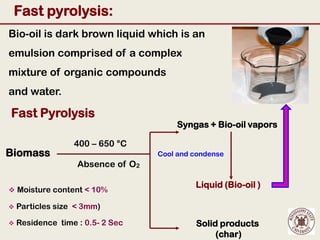
Fast pyrolysis:
Bio-oil is dark brown liquid which is an
emulsion comprised of a complex
mixture of organic compounds
and water.

Fast Pyrolysis
                                       Syngas + Bio-oil vapors

                  400 – 650 °C
Biomass                            Cool and condense
                   Absence of O2

                                            Liquid (Bio-oil )
 Moisture content < 10%

   Particles size < 3mm)

   Residence time : 0.5- 2 Sec             Solid products
                                                 (char)
Techno economic analyses:

• Several researchers have performed techno-economic analyses for
  pyrolysis oil production.

• Costs to produce bio-oil vary depending on the following factors.
        Feedstock, moisture content, chip size, plant scale, etc.

• Mullaney and Farage (2002) estimated that the bio-oil cost for 110-gt/d
  facility was $1.21/gal

• For 440-gt/d facility cost was $0.89/gal or $0.16/MMBtu, assuming feed
  feedstock cost $18 gt

• Ringer et al. (2007) developed an Aspen model of 540-dt/d pyrolysis
  facility, and based on $30/dt cost was $1.12, LHV
Life cycle assessment (LCA):

• Several techno economic analyses have been
  performed to determine the cost of producing
  fast pyrolysis bio-oil.

• However, no LCA analyses have been
  performed.

Objective
• Perform an LCA analysis for the production of
  bio-oil
Method and scope:

• Ringer et al. (2006) developed ASPEN-Plus® model at 540 dt/d for
  bio-oil production was modified to 2000 dt/d scale with feedstock
  cost increased from $30 to $50/dt.

• Mass and energy balance data from the adapted Ringer et al. Aspen
  for LCA analysis.

• Biomass collection for harvesting whole trees, chipping and loading
  feedstock were combined with Aspen process modeling to develop
  cradle to grave impacts for bio-oil production.

• LCA analysis to estimate environmental impacts in the form of
  emissions, fossil fuel use, resource consumption and global
  warming impacts were provided by SimaPro 7.
Production of bio-oil:

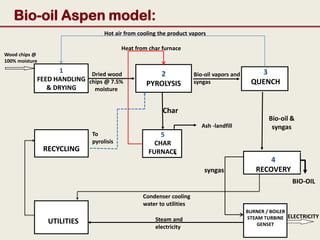
• Production of bio-oil was divided into five unit processes
  for Aspen analysis

      1. Feedstock preparation and drying.
      2. Pyrolysis reactor
      3. Quench condenser
      4. Char recovery and
      5. Furnace process (heat/energy generation)
Bio-oil Aspen model:
                                  Hot air from cooling the product vapors

                                         Heat from char furnace
Wood chips @
100% moisture
                   1       Dried wood                2                                       3
                                                                     Bio-oil vapors and
            FEED HANDLING chips @ 7.5%                               syngas                QUENCH
               & DRYING
                                                  PYROLYSIS
                            moisture


                                                        Char
                                                                                                 Bio-oil &
                                                                        Ash -landfill             syngas
                             To                        5
                             pyrolisis               CHAR
                RECYCLING                          FURNACE
                                                                                                 4
                                                                         syngas              RECOVERY
                                                                                                         BIO-OIL

                                                Condenser cooling
                                                water to utilities
                                                                                          BURNER / BOILER
                                                     Steam and                            STEAM TURBINE ELECTRICITY
                 UTILITIES                                                                    GENSET
                                                     electricity
Production of bio-oil:
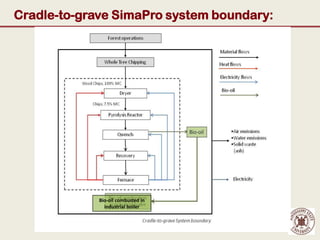
• Cradle-to-grave system boundary for the production of
  bio-oil

      • Processes for harvesting, chipping and loading
        biomass onto trucks; transportation to pyrolysis
        facility

      • Production of bio-oil with heat and energy
        generation accounting for associated emissions

      • Combustion of bio-oil to produce heat
Cradle-to-grave SimaPro system boundary:


             Bio-oil combusted in
               industrial boiler
Assumptions for the SimaPro model:

• Feedstocks obtained from whole tree chipping(southern pine forests) and
  include bark and 50% water; chips were dried to 7.5 % MC

• Emissions associated with the combustion of syngas were equivalent to the
  combustion of natural gas.

• All heat energy and electricity necessary for the production of the bio-oil
  was self generated as indicated by the Aspen model results.

• HHV for bio-oil was assumed to be 18 MJ/kg compared to 45.5 MJ/kg for
  refined fuel oil (RFO); bio-oil density was assumed to be 10 lb/gal or 1.2 kg/L
Assumptions, cont’d:
• Life cycle impact assessments (LCIA) were performed using the Tool for the
  reduction and assessment of chemical and other environmental impacts
  (TRACI 2)

• TRACI is a LCIA methodology developed by US EPA specifically for the US
  for input parameters consistent with US locations

• Cradle-to-grave impact assessment comparisons were conducted between
  bio-oil and RFO

• Aspen values for the recovery efficiency of bio-oil from oven-dry wood
  chips was 59.7%. Other yields for char, ash and syngas were 15.3, 0.9 and
  13.0 %, respectively
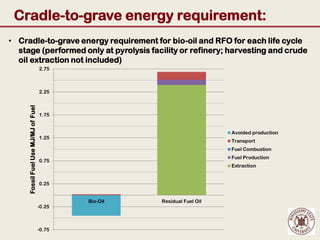
Cradle-to-grave energy requirement:
• Cradle-to-grave energy requirement for bio-oil and RFO for each life cycle
  stage (performed only at pyrolysis facility or refinery; harvesting and crude
  oil extraction not included)
                                     2.75


                                     2.25
     Fossil Fuel Use MJ/MJ of Fuel


                                     1.75


                                                                           Avoided production
                                     1.25
                                                                           Transport
                                                                           Fuel Combustion
                                                                           Fuel Production
                                     0.75
                                                                           Extraction


                                     0.25


                                             Bio-Oil   Residual Fuel Oil
                                     -0.25


                                     -0.75
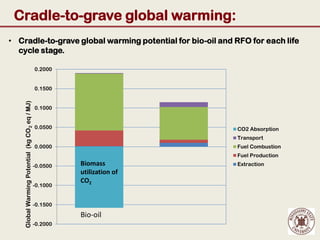
Cradle-to-grave global warming:
• Cradle-to-grave global warming potential for bio-oil and RFO for each life
  cycle stage.

                                                0.2000


                                                0.1500
    Global Warming Potential (kg CO2 eq / MJ)


                                                0.1000


                                                0.0500                     CO2 Absorption
                                                                           Transport
                                                0.0000                     Fuel Combustion
                                                                           Fuel Production
                                                -0.0500   Biomass          Extraction
                                                          utilization of
                                                          CO2
                                                -0.1000


                                                -0.1500

                                                          Bio-oil
                                                -0.2000
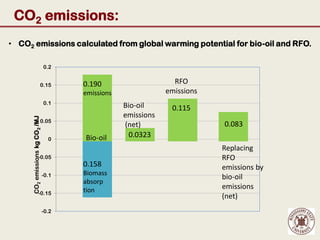
CO2 emissions:
• CO2 emissions calculated from global warming potential for bio-oil and RFO.

                                 0.2


                           0.15         0.190                     RFO
                                        emissions               emissions
                                 0.1
                                                    Bio-oil      0.115
                                                    emissions
      CO2 emissions kg CO2 /MJ


                           0.05
                                                    (net)                   0.083
                                   0    Bio-oil       0.0323
                                                                            Replacing
                     -0.05                                                  RFO
                                        0.158                               emissions by
                                 -0.1   Biomass
                                                                            bio-oil
                                        absorp
                                        tion                                emissions
                     -0.15
                                                                            (net)
                                 -0.2
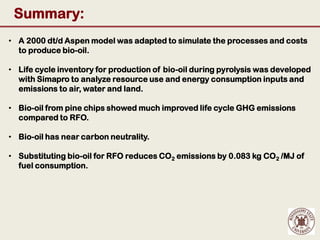
Summary:
• A 2000 dt/d Aspen model was adapted to simulate the processes and costs
  to produce bio-oil.

• Life cycle inventory for production of bio-oil during pyrolysis was developed
  with Simapro to analyze resource use and energy consumption inputs and
  emissions to air, water and land.

• Bio-oil from pine chips showed much improved life cycle GHG emissions
  compared to RFO.

• Bio-oil has near carbon neutrality.

• Substituting bio-oil for RFO reduces CO2 emissions by 0.083 kg CO2 /MJ of
  fuel consumption.
Summary, cont’d:

• Energy required for bio-oil production used 89% of the total energy
  required from self generated fuel.
Producing Liquid Fuels from
Pyrolysis of Woody Biomass: Aspen
          and SimaPro LCA


Philip H Steele*, Kanthi Penmetsa*, Maureen Puettmann# and
                     Jerome Cooper*
*Department of Forest Products, Mississippi State University,
                      Starkville, MS;
 #WoodLife Environmental Consulting, LLC, Corvallis, OR USA

Session 17 ic2011 steele

  • 1.
    Producing Liquid Fuelsfrom Pyrolysis of Woody Biomass: Aspen and SimaPro LCA Philip H Steele*, Kanthi Penmetsa*, Maureen Puettmann# and Jerome Cooper* *Department of Forest Products, Mississippi State University, Starkville, MS; #WoodLife Environmental Consulting, LLC, Corvallis, OR USA
  • 2.
    Fast pyrolysis: Bio-oil isdark brown liquid which is an emulsion comprised of a complex mixture of organic compounds and water. Fast Pyrolysis Syngas + Bio-oil vapors 400 – 650 °C Biomass Cool and condense Absence of O2 Liquid (Bio-oil )  Moisture content < 10%  Particles size < 3mm)  Residence time : 0.5- 2 Sec Solid products (char)
  • 3.
    Techno economic analyses: •Several researchers have performed techno-economic analyses for pyrolysis oil production. • Costs to produce bio-oil vary depending on the following factors.  Feedstock, moisture content, chip size, plant scale, etc. • Mullaney and Farage (2002) estimated that the bio-oil cost for 110-gt/d facility was $1.21/gal • For 440-gt/d facility cost was $0.89/gal or $0.16/MMBtu, assuming feed feedstock cost $18 gt • Ringer et al. (2007) developed an Aspen model of 540-dt/d pyrolysis facility, and based on $30/dt cost was $1.12, LHV
  • 4.
    Life cycle assessment(LCA): • Several techno economic analyses have been performed to determine the cost of producing fast pyrolysis bio-oil. • However, no LCA analyses have been performed. Objective • Perform an LCA analysis for the production of bio-oil
  • 5.
    Method and scope: •Ringer et al. (2006) developed ASPEN-Plus® model at 540 dt/d for bio-oil production was modified to 2000 dt/d scale with feedstock cost increased from $30 to $50/dt. • Mass and energy balance data from the adapted Ringer et al. Aspen for LCA analysis. • Biomass collection for harvesting whole trees, chipping and loading feedstock were combined with Aspen process modeling to develop cradle to grave impacts for bio-oil production. • LCA analysis to estimate environmental impacts in the form of emissions, fossil fuel use, resource consumption and global warming impacts were provided by SimaPro 7.
  • 6.
    Production of bio-oil: •Production of bio-oil was divided into five unit processes for Aspen analysis 1. Feedstock preparation and drying. 2. Pyrolysis reactor 3. Quench condenser 4. Char recovery and 5. Furnace process (heat/energy generation)
  • 7.
    Bio-oil Aspen model: Hot air from cooling the product vapors Heat from char furnace Wood chips @ 100% moisture 1 Dried wood 2 3 Bio-oil vapors and FEED HANDLING chips @ 7.5% syngas QUENCH & DRYING PYROLYSIS moisture Char Bio-oil & Ash -landfill syngas To 5 pyrolisis CHAR RECYCLING FURNACE 4 syngas RECOVERY BIO-OIL Condenser cooling water to utilities BURNER / BOILER Steam and STEAM TURBINE ELECTRICITY UTILITIES GENSET electricity
  • 8.
    Production of bio-oil: •Cradle-to-grave system boundary for the production of bio-oil • Processes for harvesting, chipping and loading biomass onto trucks; transportation to pyrolysis facility • Production of bio-oil with heat and energy generation accounting for associated emissions • Combustion of bio-oil to produce heat
  • 9.
    Cradle-to-grave SimaPro systemboundary: Bio-oil combusted in industrial boiler
  • 10.
    Assumptions for theSimaPro model: • Feedstocks obtained from whole tree chipping(southern pine forests) and include bark and 50% water; chips were dried to 7.5 % MC • Emissions associated with the combustion of syngas were equivalent to the combustion of natural gas. • All heat energy and electricity necessary for the production of the bio-oil was self generated as indicated by the Aspen model results. • HHV for bio-oil was assumed to be 18 MJ/kg compared to 45.5 MJ/kg for refined fuel oil (RFO); bio-oil density was assumed to be 10 lb/gal or 1.2 kg/L
  • 11.
    Assumptions, cont’d: • Lifecycle impact assessments (LCIA) were performed using the Tool for the reduction and assessment of chemical and other environmental impacts (TRACI 2) • TRACI is a LCIA methodology developed by US EPA specifically for the US for input parameters consistent with US locations • Cradle-to-grave impact assessment comparisons were conducted between bio-oil and RFO • Aspen values for the recovery efficiency of bio-oil from oven-dry wood chips was 59.7%. Other yields for char, ash and syngas were 15.3, 0.9 and 13.0 %, respectively
  • 12.
    Cradle-to-grave energy requirement: •Cradle-to-grave energy requirement for bio-oil and RFO for each life cycle stage (performed only at pyrolysis facility or refinery; harvesting and crude oil extraction not included) 2.75 2.25 Fossil Fuel Use MJ/MJ of Fuel 1.75 Avoided production 1.25 Transport Fuel Combustion Fuel Production 0.75 Extraction 0.25 Bio-Oil Residual Fuel Oil -0.25 -0.75
  • 13.
    Cradle-to-grave global warming: •Cradle-to-grave global warming potential for bio-oil and RFO for each life cycle stage. 0.2000 0.1500 Global Warming Potential (kg CO2 eq / MJ) 0.1000 0.0500 CO2 Absorption Transport 0.0000 Fuel Combustion Fuel Production -0.0500 Biomass Extraction utilization of CO2 -0.1000 -0.1500 Bio-oil -0.2000
  • 14.
    CO2 emissions: • CO2emissions calculated from global warming potential for bio-oil and RFO. 0.2 0.15 0.190 RFO emissions emissions 0.1 Bio-oil 0.115 emissions CO2 emissions kg CO2 /MJ 0.05 (net) 0.083 0 Bio-oil 0.0323 Replacing -0.05 RFO 0.158 emissions by -0.1 Biomass bio-oil absorp tion emissions -0.15 (net) -0.2
  • 15.
    Summary: • A 2000dt/d Aspen model was adapted to simulate the processes and costs to produce bio-oil. • Life cycle inventory for production of bio-oil during pyrolysis was developed with Simapro to analyze resource use and energy consumption inputs and emissions to air, water and land. • Bio-oil from pine chips showed much improved life cycle GHG emissions compared to RFO. • Bio-oil has near carbon neutrality. • Substituting bio-oil for RFO reduces CO2 emissions by 0.083 kg CO2 /MJ of fuel consumption.
  • 16.
    Summary, cont’d: • Energyrequired for bio-oil production used 89% of the total energy required from self generated fuel.
  • 17.
    Producing Liquid Fuelsfrom Pyrolysis of Woody Biomass: Aspen and SimaPro LCA Philip H Steele*, Kanthi Penmetsa*, Maureen Puettmann# and Jerome Cooper* *Department of Forest Products, Mississippi State University, Starkville, MS; #WoodLife Environmental Consulting, LLC, Corvallis, OR USA