Water footprinting - a tool for managing
supply chain risks
Dr Craig Jones
Craig.Jones@CircularEcology.com
@EcoCraigJones
Contents
• Why water?
• Water impacts
• An Introduction to water footprinting
• Where is the impact?
• Summary
Why Water?
Water Footprinting
Is water the next carbon?
“50 percent of the companies
foresee near-term risks (1 to 5
years), with 39 percent currently
experiencing impacts such as
disruption to operations from
drought or flooding, declining
water quality, and increases in
water prices.”
CDP Water Disclosure
“UK industry must show leadership on global
water security. Through their global reach,
businesses must examine their supply chains
and production processes to assess and
reduce their water footprint. This should be a
core component of their corporate and social
responsibility strategies.”
The Royal Academy of Engineering
“Global Water security – An engineering
perspective”
“water issues are already seriously disrupting manufacturing supply chains, and
operational risks will rise...”. “They must first understand their exposure across
geographies and along value (supply) chains and product portfolios”
McKinsey, “The global corporate waterfootprint”
Our Water Resource
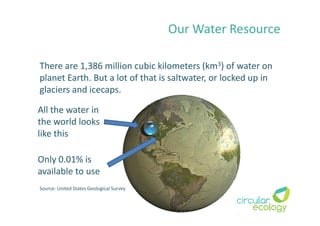
There are 1,386 million cubic kilometers (km3) of water on
planet Earth. But a lot of that is saltwater, or locked up in
glaciers and icecaps.
Source: United States Geological Survey
Only 0.01% is
available to use
All the water in
the world looks
like this
Water Impact
Water Footprinting
Impact
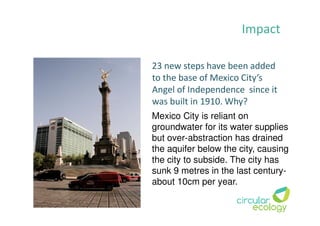
23 new steps have been added
to the base of Mexico City’s
Angel of Independence since it
was built in 1910. Why?
Mexico City is reliant on
groundwater for its water supplies
but over-abstraction has drained
the aquifer below the city, causing
the city to subside. The city has
sunk 9 metres in the last century-
about 10cm per year.
Impact
• 2003 drought cost Europe €8.2 billion
• 2007 Barcelona drought cost Catalan economy 1% GDP
• 2011 drought in Texas cost $5.2 billion to the local
economy
• 2012 drought in US pushed up the price of wheat
around the world
Water scarcity is an increasing risk to economies and
supply chains
Introducing Water Footprinting: A tool to
help manage water related risks
Water Footprinting
Water Footprinting
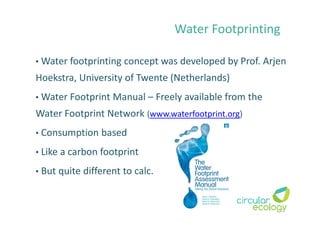
• Water footprinting concept was developed by Prof. Arjen
Hoekstra, University of Twente (Netherlands)
• Water Footprint Manual – Freely available from the
Water Footprint Network (www.waterfootprint.org)
• Consumption based
• Like a carbon footprint
• But quite different to calc.
What is a water footprint?
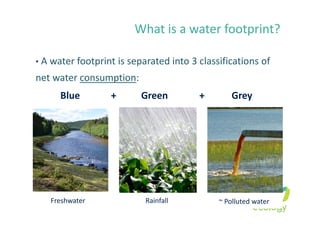
• A water footprint is separated into 3 classifications of
net water consumption:
Blue Green Grey
Freshwater Rainfall ~ Polluted water
+ +
Water Footprints
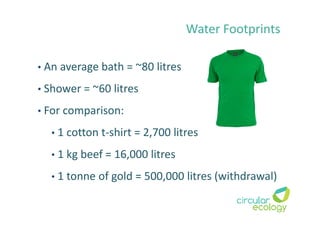
• An average bath = ~80 litres
• Shower = ~60 litres
• For comparison:
• 1 cotton t-shirt = 2,700 litres
• 1 kg beef = 16,000 litres
• 1 tonne of gold = 500,000 litres (withdrawal)
International Standards – ISO 14046
• ISO 14046:2014 – Environmental management -
Water footprint - Principles, requirements and
guidelines
• Standard based upon life cycle assessment (LCA)
• Rather than the water footprint manual (water
footprint network - WFN)
• Standards normally take a few years to be picked up
• Most work to date is to WFN method
Local consumption & global supply
chains. Where is the impact?
Water Footprinting
Hotspot Mapping
• A high water consumption isn’t necessarily an
issue by itself
• We need to consider the stress this demand
places on the local water resources
• Supply versus demand
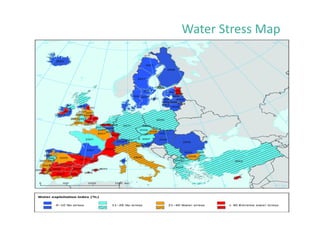
• Hotspot maps overlay water consumption with
local water stress data
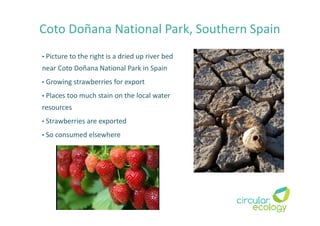
• Picture to the right is a dried up river bed
near Coto Doñana National Park in Spain
• Growing strawberries for export
• Places too much stain on the local water
resources
• Strawberries are exported
• So consumed elsewhere
Coto Doñana National Park, Southern Spain
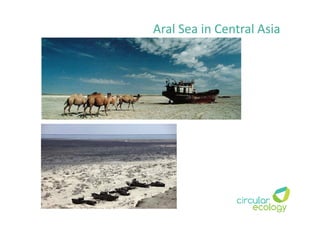
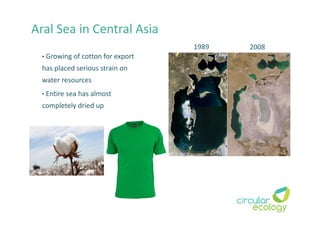
Aral Sea in Central Asia
1989 2008
• Growing of cotton for export
has placed serious strain on
water resources
• Entire sea has almost
completely dried up
Water Stress Map
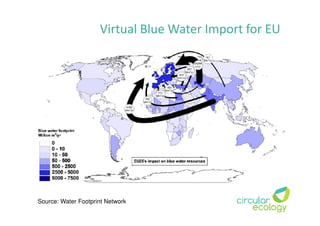
Virtual Blue Water Import for EU
Source: Water Footprint Network
Water Footprinting: Exposing
Where the Real Impacts Are
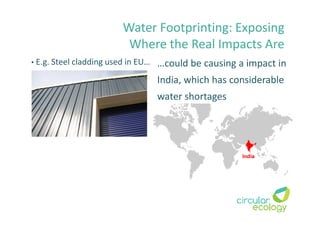
• E.g. Steel cladding used in EU… …could be causing a impact in
India, which has considerable
water shortages
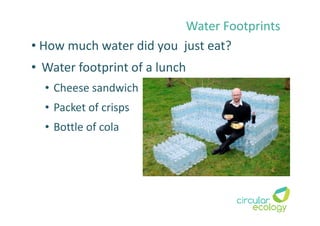
Water Footprints
• Water footprint of a lunch
• Cheese sandwich
• Packet of crisps
• Bottle of cola
• How much water did you just eat?
Water Footprint Summary
Water Footprinting
Summary
• Water footprinting is a tool that reveals water related
risks and impacts in a supply chain
• It shares a name with carbon footprinting
• Although it is quite different than a carbon footprint
• Good to identify supply chain and life cycle hotspots
• Offering transparency and focus
• i.e. Is your process 1% or 50% of the impact?
• Is the water impact local or halfway around the world?
• It can be used to measure, manage and monitor water
related impacts
Thank You for Watching
Craig.Jones@CircularEcology.com
@EcoCraigJones
Water Footprinting

An introduction to water footprinting

  • 1.
    Water footprinting -a tool for managing supply chain risks Dr Craig Jones Craig.Jones@CircularEcology.com @EcoCraigJones
  • 2.
    Contents • Why water? •Water impacts • An Introduction to water footprinting • Where is the impact? • Summary
  • 3.
  • 4.
    Is water thenext carbon? “50 percent of the companies foresee near-term risks (1 to 5 years), with 39 percent currently experiencing impacts such as disruption to operations from drought or flooding, declining water quality, and increases in water prices.” CDP Water Disclosure “UK industry must show leadership on global water security. Through their global reach, businesses must examine their supply chains and production processes to assess and reduce their water footprint. This should be a core component of their corporate and social responsibility strategies.” The Royal Academy of Engineering “Global Water security – An engineering perspective” “water issues are already seriously disrupting manufacturing supply chains, and operational risks will rise...”. “They must first understand their exposure across geographies and along value (supply) chains and product portfolios” McKinsey, “The global corporate waterfootprint”
  • 5.
    Our Water Resource Thereare 1,386 million cubic kilometers (km3) of water on planet Earth. But a lot of that is saltwater, or locked up in glaciers and icecaps. Source: United States Geological Survey Only 0.01% is available to use All the water in the world looks like this
  • 6.
  • 7.
    Impact 23 new stepshave been added to the base of Mexico City’s Angel of Independence since it was built in 1910. Why? Mexico City is reliant on groundwater for its water supplies but over-abstraction has drained the aquifer below the city, causing the city to subside. The city has sunk 9 metres in the last century- about 10cm per year.
  • 8.
    Impact • 2003 droughtcost Europe €8.2 billion • 2007 Barcelona drought cost Catalan economy 1% GDP • 2011 drought in Texas cost $5.2 billion to the local economy • 2012 drought in US pushed up the price of wheat around the world Water scarcity is an increasing risk to economies and supply chains
  • 9.
    Introducing Water Footprinting:A tool to help manage water related risks Water Footprinting
  • 10.
    Water Footprinting • Waterfootprinting concept was developed by Prof. Arjen Hoekstra, University of Twente (Netherlands) • Water Footprint Manual – Freely available from the Water Footprint Network (www.waterfootprint.org) • Consumption based • Like a carbon footprint • But quite different to calc.
  • 11.
    What is awater footprint? • A water footprint is separated into 3 classifications of net water consumption: Blue Green Grey Freshwater Rainfall ~ Polluted water + +
  • 12.
    Water Footprints • Anaverage bath = ~80 litres • Shower = ~60 litres • For comparison: • 1 cotton t-shirt = 2,700 litres • 1 kg beef = 16,000 litres • 1 tonne of gold = 500,000 litres (withdrawal)
  • 13.
    International Standards –ISO 14046 • ISO 14046:2014 – Environmental management - Water footprint - Principles, requirements and guidelines • Standard based upon life cycle assessment (LCA) • Rather than the water footprint manual (water footprint network - WFN) • Standards normally take a few years to be picked up • Most work to date is to WFN method
  • 14.
    Local consumption &global supply chains. Where is the impact? Water Footprinting
  • 15.
    Hotspot Mapping • Ahigh water consumption isn’t necessarily an issue by itself • We need to consider the stress this demand places on the local water resources • Supply versus demand • Hotspot maps overlay water consumption with local water stress data
  • 16.
    • Picture tothe right is a dried up river bed near Coto Doñana National Park in Spain • Growing strawberries for export • Places too much stain on the local water resources • Strawberries are exported • So consumed elsewhere Coto Doñana National Park, Southern Spain
  • 17.
    Aral Sea inCentral Asia
  • 18.
    Aral Sea inCentral Asia 1989 2008 • Growing of cotton for export has placed serious strain on water resources • Entire sea has almost completely dried up
  • 19.
  • 20.
    Virtual Blue WaterImport for EU Source: Water Footprint Network
  • 21.
    Water Footprinting: Exposing Wherethe Real Impacts Are • E.g. Steel cladding used in EU… …could be causing a impact in India, which has considerable water shortages
  • 22.
    Water Footprints • Waterfootprint of a lunch • Cheese sandwich • Packet of crisps • Bottle of cola • How much water did you just eat?
  • 23.
  • 24.
    Summary • Water footprintingis a tool that reveals water related risks and impacts in a supply chain • It shares a name with carbon footprinting • Although it is quite different than a carbon footprint • Good to identify supply chain and life cycle hotspots • Offering transparency and focus • i.e. Is your process 1% or 50% of the impact? • Is the water impact local or halfway around the world? • It can be used to measure, manage and monitor water related impacts
  • 25.
    Thank You forWatching Craig.Jones@CircularEcology.com @EcoCraigJones Water Footprinting