Co-Feeding Fibrous Biomass and Coal
               into Entrained Flow Gasifiers
                                      Robin Zwart
                      GAP & Coal Chemicals Conference


1   GAP & Coal Chemicals Conference             8-9 June 2011 - Beijing
Presentation overview

    Energy research Centre of the Netherlands (ECN)
      Short introduction to ECN


    Entrained Flow Gasification
      General process flow scheme illustrating
       the issues of co-feeding biomass


                                                                               Photography by Jasper Lensselink
    ECNs contribution to solving the issues
        Torrefaction technology development
        Quality control of the torrefied biomass
        Modelling slagging and fouling behaviour
        Simulating slagging and fouling behaviour
         as well as testing reactivity

2                GAP & Coal Chemicals Conference     8-9 June 2011 - Beijing
The Energy research Centre of the Netherlands

    Mission of ECN
    develop high-quality knowledge and technology for the
    transition to sustainable energy management and
    introduce this knowledge and technology to the market


    Focus of ECN
    - energy conservation
    - sustainable energy by means of wind, solar and biomass
    - efficient and clean use of fossil fuels


    Technology development at ECN
    - gasification and tar removal for production of CHP
    - torrefaction as pre-treatment step for EF gasification

3         GAP & Coal Chemicals Conference   8-9 June 2011 - Beijing
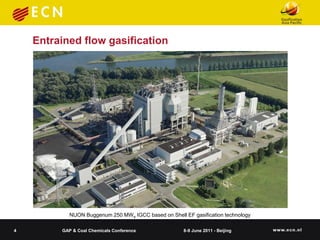
Entrained flow gasification


            NUON Buggenum 250 MWe IGCC based on Shell EF gasification technology

4        GAP & Coal Chemicals Conference              8-9 June 2011 - Beijing
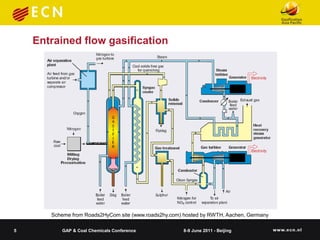
Entrained flow gasification


       Scheme from Roads2HyCom site (www.roads2hy.com) hosted by RWTH, Aachen, Germany

5         GAP & Coal Chemicals Conference              8-9 June 2011 - Beijing
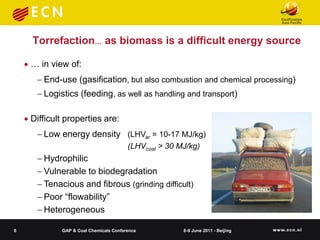
Torrefaction… as biomass is a difficult energy source

     … in view of:
        End-use (gasification, but also combustion and chemical processing)
        Logistics (feeding, as well as handling and transport)

     Difficult properties are:
        Low energy density (LHVar = 10-17 MJ/kg)
                                         (LHVcoal > 30 MJ/kg)
        Hydrophilic
        Vulnerable to biodegradation
        Tenacious and fibrous (grinding difficult)
        Poor “flowability”
        Heterogeneous

6             GAP & Coal Chemicals Conference           8-9 June 2011 - Beijing
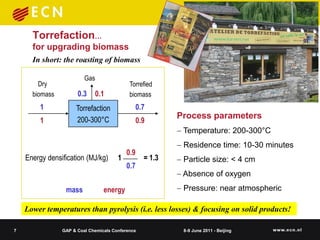
Torrefaction…
      for upgrading biomass
      In short: the roasting of biomass

                         Gas
        Dry                                 Torrefied
      biomass         0.3    0.1            biomass
         1           Torrefaction             0.7
                     200-300°C                            Process parameters
         1                                    0.9
                                                           Temperature: 200-300°C
                                                           Residence time: 10-30 minutes
                                           0.9
    Energy densification (MJ/kg)       1          = 1.3    Particle size: < 4 cm
                                           0.7
                                                           Absence of oxygen

                 mass            energy                    Pressure: near atmospheric

    Lower temperatures than pyrolysis (i.e. less losses) & focusing on solid products!

7               GAP & Coal Chemicals Conference            8-9 June 2011 - Beijing
Torrefaction
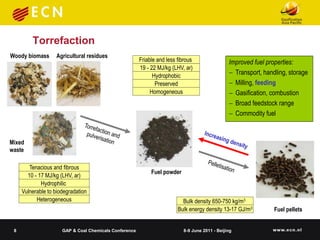
Woody biomass      Agricultural residues
                                                        Friable and less fibrous                Improved fuel properties:
                                                        19 - 22 MJ/kg (LHV, ar)
                                                              Hydrophobic                        Transport, handling, storage
                                                               Preserved                         Milling, feeding
                                                             Homogeneous                         Gasification, combustion
                                                                                                 Broad feedstock range
                                                                                                 Commodity fuel


Mixed
waste

        Tenacious and fibrous
                                                             Fuel powder
       10 - 17 MJ/kg (LHV, ar)
             Hydrophilic
     Vulnerable to biodegradation
           Heterogeneous                                                   Bulk density 650-750 kg/m3
                                                                         Bulk energy density 13-17 GJ/m3         Fuel pellets


 8                    GAP & Coal Chemicals Conference                      8-9 June 2011 - Beijing
Torrefaction                                        Air

                                                            Utillity fuel

The ECN       BO2 technology                                                                                       Flue gas
 Conventional drying
  and pelletisation                                          Torrefaction
                                                               gas
 Compact dedicated                                                                        Combustion

 moving bed technology
                                                                                  Gas
  with direct heating                                                            recycle
  (no moving parts)
                                   Biomass                                                                                               BO2pellets
                                                                                                                         Pelletisation
                                                   Drying         Torrefaction                           Cooling


 Heat integration
                                                                                      DP
 High energy
  efficiency (> 90%)                         Flue gas
 Cost effective                                               Heat exchange
                                                                                              Flue gas
 IP is patent protected
 Over 1,000 hours of
  pilot scale production

  9                   GAP & Coal Chemicals Conference                        8-9 June 2011 - Beijing
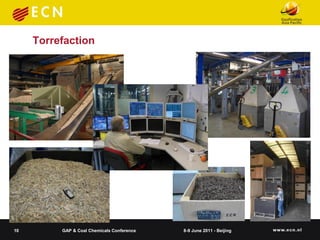
Torrefaction


10        GAP & Coal Chemicals Conference   8-9 June 2011 - Beijing
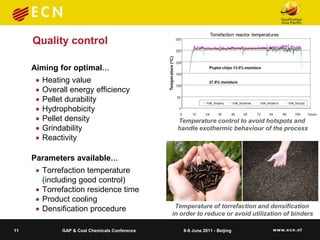
Quality control

     Aiming for optimal…
         Heating value
         Overall energy efficiency
         Pellet durability
         Hydrophobicity
         Pellet density                          Temperature control to avoid hotspots and
         Grindability                            handle exothermic behaviour of the process
         Reactivity

     Parameters available…
       Torrefaction temperature
        (including good control)
       Torrefaction residence time
       Product cooling
       Densification procedure                   Temperature of torrefaction and densification
                                                 in order to reduce or avoid utilization of binders

11             GAP & Coal Chemicals Conference       8-9 June 2011 - Beijing
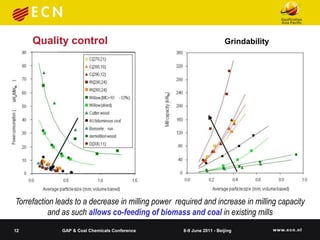
Quality control                                                   Grindability


Torrefaction leads to a decrease in milling power required and increase in milling capacity
           and as such allows co-feeding of biomass and coal in existing mills
12            GAP & Coal Chemicals Conference       8-9 June 2011 - Beijing
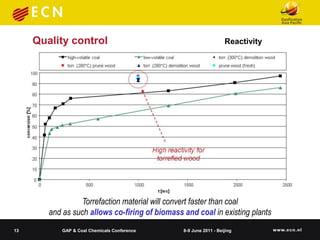
Quality control                                               Reactivity


                  Torrefaction material will convert faster than coal
        and as such allows co-firing of biomass and coal in existing plants
13          GAP & Coal Chemicals Conference     8-9 June 2011 - Beijing
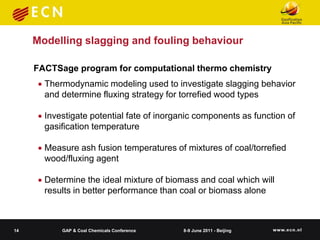
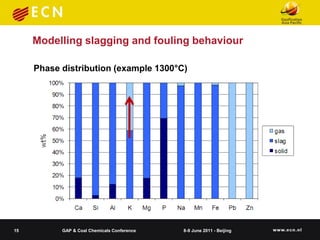
Modelling slagging and fouling behaviour

     FACTSage program for computational thermo chemistry
       Thermodynamic modeling used to investigate slagging behavior
        and determine fluxing strategy for torrefied wood types

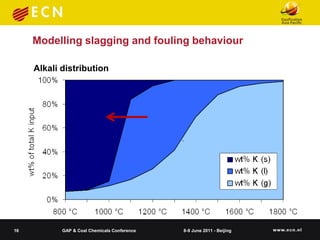
       Investigate potential fate of inorganic components as function of
        gasification temperature

       Measure ash fusion temperatures of mixtures of coal/torrefied
        wood/fluxing agent

       Determine the ideal mixture of biomass and coal which will
        results in better performance than coal or biomass alone


14          GAP & Coal Chemicals Conference   8-9 June 2011 - Beijing
Modelling slagging and fouling behaviour

     Phase distribution (example 1300°C)


15         GAP & Coal Chemicals Conference   8-9 June 2011 - Beijing
Modelling slagging and fouling behaviour

     Alkali distribution


16          GAP & Coal Chemicals Conference   8-9 June 2011 - Beijing
Modelling slagging and fouling behaviour

                                                Slagging behavior as function ofelements in biomass for fluxed clean wood fuel
                                                                         wt% ash mixing slag as f(T) and coal
                                               wt% ash elements in slag as f(T) for fluxed clean wood fuel
                                                                                                                     100
                                       100
                                                                                                                      90


                                                                              slag as wt% of fuel ash (incl. flux)
                                        90
slag as wt% of fuel ash (incl. flux)


                                                                                                                                                               Original clean wood
                                                                                                                      80
                                        80
                                                                                                                      70
                                        70                                                                                                                     Silica/fuel ash=0.25 kg/kg
                                                                                                                      60
                                        60
                                                                                                                      50
                                                                                                                                                               Silica/fuel ash=0.75 kg/kg
                                        50                                                                            40
                                        40                                                                            30                                       Silica/fuel ash=1.25 kg/kg
                                        30                                                                            20
                                        20                                                                            10                                       Silica/alumina/fuel
                                        10                                                                             0                                       ash=0.5/0.45 kg/kg
                                            0                                                                           800    1000            1200              1400        1600           18
                                             800       1000          1200                                             1400    1600           1800 T [°C]
                                                                            T [°C]
                                       17                GAP & Coal Chemicals Conference                                             8-9 June 2011 - Beijing
Labscale Combustion & gasification simulator (LCS)

     Residence time/temperature profile (example)

                                      LCS PF facility (controlled conditions, 5 ms up
                                       to 2500ms, 600-1550°C, gas composition)
                                                                      Temperature [°C]
                                                               1000   1200      1400     1600
                                                               0                            20
                                                                                            90
                                                              0,1

                                                              0,2                                                        Burner Area
                                                              0,3                           210


                                                                                                   Residence time [ms]
                                               Distance [m]   0,4

                                                              0,5

                                                              0,6

                                                              0,7
                                                                                            1300
                                                              0,8

                                                              0,9
                                                                                                                         Furnace Exit
                                                               1


18         GAP & Coal Chemicals Conference                            8-9 June 2011 - Beijing
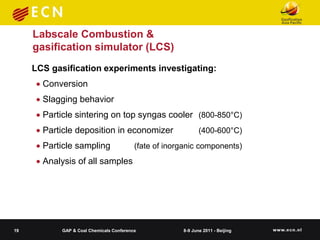
Labscale Combustion &
     gasification simulator (LCS)
     LCS gasification experiments investigating:
       Conversion
       Slagging behavior
       Particle sintering on top syngas cooler (800-850°C)
       Particle deposition in economizer                     (400-600°C)
       Particle sampling                 (fate of inorganic components)
       Analysis of all samples


19          GAP & Coal Chemicals Conference            8-9 June 2011 - Beijing
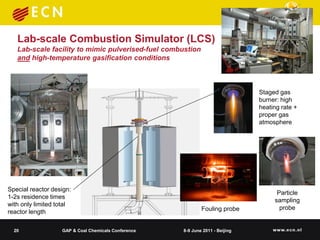
Lab-scale Combustion Simulator (LCS)
   Lab-scale facility to mimic pulverised-fuel combustion
   and high-temperature gasification conditions


                                                                               Staged gas
                                                                               burner: high
                                                                               heating rate +
                                                                               proper gas
                                                                               atmosphere


Special reactor design:
                                                                                     Particle
1-2s residence times
                                                                                    sampling
with only limited total
                                                             Fouling probe            probe
reactor length

  20               GAP & Coal Chemicals Conference   8-9 June 2011 - Beijing
Labscale Combustion & gasification simulator (LCS)

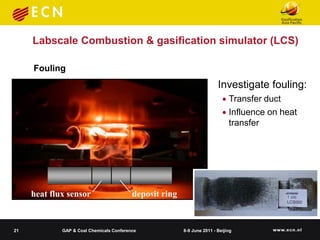
     Fouling
                                                                         Investigate fouling:
                                                                            Transfer duct
                                                                            Influence on heat
                                                                             transfer


     heat flux sensor                     deposit ring


21           GAP & Coal Chemicals Conference             8-9 June 2011 - Beijing
Labscale Combustion & gasification simulator (LCS)

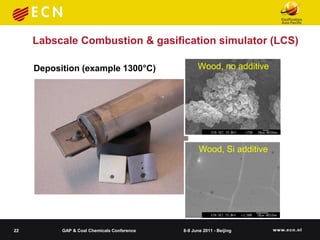
     Deposition (example 1300°C)                   Wood, no additive


                                                    Wood, Si additive


22         GAP & Coal Chemicals Conference   8-9 June 2011 - Beijing
Labscale Combustion & gasification simulator (LCS)

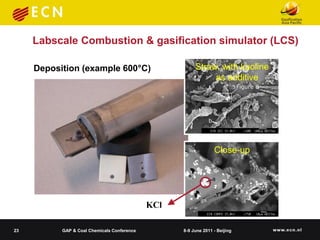
     Deposition (example 600°C)                         Straw, with kaoline
                                                             as additive


                                                                 Close-up


                                             KCl

23         GAP & Coal Chemicals Conference         8-9 June 2011 - Beijing
Labscale Combustion & gasification simulator (LCS)

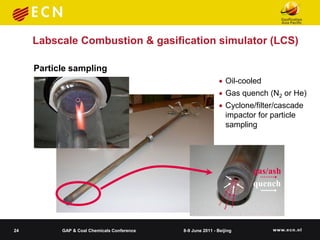
     Particle sampling
                                                              Oil-cooled
                                                              Gas quench (N2 or He)
                                                              Cyclone/filter/cascade
                                                               impactor for particle
                                                               sampling


                                                    wood, Si additive
                                                                       gas/ash
                                                                       quench


24         GAP & Coal Chemicals Conference   8-9 June 2011 - Beijing
Labscale Combustion &
     gasification simulator (LCS)
     Particle sampling
     Fractionated samples (lab- & full-scale)
     obtained with cascade impactors (CI):
       Study release inorganics and
        aerosol formation
       Provides composition and
        morphology of each size                                          70

        fraction                                                         60
                                                                              plate
                                                                              stage 1
                                                                              stage 2

       In short: particle sampling
                                                                              stage 3


                                               weight fraction [% w/w]
                                                                         50   stage 4
                                                                              stage 5

        allows investigation of                                          40   stage 6
                                                                              stage 7
                                                                              stage 8
        all inorganic particles that                                     30   stage 9
                                                                              stage 10
        enter syngas cooler                                              20

                                                                         10

                                                                         0
25          GAP & Coal Chemicals Conference   8-9 June 2011 - Fe
                                                        S     Beijing
                                                                   Na               Mg   Al   Si   P   Cl   K   Ca
Thank you for your attention...

     For more information,
     please contact:

     Robin Zwart

     phone      +31 224 56 4574
     mobile     +31 6 3073 6496
     e-mail     zwart@ecn.nl
     internet   www.ecn.nl


26          GAP & Coal Chemicals Conference   8-9 June 2011 - Beijing

Cofiring biomass &amp; coal

  • 1.
    Co-Feeding Fibrous Biomassand Coal into Entrained Flow Gasifiers Robin Zwart GAP & Coal Chemicals Conference 1 GAP & Coal Chemicals Conference 8-9 June 2011 - Beijing
  • 2.
    Presentation overview Energy research Centre of the Netherlands (ECN)  Short introduction to ECN Entrained Flow Gasification  General process flow scheme illustrating the issues of co-feeding biomass Photography by Jasper Lensselink ECNs contribution to solving the issues  Torrefaction technology development  Quality control of the torrefied biomass  Modelling slagging and fouling behaviour  Simulating slagging and fouling behaviour as well as testing reactivity 2 GAP & Coal Chemicals Conference 8-9 June 2011 - Beijing
  • 3.
    The Energy researchCentre of the Netherlands Mission of ECN develop high-quality knowledge and technology for the transition to sustainable energy management and introduce this knowledge and technology to the market Focus of ECN - energy conservation - sustainable energy by means of wind, solar and biomass - efficient and clean use of fossil fuels Technology development at ECN - gasification and tar removal for production of CHP - torrefaction as pre-treatment step for EF gasification 3 GAP & Coal Chemicals Conference 8-9 June 2011 - Beijing
  • 4.
    Entrained flow gasification NUON Buggenum 250 MWe IGCC based on Shell EF gasification technology 4 GAP & Coal Chemicals Conference 8-9 June 2011 - Beijing
  • 5.
    Entrained flow gasification Scheme from Roads2HyCom site (www.roads2hy.com) hosted by RWTH, Aachen, Germany 5 GAP & Coal Chemicals Conference 8-9 June 2011 - Beijing
  • 6.
    Torrefaction… as biomassis a difficult energy source  … in view of:  End-use (gasification, but also combustion and chemical processing)  Logistics (feeding, as well as handling and transport)  Difficult properties are:  Low energy density (LHVar = 10-17 MJ/kg) (LHVcoal > 30 MJ/kg)  Hydrophilic  Vulnerable to biodegradation  Tenacious and fibrous (grinding difficult)  Poor “flowability”  Heterogeneous 6 GAP & Coal Chemicals Conference 8-9 June 2011 - Beijing
  • 7.
    Torrefaction… for upgrading biomass In short: the roasting of biomass Gas Dry Torrefied biomass 0.3 0.1 biomass 1 Torrefaction 0.7 200-300°C Process parameters 1 0.9  Temperature: 200-300°C  Residence time: 10-30 minutes 0.9 Energy densification (MJ/kg) 1 = 1.3  Particle size: < 4 cm 0.7  Absence of oxygen mass energy  Pressure: near atmospheric Lower temperatures than pyrolysis (i.e. less losses) & focusing on solid products! 7 GAP & Coal Chemicals Conference 8-9 June 2011 - Beijing
  • 8.
    Torrefaction Woody biomass Agricultural residues Friable and less fibrous Improved fuel properties: 19 - 22 MJ/kg (LHV, ar) Hydrophobic  Transport, handling, storage Preserved  Milling, feeding Homogeneous  Gasification, combustion  Broad feedstock range  Commodity fuel Mixed waste Tenacious and fibrous Fuel powder 10 - 17 MJ/kg (LHV, ar) Hydrophilic Vulnerable to biodegradation Heterogeneous Bulk density 650-750 kg/m3 Bulk energy density 13-17 GJ/m3 Fuel pellets 8 GAP & Coal Chemicals Conference 8-9 June 2011 - Beijing
  • 9.
    Torrefaction Air Utillity fuel The ECN BO2 technology Flue gas  Conventional drying and pelletisation Torrefaction gas  Compact dedicated Combustion  moving bed technology Gas with direct heating recycle (no moving parts) Biomass BO2pellets Pelletisation Drying Torrefaction Cooling  Heat integration DP  High energy efficiency (> 90%) Flue gas  Cost effective Heat exchange Flue gas  IP is patent protected  Over 1,000 hours of pilot scale production 9 GAP & Coal Chemicals Conference 8-9 June 2011 - Beijing
  • 10.
    Torrefaction 10 GAP & Coal Chemicals Conference 8-9 June 2011 - Beijing
  • 11.
    Quality control Aiming for optimal…  Heating value  Overall energy efficiency  Pellet durability  Hydrophobicity  Pellet density Temperature control to avoid hotspots and  Grindability handle exothermic behaviour of the process  Reactivity Parameters available…  Torrefaction temperature (including good control)  Torrefaction residence time  Product cooling  Densification procedure Temperature of torrefaction and densification in order to reduce or avoid utilization of binders 11 GAP & Coal Chemicals Conference 8-9 June 2011 - Beijing
  • 12.
    Quality control Grindability Torrefaction leads to a decrease in milling power required and increase in milling capacity and as such allows co-feeding of biomass and coal in existing mills 12 GAP & Coal Chemicals Conference 8-9 June 2011 - Beijing
  • 13.
    Quality control Reactivity Torrefaction material will convert faster than coal and as such allows co-firing of biomass and coal in existing plants 13 GAP & Coal Chemicals Conference 8-9 June 2011 - Beijing
  • 14.
    Modelling slagging andfouling behaviour FACTSage program for computational thermo chemistry  Thermodynamic modeling used to investigate slagging behavior and determine fluxing strategy for torrefied wood types  Investigate potential fate of inorganic components as function of gasification temperature  Measure ash fusion temperatures of mixtures of coal/torrefied wood/fluxing agent  Determine the ideal mixture of biomass and coal which will results in better performance than coal or biomass alone 14 GAP & Coal Chemicals Conference 8-9 June 2011 - Beijing
  • 15.
    Modelling slagging andfouling behaviour Phase distribution (example 1300°C) 15 GAP & Coal Chemicals Conference 8-9 June 2011 - Beijing
  • 16.
    Modelling slagging andfouling behaviour Alkali distribution 16 GAP & Coal Chemicals Conference 8-9 June 2011 - Beijing
  • 17.
    Modelling slagging andfouling behaviour Slagging behavior as function ofelements in biomass for fluxed clean wood fuel wt% ash mixing slag as f(T) and coal wt% ash elements in slag as f(T) for fluxed clean wood fuel 100 100 90 slag as wt% of fuel ash (incl. flux) 90 slag as wt% of fuel ash (incl. flux) Original clean wood 80 80 70 70 Silica/fuel ash=0.25 kg/kg 60 60 50 Silica/fuel ash=0.75 kg/kg 50 40 40 30 Silica/fuel ash=1.25 kg/kg 30 20 20 10 Silica/alumina/fuel 10 0 ash=0.5/0.45 kg/kg 0 800 1000 1200 1400 1600 18 800 1000 1200 1400 1600 1800 T [°C] T [°C] 17 GAP & Coal Chemicals Conference 8-9 June 2011 - Beijing
  • 18.
    Labscale Combustion &gasification simulator (LCS) Residence time/temperature profile (example) LCS PF facility (controlled conditions, 5 ms up to 2500ms, 600-1550°C, gas composition) Temperature [°C] 1000 1200 1400 1600 0 20 90 0,1 0,2 Burner Area 0,3 210 Residence time [ms] Distance [m] 0,4 0,5 0,6 0,7 1300 0,8 0,9 Furnace Exit 1 18 GAP & Coal Chemicals Conference 8-9 June 2011 - Beijing
  • 19.
    Labscale Combustion & gasification simulator (LCS) LCS gasification experiments investigating:  Conversion  Slagging behavior  Particle sintering on top syngas cooler (800-850°C)  Particle deposition in economizer (400-600°C)  Particle sampling (fate of inorganic components)  Analysis of all samples 19 GAP & Coal Chemicals Conference 8-9 June 2011 - Beijing
  • 20.
    Lab-scale Combustion Simulator(LCS) Lab-scale facility to mimic pulverised-fuel combustion and high-temperature gasification conditions Staged gas burner: high heating rate + proper gas atmosphere Special reactor design: Particle 1-2s residence times sampling with only limited total Fouling probe probe reactor length 20 GAP & Coal Chemicals Conference 8-9 June 2011 - Beijing
  • 21.
    Labscale Combustion &gasification simulator (LCS) Fouling Investigate fouling:  Transfer duct  Influence on heat transfer heat flux sensor deposit ring 21 GAP & Coal Chemicals Conference 8-9 June 2011 - Beijing
  • 22.
    Labscale Combustion &gasification simulator (LCS) Deposition (example 1300°C) Wood, no additive Wood, Si additive 22 GAP & Coal Chemicals Conference 8-9 June 2011 - Beijing
  • 23.
    Labscale Combustion &gasification simulator (LCS) Deposition (example 600°C) Straw, with kaoline as additive Close-up KCl 23 GAP & Coal Chemicals Conference 8-9 June 2011 - Beijing
  • 24.
    Labscale Combustion &gasification simulator (LCS) Particle sampling  Oil-cooled  Gas quench (N2 or He)  Cyclone/filter/cascade impactor for particle sampling wood, Si additive gas/ash quench 24 GAP & Coal Chemicals Conference 8-9 June 2011 - Beijing
  • 25.
    Labscale Combustion & gasification simulator (LCS) Particle sampling Fractionated samples (lab- & full-scale) obtained with cascade impactors (CI):  Study release inorganics and aerosol formation  Provides composition and morphology of each size 70 fraction 60 plate stage 1 stage 2  In short: particle sampling stage 3 weight fraction [% w/w] 50 stage 4 stage 5 allows investigation of 40 stage 6 stage 7 stage 8 all inorganic particles that 30 stage 9 stage 10 enter syngas cooler 20 10 0 25 GAP & Coal Chemicals Conference 8-9 June 2011 - Fe S Beijing Na Mg Al Si P Cl K Ca
  • 26.
    Thank you foryour attention... For more information, please contact: Robin Zwart phone +31 224 56 4574 mobile +31 6 3073 6496 e-mail zwart@ecn.nl internet www.ecn.nl 26 GAP & Coal Chemicals Conference 8-9 June 2011 - Beijing