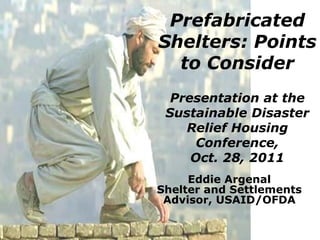
Prefabricated
Shelters: Points
  to Consider
  Presentation at the
 Sustainable Disaster
    Relief Housing
      Conference,
     Oct. 28, 2011
     Eddie Argenal
Shelter and Settlements
 Advisor, USAID/OFDA
Session Agenda

• NOT Housing, but Shelter
• NOT just Shelter, but “S&S”
• NOT just “S&S,” but Links to
  DRR and other Sectors
• Lesson from Haiti
OFDA: Lead USG Agency for Int‟l
Disaster Assistance Since 1964


                    1963, Irazu
                    Volcano in Costa
                    Rica
1963, Skopje EQ, Former Yugoslavia
USAID/OFDA Mandate

   Save Lives

   Reduce Suffering

   Reduce the Economic and
    Social Impacts of Disasters
    (OFDA’s “Third Phrase”)
OFDA Criteria for Response

   Host country must ask for, or be
    willing to accept, USG assistance

   The disaster is of such magnitude
    that it is beyond the host
    country‟s ability to respond
    adequately, and

   It is in the interest of the USG to
    provide assistance.
Quick Review of OFDA Activities

• In FY ‟10 spent $1.3B
 (5.8% of total USAID budget)

• 73 “declared disasters”
 (1 every 5 days)

• Worked in 56 countries
• 250 employees in 25 offices
• FY‟08 = $550M
• FY‟12 = ???
Some of
  OFDA‟s
Operational
 Partners
A Challenging Work Environment:
        The Fog of Relief
   EU/
  ECHO                            USAID
          UN  NGOs                      HOST
         OCHA    NGOs
                                       NATION
NGOs                                  SECURITY
                                       FORCES
                         OTHER
    WFP NGOs
ICRC USAID
                         DONORS

                    OTHER UN
                   AGENCIES IN
                    COUNTRY
                                   UNHCR
     US Military
                   Other Nation              IOM
UNDP                 Military
                                     UNJLC
Not an Atypical Pattern of
Recent OFDA Grant Funding to
       OFDA Grant Funding 2003

  Implementing Partners…
                10%
                                  25%


          65%


  UN Agencies         NGOs/PVOs   Int'l Orgs
OFDA Does NOT Engage in
  Housing Reconstruction or
   Development, But Rather
Humanitarian Shelter Assistance
“Full Reconstruction” Exceeds
“HA” Mandates and Capacities
“Full Reconstruction” in Response
Phase May Appear to Close Gap, But
Few “HA” Actors Know How to do it,
so… MORE PROBLEMS
Transitional Shelter

• More than a tent, less than a house
• Jump-starts and re-engages affected
  populations in the incremental, longer-
  term process of housing development
• Means of Promoting DRR and
  Livelihoods (platform for other sector interventions), and
• Unlike other sectors, no easy handoff to
  development. With programmatic
  vacuum, all the more reason to
  emphasize CONTEXT and TRANSITION.
Transitional
  Shelter,
 Indonesia
Back to the Big Picture:
    SETTLEMENTS, the
“Where?” of “Our” Mandate
Where Settlements are located,
How they have developed,
How rapidly they grow,
How strong their economies are, and
How well they are managed, esp. in
times of crisis…


                Will largely determine
                whether they become
                the sites of future
                disasters -- and
                possible USG responses
The TRENDS Affecting Settlements
     Are Many, and Include…
• The Future Is Urban. Global population will increase from
  6.2 billion to 8.3 billion, ’03-’30; equiv. of nearly 100% located
  in the cities of developing countries, increasing pop. from 2 to 4
  billion!

• Persistent Poverty. Over 3.3 billion people -- 48% of
  humanity -- survived on per capita incomes of no more than
  $2.50/day in 2005. The poverty level was 2.5 billion in 1987.

• Increasing Strains        on Basic Social Services and Institutions

• Growing Environmental Decline,                Coupled with Limited
  Economic Growth

• HIV/AIDS, Bird Flu, Swine Flu, Pandemic
  Influenza, etc. increasingly a feature of settlements
ANYONE SEEN…


• Conditions depicted are experienced
  by nearly 1 of every 6 human beings
• By 2030, nearly 1 of every 4!!!
Implications for OUR
         Work…
• Context: 2X urban pop., 3X urban
  land; LOTS of issues with growth
• Chronic and acute needs are
  merging more and more every day
• Disasters/crises accelerate and
  exacerbate the urbanization
  process, and
• How to address urban
  displacement?
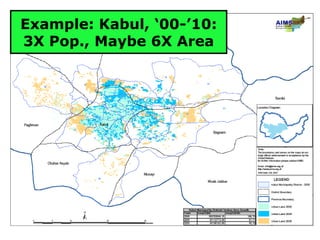
Example: Kabul, „00-‟10:
3X Pop., Maybe 6X Area
The Importance of
        Settlements
• Settlements provide context for
 shelter interventions
• Unit of Analysis changes with a
 settlements approach; no longer a
 near-exclusive focus on households
 and shelter, but neighborhoods and
 larger communities, and
• Change in Unit of Analysis
 particularly useful in urban areas.
One Solution Does NOT Fit
            All
• Return to safe shelter
• Return to safe, cleared sites
• Stay with host family
• Stay in proximity site with
  host community, and
• Relocate to planned sites
The Basic of a Settlements
          Intervention
• Shelter-led
• Multi-sectoral, reflecting multi-faceted
  character of context (i.e., settlements)
• Opportunistic with regard to livelihood
  promotion and “DRR” (e.g., rubble removal)
• Cognizant of gender, environment,
  local organizations, and social relations
• Transitional, by linking relief and
  developmental concerns, and
• Accountable to local governing
  structures
CONTEXT, CONTEXT, CONTEXT
   Poorest country in the hemisphere, about
    149th of 182 countries listed in the UN's
    Human Development Index, just below PNG
   80% unemployed or underemployed
   60% below the poverty line, making less than
    $2/day per capita
   In PAP, 70% of population doesn‟t officially
    exist (rent, lease, squat, but don’t own land)
   In PAP slums, 11 sq. m. for 6 people
   Limited institutional capacities, and
   High vulnerability to flooding, landslides,
    hurricanes, and, yes, earthquakes.
USAID/OFDA Shelter Outputs
   Emergency Phase:

    -- Plastic sheeting distributed to estimated
    500,000-600,000 people

   Transitional Phase:
    -- Hosting Support to est. 17,500 HHs
    (HA community doesn‟t track totals, but OFDA share thought to be notable)


    -- House Repairs for 7,181 Families                                  (Approx. 80% of
    HA community output, via 5,081 repairs)


    -- Transitional Shelter for 28,326 HHs                                      (as of 10-1-
    11. Also, approx 33% of HA community output)


    -- Completed approx. 112% of 47,500
    identified “shelter solutions” (as of 10-1-11)
Habitability Assessment and
    Yellow-Tag House Repairs
• USAID/OFDA supported UN Habitat and
  PADF/Miyamoto to conduct/manage
  assessment of 403,176 structures
• USAID/OFDA supported PADF/M and
  WCDO to repair 3,908 houses as of 3-9-
  11, approx. 80-90% of humanitarian
  community (HC) output; will repair
  approx. 2,000 more houses, and
• 94,002 yellow-tag houses, but current
  HC plans only call for repairs to fewer
  than 10,000 structures.
“CCC”:
UNDAMAGED
Rural House,
 Mirebalais
    Area
UNDAMAGED Rural House,
Leogane Area
CHF Transitional Shelter
for Leogane and West
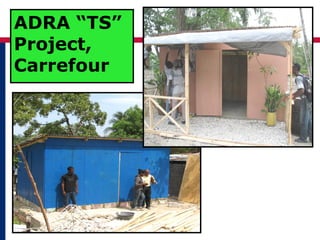
ADRA “TS”
Project,
Carrefour
RE-Learned Lessons
    Become “New” Guidance…
   Context, Context, Context!
   Tents Typically Not Large Enough
   Good Tents Expensive
   Complex logistics could make deployed
    “Pre-fabs” More Expensive
   Schools = Poor Shelter
   Local Options are Familiar, Available,
    Often Inexpensive, thus Accepted.
RE-LEARNED
    LESSON:
 THINK BIG, OR
YOU‟LL MISS THE
 “BIG PICTURE”
How Much
Rubble in Haiti?
1,000 Truckloads a Day for
  1,000 Days – Minimum!
EMERGENT LESSON
• Few want to deal with rubble, and it‟s
  expensive to address, so it could take
  years to remove/dispose
• Yet rubble is ALSO the most effective
  land use management tool most
  countries will ever have: where you
  don‟t clear, you don‟t build, and
• Surgical, neighborhood-based focus
  preferred over “clear cut” efforts; will
  require creative “S&S” work, like land
  sharing, land readjustment, and two-
  story T-shelters.
EMERGENT LESSON:
 THINK SMALL, OR YOU
WON‟T FIT (SPHERE) INTO
        CITIES
3.5 sq. m. per person is NOT
based on comfort, but is
considered “minimally
adequate” to
promote health,
privacy, and
human dignity

                  A = ± 3.5 m2/p
A First:
  Two-Story
 Transitional
Shelter, Haiti,
    5-12-11

• Response to site
  conditions and
  need
• Platform for DRR
  (structure, evac
  routes, and WASH
  opps)
RE-Learned Lessons
• Shelter is the Easy Part; the Much
  Tougher Issue is LAND
• Shelter Delivery Made More Difficult
  with Rubble. Affected Communities
  Effectively Smaller in Area Because
  Rubble is on top of Land, and
• In Haiti, PAP alone “lost” an
  estimated 30% of land area, making
  sheltering all the more difficult. (Ravine
 Pintade 18 AC/7.3 HA, covered with 120k cubic m to height of 5‟/1.64 m)
RE-Learned Lesson:
  Hosting (“STEALTH” Shelter)
       Really Does Work
• Primarily socially defined, based on
  family, friends, neighbors, etc.
• Commences before humanitarians
  arrive on the scene, i.e., self-selected
• Cost-effective, flexible means of
  sheltering
• Buys time for longer-term solutions to
  emerge, and
• Often transitions to permanent shelter.
Host Family Support, Mirebalais
(New self-built shelter in family compound is on right)
RE-Learned Lesson:
 Land Policies and Institutions
Are Often Dysfunctional, at Best

• In many countries, land management
  (e.g., planning, measuring, recording,
  documenting, regulating, taxing) is
  ineffective, and

• Policy makers know steps “A and Z”, but
  not steps B, C, D, etc. Problems are so
  complex that they overwhelm existing
  capacities.
THANK YOU FOR YOUR
 TIME AND PATIENCE


 EARGENAL@USAID.GOV

Sdrhcon2011 argenal

  • 1.
    Prefabricated Shelters: Points to Consider Presentation at the Sustainable Disaster Relief Housing Conference, Oct. 28, 2011 Eddie Argenal Shelter and Settlements Advisor, USAID/OFDA
  • 2.
    Session Agenda • NOTHousing, but Shelter • NOT just Shelter, but “S&S” • NOT just “S&S,” but Links to DRR and other Sectors • Lesson from Haiti
  • 3.
    OFDA: Lead USGAgency for Int‟l Disaster Assistance Since 1964 1963, Irazu Volcano in Costa Rica 1963, Skopje EQ, Former Yugoslavia
  • 4.
    USAID/OFDA Mandate  Save Lives  Reduce Suffering  Reduce the Economic and Social Impacts of Disasters (OFDA’s “Third Phrase”)
  • 5.
    OFDA Criteria forResponse  Host country must ask for, or be willing to accept, USG assistance  The disaster is of such magnitude that it is beyond the host country‟s ability to respond adequately, and  It is in the interest of the USG to provide assistance.
  • 6.
    Quick Review ofOFDA Activities • In FY ‟10 spent $1.3B (5.8% of total USAID budget) • 73 “declared disasters” (1 every 5 days) • Worked in 56 countries • 250 employees in 25 offices • FY‟08 = $550M • FY‟12 = ???
  • 7.
    Some of OFDA‟s Operational Partners
  • 8.
    A Challenging WorkEnvironment: The Fog of Relief EU/ ECHO USAID UN NGOs HOST OCHA NGOs NATION NGOs SECURITY FORCES OTHER WFP NGOs ICRC USAID DONORS OTHER UN AGENCIES IN COUNTRY UNHCR US Military Other Nation IOM UNDP Military UNJLC
  • 9.
    Not an AtypicalPattern of Recent OFDA Grant Funding to OFDA Grant Funding 2003 Implementing Partners… 10% 25% 65% UN Agencies NGOs/PVOs Int'l Orgs
  • 10.
    OFDA Does NOTEngage in Housing Reconstruction or Development, But Rather Humanitarian Shelter Assistance
  • 11.
  • 12.
    “Full Reconstruction” inResponse Phase May Appear to Close Gap, But Few “HA” Actors Know How to do it, so… MORE PROBLEMS
  • 13.
    Transitional Shelter • Morethan a tent, less than a house • Jump-starts and re-engages affected populations in the incremental, longer- term process of housing development • Means of Promoting DRR and Livelihoods (platform for other sector interventions), and • Unlike other sectors, no easy handoff to development. With programmatic vacuum, all the more reason to emphasize CONTEXT and TRANSITION.
  • 14.
  • 15.
    Back to theBig Picture: SETTLEMENTS, the “Where?” of “Our” Mandate
  • 16.
    Where Settlements arelocated, How they have developed, How rapidly they grow, How strong their economies are, and How well they are managed, esp. in times of crisis… Will largely determine whether they become the sites of future disasters -- and possible USG responses
  • 17.
    The TRENDS AffectingSettlements Are Many, and Include… • The Future Is Urban. Global population will increase from 6.2 billion to 8.3 billion, ’03-’30; equiv. of nearly 100% located in the cities of developing countries, increasing pop. from 2 to 4 billion! • Persistent Poverty. Over 3.3 billion people -- 48% of humanity -- survived on per capita incomes of no more than $2.50/day in 2005. The poverty level was 2.5 billion in 1987. • Increasing Strains on Basic Social Services and Institutions • Growing Environmental Decline, Coupled with Limited Economic Growth • HIV/AIDS, Bird Flu, Swine Flu, Pandemic Influenza, etc. increasingly a feature of settlements
  • 18.
    ANYONE SEEN… • Conditionsdepicted are experienced by nearly 1 of every 6 human beings • By 2030, nearly 1 of every 4!!!
  • 19.
    Implications for OUR Work… • Context: 2X urban pop., 3X urban land; LOTS of issues with growth • Chronic and acute needs are merging more and more every day • Disasters/crises accelerate and exacerbate the urbanization process, and • How to address urban displacement?
  • 20.
  • 21.
    The Importance of Settlements • Settlements provide context for shelter interventions • Unit of Analysis changes with a settlements approach; no longer a near-exclusive focus on households and shelter, but neighborhoods and larger communities, and • Change in Unit of Analysis particularly useful in urban areas.
  • 22.
    One Solution DoesNOT Fit All • Return to safe shelter • Return to safe, cleared sites • Stay with host family • Stay in proximity site with host community, and • Relocate to planned sites
  • 23.
    The Basic ofa Settlements Intervention • Shelter-led • Multi-sectoral, reflecting multi-faceted character of context (i.e., settlements) • Opportunistic with regard to livelihood promotion and “DRR” (e.g., rubble removal) • Cognizant of gender, environment, local organizations, and social relations • Transitional, by linking relief and developmental concerns, and • Accountable to local governing structures
  • 24.
    CONTEXT, CONTEXT, CONTEXT  Poorest country in the hemisphere, about 149th of 182 countries listed in the UN's Human Development Index, just below PNG  80% unemployed or underemployed  60% below the poverty line, making less than $2/day per capita  In PAP, 70% of population doesn‟t officially exist (rent, lease, squat, but don’t own land)  In PAP slums, 11 sq. m. for 6 people  Limited institutional capacities, and  High vulnerability to flooding, landslides, hurricanes, and, yes, earthquakes.
  • 26.
    USAID/OFDA Shelter Outputs  Emergency Phase: -- Plastic sheeting distributed to estimated 500,000-600,000 people  Transitional Phase: -- Hosting Support to est. 17,500 HHs (HA community doesn‟t track totals, but OFDA share thought to be notable) -- House Repairs for 7,181 Families (Approx. 80% of HA community output, via 5,081 repairs) -- Transitional Shelter for 28,326 HHs (as of 10-1- 11. Also, approx 33% of HA community output) -- Completed approx. 112% of 47,500 identified “shelter solutions” (as of 10-1-11)
  • 27.
    Habitability Assessment and Yellow-Tag House Repairs • USAID/OFDA supported UN Habitat and PADF/Miyamoto to conduct/manage assessment of 403,176 structures • USAID/OFDA supported PADF/M and WCDO to repair 3,908 houses as of 3-9- 11, approx. 80-90% of humanitarian community (HC) output; will repair approx. 2,000 more houses, and • 94,002 yellow-tag houses, but current HC plans only call for repairs to fewer than 10,000 structures.
  • 28.
  • 29.
  • 30.
  • 31.
  • 32.
    RE-Learned Lessons Become “New” Guidance…  Context, Context, Context!  Tents Typically Not Large Enough  Good Tents Expensive  Complex logistics could make deployed “Pre-fabs” More Expensive  Schools = Poor Shelter  Local Options are Familiar, Available, Often Inexpensive, thus Accepted.
  • 33.
    RE-LEARNED LESSON: THINK BIG, OR YOU‟LL MISS THE “BIG PICTURE”
  • 34.
  • 35.
    1,000 Truckloads aDay for 1,000 Days – Minimum!
  • 36.
    EMERGENT LESSON • Fewwant to deal with rubble, and it‟s expensive to address, so it could take years to remove/dispose • Yet rubble is ALSO the most effective land use management tool most countries will ever have: where you don‟t clear, you don‟t build, and • Surgical, neighborhood-based focus preferred over “clear cut” efforts; will require creative “S&S” work, like land sharing, land readjustment, and two- story T-shelters.
  • 37.
    EMERGENT LESSON: THINKSMALL, OR YOU WON‟T FIT (SPHERE) INTO CITIES
  • 38.
    3.5 sq. m.per person is NOT based on comfort, but is considered “minimally adequate” to promote health, privacy, and human dignity A = ± 3.5 m2/p
  • 39.
    A First: Two-Story Transitional Shelter, Haiti, 5-12-11 • Response to site conditions and need • Platform for DRR (structure, evac routes, and WASH opps)
  • 40.
    RE-Learned Lessons • Shelteris the Easy Part; the Much Tougher Issue is LAND • Shelter Delivery Made More Difficult with Rubble. Affected Communities Effectively Smaller in Area Because Rubble is on top of Land, and • In Haiti, PAP alone “lost” an estimated 30% of land area, making sheltering all the more difficult. (Ravine Pintade 18 AC/7.3 HA, covered with 120k cubic m to height of 5‟/1.64 m)
  • 41.
    RE-Learned Lesson: Hosting (“STEALTH” Shelter) Really Does Work • Primarily socially defined, based on family, friends, neighbors, etc. • Commences before humanitarians arrive on the scene, i.e., self-selected • Cost-effective, flexible means of sheltering • Buys time for longer-term solutions to emerge, and • Often transitions to permanent shelter.
  • 42.
    Host Family Support,Mirebalais (New self-built shelter in family compound is on right)
  • 43.
    RE-Learned Lesson: LandPolicies and Institutions Are Often Dysfunctional, at Best • In many countries, land management (e.g., planning, measuring, recording, documenting, regulating, taxing) is ineffective, and • Policy makers know steps “A and Z”, but not steps B, C, D, etc. Problems are so complex that they overwhelm existing capacities.
  • 44.
    THANK YOU FORYOUR TIME AND PATIENCE EARGENAL@USAID.GOV