www.fpinnovations.ca


                       Design and Treatment
                       Specifications for Durable
                       Disaster Relief Housing

                       Paul Morris and Jieying Wang
                       Durability and Protection Group
                       FPInnovations
Durability Concerns for Disaster Relief Housing

• Need to maximize number of shelters pushes
  down cost which leads to simplified designs with
  fewer moisture management features
• May be difficult to control construction quality
• Temporary structures tend to become permanent
• Occupier improvements may increase moisture
  and termite problems
  – Addition of untreated wood invites decay and termites
  – Addition of concrete embeds wood
  – Addition of cladding or insulation hides termites
Durability Concerns for Disaster Relief Housing

In tropical/subtropical countries
• High humidity and rainfall promotes decay
• Warm temperatures favour termites

In extreme northern climates
• High occupancy - high interior moisture load
• High insulation can promote condensation
Understanding the Decay and Termite Hazard

• Scheffer index values indicate decay potential
  – Derived from equation using rainfall and temperature data
• 3 main divisions in termite hazard zones
  1. No termites – wood boring beetles may be a problem
  2. Reticulitermes and other termite species. No Coptotermes
  3. Coptotermes species present, drywood termites also likely
• Get expert advice


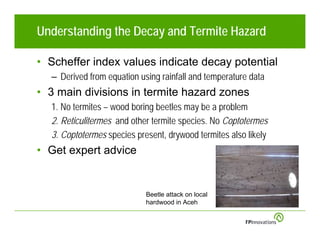
                            Beetle attack on local
                            hardwood in Aceh
Native termites in Haiti

• Subterranean termites    Reticulitermes sp.
• Drywood termites         Cryptotermes sp.
• Tree-dwelling termites   Nastitutermes sp.
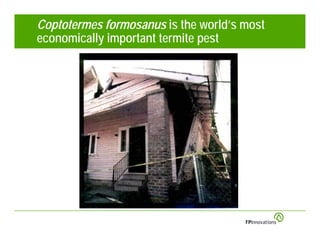
Coptotermes formosanus is the world’s most
economically important termite pest
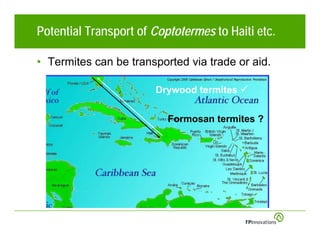
Potential Transport of Coptotermes to Haiti etc.

• Termites can be transported via trade or aid.

                       Drywood termites

                          Formosan termites ?
Native termites in Indonesia

• Copotermes gestroi mainly in cities
  – C. formosanus sophisticated cousin
• Coptotermes curvignathus mainly in rural areas
  – C. formosanus hillbilly cousin


• Best to consider all Coptotermes as equally bad
• ~198 other species
Moisture Management

      Design Solutions for Durability

Moisture Management
The 4Ds

   • Deflection
        – Divert water
   • Drainage
        – Let water go
   • Drying
        – Allow to dry
   • Durability
        – Durable materials

  Hazleden, D.G., Morris, P.I. 1999.
Moisture Management

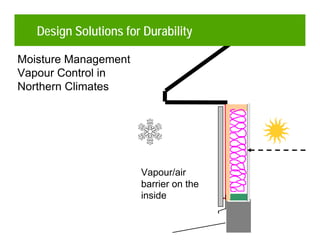
      Design Solutions for Durability

Moisture Management
Vapour Control in
Northern Climates


                          Vapour/air
                          barrier on the
                          inside
Moisture Management

      Design Solutions for Durability

Moisture Management
Vapour Control in
Tropical Climates


                          Vapour/air
                          barrier on the
                          outside
Design Solutions for Durability

•   Pitched roof with overhangs on all sides
•   Minimize penetrations in roof
•   Minimize rainfall traps
•   Minimize wood-soil contact
    – Even if treated, this can attract termites
• Minimize penetrations through slab
    – Termites enter through cracks
• Design should be congruent with local custom
Design Solutions for Durability

• Support posts above concrete
  – Prevent wicking of water
  – Facilitate inspection for termites


                                         Ain’t
• Raised floor                           nobody
                                         here but us
   – Reduced flood damage                chickens

   – Improved ventilation
   – Facilitates inspection and termite control
                                  Chickens eating tree-
                                  dwelling termites in Cuba
Integrated Termites Management : The 6Ss
                     Developed Countries
            Suppression


Surveillance
                                         Structural
  BUG OFF
                             Site        durability
                          management
                                       Slab/foundation
                                        Slab/foundation
                                         Soil barrier
Integrated Termites Management : The 3Ss
             Disaster Relief


                                 Structural
                   Site
                management       durability

                               Slab/foundation
                                Slab/foundation
Integrated Termites Management : The 3Ss
                                                        Drywood
                             Formosan                   termites
                             termites?


                  Tree
                  dwelling
                  termites                 Structural
                          Site             durability
                       management
                                         Slab/foundation
                                          Slab/foundation

                        Subterranean
                        termites

Slab/Foundation detailing does not stop all termites
Integrated Termite Management

Structure Durability
• Most of our species are not termite resistant
• Exceptions:
  – Western red-cedar is non-preferred but still gets eaten
  – Eastern white-cedar is non-preferred but still gets eaten
  – Yellow cedar is the most termite resistant
• For most species, treatment is the only option
  – Note: thermal treatment is not effective vs termites
Preservative Treatment Options

Not only the lumber needs to be treated
• Plywood and PSL can be pressure treated
• OSB can be treated during manufacture
• LVL very difficult to treat – avoid
• I-joists need to be made from treated material
• Glulam reacts badly to waterborne treatment
  – Oil borne preservatives not appropriate for residential
  – LOSP (Hi-Clear or Cu-nap) treatment not available in Canada
  – Can treat lamina prior to gluing
Preservative Treatment Options

Must consider
• Regulations in exporting country
• Regulations in importing country
• Potential for human contact
• Building design
• Wood species
• Local decay and termite hazards
Preservative Treatment Options

• Many countries have their own standards
  – Former British colonies may use British (European) standards
  – American dependencies use AWPA standards
  – French colonies may use French ( European) standards
• All should be using ISO 21887 Use Classes
  –   UC 1 Interior, dry
  –   UC2 Interior, damp
  –   UC3 Outdoors above ground
  –   UC4 Outdoors ground contact
Preservative Treatment Options

• Canadian species mostly impermeable heartwood
• Tough to meet foreign treatment standards
• After intensive research by FPInnovations and
  UBC, Canadian standards for outdoor residential
  lumber have been reduced
  – No penetration requirement for 2x4 and smaller
• These specifications are fine for northern climates
• Not for tropical/subtropical regions
• Shallow penetration won’t stop termites
Preservative Treatment Options

• ACQ and CA Pressure Treatment
  – Require incising (perforation) - 25% strength loss
  – React with wood. Stop moving when pressure stops
• Borate Pressure+Diffusion Treatment
  – Does not require incising
  – Don’t react with wood. Keep moving when pressure stops
• New surface-applied penetrating process
  – Chemistry and process provide deep penetration
• In process Zinc-borate treatment of OSB
• Surface-treatments
Preservative Treatment Options

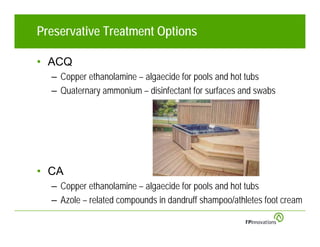
• ACQ
  – Copper ethanolamine – algaecide for pools and hot tubs
  – Quaternary ammonium – disinfectant for surfaces and swabs


• CA
  – Copper ethanolamine – algaecide for pools and hot tubs
  – Azole – related compounds in dandruff shampoo/athletes foot cream
Preservative Treatment Options

ACQ and CA pressure treatment
• Choice of species is critical


        High-density Incised White Spruce
  Incised white spruce     Incised Pacific Silver fir
Preservative Treatment Options

Termites eat through a thin shell of treatment
Preservative Treatment Options

Termites give up if treated shell is thick enough
Preservative Treatment Options

Or, if they get through, the box is strong enough
Preservative Treatment Options

  • That is why I favour borate treatment
  • Borates penetrate our wood


Red colour with reagent shows borate penetration
Preservative Treatment Options

                         Borates have a
                         positive perception


                         • Got it on your hands?
                         • Got it on your clothes?.
                         • Got it in your eyes?
                         • Got hungry?
                         • Got boron ?
Preservative Treatment Options

Above ground protected termite test


                     400mm            1000mm
                     m

                             600mm
Preservative Treatment Options

Performance of treated samples in Hawaii
                      10

                       9
                       8
AWPA termite rating


                       7
                       6

                       5
                       4

                       3
                       2

                       1
                       0
                           0           2             4                6       8          10
                                                      Years of exposure

                               hem-fir control   ACZA              2% shell   3% shell
                               2% through        3% through        2%+DDAC    CCA
Preservative Treatment Options

• In Hawaii almost all wood-frame homes are
  100% borate treated.
• Higher loadings required for Formosan
  termites than in CSA – Use AWPA standards
• Borates not for use outdoors exposed to rain
  – Except under well maintained 3-coat paint finish
Preservative Treatment Options

New surface-applied penetrating process
• Developed for New Zealand market
• Penetrating formulation
  – Various fungicides and insecticides can be added
• Dip or spray
  plus kiln-
  conditioning
Preservative Treatment Options

  New surface-applied penetrating process


             Treatment results on BC SPF (pine)

Red colour with reagent shows penetration
Preservative Treatment Options

New surface-applied penetrating process

   Treatment               Rating (10-0) at 2 yrs

   Control (untreated)                2

   Borate (sub-standard)              8

   Formulation 1                      9

   Formulation 2                      10

   Formulation 3                      10
Preservative Treatment Options

   • ZB added to OSB during manufacture
   • Added as a powder at the blender
   • Effectively treats full cross section
   • ZB is resistant to leaching
   • Factory coated/sealed boards for
     exterior use
   • Field tested in Hawaii*


*Image courtesy of Peter Laks, Michigan Tech University
Preservative Treatment Options

   • OSB Treated with ZB During Manufacture


Data courtesy of Peter Laks, Michigan Tech University
Preservative Treatment Options

Other Treatments
• What are the active ingredients?
    – Vs decay
    – Vs termites
•   What loading is achieved?
•   What penetration is achieved?
•   What standards are met?
•   What long term field test data are available?
    – Lab testing is not good enough – small samples easily treated
• What are the warranties?
Preservative Treatment Specifications

• Treated wood off the shelf likely won’t perform
• Don’t accept “treatment to refusal”
• Get expert advice
• Specify standard and subsection
• Specify preservative and species
• Treatment certificates are worth
  the value of the paper and the ink
• Use third party quality assurance
Preservative Treatment Specifications

• For Britco pre-fab homes for tsunami relief
  in Indonesia we recommended to FII:
  – ACQ treated plywood sheathing – no cladding supplied
  – Incised ACQ treated hem-fir for outside
  – Borate treated SPF for inside
    protected from rain
Preservative Treatment Specifications

    • For home kits for earthquake relief
      in Haiti we recommended to SNC Lavelin:
        – ACQ or CA treatment for all components because all components
          were potentially exposed to soil or rain –long term


Prototype with untreated components. Photos courtesy of SNC Lavelin
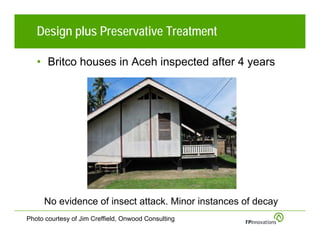
Design plus Preservative Treatment

   • Britco houses in Aceh inspected after 4 years


     No evidence of insect attack. Minor instances of decay
Photo courtesy of Jim Creffield, Onwood Consulting
Without Preservative Treatment?

• Housing built in Aceh using untreated local
  materials attacked by termites after 6 months.
  – Source: representive of aid group
• Housing built in Haiti using imported material
  with treated sheathing and untreated framing
  – Not a good idea
Conclusions

• Fit design and treatment to local hazards
• Simple design solutions can improve durability
• Preservative treatment is needed vs. termites
    – Deep penetration essential for termite protection
•   Most Canadian species resist pressure treatment
•   Diffusible/pervasive treatments are best
•   Borates as effective as CCA under cover
•   Tru-core process looks promising
•   Specify precisely
•   Quality assurance is critical
Any Questions

Sdrhcon2011 morris

  • 1.
    www.fpinnovations.ca Design and Treatment Specifications for Durable Disaster Relief Housing Paul Morris and Jieying Wang Durability and Protection Group FPInnovations
  • 2.
    Durability Concerns forDisaster Relief Housing • Need to maximize number of shelters pushes down cost which leads to simplified designs with fewer moisture management features • May be difficult to control construction quality • Temporary structures tend to become permanent • Occupier improvements may increase moisture and termite problems – Addition of untreated wood invites decay and termites – Addition of concrete embeds wood – Addition of cladding or insulation hides termites
  • 3.
    Durability Concerns forDisaster Relief Housing In tropical/subtropical countries • High humidity and rainfall promotes decay • Warm temperatures favour termites In extreme northern climates • High occupancy - high interior moisture load • High insulation can promote condensation
  • 4.
    Understanding the Decayand Termite Hazard • Scheffer index values indicate decay potential – Derived from equation using rainfall and temperature data • 3 main divisions in termite hazard zones 1. No termites – wood boring beetles may be a problem 2. Reticulitermes and other termite species. No Coptotermes 3. Coptotermes species present, drywood termites also likely • Get expert advice Beetle attack on local hardwood in Aceh
  • 5.
    Native termites inHaiti • Subterranean termites Reticulitermes sp. • Drywood termites Cryptotermes sp. • Tree-dwelling termites Nastitutermes sp.
  • 6.
    Coptotermes formosanus isthe world’s most economically important termite pest
  • 7.
    Potential Transport ofCoptotermes to Haiti etc. • Termites can be transported via trade or aid. Drywood termites Formosan termites ?
  • 8.
    Native termites inIndonesia • Copotermes gestroi mainly in cities – C. formosanus sophisticated cousin • Coptotermes curvignathus mainly in rural areas – C. formosanus hillbilly cousin • Best to consider all Coptotermes as equally bad • ~198 other species
  • 9.
    Moisture Management Design Solutions for Durability Moisture Management The 4Ds • Deflection – Divert water • Drainage – Let water go • Drying – Allow to dry • Durability – Durable materials Hazleden, D.G., Morris, P.I. 1999.
  • 10.
    Moisture Management Design Solutions for Durability Moisture Management Vapour Control in Northern Climates Vapour/air barrier on the inside
  • 11.
    Moisture Management Design Solutions for Durability Moisture Management Vapour Control in Tropical Climates Vapour/air barrier on the outside
  • 12.
    Design Solutions forDurability • Pitched roof with overhangs on all sides • Minimize penetrations in roof • Minimize rainfall traps • Minimize wood-soil contact – Even if treated, this can attract termites • Minimize penetrations through slab – Termites enter through cracks • Design should be congruent with local custom
  • 13.
    Design Solutions forDurability • Support posts above concrete – Prevent wicking of water – Facilitate inspection for termites Ain’t • Raised floor nobody here but us – Reduced flood damage chickens – Improved ventilation – Facilitates inspection and termite control Chickens eating tree- dwelling termites in Cuba
  • 14.
    Integrated Termites Management: The 6Ss Developed Countries Suppression Surveillance Structural BUG OFF Site durability management Slab/foundation Slab/foundation Soil barrier
  • 15.
    Integrated Termites Management: The 3Ss Disaster Relief Structural Site management durability Slab/foundation Slab/foundation
  • 16.
    Integrated Termites Management: The 3Ss Drywood Formosan termites termites? Tree dwelling termites Structural Site durability management Slab/foundation Slab/foundation Subterranean termites Slab/Foundation detailing does not stop all termites
  • 17.
    Integrated Termite Management StructureDurability • Most of our species are not termite resistant • Exceptions: – Western red-cedar is non-preferred but still gets eaten – Eastern white-cedar is non-preferred but still gets eaten – Yellow cedar is the most termite resistant • For most species, treatment is the only option – Note: thermal treatment is not effective vs termites
  • 18.
    Preservative Treatment Options Notonly the lumber needs to be treated • Plywood and PSL can be pressure treated • OSB can be treated during manufacture • LVL very difficult to treat – avoid • I-joists need to be made from treated material • Glulam reacts badly to waterborne treatment – Oil borne preservatives not appropriate for residential – LOSP (Hi-Clear or Cu-nap) treatment not available in Canada – Can treat lamina prior to gluing
  • 19.
    Preservative Treatment Options Mustconsider • Regulations in exporting country • Regulations in importing country • Potential for human contact • Building design • Wood species • Local decay and termite hazards
  • 20.
    Preservative Treatment Options •Many countries have their own standards – Former British colonies may use British (European) standards – American dependencies use AWPA standards – French colonies may use French ( European) standards • All should be using ISO 21887 Use Classes – UC 1 Interior, dry – UC2 Interior, damp – UC3 Outdoors above ground – UC4 Outdoors ground contact
  • 21.
    Preservative Treatment Options •Canadian species mostly impermeable heartwood • Tough to meet foreign treatment standards • After intensive research by FPInnovations and UBC, Canadian standards for outdoor residential lumber have been reduced – No penetration requirement for 2x4 and smaller • These specifications are fine for northern climates • Not for tropical/subtropical regions • Shallow penetration won’t stop termites
  • 22.
    Preservative Treatment Options •ACQ and CA Pressure Treatment – Require incising (perforation) - 25% strength loss – React with wood. Stop moving when pressure stops • Borate Pressure+Diffusion Treatment – Does not require incising – Don’t react with wood. Keep moving when pressure stops • New surface-applied penetrating process – Chemistry and process provide deep penetration • In process Zinc-borate treatment of OSB • Surface-treatments
  • 23.
    Preservative Treatment Options •ACQ – Copper ethanolamine – algaecide for pools and hot tubs – Quaternary ammonium – disinfectant for surfaces and swabs • CA – Copper ethanolamine – algaecide for pools and hot tubs – Azole – related compounds in dandruff shampoo/athletes foot cream
  • 24.
    Preservative Treatment Options ACQand CA pressure treatment • Choice of species is critical High-density Incised White Spruce Incised white spruce Incised Pacific Silver fir
  • 25.
    Preservative Treatment Options Termiteseat through a thin shell of treatment
  • 26.
    Preservative Treatment Options Termitesgive up if treated shell is thick enough
  • 27.
    Preservative Treatment Options Or,if they get through, the box is strong enough
  • 28.
    Preservative Treatment Options • That is why I favour borate treatment • Borates penetrate our wood Red colour with reagent shows borate penetration
  • 29.
    Preservative Treatment Options Borates have a positive perception • Got it on your hands? • Got it on your clothes?. • Got it in your eyes? • Got hungry? • Got boron ?
  • 30.
    Preservative Treatment Options Aboveground protected termite test 400mm 1000mm m 600mm
  • 31.
    Preservative Treatment Options Performanceof treated samples in Hawaii 10 9 8 AWPA termite rating 7 6 5 4 3 2 1 0 0 2 4 6 8 10 Years of exposure hem-fir control ACZA 2% shell 3% shell 2% through 3% through 2%+DDAC CCA
  • 32.
    Preservative Treatment Options •In Hawaii almost all wood-frame homes are 100% borate treated. • Higher loadings required for Formosan termites than in CSA – Use AWPA standards • Borates not for use outdoors exposed to rain – Except under well maintained 3-coat paint finish
  • 33.
    Preservative Treatment Options Newsurface-applied penetrating process • Developed for New Zealand market • Penetrating formulation – Various fungicides and insecticides can be added • Dip or spray plus kiln- conditioning
  • 34.
    Preservative Treatment Options New surface-applied penetrating process Treatment results on BC SPF (pine) Red colour with reagent shows penetration
  • 35.
    Preservative Treatment Options Newsurface-applied penetrating process Treatment Rating (10-0) at 2 yrs Control (untreated) 2 Borate (sub-standard) 8 Formulation 1 9 Formulation 2 10 Formulation 3 10
  • 36.
    Preservative Treatment Options • ZB added to OSB during manufacture • Added as a powder at the blender • Effectively treats full cross section • ZB is resistant to leaching • Factory coated/sealed boards for exterior use • Field tested in Hawaii* *Image courtesy of Peter Laks, Michigan Tech University
  • 37.
    Preservative Treatment Options • OSB Treated with ZB During Manufacture Data courtesy of Peter Laks, Michigan Tech University
  • 38.
    Preservative Treatment Options OtherTreatments • What are the active ingredients? – Vs decay – Vs termites • What loading is achieved? • What penetration is achieved? • What standards are met? • What long term field test data are available? – Lab testing is not good enough – small samples easily treated • What are the warranties?
  • 39.
    Preservative Treatment Specifications •Treated wood off the shelf likely won’t perform • Don’t accept “treatment to refusal” • Get expert advice • Specify standard and subsection • Specify preservative and species • Treatment certificates are worth the value of the paper and the ink • Use third party quality assurance
  • 40.
    Preservative Treatment Specifications •For Britco pre-fab homes for tsunami relief in Indonesia we recommended to FII: – ACQ treated plywood sheathing – no cladding supplied – Incised ACQ treated hem-fir for outside – Borate treated SPF for inside protected from rain
  • 41.
    Preservative Treatment Specifications • For home kits for earthquake relief in Haiti we recommended to SNC Lavelin: – ACQ or CA treatment for all components because all components were potentially exposed to soil or rain –long term Prototype with untreated components. Photos courtesy of SNC Lavelin
  • 42.
    Design plus PreservativeTreatment • Britco houses in Aceh inspected after 4 years No evidence of insect attack. Minor instances of decay Photo courtesy of Jim Creffield, Onwood Consulting
  • 43.
    Without Preservative Treatment? •Housing built in Aceh using untreated local materials attacked by termites after 6 months. – Source: representive of aid group • Housing built in Haiti using imported material with treated sheathing and untreated framing – Not a good idea
  • 44.
    Conclusions • Fit designand treatment to local hazards • Simple design solutions can improve durability • Preservative treatment is needed vs. termites – Deep penetration essential for termite protection • Most Canadian species resist pressure treatment • Diffusible/pervasive treatments are best • Borates as effective as CCA under cover • Tru-core process looks promising • Specify precisely • Quality assurance is critical
  • 45.