Forced Fluid Imbibition
in a Powder-Packed Column
  Jinwu Wang, Post Doctoral Associate
   Sheldon Q. Shi, Assistant Professor

     Department of Forest Products
      Mississippi State University
Objectives
Develop a tool to measure contact angles
and surface energies for both
– Spontaneous and
– non-spontaneous imbibing liquids in powders
Current Problem
– Spontaneous inbibition is not achieved in many
  cases when the wetting angle is larger than 900
Explanation
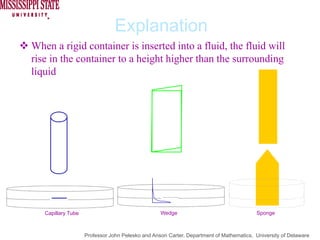
When a rigid container is inserted into a fluid, the fluid will
rise in the container to a height higher than the surrounding
liquid


   Capillary Tube                                 Wedge                                 Sponge


                    Professor John Pelesko and Anson Carter, Department of Mathematics, University of Delaware
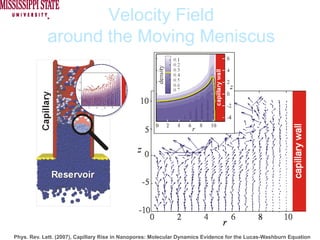
Velocity Field
            around the Moving Meniscus


Phys. Rev. Lett. (2007), Capillary Rise in Nanopores: Molecular Dynamics Evidence for the Lucas-Washburn Equation
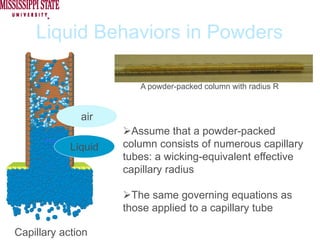
Liquid Behaviors in Powders

                        A powder-packed column with radius R


              air
                       Assume that a powder-packed
            Liquid   column consists of numerous capillary
                     tubes: a wicking-equivalent effective
                     capillary radius

                       The same governing equations as
                     those applied to a capillary tube

Capillary action
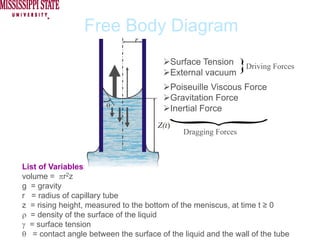
Free Body Diagram
                                r

                                             Surface Tension
                                             External vacuum
                                                                  }Driving Forces
                                             Poiseuille Viscous Force
                                             Gravitation Force
                                             Inertial Force
                                      Z(t)
                                                Dragging Forces


List of Variables:
volume = πr2z
g = gravity
r = radius of capillary tube
z = rising height, measured to the bottom of the meniscus, at time t ≥ 0
ρ = density of the surface of the liquid
γ = surface tension
θ = contact angle between the surface of the liquid and the wall of the tube
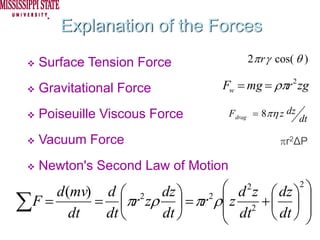
Explanation of the Forces
   Surface Tension Force               2π r γ cos( θ )

   Gravitational Force         Fw = mg = ρπr 2 zg

   Poiseuille Viscous Force        Fdrag = 8πη z dz
                                                      dt

   Vacuum Force                                πr2ΔP

   Newton's Second Law of Motion
     d (mv) d ⎛ 2 dz ⎞      ⎛ d 2 z ⎛ dz ⎞2 ⎞
∑ F=
        dt  dt ⎝   dt ⎠
                          2 ⎜
           = ⎜πr zρ ⎟ = πr ρ z 2 + ⎜ ⎟ ⎟
                            ⎜ dt ⎝ dt ⎠ ⎟
                            ⎝               ⎠
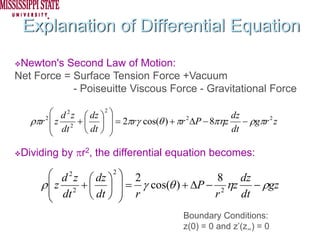
Explanation of Differential Equation
 Newton's Second Law of Motion:
Net Force = Surface Tension Force +Vacuum
            - Poiseuitte Viscous Force - Gravitational Force

         ⎛ d 2 z ⎛ dz ⎞ 2 ⎞                           dz
   ρπr 2 ⎜ z 2 + ⎜ ⎟ ⎟ = 2πrγ cos(θ ) + πr 2 ΔP − 8πηz − ρgπr 2 z
         ⎜ dt    ⎝ dt ⎠ ⎠ ⎟                           dt
         ⎝

 Dividing by πr2, the differential equation becomes:

       ⎛Zo = Z(0) =⎛0dz ⎞ 2 ⎞ 2
           d 2z
     ρ ⎜z       +⎜ ⎟        ⎟ = γ cos(θ ) + ΔP − 8 ηz dz − ρgz
       ⎜ dt        ⎝ dt ⎠ ⎟ r
              2
       ⎝                    ⎠                    r 2 dt
                                         Boundary Conditions:
                                         z(0) = 0 and z’(z∞) = 0
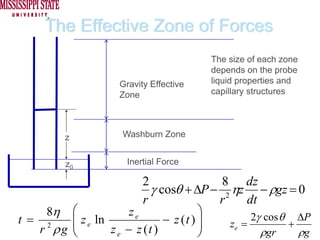
The Effective Zone of Forces
                                        The size of each zone
                                        depends on the probe
                    Gravity Effective   liquid properties and
                    Zone                capillary structures


         z           Washburn Zone


         z0           Inertial Force

                         2               8 dz
                           γ cosθ + ΔP − 2 ηz − ρgz = 0
                         r               r     dt
    8η ⎛              ze               ⎞        2γ cos θ ΔP
t = 2   ⎜ z e ln
        ⎜                     − z (t ) ⎟
                                       ⎟   ze =         +
   r ρg ⎝        z e − z (t )          ⎠          ρgr     ρg
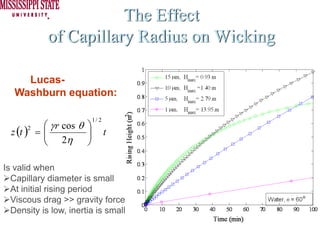
The Effect
               of Capillary Radius on Wicking

     Lucas-
   Washburn equation:

                               1/ 2
             ⎛ γ r cos θ   ⎞
  z (t )    =⎜             ⎟
        2
             ⎜ 2η          ⎟          t
             ⎝             ⎠

Is valid when
  Capillary diameter is small
  At initial rising period
  Viscous drag >> gravity force
  Density is low, inertia is small
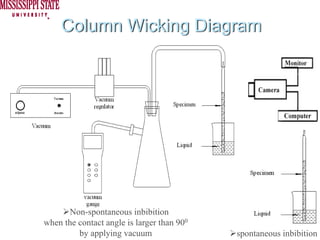
Column Wicking Diagram


      Non-spontaneous inbibition
when the contact angle is larger than 900
         by applying vacuum                 spontaneous inbibition
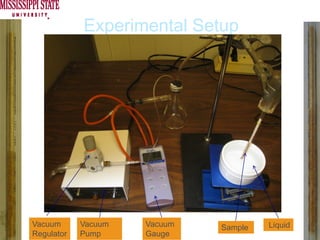
Experimental Setup


Vacuum      Vacuum   Vacuum   Sample   Liquid
Regulator   Pump     Gauge
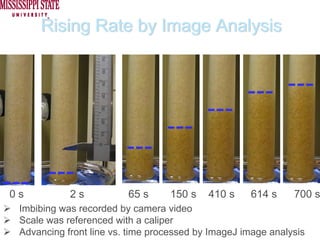
Rising Rate by Image Analysis


0s          2s           65 s     150 s    410 s    614 s     700 s
 Imbibing was recorded by camera video
 Scale was referenced with a caliper
 Advancing front line vs. time processed by ImageJ image analysis
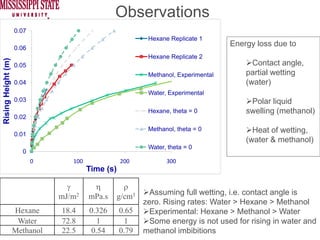
Observations
                    0.07
                                                            Hexane Replicate 1
                    0.06
                                                                                     Energy loss due to
                                                            Hexane Replicate 2
Rising Height (m)


                    0.05                                                                   Contact angle,
                                                            Methanol, Experimental       partial wetting
                    0.04                                                                 (water)
                                                            Water, Experimental
                    0.03                                                                  Polar liquid
                                                            Hexane, theta = 0            swelling (methanol)
                    0.02
                                                            Methanol, theta = 0            Heat of wetting,
                    0.01
                                                                                         (water & methanol)
                                                            Water, theta = 0
                      0
                           0      100              200            300
                                        Time (s)

                                 γ       η           ρ
                                                             Assuming full wetting, i.e. contact angle is
                               mJ/m2    mPa.s      g/cm3
                                                           zero. Rising rates: Water > Hexane > Methanol
                    Hexane     18.4     0.326      0.65      Experimental: Hexane > Methanol > Water
                     Water     72.8       1          1       Some energy is not used for rising in water and
                    Methanol   22.5      0.54      0.79    methanol imbibitions
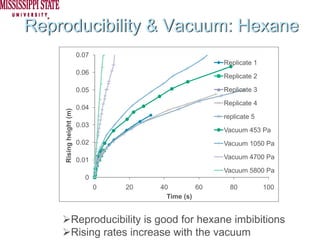
Reproducibility & Vacuum: Hexane
                        0.07
                                                        Replicate 1
                        0.06
                                                        Replicate 2

                        0.05                            Replicate 3

                                                        Replicate 4
                        0.04
    Rising height (m)


                                                        replicate 5
                        0.03
                                                        Vacuum 453 Pa
                        0.02                            Vacuum 1050 Pa

                        0.01                            Vacuum 4700 Pa

                                                        Vacuum 5800 Pa
                          0
                               0   20   40         60     80          100
                                          Time (s)


                 Reproducibility is good for hexane imbibitions
                 Rising rates increase with the vacuum
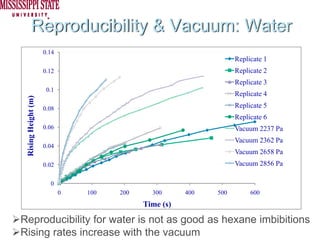
Reproducibility & Vacuum: Water
                     0.14
                                                                   Replicate 1
                     0.12                                          Replicate 2
                                                                   Replicate 3
                      0.1
                                                                   Replicate 4
 Rising Height (m)


                     0.08                                          Replicate 5
                                                                   Replicate 6
                     0.06                                          Vacuum 2237 Pa
                                                                   Vacuum 2362 Pa
                     0.04
                                                                   Vacuum 2658 Pa
                     0.02                                          Vacuum 2856 Pa

                       0
                            0   100   200     300      400   500        600
                                            Time (s)

Reproducibility for water is not as good as hexane imbibitions
Rising rates increase with the vacuum
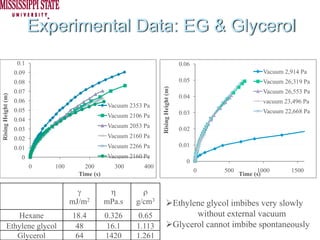
Experimental Data: EG & Glycerol
                     0.1                                                                 0.06
                    0.09                                                                                          Vacuum 2,914 Pa
                    0.08                                                                 0.05                     Vacuum 26,319 Pa


                                                                    Rising Height (m)
                    0.07                                                                                          Vacuum 26,553 Pa
Rising Height (m)


                                                                                         0.04
                    0.06                                                                                          vacuum 23,496 Pa
                                                  Vacuum 2353 Pa
                    0.05                                                                 0.03                     Vacuum 22,668 Pa
                                                  Vacuum 2106 Pa
                    0.04
                                                  Vacuum 2053 Pa                         0.02
                    0.03
                    0.02                          Vacuum 2160 Pa
                    0.01                          Vacuum 2266 Pa                         0.01
                      0                           Vacuum 2160 Pa
                                                                                           0
                           0   100       200        300       400
                                                                                                0    500         1000      1500
                                       Time (s)                                                            Time (s)

                                       γ           η         ρ
                                     mJ/m2        mPa.s    g/cm3                        Ethylene glycol imbibes very slowly
             Hexane                  18.4         0.326    0.65                               without external vacuum
          Ethylene glycol             48           16.1    1.113                        Glycerol cannot imbibe spontaneously
             Glycerol                 64          1420     1.261
Results and Discussion
Define the effective capillary radius with
hexane
The effect of polar liquids
Energy loss constant
Contact angle with water
Vacuum induced slip
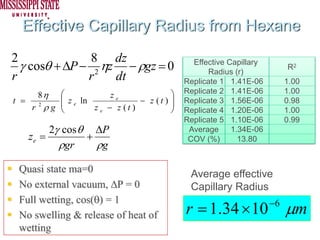
Effective Capillary Radius from Hexane
2               8 dz
  γ cosθ + ΔP − 2 ηz − ρgz = 0                   Effective Capillary
                                                     Radius (r)
                                                                            R2
r              r    dt                         Replicate 1 1.41E-06         1.00
          ⎛                                ⎞   Replicate 2 1.41E-06         1.00
      8η                ze
t =       ⎜ z e ln              − z (t )   ⎟   Replicate 3 1.56E-06         0.98
    r 2ρg ⎜
          ⎝        z e − z (t )            ⎟
                                           ⎠   Replicate 4 1.20E-06         1.00
                                               Replicate 5 1.10E-06         0.99
         2γ cos θ ΔP                            Average     1.34E-06
    ze =         +                              COV (%)       13.80
           ρgr     ρg

 Quasi state ma=0                               Average effective
 No external vacuum, ΔP = 0                     Capillary Radius
 Full wetting, cos(θ) = 1
 No swelling & release of heat of              r = 1.34 × 10           −6
                                                                            μm
 wetting
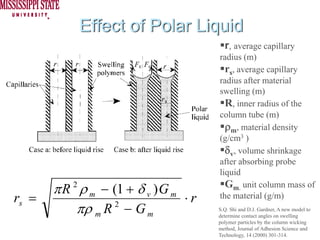
Effect of Polar Liquid
                                         r, average capillary
                                       radius (m)
                                         rs, average capillary
                                       radius after material
                                       swelling (m)
                                         R, inner radius of the
                                       column tube (m)
                                         ρm, material density
                                       (g/cm3 )
                                         δv, volume shrinkage
                                       after absorbing probe
                                       liquid

       π R 2 ρ m − (1 + δ v ) G m        Gm, unit column mass of
rs =                              ⋅r   the material (g/m)
            πρ m R − G m
                    2
                                       S.Q. Shi and D.J. Gardner, A new model to
                                       determine contact angles on swelling
                                       polymer particles by the column wicking
                                       method, Journal of Adhesion Science and
                                       Technology, 14 (2000) 301-314.
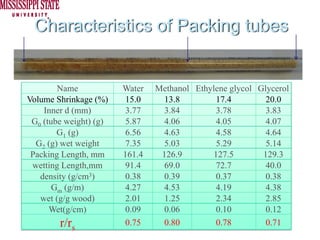
Characteristics of Packing tubes


        Name            Water   Methanol Ethylene glycol Glycerol
Volume Shrinkage (%)    15.0     13.8         17.4         20.0
    Inner d (mm)         3.77     3.84        3.78         3.83
 G0 (tube weight) (g)    5.87     4.06        4.05         4.07
        G1 (g)          6.56      4.63        4.58         4.64
  G2 (g) wet weight      7.35     5.03        5.29         5.14
 Packing Length, mm     161.4    126.9       127.5        129.3
 wetting Length,mm       91.4     69.0        72.7         40.0
   density (g/cm3)       0.38     0.39        0.37         0.38
       Gm (g/m)         4.27      4.53        4.19         4.38
   wet (g/g wood)        2.01     1.25        2.34         2.85
      Wet(g/cm)          0.09     0.06        0.10         0.12
        r/rs             0.75     0.80        0.78         0.71
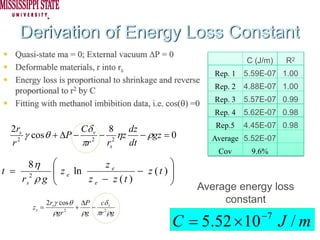
Derivation of Energy Loss Constant
   Quasi-state ma = 0; External vacuum ΔP = 0
                                                                    C (J/m)   R2
   Deformable materials, r into rs
                                                           Rep. 1   5.59E-07 1.00
   Energy loss is proportional to shrinkage and reverse
                                                           Rep. 2   4.88E-07 1.00
   proportional to r2 by C
                                                           Rep. 3   5.57E-07 0.99
   Fitting with methanol imbibition data, i.e. cos(θ) =0
                                                           Rep. 4   5.62E-07 0.98

  2rs               Cδ    8   dz                           Rep.5    4.45E-07 0.98
      γ cos θ + ΔP − 2v − 2 ηz − ρgz = 0                   Average 5.52E-07
  r2                πr   rs   dt
                                                            Cov      9.6%
      8η  ⎛             ze               ⎞
t = 2     ⎜ z e ln
          ⎜                     − z (t ) ⎟
                                         ⎟
   rs ρ g ⎝        z e − z (t )          ⎠
                                                       Average energy loss
               2rsγ cos θ ΔP   cδ                           constant
        ze =             +   − 2v
                  ρgr 2    ρg πr ρg
                                                                        −7
                                                C = 5.52 × 10                 J /m
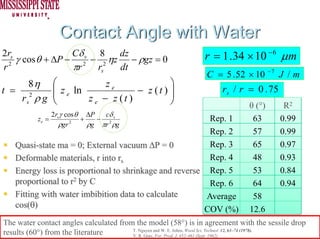
Contact Angle with Water
2rs               Cδ v 8   dz                                       r = 1 . 34 × 10 − 6 μ m
    γ cos θ + ΔP − 2 − 2 ηz − ρgz = 0
r 2
                  πr   rs  dt
                                                                     C = 5 . 52 × 10 − 7 J / m
        8η⎛             ze               ⎞
t = 2     ⎜ z e ln              − z (t ) ⎟                                rs / r = 0 . 75
          ⎜
   rs ρ g ⎝        z e − z (t )          ⎟
                                         ⎠                                         θ (°)       R2
                  2rsγ cos θ ΔP   cδ
           ze =             +   − 2v                      Rep. 1                    63        0.99
                     ρgr 2    ρg πr ρg
                                                          Rep. 2                    57        0.99
    Quasi-state ma = 0; External vacuum ΔP = 0            Rep. 3                    65        0.97
    Deformable materials, r into rs                       Rep. 4                    48        0.93
    Energy loss is proportional to shrinkage and reverse Rep. 5                     53        0.84
    proportional to r2 by C                               Rep. 6                    64        0.94
    Fitting with water imbibition data to calculate      Average                    58
    cos(θ)                                              COV (%)                    12.6
The water contact angles calculated from the model (58°) is in agreement with the sessile drop
                                        T. Nguyen and W. E. Johns, Wood Sci. Technol. 12, 63–74 (1978).
results (60°) from the literature       V. R. Gray, For. Prod. J. 452–461 (Sept. 1962).
Effect of Vacuum


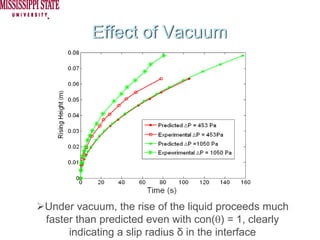
Under vacuum, the rise of the liquid proceeds much
faster than predicted even with con(θ) = 1, clearly
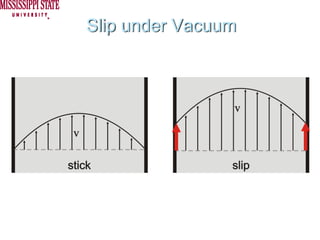
     indicating a slip radius δ in the interface
Slip under Vacuum
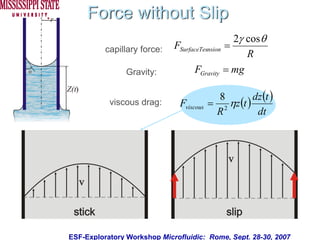
r          Force without Slip
                                                    2γ cosθ
              capillary force:   FSurfaceTesnsion =
                                                       R
                    Gravity:           FGravity = mg

                                                           dz (t )
    Z(t)
                                                   ηz (t )
                                                8
               viscous drag:       Fviscous =
                                                R2          dt


    ESF-Exploratory Workshop Microfluidic: Rome, Sept. 28-30, 2007
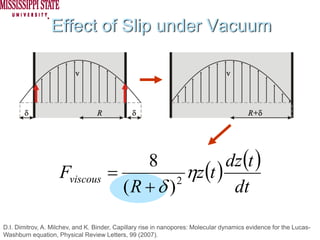
Effect of Slip under Vacuum


                                                           dz (t )
                                                   ηz (t )
                                           8
                    Fviscous          =
                                        (R + δ ) 2
                                                            dt

D.I. Dimitrov, A. Milchev, and K. Binder, Capillary rise in nanopores: Molecular dynamics evidence for the Lucas-
Washburn equation, Physical Review Letters, 99 (2007).
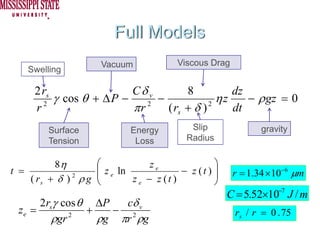
Full Models
                      Vacuum            Viscous Drag
    Swelling

     2 rs                 Cδ v        8          dz
          γ cos θ + Δ P −      −              ηz    − ρ gz = 0
     r 2
                          πr 2
                                 ( rs + δ ) 2
                                                 dt
         Surface             Energy         Slip              gravity
         Tension              Loss         Radius


          8η       ⎛             ze               ⎞
t =                ⎜ z e ln
                   ⎜                     − z (t ) ⎟
                                                  ⎟    r = 1.34 × 10 −6 μm
    ( rs + δ ) ρ g ⎝
              2
                            z e − z (t )          ⎠
                                                      C = 5.52×10⁻⁷ J / m
      2rsγ cos θ ΔP   cδ v
 ze =           +   − 2                                rs / r = 0 . 75
         ρgr 2
                  ρg πr ρg
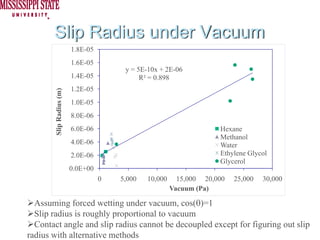
Slip Radius under Vacuum
                          1.8E-05
                          1.6E-05
                                         y = 5E-10x + 2E-06
                          1.4E-05             R² = 0.898
                          1.2E-05
        Slip Radius (m)


                          1.0E-05
                          8.0E-06
                          6.0E-06                                     Hexane
                                                                      Methanol
                          4.0E-06                                     Water
                          2.0E-06                                     Ethylene Glycol
                                                                      Glycerol
                          0.0E+00
                                    0   5,000   10,000     15,000 20,000   25,000   30,000
                                                         Vacuum (Pa)

  Assuming forced wetting under vacuum, cos(θ)=1
  Slip radius is roughly proportional to vacuum
  Contact angle and slip radius cannot be decoupled except for figuring out slip
radius with alternative methods
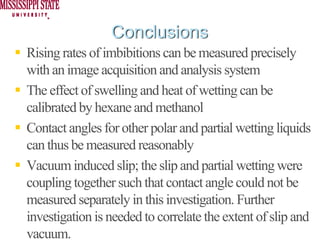
Conclusions
Rising rates of imbibitions can be measured precisely
with an image acquisition and analysis system
The effect of swelling and heat of wetting can be
calibrated by hexane and methanol
Contact angles for other polar and partial wetting liquids
can thus be measured reasonably
Vacuum induced slip; the slip and partial wetting were
coupling together such that contact angle could not be
measured separately in this investigation. Further
investigation is needed to correlate the extent of slip and
vacuum.
Thank you for your attentions


Questions or Comments

           ?

Session 4 ic2011 wang

  • 1.
    Forced Fluid Imbibition ina Powder-Packed Column Jinwu Wang, Post Doctoral Associate Sheldon Q. Shi, Assistant Professor Department of Forest Products Mississippi State University
  • 2.
    Objectives Develop a toolto measure contact angles and surface energies for both – Spontaneous and – non-spontaneous imbibing liquids in powders Current Problem – Spontaneous inbibition is not achieved in many cases when the wetting angle is larger than 900
  • 3.
    Explanation When a rigidcontainer is inserted into a fluid, the fluid will rise in the container to a height higher than the surrounding liquid Capillary Tube Wedge Sponge Professor John Pelesko and Anson Carter, Department of Mathematics, University of Delaware
  • 4.
    Velocity Field around the Moving Meniscus Phys. Rev. Lett. (2007), Capillary Rise in Nanopores: Molecular Dynamics Evidence for the Lucas-Washburn Equation
  • 5.
    Liquid Behaviors inPowders A powder-packed column with radius R air Assume that a powder-packed Liquid column consists of numerous capillary tubes: a wicking-equivalent effective capillary radius The same governing equations as those applied to a capillary tube Capillary action
  • 6.
    Free Body Diagram r Surface Tension External vacuum }Driving Forces Poiseuille Viscous Force Gravitation Force Inertial Force Z(t) Dragging Forces List of Variables: volume = πr2z g = gravity r = radius of capillary tube z = rising height, measured to the bottom of the meniscus, at time t ≥ 0 ρ = density of the surface of the liquid γ = surface tension θ = contact angle between the surface of the liquid and the wall of the tube
  • 7.
    Explanation of theForces Surface Tension Force 2π r γ cos( θ ) Gravitational Force Fw = mg = ρπr 2 zg Poiseuille Viscous Force Fdrag = 8πη z dz dt Vacuum Force πr2ΔP Newton's Second Law of Motion d (mv) d ⎛ 2 dz ⎞ ⎛ d 2 z ⎛ dz ⎞2 ⎞ ∑ F= dt dt ⎝ dt ⎠ 2 ⎜ = ⎜πr zρ ⎟ = πr ρ z 2 + ⎜ ⎟ ⎟ ⎜ dt ⎝ dt ⎠ ⎟ ⎝ ⎠
  • 8.
    Explanation of DifferentialEquation Newton's Second Law of Motion: Net Force = Surface Tension Force +Vacuum - Poiseuitte Viscous Force - Gravitational Force ⎛ d 2 z ⎛ dz ⎞ 2 ⎞ dz ρπr 2 ⎜ z 2 + ⎜ ⎟ ⎟ = 2πrγ cos(θ ) + πr 2 ΔP − 8πηz − ρgπr 2 z ⎜ dt ⎝ dt ⎠ ⎠ ⎟ dt ⎝ Dividing by πr2, the differential equation becomes: ⎛Zo = Z(0) =⎛0dz ⎞ 2 ⎞ 2 d 2z ρ ⎜z +⎜ ⎟ ⎟ = γ cos(θ ) + ΔP − 8 ηz dz − ρgz ⎜ dt ⎝ dt ⎠ ⎟ r 2 ⎝ ⎠ r 2 dt Boundary Conditions: z(0) = 0 and z’(z∞) = 0
  • 9.
    The Effective Zoneof Forces The size of each zone depends on the probe Gravity Effective liquid properties and Zone capillary structures z Washburn Zone z0 Inertial Force 2 8 dz γ cosθ + ΔP − 2 ηz − ρgz = 0 r r dt 8η ⎛ ze ⎞ 2γ cos θ ΔP t = 2 ⎜ z e ln ⎜ − z (t ) ⎟ ⎟ ze = + r ρg ⎝ z e − z (t ) ⎠ ρgr ρg
  • 10.
    The Effect of Capillary Radius on Wicking Lucas- Washburn equation: 1/ 2 ⎛ γ r cos θ ⎞ z (t ) =⎜ ⎟ 2 ⎜ 2η ⎟ t ⎝ ⎠ Is valid when Capillary diameter is small At initial rising period Viscous drag >> gravity force Density is low, inertia is small
  • 11.
    Column Wicking Diagram Non-spontaneous inbibition when the contact angle is larger than 900 by applying vacuum spontaneous inbibition
  • 12.
    Experimental Setup Vacuum Vacuum Vacuum Sample Liquid Regulator Pump Gauge
  • 13.
    Rising Rate byImage Analysis 0s 2s 65 s 150 s 410 s 614 s 700 s Imbibing was recorded by camera video Scale was referenced with a caliper Advancing front line vs. time processed by ImageJ image analysis
  • 14.
    Observations 0.07 Hexane Replicate 1 0.06 Energy loss due to Hexane Replicate 2 Rising Height (m) 0.05 Contact angle, Methanol, Experimental partial wetting 0.04 (water) Water, Experimental 0.03 Polar liquid Hexane, theta = 0 swelling (methanol) 0.02 Methanol, theta = 0 Heat of wetting, 0.01 (water & methanol) Water, theta = 0 0 0 100 200 300 Time (s) γ η ρ Assuming full wetting, i.e. contact angle is mJ/m2 mPa.s g/cm3 zero. Rising rates: Water > Hexane > Methanol Hexane 18.4 0.326 0.65 Experimental: Hexane > Methanol > Water Water 72.8 1 1 Some energy is not used for rising in water and Methanol 22.5 0.54 0.79 methanol imbibitions
  • 15.
    Reproducibility & Vacuum:Hexane 0.07 Replicate 1 0.06 Replicate 2 0.05 Replicate 3 Replicate 4 0.04 Rising height (m) replicate 5 0.03 Vacuum 453 Pa 0.02 Vacuum 1050 Pa 0.01 Vacuum 4700 Pa Vacuum 5800 Pa 0 0 20 40 60 80 100 Time (s) Reproducibility is good for hexane imbibitions Rising rates increase with the vacuum
  • 16.
    Reproducibility & Vacuum:Water 0.14 Replicate 1 0.12 Replicate 2 Replicate 3 0.1 Replicate 4 Rising Height (m) 0.08 Replicate 5 Replicate 6 0.06 Vacuum 2237 Pa Vacuum 2362 Pa 0.04 Vacuum 2658 Pa 0.02 Vacuum 2856 Pa 0 0 100 200 300 400 500 600 Time (s) Reproducibility for water is not as good as hexane imbibitions Rising rates increase with the vacuum
  • 17.
    Experimental Data: EG& Glycerol 0.1 0.06 0.09 Vacuum 2,914 Pa 0.08 0.05 Vacuum 26,319 Pa Rising Height (m) 0.07 Vacuum 26,553 Pa Rising Height (m) 0.04 0.06 vacuum 23,496 Pa Vacuum 2353 Pa 0.05 0.03 Vacuum 22,668 Pa Vacuum 2106 Pa 0.04 Vacuum 2053 Pa 0.02 0.03 0.02 Vacuum 2160 Pa 0.01 Vacuum 2266 Pa 0.01 0 Vacuum 2160 Pa 0 0 100 200 300 400 0 500 1000 1500 Time (s) Time (s) γ η ρ mJ/m2 mPa.s g/cm3 Ethylene glycol imbibes very slowly Hexane 18.4 0.326 0.65 without external vacuum Ethylene glycol 48 16.1 1.113 Glycerol cannot imbibe spontaneously Glycerol 64 1420 1.261
  • 18.
    Results and Discussion Definethe effective capillary radius with hexane The effect of polar liquids Energy loss constant Contact angle with water Vacuum induced slip
  • 19.
    Effective Capillary Radiusfrom Hexane 2 8 dz γ cosθ + ΔP − 2 ηz − ρgz = 0 Effective Capillary Radius (r) R2 r r dt Replicate 1 1.41E-06 1.00 ⎛ ⎞ Replicate 2 1.41E-06 1.00 8η ze t = ⎜ z e ln − z (t ) ⎟ Replicate 3 1.56E-06 0.98 r 2ρg ⎜ ⎝ z e − z (t ) ⎟ ⎠ Replicate 4 1.20E-06 1.00 Replicate 5 1.10E-06 0.99 2γ cos θ ΔP Average 1.34E-06 ze = + COV (%) 13.80 ρgr ρg Quasi state ma=0 Average effective No external vacuum, ΔP = 0 Capillary Radius Full wetting, cos(θ) = 1 No swelling & release of heat of r = 1.34 × 10 −6 μm wetting
  • 20.
    Effect of PolarLiquid r, average capillary radius (m) rs, average capillary radius after material swelling (m) R, inner radius of the column tube (m) ρm, material density (g/cm3 ) δv, volume shrinkage after absorbing probe liquid π R 2 ρ m − (1 + δ v ) G m Gm, unit column mass of rs = ⋅r the material (g/m) πρ m R − G m 2 S.Q. Shi and D.J. Gardner, A new model to determine contact angles on swelling polymer particles by the column wicking method, Journal of Adhesion Science and Technology, 14 (2000) 301-314.
  • 21.
    Characteristics of Packingtubes Name Water Methanol Ethylene glycol Glycerol Volume Shrinkage (%) 15.0 13.8 17.4 20.0 Inner d (mm) 3.77 3.84 3.78 3.83 G0 (tube weight) (g) 5.87 4.06 4.05 4.07 G1 (g) 6.56 4.63 4.58 4.64 G2 (g) wet weight 7.35 5.03 5.29 5.14 Packing Length, mm 161.4 126.9 127.5 129.3 wetting Length,mm 91.4 69.0 72.7 40.0 density (g/cm3) 0.38 0.39 0.37 0.38 Gm (g/m) 4.27 4.53 4.19 4.38 wet (g/g wood) 2.01 1.25 2.34 2.85 Wet(g/cm) 0.09 0.06 0.10 0.12 r/rs 0.75 0.80 0.78 0.71
  • 22.
    Derivation of EnergyLoss Constant Quasi-state ma = 0; External vacuum ΔP = 0 C (J/m) R2 Deformable materials, r into rs Rep. 1 5.59E-07 1.00 Energy loss is proportional to shrinkage and reverse Rep. 2 4.88E-07 1.00 proportional to r2 by C Rep. 3 5.57E-07 0.99 Fitting with methanol imbibition data, i.e. cos(θ) =0 Rep. 4 5.62E-07 0.98 2rs Cδ 8 dz Rep.5 4.45E-07 0.98 γ cos θ + ΔP − 2v − 2 ηz − ρgz = 0 Average 5.52E-07 r2 πr rs dt Cov 9.6% 8η ⎛ ze ⎞ t = 2 ⎜ z e ln ⎜ − z (t ) ⎟ ⎟ rs ρ g ⎝ z e − z (t ) ⎠ Average energy loss 2rsγ cos θ ΔP cδ constant ze = + − 2v ρgr 2 ρg πr ρg −7 C = 5.52 × 10 J /m
  • 23.
    Contact Angle withWater 2rs Cδ v 8 dz r = 1 . 34 × 10 − 6 μ m γ cos θ + ΔP − 2 − 2 ηz − ρgz = 0 r 2 πr rs dt C = 5 . 52 × 10 − 7 J / m 8η⎛ ze ⎞ t = 2 ⎜ z e ln − z (t ) ⎟ rs / r = 0 . 75 ⎜ rs ρ g ⎝ z e − z (t ) ⎟ ⎠ θ (°) R2 2rsγ cos θ ΔP cδ ze = + − 2v Rep. 1 63 0.99 ρgr 2 ρg πr ρg Rep. 2 57 0.99 Quasi-state ma = 0; External vacuum ΔP = 0 Rep. 3 65 0.97 Deformable materials, r into rs Rep. 4 48 0.93 Energy loss is proportional to shrinkage and reverse Rep. 5 53 0.84 proportional to r2 by C Rep. 6 64 0.94 Fitting with water imbibition data to calculate Average 58 cos(θ) COV (%) 12.6 The water contact angles calculated from the model (58°) is in agreement with the sessile drop T. Nguyen and W. E. Johns, Wood Sci. Technol. 12, 63–74 (1978). results (60°) from the literature V. R. Gray, For. Prod. J. 452–461 (Sept. 1962).
  • 24.
    Effect of Vacuum Undervacuum, the rise of the liquid proceeds much faster than predicted even with con(θ) = 1, clearly indicating a slip radius δ in the interface
  • 25.
  • 26.
    r Force without Slip 2γ cosθ capillary force: FSurfaceTesnsion = R Gravity: FGravity = mg dz (t ) Z(t) ηz (t ) 8 viscous drag: Fviscous = R2 dt ESF-Exploratory Workshop Microfluidic: Rome, Sept. 28-30, 2007
  • 27.
    Effect of Slipunder Vacuum dz (t ) ηz (t ) 8 Fviscous = (R + δ ) 2 dt D.I. Dimitrov, A. Milchev, and K. Binder, Capillary rise in nanopores: Molecular dynamics evidence for the Lucas- Washburn equation, Physical Review Letters, 99 (2007).
  • 28.
    Full Models Vacuum Viscous Drag Swelling 2 rs Cδ v 8 dz γ cos θ + Δ P − − ηz − ρ gz = 0 r 2 πr 2 ( rs + δ ) 2 dt Surface Energy Slip gravity Tension Loss Radius 8η ⎛ ze ⎞ t = ⎜ z e ln ⎜ − z (t ) ⎟ ⎟ r = 1.34 × 10 −6 μm ( rs + δ ) ρ g ⎝ 2 z e − z (t ) ⎠ C = 5.52×10⁻⁷ J / m 2rsγ cos θ ΔP cδ v ze = + − 2 rs / r = 0 . 75 ρgr 2 ρg πr ρg
  • 29.
    Slip Radius underVacuum 1.8E-05 1.6E-05 y = 5E-10x + 2E-06 1.4E-05 R² = 0.898 1.2E-05 Slip Radius (m) 1.0E-05 8.0E-06 6.0E-06 Hexane Methanol 4.0E-06 Water 2.0E-06 Ethylene Glycol Glycerol 0.0E+00 0 5,000 10,000 15,000 20,000 25,000 30,000 Vacuum (Pa) Assuming forced wetting under vacuum, cos(θ)=1 Slip radius is roughly proportional to vacuum Contact angle and slip radius cannot be decoupled except for figuring out slip radius with alternative methods
  • 30.
    Conclusions Rising rates ofimbibitions can be measured precisely with an image acquisition and analysis system The effect of swelling and heat of wetting can be calibrated by hexane and methanol Contact angles for other polar and partial wetting liquids can thus be measured reasonably Vacuum induced slip; the slip and partial wetting were coupling together such that contact angle could not be measured separately in this investigation. Further investigation is needed to correlate the extent of slip and vacuum.
  • 31.
    Thank you foryour attentions Questions or Comments ?