A Short Introduction to Biochar


                  Jim Amonette
     Pacific Northwest National Laboratory
           Richland, WA 99352 USA
             jim.amonette@pnl.gov

  National Society of Consulting Soil Scientists
                Morning Plenary
                 04 March 2010


                PNNL-SA-71407
Outline
              What is Biochar?
              How is it Made?
                        Pyrolysis and Hydrothermal Carbonization Processes
                        Feedstocks
                        Yields
              What are its Properties?
                        Chemical
                        Physical
              How can it be Used to Mitigate Climate Change?
                        General Concept
                        Sustainability
                        Need for Modern Technology
                        Biochar, Biofuels and N2O
              Where does it fit in the Environmental Technology Landscape?


JE Amonette 04Mar2010
What is Biochar?


         Product
               Solid product resulting from advanced thermal degradation of
               biomass
         Technology
               Biofuel—process heat, bio-oil, and gases (steam, volatile HCs)
               Soil Amendment—sorbent for cations and organics, liming agent,
               inoculation carrier
               Climate Change Mitigation—highly stable pool for C, avoidance of
               N2O and CH4 emissions, carbon negative energy, increased net
               primary productivity (NPP)


JE Amonette 04Mar2010
How is Biochar Made?

         Major Techniques:
               Slow Pyrolysis
                   traditional (dirty, low char yields) and modern (clean, high char yields)
               Flash Pyrolysis
                   modern, high pressure, higher char yields
               Fast Pyrolysis
                   modern, maximizes bio-oil production, low char yields
               Gasification
                   modern, maximizes bio-gas production, minimizes bio-oil production,
                   low char yields but highly stable, high ash content
               Hydrothermal Carbonization
                   under development, wet feedstock, high pressure, highest “char”
                   yield but quite different composition and probably not as stable as
                   pyrolytic carbons


JE Amonette 04Mar2010
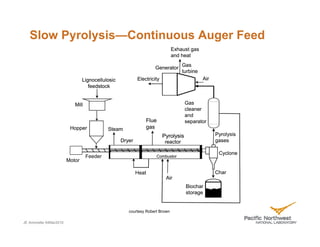
Slow Pyrolysis—Continuous Auger Feed
                                                                             Exhaust gas
                                                                             and heat
                                                                                   Gas
                                                                   Generator
                                                                                   turbine
                                Lignocellulosic           Electricity                        Air
                                   feedstock


                           Mill                                                     Gas
                                                                                    cleaner
                                                                                    and
                                                              Flue                  separator
                         Hopper            Steam              gas
                                                                        Pyrolysis                  Pyrolysis
                                                  Dryer                  reactor                   gases

                                                                                                    Cyclone
                                  Feeder                           Combustor
                        Motor

                                                          Heat                                     Char
                                                                         Air
                                                                                    Biochar
                                                                                    storage


                                                     courtesy Robert Brown

JE Amonette 04Mar2010
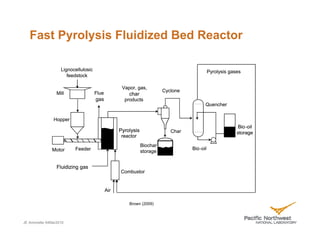
Fast Pyrolysis Fluidized Bed Reactor

                   Lignocellulosic                                                          Pyrolysis gases
                      feedstock

                                                   Vapor, gas,
                                     Flue                               Cyclone
                 Mill                                 char
                                     gas            products
                                                                                        Quencher


               Hopper
                                                                                                          Bio -oil
                                                  Pyrolysis                Char                          storage
                                                   reactor
                                                              Biochar
               Motor     Feeder                                                   Bio-oil
                                                              storage


                 Fluidizing gas
                                                  Combustor


                                            Air

                                                      Brown (2009)


JE Amonette 04Mar2010
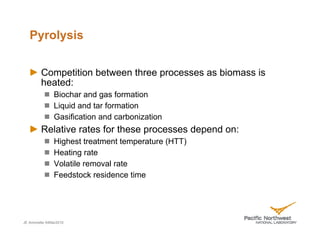
Pyrolysis


         Competition between three processes as biomass is
         heated:
               Biochar and gas formation
               Liquid and tar formation
               Gasification and carbonization
         Relative rates for these processes depend on:
               Highest treatment temperature (HTT)
               Heating rate
               Volatile removal rate
               Feedstock residence time


JE Amonette 04Mar2010
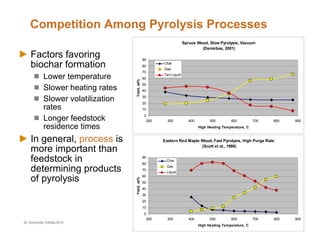
Competition Among Pyrolysis Processes
                                                                    Spruce Wood, Slow Pyrolysis, Vacuum
                                                                             (Demirbas, 2001)
   Factors favoring                            90
   biochar formation                           80
                                                       Char
                                                       Gas
                                               70
          Lower temperature                    60
                                                       Tar+Liquid


                                  Yield, wt%
                                               50
          Slower heating rates                 40

          Slower volatilization                30
                                               20
          rates                                10
                                                0
          Longer feedstock                       200     300           400         500        600          700   800   900
          residence times                                                    High Heating Temperature, C


   In general, process is                              Eastern Red Maple Wood, Fast Pyrolysis, High Purge Rate
                                                                         (Scott et al., 1988)
   more important than
   feedstock in                                90
                                               80
                                                        Char

   determining products                        70
                                                        Gas
                                                        Liquid

   of pyrolysis                                60
                                  Yield, wt%


                                               50
                                               40
                                               30
                                               20
                                               10
                                               0
                                                200      300           400         500        600          700   800   900
JE Amonette 04Mar2010
                                                                             High Heating Temperature, C
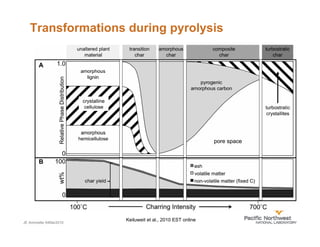
Transformations during pyrolysis


JE Amonette 04Mar2010
                        Keiluweit et al., 2010 EST online
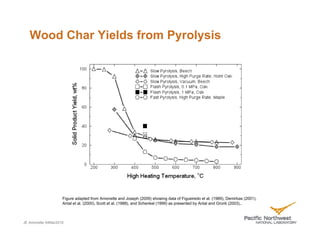
Wood Char Yields from Pyrolysis


                    Figure adapted from Amonette and Joseph (2009) showing data of Figueiredo et al. (1989), Demirbas (2001),
                    Antal et al. (2000), Scott et al. (1988), and Schenkel (1999) as presented by Antal and Gronli (2003),.


JE Amonette 04Mar2010
Feedstocks

  Essentially all forms of biomass can be converted to biochar
  Preferable forms include: forest thinnings, crop residues (e.g., corn
     stover, alfalfa stems, grain husks), yard waste, paper sludge,
     manures, bone meal
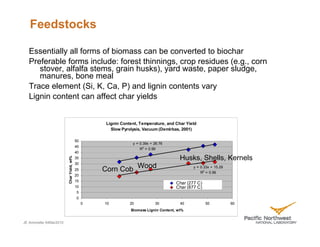
  Trace element (Si, K, Ca, P) and lignin contents vary
  Lignin content can affect char yields


                                                   Lignin Content, Temperature, and Char Yield
                                                     Slow Pyrolysis, Vacuum (Demirbas, 2001)

                                          50
                                                               y = 0.39x + 26.76
                                          45
                                                                   R2 = 0.99
                                          40
                                                                                       Husks, Shells, Kernels
                        Char Yield, wt%


                                          35
                                          30
                                          25       Corn Cob Wood                             y = 0.33x + 15.29
                                                                                                 R2 = 0.96
                                          20
                                          15
                                                                                     Char (277 C)
                                          10                                         Char (877 C)
                                          5
                                          0
                                               0   10         20           30          40           50           60
                                                              Biomass Lignin Content, wt%


JE Amonette 04Mar2010
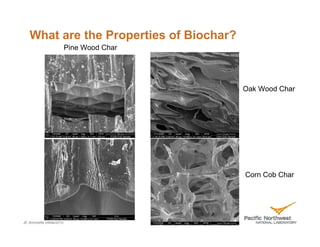
What are the Properties of Biochar?
                        Pine Wood Char


                                         Oak Wood Char


                                         Corn Cob Char


JE Amonette 04Mar2010
Proximate Analysis
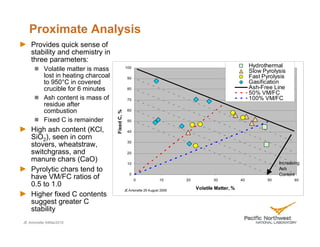
    Provides quick sense of
    stability and chemistry in
    three parameters:
                                                  100                                                         Hydrothermal
          Volatile matter is mass                                                                             Slow Pyrolysis
          lost in heating charcoal                 90                                                         Fast Pyrolysis
          to 950°C in covered                                                                                 Gasification
          crucible for 6 minutes                   80                                                         Ash-Free Line
                                                                                                              50% VM/FC
          Ash content is mass of                   70                                                         100% VM/FC
          residue after
          combustion                               60

          Fixed C is remainder       Fixed C, %    50

    High ash content (KCl,                         40
    SiO2), seen in corn
                                                   30
    stovers, wheatstraw,
    switchgrass, and                               20
    manure chars (CaO)                             10                                                                     Increasing
    Pyrolytic chars tend to                                                                                               Ash
                                                     0                                                                    Content
    have VM/FC ratios of                                 0             10      20           30           40          50          60
    0.5 to 1.0                                                                      Volatile Matter, %
                                                  JE Amonette 29 August 2009
    Higher fixed C contents
    suggest greater C
    stability
JE Amonette 04Mar2010
Other chemical properties
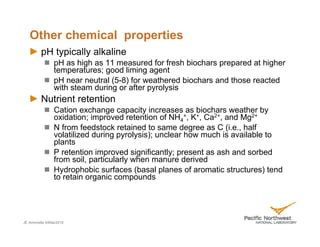
         pH typically alkaline
               pH as high as 11 measured for fresh biochars prepared at higher
               temperatures; good liming agent
               pH near neutral (5-8) for weathered biochars and those reacted
               with steam during or after pyrolysis
         Nutrient retention
               Cation exchange capacity increases as biochars weather by
               oxidation; improved retention of NH4+, K+, Ca2+, and Mg2+
               N from feedstock retained to same degree as C (i.e., half
               volatilized during pyrolysis); unclear how much is available to
               plants
               P retention improved significantly; present as ash and sorbed
               from soil, particularly when manure derived
               Hydrophobic surfaces (basal planes of aromatic structures) tend
               to retain organic compounds


JE Amonette 04Mar2010
Physical properties
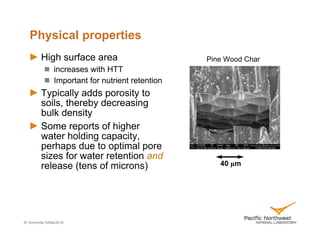
         High surface area                        Pine Wood Char
               increases with HTT
               Important for nutrient retention
         Typically adds porosity to
         soils, thereby decreasing
         bulk density
         Some reports of higher
         water holding capacity,
         perhaps due to optimal pore
         sizes for water retention and
         release (tens of microns)                   40 μm


JE Amonette 04Mar2010
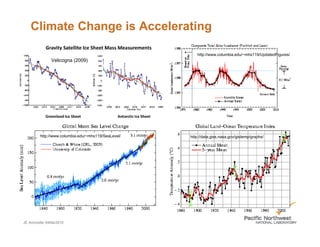
Climate Change is Accelerating

                                                       http://www.columbia.edu/~mhs119/UpdatedFigures/
              Velicogna (2009)


        http://www.columbia.edu/~mhs119/SeaLevel/   http://data.giss.nasa.gov/gistemp/graphs/


JE Amonette 04Mar2010
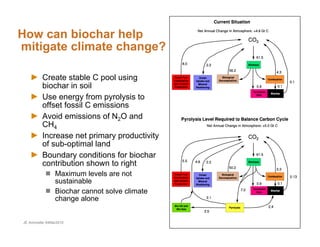
How can biochar help
mitigate climate change?

         Create stable C pool using
         biochar in soil
         Use energy from pyrolysis to
         offset fossil C emissions
         Avoid emissions of N2O and
         CH4
         Increase net primary productivity
         of sub-optimal land
         Boundary conditions for biochar
         contribution shown to right
                Maximum levels are not
                sustainable
                Biochar cannot solve climate
                change alone


JE Amonette 04Mar2010
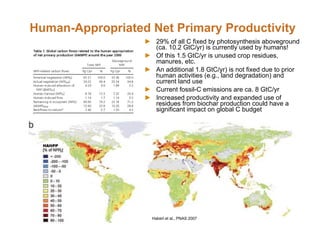
Human-Appropriated Net Primary Productivity
                          29% of all C fixed by photosynthesis aboveground
                          (ca. 10.2 GtC/yr) is currently used by humans!
                          Of this 1.5 GtC/yr is unused crop residues,
                          manures, etc.
                          An additional 1.8 GtC/yr) is not fixed due to prior
                          human activities (e.g., land degradation) and
                          current land use
                          Current fossil-C emissions are ca. 8 GtC/yr
                          Increased productivity and expanded use of
                          residues from biochar production could have a
                          significant impact on global C budget


                        Haberl et al., PNAS 2007
JE Amonette 04Mar2010
Sustainability Criteria


         Biomass primarily from agricultural/silvicultural residues
         Minimal C debt from land-use changes (10-yr maximum
         payback time, < 22 Mg CO2-Ceq ha-1)
         No previously unmanaged lands converted for biochar
         production; abandoned croplands ok
         Modern pyrolysis technology used
               eliminates soot, CH4, and N2O emissions
               captures energy released as process heat, bio-oil, and flammable
               gases


JE Amonette 04Mar2010
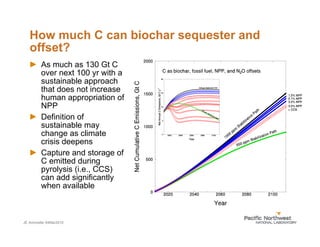
How much C can biochar sequester and
   offset?
         As much as 130 Gt C
         over next 100 yr with a
         sustainable approach
         that does not increase
         human appropriation of
         NPP
         Definition of
         sustainable may
         change as climate
         crisis deepens
         Capture and storage of
         C emitted during
         pyrolysis (i.e., CCS)
         can add significantly
         when available


JE Amonette 04Mar2010
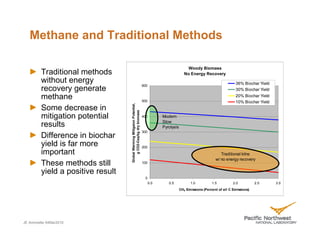
Methane and Traditional Methods

                                                                                                      Woody Biomass
         Traditional methods                                                                        No Energy Recovery
         without energy                                                                                                           36% Biochar Yield
                                                                         600
         recovery generate                                                                                                        30% Biochar Yield
         methane                                                         500
                                                                                                                                  20% Biochar Yield
                                                                                                                                  10% Biochar Yield


                                   Global Warming Mitigaion Potential,
         Some decrease in


                                       g CO2-Ceq/kg dry biomass
         mitigation potential                                            400         Modern
                                                                                     Slow
         results                                                                     Pyrolysis
                                                                         300
         Difference in biochar
         yield is far more                                               200
         important                                                                                                       Traditional kilns
                                                                                                                      w/ no energy recovery
         These methods still                                             100

         yield a positive result
                                                                          0
                                                                               0.0      0.5            1.0          1.5          2.0          2.5     3.0
                                                                                                 CH4 Emissions (Percent of all C Emissions)


JE Amonette 04Mar2010
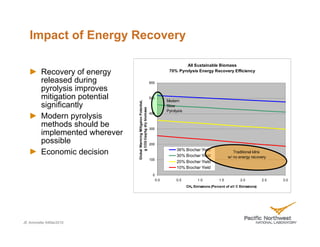
Impact of Energy Recovery

                                                                                           All Sustainable Biomass
         Recovery of energy                                                        70% Pyrolysis Energy Recovery Efficiency

         released during                                              600

         pyrolysis improves
         mitigation potential                                         500
                                                                                  Modern


                                Global Warming Mitigaion Potential,
         significantly                                                            Slow


                                    g CO2-Ceq/kg dry biomass
                                                                                  Pyrolysis
                                                                      400
         Modern pyrolysis
         methods should be                                            300
         implemented wherever
         possible                                                     200
                                                                                       36% Biochar Yield
         Economic decision                                                             30% Biochar Yield
                                                                                                                          Traditional kilns
                                                                                                                       w/ no energy recovery
                                                                      100
                                                                                       20% Biochar Yield
                                                                                       10% Biochar Yield
                                                                       0
                                                                            0.0        0.5          1.0          1.5          2.0          2.5   3.0
                                                                                              CH4 Emissions (Percent of all C Emissions)


JE Amonette 04Mar2010
The Biofuel N2O Problem
         Recent work (Crutzen et al., 2007; Del Grosso, 2008) suggests that
         globally, N2O production averages at 4% (+/- 1%) of N that is fixed
         IPCC reports have accounted only for field measurements of N2O
         emitted, which show values close to 1%, but ignore other indicators
         discussed by Crutzen et al.
         If 4% is correct, then combustion of biofuels except for high cellulose
         (low-N) fuels will actually increase global warming relative to
         petroleum due to large global warming potential of N2O
         Biochar avoids this issue
               Ties up reactive N in a stable or slowly available pool or converts most of
               it to harmless N2 during pyrolysis
               Eliminates potential N2O emissions from manures and other biomass
               sources converted to biochar
               Decreases N2O emissions in field by improving N-fertilizer use efficiency
               and increasing air-filled porosity

JE Amonette 04Mar2010
Where does Biochar Fit?
         Offers a flexible blend of biofuel energy, soil fertility enhancement,
         and climate change mitigation
         Limited by biomass availability and, eventually, land disposal area
         How much biomass can be made available for biochar production vs.
         other uses?
         Crop-derived biofuels cannot supply all the world’s energy needs
               Maximum estimates suggest 50% of current, 33% of future
               Biodiversity (HANPP)?
               N2O?
         Perhaps best use of harvested biomass is to make biochar to draw
         down atmospheric C levels and enhance soil productivity, with energy
         production as a bonus (but not the driving force).
         This will require government incentives (C credits/taxes?) and a
         change in the way we value cropped biofuels


JE Amonette 04Mar2010
Further Information and Acknowledgments
       International Biochar Initiative
         (www.biochar-international.org)
       Biochar for Environmental Management: Science and
       Technology, Earthscan, 2009
       North American Biochar Conference 2010
       Iowa State University, June 27-30, 2010

   Research supported by
     USDOE Office of Fossil Energy through the National Energy Technology
     Laboratory
     USDOE Office of Biological and Environmental Research (OBER) through
     the Carbon Sequestration in Terrestrial Ecosystems (CSiTE) project.
   Research was performed at the W.R. Wiley Environmental Molecular Sciences
     Laboratory, a national scientific user facility at the Pacific Northwest National
     Laboratory (PNNL) sponsored by the USDOE-OBER.
   PNNL is operated for the USDOE by Battelle Memorial Institute under contract
     DE AC06 76RL01830.

                                         PNNL-SA-64398
JE Amonette 04Mar2010
References Cited
   Amonette, J. E., and Joseph, S. 2009. Characteristics of biochar: Micro-chemical properties. Chapter 3 in (J. Lehmann
        and S. Joseph, eds.) Biochar for Environmental Management: Science and Technology. Earthscan, London, UK
        and Sterling, VA.
   Antal, M. J. Jr. and Grønli, M. 2003. ‘The art, science, and technology of charcoal production’, Industrial and Engineering
        Chemistry Research, vol 42, pp1619-1640
   Antal, M. J. Jr., Allen, S. G., Dai, X.-F., Shimizu, B., Tam, M. S. and Grønli, M. 2000. ‘Attainment of the theoretical yield of
        carbon from biomass’, Industrial and Engineering Chemistry Research, vol 39, pp4024-4031
   Brown, R. 2009. Biochar production technology. Chapter 7 in (J. Lehmann and S. Joseph, eds.) Biochar for
        Environmental Management: Science and Technology. Earthscan, London, UK and Sterling, VA.
   Crutzen, P. J., Mosier, A. R., Smith, K. A., and Winiwarter, W. 2007. ‘N2O release from agro-biofuel production negates
        global warming reduction by replacing fossil fuels.’ Atmos. Chem. Discuss. 7:11191-11205.
   Del Grosso, S. J., Wirth, T., Ogle, S. M., and Parton, W. J. 2008. ‘Estimating agricultural nitrous oxide emissions.’ Eos
        89(51):529-530.
   Demirbas, A. (2001) ‘Carbonization ranking of selected biomass for charcoal, liquid and gaseous products’, Energy
        Conversion and Management, vol 42, pp1229-1238
   Figueiredo, J. L., Valenzuela, C., Bernalte, A. and Encinar, J. M. 1989. ‘Pyrolysis of holm-oak wood: influence of
        temperature and particle size’, Fuel, vol 68, pp1012-1017
   Haberl, H. Heinz Erb, K., Krausmann, F., Gaube, V., Bondeau, A., Plutzar, C., Gingrich, S., Lucht, W., and Fischer-
        Kowalski, M. 2007. ‘Quantifying and mapping the human appropriation of net primary production in earth’s
        terrestrial ecosystems.’ Proc. Natl. Acad. Sci. 104:12942-12947.
   Schenkel, Y. 1999. ‘Modelisation des flux massiques et energetiques dans la carbonisation du bois en four cornue’, PhD
        thesis, Université des Sciences Agronomiques de Gembloux, Gembloux, Belgium
   Scott, D. S., Piskorz, J., Bergougnou, M. A., Graham, R. and Overend, R. P. 1988. ‘The role of temperature in the fast
        pyrolysis of cellulose and wood’, Industrial and Engineering Chemistry Research, 27, 8-15.
   Velicogna, I. 2009. ‘Increasing rates of ice mass loss from the Greenland and Antarctic ice sheets revealed by GRACE’,
        Geophysical Research Letters, 36, L19503.


JE Amonette 04Mar2010

Amonette: Biochar Introduction

  • 1.
    A Short Introductionto Biochar Jim Amonette Pacific Northwest National Laboratory Richland, WA 99352 USA jim.amonette@pnl.gov National Society of Consulting Soil Scientists Morning Plenary 04 March 2010 PNNL-SA-71407
  • 2.
    Outline What is Biochar? How is it Made? Pyrolysis and Hydrothermal Carbonization Processes Feedstocks Yields What are its Properties? Chemical Physical How can it be Used to Mitigate Climate Change? General Concept Sustainability Need for Modern Technology Biochar, Biofuels and N2O Where does it fit in the Environmental Technology Landscape? JE Amonette 04Mar2010
  • 3.
    What is Biochar? Product Solid product resulting from advanced thermal degradation of biomass Technology Biofuel—process heat, bio-oil, and gases (steam, volatile HCs) Soil Amendment—sorbent for cations and organics, liming agent, inoculation carrier Climate Change Mitigation—highly stable pool for C, avoidance of N2O and CH4 emissions, carbon negative energy, increased net primary productivity (NPP) JE Amonette 04Mar2010
  • 4.
    How is BiocharMade? Major Techniques: Slow Pyrolysis traditional (dirty, low char yields) and modern (clean, high char yields) Flash Pyrolysis modern, high pressure, higher char yields Fast Pyrolysis modern, maximizes bio-oil production, low char yields Gasification modern, maximizes bio-gas production, minimizes bio-oil production, low char yields but highly stable, high ash content Hydrothermal Carbonization under development, wet feedstock, high pressure, highest “char” yield but quite different composition and probably not as stable as pyrolytic carbons JE Amonette 04Mar2010
  • 5.
    Slow Pyrolysis—Continuous AugerFeed Exhaust gas and heat Gas Generator turbine Lignocellulosic Electricity Air feedstock Mill Gas cleaner and Flue separator Hopper Steam gas Pyrolysis Pyrolysis Dryer reactor gases Cyclone Feeder Combustor Motor Heat Char Air Biochar storage courtesy Robert Brown JE Amonette 04Mar2010
  • 6.
    Fast Pyrolysis FluidizedBed Reactor Lignocellulosic Pyrolysis gases feedstock Vapor, gas, Flue Cyclone Mill char gas products Quencher Hopper Bio -oil Pyrolysis Char storage reactor Biochar Motor Feeder Bio-oil storage Fluidizing gas Combustor Air Brown (2009) JE Amonette 04Mar2010
  • 7.
    Pyrolysis Competition between three processes as biomass is heated: Biochar and gas formation Liquid and tar formation Gasification and carbonization Relative rates for these processes depend on: Highest treatment temperature (HTT) Heating rate Volatile removal rate Feedstock residence time JE Amonette 04Mar2010
  • 8.
    Competition Among PyrolysisProcesses Spruce Wood, Slow Pyrolysis, Vacuum (Demirbas, 2001) Factors favoring 90 biochar formation 80 Char Gas 70 Lower temperature 60 Tar+Liquid Yield, wt% 50 Slower heating rates 40 Slower volatilization 30 20 rates 10 0 Longer feedstock 200 300 400 500 600 700 800 900 residence times High Heating Temperature, C In general, process is Eastern Red Maple Wood, Fast Pyrolysis, High Purge Rate (Scott et al., 1988) more important than feedstock in 90 80 Char determining products 70 Gas Liquid of pyrolysis 60 Yield, wt% 50 40 30 20 10 0 200 300 400 500 600 700 800 900 JE Amonette 04Mar2010 High Heating Temperature, C
  • 9.
    Transformations during pyrolysis JEAmonette 04Mar2010 Keiluweit et al., 2010 EST online
  • 10.
    Wood Char Yieldsfrom Pyrolysis Figure adapted from Amonette and Joseph (2009) showing data of Figueiredo et al. (1989), Demirbas (2001), Antal et al. (2000), Scott et al. (1988), and Schenkel (1999) as presented by Antal and Gronli (2003),. JE Amonette 04Mar2010
  • 11.
    Feedstocks Essentiallyall forms of biomass can be converted to biochar Preferable forms include: forest thinnings, crop residues (e.g., corn stover, alfalfa stems, grain husks), yard waste, paper sludge, manures, bone meal Trace element (Si, K, Ca, P) and lignin contents vary Lignin content can affect char yields Lignin Content, Temperature, and Char Yield Slow Pyrolysis, Vacuum (Demirbas, 2001) 50 y = 0.39x + 26.76 45 R2 = 0.99 40 Husks, Shells, Kernels Char Yield, wt% 35 30 25 Corn Cob Wood y = 0.33x + 15.29 R2 = 0.96 20 15 Char (277 C) 10 Char (877 C) 5 0 0 10 20 30 40 50 60 Biomass Lignin Content, wt% JE Amonette 04Mar2010
  • 12.
    What are theProperties of Biochar? Pine Wood Char Oak Wood Char Corn Cob Char JE Amonette 04Mar2010
  • 13.
    Proximate Analysis Provides quick sense of stability and chemistry in three parameters: 100 Hydrothermal Volatile matter is mass Slow Pyrolysis lost in heating charcoal 90 Fast Pyrolysis to 950°C in covered Gasification crucible for 6 minutes 80 Ash-Free Line 50% VM/FC Ash content is mass of 70 100% VM/FC residue after combustion 60 Fixed C is remainder Fixed C, % 50 High ash content (KCl, 40 SiO2), seen in corn 30 stovers, wheatstraw, switchgrass, and 20 manure chars (CaO) 10 Increasing Pyrolytic chars tend to Ash 0 Content have VM/FC ratios of 0 10 20 30 40 50 60 0.5 to 1.0 Volatile Matter, % JE Amonette 29 August 2009 Higher fixed C contents suggest greater C stability JE Amonette 04Mar2010
  • 14.
    Other chemical properties pH typically alkaline pH as high as 11 measured for fresh biochars prepared at higher temperatures; good liming agent pH near neutral (5-8) for weathered biochars and those reacted with steam during or after pyrolysis Nutrient retention Cation exchange capacity increases as biochars weather by oxidation; improved retention of NH4+, K+, Ca2+, and Mg2+ N from feedstock retained to same degree as C (i.e., half volatilized during pyrolysis); unclear how much is available to plants P retention improved significantly; present as ash and sorbed from soil, particularly when manure derived Hydrophobic surfaces (basal planes of aromatic structures) tend to retain organic compounds JE Amonette 04Mar2010
  • 15.
    Physical properties High surface area Pine Wood Char increases with HTT Important for nutrient retention Typically adds porosity to soils, thereby decreasing bulk density Some reports of higher water holding capacity, perhaps due to optimal pore sizes for water retention and release (tens of microns) 40 μm JE Amonette 04Mar2010
  • 16.
    Climate Change isAccelerating http://www.columbia.edu/~mhs119/UpdatedFigures/ Velicogna (2009) http://www.columbia.edu/~mhs119/SeaLevel/ http://data.giss.nasa.gov/gistemp/graphs/ JE Amonette 04Mar2010
  • 17.
    How can biocharhelp mitigate climate change? Create stable C pool using biochar in soil Use energy from pyrolysis to offset fossil C emissions Avoid emissions of N2O and CH4 Increase net primary productivity of sub-optimal land Boundary conditions for biochar contribution shown to right Maximum levels are not sustainable Biochar cannot solve climate change alone JE Amonette 04Mar2010
  • 18.
    Human-Appropriated Net PrimaryProductivity 29% of all C fixed by photosynthesis aboveground (ca. 10.2 GtC/yr) is currently used by humans! Of this 1.5 GtC/yr is unused crop residues, manures, etc. An additional 1.8 GtC/yr) is not fixed due to prior human activities (e.g., land degradation) and current land use Current fossil-C emissions are ca. 8 GtC/yr Increased productivity and expanded use of residues from biochar production could have a significant impact on global C budget Haberl et al., PNAS 2007 JE Amonette 04Mar2010
  • 19.
    Sustainability Criteria Biomass primarily from agricultural/silvicultural residues Minimal C debt from land-use changes (10-yr maximum payback time, < 22 Mg CO2-Ceq ha-1) No previously unmanaged lands converted for biochar production; abandoned croplands ok Modern pyrolysis technology used eliminates soot, CH4, and N2O emissions captures energy released as process heat, bio-oil, and flammable gases JE Amonette 04Mar2010
  • 20.
    How much Ccan biochar sequester and offset? As much as 130 Gt C over next 100 yr with a sustainable approach that does not increase human appropriation of NPP Definition of sustainable may change as climate crisis deepens Capture and storage of C emitted during pyrolysis (i.e., CCS) can add significantly when available JE Amonette 04Mar2010
  • 21.
    Methane and TraditionalMethods Woody Biomass Traditional methods No Energy Recovery without energy 36% Biochar Yield 600 recovery generate 30% Biochar Yield methane 500 20% Biochar Yield 10% Biochar Yield Global Warming Mitigaion Potential, Some decrease in g CO2-Ceq/kg dry biomass mitigation potential 400 Modern Slow results Pyrolysis 300 Difference in biochar yield is far more 200 important Traditional kilns w/ no energy recovery These methods still 100 yield a positive result 0 0.0 0.5 1.0 1.5 2.0 2.5 3.0 CH4 Emissions (Percent of all C Emissions) JE Amonette 04Mar2010
  • 22.
    Impact of EnergyRecovery All Sustainable Biomass Recovery of energy 70% Pyrolysis Energy Recovery Efficiency released during 600 pyrolysis improves mitigation potential 500 Modern Global Warming Mitigaion Potential, significantly Slow g CO2-Ceq/kg dry biomass Pyrolysis 400 Modern pyrolysis methods should be 300 implemented wherever possible 200 36% Biochar Yield Economic decision 30% Biochar Yield Traditional kilns w/ no energy recovery 100 20% Biochar Yield 10% Biochar Yield 0 0.0 0.5 1.0 1.5 2.0 2.5 3.0 CH4 Emissions (Percent of all C Emissions) JE Amonette 04Mar2010
  • 23.
    The Biofuel N2OProblem Recent work (Crutzen et al., 2007; Del Grosso, 2008) suggests that globally, N2O production averages at 4% (+/- 1%) of N that is fixed IPCC reports have accounted only for field measurements of N2O emitted, which show values close to 1%, but ignore other indicators discussed by Crutzen et al. If 4% is correct, then combustion of biofuels except for high cellulose (low-N) fuels will actually increase global warming relative to petroleum due to large global warming potential of N2O Biochar avoids this issue Ties up reactive N in a stable or slowly available pool or converts most of it to harmless N2 during pyrolysis Eliminates potential N2O emissions from manures and other biomass sources converted to biochar Decreases N2O emissions in field by improving N-fertilizer use efficiency and increasing air-filled porosity JE Amonette 04Mar2010
  • 24.
    Where does BiocharFit? Offers a flexible blend of biofuel energy, soil fertility enhancement, and climate change mitigation Limited by biomass availability and, eventually, land disposal area How much biomass can be made available for biochar production vs. other uses? Crop-derived biofuels cannot supply all the world’s energy needs Maximum estimates suggest 50% of current, 33% of future Biodiversity (HANPP)? N2O? Perhaps best use of harvested biomass is to make biochar to draw down atmospheric C levels and enhance soil productivity, with energy production as a bonus (but not the driving force). This will require government incentives (C credits/taxes?) and a change in the way we value cropped biofuels JE Amonette 04Mar2010
  • 25.
    Further Information andAcknowledgments International Biochar Initiative (www.biochar-international.org) Biochar for Environmental Management: Science and Technology, Earthscan, 2009 North American Biochar Conference 2010 Iowa State University, June 27-30, 2010 Research supported by USDOE Office of Fossil Energy through the National Energy Technology Laboratory USDOE Office of Biological and Environmental Research (OBER) through the Carbon Sequestration in Terrestrial Ecosystems (CSiTE) project. Research was performed at the W.R. Wiley Environmental Molecular Sciences Laboratory, a national scientific user facility at the Pacific Northwest National Laboratory (PNNL) sponsored by the USDOE-OBER. PNNL is operated for the USDOE by Battelle Memorial Institute under contract DE AC06 76RL01830. PNNL-SA-64398 JE Amonette 04Mar2010
  • 26.
    References Cited Amonette, J. E., and Joseph, S. 2009. Characteristics of biochar: Micro-chemical properties. Chapter 3 in (J. Lehmann and S. Joseph, eds.) Biochar for Environmental Management: Science and Technology. Earthscan, London, UK and Sterling, VA. Antal, M. J. Jr. and Grønli, M. 2003. ‘The art, science, and technology of charcoal production’, Industrial and Engineering Chemistry Research, vol 42, pp1619-1640 Antal, M. J. Jr., Allen, S. G., Dai, X.-F., Shimizu, B., Tam, M. S. and Grønli, M. 2000. ‘Attainment of the theoretical yield of carbon from biomass’, Industrial and Engineering Chemistry Research, vol 39, pp4024-4031 Brown, R. 2009. Biochar production technology. Chapter 7 in (J. Lehmann and S. Joseph, eds.) Biochar for Environmental Management: Science and Technology. Earthscan, London, UK and Sterling, VA. Crutzen, P. J., Mosier, A. R., Smith, K. A., and Winiwarter, W. 2007. ‘N2O release from agro-biofuel production negates global warming reduction by replacing fossil fuels.’ Atmos. Chem. Discuss. 7:11191-11205. Del Grosso, S. J., Wirth, T., Ogle, S. M., and Parton, W. J. 2008. ‘Estimating agricultural nitrous oxide emissions.’ Eos 89(51):529-530. Demirbas, A. (2001) ‘Carbonization ranking of selected biomass for charcoal, liquid and gaseous products’, Energy Conversion and Management, vol 42, pp1229-1238 Figueiredo, J. L., Valenzuela, C., Bernalte, A. and Encinar, J. M. 1989. ‘Pyrolysis of holm-oak wood: influence of temperature and particle size’, Fuel, vol 68, pp1012-1017 Haberl, H. Heinz Erb, K., Krausmann, F., Gaube, V., Bondeau, A., Plutzar, C., Gingrich, S., Lucht, W., and Fischer- Kowalski, M. 2007. ‘Quantifying and mapping the human appropriation of net primary production in earth’s terrestrial ecosystems.’ Proc. Natl. Acad. Sci. 104:12942-12947. Schenkel, Y. 1999. ‘Modelisation des flux massiques et energetiques dans la carbonisation du bois en four cornue’, PhD thesis, Université des Sciences Agronomiques de Gembloux, Gembloux, Belgium Scott, D. S., Piskorz, J., Bergougnou, M. A., Graham, R. and Overend, R. P. 1988. ‘The role of temperature in the fast pyrolysis of cellulose and wood’, Industrial and Engineering Chemistry Research, 27, 8-15. Velicogna, I. 2009. ‘Increasing rates of ice mass loss from the Greenland and Antarctic ice sheets revealed by GRACE’, Geophysical Research Letters, 36, L19503. JE Amonette 04Mar2010