Prepared by:
Teacher III
San Fernando South Central Integrated School
Tanqui, City of San Fernando, La Union
LEARNING OBJECTIVES
1. Illustrate a geometric sequence;
2. Determine the 𝑛th term of a geometric
sequence; and
3. Cite ways how geometric sequence is
applied in real life scenarios.
SETTLING DOWN
1. Are your chairs arranged?
2. Is your area clean?
3. Is the room well-ventilated?
4. Is the classroom free from any noise or other
disturbances?
5. Are you all present?
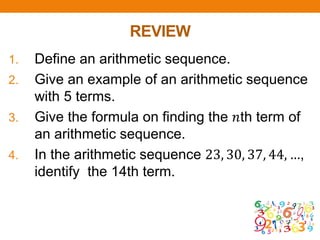
REVIEW
1. Define an arithmetic sequence.
2. Give an example of an arithmetic sequence
with 5 terms.
3. Give the formula on finding the 𝑛th term of
an arithmetic sequence.
4. In the arithmetic sequence 23, 30, 37, 44, …,
identify the 14th term.
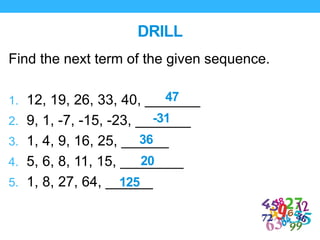
DRILL
Find the next term of the given sequence.
1. 12, 19, 26, 33, 40, _______
2. 9, 1, -7, -15, -23, _______
3. 1, 4, 9, 16, 25, ______
4. 5, 6, 8, 11, 15, ________
5. 1, 8, 27, 64, ______
47
-31
36
20
125
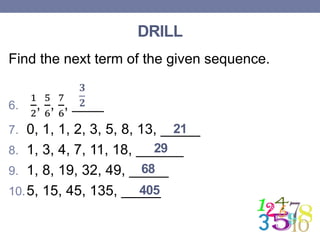
DRILL
Find the next term of the given sequence.
6.
1
2
,
5
6
,
7
6
, ____
7. 0, 1, 1, 2, 3, 5, 8, 13, _____
8. 1, 3, 4, 7, 11, 18, ______
9. 1, 8, 19, 32, 49, _____
10.5, 15, 45, 135, _____
𝟑
𝟐
21
29
68
405
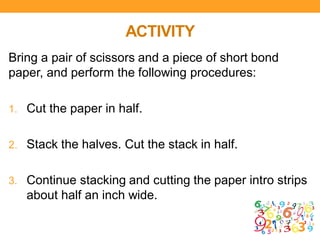
ACTIVITY
Bring a pair of scissors and a piece of short bond
paper, and perform the following procedures:
1. Cut the paper in half.
2. Stack the halves. Cut the stack in half.
3. Continue stacking and cutting the paper intro strips
about half an inch wide.
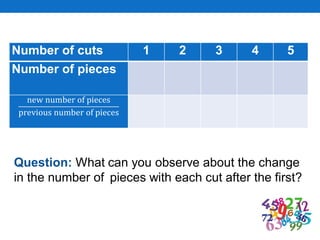
Number of cuts 1 2 3 4 5
Number of pieces
new number of pieces
previous number of pieces
Question: What can you observe about the change
in the number of pieces with each cut after the first?
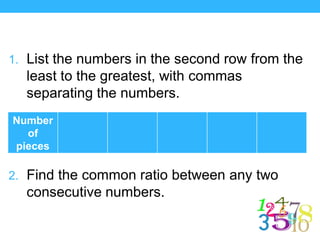
1. List the numbers in the second row from the
least to the greatest, with commas
separating the numbers.
2. Find the common ratio between any two
consecutive numbers.
Number
of
pieces
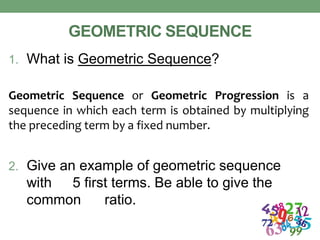
GEOMETRIC SEQUENCE
1. What is Geometric Sequence?
Geometric Sequence or Geometric Progression is a
sequence in which each term is obtained by multiplying
the preceding term by a fixed number.
2. Give an example of geometric sequence
with 5 first terms. Be able to give the
common ratio.
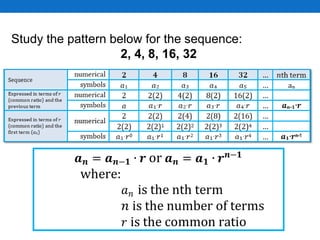
Study the pattern below for the sequence:
2, 4, 8, 16, 32
𝒂 𝒏 = 𝒂 𝒏−𝟏 ∙ 𝒓 or 𝒂 𝒏 = 𝒂 𝟏 ∙ 𝒓 𝒏−𝟏
where:
𝑎 𝑛 is the nth term
𝑛 is the number of terms
𝑟 is the common ratio
Illustrative Examples
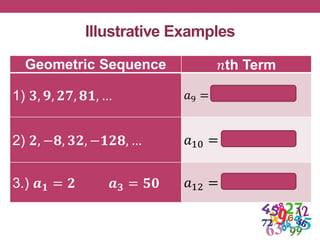
Geometric Sequence 𝑛th Term
1) 𝟑, 𝟗, 𝟐𝟕, 𝟖𝟏, … 𝑎9 = 19,683
2) 𝟐, −𝟖, 𝟑𝟐, −𝟏𝟐𝟖, … 𝑎10 = −524,288
3.) 𝒂 𝟏 = 𝟐 𝒂 𝟑 = 𝟓𝟎 𝑎12 = 97,656,250
Illustrative Example 1
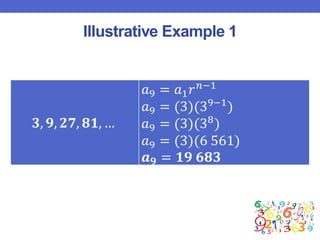
𝟑, 𝟗, 𝟐𝟕, 𝟖𝟏, …
𝑎9 = 𝑎1 𝑟 𝑛−1
𝑎9 = (3)(39−1
)
𝑎9 = (3)(38
)
𝑎9 = (3)(6 561)
𝒂 𝟗 = 𝟏𝟗 𝟔𝟖𝟑
Illustrative Example 2
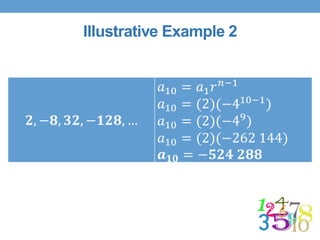
𝟐, −𝟖, 𝟑𝟐, −𝟏𝟐𝟖, …
𝑎10 = 𝑎1 𝑟 𝑛−1
𝑎10 = (2)(−410−1
)
𝑎10 = (2)(−49
)
𝑎10 = (2)(−262 144)
𝒂 𝟏𝟎 = −𝟓𝟐𝟒 𝟐𝟖𝟖
Illustrative Example 3
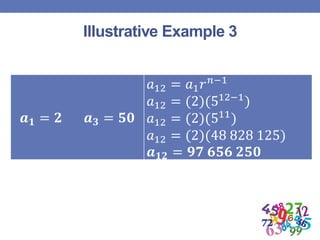
𝒂 𝟏 = 𝟐 𝒂 𝟑 = 𝟓𝟎
𝑎12 = 𝑎1 𝑟 𝑛−1
𝑎12 = (2)(512−1
)
𝑎12 = (2)(511
)
𝑎12 = (2)(48 828 125)
𝒂 𝟏𝟐 = 𝟗𝟕 𝟔𝟓𝟔 𝟐𝟓𝟎
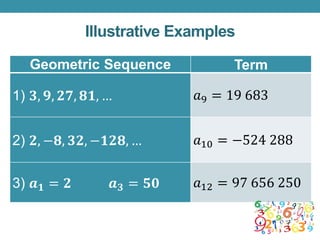
Illustrative Examples
Geometric Sequence Term
1) 𝟑, 𝟗, 𝟐𝟕, 𝟖𝟏, … 𝑎9 = 19 683
2) 𝟐, −𝟖, 𝟑𝟐, −𝟏𝟐𝟖, … 𝑎10 = −524 288
3) 𝒂 𝟏 = 𝟐 𝒂 𝟑 = 𝟓𝟎 𝑎12 = 97 656 250
GROUP EXERCISES
TASK 1 TASK 2 TASK 3
GROUP 1A
BACANI, Gwinette Angela B.
BALAGOT, Yzeus Von B.
CARIÑO, John Ardy C.
DANTE, Camille Shane T.
MANANGAN, Valerie Joy A.
SACRIZ, Tricia Mae G.
GROUP 2A
ABUNGAN, Sean Aaron D.
DULOS, Rafael C.
HILARDE, Jessabel P.
MARQUEZ, Melanie D.
OPEÑA, Justine S.
SIMYUNN, Jhoemar J.
GROUP 3A
DUCUSIN, Jarvi Janne L.
GACAYAN, Cyril Clyde C.
MACAIRING, Johaynnah B.
GROUP 1B
BALANON, James Kenneth S.
BRAVO, Amante Amor R.
CABERO, Ma. Angelica A.
DOMINGUEZ, Dave I.
NISPEROS, Jonalyn M.
RIVERA, Franz Jethro D.
GROUP 2B
DUMAGUIN, Ralph G.
GALVEZ, Jonathan Augusto S.
GRAYCOCHEA, Rex Ivan R.
JUCAR, Deanne Krystelle C.
SANCHEZ, Justin Louie B.
GROUP 3B
APILADO, Diana M.
LUMNA, Muhaimen U.
PULIDO, Julliane C.
GROUP 1C
AGAGAS, Zarah Iris B.
BARADI, Johnberg D.
CARIAGA, Angel Kyle A.
DULOS, Febilyn C.
FLORES, Leslie Q.
RAMOS, Justine S.
GROUP 2C
ALMEN, Angelie Mae V.
CAROLINO, Lanz Alexis F.
FUSILERO, Jan Lhoyd B.
GALVEZ, Tricia Ann D.
LIBAO, James Kenneth D.
MARZO, Perry L.
GROUP 3C
BOAC, Renzdale Lance Kurl V.
CARIÑO, Elaija Grace L.
MAZON, Isaac Marvin C.
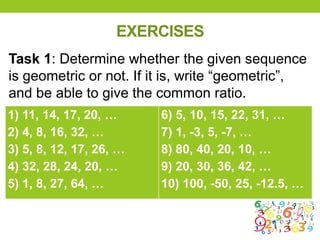
EXERCISES
1) 11, 14, 17, 20, …
2) 4, 8, 16, 32, …
3) 5, 8, 12, 17, 26, …
4) 32, 28, 24, 20, …
5) 1, 8, 27, 64, …
6) 5, 10, 15, 22, 31, …
7) 1, -3, 5, -7, …
8) 80, 40, 20, 10, …
9) 20, 30, 36, 42, …
10) 100, -50, 25, -12.5, …
Task 1: Determine whether the given sequence
is geometric or not. If it is, write “geometric”,
and be able to give the common ratio.
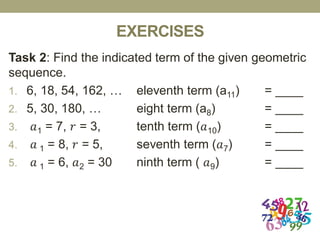
EXERCISES
Task 2: Find the indicated term of the given geometric
sequence.
1. 6, 18, 54, 162, … eleventh term (a11) = ____
2. 5, 30, 180, … eight term (a8) = ____
3. 𝑎1 = 7, 𝑟 = 3, tenth term (𝑎10) = ____
4. 𝑎 1 = 8, 𝑟 = 5, seventh term (𝑎7) = ____
5. 𝑎 1 = 6, 𝑎2 = 30 ninth term ( 𝑎9) = ____
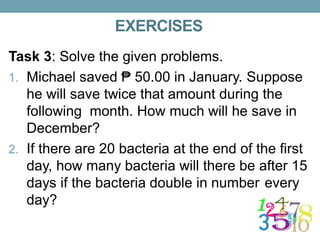
EXERCISES
Task 3: Solve the given problems.
1. Michael saved ₱ 50.00 in January. Suppose
he will save twice that amount during the
following month. How much will he save in
December?
2. If there are 20 bacteria at the end of the first
day, how many bacteria will there be after 15
days if the bacteria double in number every
day?
EXERCISES (Answers)
1) 11, 22, 44, 88, …
2) 4, 8, 16, 32, …
3) 5, 8, 12, 17, 26, …
4) 32, 28, 24, 20, …
5) 1, 8, 64, 512…
6) 5, 10, 15, 22, 31, …
7) 1, -3, 5, -7, …
8) 80, 40, 20, 10, …
9) 20, 30, 36, 42, …
10) 100, -50, 25, -12.5, …
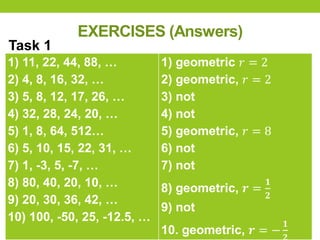
1) geometric 𝑟 = 2
2) geometric, 𝑟 = 2
3) not
4) not
5) geometric, 𝑟 = 8
6) not
7) not
8) geometric, 𝒓 =
𝟏
𝟐
9) not
10. geometric, 𝒓 = −
𝟏
Task 1
EXERCISES (Answers)
Task 2
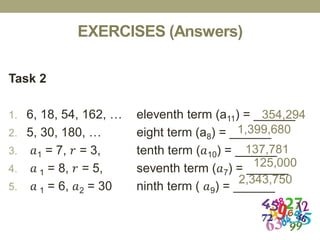
1. 6, 18, 54, 162, … eleventh term (a11) = ______
2. 5, 30, 180, … eight term (a8) = ______
3. 𝑎1 = 7, 𝑟 = 3, tenth term (𝑎10) = ______
4. 𝑎 1 = 8, 𝑟 = 5, seventh term (𝑎7) = ______
5. 𝑎 1 = 6, 𝑎2 = 30 ninth term ( 𝑎9) = ______
354,294
1,399,680
137,781
125,000
2,343,750
EXERCISES (Answers)
Task 3
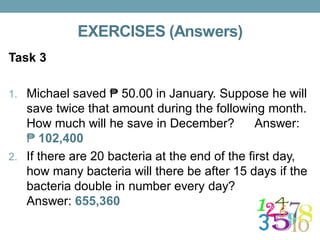
1. Michael saved ₱ 50.00 in January. Suppose he will
save twice that amount during the following month.
How much will he save in December? Answer:
₱ 102,400
2. If there are 20 bacteria at the end of the first day,
how many bacteria will there be after 15 days if the
bacteria double in number every day?
Answer: 655,360
INTEGRATION
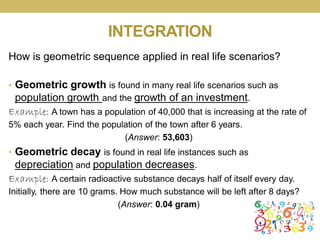
How is geometric sequence applied in real life scenarios?
• Geometric growth is found in many real life scenarios such as
population growth and the growth of an investment.
Example: A town has a population of 40,000 that is increasing at the rate of
5% each year. Find the population of the town after 6 years.
(Answer: 53,603)
• Geometric decay is found in real life instances such as
depreciation and population decreases.
Example: A certain radioactive substance decays half of itself every day.
Initially, there are 10 grams. How much substance will be left after 8 days?
(Answer: 0.04 gram)
GENERALIZATION
1. A geometric sequence is a sequence __________.
2. An example of geometric sequence is _________.
3. To find the 𝑛th term of a geometric sequence, the
formula to use is ____________.
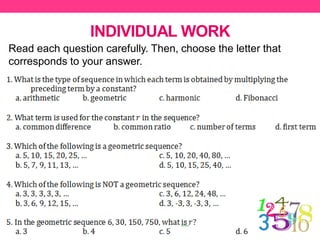
INDIVIDUAL WORK
Read each question carefully. Then, choose the letter that
corresponds to your answer.
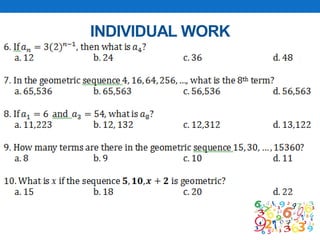
INDIVIDUAL WORK
ASSIGNMENT
Solve the following problems where geometric
sequence is applied.
1. The population of a certain province increases
by 10% each year. What will be the population of
the province five years from now if the current
population is 200,000?
2. A car that costs ₱ 700,000.00 depreciates 15%
in value each year for the first five years. What is
its cost after 5 years?
Geometric Sequence
Geometric Sequence

Geometric Sequence

  • 1.
    Prepared by: Teacher III SanFernando South Central Integrated School Tanqui, City of San Fernando, La Union
  • 2.
    LEARNING OBJECTIVES 1. Illustratea geometric sequence; 2. Determine the 𝑛th term of a geometric sequence; and 3. Cite ways how geometric sequence is applied in real life scenarios.
  • 3.
    SETTLING DOWN 1. Areyour chairs arranged? 2. Is your area clean? 3. Is the room well-ventilated? 4. Is the classroom free from any noise or other disturbances? 5. Are you all present?
  • 4.
    REVIEW 1. Define anarithmetic sequence. 2. Give an example of an arithmetic sequence with 5 terms. 3. Give the formula on finding the 𝑛th term of an arithmetic sequence. 4. In the arithmetic sequence 23, 30, 37, 44, …, identify the 14th term.
  • 5.
    DRILL Find the nextterm of the given sequence. 1. 12, 19, 26, 33, 40, _______ 2. 9, 1, -7, -15, -23, _______ 3. 1, 4, 9, 16, 25, ______ 4. 5, 6, 8, 11, 15, ________ 5. 1, 8, 27, 64, ______ 47 -31 36 20 125
  • 6.
    DRILL Find the nextterm of the given sequence. 6. 1 2 , 5 6 , 7 6 , ____ 7. 0, 1, 1, 2, 3, 5, 8, 13, _____ 8. 1, 3, 4, 7, 11, 18, ______ 9. 1, 8, 19, 32, 49, _____ 10.5, 15, 45, 135, _____ 𝟑 𝟐 21 29 68 405
  • 7.
    ACTIVITY Bring a pairof scissors and a piece of short bond paper, and perform the following procedures: 1. Cut the paper in half. 2. Stack the halves. Cut the stack in half. 3. Continue stacking and cutting the paper intro strips about half an inch wide.
  • 8.
    Number of cuts1 2 3 4 5 Number of pieces new number of pieces previous number of pieces Question: What can you observe about the change in the number of pieces with each cut after the first?
  • 9.
    1. List thenumbers in the second row from the least to the greatest, with commas separating the numbers. 2. Find the common ratio between any two consecutive numbers. Number of pieces
  • 10.
    GEOMETRIC SEQUENCE 1. Whatis Geometric Sequence? Geometric Sequence or Geometric Progression is a sequence in which each term is obtained by multiplying the preceding term by a fixed number. 2. Give an example of geometric sequence with 5 first terms. Be able to give the common ratio.
  • 11.
    Study the patternbelow for the sequence: 2, 4, 8, 16, 32 𝒂 𝒏 = 𝒂 𝒏−𝟏 ∙ 𝒓 or 𝒂 𝒏 = 𝒂 𝟏 ∙ 𝒓 𝒏−𝟏 where: 𝑎 𝑛 is the nth term 𝑛 is the number of terms 𝑟 is the common ratio
  • 12.
    Illustrative Examples Geometric Sequence𝑛th Term 1) 𝟑, 𝟗, 𝟐𝟕, 𝟖𝟏, … 𝑎9 = 19,683 2) 𝟐, −𝟖, 𝟑𝟐, −𝟏𝟐𝟖, … 𝑎10 = −524,288 3.) 𝒂 𝟏 = 𝟐 𝒂 𝟑 = 𝟓𝟎 𝑎12 = 97,656,250
  • 13.
    Illustrative Example 1 𝟑,𝟗, 𝟐𝟕, 𝟖𝟏, … 𝑎9 = 𝑎1 𝑟 𝑛−1 𝑎9 = (3)(39−1 ) 𝑎9 = (3)(38 ) 𝑎9 = (3)(6 561) 𝒂 𝟗 = 𝟏𝟗 𝟔𝟖𝟑
  • 14.
    Illustrative Example 2 𝟐,−𝟖, 𝟑𝟐, −𝟏𝟐𝟖, … 𝑎10 = 𝑎1 𝑟 𝑛−1 𝑎10 = (2)(−410−1 ) 𝑎10 = (2)(−49 ) 𝑎10 = (2)(−262 144) 𝒂 𝟏𝟎 = −𝟓𝟐𝟒 𝟐𝟖𝟖
  • 15.
    Illustrative Example 3 𝒂𝟏 = 𝟐 𝒂 𝟑 = 𝟓𝟎 𝑎12 = 𝑎1 𝑟 𝑛−1 𝑎12 = (2)(512−1 ) 𝑎12 = (2)(511 ) 𝑎12 = (2)(48 828 125) 𝒂 𝟏𝟐 = 𝟗𝟕 𝟔𝟓𝟔 𝟐𝟓𝟎
  • 16.
    Illustrative Examples Geometric SequenceTerm 1) 𝟑, 𝟗, 𝟐𝟕, 𝟖𝟏, … 𝑎9 = 19 683 2) 𝟐, −𝟖, 𝟑𝟐, −𝟏𝟐𝟖, … 𝑎10 = −524 288 3) 𝒂 𝟏 = 𝟐 𝒂 𝟑 = 𝟓𝟎 𝑎12 = 97 656 250
  • 17.
    GROUP EXERCISES TASK 1TASK 2 TASK 3 GROUP 1A BACANI, Gwinette Angela B. BALAGOT, Yzeus Von B. CARIÑO, John Ardy C. DANTE, Camille Shane T. MANANGAN, Valerie Joy A. SACRIZ, Tricia Mae G. GROUP 2A ABUNGAN, Sean Aaron D. DULOS, Rafael C. HILARDE, Jessabel P. MARQUEZ, Melanie D. OPEÑA, Justine S. SIMYUNN, Jhoemar J. GROUP 3A DUCUSIN, Jarvi Janne L. GACAYAN, Cyril Clyde C. MACAIRING, Johaynnah B. GROUP 1B BALANON, James Kenneth S. BRAVO, Amante Amor R. CABERO, Ma. Angelica A. DOMINGUEZ, Dave I. NISPEROS, Jonalyn M. RIVERA, Franz Jethro D. GROUP 2B DUMAGUIN, Ralph G. GALVEZ, Jonathan Augusto S. GRAYCOCHEA, Rex Ivan R. JUCAR, Deanne Krystelle C. SANCHEZ, Justin Louie B. GROUP 3B APILADO, Diana M. LUMNA, Muhaimen U. PULIDO, Julliane C. GROUP 1C AGAGAS, Zarah Iris B. BARADI, Johnberg D. CARIAGA, Angel Kyle A. DULOS, Febilyn C. FLORES, Leslie Q. RAMOS, Justine S. GROUP 2C ALMEN, Angelie Mae V. CAROLINO, Lanz Alexis F. FUSILERO, Jan Lhoyd B. GALVEZ, Tricia Ann D. LIBAO, James Kenneth D. MARZO, Perry L. GROUP 3C BOAC, Renzdale Lance Kurl V. CARIÑO, Elaija Grace L. MAZON, Isaac Marvin C.
  • 18.
    EXERCISES 1) 11, 14,17, 20, … 2) 4, 8, 16, 32, … 3) 5, 8, 12, 17, 26, … 4) 32, 28, 24, 20, … 5) 1, 8, 27, 64, … 6) 5, 10, 15, 22, 31, … 7) 1, -3, 5, -7, … 8) 80, 40, 20, 10, … 9) 20, 30, 36, 42, … 10) 100, -50, 25, -12.5, … Task 1: Determine whether the given sequence is geometric or not. If it is, write “geometric”, and be able to give the common ratio.
  • 19.
    EXERCISES Task 2: Findthe indicated term of the given geometric sequence. 1. 6, 18, 54, 162, … eleventh term (a11) = ____ 2. 5, 30, 180, … eight term (a8) = ____ 3. 𝑎1 = 7, 𝑟 = 3, tenth term (𝑎10) = ____ 4. 𝑎 1 = 8, 𝑟 = 5, seventh term (𝑎7) = ____ 5. 𝑎 1 = 6, 𝑎2 = 30 ninth term ( 𝑎9) = ____
  • 20.
    EXERCISES Task 3: Solvethe given problems. 1. Michael saved ₱ 50.00 in January. Suppose he will save twice that amount during the following month. How much will he save in December? 2. If there are 20 bacteria at the end of the first day, how many bacteria will there be after 15 days if the bacteria double in number every day?
  • 21.
    EXERCISES (Answers) 1) 11,22, 44, 88, … 2) 4, 8, 16, 32, … 3) 5, 8, 12, 17, 26, … 4) 32, 28, 24, 20, … 5) 1, 8, 64, 512… 6) 5, 10, 15, 22, 31, … 7) 1, -3, 5, -7, … 8) 80, 40, 20, 10, … 9) 20, 30, 36, 42, … 10) 100, -50, 25, -12.5, … 1) geometric 𝑟 = 2 2) geometric, 𝑟 = 2 3) not 4) not 5) geometric, 𝑟 = 8 6) not 7) not 8) geometric, 𝒓 = 𝟏 𝟐 9) not 10. geometric, 𝒓 = − 𝟏 Task 1
  • 22.
    EXERCISES (Answers) Task 2 1.6, 18, 54, 162, … eleventh term (a11) = ______ 2. 5, 30, 180, … eight term (a8) = ______ 3. 𝑎1 = 7, 𝑟 = 3, tenth term (𝑎10) = ______ 4. 𝑎 1 = 8, 𝑟 = 5, seventh term (𝑎7) = ______ 5. 𝑎 1 = 6, 𝑎2 = 30 ninth term ( 𝑎9) = ______ 354,294 1,399,680 137,781 125,000 2,343,750
  • 23.
    EXERCISES (Answers) Task 3 1.Michael saved ₱ 50.00 in January. Suppose he will save twice that amount during the following month. How much will he save in December? Answer: ₱ 102,400 2. If there are 20 bacteria at the end of the first day, how many bacteria will there be after 15 days if the bacteria double in number every day? Answer: 655,360
  • 24.
    INTEGRATION How is geometricsequence applied in real life scenarios? • Geometric growth is found in many real life scenarios such as population growth and the growth of an investment. Example: A town has a population of 40,000 that is increasing at the rate of 5% each year. Find the population of the town after 6 years. (Answer: 53,603) • Geometric decay is found in real life instances such as depreciation and population decreases. Example: A certain radioactive substance decays half of itself every day. Initially, there are 10 grams. How much substance will be left after 8 days? (Answer: 0.04 gram)
  • 25.
    GENERALIZATION 1. A geometricsequence is a sequence __________. 2. An example of geometric sequence is _________. 3. To find the 𝑛th term of a geometric sequence, the formula to use is ____________.
  • 26.
    INDIVIDUAL WORK Read eachquestion carefully. Then, choose the letter that corresponds to your answer.
  • 27.
  • 28.
    ASSIGNMENT Solve the followingproblems where geometric sequence is applied. 1. The population of a certain province increases by 10% each year. What will be the population of the province five years from now if the current population is 200,000? 2. A car that costs ₱ 700,000.00 depreciates 15% in value each year for the first five years. What is its cost after 5 years?