SITUATION:
SITUATION:
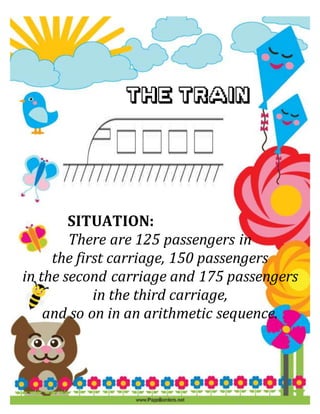
There are 125 passengers in
the first carriage, 150 passengers
in the second carriage and 175 passengers
in the third carriage,
and so on in an arithmetic sequence.
PROBLEM:
What’s the total number of passengers in the
first 7 carriages?
SOLUTION:
The sequence is 125, 150, 175 …
Given: a1= 125; a2= 150; a3= 175
Find: S7=?
an = 125+(n-1)25
a7 = 125+(7-1)25=275
We can use the formula:
Thus, =1400
Carriage 1st 2nd 3rd … 7th First 7
carriages
Number of
Passengers
125 150 175 … ? Sn
SITUATION:
SITUATION:
There are 130 students in grade
one, 210 students in grade two and
290students in grade three in a
primary school, and so on in an
arithmetic sequence.
PROBLEM:
What’s the total amount of students
In the primary school?
(Primary School has 6 grades)
SOLUTION:
The sequence is 130, 210, 290 …
Given: a1= 130; a2= 210; a3= 290
Find: S6= ?
an = 130+(n-1)80
a6 = 130+(6-1)80=530
We can use the formula:
Thus, = 1980
Grade 1st 2nd 3rd … 6th Total
from 1st
to 6th
Grade
Number
of
Students
130 210 290 … ? Sn
SITUATION:
A car travels 300 m the first
minute, 420 m the next minute,
540 m the third minute,
and so on in an arithmetic
sequence.
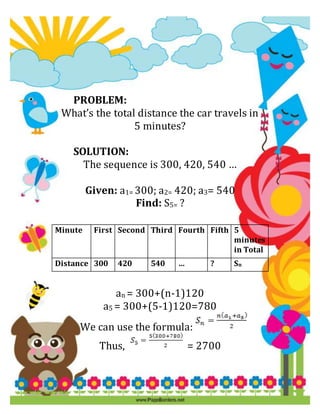
PROBLEM:
What’s the total distance the car travels in
5 minutes?
SOLUTION:
The sequence is 300, 420, 540 …
Given: a1= 300; a2= 420; a3= 540
Find: S5= ?
an = 300+(n-1)120
a5 = 300+(5-1)120=780
We can use the formula:
Thus, = 2700
Minute First Second Third Fourth Fifth 5
minutes
in Total
Distance 300 420 540 … ? Sn
PROBLEM:
SITUATION:
A writer wrote 890 words on the
first day, 760 words on the second
day and 630 words on the third day,
and so on in an arithmetic sequence.
PROBLEM:
How many words did the writer
write in a week?
SOLUTION:
The sequence is 890, 760, 630 …
Given: a1= 890; a2= 760; a3= 630
Find: s7= ?
an = 890-(n-1)130
a7 = 890-(7-1)130=110
We can use the formula:
Thus, =3500
Day 1st 2nd 3rd … 7th Whole
Week
Number of
Words
890 760 630 … ? Sn
SITUATION:
You visit the Grand Canyon and
drop a penny off the edge of a cliff.
The distance the penny will fall is 16 feet
the first second, 48 feet the
next second, 80 feet the third second,
and so on in an
arithmetic sequence.
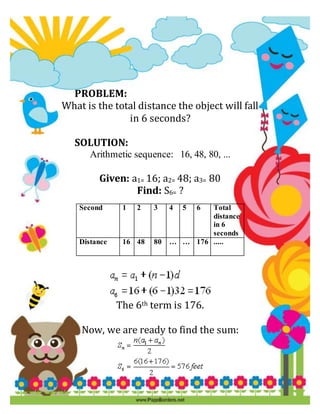
PROBLEM:
What is the total distance the object will fall
in 6 seconds?
SOLUTION:
Arithmetic sequence: 16, 48, 80, ...
Given: a1= 16; a2= 48; a3= 80
Find: S6= ?
The 6th term is 176.
Now, we are ready to find the sum:
Second 1 2 3 4 5 6 Total
distance
in 6
seconds
Distance 16 48 80 … … 176 .....
SITUATION:
The sum of the interior angles
of a triangle is 180º,of a
quadrilateral is 360º
and of a pentagon
is 540º.
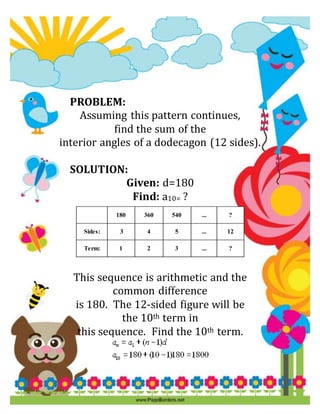
PROBLEM:
Assuming this pattern continues,
find the sum of the
interior angles of a dodecagon (12 sides).
SOLUTION:
Given: d=180
Find: a10= ?
This sequence is arithmetic and the
common difference
is 180. The 12-sided figure will be
the 10th term in
this sequence. Find the 10th term.
180 360 540 ... ?
Sides: 3 4 5 ... 12
Term: 1 2 3 ... ?
SITUATION:
After knee surgery, your trainer tells you to
return to your jogging program slowly. He
suggests jogging for 12 minutes each day
for the first week.
Each week thereafter, he suggests that you
increase that time
by 6 minutes per day.
PROBLEM:
How many weeks will it be before you
are upto jogging 60 minutes per day?
SOLUTION:
Given: a1 60; d=6
Find: n= ?
Adding 6 minutes to the weekly jogging
time for each week creates the
sequence: 12, 18, 24, ...
This sequence is arithmetic.
Week
Number
1 2 3 … ?
Minutes of
Jogging each
day inside
the week
12 18 24 … n
SITUATION:
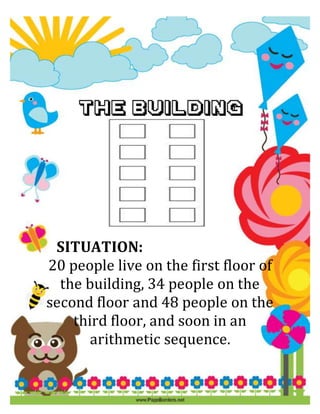
20 people live on the first floor of
the building, 34 people on the
second floor and 48 people on the
third floor, and soon in an
arithmetic sequence.
PROBLEM:
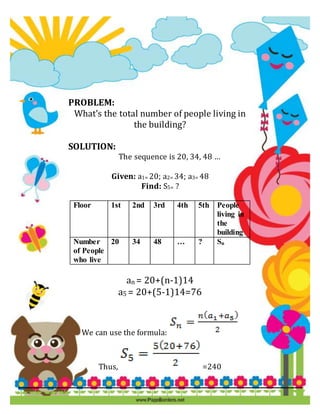
What’s the total number of people living in
the building?
SOLUTION:
The sequence is 20, 34, 48 …
Given: a1= 20; a2= 34; a3= 48
Find: S5= ?
Floor 1st 2nd 3rd 4th 5th People
living in
the
building
Number
of People
who live
20 34 48 … ? Sn
an = 20+(n-1)14
a5 = 20+(5-1)14=76
We can use the formula:
Thus, =240
SITUATION:
Lee earned $240 in the first week,
$350in the second week and $460
in the third week, and so on
in an arithmetic
sequence.
PROBLEM:
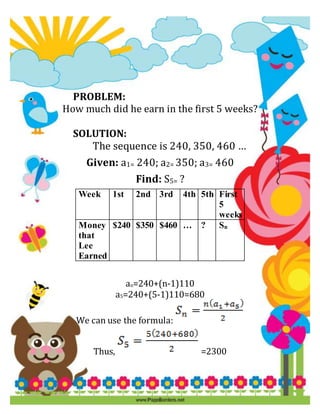
How much did he earn in the first 5 weeks?
SOLUTION:
The sequence is 240, 350, 460 …
Given: a1= 240; a2= 350; a3= 460
Find: S5= ?
Week 1st 2nd 3rd 4th 5th First
5
weeks
Money
that
Lee
Earned
$240 $350 $460 … ? Sn
an=240+(n-1)110
a5=240+(5-1)110=680
We can use the formula:
Thus, =2300
SITUATION:
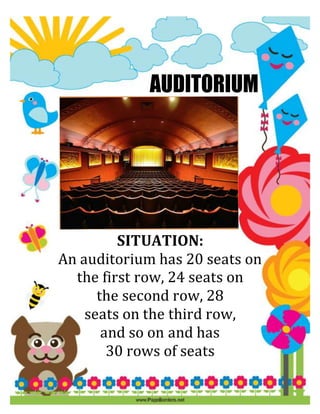
An auditorium has 20 seats on
the first row, 24 seats on
the second row, 28
seats on the third row,
and so on and has
30 rows of seats
PROBLEM:
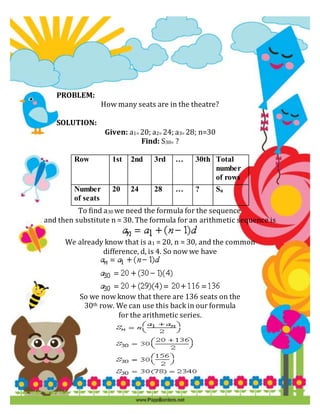
How many seats are in the theatre?
SOLUTION:
Given: a1= 20; a2= 24; a3= 28; n=30
Find: S30= ?
Row 1st 2nd 3rd … 30th Total
number
of rows
Number
of seats
20 24 28 … ? Sn
To find a30 we need the formula for the sequence
and then substitute n = 30. The formula for an arithmetic sequence is
We already know that is a1 = 20, n = 30, and the common
difference, d, is 4. So now we have
So we now know that there are 136 seats on the
30th row. We can use this back in our formula
for the arithmetic series.

Arithmetic Sequence Real Life Problems

  • 1.
    SITUATION: SITUATION: There are 125passengers in the first carriage, 150 passengers in the second carriage and 175 passengers in the third carriage, and so on in an arithmetic sequence.
  • 2.
    PROBLEM: What’s the totalnumber of passengers in the first 7 carriages? SOLUTION: The sequence is 125, 150, 175 … Given: a1= 125; a2= 150; a3= 175 Find: S7=? an = 125+(n-1)25 a7 = 125+(7-1)25=275 We can use the formula: Thus, =1400 Carriage 1st 2nd 3rd … 7th First 7 carriages Number of Passengers 125 150 175 … ? Sn
  • 3.
    SITUATION: SITUATION: There are 130students in grade one, 210 students in grade two and 290students in grade three in a primary school, and so on in an arithmetic sequence.
  • 4.
    PROBLEM: What’s the totalamount of students In the primary school? (Primary School has 6 grades) SOLUTION: The sequence is 130, 210, 290 … Given: a1= 130; a2= 210; a3= 290 Find: S6= ? an = 130+(n-1)80 a6 = 130+(6-1)80=530 We can use the formula: Thus, = 1980 Grade 1st 2nd 3rd … 6th Total from 1st to 6th Grade Number of Students 130 210 290 … ? Sn
  • 5.
    SITUATION: A car travels300 m the first minute, 420 m the next minute, 540 m the third minute, and so on in an arithmetic sequence.
  • 6.
    PROBLEM: What’s the totaldistance the car travels in 5 minutes? SOLUTION: The sequence is 300, 420, 540 … Given: a1= 300; a2= 420; a3= 540 Find: S5= ? an = 300+(n-1)120 a5 = 300+(5-1)120=780 We can use the formula: Thus, = 2700 Minute First Second Third Fourth Fifth 5 minutes in Total Distance 300 420 540 … ? Sn
  • 7.
    PROBLEM: SITUATION: A writer wrote890 words on the first day, 760 words on the second day and 630 words on the third day, and so on in an arithmetic sequence.
  • 8.
    PROBLEM: How many wordsdid the writer write in a week? SOLUTION: The sequence is 890, 760, 630 … Given: a1= 890; a2= 760; a3= 630 Find: s7= ? an = 890-(n-1)130 a7 = 890-(7-1)130=110 We can use the formula: Thus, =3500 Day 1st 2nd 3rd … 7th Whole Week Number of Words 890 760 630 … ? Sn
  • 9.
    SITUATION: You visit theGrand Canyon and drop a penny off the edge of a cliff. The distance the penny will fall is 16 feet the first second, 48 feet the next second, 80 feet the third second, and so on in an arithmetic sequence.
  • 10.
    PROBLEM: What is thetotal distance the object will fall in 6 seconds? SOLUTION: Arithmetic sequence: 16, 48, 80, ... Given: a1= 16; a2= 48; a3= 80 Find: S6= ? The 6th term is 176. Now, we are ready to find the sum: Second 1 2 3 4 5 6 Total distance in 6 seconds Distance 16 48 80 … … 176 .....
  • 11.
    SITUATION: The sum ofthe interior angles of a triangle is 180º,of a quadrilateral is 360º and of a pentagon is 540º.
  • 12.
    PROBLEM: Assuming this patterncontinues, find the sum of the interior angles of a dodecagon (12 sides). SOLUTION: Given: d=180 Find: a10= ? This sequence is arithmetic and the common difference is 180. The 12-sided figure will be the 10th term in this sequence. Find the 10th term. 180 360 540 ... ? Sides: 3 4 5 ... 12 Term: 1 2 3 ... ?
  • 13.
    SITUATION: After knee surgery,your trainer tells you to return to your jogging program slowly. He suggests jogging for 12 minutes each day for the first week. Each week thereafter, he suggests that you increase that time by 6 minutes per day.
  • 14.
    PROBLEM: How many weekswill it be before you are upto jogging 60 minutes per day? SOLUTION: Given: a1 60; d=6 Find: n= ? Adding 6 minutes to the weekly jogging time for each week creates the sequence: 12, 18, 24, ... This sequence is arithmetic. Week Number 1 2 3 … ? Minutes of Jogging each day inside the week 12 18 24 … n
  • 15.
    SITUATION: 20 people liveon the first floor of the building, 34 people on the second floor and 48 people on the third floor, and soon in an arithmetic sequence.
  • 16.
    PROBLEM: What’s the totalnumber of people living in the building? SOLUTION: The sequence is 20, 34, 48 … Given: a1= 20; a2= 34; a3= 48 Find: S5= ? Floor 1st 2nd 3rd 4th 5th People living in the building Number of People who live 20 34 48 … ? Sn an = 20+(n-1)14 a5 = 20+(5-1)14=76 We can use the formula: Thus, =240
  • 17.
    SITUATION: Lee earned $240in the first week, $350in the second week and $460 in the third week, and so on in an arithmetic sequence.
  • 18.
    PROBLEM: How much didhe earn in the first 5 weeks? SOLUTION: The sequence is 240, 350, 460 … Given: a1= 240; a2= 350; a3= 460 Find: S5= ? Week 1st 2nd 3rd 4th 5th First 5 weeks Money that Lee Earned $240 $350 $460 … ? Sn an=240+(n-1)110 a5=240+(5-1)110=680 We can use the formula: Thus, =2300
  • 19.
    SITUATION: An auditorium has20 seats on the first row, 24 seats on the second row, 28 seats on the third row, and so on and has 30 rows of seats
  • 20.
    PROBLEM: How many seatsare in the theatre? SOLUTION: Given: a1= 20; a2= 24; a3= 28; n=30 Find: S30= ? Row 1st 2nd 3rd … 30th Total number of rows Number of seats 20 24 28 … ? Sn To find a30 we need the formula for the sequence and then substitute n = 30. The formula for an arithmetic sequence is We already know that is a1 = 20, n = 30, and the common difference, d, is 4. So now we have So we now know that there are 136 seats on the 30th row. We can use this back in our formula for the arithmetic series.