Introduction 
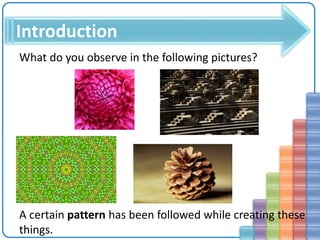
What do you observe in the following pictures? 
A certain pattern has been followed while creating these 
things.
Some Number Patterns 
Namita’s school offered her a scholarship of Rs. 1000 
when she was in class 6 and increased the amount by 
Rs. 500 each year till class 10. The amounts of money 
(in Rs) Namita received in class 7th,8th,9th and 10th were 
respectively: 
1500, 2000, 2500 and 3000 
Each of the numbers in the list is called a term. 
Here we find that the succeeding terms are obtained by 
adding a fixed number.
Some Number Patterns 
In a savings scheme, the amount becomes double after 
every 10 years. The maturity amount (in Rs) of an 
investment of Rs 8000 after 10, 20, 30 and 40 years will 
be, respectively: 
16000, 32000, 64000, 128000 
Here we find that the succeeding terms are obtained by 
multiplying with a fixed number.
Some Number Patterns 
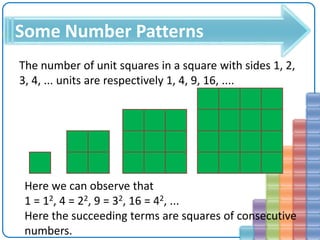
The number of unit squares in a square with sides 1, 2, 
3, 4, ... units are respectively 1, 4, 9, 16, .... 
Here we can observe that 
1 = 12, 4 = 22, 9 = 32, 16 = 42, ... 
Here the succeeding terms are squares of consecutive 
numbers.
Arithmetic Progressions 
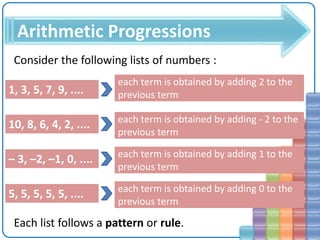
Consider the following lists of numbers : 
1, 3, 5, 7, 9, .... 
10, 8, 6, 4, 2, .... 
– 3, –2, –1, 0, .... 
5, 5, 5, 5, 5, .... 
each term is obtained by adding 2 to the 
previous term 
each term is obtained by adding - 2 to the 
previous term 
each term is obtained by adding 1 to the 
previous term 
each term is obtained by adding 0 to the 
previous term 
Each list follows a pattern or rule.
Arithmetic Progressions 
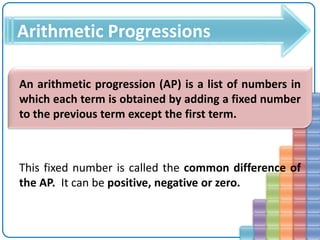
An arithmetic progression (AP) is a list of numbers in 
which each term is obtained by adding a fixed number 
to the previous term except the first term. 
This fixed number is called the common difference of 
the AP. It can be positive, negative or zero.
Formula for Common Difference 
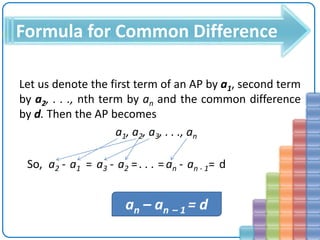
Let us denote the first term of an AP by a1, second term 
by a2, . . ., nth term by an and the common difference 
by d. Then the AP becomes 
a1, a2, a3, . . ., an 
So, a2 - a1 = a3 - a2 = . . . = an - an - 1 = d 
an – an – 1 = d
General Form of an AP 
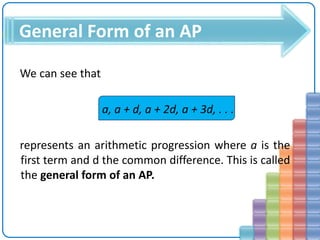
We can see that 
a, a + d, a + 2d, a + 3d, . . . 
represents an arithmetic progression where a is the 
first term and d the common difference. This is called 
the general form of an AP.
Finite and Infinite APs 
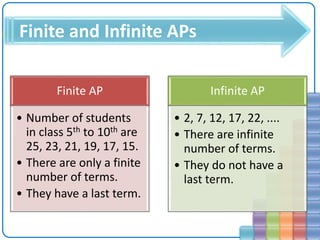
Finite AP 
• Number of students 
in class 5th to 10th are 
25, 23, 21, 19, 17, 15. 
• There are only a finite 
number of terms. 
• They have a last term. 
Infinite AP 
• 2, 7, 12, 17, 22, .... 
• There are infinite 
number of terms. 
• They do not have a 
last term.
Visit us on – www.letstute.com 
Subscribe us on www.youtube.com/letstute 
Thank you

Arithmetic progression - Introduction to Arithmetic progressions for class 10 maths.

  • 2.
    Introduction What doyou observe in the following pictures? A certain pattern has been followed while creating these things.
  • 3.
    Some Number Patterns Namita’s school offered her a scholarship of Rs. 1000 when she was in class 6 and increased the amount by Rs. 500 each year till class 10. The amounts of money (in Rs) Namita received in class 7th,8th,9th and 10th were respectively: 1500, 2000, 2500 and 3000 Each of the numbers in the list is called a term. Here we find that the succeeding terms are obtained by adding a fixed number.
  • 4.
    Some Number Patterns In a savings scheme, the amount becomes double after every 10 years. The maturity amount (in Rs) of an investment of Rs 8000 after 10, 20, 30 and 40 years will be, respectively: 16000, 32000, 64000, 128000 Here we find that the succeeding terms are obtained by multiplying with a fixed number.
  • 5.
    Some Number Patterns The number of unit squares in a square with sides 1, 2, 3, 4, ... units are respectively 1, 4, 9, 16, .... Here we can observe that 1 = 12, 4 = 22, 9 = 32, 16 = 42, ... Here the succeeding terms are squares of consecutive numbers.
  • 6.
    Arithmetic Progressions Considerthe following lists of numbers : 1, 3, 5, 7, 9, .... 10, 8, 6, 4, 2, .... – 3, –2, –1, 0, .... 5, 5, 5, 5, 5, .... each term is obtained by adding 2 to the previous term each term is obtained by adding - 2 to the previous term each term is obtained by adding 1 to the previous term each term is obtained by adding 0 to the previous term Each list follows a pattern or rule.
  • 7.
    Arithmetic Progressions Anarithmetic progression (AP) is a list of numbers in which each term is obtained by adding a fixed number to the previous term except the first term. This fixed number is called the common difference of the AP. It can be positive, negative or zero.
  • 8.
    Formula for CommonDifference Let us denote the first term of an AP by a1, second term by a2, . . ., nth term by an and the common difference by d. Then the AP becomes a1, a2, a3, . . ., an So, a2 - a1 = a3 - a2 = . . . = an - an - 1 = d an – an – 1 = d
  • 9.
    General Form ofan AP We can see that a, a + d, a + 2d, a + 3d, . . . represents an arithmetic progression where a is the first term and d the common difference. This is called the general form of an AP.
  • 10.
    Finite and InfiniteAPs Finite AP • Number of students in class 5th to 10th are 25, 23, 21, 19, 17, 15. • There are only a finite number of terms. • They have a last term. Infinite AP • 2, 7, 12, 17, 22, .... • There are infinite number of terms. • They do not have a last term.
  • 11.
    Visit us on– www.letstute.com Subscribe us on www.youtube.com/letstute Thank you

Editor's Notes

  • #3 Image of flower: http://farm5.static.flickr.com/4041/4329196400_af7e1c31b7.jpg Fine art pattern: http://images.fineartamerica.com/images-medium-large/radiating-patterns-susan-leggett.jpg Architectural Pattern:http://farm5.staticflickr.com/4080/4931654654_846eca23fb_o.jpg Pine cone: http://static.guim.co.uk/sys-images/Guardian/Pix/pictures/2012/8/28/1346149759217/A-pine-cone-008.jpg
  • #4 Image: http://www.piercepioneernews.com/wp-content/uploads/2012/07/Scholarship-Winners.jpg
  • #5 Image: http://www.solusrenewableenergy.co.uk/assets/images/sidebarimages/Money%20Saving%20Solar%20PV%208.jpg
  • #6 In this session, we shall discuss one of these patterns in which succeeding terms are obtained by adding a fixed number to the preceding terms.
  • #7 In all the lists above, we see that successive terms are obtained by adding a fixed number to the preceding terms. Such list of numbers is said to form an Arithmetic Progression.