Arithmetic Sequences and Series
USING AND WRITING SEQUENCES
The numbers in sequences are called terms.
You can think of a sequence as a function whose domain
is a set of consecutive integers. If a domain is not
specified, it is understood that the domain starts with 1.
The domain gives
the relative position
of each term.
1 2 3 4 5
DOMAIN:
3 6 9 12 15
RANGE:
The range gives the
terms of the sequence.
This is a finite sequence having the rule
an = 3n,
where an represents the nth term of the sequence.
USING AND WRITING SEQUENCES
n
an
Sequence 1 Sequence 2
2,4,6,8,10 2,4,6,8,10,…
A sequence can be finite or infinite.
The sequence has a
last term or final
term.
(such as seq. 1)
The sequence continues
without stopping.
(such as seq. 2)
Both sequences have an equation or general rule: an = 2n where n is the
term # and an is the nth term.
The general rule can also be written in function notation: f(n) = 2n
•
Examples:
Write the first six terms of f (n) = (– 3)n – 1.
f (1) = (– 3)1 – 1 = 1
f (2) = (– 3)2 – 1 = – 3
f (3) = (– 3)3 – 1 = 9
f (4) = (– 3)4 – 1 = – 27
f (5) = (– 3)5 – 1 = 81
f (6) = (– 3)6 – 1 = – 243
2nd term
3rd term
4th term
5th term
6th term
1st term
You are just substituting numbers into
the equation to get your term.
Writing Terms of Sequences
Write the first five terms of the sequence an = 2n + 3.
SOLUTION
a1 = 2(1) + 3 = 5 1st term
2nd term
3rd term
4th term
a2 = 2(2) + 3 = 7
a3 = 2(3) + 3 = 9
a4 = 2(4) + 3 = 11
a5 = 2(5) + 3 = 13 5th term
Writing Terms of Sequences
Write the first five terms of the sequence f(n) = (–2)n – 1
.
SOLUTION
f(1) = (–2) 1 – 1
= 1 1st term
2nd term
3rd term
4th term
f(2) = (–2) 2 – 1
= –2
f(3) = (–2) 3 – 1
= 4
f(4) = (–2) 4 – 1
= – 8
f(5) = (–2) 5 – 1
= 16 5th term
Example: write a rule for the nth term.
Think:
Arithmetic Sequences and Series
Arithmetic Sequence: sequence whose consecutive terms
have a common difference.
Example: 3, 5, 7, 9, 11, 13, ...
The terms have a common difference of 2.
The common difference is the number d.
To find the common difference you use an+1 – an
Example: Is the sequence arithmetic?
–45, –30, –15, 0, 15, 30
Yes, the common difference is 15
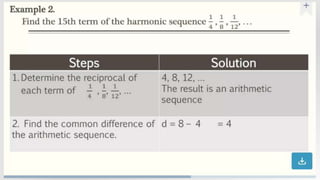
Find the next four terms of –9, -2, 5, …
Arithmetic Sequence
7 is referred to as the common difference (d)
Common Difference (d) – what we ADD to get next term
Next four terms……12, 19, 26, 33
-2 - -9 = 7 and 5 - -2 = 7
How do you find any term in this sequence?
To find any term in an arithmetic sequence, use the formula
an = a1 + (n – 1)d
where d is the common difference.
Vocabulary of Sequences (Universal)
1
a First term

n
a nth term

n
S sum of n terms

n number of terms

d common difference

 
 
n 1
n 1 n
nth term of arithmetic sequence
sum of n terms of arithmetic sequen
a a n 1 d
n
S a a
2
ce
  
 


Find the 14th term of the
arithmetic sequence
4, 7, 10, 13,……
1 ( 1)
n
a a n d
  
14
a  (14 1)
 
4 3
4 (13)3
 
4 39
 
43

n 1
Findnif a 633, a 9, and d 24
  
1
a First term

n
a nth term

n
S sum of n terms

n number of terms

d common difference

9
n
633
NA
24
 
n 1
a a n 1 d
  
Try this one:
633 = 9 + (n - 1)(24)
633 = 9 + 24n - 24
633 = 24n – 15
648 = 24n
n = 27
Given an arithmetic sequence with 15 1
a 38 and d 3, find a .
  
1
a First term

n
a nth term

n
S sum of n terms

n number of terms

d common difference

a1
15
38
NA
-3
 
n 1
a a n 1 d
  
38 = a1 + (15 - 1)(-3)
38 = a1 + (14)(-3)
38 = a1 - 42
a1 = 80
1 29
Find d if a 6 and a 20
  
-6
29
20
NA
d
1
a First term

n
a nth term

n
S sum of n terms

n number of terms

d common difference

 
n 1
a a n 1 d
  
20 = -6 + (29 - 1)(d)
20 = -6 + (28)(d)
26 = 28d
14
13

d
Write an equation for the nth term of the arithmetic
sequence 8, 17, 26, 35, …
1
a First term

d common difference

8
9
an = 8 + (n - 1)(9)
an = 8 + 9n - 9
an = 9n - 1
 
n 1
a a n 1 d
  
1. Describe the pattern, write the next term, and write a rule for the nth term of the sequence (a) – 1, – 8, – 27, –
64, . . .
2. Describe the pattern, write the next term, and write a rule for the nth term of the sequence (b) 0, 2, 6, 12, . . .
.
3. Write the first five terms of the sequence an = n! - 2. and Find the sum of the sequence
4. Write the first five terms of the sequence and sum of the sequence
5. The table shows typical costs for a construction company to rent a crane for one, two, three, or four months. Assuming
that the arithmetic sequence continues, how much would it cost to rent the crane for twelve months?
6. In the arithmetic sequence 4,7,10,13,…, which term has a value of 301?
1


n
n
an
Months Cost ($)
1 75,000
2 90,000
3 105,000
4 120,000
Geometric Sequences
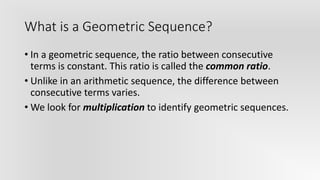
What is a Geometric Sequence?
• In a geometric sequence, the ratio between consecutive
terms is constant. This ratio is called the common ratio.
• Unlike in an arithmetic sequence, the difference between
consecutive terms varies.
• We look for multiplication to identify geometric sequences.
Ex: Determine if the sequence is geometric. If so, identify the
common ratio
• 1, -6, 36, -216
yes. Common ratio=-6
• 2, 4, 6, 8
no. No common ratio
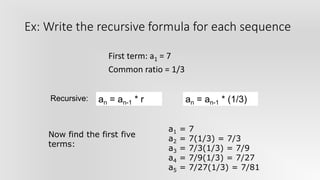
Ex: Write the recursive formula for each sequence
First term: a1 = 7
Common ratio = 1/3
Recursive: an = an-1 * r
Now find the first five
terms:
a1 = 7
a2 = 7(1/3) = 7/3
a3 = 7/3(1/3) = 7/9
a4 = 7/9(1/3) = 7/27
a5 = 7/27(1/3) = 7/81
an = an-1 * (1/3)
Ex: Write the explicit formula for each sequence
First term: a1 = 7
Common ratio = 1/3
Explicit: an = a1 * r n-1
Now find the first five
terms:
a1 = 7(1/3) (1-1) = 7
a2 = 7(1/3) (2-1) = 7/3
a3 = 7(1/3) (3-1) = 7/9
a4 = 7(1/3) (4-1) = 7/27
a5 = 7(1/3) (5-1) = 7/81
Recursive Geometic Sequence Problem
Find the 5th and 6th term in the sequence of
11,33,99,297 . . .
a6 = 891(3) = 2673
Common ratio = 3
a5 = 297 (3) = 891
Start with the recursive sequence
formula
Find the common ratio
between the values.
Plug in known values
Simplify
an = an-1 * r
Explicit Geometic Sequence Problem
Find the 19th term in the sequence of
11,33,99,297 . . .
a19 = 11(3)18 =4,261,625,379
Common ratio = 3
a19 = 11 (3) (19-1)
Start with the explicit sequence formula
Find the common ratio
between the values.
Plug in known values
Simplify
an = a1 * r n-1
Let’s try one
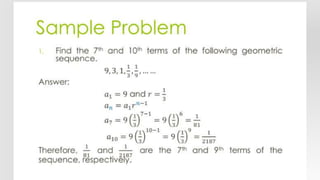
Find the 10th term in the sequence of 1, -6, 36, -
216 . . .
a10 = 1(-6)9 = -10,077,696
Common ratio = -6
a10 = 1 (-6) (10-1)
Start with the explicit sequence formula
Find the common ratio
between the values.
Plug in known values
Simplify
an = a1 * r n-1
Sequences_Arithmetic_Harmonic_Geometric.ppt

Sequences_Arithmetic_Harmonic_Geometric.ppt

  • 12.
  • 13.
    USING AND WRITINGSEQUENCES The numbers in sequences are called terms. You can think of a sequence as a function whose domain is a set of consecutive integers. If a domain is not specified, it is understood that the domain starts with 1.
  • 14.
    The domain gives therelative position of each term. 1 2 3 4 5 DOMAIN: 3 6 9 12 15 RANGE: The range gives the terms of the sequence. This is a finite sequence having the rule an = 3n, where an represents the nth term of the sequence. USING AND WRITING SEQUENCES n an
  • 15.
    Sequence 1 Sequence2 2,4,6,8,10 2,4,6,8,10,… A sequence can be finite or infinite. The sequence has a last term or final term. (such as seq. 1) The sequence continues without stopping. (such as seq. 2) Both sequences have an equation or general rule: an = 2n where n is the term # and an is the nth term. The general rule can also be written in function notation: f(n) = 2n
  • 16.
  • 17.
    Write the firstsix terms of f (n) = (– 3)n – 1. f (1) = (– 3)1 – 1 = 1 f (2) = (– 3)2 – 1 = – 3 f (3) = (– 3)3 – 1 = 9 f (4) = (– 3)4 – 1 = – 27 f (5) = (– 3)5 – 1 = 81 f (6) = (– 3)6 – 1 = – 243 2nd term 3rd term 4th term 5th term 6th term 1st term You are just substituting numbers into the equation to get your term.
  • 18.
    Writing Terms ofSequences Write the first five terms of the sequence an = 2n + 3. SOLUTION a1 = 2(1) + 3 = 5 1st term 2nd term 3rd term 4th term a2 = 2(2) + 3 = 7 a3 = 2(3) + 3 = 9 a4 = 2(4) + 3 = 11 a5 = 2(5) + 3 = 13 5th term
  • 19.
    Writing Terms ofSequences Write the first five terms of the sequence f(n) = (–2)n – 1 . SOLUTION f(1) = (–2) 1 – 1 = 1 1st term 2nd term 3rd term 4th term f(2) = (–2) 2 – 1 = –2 f(3) = (–2) 3 – 1 = 4 f(4) = (–2) 4 – 1 = – 8 f(5) = (–2) 5 – 1 = 16 5th term
  • 20.
    Example: write arule for the nth term. Think:
  • 21.
    Arithmetic Sequences andSeries Arithmetic Sequence: sequence whose consecutive terms have a common difference. Example: 3, 5, 7, 9, 11, 13, ... The terms have a common difference of 2. The common difference is the number d. To find the common difference you use an+1 – an Example: Is the sequence arithmetic? –45, –30, –15, 0, 15, 30 Yes, the common difference is 15
  • 22.
    Find the nextfour terms of –9, -2, 5, … Arithmetic Sequence 7 is referred to as the common difference (d) Common Difference (d) – what we ADD to get next term Next four terms……12, 19, 26, 33 -2 - -9 = 7 and 5 - -2 = 7
  • 23.
    How do youfind any term in this sequence? To find any term in an arithmetic sequence, use the formula an = a1 + (n – 1)d where d is the common difference.
  • 24.
    Vocabulary of Sequences(Universal) 1 a First term  n a nth term  n S sum of n terms  n number of terms  d common difference      n 1 n 1 n nth term of arithmetic sequence sum of n terms of arithmetic sequen a a n 1 d n S a a 2 ce       
  • 25.
    Find the 14thterm of the arithmetic sequence 4, 7, 10, 13,…… 1 ( 1) n a a n d    14 a  (14 1)   4 3 4 (13)3   4 39   43 
  • 26.
    n 1 Findnif a633, a 9, and d 24    1 a First term  n a nth term  n S sum of n terms  n number of terms  d common difference  9 n 633 NA 24   n 1 a a n 1 d    Try this one: 633 = 9 + (n - 1)(24) 633 = 9 + 24n - 24 633 = 24n – 15 648 = 24n n = 27
  • 27.
    Given an arithmeticsequence with 15 1 a 38 and d 3, find a .    1 a First term  n a nth term  n S sum of n terms  n number of terms  d common difference  a1 15 38 NA -3   n 1 a a n 1 d    38 = a1 + (15 - 1)(-3) 38 = a1 + (14)(-3) 38 = a1 - 42 a1 = 80
  • 28.
    1 29 Find dif a 6 and a 20    -6 29 20 NA d 1 a First term  n a nth term  n S sum of n terms  n number of terms  d common difference    n 1 a a n 1 d    20 = -6 + (29 - 1)(d) 20 = -6 + (28)(d) 26 = 28d 14 13  d
  • 29.
    Write an equationfor the nth term of the arithmetic sequence 8, 17, 26, 35, … 1 a First term  d common difference  8 9 an = 8 + (n - 1)(9) an = 8 + 9n - 9 an = 9n - 1   n 1 a a n 1 d   
  • 30.
    1. Describe thepattern, write the next term, and write a rule for the nth term of the sequence (a) – 1, – 8, – 27, – 64, . . . 2. Describe the pattern, write the next term, and write a rule for the nth term of the sequence (b) 0, 2, 6, 12, . . . . 3. Write the first five terms of the sequence an = n! - 2. and Find the sum of the sequence 4. Write the first five terms of the sequence and sum of the sequence 5. The table shows typical costs for a construction company to rent a crane for one, two, three, or four months. Assuming that the arithmetic sequence continues, how much would it cost to rent the crane for twelve months? 6. In the arithmetic sequence 4,7,10,13,…, which term has a value of 301? 1   n n an Months Cost ($) 1 75,000 2 90,000 3 105,000 4 120,000
  • 40.
  • 41.
    What is aGeometric Sequence? • In a geometric sequence, the ratio between consecutive terms is constant. This ratio is called the common ratio. • Unlike in an arithmetic sequence, the difference between consecutive terms varies. • We look for multiplication to identify geometric sequences.
  • 43.
    Ex: Determine ifthe sequence is geometric. If so, identify the common ratio • 1, -6, 36, -216 yes. Common ratio=-6 • 2, 4, 6, 8 no. No common ratio
  • 44.
    Ex: Write therecursive formula for each sequence First term: a1 = 7 Common ratio = 1/3 Recursive: an = an-1 * r Now find the first five terms: a1 = 7 a2 = 7(1/3) = 7/3 a3 = 7/3(1/3) = 7/9 a4 = 7/9(1/3) = 7/27 a5 = 7/27(1/3) = 7/81 an = an-1 * (1/3)
  • 45.
    Ex: Write theexplicit formula for each sequence First term: a1 = 7 Common ratio = 1/3 Explicit: an = a1 * r n-1 Now find the first five terms: a1 = 7(1/3) (1-1) = 7 a2 = 7(1/3) (2-1) = 7/3 a3 = 7(1/3) (3-1) = 7/9 a4 = 7(1/3) (4-1) = 7/27 a5 = 7(1/3) (5-1) = 7/81
  • 46.
    Recursive Geometic SequenceProblem Find the 5th and 6th term in the sequence of 11,33,99,297 . . . a6 = 891(3) = 2673 Common ratio = 3 a5 = 297 (3) = 891 Start with the recursive sequence formula Find the common ratio between the values. Plug in known values Simplify an = an-1 * r
  • 47.
    Explicit Geometic SequenceProblem Find the 19th term in the sequence of 11,33,99,297 . . . a19 = 11(3)18 =4,261,625,379 Common ratio = 3 a19 = 11 (3) (19-1) Start with the explicit sequence formula Find the common ratio between the values. Plug in known values Simplify an = a1 * r n-1
  • 48.
    Let’s try one Findthe 10th term in the sequence of 1, -6, 36, - 216 . . . a10 = 1(-6)9 = -10,077,696 Common ratio = -6 a10 = 1 (-6) (10-1) Start with the explicit sequence formula Find the common ratio between the values. Plug in known values Simplify an = a1 * r n-1