SEQUENCES AND
SERIES
Arithmetic and Geometric Sequences and
Series
Content to be Covered
1. Revision of number patterns covered in previous
grades
2. Arithmetic and Geometric Sequences
3. Sum of Arithmetic and Geometric Series
4. Sigma Notation
5. Sum of an Infinite Geometric Series
What you should learn
• Definition of an Arithmetic and a Geometric sequence
• How to recognise an Arithmetic and a Geometric
sequence (or progression)
• Using and manipulating formulae to calculate an unknown
term and the nth term of a sequence
• Applying Sigma notation to evaluate sum of a series
• Apply this knowledge in real-world contexts
Prior Knowledge
• Natural ability to notice trends or patterns
• Patterns covered in previous grades
• Simultaneous equations
Useful in determining general formula in cases where a sequence
is not given
• Determining nth term of a number pattern
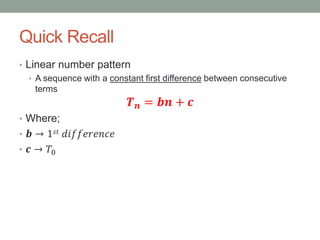
Quick Recall
• Linear number pattern
• A sequence with a constant first difference between consecutive
terms
𝑻 𝒏 = 𝒃𝒏 + 𝒄
• Where;
• 𝒃 → 1 𝑠𝑡 𝑑𝑖𝑓𝑓𝑒𝑟𝑒𝑛𝑐𝑒
• 𝒄 → 𝑇0
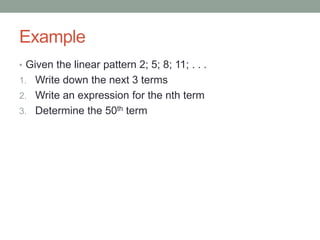
Example
• Given the linear pattern 2; 5; 8; 11; . . .
1. Write down the next 3 terms
2. Write an expression for the nth term
3. Determine the 50th term
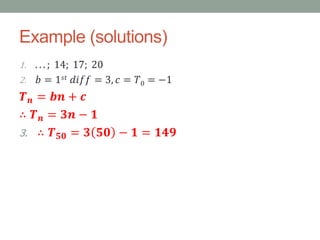
Example (solutions)
1. . . . ; 14; 17; 20
2. 𝑏 = 1 𝑠𝑡 𝑑𝑖𝑓𝑓 = 3, 𝑐 = 𝑇0 = −1
𝑻 𝒏 = 𝒃𝒏 + 𝒄
∴ 𝑻 𝒏 = 𝟑𝒏 − 𝟏
3. ∴ 𝑻 𝟓𝟎 = 𝟑 𝟓𝟎 − 𝟏 = 𝟏𝟒𝟗
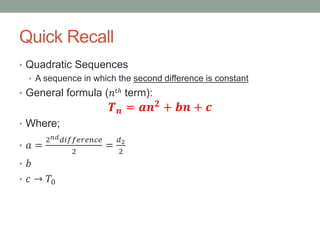
Quick Recall
• Quadratic Sequences
• A sequence in which the second difference is constant
• General formula (𝑛𝑡ℎ term):
𝑻 𝒏 = 𝒂𝒏 𝟐 + 𝒃𝒏 + 𝒄
• Where;
• 𝑎 =
2 𝑛𝑑 𝑑𝑖𝑓𝑓𝑒𝑟𝑒𝑛𝑐𝑒
2
=
𝑑2
2
• 𝑏
• 𝑐 → 𝑇0
Example
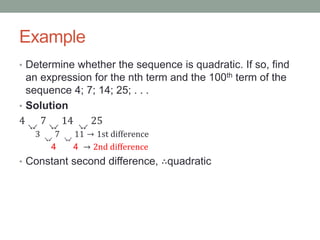
• Determine whether the sequence is quadratic. If so, find
an expression for the nth term and the 100th term of the
sequence 4; 7; 14; 25; . . .
• Solution
4 ↘↙
7 ↘↙
14 ↘↙
25
3 ↘↙
7 ↘↙
11 → 1st difference
4 4 → 2nd difference
• Constant second difference, ∴quadratic
Example
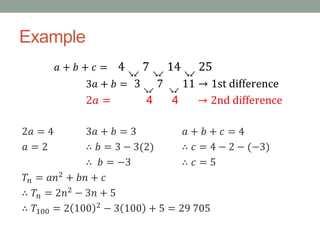
𝑎 + 𝑏 + 𝑐 = 4 ↘↙
7 ↘↙
14 ↘↙
25
3𝑎 + 𝑏 = 3 ↘↙
7 ↘↙
11 → 1st difference
2𝑎 = 4 4 → 2nd difference
2𝑎 = 4 3𝑎 + 𝑏 = 3 𝑎 + 𝑏 + 𝑐 = 4
𝑎 = 2 ∴ 𝑏 = 3 − 3(2) ∴ 𝑐 = 4 − 2 − (−3)
∴ 𝑏 = −3 ∴ 𝑐 = 5
𝑇𝑛 = 𝑎𝑛2 + 𝑏𝑛 + 𝑐
∴ 𝑇𝑛 = 2𝑛2 − 3𝑛 + 5
∴ 𝑇100 = 2 100 2
− 3 100 + 5 = 29 705
1. Arithmetic & Geometric Sequences
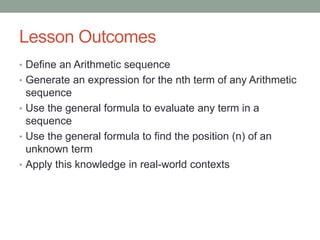
Lesson Outcomes
• Define an Arithmetic sequence
• Generate an expression for the nth term of any Arithmetic
sequence
• Use the general formula to evaluate any term in a
sequence
• Use the general formula to find the position (n) of an
unknown term
• Apply this knowledge in real-world contexts
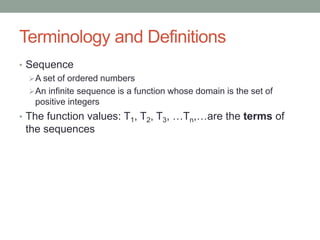
Terminology and Definitions
• Sequence
A set of ordered numbers
An infinite sequence is a function whose domain is the set of
positive integers
• The function values: T1, T2, T3, …Tn,…are the terms of
the sequences
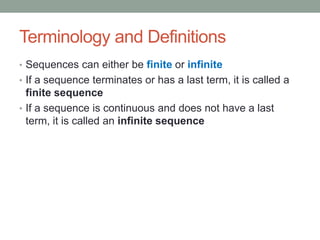
Terminology and Definitions
• Sequences can either be finite or infinite
• If a sequence terminates or has a last term, it is called a
finite sequence
• If a sequence is continuous and does not have a last
term, it is called an infinite sequence
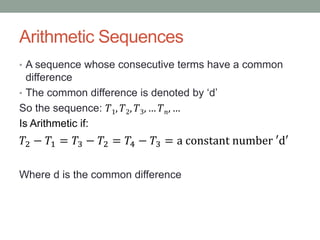
Arithmetic Sequences
• A sequence whose consecutive terms have a common
difference
• The common difference is denoted by ‘d’
So the sequence: 𝑇1, 𝑇2, 𝑇3, … 𝑇 𝑛, …
Is Arithmetic if:
𝑇2 − 𝑇1 = 𝑇3 − 𝑇2 = 𝑇4 − 𝑇3 = a constant number ′d′
Where d is the common difference
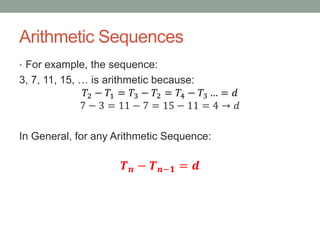
Arithmetic Sequences
• For example, the sequence:
3, 7, 11, 15, … is arithmetic because:
𝑇2 − 𝑇1 = 𝑇3 − 𝑇2 = 𝑇4 − 𝑇3 … = 𝑑
7 − 3 = 11 − 7 = 15 − 11 = 4 → 𝑑
In General, for any Arithmetic Sequence:
𝑻 𝒏 − 𝑻 𝒏−𝟏 = 𝒅
Arithmetic Sequences
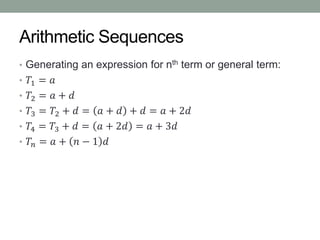
• Generating an expression for nth term or general term:
• 𝑇1 = 𝑎
• 𝑇2 = 𝑎 + 𝑑
• 𝑇3 = 𝑇2 + 𝑑 = 𝑎 + 𝑑 + 𝑑 = 𝑎 + 2𝑑
• 𝑇4 = 𝑇3 + 𝑑 = 𝑎 + 2𝑑 = 𝑎 + 3𝑑
• 𝑇𝑛 = 𝑎 + 𝑛 − 1 𝑑
Arithmetic Sequences
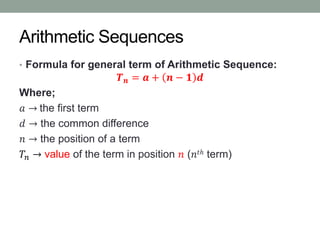
• Formula for general term of Arithmetic Sequence:
𝑻 𝒏 = 𝒂 + 𝒏 − 𝟏 𝒅
Where;
𝑎 → the first term
𝑑 → the common difference
𝑛 → the position of a term
𝑇𝑛 → value of the term in position 𝑛 (𝑛𝑡ℎ term)
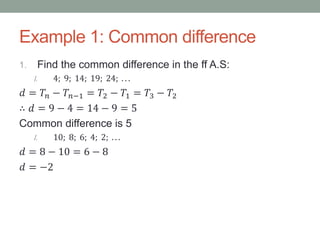
Example 1: Common difference
1. Find the common difference in the ff A.S:
I. 4; 9; 14; 19; 24; . . .
𝑑 = 𝑇𝑛 − 𝑇𝑛−1 = 𝑇2 − 𝑇1 = 𝑇3 − 𝑇2
∴ 𝑑 = 9 − 4 = 14 − 9 = 5
Common difference is 5
I. 10; 8; 6; 4; 2; . . .
𝑑 = 8 − 10 = 6 − 8
𝑑 = −2
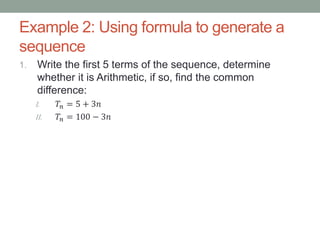
Example 2: Using formula to generate a
sequence
1. Write the first 5 terms of the sequence, determine
whether it is Arithmetic, if so, find the common
difference:
I. 𝑇𝑛 = 5 + 3𝑛
II. 𝑇𝑛 = 100 − 3𝑛
Example 2: Using formula to generate a
sequence
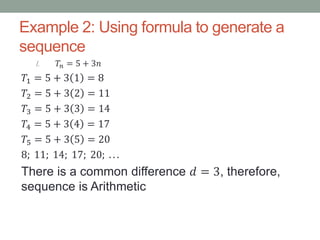
I. 𝑇𝑛 = 5 + 3𝑛
𝑇1 = 5 + 3 1 = 8
𝑇2 = 5 + 3 2 = 11
𝑇3 = 5 + 3 3 = 14
𝑇4 = 5 + 3 4 = 17
𝑇5 = 5 + 3 5 = 20
8; 11; 14; 17; 20; . . .
There is a common difference 𝑑 = 3, therefore,
sequence is Arithmetic
Example 2: Using formula to generate a
sequence
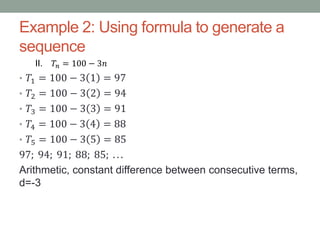
II. 𝑇𝑛 = 100 − 3𝑛
• 𝑇1 = 100 − 3 1 = 97
• 𝑇2 = 100 − 3 2 = 94
• 𝑇3 = 100 − 3 3 = 91
• 𝑇4 = 100 − 3 4 = 88
• 𝑇5 = 100 − 3 5 = 85
97; 94; 91; 88; 85; . . .
Arithmetic, constant difference between consecutive terms,
d=-3
Example: finding formula for 𝑛𝑡ℎ term
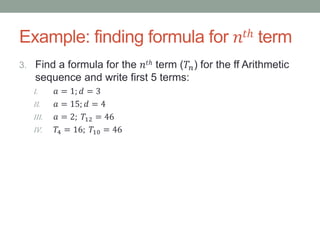
3. Find a formula for the 𝑛𝑡ℎ term (𝑇𝑛) for the ff Arithmetic
sequence and write first 5 terms:
I. 𝑎 = 1; 𝑑 = 3
II. 𝑎 = 15; 𝑑 = 4
III. 𝑎 = 2; 𝑇12 = 46
IV. 𝑇4 = 16; 𝑇10 = 46
Example: finding formula for 𝑛𝑡ℎ term
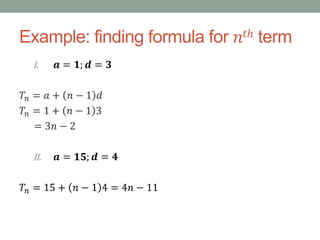
I. 𝒂 = 𝟏; 𝒅 = 𝟑
𝑇𝑛 = 𝑎 + 𝑛 − 1 𝑑
𝑇𝑛 = 1 + 𝑛 − 1 3
= 3𝑛 − 2
II. 𝒂 = 𝟏𝟓; 𝒅 = 𝟒
𝑇𝑛 = 15 + 𝑛 − 1 4 = 4𝑛 − 11
Example: finding formula for 𝑛𝑡ℎ term
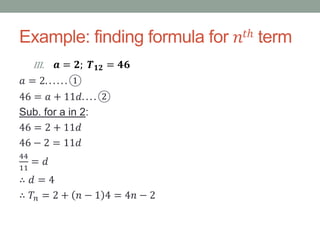
III. 𝒂 = 𝟐; 𝑻 𝟏𝟐 = 𝟒𝟔
𝑎 = 2. . . . . . ①
46 = 𝑎 + 11𝑑. . . . ②
Sub. for a in 2:
46 = 2 + 11𝑑
46 − 2 = 11𝑑
44
11
= 𝑑
∴ 𝑑 = 4
∴ 𝑇𝑛 = 2 + 𝑛 − 1 4 = 4𝑛 − 2
Example: finding formula for 𝑛𝑡ℎ term
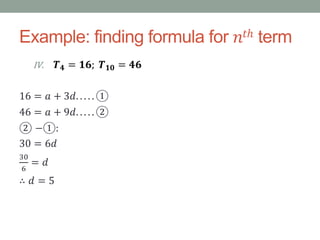
IV. 𝑻 𝟒 = 𝟏𝟔; 𝑻 𝟏𝟎 = 𝟒𝟔
16 = 𝑎 + 3𝑑. . . . . ①
46 = 𝑎 + 9𝑑. . . . . ②
② −①:
30 = 6𝑑
30
6
= 𝑑
∴ 𝑑 = 5
Example: finding formula for 𝑛𝑡ℎ term
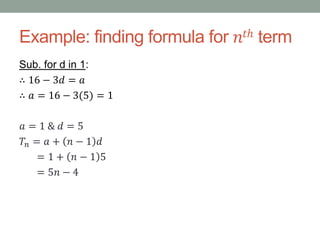
Sub. for d in 1:
∴ 16 − 3𝑑 = 𝑎
∴ 𝑎 = 16 − 3(5) = 1
𝑎 = 1 & 𝑑 = 5
𝑇𝑛 = 𝑎 + 𝑛 − 1 𝑑
= 1 + 𝑛 − 1 5
= 5𝑛 − 4
Arithmetic Sequences (summary)
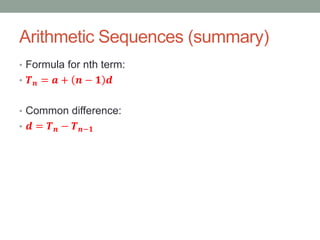
• Formula for nth term:
• 𝑻 𝒏 = 𝒂 + 𝒏 − 𝟏 𝒅
• Common difference:
• 𝒅 = 𝑻 𝒏 − 𝑻 𝒏−𝟏
Activity 1
• Classwork: Exercise 1: Platinum Mathematics (p.5)
• Homework: Exercise 2: Platinum Mathematics (p.6)
• 1, 2, 7
Geometric Sequences
Lesson Outcomes
• Define a Geometric sequence
• Generate an expression for the nth of any Geometric
sequence
• Use the general formula to evaluate any term in a
sequence
• Use the general formula to find the position (n) of an
unknown term
• Apply this knowledge in real-world contexts
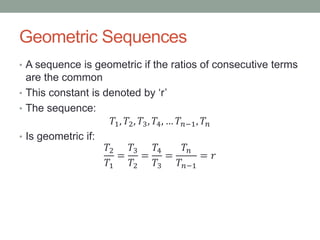
Geometric Sequences
• A sequence is geometric if the ratios of consecutive terms
are the common
• This constant is denoted by ‘r’
• The sequence:
𝑇1, 𝑇2, 𝑇3, 𝑇4, … 𝑇𝑛−1, 𝑇𝑛
• Is geometric if:
𝑇2
𝑇1
=
𝑇3
𝑇2
=
𝑇4
𝑇3
=
𝑇𝑛
𝑇𝑛−1
= 𝑟
Geometric Sequences
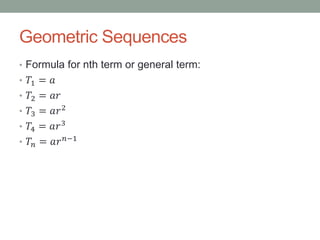
• Formula for nth term or general term:
• 𝑇1 = 𝑎
• 𝑇2 = 𝑎𝑟
• 𝑇3 = 𝑎𝑟2
• 𝑇4 = 𝑎𝑟3
• 𝑇𝑛 = 𝑎𝑟 𝑛−1
Geometric Sequences
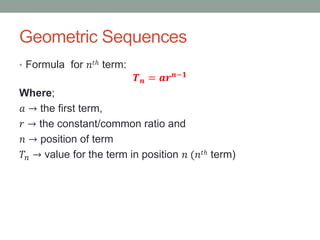
• Formula for 𝑛𝑡ℎ term:
𝑻 𝒏 = 𝒂𝒓 𝒏−𝟏
Where;
𝑎 → the first term,
𝑟 → the constant/common ratio and
𝑛 → position of term
𝑇𝑛 → value for the term in position 𝑛 (𝑛𝑡ℎ term)
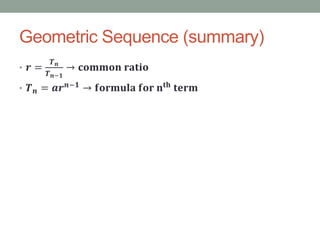
Geometric Sequence (summary)
• 𝒓 =
𝑻 𝒏
𝑻 𝒏−𝟏
→ 𝐜𝐨𝐦𝐦𝐨𝐧 𝐫𝐚𝐭𝐢𝐨
• 𝑻 𝒏 = 𝒂𝒓 𝒏−𝟏 → 𝐟𝐨𝐫𝐦𝐮𝐥𝐚 𝐟𝐨𝐫 𝐧𝐭𝐡 𝐭𝐞𝐫𝐦
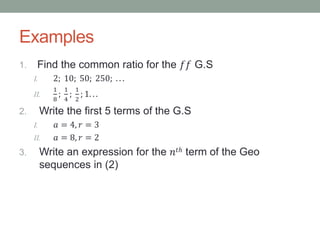
Examples
1. Find the common ratio for the 𝑓𝑓 G.S
I. 2; 10; 50; 250; . . .
II.
1
8
;
1
4
;
1
2
; 1. . .
2. Write the first 5 terms of the G.S
I. 𝑎 = 4, 𝑟 = 3
II. 𝑎 = 8, 𝑟 = 2
3. Write an expression for the 𝑛𝑡ℎ term of the Geo
sequences in (2)
Examples
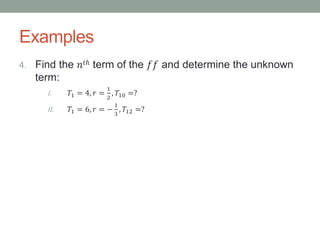
4. Find the 𝑛𝑡ℎ term of the 𝑓𝑓 and determine the unknown
term:
I. 𝑇1 = 4, 𝑟 =
1
2
, 𝑇10 =?
II. 𝑇1 = 6, 𝑟 = −
1
3
, 𝑇12 =?
Example: finding common ratio
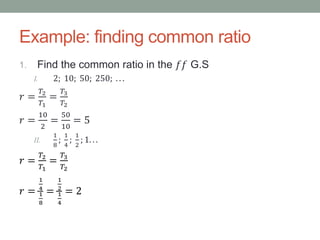
1. Find the common ratio in the 𝑓𝑓 G.S
I. 2; 10; 50; 250; . . .
𝑟 =
𝑇2
𝑇1
=
𝑇3
𝑇2
𝑟 =
10
2
=
50
10
= 5
II.
1
8
;
1
4
;
1
2
; 1. . .
𝑟 =
𝑇2
𝑇1
=
𝑇3
𝑇2
𝑟 =
1
4
1
8
=
1
2
1
4
= 2
Example 2: generating a Geo sequence
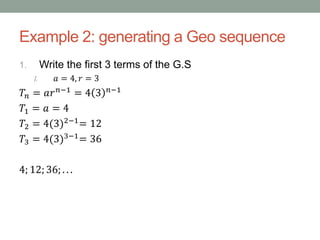
1. Write the first 3 terms of the G.S
I. 𝑎 = 4, 𝑟 = 3
𝑇𝑛 = 𝑎𝑟 𝑛−1
= 4 3 𝑛−1
𝑇1 = 𝑎 = 4
𝑇2 = 4(3)2−1= 12
𝑇3 = 4(3)3−1= 36
4; 12; 36; . . .
Example 2: generating a Geo sequence
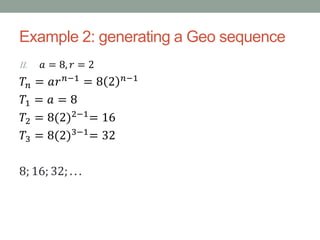
II. 𝑎 = 8, 𝑟 = 2
𝑇𝑛 = 𝑎𝑟 𝑛−1 = 8 2 𝑛−1
𝑇1 = 𝑎 = 8
𝑇2 = 8(2)2−1
= 16
𝑇3 = 8(2)3−1= 32
8; 16; 32; . . .
Example 3: finding the value a term
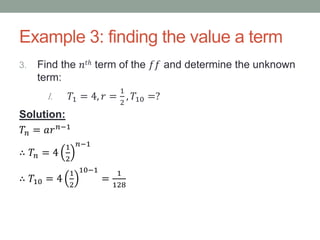
3. Find the 𝑛𝑡ℎ term of the 𝑓𝑓 and determine the unknown
term:
I. 𝑇1 = 4, 𝑟 =
1
2
, 𝑇10 =?
Solution:
𝑇𝑛 = 𝑎𝑟 𝑛−1
∴ 𝑇𝑛 = 4
1
2
𝑛−1
∴ 𝑇10 = 4
1
2
10−1
=
1
128
Example 4: generating a formula for nth
term of a geo sequence
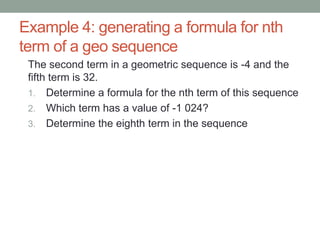
The second term in a geometric sequence is -4 and the
fifth term is 32.
1. Determine a formula for the nth term of this sequence
2. Which term has a value of -1 024?
3. Determine the eighth term in the sequence
Example 4: generating a formula for nth
term of a geo sequence (solutions)
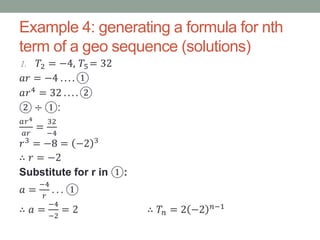
1. 𝑇2 = −4, 𝑇5 = 32
𝑎𝑟 = −4 . . . . ①
𝑎𝑟4 = 32 . . . . ②
② ÷ ①:
𝑎𝑟4
𝑎𝑟
=
32
−4
𝑟3
= −8 = −2 3
∴ 𝑟 = −2
Substitute for r in ①:
𝑎 =
−4
𝑟
. . . ①
∴ 𝑎 =
−4
−2
= 2 ∴ 𝑇𝑛 = 2 −2 𝑛−1
Example 4: generating a formula for nth
term of a geo sequence (solutions)
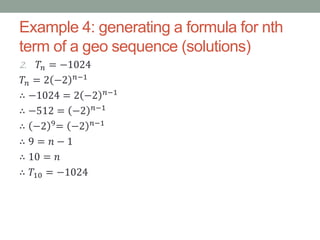
2. 𝑇𝑛 = −1024
𝑇𝑛 = 2 −2 𝑛−1
∴ −1024 = 2 −2 𝑛−1
∴ −512 = −2 𝑛−1
∴ −2 9= −2 𝑛−1
∴ 9 = 𝑛 − 1
∴ 10 = 𝑛
∴ 𝑇10 = −1024
Example 4: generating a formula for nth
term of a geo sequence (solutions)
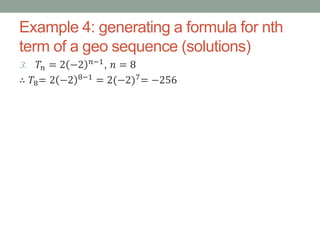
3. 𝑇𝑛 = 2 −2 𝑛−1
, 𝑛 = 8
∴ 𝑇8= 2 −2 8−1
= 2(−2)7
= −256
Exercise
Arithmetic and Geometric Series
Series
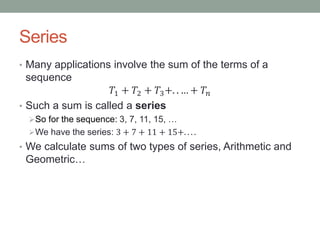
• Many applications involve the sum of the terms of a
sequence
𝑇1 + 𝑇2 + 𝑇3+. . … + 𝑇𝑛
• Such a sum is called a series
So for the sequence: 3, 7, 11, 15, …
We have the series: 3 + 7 + 11 + 15+. . . .
• We calculate sums of two types of series, Arithmetic and
Geometric…
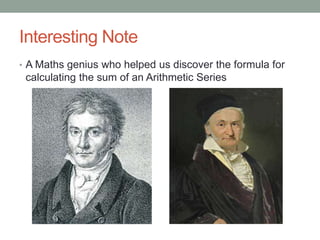
Interesting Note
• A Maths genius who helped us discover the formula for
calculating the sum of an Arithmetic Series
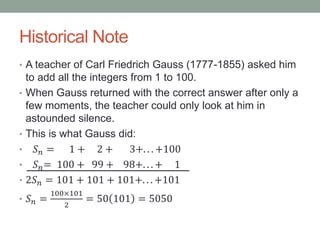
Historical Note
• A teacher of Carl Friedrich Gauss (1777-1855) asked him
to add all the integers from 1 to 100.
• When Gauss returned with the correct answer after only a
few moments, the teacher could only look at him in
astounded silence.
• This is what Gauss did:
• 𝑆 𝑛 = 1 + 2 + 3+. . . +100
• 𝑆 𝑛= 100 + 99 + 98+. . . + 1
• 2𝑆 𝑛 = 101 + 101 + 101+. . . +101
• 𝑆 𝑛 =
100×101
2
= 50 101 = 5050
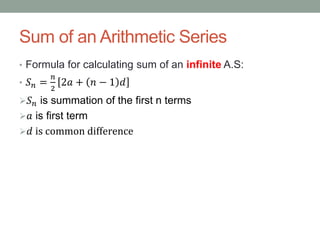
Sum of an Arithmetic Series
• Formula for calculating sum of an infinite A.S:
• 𝑆 𝑛 =
𝑛
2
2𝑎 + 𝑛 − 1 𝑑
 𝑆 𝑛 is summation of the first n terms
 𝑎 is first term
 𝑑 is common difference
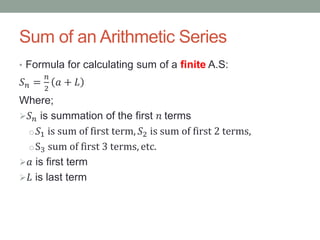
Sum of an Arithmetic Series
• Formula for calculating sum of a finite A.S:
𝑆 𝑛 =
𝑛
2
𝑎 + 𝐿
Where;
 𝑆 𝑛 is summation of the first 𝑛 terms
o 𝑆1 is sum of first term, 𝑆2 is sum of first 2 terms,
oS3 sum of first 3 terms, etc.
 𝑎 is first term
 𝐿 is last term
Proof 1
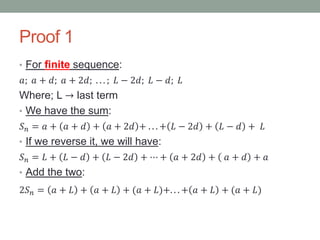
• For finite sequence:
𝑎; 𝑎 + 𝑑; 𝑎 + 2𝑑; . . . ; 𝐿 − 2𝑑; 𝐿 − 𝑑; 𝐿
Where; L → last term
• We have the sum:
𝑆 𝑛 = 𝑎 + 𝑎 + 𝑑 + 𝑎 + 2𝑑 + . . . + 𝐿 − 2𝑑 + 𝐿 − 𝑑 + 𝐿
• If we reverse it, we will have:
𝑆 𝑛 = 𝐿 + 𝐿 − 𝑑 + 𝐿 − 2𝑑 + ⋯ + 𝑎 + 2𝑑 + 𝑎 + 𝑑 + 𝑎
• Add the two:
2𝑆 𝑛 = 𝑎 + 𝐿 + 𝑎 + 𝐿 + (𝑎 + 𝐿)+. . . + 𝑎 + 𝐿 + (𝑎 + 𝐿)
Proof 1
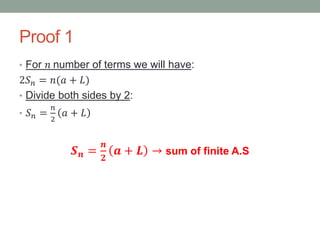
• For 𝑛 number of terms we will have:
2𝑆 𝑛 = 𝑛(𝑎 + 𝐿)
• Divide both sides by 2:
• 𝑆 𝑛 =
𝑛
2
𝑎 + 𝐿
𝑺 𝒏 =
𝒏
𝟐
𝒂 + 𝑳 → sum of finite A.S
Proof 2
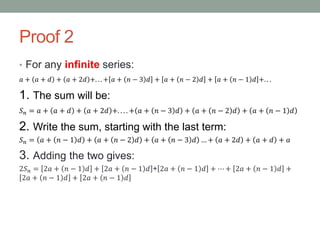
• For any infinite series:
𝑎 + 𝑎 + 𝑑 + 𝑎 + 2𝑑 +. . . + 𝑎 + 𝑛 − 3 𝑑 + 𝑎 + 𝑛 − 2 𝑑 + 𝑎 + 𝑛 − 1 𝑑 +. . .
1. The sum will be:
𝑆 𝑛 = 𝑎 + 𝑎 + 𝑑 + 𝑎 + 2𝑑 +. . . . + 𝑎 + 𝑛 − 3 𝑑 + 𝑎 + 𝑛 − 2 𝑑 + 𝑎 + 𝑛 − 1 𝑑
2. Write the sum, starting with the last term:
𝑆 𝑛 = 𝑎 + 𝑛 − 1 𝑑 + 𝑎 + 𝑛 − 2 𝑑 + 𝑎 + 𝑛 − 3 𝑑 … + 𝑎 + 2𝑑 + 𝑎 + 𝑑 + 𝑎
3. Adding the two gives:
2𝑆 𝑛 = 2𝑎 + 𝑛 − 1 𝑑 + 2𝑎 + 𝑛 − 1 𝑑 + 2𝑎 + 𝑛 − 1 𝑑 + ⋯ + 2𝑎 + 𝑛 − 1 𝑑 +
2𝑎 + 𝑛 − 1 𝑑 + 2𝑎 + 𝑛 − 1 𝑑
Proof 2
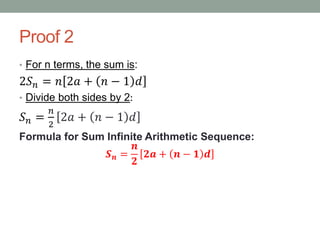
• For n terms, the sum is:
2𝑆 𝑛 = 𝑛 2𝑎 + 𝑛 − 1 𝑑
• Divide both sides by 2:
𝑆 𝑛 =
𝑛
2
2𝑎 + 𝑛 − 1 𝑑
Formula for Sum Infinite Arithmetic Sequence:
𝑺 𝒏 =
𝒏
𝟐
𝟐𝒂 + 𝒏 − 𝟏 𝒅
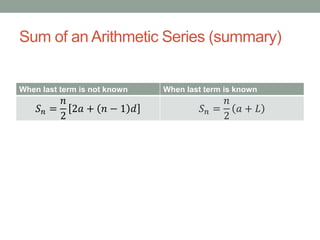
Sum of an Arithmetic Series (summary)
When last term is not known When last term is known
𝑆 𝑛 =
𝑛
2
2𝑎 + 𝑛 − 1 𝑑 𝑆 𝑛 =
𝑛
2
𝑎 + 𝐿
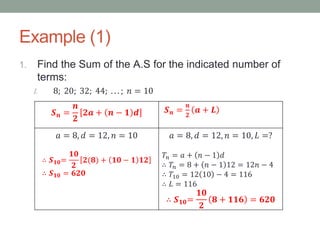
Example (1)
1. Find the Sum of the A.S for the indicated number of
terms:
I. 8; 20; 32; 44; . . . ; 𝑛 = 10
𝑺 𝒏 =
𝒏
𝟐
𝟐𝒂 + 𝒏 − 𝟏 𝒅 𝑺 𝒏 =
𝒏
𝟐
𝒂 + 𝑳
𝑎 = 8, 𝑑 = 12, 𝑛 = 10
∴ 𝑺 𝟏𝟎=
𝟏𝟎
𝟐
𝟐(𝟖) + 𝟏𝟎 − 𝟏 𝟏𝟐
∴ 𝑺 𝟏𝟎 = 𝟔𝟐𝟎
𝑎 = 8, 𝑑 = 12, 𝑛 = 10, 𝐿 =?
𝑇𝑛 = 𝑎 + 𝑛 − 1 𝑑
∴ 𝑇𝑛 = 8 + 𝑛 − 1 12 = 12𝑛 − 4
∴ 𝑇10 = 12 10 − 4 = 116
∴ 𝐿 = 116
∴ 𝑺 𝟏𝟎=
𝟏𝟎
𝟐
𝟖 + 𝟏𝟏𝟔 = 𝟔𝟐𝟎
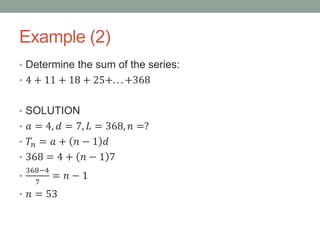
Example (2)
• Determine the sum of the series:
• 4 + 11 + 18 + 25+. . . +368
• SOLUTION
• 𝑎 = 4, 𝑑 = 7, 𝐿 = 368, 𝑛 =?
• 𝑇𝑛 = 𝑎 + 𝑛 − 1 𝑑
• 368 = 4 + 𝑛 − 1 7
•
368−4
7
= 𝑛 − 1
• 𝑛 = 53
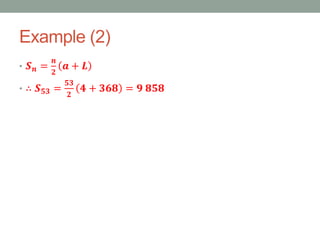
Example (2)
• 𝑺 𝒏 =
𝒏
𝟐
𝒂 + 𝑳
• ∴ 𝑺 𝟓𝟑 =
𝟓𝟑
𝟐
𝟒 + 𝟑𝟔𝟖 = 𝟗 𝟖𝟓𝟖
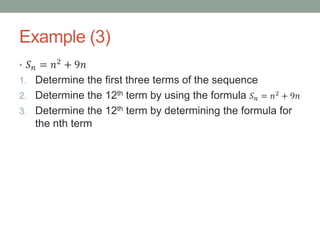
Example (3)
• 𝑆 𝑛 = 𝑛2
+ 9𝑛
1. Determine the first three terms of the sequence
2. Determine the 12th term by using the formula 𝑆 𝑛 = 𝑛2
+ 9𝑛
3. Determine the 12th term by determining the formula for
the nth term
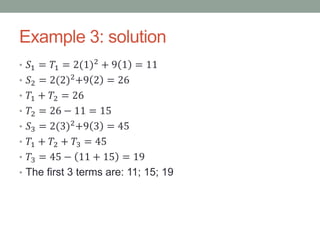
Example 3: solution
• 𝑆1 = 𝑇1 = 2(1)2
+ 9 1 = 11
• 𝑆2 = 2(2)2
+9 2 = 26
• 𝑇1 + 𝑇2 = 26
• 𝑇2 = 26 − 11 = 15
• 𝑆3 = 2(3)2+9 3 = 45
• 𝑇1 + 𝑇2 + 𝑇3 = 45
• 𝑇3 = 45 − 11 + 15 = 19
• The first 3 terms are: 11; 15; 19
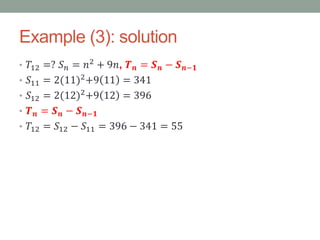
Example (3): solution
• 𝑇12 =? 𝑆 𝑛 = 𝑛2
+ 9𝑛, 𝑻 𝒏 = 𝑺 𝒏 − 𝑺 𝒏−𝟏
• 𝑆11 = 2(11)2
+9 11 = 341
• 𝑆12 = 2(12)2+9 12 = 396
• 𝑻 𝒏 = 𝑺 𝒏 − 𝑺 𝒏−𝟏
• 𝑇12 = 𝑆12 − 𝑆11 = 396 − 341 = 55
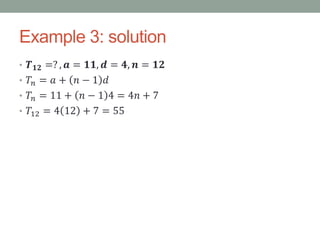
Example 3: solution
• 𝑻 𝟏𝟐 =? , 𝒂 = 𝟏𝟏, 𝒅 = 𝟒, 𝒏 = 𝟏𝟐
• 𝑇𝑛 = 𝑎 + 𝑛 − 1 𝑑
• 𝑇𝑛 = 11 + 𝑛 − 1 4 = 4𝑛 + 7
• 𝑇12 = 4 12 + 7 = 55
Example (4)
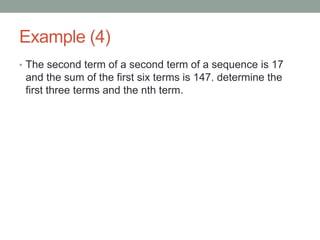
• The second term of a second term of a sequence is 17
and the sum of the first six terms is 147. determine the
first three terms and the nth term.
Example 3: Solution
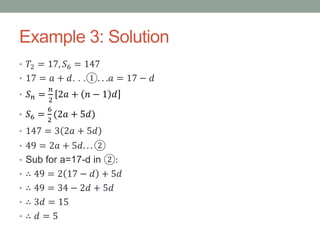
• 𝑇2 = 17, 𝑆6 = 147
• 17 = 𝑎 + 𝑑. . .①. . .𝑎 = 17 − 𝑑
• 𝑆 𝑛 =
𝑛
2
2𝑎 + 𝑛 − 1 𝑑
• 𝑆6 =
6
2
(2𝑎 + 5𝑑)
• 147 = 3 2𝑎 + 5𝑑
• 49 = 2𝑎 + 5𝑑. . . ②
• Sub for a=17-d in ②:
• ∴ 49 = 2 17 − 𝑑 + 5𝑑
• ∴ 49 = 34 − 2𝑑 + 5𝑑
• ∴ 3𝑑 = 15
• ∴ 𝑑 = 5
Example 3: Solution
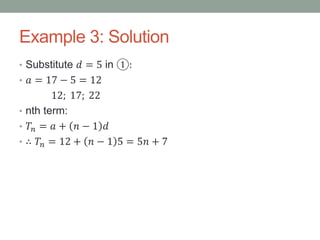
• Substitute 𝑑 = 5 in ①:
• 𝑎 = 17 − 5 = 12
12; 17; 22
• nth term:
• 𝑇𝑛 = 𝑎 + 𝑛 − 1 𝑑
• ∴ 𝑇𝑛 = 12 + 𝑛 − 1 5 = 5𝑛 + 7
Classwork
• Exercise 5
Sum of Geometric Sequence
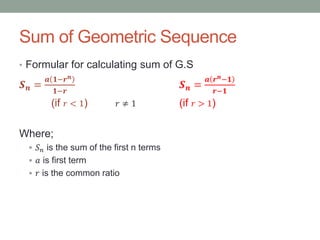
• Formular for calculating sum of G.S
𝑺 𝒏 =
𝒂 𝟏−𝒓 𝒏
𝟏−𝒓
𝑺 𝒏 =
𝒂 𝒓 𝒏−𝟏
𝒓−𝟏
(if 𝑟 < 1) 𝑟 ≠ 1 (if 𝑟 > 1)
Where;
 𝑆 𝑛 is the sum of the first n terms
 𝑎 is first term
 𝑟 is the common ratio
Proof
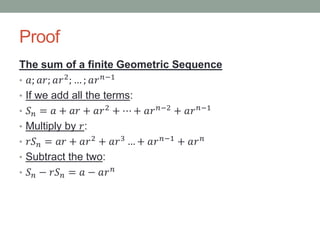
The sum of a finite Geometric Sequence
• 𝑎; 𝑎𝑟; 𝑎𝑟2
; … ; 𝑎𝑟 𝑛−1
• If we add all the terms:
• 𝑆 𝑛 = 𝑎 + 𝑎𝑟 + 𝑎𝑟2 + ⋯ + 𝑎𝑟 𝑛−2 + 𝑎𝑟 𝑛−1
• Multiply by 𝑟:
• 𝑟𝑆 𝑛 = 𝑎𝑟 + 𝑎𝑟2 + 𝑎𝑟3 … + 𝑎𝑟 𝑛−1 + 𝑎𝑟 𝑛
• Subtract the two:
• 𝑆 𝑛 − 𝑟𝑆 𝑛 = 𝑎 − 𝑎𝑟 𝑛
Proof
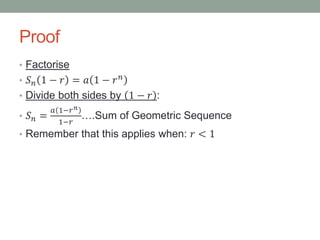
• Factorise
• 𝑆 𝑛 1 − 𝑟 = 𝑎 1 − 𝑟 𝑛
• Divide both sides by 1 − 𝑟 :
• 𝑆 𝑛 =
𝑎 1−𝑟 𝑛
1−𝑟
….Sum of Geometric Sequence
• Remember that this applies when: 𝑟 < 1
Proof
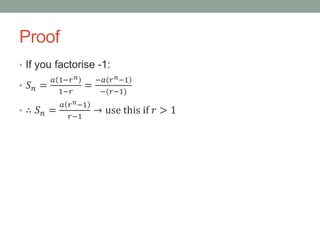
• If you factorise -1:
• 𝑆 𝑛 =
𝑎 1−𝑟 𝑛
1−𝑟
=
−𝑎 𝑟 𝑛−1
−(𝑟−1)
• ∴ 𝑆 𝑛 =
𝑎 𝑟 𝑛−1
𝑟−1
→ use this if 𝑟 > 1
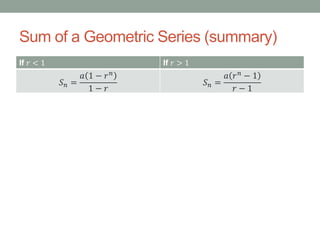
Sum of a Geometric Series (summary)
If 𝑟 < 1 If 𝑟 > 1
𝑆 𝑛 =
𝑎 1 − 𝑟 𝑛
1 − 𝑟
𝑆 𝑛 =
𝑎 𝑟 𝑛
− 1
𝑟 − 1
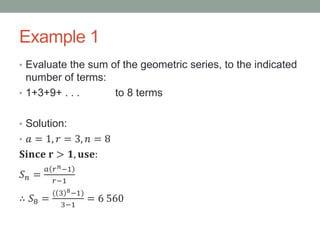
Example 1
• Evaluate the sum of the geometric series, to the indicated
number of terms:
• 1+3+9+ . . . to 8 terms
• Solution:
• 𝑎 = 1, 𝑟 = 3, 𝑛 = 8
𝐒𝐢𝐧𝐜𝐞 𝐫 > 𝟏, 𝐮𝐬𝐞:
𝑆 𝑛 =
𝑎 𝑟 𝑛−1
𝑟−1
∴ 𝑆8 =
( 3 8−1)
3−1
= 6 560
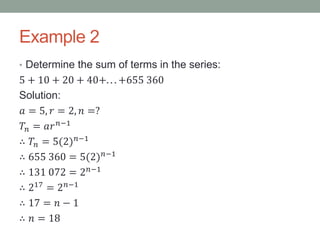
Example 2
• Determine the sum of terms in the series:
5 + 10 + 20 + 40+. . . +655 360
Solution:
𝑎 = 5, 𝑟 = 2, 𝑛 =?
𝑇𝑛 = 𝑎𝑟 𝑛−1
∴ 𝑇𝑛 = 5(2) 𝑛−1
∴ 655 360 = 5(2) 𝑛−1
∴ 131 072 = 2 𝑛−1
∴ 217
= 2 𝑛−1
∴ 17 = 𝑛 − 1
∴ 𝑛 = 18
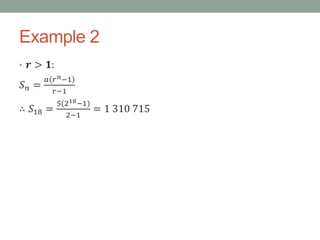
Example 2
• 𝒓 > 𝟏:
𝑆 𝑛 =
𝑎 𝑟 𝑛−1
𝑟−1
∴ 𝑆18 =
5(218−1)
2−1
= 1 310 715
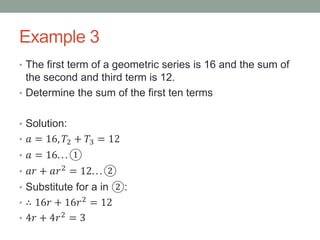
Example 3
• The first term of a geometric series is 16 and the sum of
the second and third term is 12.
• Determine the sum of the first ten terms
• Solution:
• 𝑎 = 16, 𝑇2 + 𝑇3 = 12
• 𝑎 = 16. . . ①
• 𝑎𝑟 + 𝑎𝑟2 = 12. . . ②
• Substitute for a in ②:
• ∴ 16𝑟 + 16𝑟2 = 12
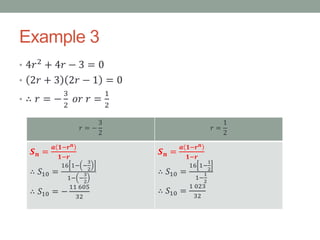
• 4𝑟 + 4𝑟2 = 3
Example 3
• 4𝑟2
+ 4𝑟 − 3 = 0
• 2𝑟 + 3 2𝑟 − 1 = 0
• ∴ 𝑟 = −
3
2
𝑜𝑟 𝑟 =
1
2
𝑟 = −
3
2
𝑟 =
1
2
𝑺 𝒏 =
𝒂 𝟏−𝒓 𝒏
𝟏−𝒓
∴ 𝑆10 =
16 1− −
3
2
1− −
3
2
∴ 𝑆10 = −
11 605
32
𝑺 𝒏 =
𝒂 𝟏−𝒓 𝒏
𝟏−𝒓
∴ 𝑆10 =
16 1−
1
2
1−
1
2
∴ 𝑆10 =
1 023
32
Activity
• Exercise 6
Sigma Notation
&
Infinite Geometric Series
Sum to infinity of Geometric Series
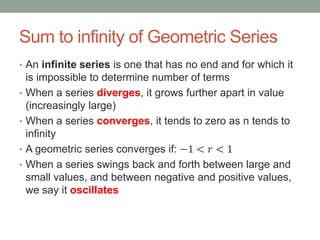
• An infinite series is one that has no end and for which it
is impossible to determine number of terms
• When a series diverges, it grows further apart in value
(increasingly large)
• When a series converges, it tends to zero as n tends to
infinity
• A geometric series converges if: −1 < 𝑟 < 1
• When a series swings back and forth between large and
small values, and between negative and positive values,
we say it oscillates
Formula for calculating Sum to infinity of a
Geometric Series
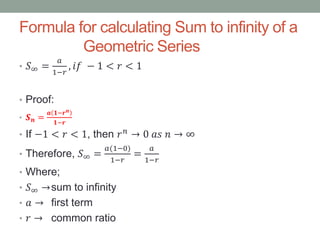
• 𝑆∞ =
𝑎
1−𝑟
, 𝑖𝑓 − 1 < 𝑟 < 1
• Proof:
• 𝑺 𝒏 =
𝒂 𝟏−𝒓 𝒏
𝟏−𝒓
• If −1 < 𝑟 < 1, then 𝑟 𝑛
→ 0 𝑎𝑠 𝑛 → ∞
• Therefore, 𝑆∞ =
𝑎(1−0)
1−𝑟
=
𝑎
1−𝑟
• Where;
• 𝑆∞ →sum to infinity
• 𝑎 → first term
• 𝑟 → common ratio
Example 1
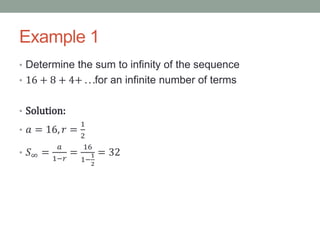
• Determine the sum to infinity of the sequence
• 16 + 8 + 4+ . . .for an infinite number of terms
• Solution:
• 𝑎 = 16, 𝑟 =
1
2
• 𝑆∞ =
𝑎
1−𝑟
=
16
1−
1
2
= 32
Example 2
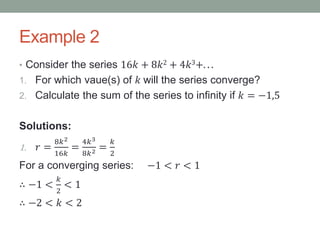
• Consider the series 16𝑘 + 8𝑘2 + 4𝑘3+. . .
1. For which vaue(s) of 𝑘 will the series converge?
2. Calculate the sum of the series to infinity if 𝑘 = −1,5
Solutions:
1. 𝑟 =
8𝑘2
16𝑘
=
4𝑘3
8𝑘2 =
𝑘
2
For a converging series: −1 < 𝑟 < 1
∴ −1 <
𝑘
2
< 1
∴ −2 < 𝑘 < 2
Example 2
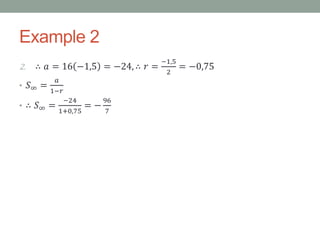
2. ∴ 𝑎 = 16 −1,5 = −24, ∴ 𝑟 =
−1,5
2
= −0,75
• 𝑆∞ =
𝑎
1−𝑟
• ∴ 𝑆∞ =
−24
1+0,75
= −
96
7
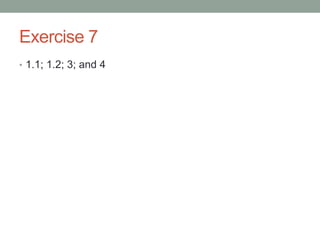
Exercise 7
• 1.1; 1.2; 3; and 4
Sigma Notation
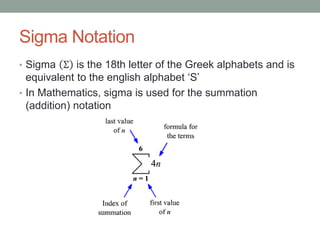
• Sigma Σ is the 18th letter of the Greek alphabets and is
equivalent to the english alphabet ‘S’
• In Mathematics, sigma is used for the summation
(addition) notation
Sigma Notation
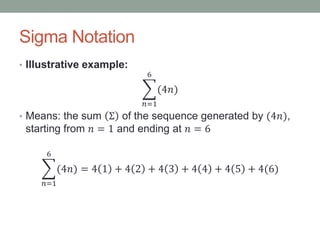
• Illustrative example:
𝑛=1
6
(4𝑛)
• Means: the sum Σ of the sequence generated by (4𝑛),
starting from 𝑛 = 1 and ending at 𝑛 = 6
𝑛=1
6
(4𝑛) = 4 1 + 4 2 + 4 3 + 4 4 + 4 5 + 4(6)
Sigma Notation
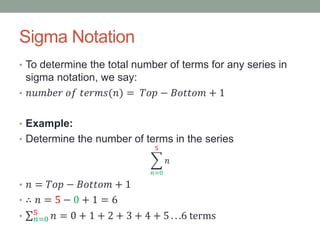
• To determine the total number of terms for any series in
sigma notation, we say:
• 𝑛𝑢𝑚𝑏𝑒𝑟 𝑜𝑓 𝑡𝑒𝑟𝑚𝑠(𝑛) = 𝑇𝑜𝑝 − 𝐵𝑜𝑡𝑡𝑜𝑚 + 1
• Example:
• Determine the number of terms in the series
𝑛=0
5
𝑛
• 𝑛 = 𝑇𝑜𝑝 − 𝐵𝑜𝑡𝑡𝑜𝑚 + 1
• ∴ 𝑛 = 5 − 0 + 1 = 6
• 𝑛=0
5
𝑛 = 0 + 1 + 2 + 3 + 4 + 5 . . .6 terms
Example 1
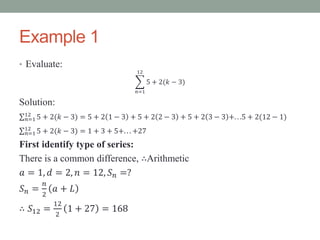
• Evaluate:
𝑛=1
12
5 + 2(𝑘 − 3)
Solution:
𝑛=1
12
5 + 2(𝑘 − 3) = 5 + 2 1 − 3 + 5 + 2 2 − 3 + 5 + 2 3 − 3 +. . .5 + 2(12 − 1)
𝑛=1
12
5 + 2(𝑘 − 3) = 1 + 3 + 5+. . . +27
First identify type of series:
There is a common difference, ∴Arithmetic
𝑎 = 1, 𝑑 = 2, 𝑛 = 12, 𝑆 𝑛 =?
𝑆 𝑛 =
𝑛
2
𝑎 + 𝐿
∴ 𝑆12 =
12
2
1 + 27 = 168
Example 2
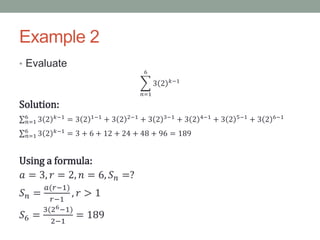
• Evaluate
𝑛=1
6
3 2 𝑘−1
Solution:
𝑛=1
6
3 2 𝑘−1
= 3 2 1−1
+ 3 2 2−1
+ 3 2 3−1
+ 3 2 4−1
+ 3 2 5−1
+ 3 2 6−1
𝑛=1
6
3 2 𝑘−1
= 3 + 6 + 12 + 24 + 48 + 96 = 189
Using a formula:
𝑎 = 3, 𝑟 = 2, 𝑛 = 6, 𝑆 𝑛 =?
𝑆 𝑛 =
𝑎(𝑟−1)
𝑟−1
, 𝑟 > 1
𝑆6 =
3(26−1)
2−1
= 189
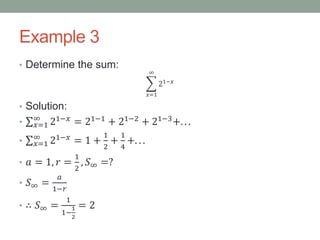
Example 3
• Determine the sum:
𝑥=1
∞
21−𝑥
• Solution:
• 𝑥=1
∞
21−𝑥
= 21−1
+ 21−2
+ 21−3
+. . .
• 𝑥=1
∞
21−𝑥 = 1 +
1
2
+
1
4
+. . .
• 𝑎 = 1, 𝑟 =
1
2
, 𝑆∞ =?
• 𝑆∞ =
𝑎
1−𝑟
• ∴ 𝑆∞ =
1
1−
1
2
= 2
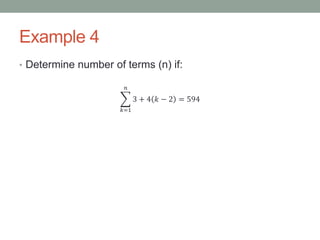
Example 4
• Determine number of terms (n) if:
𝑘=1
𝑛
3 + 4 𝑘 − 2 = 594
Example 4: solution
𝑘=1
𝑛
3 + 4 𝑘 − 2 = 3 + 4 1 − 2 + 3 + 4 2 − 2 + 3 + 4 3 − 2 +. . . [3 +
4 𝑛 − 3 ]
𝑘=1
𝑛
3 + 4(𝑘 − 2) = −1 + 3 + 7+. . . +3 + 4 n − 2 = 594
𝑎 = −1, 𝑑 = 4, 𝑆 𝑛 = 594, 𝑛 =?
𝑆 𝑛 =
𝑛
2
2𝑎 + 𝑛 − 1 𝑑
∴ 594 =
𝑛
2
2 −1 + 𝑛 − 1 4
∴ 594 = 𝑛 −1 + 𝑛 − 1 2
∴ 594 = 𝑛 2𝑛 − 3
∴ 0 = 2𝑛2
− 3𝑛 − 594
∴ 0 = 2𝑛 + 33 𝑛 − 18
∴ 𝑛 = −
33
2
𝑜𝑟 𝑛 = 18
𝐵𝑢𝑡 𝑛 𝑖𝑠 𝑎 𝑛𝑎𝑡𝑢𝑟𝑎𝑙 𝑛𝑢𝑚𝑏𝑒𝑟 ∴ 𝑛 = 18
Exercise 8
Applications of Sequences & Series
Example 1
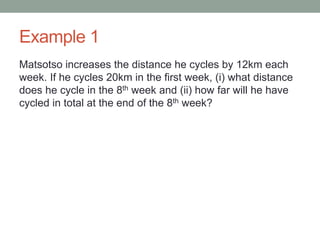
Matsotso increases the distance he cycles by 12km each
week. If he cycles 20km in the first week, (i) what distance
does he cycle in the 8th week and (ii) how far will he have
cycled in total at the end of the 8th week?
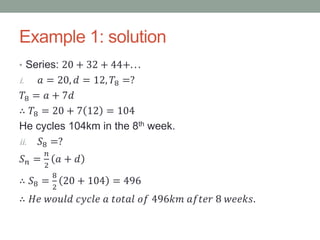
Example 1: solution
• Series: 20 + 32 + 44+. . .
i. 𝑎 = 20, 𝑑 = 12, 𝑇8 =?
𝑇8 = 𝑎 + 7𝑑
∴ 𝑇8 = 20 + 7 12 = 104
He cycles 104km in the 8th week.
ii. 𝑆8 =?
𝑆 𝑛 =
𝑛
2
𝑎 + 𝑑
∴ 𝑆8 =
8
2
20 + 104 = 496
∴ 𝐻𝑒 𝑤𝑜𝑢𝑙𝑑 𝑐𝑦𝑐𝑙𝑒 𝑎 𝑡𝑜𝑡𝑎𝑙 𝑜𝑓 496𝑘𝑚 𝑎𝑓𝑡𝑒𝑟 8 𝑤𝑒𝑒𝑘𝑠.
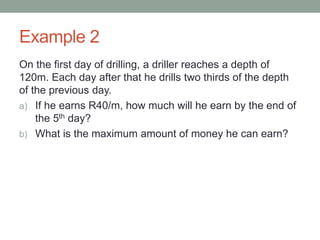
Example 2
On the first day of drilling, a driller reaches a depth of
120m. Each day after that he drills two thirds of the depth
of the previous day.
a) If he earns R40/m, how much will he earn by the end of
the 5th day?
b) What is the maximum amount of money he can earn?
Example 2: solutions
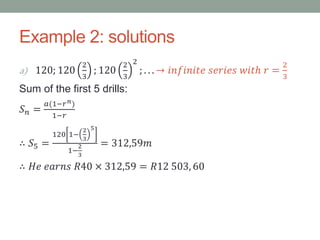
a) 120; 120
2
3
; 120
2
3
2
; . . . → 𝑖𝑛𝑓𝑖𝑛𝑖𝑡𝑒 𝑠𝑒𝑟𝑖𝑒𝑠 𝑤𝑖𝑡ℎ 𝑟 =
2
3
Sum of the first 5 drills:
𝑆 𝑛 =
𝑎(1−𝑟 𝑛)
1−𝑟
∴ 𝑆5 =
120 1−
2
3
5
1−
2
3
= 312,59𝑚
∴ 𝐻𝑒 𝑒𝑎𝑟𝑛𝑠 𝑅40 × 312,59 = 𝑅12 503, 60
Example 2: solutions
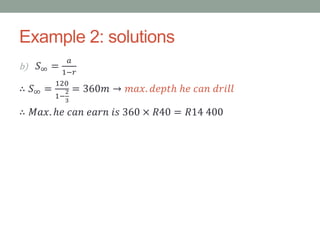
b) 𝑆∞ =
𝑎
1−𝑟
∴ 𝑆∞ =
120
1−
2
3
= 360𝑚 → 𝑚𝑎𝑥. 𝑑𝑒𝑝𝑡ℎ ℎ𝑒 𝑐𝑎𝑛 𝑑𝑟𝑖𝑙𝑙
∴ 𝑀𝑎𝑥. ℎ𝑒 𝑐𝑎𝑛 𝑒𝑎𝑟𝑛 𝑖𝑠 360 × 𝑅40 = 𝑅14 400
Example 3
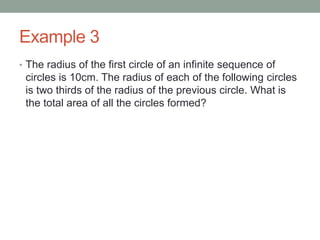
• The radius of the first circle of an infinite sequence of
circles is 10cm. The radius of each of the following circles
is two thirds of the radius of the previous circle. What is
the total area of all the circles formed?
Example 3: solution
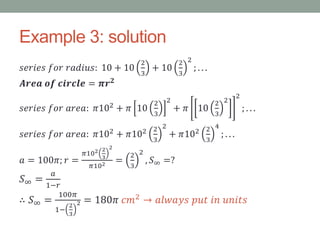
𝑠𝑒𝑟𝑖𝑒𝑠 𝑓𝑜𝑟 𝑟𝑎𝑑𝑖𝑢𝑠: 10 + 10
2
3
+ 10
2
3
2
; . . .
𝑨𝒓𝒆𝒂 𝒐𝒇 𝒄𝒊𝒓𝒄𝒍𝒆 = 𝝅𝒓 𝟐
𝑠𝑒𝑟𝑖𝑒𝑠 𝑓𝑜𝑟 𝑎𝑟𝑒𝑎: 𝜋102 + 𝜋 10
2
3
2
+ 𝜋 10
2
3
2
2
; . . .
𝑠𝑒𝑟𝑖𝑒𝑠 𝑓𝑜𝑟 𝑎𝑟𝑒𝑎: 𝜋102
+ 𝜋102 2
3
2
+ 𝜋102 2
3
4
; . . .
𝑎 = 100𝜋; 𝑟 =
𝜋102 2
3
2
𝜋102 =
2
3
2
, 𝑆∞ =?
𝑆∞ =
𝑎
1−𝑟
∴ 𝑆∞ =
100𝜋
1−
2
3
2 = 180𝜋 𝑐𝑚2 → 𝑎𝑙𝑤𝑎𝑦𝑠 𝑝𝑢𝑡 𝑖𝑛 𝑢𝑛𝑖𝑡𝑠
Exercise 9

Patterns, sequences and series

  • 1.
    SEQUENCES AND SERIES Arithmetic andGeometric Sequences and Series
  • 2.
    Content to beCovered 1. Revision of number patterns covered in previous grades 2. Arithmetic and Geometric Sequences 3. Sum of Arithmetic and Geometric Series 4. Sigma Notation 5. Sum of an Infinite Geometric Series
  • 3.
    What you shouldlearn • Definition of an Arithmetic and a Geometric sequence • How to recognise an Arithmetic and a Geometric sequence (or progression) • Using and manipulating formulae to calculate an unknown term and the nth term of a sequence • Applying Sigma notation to evaluate sum of a series • Apply this knowledge in real-world contexts
  • 4.
    Prior Knowledge • Naturalability to notice trends or patterns • Patterns covered in previous grades • Simultaneous equations Useful in determining general formula in cases where a sequence is not given • Determining nth term of a number pattern
  • 5.
    Quick Recall • Linearnumber pattern • A sequence with a constant first difference between consecutive terms 𝑻 𝒏 = 𝒃𝒏 + 𝒄 • Where; • 𝒃 → 1 𝑠𝑡 𝑑𝑖𝑓𝑓𝑒𝑟𝑒𝑛𝑐𝑒 • 𝒄 → 𝑇0
  • 6.
    Example • Given thelinear pattern 2; 5; 8; 11; . . . 1. Write down the next 3 terms 2. Write an expression for the nth term 3. Determine the 50th term
  • 7.
    Example (solutions) 1. .. . ; 14; 17; 20 2. 𝑏 = 1 𝑠𝑡 𝑑𝑖𝑓𝑓 = 3, 𝑐 = 𝑇0 = −1 𝑻 𝒏 = 𝒃𝒏 + 𝒄 ∴ 𝑻 𝒏 = 𝟑𝒏 − 𝟏 3. ∴ 𝑻 𝟓𝟎 = 𝟑 𝟓𝟎 − 𝟏 = 𝟏𝟒𝟗
  • 8.
    Quick Recall • QuadraticSequences • A sequence in which the second difference is constant • General formula (𝑛𝑡ℎ term): 𝑻 𝒏 = 𝒂𝒏 𝟐 + 𝒃𝒏 + 𝒄 • Where; • 𝑎 = 2 𝑛𝑑 𝑑𝑖𝑓𝑓𝑒𝑟𝑒𝑛𝑐𝑒 2 = 𝑑2 2 • 𝑏 • 𝑐 → 𝑇0
  • 9.
    Example • Determine whetherthe sequence is quadratic. If so, find an expression for the nth term and the 100th term of the sequence 4; 7; 14; 25; . . . • Solution 4 ↘↙ 7 ↘↙ 14 ↘↙ 25 3 ↘↙ 7 ↘↙ 11 → 1st difference 4 4 → 2nd difference • Constant second difference, ∴quadratic
  • 10.
    Example 𝑎 + 𝑏+ 𝑐 = 4 ↘↙ 7 ↘↙ 14 ↘↙ 25 3𝑎 + 𝑏 = 3 ↘↙ 7 ↘↙ 11 → 1st difference 2𝑎 = 4 4 → 2nd difference 2𝑎 = 4 3𝑎 + 𝑏 = 3 𝑎 + 𝑏 + 𝑐 = 4 𝑎 = 2 ∴ 𝑏 = 3 − 3(2) ∴ 𝑐 = 4 − 2 − (−3) ∴ 𝑏 = −3 ∴ 𝑐 = 5 𝑇𝑛 = 𝑎𝑛2 + 𝑏𝑛 + 𝑐 ∴ 𝑇𝑛 = 2𝑛2 − 3𝑛 + 5 ∴ 𝑇100 = 2 100 2 − 3 100 + 5 = 29 705
  • 11.
    1. Arithmetic &Geometric Sequences
  • 12.
    Lesson Outcomes • Definean Arithmetic sequence • Generate an expression for the nth term of any Arithmetic sequence • Use the general formula to evaluate any term in a sequence • Use the general formula to find the position (n) of an unknown term • Apply this knowledge in real-world contexts
  • 13.
    Terminology and Definitions •Sequence A set of ordered numbers An infinite sequence is a function whose domain is the set of positive integers • The function values: T1, T2, T3, …Tn,…are the terms of the sequences
  • 14.
    Terminology and Definitions •Sequences can either be finite or infinite • If a sequence terminates or has a last term, it is called a finite sequence • If a sequence is continuous and does not have a last term, it is called an infinite sequence
  • 15.
    Arithmetic Sequences • Asequence whose consecutive terms have a common difference • The common difference is denoted by ‘d’ So the sequence: 𝑇1, 𝑇2, 𝑇3, … 𝑇 𝑛, … Is Arithmetic if: 𝑇2 − 𝑇1 = 𝑇3 − 𝑇2 = 𝑇4 − 𝑇3 = a constant number ′d′ Where d is the common difference
  • 16.
    Arithmetic Sequences • Forexample, the sequence: 3, 7, 11, 15, … is arithmetic because: 𝑇2 − 𝑇1 = 𝑇3 − 𝑇2 = 𝑇4 − 𝑇3 … = 𝑑 7 − 3 = 11 − 7 = 15 − 11 = 4 → 𝑑 In General, for any Arithmetic Sequence: 𝑻 𝒏 − 𝑻 𝒏−𝟏 = 𝒅
  • 17.
    Arithmetic Sequences • Generatingan expression for nth term or general term: • 𝑇1 = 𝑎 • 𝑇2 = 𝑎 + 𝑑 • 𝑇3 = 𝑇2 + 𝑑 = 𝑎 + 𝑑 + 𝑑 = 𝑎 + 2𝑑 • 𝑇4 = 𝑇3 + 𝑑 = 𝑎 + 2𝑑 = 𝑎 + 3𝑑 • 𝑇𝑛 = 𝑎 + 𝑛 − 1 𝑑
  • 18.
    Arithmetic Sequences • Formulafor general term of Arithmetic Sequence: 𝑻 𝒏 = 𝒂 + 𝒏 − 𝟏 𝒅 Where; 𝑎 → the first term 𝑑 → the common difference 𝑛 → the position of a term 𝑇𝑛 → value of the term in position 𝑛 (𝑛𝑡ℎ term)
  • 19.
    Example 1: Commondifference 1. Find the common difference in the ff A.S: I. 4; 9; 14; 19; 24; . . . 𝑑 = 𝑇𝑛 − 𝑇𝑛−1 = 𝑇2 − 𝑇1 = 𝑇3 − 𝑇2 ∴ 𝑑 = 9 − 4 = 14 − 9 = 5 Common difference is 5 I. 10; 8; 6; 4; 2; . . . 𝑑 = 8 − 10 = 6 − 8 𝑑 = −2
  • 20.
    Example 2: Usingformula to generate a sequence 1. Write the first 5 terms of the sequence, determine whether it is Arithmetic, if so, find the common difference: I. 𝑇𝑛 = 5 + 3𝑛 II. 𝑇𝑛 = 100 − 3𝑛
  • 21.
    Example 2: Usingformula to generate a sequence I. 𝑇𝑛 = 5 + 3𝑛 𝑇1 = 5 + 3 1 = 8 𝑇2 = 5 + 3 2 = 11 𝑇3 = 5 + 3 3 = 14 𝑇4 = 5 + 3 4 = 17 𝑇5 = 5 + 3 5 = 20 8; 11; 14; 17; 20; . . . There is a common difference 𝑑 = 3, therefore, sequence is Arithmetic
  • 22.
    Example 2: Usingformula to generate a sequence II. 𝑇𝑛 = 100 − 3𝑛 • 𝑇1 = 100 − 3 1 = 97 • 𝑇2 = 100 − 3 2 = 94 • 𝑇3 = 100 − 3 3 = 91 • 𝑇4 = 100 − 3 4 = 88 • 𝑇5 = 100 − 3 5 = 85 97; 94; 91; 88; 85; . . . Arithmetic, constant difference between consecutive terms, d=-3
  • 23.
    Example: finding formulafor 𝑛𝑡ℎ term 3. Find a formula for the 𝑛𝑡ℎ term (𝑇𝑛) for the ff Arithmetic sequence and write first 5 terms: I. 𝑎 = 1; 𝑑 = 3 II. 𝑎 = 15; 𝑑 = 4 III. 𝑎 = 2; 𝑇12 = 46 IV. 𝑇4 = 16; 𝑇10 = 46
  • 24.
    Example: finding formulafor 𝑛𝑡ℎ term I. 𝒂 = 𝟏; 𝒅 = 𝟑 𝑇𝑛 = 𝑎 + 𝑛 − 1 𝑑 𝑇𝑛 = 1 + 𝑛 − 1 3 = 3𝑛 − 2 II. 𝒂 = 𝟏𝟓; 𝒅 = 𝟒 𝑇𝑛 = 15 + 𝑛 − 1 4 = 4𝑛 − 11
  • 25.
    Example: finding formulafor 𝑛𝑡ℎ term III. 𝒂 = 𝟐; 𝑻 𝟏𝟐 = 𝟒𝟔 𝑎 = 2. . . . . . ① 46 = 𝑎 + 11𝑑. . . . ② Sub. for a in 2: 46 = 2 + 11𝑑 46 − 2 = 11𝑑 44 11 = 𝑑 ∴ 𝑑 = 4 ∴ 𝑇𝑛 = 2 + 𝑛 − 1 4 = 4𝑛 − 2
  • 26.
    Example: finding formulafor 𝑛𝑡ℎ term IV. 𝑻 𝟒 = 𝟏𝟔; 𝑻 𝟏𝟎 = 𝟒𝟔 16 = 𝑎 + 3𝑑. . . . . ① 46 = 𝑎 + 9𝑑. . . . . ② ② −①: 30 = 6𝑑 30 6 = 𝑑 ∴ 𝑑 = 5
  • 27.
    Example: finding formulafor 𝑛𝑡ℎ term Sub. for d in 1: ∴ 16 − 3𝑑 = 𝑎 ∴ 𝑎 = 16 − 3(5) = 1 𝑎 = 1 & 𝑑 = 5 𝑇𝑛 = 𝑎 + 𝑛 − 1 𝑑 = 1 + 𝑛 − 1 5 = 5𝑛 − 4
  • 28.
    Arithmetic Sequences (summary) •Formula for nth term: • 𝑻 𝒏 = 𝒂 + 𝒏 − 𝟏 𝒅 • Common difference: • 𝒅 = 𝑻 𝒏 − 𝑻 𝒏−𝟏
  • 29.
    Activity 1 • Classwork:Exercise 1: Platinum Mathematics (p.5) • Homework: Exercise 2: Platinum Mathematics (p.6) • 1, 2, 7
  • 30.
  • 31.
    Lesson Outcomes • Definea Geometric sequence • Generate an expression for the nth of any Geometric sequence • Use the general formula to evaluate any term in a sequence • Use the general formula to find the position (n) of an unknown term • Apply this knowledge in real-world contexts
  • 32.
    Geometric Sequences • Asequence is geometric if the ratios of consecutive terms are the common • This constant is denoted by ‘r’ • The sequence: 𝑇1, 𝑇2, 𝑇3, 𝑇4, … 𝑇𝑛−1, 𝑇𝑛 • Is geometric if: 𝑇2 𝑇1 = 𝑇3 𝑇2 = 𝑇4 𝑇3 = 𝑇𝑛 𝑇𝑛−1 = 𝑟
  • 33.
    Geometric Sequences • Formulafor nth term or general term: • 𝑇1 = 𝑎 • 𝑇2 = 𝑎𝑟 • 𝑇3 = 𝑎𝑟2 • 𝑇4 = 𝑎𝑟3 • 𝑇𝑛 = 𝑎𝑟 𝑛−1
  • 34.
    Geometric Sequences • Formulafor 𝑛𝑡ℎ term: 𝑻 𝒏 = 𝒂𝒓 𝒏−𝟏 Where; 𝑎 → the first term, 𝑟 → the constant/common ratio and 𝑛 → position of term 𝑇𝑛 → value for the term in position 𝑛 (𝑛𝑡ℎ term)
  • 35.
    Geometric Sequence (summary) •𝒓 = 𝑻 𝒏 𝑻 𝒏−𝟏 → 𝐜𝐨𝐦𝐦𝐨𝐧 𝐫𝐚𝐭𝐢𝐨 • 𝑻 𝒏 = 𝒂𝒓 𝒏−𝟏 → 𝐟𝐨𝐫𝐦𝐮𝐥𝐚 𝐟𝐨𝐫 𝐧𝐭𝐡 𝐭𝐞𝐫𝐦
  • 36.
    Examples 1. Find thecommon ratio for the 𝑓𝑓 G.S I. 2; 10; 50; 250; . . . II. 1 8 ; 1 4 ; 1 2 ; 1. . . 2. Write the first 5 terms of the G.S I. 𝑎 = 4, 𝑟 = 3 II. 𝑎 = 8, 𝑟 = 2 3. Write an expression for the 𝑛𝑡ℎ term of the Geo sequences in (2)
  • 37.
    Examples 4. Find the𝑛𝑡ℎ term of the 𝑓𝑓 and determine the unknown term: I. 𝑇1 = 4, 𝑟 = 1 2 , 𝑇10 =? II. 𝑇1 = 6, 𝑟 = − 1 3 , 𝑇12 =?
  • 38.
    Example: finding commonratio 1. Find the common ratio in the 𝑓𝑓 G.S I. 2; 10; 50; 250; . . . 𝑟 = 𝑇2 𝑇1 = 𝑇3 𝑇2 𝑟 = 10 2 = 50 10 = 5 II. 1 8 ; 1 4 ; 1 2 ; 1. . . 𝑟 = 𝑇2 𝑇1 = 𝑇3 𝑇2 𝑟 = 1 4 1 8 = 1 2 1 4 = 2
  • 39.
    Example 2: generatinga Geo sequence 1. Write the first 3 terms of the G.S I. 𝑎 = 4, 𝑟 = 3 𝑇𝑛 = 𝑎𝑟 𝑛−1 = 4 3 𝑛−1 𝑇1 = 𝑎 = 4 𝑇2 = 4(3)2−1= 12 𝑇3 = 4(3)3−1= 36 4; 12; 36; . . .
  • 40.
    Example 2: generatinga Geo sequence II. 𝑎 = 8, 𝑟 = 2 𝑇𝑛 = 𝑎𝑟 𝑛−1 = 8 2 𝑛−1 𝑇1 = 𝑎 = 8 𝑇2 = 8(2)2−1 = 16 𝑇3 = 8(2)3−1= 32 8; 16; 32; . . .
  • 41.
    Example 3: findingthe value a term 3. Find the 𝑛𝑡ℎ term of the 𝑓𝑓 and determine the unknown term: I. 𝑇1 = 4, 𝑟 = 1 2 , 𝑇10 =? Solution: 𝑇𝑛 = 𝑎𝑟 𝑛−1 ∴ 𝑇𝑛 = 4 1 2 𝑛−1 ∴ 𝑇10 = 4 1 2 10−1 = 1 128
  • 42.
    Example 4: generatinga formula for nth term of a geo sequence The second term in a geometric sequence is -4 and the fifth term is 32. 1. Determine a formula for the nth term of this sequence 2. Which term has a value of -1 024? 3. Determine the eighth term in the sequence
  • 43.
    Example 4: generatinga formula for nth term of a geo sequence (solutions) 1. 𝑇2 = −4, 𝑇5 = 32 𝑎𝑟 = −4 . . . . ① 𝑎𝑟4 = 32 . . . . ② ② ÷ ①: 𝑎𝑟4 𝑎𝑟 = 32 −4 𝑟3 = −8 = −2 3 ∴ 𝑟 = −2 Substitute for r in ①: 𝑎 = −4 𝑟 . . . ① ∴ 𝑎 = −4 −2 = 2 ∴ 𝑇𝑛 = 2 −2 𝑛−1
  • 44.
    Example 4: generatinga formula for nth term of a geo sequence (solutions) 2. 𝑇𝑛 = −1024 𝑇𝑛 = 2 −2 𝑛−1 ∴ −1024 = 2 −2 𝑛−1 ∴ −512 = −2 𝑛−1 ∴ −2 9= −2 𝑛−1 ∴ 9 = 𝑛 − 1 ∴ 10 = 𝑛 ∴ 𝑇10 = −1024
  • 45.
    Example 4: generatinga formula for nth term of a geo sequence (solutions) 3. 𝑇𝑛 = 2 −2 𝑛−1 , 𝑛 = 8 ∴ 𝑇8= 2 −2 8−1 = 2(−2)7 = −256
  • 46.
  • 47.
  • 48.
    Series • Many applicationsinvolve the sum of the terms of a sequence 𝑇1 + 𝑇2 + 𝑇3+. . … + 𝑇𝑛 • Such a sum is called a series So for the sequence: 3, 7, 11, 15, … We have the series: 3 + 7 + 11 + 15+. . . . • We calculate sums of two types of series, Arithmetic and Geometric…
  • 49.
    Interesting Note • AMaths genius who helped us discover the formula for calculating the sum of an Arithmetic Series
  • 50.
    Historical Note • Ateacher of Carl Friedrich Gauss (1777-1855) asked him to add all the integers from 1 to 100. • When Gauss returned with the correct answer after only a few moments, the teacher could only look at him in astounded silence. • This is what Gauss did: • 𝑆 𝑛 = 1 + 2 + 3+. . . +100 • 𝑆 𝑛= 100 + 99 + 98+. . . + 1 • 2𝑆 𝑛 = 101 + 101 + 101+. . . +101 • 𝑆 𝑛 = 100×101 2 = 50 101 = 5050
  • 51.
    Sum of anArithmetic Series • Formula for calculating sum of an infinite A.S: • 𝑆 𝑛 = 𝑛 2 2𝑎 + 𝑛 − 1 𝑑  𝑆 𝑛 is summation of the first n terms  𝑎 is first term  𝑑 is common difference
  • 52.
    Sum of anArithmetic Series • Formula for calculating sum of a finite A.S: 𝑆 𝑛 = 𝑛 2 𝑎 + 𝐿 Where;  𝑆 𝑛 is summation of the first 𝑛 terms o 𝑆1 is sum of first term, 𝑆2 is sum of first 2 terms, oS3 sum of first 3 terms, etc.  𝑎 is first term  𝐿 is last term
  • 53.
    Proof 1 • Forfinite sequence: 𝑎; 𝑎 + 𝑑; 𝑎 + 2𝑑; . . . ; 𝐿 − 2𝑑; 𝐿 − 𝑑; 𝐿 Where; L → last term • We have the sum: 𝑆 𝑛 = 𝑎 + 𝑎 + 𝑑 + 𝑎 + 2𝑑 + . . . + 𝐿 − 2𝑑 + 𝐿 − 𝑑 + 𝐿 • If we reverse it, we will have: 𝑆 𝑛 = 𝐿 + 𝐿 − 𝑑 + 𝐿 − 2𝑑 + ⋯ + 𝑎 + 2𝑑 + 𝑎 + 𝑑 + 𝑎 • Add the two: 2𝑆 𝑛 = 𝑎 + 𝐿 + 𝑎 + 𝐿 + (𝑎 + 𝐿)+. . . + 𝑎 + 𝐿 + (𝑎 + 𝐿)
  • 54.
    Proof 1 • For𝑛 number of terms we will have: 2𝑆 𝑛 = 𝑛(𝑎 + 𝐿) • Divide both sides by 2: • 𝑆 𝑛 = 𝑛 2 𝑎 + 𝐿 𝑺 𝒏 = 𝒏 𝟐 𝒂 + 𝑳 → sum of finite A.S
  • 55.
    Proof 2 • Forany infinite series: 𝑎 + 𝑎 + 𝑑 + 𝑎 + 2𝑑 +. . . + 𝑎 + 𝑛 − 3 𝑑 + 𝑎 + 𝑛 − 2 𝑑 + 𝑎 + 𝑛 − 1 𝑑 +. . . 1. The sum will be: 𝑆 𝑛 = 𝑎 + 𝑎 + 𝑑 + 𝑎 + 2𝑑 +. . . . + 𝑎 + 𝑛 − 3 𝑑 + 𝑎 + 𝑛 − 2 𝑑 + 𝑎 + 𝑛 − 1 𝑑 2. Write the sum, starting with the last term: 𝑆 𝑛 = 𝑎 + 𝑛 − 1 𝑑 + 𝑎 + 𝑛 − 2 𝑑 + 𝑎 + 𝑛 − 3 𝑑 … + 𝑎 + 2𝑑 + 𝑎 + 𝑑 + 𝑎 3. Adding the two gives: 2𝑆 𝑛 = 2𝑎 + 𝑛 − 1 𝑑 + 2𝑎 + 𝑛 − 1 𝑑 + 2𝑎 + 𝑛 − 1 𝑑 + ⋯ + 2𝑎 + 𝑛 − 1 𝑑 + 2𝑎 + 𝑛 − 1 𝑑 + 2𝑎 + 𝑛 − 1 𝑑
  • 56.
    Proof 2 • Forn terms, the sum is: 2𝑆 𝑛 = 𝑛 2𝑎 + 𝑛 − 1 𝑑 • Divide both sides by 2: 𝑆 𝑛 = 𝑛 2 2𝑎 + 𝑛 − 1 𝑑 Formula for Sum Infinite Arithmetic Sequence: 𝑺 𝒏 = 𝒏 𝟐 𝟐𝒂 + 𝒏 − 𝟏 𝒅
  • 57.
    Sum of anArithmetic Series (summary) When last term is not known When last term is known 𝑆 𝑛 = 𝑛 2 2𝑎 + 𝑛 − 1 𝑑 𝑆 𝑛 = 𝑛 2 𝑎 + 𝐿
  • 58.
    Example (1) 1. Findthe Sum of the A.S for the indicated number of terms: I. 8; 20; 32; 44; . . . ; 𝑛 = 10 𝑺 𝒏 = 𝒏 𝟐 𝟐𝒂 + 𝒏 − 𝟏 𝒅 𝑺 𝒏 = 𝒏 𝟐 𝒂 + 𝑳 𝑎 = 8, 𝑑 = 12, 𝑛 = 10 ∴ 𝑺 𝟏𝟎= 𝟏𝟎 𝟐 𝟐(𝟖) + 𝟏𝟎 − 𝟏 𝟏𝟐 ∴ 𝑺 𝟏𝟎 = 𝟔𝟐𝟎 𝑎 = 8, 𝑑 = 12, 𝑛 = 10, 𝐿 =? 𝑇𝑛 = 𝑎 + 𝑛 − 1 𝑑 ∴ 𝑇𝑛 = 8 + 𝑛 − 1 12 = 12𝑛 − 4 ∴ 𝑇10 = 12 10 − 4 = 116 ∴ 𝐿 = 116 ∴ 𝑺 𝟏𝟎= 𝟏𝟎 𝟐 𝟖 + 𝟏𝟏𝟔 = 𝟔𝟐𝟎
  • 59.
    Example (2) • Determinethe sum of the series: • 4 + 11 + 18 + 25+. . . +368 • SOLUTION • 𝑎 = 4, 𝑑 = 7, 𝐿 = 368, 𝑛 =? • 𝑇𝑛 = 𝑎 + 𝑛 − 1 𝑑 • 368 = 4 + 𝑛 − 1 7 • 368−4 7 = 𝑛 − 1 • 𝑛 = 53
  • 60.
    Example (2) • 𝑺𝒏 = 𝒏 𝟐 𝒂 + 𝑳 • ∴ 𝑺 𝟓𝟑 = 𝟓𝟑 𝟐 𝟒 + 𝟑𝟔𝟖 = 𝟗 𝟖𝟓𝟖
  • 61.
    Example (3) • 𝑆𝑛 = 𝑛2 + 9𝑛 1. Determine the first three terms of the sequence 2. Determine the 12th term by using the formula 𝑆 𝑛 = 𝑛2 + 9𝑛 3. Determine the 12th term by determining the formula for the nth term
  • 62.
    Example 3: solution •𝑆1 = 𝑇1 = 2(1)2 + 9 1 = 11 • 𝑆2 = 2(2)2 +9 2 = 26 • 𝑇1 + 𝑇2 = 26 • 𝑇2 = 26 − 11 = 15 • 𝑆3 = 2(3)2+9 3 = 45 • 𝑇1 + 𝑇2 + 𝑇3 = 45 • 𝑇3 = 45 − 11 + 15 = 19 • The first 3 terms are: 11; 15; 19
  • 63.
    Example (3): solution •𝑇12 =? 𝑆 𝑛 = 𝑛2 + 9𝑛, 𝑻 𝒏 = 𝑺 𝒏 − 𝑺 𝒏−𝟏 • 𝑆11 = 2(11)2 +9 11 = 341 • 𝑆12 = 2(12)2+9 12 = 396 • 𝑻 𝒏 = 𝑺 𝒏 − 𝑺 𝒏−𝟏 • 𝑇12 = 𝑆12 − 𝑆11 = 396 − 341 = 55
  • 64.
    Example 3: solution •𝑻 𝟏𝟐 =? , 𝒂 = 𝟏𝟏, 𝒅 = 𝟒, 𝒏 = 𝟏𝟐 • 𝑇𝑛 = 𝑎 + 𝑛 − 1 𝑑 • 𝑇𝑛 = 11 + 𝑛 − 1 4 = 4𝑛 + 7 • 𝑇12 = 4 12 + 7 = 55
  • 65.
    Example (4) • Thesecond term of a second term of a sequence is 17 and the sum of the first six terms is 147. determine the first three terms and the nth term.
  • 66.
    Example 3: Solution •𝑇2 = 17, 𝑆6 = 147 • 17 = 𝑎 + 𝑑. . .①. . .𝑎 = 17 − 𝑑 • 𝑆 𝑛 = 𝑛 2 2𝑎 + 𝑛 − 1 𝑑 • 𝑆6 = 6 2 (2𝑎 + 5𝑑) • 147 = 3 2𝑎 + 5𝑑 • 49 = 2𝑎 + 5𝑑. . . ② • Sub for a=17-d in ②: • ∴ 49 = 2 17 − 𝑑 + 5𝑑 • ∴ 49 = 34 − 2𝑑 + 5𝑑 • ∴ 3𝑑 = 15 • ∴ 𝑑 = 5
  • 67.
    Example 3: Solution •Substitute 𝑑 = 5 in ①: • 𝑎 = 17 − 5 = 12 12; 17; 22 • nth term: • 𝑇𝑛 = 𝑎 + 𝑛 − 1 𝑑 • ∴ 𝑇𝑛 = 12 + 𝑛 − 1 5 = 5𝑛 + 7
  • 68.
  • 69.
    Sum of GeometricSequence • Formular for calculating sum of G.S 𝑺 𝒏 = 𝒂 𝟏−𝒓 𝒏 𝟏−𝒓 𝑺 𝒏 = 𝒂 𝒓 𝒏−𝟏 𝒓−𝟏 (if 𝑟 < 1) 𝑟 ≠ 1 (if 𝑟 > 1) Where;  𝑆 𝑛 is the sum of the first n terms  𝑎 is first term  𝑟 is the common ratio
  • 70.
    Proof The sum ofa finite Geometric Sequence • 𝑎; 𝑎𝑟; 𝑎𝑟2 ; … ; 𝑎𝑟 𝑛−1 • If we add all the terms: • 𝑆 𝑛 = 𝑎 + 𝑎𝑟 + 𝑎𝑟2 + ⋯ + 𝑎𝑟 𝑛−2 + 𝑎𝑟 𝑛−1 • Multiply by 𝑟: • 𝑟𝑆 𝑛 = 𝑎𝑟 + 𝑎𝑟2 + 𝑎𝑟3 … + 𝑎𝑟 𝑛−1 + 𝑎𝑟 𝑛 • Subtract the two: • 𝑆 𝑛 − 𝑟𝑆 𝑛 = 𝑎 − 𝑎𝑟 𝑛
  • 71.
    Proof • Factorise • 𝑆𝑛 1 − 𝑟 = 𝑎 1 − 𝑟 𝑛 • Divide both sides by 1 − 𝑟 : • 𝑆 𝑛 = 𝑎 1−𝑟 𝑛 1−𝑟 ….Sum of Geometric Sequence • Remember that this applies when: 𝑟 < 1
  • 72.
    Proof • If youfactorise -1: • 𝑆 𝑛 = 𝑎 1−𝑟 𝑛 1−𝑟 = −𝑎 𝑟 𝑛−1 −(𝑟−1) • ∴ 𝑆 𝑛 = 𝑎 𝑟 𝑛−1 𝑟−1 → use this if 𝑟 > 1
  • 73.
    Sum of aGeometric Series (summary) If 𝑟 < 1 If 𝑟 > 1 𝑆 𝑛 = 𝑎 1 − 𝑟 𝑛 1 − 𝑟 𝑆 𝑛 = 𝑎 𝑟 𝑛 − 1 𝑟 − 1
  • 74.
    Example 1 • Evaluatethe sum of the geometric series, to the indicated number of terms: • 1+3+9+ . . . to 8 terms • Solution: • 𝑎 = 1, 𝑟 = 3, 𝑛 = 8 𝐒𝐢𝐧𝐜𝐞 𝐫 > 𝟏, 𝐮𝐬𝐞: 𝑆 𝑛 = 𝑎 𝑟 𝑛−1 𝑟−1 ∴ 𝑆8 = ( 3 8−1) 3−1 = 6 560
  • 75.
    Example 2 • Determinethe sum of terms in the series: 5 + 10 + 20 + 40+. . . +655 360 Solution: 𝑎 = 5, 𝑟 = 2, 𝑛 =? 𝑇𝑛 = 𝑎𝑟 𝑛−1 ∴ 𝑇𝑛 = 5(2) 𝑛−1 ∴ 655 360 = 5(2) 𝑛−1 ∴ 131 072 = 2 𝑛−1 ∴ 217 = 2 𝑛−1 ∴ 17 = 𝑛 − 1 ∴ 𝑛 = 18
  • 76.
    Example 2 • 𝒓> 𝟏: 𝑆 𝑛 = 𝑎 𝑟 𝑛−1 𝑟−1 ∴ 𝑆18 = 5(218−1) 2−1 = 1 310 715
  • 77.
    Example 3 • Thefirst term of a geometric series is 16 and the sum of the second and third term is 12. • Determine the sum of the first ten terms • Solution: • 𝑎 = 16, 𝑇2 + 𝑇3 = 12 • 𝑎 = 16. . . ① • 𝑎𝑟 + 𝑎𝑟2 = 12. . . ② • Substitute for a in ②: • ∴ 16𝑟 + 16𝑟2 = 12 • 4𝑟 + 4𝑟2 = 3
  • 78.
    Example 3 • 4𝑟2 +4𝑟 − 3 = 0 • 2𝑟 + 3 2𝑟 − 1 = 0 • ∴ 𝑟 = − 3 2 𝑜𝑟 𝑟 = 1 2 𝑟 = − 3 2 𝑟 = 1 2 𝑺 𝒏 = 𝒂 𝟏−𝒓 𝒏 𝟏−𝒓 ∴ 𝑆10 = 16 1− − 3 2 1− − 3 2 ∴ 𝑆10 = − 11 605 32 𝑺 𝒏 = 𝒂 𝟏−𝒓 𝒏 𝟏−𝒓 ∴ 𝑆10 = 16 1− 1 2 1− 1 2 ∴ 𝑆10 = 1 023 32
  • 79.
  • 80.
  • 81.
    Sum to infinityof Geometric Series • An infinite series is one that has no end and for which it is impossible to determine number of terms • When a series diverges, it grows further apart in value (increasingly large) • When a series converges, it tends to zero as n tends to infinity • A geometric series converges if: −1 < 𝑟 < 1 • When a series swings back and forth between large and small values, and between negative and positive values, we say it oscillates
  • 82.
    Formula for calculatingSum to infinity of a Geometric Series • 𝑆∞ = 𝑎 1−𝑟 , 𝑖𝑓 − 1 < 𝑟 < 1 • Proof: • 𝑺 𝒏 = 𝒂 𝟏−𝒓 𝒏 𝟏−𝒓 • If −1 < 𝑟 < 1, then 𝑟 𝑛 → 0 𝑎𝑠 𝑛 → ∞ • Therefore, 𝑆∞ = 𝑎(1−0) 1−𝑟 = 𝑎 1−𝑟 • Where; • 𝑆∞ →sum to infinity • 𝑎 → first term • 𝑟 → common ratio
  • 83.
    Example 1 • Determinethe sum to infinity of the sequence • 16 + 8 + 4+ . . .for an infinite number of terms • Solution: • 𝑎 = 16, 𝑟 = 1 2 • 𝑆∞ = 𝑎 1−𝑟 = 16 1− 1 2 = 32
  • 84.
    Example 2 • Considerthe series 16𝑘 + 8𝑘2 + 4𝑘3+. . . 1. For which vaue(s) of 𝑘 will the series converge? 2. Calculate the sum of the series to infinity if 𝑘 = −1,5 Solutions: 1. 𝑟 = 8𝑘2 16𝑘 = 4𝑘3 8𝑘2 = 𝑘 2 For a converging series: −1 < 𝑟 < 1 ∴ −1 < 𝑘 2 < 1 ∴ −2 < 𝑘 < 2
  • 85.
    Example 2 2. ∴𝑎 = 16 −1,5 = −24, ∴ 𝑟 = −1,5 2 = −0,75 • 𝑆∞ = 𝑎 1−𝑟 • ∴ 𝑆∞ = −24 1+0,75 = − 96 7
  • 86.
    Exercise 7 • 1.1;1.2; 3; and 4
  • 87.
    Sigma Notation • SigmaΣ is the 18th letter of the Greek alphabets and is equivalent to the english alphabet ‘S’ • In Mathematics, sigma is used for the summation (addition) notation
  • 88.
    Sigma Notation • Illustrativeexample: 𝑛=1 6 (4𝑛) • Means: the sum Σ of the sequence generated by (4𝑛), starting from 𝑛 = 1 and ending at 𝑛 = 6 𝑛=1 6 (4𝑛) = 4 1 + 4 2 + 4 3 + 4 4 + 4 5 + 4(6)
  • 89.
    Sigma Notation • Todetermine the total number of terms for any series in sigma notation, we say: • 𝑛𝑢𝑚𝑏𝑒𝑟 𝑜𝑓 𝑡𝑒𝑟𝑚𝑠(𝑛) = 𝑇𝑜𝑝 − 𝐵𝑜𝑡𝑡𝑜𝑚 + 1 • Example: • Determine the number of terms in the series 𝑛=0 5 𝑛 • 𝑛 = 𝑇𝑜𝑝 − 𝐵𝑜𝑡𝑡𝑜𝑚 + 1 • ∴ 𝑛 = 5 − 0 + 1 = 6 • 𝑛=0 5 𝑛 = 0 + 1 + 2 + 3 + 4 + 5 . . .6 terms
  • 90.
    Example 1 • Evaluate: 𝑛=1 12 5+ 2(𝑘 − 3) Solution: 𝑛=1 12 5 + 2(𝑘 − 3) = 5 + 2 1 − 3 + 5 + 2 2 − 3 + 5 + 2 3 − 3 +. . .5 + 2(12 − 1) 𝑛=1 12 5 + 2(𝑘 − 3) = 1 + 3 + 5+. . . +27 First identify type of series: There is a common difference, ∴Arithmetic 𝑎 = 1, 𝑑 = 2, 𝑛 = 12, 𝑆 𝑛 =? 𝑆 𝑛 = 𝑛 2 𝑎 + 𝐿 ∴ 𝑆12 = 12 2 1 + 27 = 168
  • 91.
    Example 2 • Evaluate 𝑛=1 6 32 𝑘−1 Solution: 𝑛=1 6 3 2 𝑘−1 = 3 2 1−1 + 3 2 2−1 + 3 2 3−1 + 3 2 4−1 + 3 2 5−1 + 3 2 6−1 𝑛=1 6 3 2 𝑘−1 = 3 + 6 + 12 + 24 + 48 + 96 = 189 Using a formula: 𝑎 = 3, 𝑟 = 2, 𝑛 = 6, 𝑆 𝑛 =? 𝑆 𝑛 = 𝑎(𝑟−1) 𝑟−1 , 𝑟 > 1 𝑆6 = 3(26−1) 2−1 = 189
  • 92.
    Example 3 • Determinethe sum: 𝑥=1 ∞ 21−𝑥 • Solution: • 𝑥=1 ∞ 21−𝑥 = 21−1 + 21−2 + 21−3 +. . . • 𝑥=1 ∞ 21−𝑥 = 1 + 1 2 + 1 4 +. . . • 𝑎 = 1, 𝑟 = 1 2 , 𝑆∞ =? • 𝑆∞ = 𝑎 1−𝑟 • ∴ 𝑆∞ = 1 1− 1 2 = 2
  • 93.
    Example 4 • Determinenumber of terms (n) if: 𝑘=1 𝑛 3 + 4 𝑘 − 2 = 594
  • 94.
    Example 4: solution 𝑘=1 𝑛 3+ 4 𝑘 − 2 = 3 + 4 1 − 2 + 3 + 4 2 − 2 + 3 + 4 3 − 2 +. . . [3 + 4 𝑛 − 3 ] 𝑘=1 𝑛 3 + 4(𝑘 − 2) = −1 + 3 + 7+. . . +3 + 4 n − 2 = 594 𝑎 = −1, 𝑑 = 4, 𝑆 𝑛 = 594, 𝑛 =? 𝑆 𝑛 = 𝑛 2 2𝑎 + 𝑛 − 1 𝑑 ∴ 594 = 𝑛 2 2 −1 + 𝑛 − 1 4 ∴ 594 = 𝑛 −1 + 𝑛 − 1 2 ∴ 594 = 𝑛 2𝑛 − 3 ∴ 0 = 2𝑛2 − 3𝑛 − 594 ∴ 0 = 2𝑛 + 33 𝑛 − 18 ∴ 𝑛 = − 33 2 𝑜𝑟 𝑛 = 18 𝐵𝑢𝑡 𝑛 𝑖𝑠 𝑎 𝑛𝑎𝑡𝑢𝑟𝑎𝑙 𝑛𝑢𝑚𝑏𝑒𝑟 ∴ 𝑛 = 18
  • 95.
  • 96.
  • 97.
    Example 1 Matsotso increasesthe distance he cycles by 12km each week. If he cycles 20km in the first week, (i) what distance does he cycle in the 8th week and (ii) how far will he have cycled in total at the end of the 8th week?
  • 98.
    Example 1: solution •Series: 20 + 32 + 44+. . . i. 𝑎 = 20, 𝑑 = 12, 𝑇8 =? 𝑇8 = 𝑎 + 7𝑑 ∴ 𝑇8 = 20 + 7 12 = 104 He cycles 104km in the 8th week. ii. 𝑆8 =? 𝑆 𝑛 = 𝑛 2 𝑎 + 𝑑 ∴ 𝑆8 = 8 2 20 + 104 = 496 ∴ 𝐻𝑒 𝑤𝑜𝑢𝑙𝑑 𝑐𝑦𝑐𝑙𝑒 𝑎 𝑡𝑜𝑡𝑎𝑙 𝑜𝑓 496𝑘𝑚 𝑎𝑓𝑡𝑒𝑟 8 𝑤𝑒𝑒𝑘𝑠.
  • 99.
    Example 2 On thefirst day of drilling, a driller reaches a depth of 120m. Each day after that he drills two thirds of the depth of the previous day. a) If he earns R40/m, how much will he earn by the end of the 5th day? b) What is the maximum amount of money he can earn?
  • 100.
    Example 2: solutions a)120; 120 2 3 ; 120 2 3 2 ; . . . → 𝑖𝑛𝑓𝑖𝑛𝑖𝑡𝑒 𝑠𝑒𝑟𝑖𝑒𝑠 𝑤𝑖𝑡ℎ 𝑟 = 2 3 Sum of the first 5 drills: 𝑆 𝑛 = 𝑎(1−𝑟 𝑛) 1−𝑟 ∴ 𝑆5 = 120 1− 2 3 5 1− 2 3 = 312,59𝑚 ∴ 𝐻𝑒 𝑒𝑎𝑟𝑛𝑠 𝑅40 × 312,59 = 𝑅12 503, 60
  • 101.
    Example 2: solutions b)𝑆∞ = 𝑎 1−𝑟 ∴ 𝑆∞ = 120 1− 2 3 = 360𝑚 → 𝑚𝑎𝑥. 𝑑𝑒𝑝𝑡ℎ ℎ𝑒 𝑐𝑎𝑛 𝑑𝑟𝑖𝑙𝑙 ∴ 𝑀𝑎𝑥. ℎ𝑒 𝑐𝑎𝑛 𝑒𝑎𝑟𝑛 𝑖𝑠 360 × 𝑅40 = 𝑅14 400
  • 102.
    Example 3 • Theradius of the first circle of an infinite sequence of circles is 10cm. The radius of each of the following circles is two thirds of the radius of the previous circle. What is the total area of all the circles formed?
  • 103.
    Example 3: solution 𝑠𝑒𝑟𝑖𝑒𝑠𝑓𝑜𝑟 𝑟𝑎𝑑𝑖𝑢𝑠: 10 + 10 2 3 + 10 2 3 2 ; . . . 𝑨𝒓𝒆𝒂 𝒐𝒇 𝒄𝒊𝒓𝒄𝒍𝒆 = 𝝅𝒓 𝟐 𝑠𝑒𝑟𝑖𝑒𝑠 𝑓𝑜𝑟 𝑎𝑟𝑒𝑎: 𝜋102 + 𝜋 10 2 3 2 + 𝜋 10 2 3 2 2 ; . . . 𝑠𝑒𝑟𝑖𝑒𝑠 𝑓𝑜𝑟 𝑎𝑟𝑒𝑎: 𝜋102 + 𝜋102 2 3 2 + 𝜋102 2 3 4 ; . . . 𝑎 = 100𝜋; 𝑟 = 𝜋102 2 3 2 𝜋102 = 2 3 2 , 𝑆∞ =? 𝑆∞ = 𝑎 1−𝑟 ∴ 𝑆∞ = 100𝜋 1− 2 3 2 = 180𝜋 𝑐𝑚2 → 𝑎𝑙𝑤𝑎𝑦𝑠 𝑝𝑢𝑡 𝑖𝑛 𝑢𝑛𝑖𝑡𝑠
  • 104.