Lesson 1a
SEQUENCE
SEQUENCE
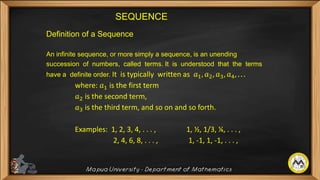
Definition of a Sequence
An infinite sequence, or more simply a sequence, is an unending
succession of numbers, called terms. It is understood that the terms
have a definite order. It is typically written as 𝑎1, 𝑎2, 𝑎3, 𝑎4, . . .
where: 𝑎1 is the first term
𝑎2 is the second term,
𝑎3 is the third term, and so on and so forth.
Examples: 1, 2, 3, 4, . . . , 1, ½, 1/3, ¼, . . . ,
2, 4, 6, 8, . . . , 1, -1, 1, -1, . . . ,
EXAMPLE
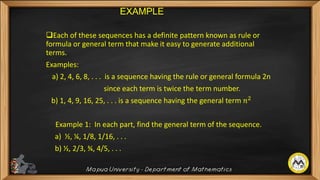
Each of these sequences has a definite pattern known as rule or
formula or general term that make it easy to generate additional
terms.
Examples:
a) 2, 4, 6, 8, . . . is a sequence having the rule or general formula 2n
since each term is twice the term number.
b) 1, 4, 9, 16, 25, . . . is a sequence having the general term 𝑛2
Example 1: In each part, find the general term of the sequence.
a) ½, ¼, 1/8, 1/16, . . .
b) ½, 2/3, ¾, 4/5, . . .
EXAMPLE
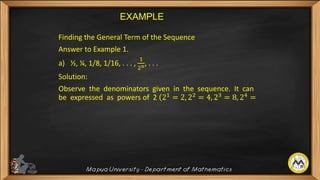
Finding the General Term of the Sequence
Answer to Example 1.
a) ½, ¼, 1/8, 1/16, . . . ,
1
2𝑛, . . .
Solution:
Observe the denominators given in the sequence. It can
be expressed as powers of 2 21 = 2, 22 = 4, 23 = 8, 24 =
SEQUENCE
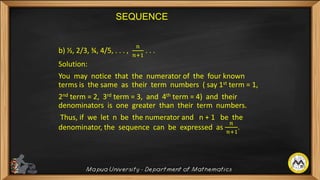
b) ½, 2/3, ¾, 4/5, . . . ,
𝑛
𝑛+1
. . .
Solution:
You may notice that the numerator of the four known
terms is the same as their term numbers ( say 1st term = 1,
2nd term = 2, 3rd term = 3, and 4th term = 4) and their
denominators is one greater than their term numbers.
Thus, if we let n be the numerator and n + 1 be the
denominator, the sequence can be expressed as
𝑛
𝑛+1
.
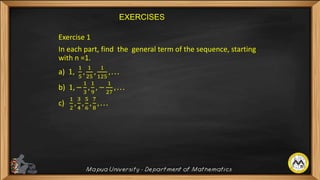
EXERCISES
Exercise 1
In each part, find the general term of the sequence, starting
with n =1.
a) 1,
1
5
,
1
25
,
1
125
, . . .
b) 1, −
1
3
,
1
9
, −
1
27
, . . .
c)
1
2
,
3
4
,
5
6
,
7
8
, . . .
EXERCISES
Exercise 1
In each part, find the general term of the sequence, starting
with n =1.
a) 1,
1
5
,
1
25
,
1
125
, . . .
b) 1, −
1
3
,
1
9
, −
1
27
, . . .
c)
1
2
,
3
4
,
5
6
,
7
8
, . . .
SEQUENCE
When the general term of a sequence
𝑎1, 𝑎2 , 𝑎3 , . . . , 𝑎𝑛 , . . . (1)
is known, there is no need to write out the initial terms and it
is common to write only the general term enclosed in braces.
Thus (1) might be written as
𝑎𝑛 𝑛=1
+∞
or 𝑎𝑛 𝑛=1
∞
A sequence is a function whose domain is a set of integers
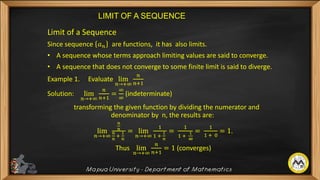
LIMIT OF A SEQUENCE
Limit of a Sequence
Since sequence 𝑎𝑛 are functions, it has also limits.
• A sequence whose terms approach limiting values are said to converge.
• A sequence that does not converge to some finite limit is said to diverge.
Example 1. Evaluate lim
𝑛→+∞
𝑛
𝑛+1
Solution: lim
𝑛→+∞
𝑛
𝑛+1
=
∞
∞
(indeterminate)
transforming the given function by dividing the numerator and
denominator by n, the results are:
lim
𝑛→+∞
𝑛
𝑛
𝑛
𝑛
+
1
𝑛
= lim
𝑛→+∞
1
1 +
1
𝑛
=
1
1 +
1
∞
=
1
1 + 0
= 1.
Thus lim
𝑛→+∞
𝑛
𝑛+1
= 1 (converges)
EXAMPLE
2. Evaluate: lim
𝑛→+∞
𝑛 + 1)
Solution:
lim
𝑛→+∞
𝑛 + 1) = ∞ + 1 = ∞ (diverges)
3. Determine whether the sequence,
1,
1
2
,
1
22 ,
1
23 , . . .
1
2𝑛 , . . . converge.
Solution:
lim
𝑛→∞
1
2𝑛 =
1
2∞ =
1
∞
= 0 converges)
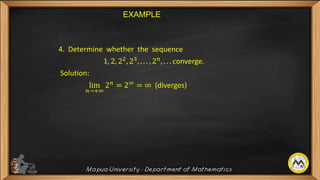
EXAMPLE
4. Determine whether the sequence
1, 2, 22
, 23
, . . . , 2𝑛
, . . . converge.
Solution:
lim
𝑛→+∞
2𝑛
= 2∞
= ∞ (diverges)
EXERCISES
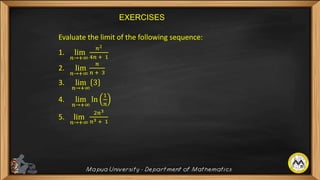
Evaluate the limit of the following sequence:
1. lim
𝑛→+∞
𝑛2
4𝑛 + 1
2. lim
𝑛→+∞
𝑛
𝑛 + 3
3. lim
𝑛→+∞
3
4. lim
𝑛→+∞
ln
1
𝑛
5. lim
𝑛→+∞
2𝑛3
𝑛3 + 1
EXERCISES
Evaluate the limit of the following sequence:
1. lim
𝑛→+∞
𝑛2
4𝑛 + 1
2. lim
𝑛→+∞
𝑛
𝑛 + 3
3. lim
𝑛→+∞
3
4. lim
𝑛→+∞
ln
1
𝑛
5. lim
𝑛→+∞
2𝑛3
𝑛3 + 1
EXERCISES
Write out the first five terms of the sequence, determine
whether the sequence converges, and if so find its limit.
1.
𝑛+1) 𝑛+2)
2𝑛2
𝑛=1
+∞
2. 1 + −1)𝑛
𝑛=1
+∞
3.
ln 𝑛
𝑛 𝑛=1
+∞
4. 𝑛2𝑒−𝑛
𝑛=1
+∞
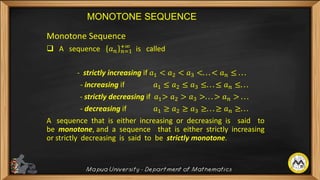
MONOTONE SEQUENCE
Monotone Sequence
 A sequence 𝑎𝑛 𝑛=1
+∞
is called
- strictly increasing if 𝑎1 < 𝑎2 < 𝑎3 <. . . < 𝑎𝑛 ≤ . . .
- increasing if 𝑎1 ≤ 𝑎2 ≤ 𝑎3 ≤. . . ≤ 𝑎𝑛 ≤. . .
- strictly decreasing if 𝑎1> 𝑎2 > 𝑎3 >. . . > 𝑎𝑛 > . . .
- decreasing if 𝑎1 ≥ 𝑎2 ≥ 𝑎3 ≥. . . ≥ 𝑎𝑛 ≥. . .
A sequence that is either increasing or decreasing is said to
be monotone, and a sequence that is either strictly increasing
or strictly decreasing is said to be strictly monotone.
EXAMPLE
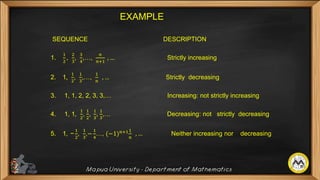
SEQUENCE DESCRIPTION
1.
1
2
,
2
3
,
3
4
,…,
𝑛
𝑛+1
, … Strictly increasing
2. 1,
1
2
,
1
3
,…,
1
𝑛
, … Strictly decreasing
3. 1, 1, 2, 2, 3, 3,… Increasing: not strictly increasing
4. 1, 1,
1
2
,
1
2
,
1
3
,
1
3
,… Decreasing: not strictly decreasing
5. 1, −
1
2
,
1
3
,−
1
4
…, −1)𝑛+11
𝑛
, … Neither increasing nor decreasing
EXAMPLE
TESTING FOR MONOTONICITY
EXAMPLE
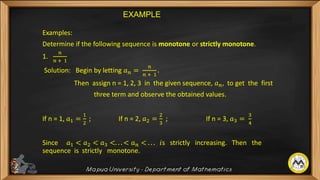
Examples:
Determine if the following sequence is monotone or strictly monotone.
1.
𝑛
𝑛 + 1
Solution: Begin by letting 𝑎𝑛 =
𝑛
𝑛 + 1
.
Then assign n = 1, 2, 3 in the given sequence, 𝑎𝑛, to get the first
three term and observe the obtained values.
If n = 1, 𝑎1 =
1
2
; If n = 2, 𝑎2 =
2
3
; If n = 3, 𝑎3 =
3
4
Since 𝑎1 < 𝑎2 < 𝑎3 <. . . < 𝑎𝑛 < . . . 𝑖s strictly increasing. Then the
sequence is strictly monotone.
EXAMPLE
2.
1
𝑛
Solution: let 𝑎𝑛 =
1
𝑛
By assigning n = 1, 2, and 3 in the given sequence, 𝑎𝑛,
the values obtained are: 𝑛 = 1, 𝑎1 = 1; 𝑛 = 2, 𝑎2 =
1
2
;
𝑛 = 3, 𝑎3 =
1
3
Since 𝑎1 > 𝑎2 > 𝑎3 >. . . > 𝑎𝑛 >. . . Is strictly decreasing.
Then the sequence is strictly monotone.
EXAMPLE
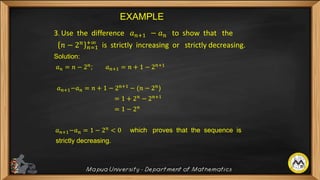
3. Use the difference 𝑎𝑛+1 − 𝑎𝑛 to show that the
𝑛 − 2𝑛
𝑛=1
+∞
is strictly increasing or strictly decreasing.
Solution:
𝑎𝑛 = 𝑛 − 2𝑛; 𝑎𝑛+1 = 𝑛 + 1 − 2𝑛+1
𝑎𝑛+1−𝑎𝑛 = 𝑛 + 1 − 2𝑛+1 − 𝑛 − 2𝑛)
= 1 + 2𝑛
− 2𝑛+1
= 1 − 2𝑛
𝑎𝑛+1−𝑎𝑛 = 1 − 2𝑛 < 0 which proves that the sequence is
strictly decreasing.
EXAMPLE
4. Use the ratio
𝑎𝑛+1
𝑎𝑛
to show that the given sequence
𝑛𝑛
𝑛! 𝑛=1
+∞
is
strictly increasing or strictly decreasing.
Solution:
𝑎𝑛 =
𝑛𝑛
𝑛!
, 𝑎𝑛+1 =
𝑛+1)𝑛+1
𝑛+1)!
Forming the ratio of successive terms we obtain
𝑎𝑛+1
𝑎𝑛
=
𝑛+1)𝑛+1
𝑛+1)!
𝑛𝑛
𝑛!
=
𝑛+1)𝑛+1
𝑛+1)!
∙
𝑛!
𝑛𝑛
=
𝑛+1 𝑛 𝑛+1)
𝑛+1)𝑛𝑛 =
𝑛+1)𝑛
𝑛𝑛 =
𝑛+1
𝑛
𝑛
From which we see that
𝑎𝑛+1
𝑎𝑛
> 1. This proves that the sequence is
strictly increasing.
EXAMPLE
5. Show that the sequence
10𝑛
𝑛! 𝑛=1
+∞
is eventually strictly
decreasing.
Solution:
𝑎𝑛 =
10𝑛
𝑛!
and 𝑎𝑛+1 =
10𝑛+1
𝑛+1)!
𝑎𝑛+1
𝑎𝑛
=
10𝑛+1
𝑛+1)!
10𝑛
𝑛!
=
10𝑛+1𝑛!
10𝑛 𝑛+1)!
= 10
𝑛!
𝑛+1 𝑛!
=
10
𝑛+1
𝑎𝑛+1
𝑎𝑛
< 1 for all 𝑛 ≥ 10 , so the sequence is eventually
decreasing as confirmed by the graph.
EXAMPLE
EXERCISES
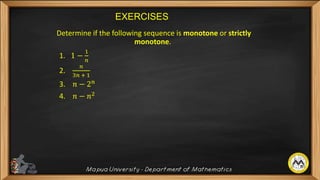
Determine if the following sequence is monotone or strictly
monotone.
1. 1 −
1
𝑛
2.
𝑛
3𝑛 + 1
3. 𝑛 − 2𝑛
4. 𝑛 − 𝑛2
BOUNDED SEQUENCE
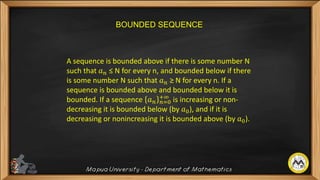
A sequence is bounded above if there is some number N
such that 𝑎𝑛 ≤ N for every n, and bounded below if there
is some number N such that 𝑎𝑛 ≥ N for every n. If a
sequence is bounded above and bounded below it is
bounded. If a sequence 𝑎𝑛 𝑛=0
+∞
is increasing or non-
decreasing it is bounded below (by 𝑎0), and if it is
decreasing or nonincreasing it is bounded above (by 𝑎0).
BOUNDED SEQUENCE
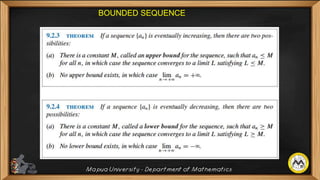
.
Theorems 9.2.3 and 9.2.4 (p. 611)
EXAMPLES
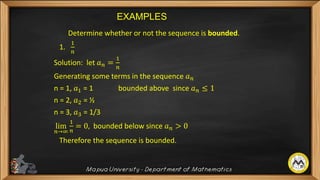
Determine whether or not the sequence is bounded.
1.
1
𝑛
Solution: let 𝑎𝑛 =
1
𝑛
Generating some terms in the sequence 𝑎𝑛
n = 1, 𝑎1 = 1 bounded above since 𝑎𝑛 ≤ 1
n = 2, 𝑎2 = ½
n = 3, 𝑎3 = 1/3
lim
𝑛→∞
1
𝑛
= 0, bounded below since 𝑎𝑛 > 0
Therefore the sequence is bounded.
EXAMPLES
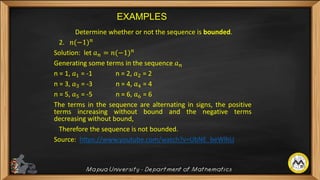
Determine whether or not the sequence is bounded.
2. 𝑛 −1)𝑛
Solution: let 𝑎𝑛 = 𝑛 −1)𝑛
Generating some terms in the sequence 𝑎𝑛
n = 1, 𝑎1 = -1 n = 2, 𝑎2 = 2
n = 3, 𝑎3 = -3 n = 4, 𝑎4 = 4
n = 5, 𝑎5 = -5 n = 6, 𝑎6 = 6
The terms in the sequence are alternating in signs, the positive
terms increasing without bound and the negative terms
decreasing without bound,
Therefore the sequence is not bounded.
Source: https://www.youtube.com/watch?v=UbNE_beWlhU
EXAMPLES
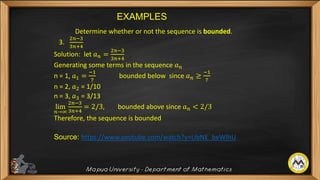
Determine whether or not the sequence is bounded.
3.
2𝑛−3
3𝑛+4
Solution: let 𝑎𝑛 =
2𝑛−3
3𝑛+4
Generating some terms in the sequence 𝑎𝑛
n = 1, 𝑎1 =
−1
7
bounded below since 𝑎𝑛 ≥
−1
7
n = 2, 𝑎2 = 1/10
n = 3, 𝑎3 = 3/13
lim
𝑛→∞
2𝑛−3
3𝑛+4
= 2/3, bounded above since 𝑎𝑛 < 2/3
Therefore, the sequence is bounded
Source: https://www.youtube.com/watch?v=UbNE_beWlhU

Lesson 1a_Sequence.pptx

  • 1.
  • 2.
    SEQUENCE Definition of aSequence An infinite sequence, or more simply a sequence, is an unending succession of numbers, called terms. It is understood that the terms have a definite order. It is typically written as 𝑎1, 𝑎2, 𝑎3, 𝑎4, . . . where: 𝑎1 is the first term 𝑎2 is the second term, 𝑎3 is the third term, and so on and so forth. Examples: 1, 2, 3, 4, . . . , 1, ½, 1/3, ¼, . . . , 2, 4, 6, 8, . . . , 1, -1, 1, -1, . . . ,
  • 3.
    EXAMPLE Each of thesesequences has a definite pattern known as rule or formula or general term that make it easy to generate additional terms. Examples: a) 2, 4, 6, 8, . . . is a sequence having the rule or general formula 2n since each term is twice the term number. b) 1, 4, 9, 16, 25, . . . is a sequence having the general term 𝑛2 Example 1: In each part, find the general term of the sequence. a) ½, ¼, 1/8, 1/16, . . . b) ½, 2/3, ¾, 4/5, . . .
  • 4.
    EXAMPLE Finding the GeneralTerm of the Sequence Answer to Example 1. a) ½, ¼, 1/8, 1/16, . . . , 1 2𝑛, . . . Solution: Observe the denominators given in the sequence. It can be expressed as powers of 2 21 = 2, 22 = 4, 23 = 8, 24 =
  • 5.
    SEQUENCE b) ½, 2/3,¾, 4/5, . . . , 𝑛 𝑛+1 . . . Solution: You may notice that the numerator of the four known terms is the same as their term numbers ( say 1st term = 1, 2nd term = 2, 3rd term = 3, and 4th term = 4) and their denominators is one greater than their term numbers. Thus, if we let n be the numerator and n + 1 be the denominator, the sequence can be expressed as 𝑛 𝑛+1 .
  • 6.
    EXERCISES Exercise 1 In eachpart, find the general term of the sequence, starting with n =1. a) 1, 1 5 , 1 25 , 1 125 , . . . b) 1, − 1 3 , 1 9 , − 1 27 , . . . c) 1 2 , 3 4 , 5 6 , 7 8 , . . .
  • 7.
    EXERCISES Exercise 1 In eachpart, find the general term of the sequence, starting with n =1. a) 1, 1 5 , 1 25 , 1 125 , . . . b) 1, − 1 3 , 1 9 , − 1 27 , . . . c) 1 2 , 3 4 , 5 6 , 7 8 , . . .
  • 8.
    SEQUENCE When the generalterm of a sequence 𝑎1, 𝑎2 , 𝑎3 , . . . , 𝑎𝑛 , . . . (1) is known, there is no need to write out the initial terms and it is common to write only the general term enclosed in braces. Thus (1) might be written as 𝑎𝑛 𝑛=1 +∞ or 𝑎𝑛 𝑛=1 ∞ A sequence is a function whose domain is a set of integers
  • 9.
    LIMIT OF ASEQUENCE Limit of a Sequence Since sequence 𝑎𝑛 are functions, it has also limits. • A sequence whose terms approach limiting values are said to converge. • A sequence that does not converge to some finite limit is said to diverge. Example 1. Evaluate lim 𝑛→+∞ 𝑛 𝑛+1 Solution: lim 𝑛→+∞ 𝑛 𝑛+1 = ∞ ∞ (indeterminate) transforming the given function by dividing the numerator and denominator by n, the results are: lim 𝑛→+∞ 𝑛 𝑛 𝑛 𝑛 + 1 𝑛 = lim 𝑛→+∞ 1 1 + 1 𝑛 = 1 1 + 1 ∞ = 1 1 + 0 = 1. Thus lim 𝑛→+∞ 𝑛 𝑛+1 = 1 (converges)
  • 10.
    EXAMPLE 2. Evaluate: lim 𝑛→+∞ 𝑛+ 1) Solution: lim 𝑛→+∞ 𝑛 + 1) = ∞ + 1 = ∞ (diverges) 3. Determine whether the sequence, 1, 1 2 , 1 22 , 1 23 , . . . 1 2𝑛 , . . . converge. Solution: lim 𝑛→∞ 1 2𝑛 = 1 2∞ = 1 ∞ = 0 converges)
  • 11.
    EXAMPLE 4. Determine whetherthe sequence 1, 2, 22 , 23 , . . . , 2𝑛 , . . . converge. Solution: lim 𝑛→+∞ 2𝑛 = 2∞ = ∞ (diverges)
  • 12.
    EXERCISES Evaluate the limitof the following sequence: 1. lim 𝑛→+∞ 𝑛2 4𝑛 + 1 2. lim 𝑛→+∞ 𝑛 𝑛 + 3 3. lim 𝑛→+∞ 3 4. lim 𝑛→+∞ ln 1 𝑛 5. lim 𝑛→+∞ 2𝑛3 𝑛3 + 1
  • 13.
    EXERCISES Evaluate the limitof the following sequence: 1. lim 𝑛→+∞ 𝑛2 4𝑛 + 1 2. lim 𝑛→+∞ 𝑛 𝑛 + 3 3. lim 𝑛→+∞ 3 4. lim 𝑛→+∞ ln 1 𝑛 5. lim 𝑛→+∞ 2𝑛3 𝑛3 + 1
  • 14.
    EXERCISES Write out thefirst five terms of the sequence, determine whether the sequence converges, and if so find its limit. 1. 𝑛+1) 𝑛+2) 2𝑛2 𝑛=1 +∞ 2. 1 + −1)𝑛 𝑛=1 +∞ 3. ln 𝑛 𝑛 𝑛=1 +∞ 4. 𝑛2𝑒−𝑛 𝑛=1 +∞
  • 15.
    MONOTONE SEQUENCE Monotone Sequence A sequence 𝑎𝑛 𝑛=1 +∞ is called - strictly increasing if 𝑎1 < 𝑎2 < 𝑎3 <. . . < 𝑎𝑛 ≤ . . . - increasing if 𝑎1 ≤ 𝑎2 ≤ 𝑎3 ≤. . . ≤ 𝑎𝑛 ≤. . . - strictly decreasing if 𝑎1> 𝑎2 > 𝑎3 >. . . > 𝑎𝑛 > . . . - decreasing if 𝑎1 ≥ 𝑎2 ≥ 𝑎3 ≥. . . ≥ 𝑎𝑛 ≥. . . A sequence that is either increasing or decreasing is said to be monotone, and a sequence that is either strictly increasing or strictly decreasing is said to be strictly monotone.
  • 16.
    EXAMPLE SEQUENCE DESCRIPTION 1. 1 2 , 2 3 , 3 4 ,…, 𝑛 𝑛+1 , …Strictly increasing 2. 1, 1 2 , 1 3 ,…, 1 𝑛 , … Strictly decreasing 3. 1, 1, 2, 2, 3, 3,… Increasing: not strictly increasing 4. 1, 1, 1 2 , 1 2 , 1 3 , 1 3 ,… Decreasing: not strictly decreasing 5. 1, − 1 2 , 1 3 ,− 1 4 …, −1)𝑛+11 𝑛 , … Neither increasing nor decreasing
  • 17.
  • 18.
  • 19.
    EXAMPLE Examples: Determine if thefollowing sequence is monotone or strictly monotone. 1. 𝑛 𝑛 + 1 Solution: Begin by letting 𝑎𝑛 = 𝑛 𝑛 + 1 . Then assign n = 1, 2, 3 in the given sequence, 𝑎𝑛, to get the first three term and observe the obtained values. If n = 1, 𝑎1 = 1 2 ; If n = 2, 𝑎2 = 2 3 ; If n = 3, 𝑎3 = 3 4 Since 𝑎1 < 𝑎2 < 𝑎3 <. . . < 𝑎𝑛 < . . . 𝑖s strictly increasing. Then the sequence is strictly monotone.
  • 20.
    EXAMPLE 2. 1 𝑛 Solution: let 𝑎𝑛= 1 𝑛 By assigning n = 1, 2, and 3 in the given sequence, 𝑎𝑛, the values obtained are: 𝑛 = 1, 𝑎1 = 1; 𝑛 = 2, 𝑎2 = 1 2 ; 𝑛 = 3, 𝑎3 = 1 3 Since 𝑎1 > 𝑎2 > 𝑎3 >. . . > 𝑎𝑛 >. . . Is strictly decreasing. Then the sequence is strictly monotone.
  • 21.
    EXAMPLE 3. Use thedifference 𝑎𝑛+1 − 𝑎𝑛 to show that the 𝑛 − 2𝑛 𝑛=1 +∞ is strictly increasing or strictly decreasing. Solution: 𝑎𝑛 = 𝑛 − 2𝑛; 𝑎𝑛+1 = 𝑛 + 1 − 2𝑛+1 𝑎𝑛+1−𝑎𝑛 = 𝑛 + 1 − 2𝑛+1 − 𝑛 − 2𝑛) = 1 + 2𝑛 − 2𝑛+1 = 1 − 2𝑛 𝑎𝑛+1−𝑎𝑛 = 1 − 2𝑛 < 0 which proves that the sequence is strictly decreasing.
  • 22.
    EXAMPLE 4. Use theratio 𝑎𝑛+1 𝑎𝑛 to show that the given sequence 𝑛𝑛 𝑛! 𝑛=1 +∞ is strictly increasing or strictly decreasing. Solution: 𝑎𝑛 = 𝑛𝑛 𝑛! , 𝑎𝑛+1 = 𝑛+1)𝑛+1 𝑛+1)! Forming the ratio of successive terms we obtain 𝑎𝑛+1 𝑎𝑛 = 𝑛+1)𝑛+1 𝑛+1)! 𝑛𝑛 𝑛! = 𝑛+1)𝑛+1 𝑛+1)! ∙ 𝑛! 𝑛𝑛 = 𝑛+1 𝑛 𝑛+1) 𝑛+1)𝑛𝑛 = 𝑛+1)𝑛 𝑛𝑛 = 𝑛+1 𝑛 𝑛 From which we see that 𝑎𝑛+1 𝑎𝑛 > 1. This proves that the sequence is strictly increasing.
  • 23.
    EXAMPLE 5. Show thatthe sequence 10𝑛 𝑛! 𝑛=1 +∞ is eventually strictly decreasing. Solution: 𝑎𝑛 = 10𝑛 𝑛! and 𝑎𝑛+1 = 10𝑛+1 𝑛+1)! 𝑎𝑛+1 𝑎𝑛 = 10𝑛+1 𝑛+1)! 10𝑛 𝑛! = 10𝑛+1𝑛! 10𝑛 𝑛+1)! = 10 𝑛! 𝑛+1 𝑛! = 10 𝑛+1 𝑎𝑛+1 𝑎𝑛 < 1 for all 𝑛 ≥ 10 , so the sequence is eventually decreasing as confirmed by the graph.
  • 24.
  • 25.
    EXERCISES Determine if thefollowing sequence is monotone or strictly monotone. 1. 1 − 1 𝑛 2. 𝑛 3𝑛 + 1 3. 𝑛 − 2𝑛 4. 𝑛 − 𝑛2
  • 26.
    BOUNDED SEQUENCE A sequenceis bounded above if there is some number N such that 𝑎𝑛 ≤ N for every n, and bounded below if there is some number N such that 𝑎𝑛 ≥ N for every n. If a sequence is bounded above and bounded below it is bounded. If a sequence 𝑎𝑛 𝑛=0 +∞ is increasing or non- decreasing it is bounded below (by 𝑎0), and if it is decreasing or nonincreasing it is bounded above (by 𝑎0).
  • 27.
    BOUNDED SEQUENCE . Theorems 9.2.3and 9.2.4 (p. 611) Theorems 9.2.3 and 9.2.4 (p. 611)
  • 28.
    EXAMPLES Determine whether ornot the sequence is bounded. 1. 1 𝑛 Solution: let 𝑎𝑛 = 1 𝑛 Generating some terms in the sequence 𝑎𝑛 n = 1, 𝑎1 = 1 bounded above since 𝑎𝑛 ≤ 1 n = 2, 𝑎2 = ½ n = 3, 𝑎3 = 1/3 lim 𝑛→∞ 1 𝑛 = 0, bounded below since 𝑎𝑛 > 0 Therefore the sequence is bounded.
  • 29.
    EXAMPLES Determine whether ornot the sequence is bounded. 2. 𝑛 −1)𝑛 Solution: let 𝑎𝑛 = 𝑛 −1)𝑛 Generating some terms in the sequence 𝑎𝑛 n = 1, 𝑎1 = -1 n = 2, 𝑎2 = 2 n = 3, 𝑎3 = -3 n = 4, 𝑎4 = 4 n = 5, 𝑎5 = -5 n = 6, 𝑎6 = 6 The terms in the sequence are alternating in signs, the positive terms increasing without bound and the negative terms decreasing without bound, Therefore the sequence is not bounded. Source: https://www.youtube.com/watch?v=UbNE_beWlhU
  • 30.
    EXAMPLES Determine whether ornot the sequence is bounded. 3. 2𝑛−3 3𝑛+4 Solution: let 𝑎𝑛 = 2𝑛−3 3𝑛+4 Generating some terms in the sequence 𝑎𝑛 n = 1, 𝑎1 = −1 7 bounded below since 𝑎𝑛 ≥ −1 7 n = 2, 𝑎2 = 1/10 n = 3, 𝑎3 = 3/13 lim 𝑛→∞ 2𝑛−3 3𝑛+4 = 2/3, bounded above since 𝑎𝑛 < 2/3 Therefore, the sequence is bounded Source: https://www.youtube.com/watch?v=UbNE_beWlhU